Life History and Reproduction of Fishes
 View linked note
 Call Kai
 Learn
Learn Practice Test
 Spaced Repetition
 Match
Match Flashcards
 Knowt Play
1/28

Earn XP
Description and Tags
Flashcards covering key vocabulary terms from the lecture on fish life history and reproduction.
Name | Mastery | Learn | Test | Matching | Spaced | Call with Kai | Chat |
|---|
No analytics yet
Send a link to your students to track their progress
29 Terms
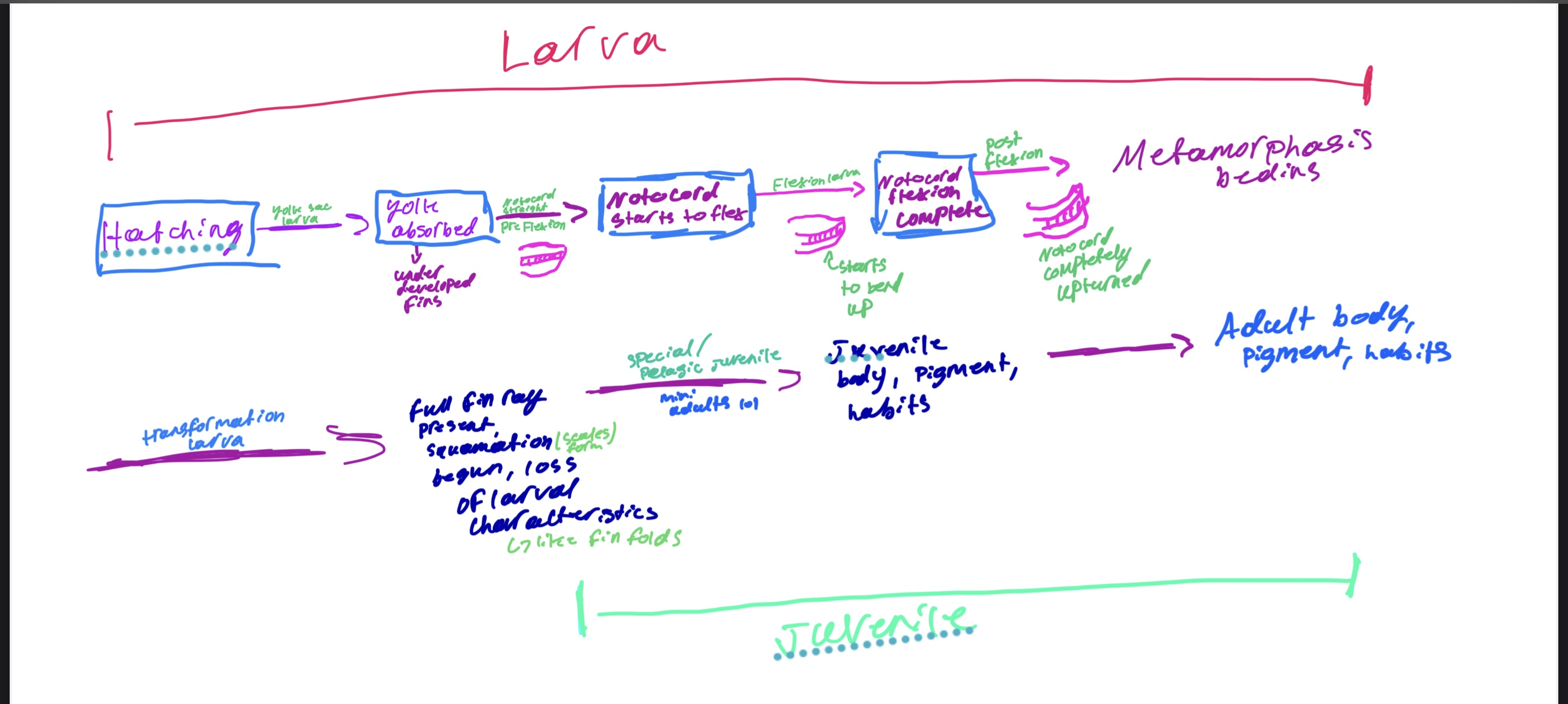
Larva
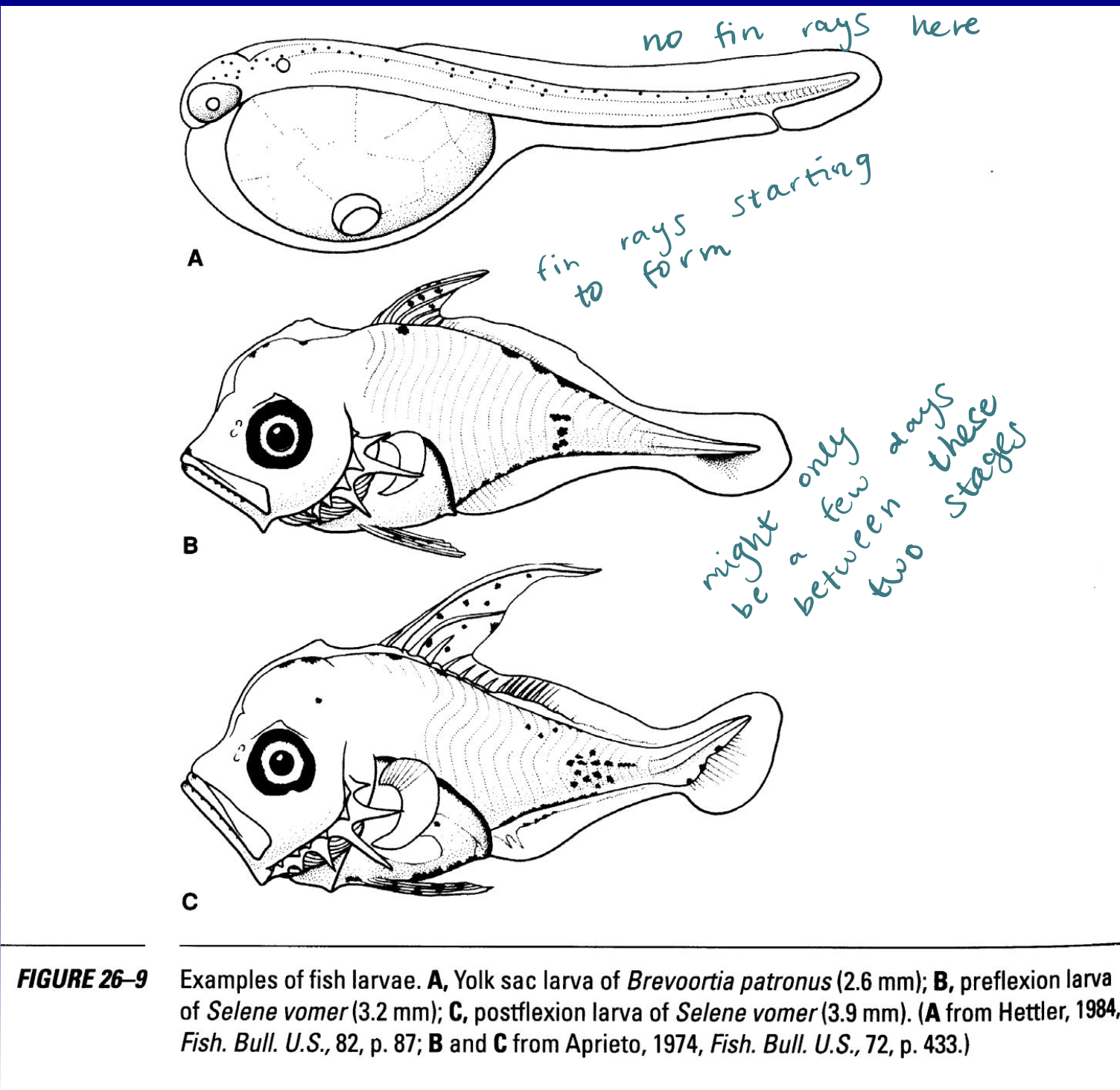
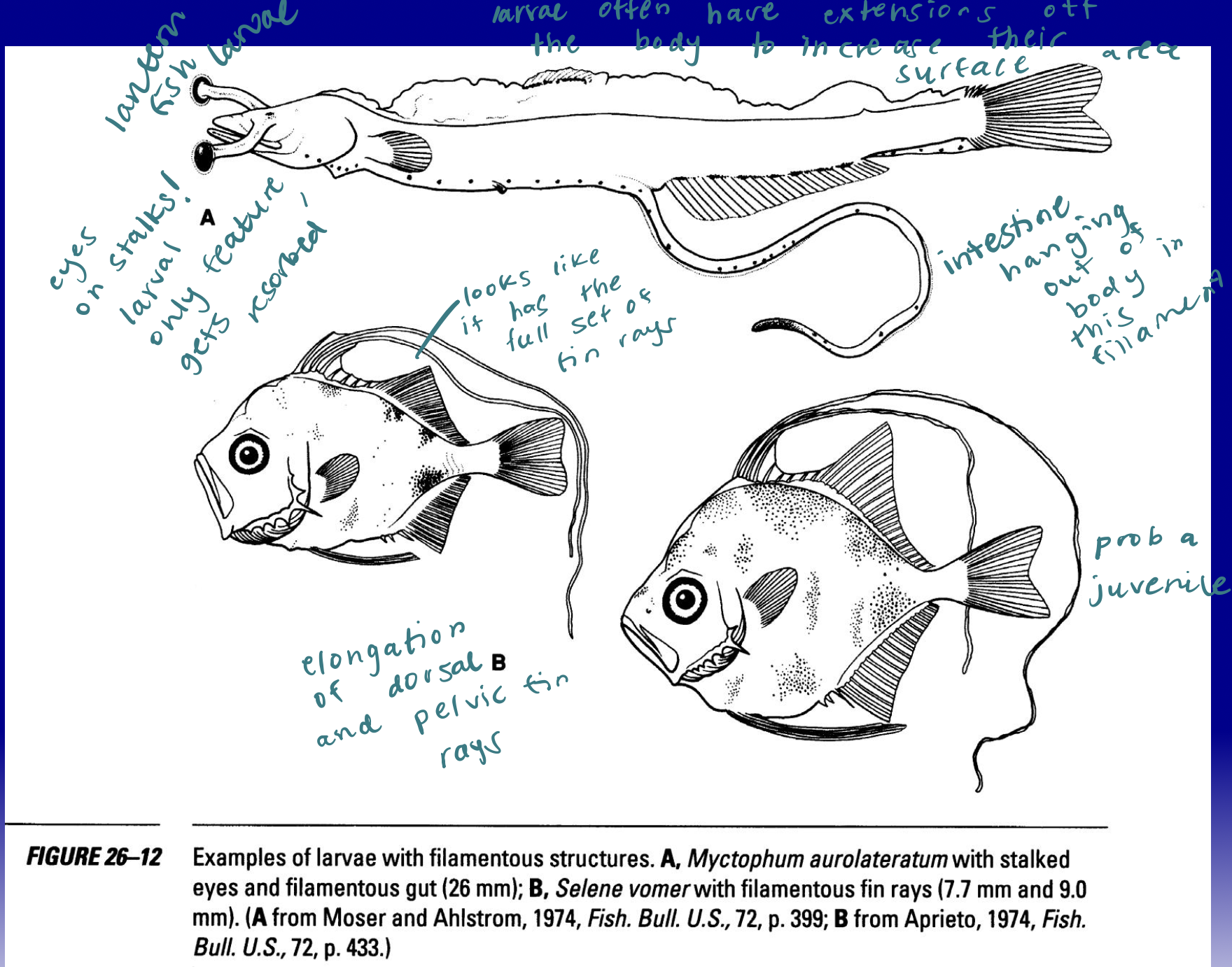
An undeveloped, early life stage of fish that is morphologically distinct from the adult form, typically incomplete with underdeveloped fins, skeleton, and pigmentation.
Metamorphosis
The rapid transition from larval to juvenile stage, completing the formation of major skeletal structures like vertebral column and fin rays.
Gonochoristic
Species that have fixed sexes throughout their life cycle, meaning individuals remain either male or female.
Example:
Most fish species, such as Cod and Tuna, exhibit gonochorism.
Hermaphroditism
The presence of both male and female reproductive organs in one individual, can be sequential (changing sex, e.g., Protandrous or Protogynous) or simultaneous (having both functioning at the same time).
Examples:
Clownfish (protandrous)
Wrasses (protogynous)
Protandrous
A type of sequential hermaphroditism where an individual starts life as male and can later change to female.
Example:
Clownfish.
Protogynous
A type of sequential hermaphroditism where an individual starts life as female and can later change to male.
Examples:
Wrasses
Parrotfish
External Fertilization
Process where eggs are fertilized outside the female's body; this is the most common mode in fishes.
Internal Fertilization
Process where fertilization occurs inside the female's body, common in chondrichthyans like sharks.
Viviparous
A reproductive strategy where the embryo develops inside the mother's body, receiving nourishment directly from her.
Examples:
Many chondrichthyans like sharks and rays.
Some teleosts like guppies.
Oviparous
A reproductive strategy where eggs are laid, with the development occurring externally. This is the most common mode in fishes.
Examples:
The vast majority of teleost fishes
Cod
Tuna
Salmon
Planktonic
Referring to fish larvae that drift in the water column, which is considered safer from predators than being on the sea floor.
Examples:
Larvae of Open-Water Spawners like Tuna.
Larvae of Cod.
Larvae of many marine reef fishes.
Substrate Spawners
Fishes that lay eggs on specific substrates (such as rocks or gravel) and may protect them after fertilization.
Example:
Salmon, who lay eggs in freshwater redds.
Bearers
Fish that carry developing eggs or young either externally or internally.
Examples:
Male seahorses carry eggs in a brood pouch.
Some cichlids are mouthbrooders.
Guarders
Fish that protect their eggs or young post-spawning by selecting specific spawning sites or building nests.
Examples:
Salmon, who guard their redds.
Many cichlids.
Reproductive Guild
Groups of fishes that share similar reproductive behaviors and methods of offspring care.
Examples:
Open-Water Spawners
Substrate Spawners
Bearers
Guarders
General Reproductive Patterns in Fishes
Fishes exhibit diverse reproductive patterns, broadly categorized by their sex determination (gonochoristic vs. hermaphroditic) and developmental pathways (direct vs. indirect).
Direct Development
A developmental pathway where offspring hatch or are born resembling miniature adults, bypassing a distinct larval stage.
Example:
Some sharks and rays (viviparous species),
some freshwater teleosts (e.g., Guppies).
Indirect Development
A developmental pathway characterized by a distinct larval stage that is morphologically different from the adult form and undergoes metamorphosis to reach the juvenile stage.
Most common mode in fishes.
Example:
The vast majority of teleost fishes:
(e.g., Cod, Tuna, Salmon in their early stages).
Open-Water Spawners (Pelagic Spawners)
Fishes that release their eggs and sperm directly into the water column, where fertilization and development occur while the eggs or larvae drift as plankton. Example: Tuna, Cod, many marine reef fishes. This guild is strongly associated with Planktonic larvae.
Major Life History Stages of Fishes
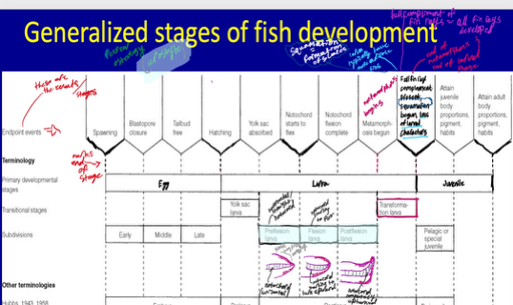
The typical progression through an individual fish's life cycle includes:
Egg: The fertilized ovum, undergoing embryonic development.
Larva: An immature, post-hatch stage, morphologically distinct from the adult, often planktonic.
Juvenile: A post-larval, pre-reproductive stage, resembling a small adult but not yet sexually mature.
Adult: A reproductively mature individual capable of spawning.
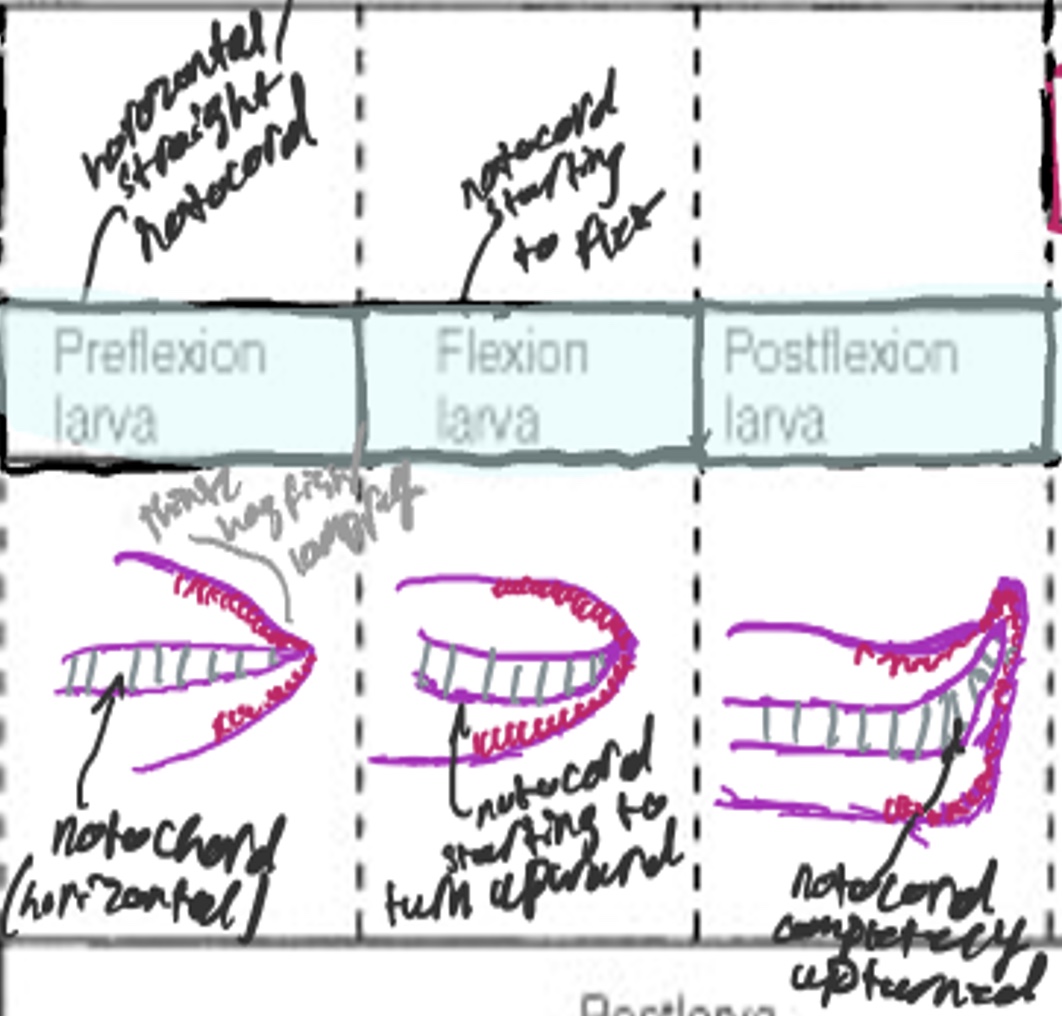
Preflexion Larva
An early larval stage where the notochord is straight, and the caudal fin rays have not yet begun to form. The gut is typically straight.
Flexion Larva
A larval stage characterized by the upward flexion (or-upturning) of the notochord, a critical phase marking the initial development of the caudal fin rays and the hypural elements.
Postflexion Larva
A larval stage where the notochord flexion is complete, and all or most of the principal caudal fin rays are formed and visible. The larva is beginning to resemble the juvenile form.
Transformation Larva (Metamorphosing Larva)
The final larval stage
rapid morphological changes to transition into juvenile form.
Involves resorption of larval structures and development of adult features (fin rays and pigmentation)
Life Cycle of Salmon (Representative Teleost)
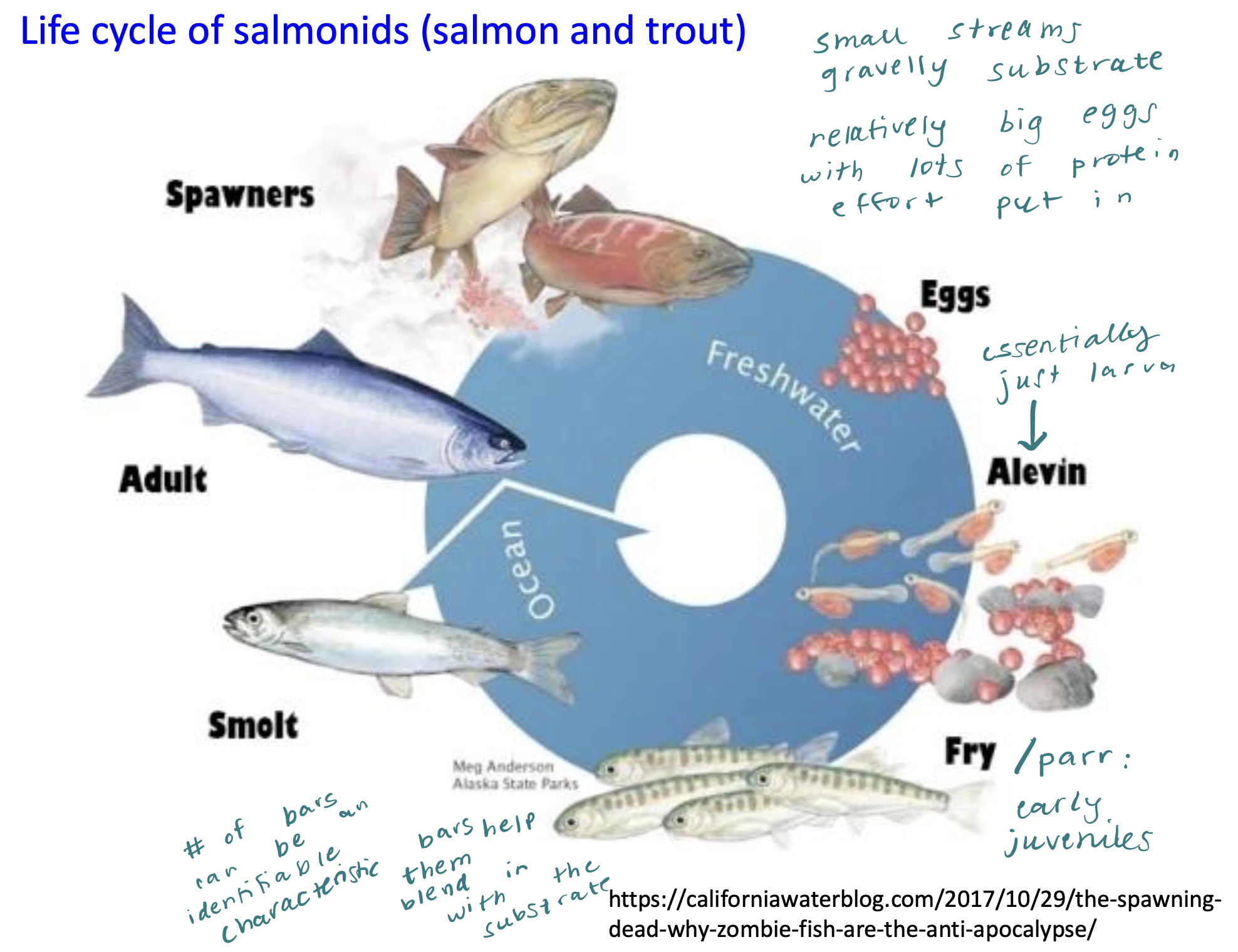
Salmon exhibit an anadromous life cycle, spending most of their adult lives in saltwater but migrating to freshwater to spawn.
Egg: Laid in freshwater redds (nests) in gravel.
Alevin: Hatches from the egg, still possessing a yolk sac for nourishment; remains in the gravel.
Fry: Absorbs the yolk sac and emerges from the gravel to feed independently in freshwater.
Parr: A freshwater juvenile stage characterized by vertical bar markings (parr marks) for camouflage. Spends 1-5 years in freshwater.
Smolt: Undergoes
smoltification, a physiological transformation enabling transition to saltwater. Develops silvery coloration and migrates downstream to the ocean.Adult: Matures in the ocean for 1-7 years, growing significantly.
Spawning Adult: Returns to freshwater to spawn, often in their natal streams; most Pacific salmon species die after spawning (semelparous), while Atlantic salmon may return to the ocean (iteroparous).
Otoliths
Ear stones
Accrete material daily so it can be analyzed to age fish