COB 300D Marketing Final Exam (Atav)
 Call Kai
 Learn
Learn Practice Test
 Spaced Repetition
 Match
Match Flashcards
 Knowt Play
1/149

There's no tags or description
Looks like no tags are added yet.
Name | Mastery | Learn | Test | Matching | Spaced | Call with Kai |
|---|
No analytics yet
Send a link to your students to track their progress
150 Terms
Marketing helps create
Value
Production-Oriented Era
Turn of the 20th century
Believed a good product would sell itself
Sales-Oriented Era
1920-1950
production and distribution techniques became more sophisticated
customers consume less or manufacture items themselves.
Firms responded to their overproduction depending on heavy doses of personal selling and advertising.
Market-Oriented Era
After WWII,
Buyers market (lots of options to buy)
Value-Based Era
-Focused on giving the customer what they want, but at a better value
-You get what you pay for... but price is not the most important factor
SWOT analysis
strengths, weaknesses, opportunities, threats
portfolio analysis (BCG matrix)
stars, cash cows, question marks, dogs
Stars
high market share, high market growth
Cash Cows
high market share, low market growth
Dogs
low market share, low market growth
Question Marks
low market share, high market growth
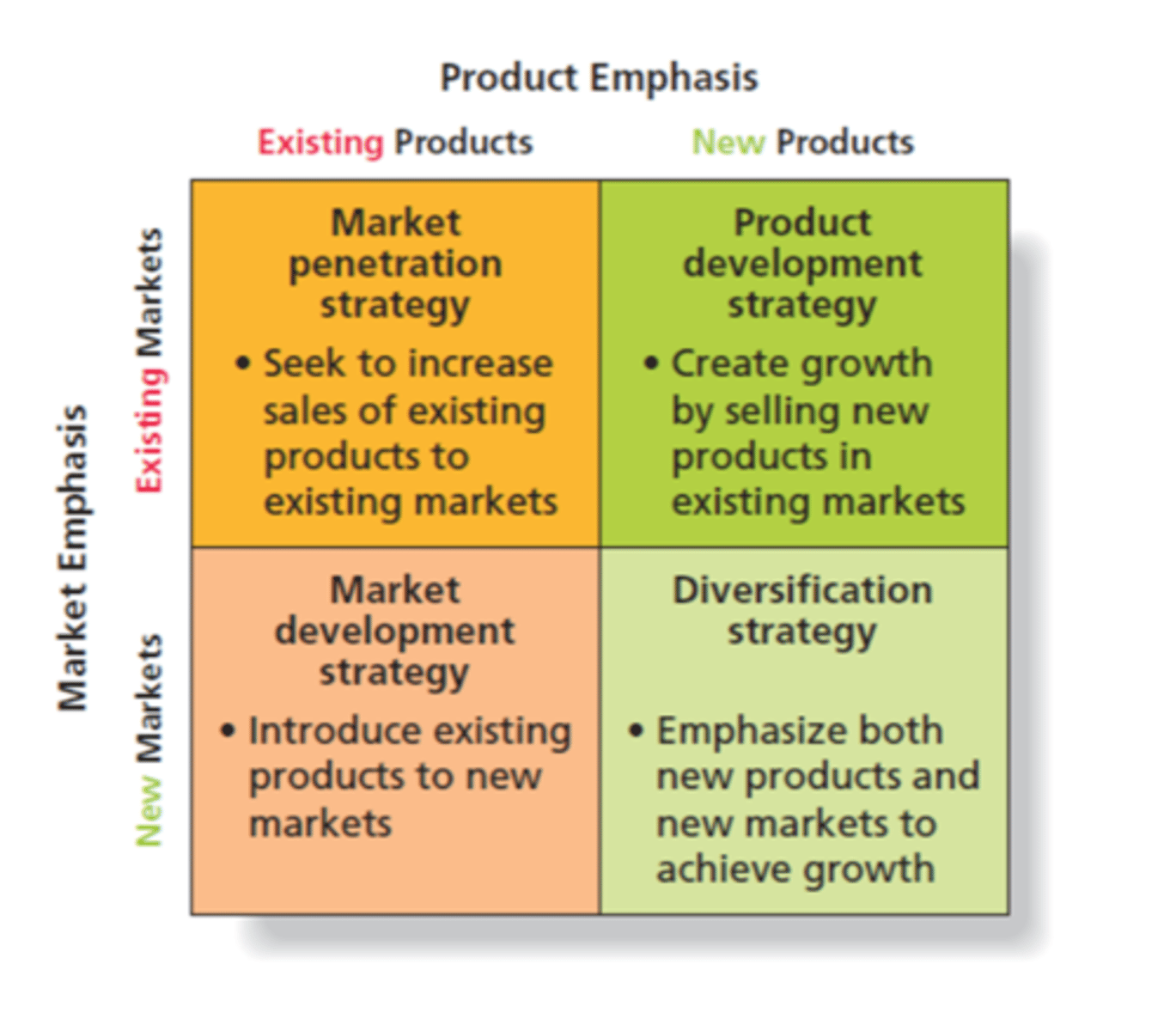
market penetration
selling more of the same to the same types of people (lowest risk)
market development
selling the existing products to new types of consumer (medium risk)
product development
selling new products to existing customers (medium risk)
diversification
selling new products to new consumer (highest risk)
Ansoff Growth Matrix
Segmentation
divide the total market into smaller segments
geographic segmentation
Value by region, Market Size, Customer Convenience, Population Shifts
demographic segmentation
segmenting markets by age, gender, income, ethnic background, and family life cycle
psychographic segmentation
segmenting markets on the basis of personality, motives, lifestyles
geodemographic segmentation
geographic, demographic, lifestyle
Benefit Segmentation
the process of grouping customers into market segments according to the benefits they seek from the product
Behavioral Segmentation
dividing a market into segments based on consumer knowledge, attitudes, uses of a product, or responses to a product
Segment Identification
Who is in the market
What are their needs
Distinct separation of segments
Segment Substantiality
segment must be large enough to warrant marketing mix
Segment Reachability
Market must be accessed through persuasive communications and product distribution
Segment Responsiveness
Customers reaction must be similar to and positive to the firm's offering
Segment Profitability
the profitability of a particular type of consumer or market segment, determined by analyzing the revenues generated through the sale of products and services to that type of consumer or segment
Segment Profitability Equation
(segment size x segment adoption percentage x purchase behavior x profit margin percentage) - fixed costs
Profit Margin Percentage
(selling price - variable costs) / selling price
Undifferentiated Targeting Strategy
aka: Mass Marketing
"focuses on the similarities in needs of the customers as opposed to the differences"
Differentiated Target Strategy
A strategy in which an organization targets two or more segments by developing a marketing mix for each segment
Concentrated Targeting Strategy
a strategy used to select one segment of a market for targeting marketing efforts
Micromarketing
- tailoring products and marketing programs to the needs and wants of specific individuals and local customer segments
- it includes local marketing and individual marketing
Five C's of Pricing
competition
COSTS
company objectives
CUSTOMERS
channel members
Demand Curves and Pricing
how many units of a product or service consumers will demand during a specific period of time at different PRICES
price elasticity of demand
a measure of how much the quantity demanded of a good responds to a change in the price of that good, computed as the percentage change in quantity demanded divided by the percentage change in price
Price Elastic
Factors Influencing Price Elasticity of Demand
(1) Substitution Effect
(2) Cross-Price Elasticity
(3) Income Effect
Substitution Effect
- Consumers' ability to substitute other products for the focal brand.
- The greater the availability of substitute products, the higher the price elasticity of demand
Cross-Price Elasticity
the percentage change in the quantity of Product A demanded compared with the percentage change in price in Product B
Income Effect
the change in the quantity of a product demanded by consumers due to changes in their incomes
Break-Even Analysis and Decision Making
useful technique that enables managers to examine the relationships among cost, price, revenue, and profit over different levels of production and sales
Break-Even Point
Fixed costs / contribution per unit
Monopoly Competition
One producer dominating the industry, leaving no room for competitors
Oligopoly Competition
Handful of competitors selling products that can be similar or different
monopolistic competition
A market structure in which barriers to entry are low and many firms compete by selling differentiated products
Pure Competition
A market structure with many competitors selling virtually identical products. Barriers to entry are quite low.
Channel Members
Businesses or individuals who assist in moving goods and services from the producer to the consumer
What is Value-Based Pricing Methods
approaches to setting prices that focus on the overall value of the product offering as perceived by the consumer
What are Value-Based Methods
Improvement Value Method
Cost of Ownership Method
Improvement Value Method
represents an estimate of how much more (or less) consumers are willing to pay for a product relative to other comparable products
Cost of Ownership Method
consumers may be willing to pay more for a particular product because, over its entire lifetime, it will eventually cost less to own than a cheaper alternative
Pricing Strategies
a long-term approach to setting prices broadly in an integrative effort (across all the firm's products) based on the five Cs of pricing
Everyday Low Pricing (EDLP)
A strategy companies use to emphasize the continuity of their retail prices at a level somewhere between the regular, nonsale price and the deep-discount sale prices their competitors may offer.
High/ Low Pricing
a pricing strategy that relies on the promotion of sales, during which prices are temporarily reduced to encourage purchases
New Product Pricing Strategies
penetration pricing
price skimming
Penetration Pricing
setting a low initial price on a new product to appeal immediately to the mass market
Price Skimming
Charging the highest possible price that buyers who most desire the product will pay
Pricing Tactics
Short-term pricing responses to opportunities or threats.
Pricing Tactics Aimed at Consumers
1. Markdowns
2. Quantity Discounts for Consumers
3. Seasonal Discounts
4. Coupons
5. Rebates
6. Leasing/Rentals
7. Price Bundling
8. Leader Pricing
9. Price Lining
Markdowns
the reductions retailers take on the initial selling price of the product or service
integral component of the high/low pricing strategy
Quantity Discounts for Consumers
- The more you buy the cheaper the unit cost
- Size discount is most common form
Seasonal Discounts
price reductions offered only during certain times of the year
Coupons
offer a discount on the price of specific items when they're purchase issued by manufacturers and retailers
Rebates
refunds paid to consumers after a purchase
leasing/rentals
consumers pay a fee to purchase the right to use a product for a specific amount of time
Price Bundling
selling more than one product for a single, lower price
Leader Pricing
a price tactic in which a product is sold near or even below cost in the hope that shoppers will buy other items once they are in the store
Pricing Lining
when marketers establish a price floor and a price ceiling for an entire line of similar products and then set a few other price points in between to represent distinct differences in quality
Legal and Ethical Aspects of Pricing
1. deceptive or illegal price advertising
2. predatory pricing
3. price discrimination
4. price fixing
Deceptive or Illegal Price Advertising
Deceptive reference prices
Loss-Leader pricing
Bait and Switch
Deceptive Reference Prices
fictitious higher "regular" prices make sale prices seem better
Loss-Leader Pricing
takes the tactic of leader pricing one step further by lowering the price below the store's cost
Bait and Switch
A store advertises bargains that do not really exist to lure customers in, in hopes that they will buy more expensive merchandise.
Predatory Pricing
selling a product below cost to drive competitors out of the market
Price Discrimination
the business practice of selling the same good at different prices to different customers
Price Fixing
an agreement between two or more firms on the price they will charge for a product
Distribution Intensity
the number of channel members to use at each level of the marketing channel; divided into 3 levels
1. Intensive
2. Exclusive
3. Selective
Intensive Distribution
stocking the product in as many outlets as possible
Exclusive Distribution
giving a limited number of dealers the exclusive right to distribute the company's products in their territories
Selective Distribution
selling through only those intermediaries who will give the product special attention
The Communication Process
the steps between a source and a receiver that result in the transfer and understanding of meaning
1. The Sender
2. The Transmitter
3. Encoding
4. The Communication Channel
5. The Receiver
6. Noise
7. Feedback Loop
The Sender
the originator of the message in the communication process
The Transmitter
An agent or intermediary with which the sender works to develop the marketing communications
Encoding
converting the sender's ideas into a message
The Communication Channel
The medium that carries the message.
The Receiver
the person who decodes a message
Noise
any interference that stems from competing messages, a lack of clarity in the message, or a flaw in the medium; a problem for all communication channels
Feedback Loop
allows the receiver to communicate with the sender and thereby informs the sender whether the message was received and decoded properly
How Consumers Perceive Communication
-receivers decode messages differently
-senders adjust messages according to the medium and receivers' traits
Setting and Allocating the IMC Budget
1. Objective and task method
2. Percentage of Sales
3. Competitive Parity
4. Available Budget
objective and task method
Developing the promotion budget by (1) defining specific promotion objectives
(2) determining the tasks needed to achieve these objectives
(3) estimating the costs of performing these tasks.
The sum of these costs is the proposed promotion budget.
percentage of sales method
A method of advertising budget allocation based on a percentage of the previous year's sales, the anticipated sales for the next year, or a combination of the two.
competitive parity method
sets the promotion budget to match competitors' outlays
Available Budget
Marketers forecast their sales and expenses, excluding communication, during the budgeting period
Measuring Success Using Marketing Metrics
1. Frequency
2. Reach
3. Gross rating points
4. Web tracking
Gross Rating Points (GRPs)
a measure used for comparing the effectiveness of different media vehicles:
average reach x frequency
continuous advertising schedule
runs steadily throughout the year
flighting advertising schedule
implemented in spurts, with periods of heavy advertising followed by periods of no advertising