Macroeconomics (Year 2)
 Call Kai
 Learn
Learn Practice Test
 Spaced Repetition
 Match
Match Flashcards
 Knowt Play
1/100

There's no tags or description
Looks like no tags are added yet.
Name | Mastery | Learn | Test | Matching | Spaced | Call with Kai |
|---|
No analytics yet
Send a link to your students to track their progress
101 Terms
Monetarist belief
In the long run full employment will be reached (deficits will balance out)
Kenynesian belief
government intervention, particularly through fiscal policy, can stabilize the economy and promote full employment by influencing aggregate demand
definition of (absolute) poverty
Less than $2.15 a day
A state in which income is insufficient to provide basic necessities (food, shelter, medical care, clothing)
definition of relative poverty
<60% Median income
Compares the income of individuals or households in a society with median incomes.
What is the poverty trap?
A poverty trap is a mechanism that makes it very difficult for people to escape poverty. A poverty trap is created when an economic system requires a significant amount of capital to escape poverty.
e.g.
lack of access to education and training, lack of affordable housing and transportation, lack of affordable childcare, and discrimination in the labour market.
Name at least 3 causes of poverty
- low levels of human capital
- location
- discrimination / health issues
- unemployment
- low or no minimum wage
- low government intervention
- external shocks
- (income) dependency
- changes in the rate of economic growth: economic development, FDI, policies which result in increased trade, government tax and benefits policies, and changes in asset
prices.
what causes changes in poverty
- infrastructure
- education and training
- aid
infrastructure to decrease poverty
increase productivity, increase incomes, decrease poverty e.g south korea farming
education to decrease poverty
increased standard of education, decreased unemployment, increased income, decreased poverty
aid to decrease poverty
if aid is spent on healthcare or education, workers become more productive, increasing their incomes and reducing poverty
HOWEVER
Somalia received $1.3 billion in 2011, but 70% went to corrupt politicians or inflation
Why may aid not decrease poverty? Give an example too
Corruption. If the government or aid recipients are corrupt, the money is unlikely to be spent efficiently or given to the right causes.
- Somalia recei
ved $1.3 billion in 2011, but 70% went to corrupt politicians or inflation
working poverty
Families with at least one person in work but are still earning less than the 60% of median income
Caused by monopsony power, wage stagnation, cost of living, inflation outstripping wages, increased use of zero-hour-wages (
What may cause working poverty?
Monopsony power, wage stagnation, cost of living, inflation outstripping wages, increased use of zero-hour-wages
how can wealth generate income (how does this lead to wealth inequality)
shares - dividends
houses - rent
savings - interest
this means inheritence is a huge cause of wealth inequality because people gain more assets than others and these assets can be used to generate incomes and more wealth
picketty - 90% of all wealth is inherited
How do shares (asset) generate income
dividends
How do houses (asset) generate income
rent
How do savings (asset) generate income?
interest
wealth inequality
the unequal distribution of assets within a population
What does Thomas Picketty say about wealth? (not in the specification but great application)
Inherited wealth represents 80-90% of total wealth
r > g Hypothesis
If r, the rate of return on wealth, is greater than g, the rate of income growth, then wealth will grow faster than incomes.
impact of increasing minimum wage on income inequality
reduces inequality.
the poorer people now earn a higher income and the richest CEOs (who earn 271x more than average worker in America) will earn a smaller income because the cost of production increases and therefore their profits decrease.
Why is income inequality inevitable in the free market?
People with higher skills and abilities will attract higher wages, whereas those with poor skill levels will earn nothing. Further, private ownership of resources means that some people
will acquire considerably more assets than others which, in turn, may generate an income.
Why/how do some argue that inequality is essential in a capitalist system?
Some argue that inequality is essential in a capitalist system to
provide an incentive for individuals to take risks in the knowledge that they,
personally, will benefit from any profits made
how to measure inequality
lorenz curve and gini coefficient - (how much richer are the richest 20% in each country than the poorest 20%)
Name 3 causes of inequality
• education, training and skills
• wage rate including minimum wage rates
• strength of trade unions
• degree of employment protection
• social benefits
• the tax system (e.g. how progressive it is)
• pension entitlements
• ownership of assets (e.g. houses and shares) and inheritance.
income inequality
the unequal distribution of income - flow of money received by an earner every year
Why may an increase in the minimum wage actually worsen inequality?
If higher costs lead to unemployment, some low-income workers may lose jobs, which could increase inequality.
The richest CEOs in America earn ____x more than the average worker
271x
Has income tax worked?
Based on recent economic studies: without it, the richest 20% would be 20x richer than the poorest 20%. With it, the gap is only 4x
Draw the lorenz curve
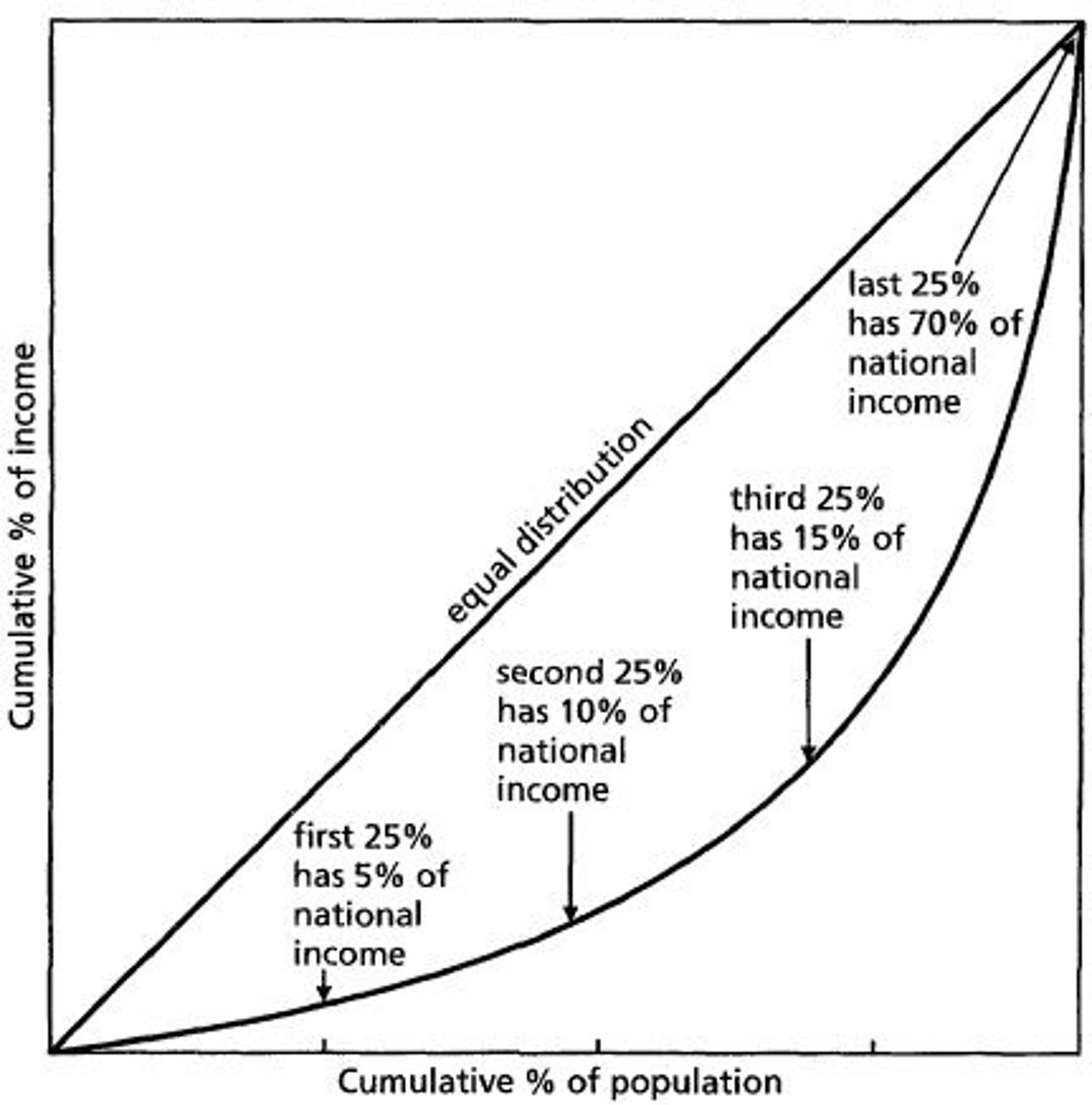
What does the lorenz curve show?
Graph showing how much the actual distribution of income differs from an equal distribution
x-cumulative % of population
y -cumulative % of income
gini coefficient
A measure of income inequality within a population, ranging from zero for complete equality, to one if one person has all the income.
Low Gini coefficient
less inequality
High Gini coefficient
more inequality
How to calculate gini coefficient
A/A+B
Palma Ratio
The ratio of the richest 10% of the population's share of gross national income (GNI) divided by the poorest 40%'s share
World Bank thinks it is more relevant than Gini and it shows if trickle-down economics works.
Perfect equality
every person has exactly the same income
Perfect inequality
one person has all the income, everyone else has zero
how to reduce inequality
Short run:
increase NmW
progressive taxation
inheritance tax
benefits
triple lock pensions
decrease maximum pay
Long run:
Spending on education (such as the gov's recent spending on T-Levels)
Spending on housing reforms (Maximum price on housing or subsidising housing production)
progressive tax
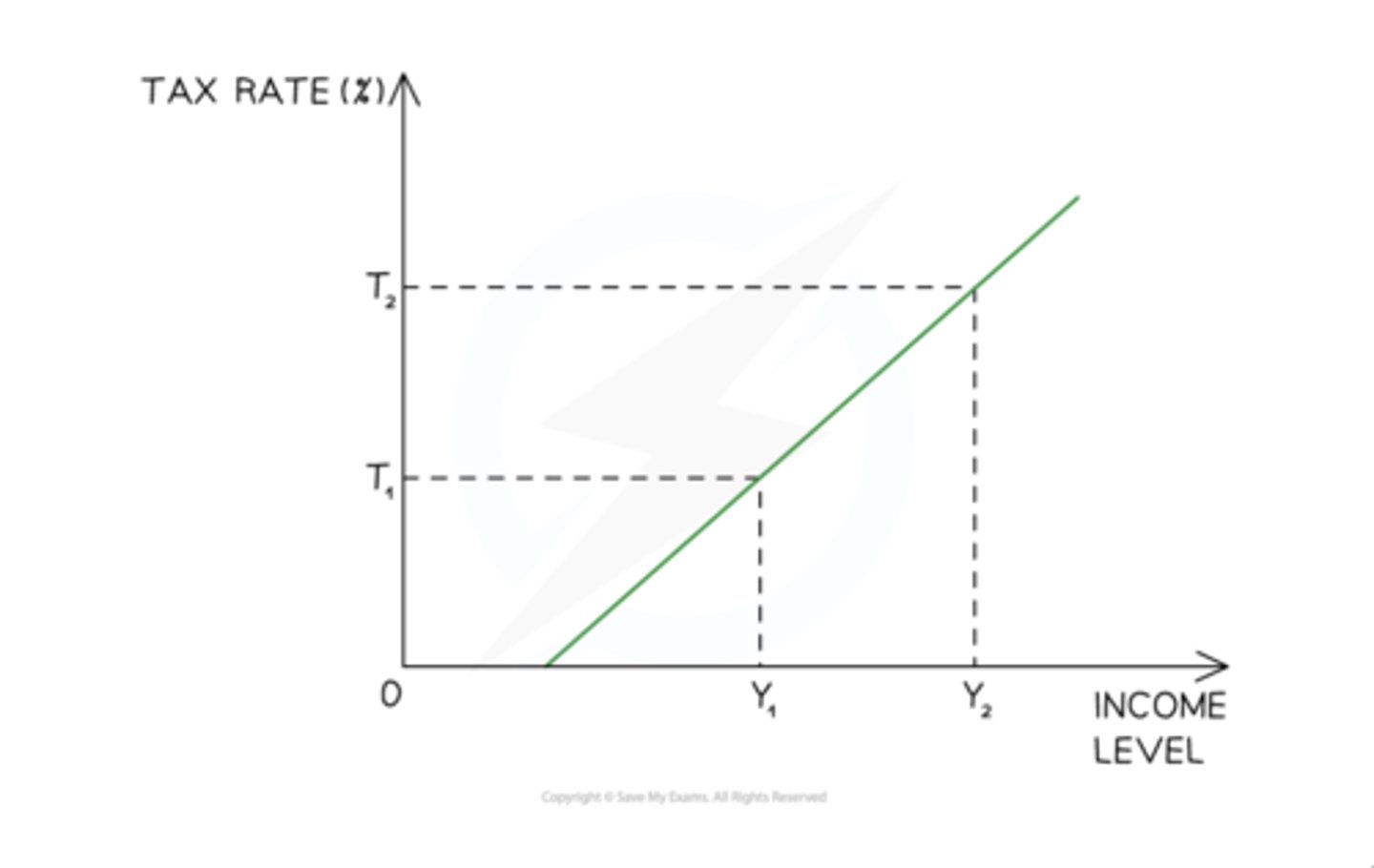
A tax for which the percentage of income paid in taxes increases as income increases
unemployment trap
Occurs when an individual is little better off or even worse off when getting a job after being unemployed because of the combined effect of increased tax and benefit withdrawal.
fiscal drag
When average tax rates increase because taxpayers have moved into higher income brackets during an expansion.
Universal Credit
Single monthly benefit designed to replace 6 separate benefits for people who are on low income or out of work
regressive tax
A tax for which the percentage of income paid in taxes decreases as income increases
Draw the laffer curve
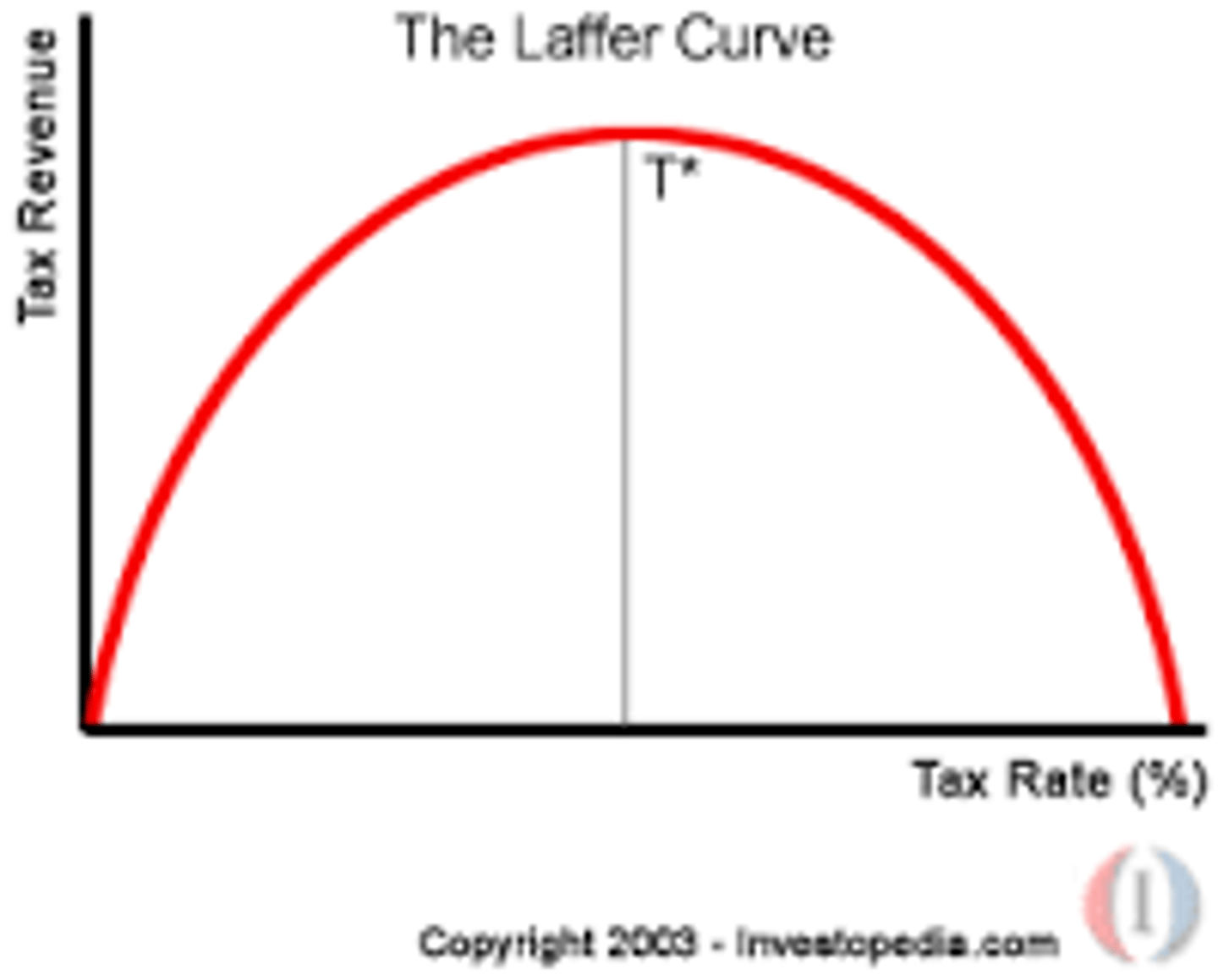
What does the Laffer curve show
A relationship between the tax rates and tax revenues that illustrates that high tax rates could lead to lower tax revenues if economic activity is severely discouraged.
Riccardian equivalence theory
Increasing the deficit by spending on the economy may not lead to growth because consumers adjust their behavior by saving more and spending less + the government will increase taxes in the long run
current spending
Government spending on the day-to-day running of the public sector, including raw materials and wages of public sector workers.
capital spending
refers to money spent by a business for an item that will be used over a long period
windfall tax
A one-off tax levied on firms that have made unexpectedly large profits, typically due to external factors rather than their own efforts (e.g. energy companies profiting from rising oil prices). It is a tax, not a fixed cost.
What is a stamp duty
ha tax, payable to the government when purchasing assets such as houses or cars
Why do we tax?
1. to generate revenue for government
2. protectionist trade policy (tariff)
3. to alter a behaviour or activity that generates negative externalities (correct market failure)
4. Redistribute income/wealth inequality
5. manipulate the economy
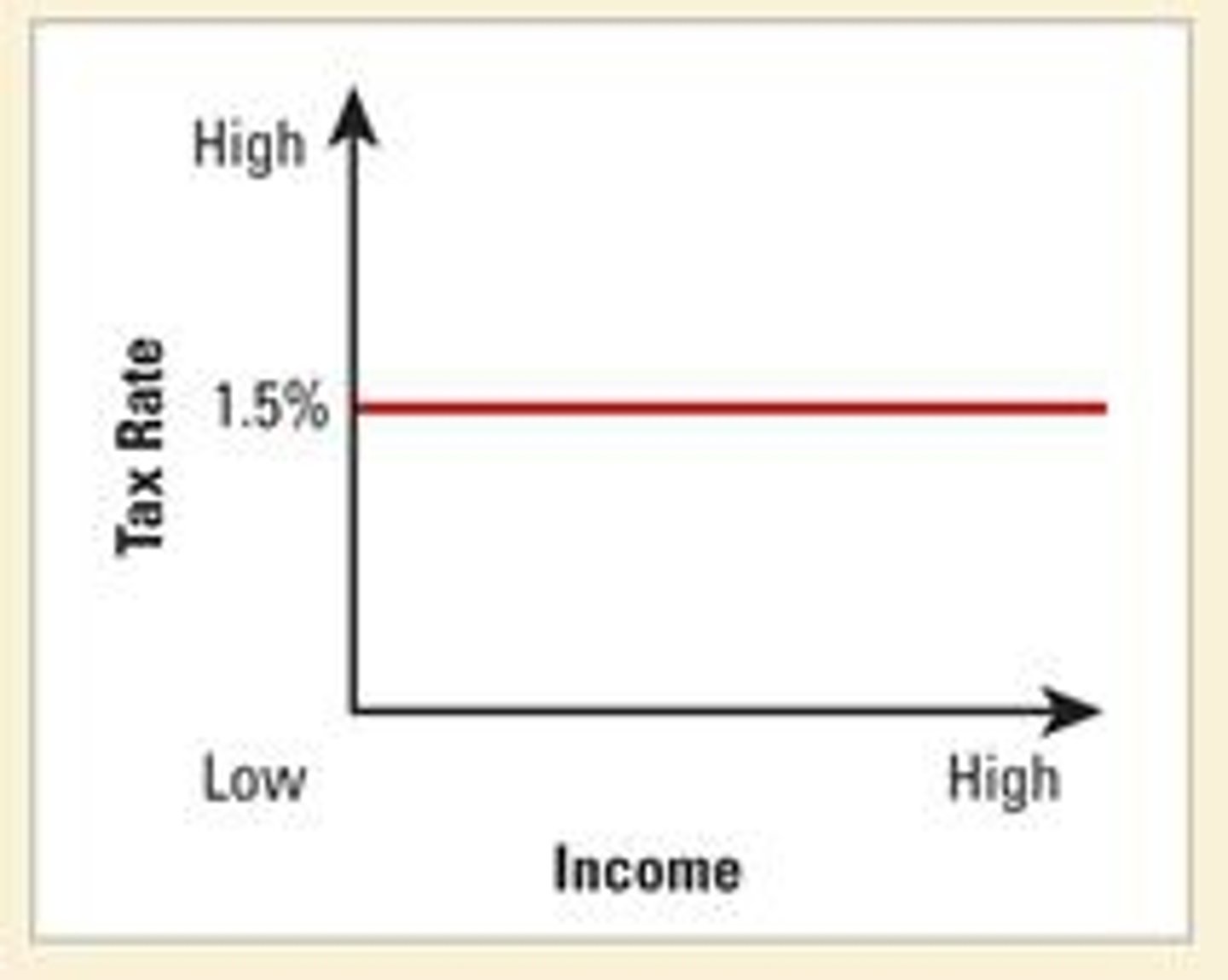
Draw a proportional tax rate diagram (not in spec but helps you to visualise it)
Draw a progressive tax diagram (not in spec but helps you to visualise it)
regressive tax diagram (not in spec but helps you to visualise it)
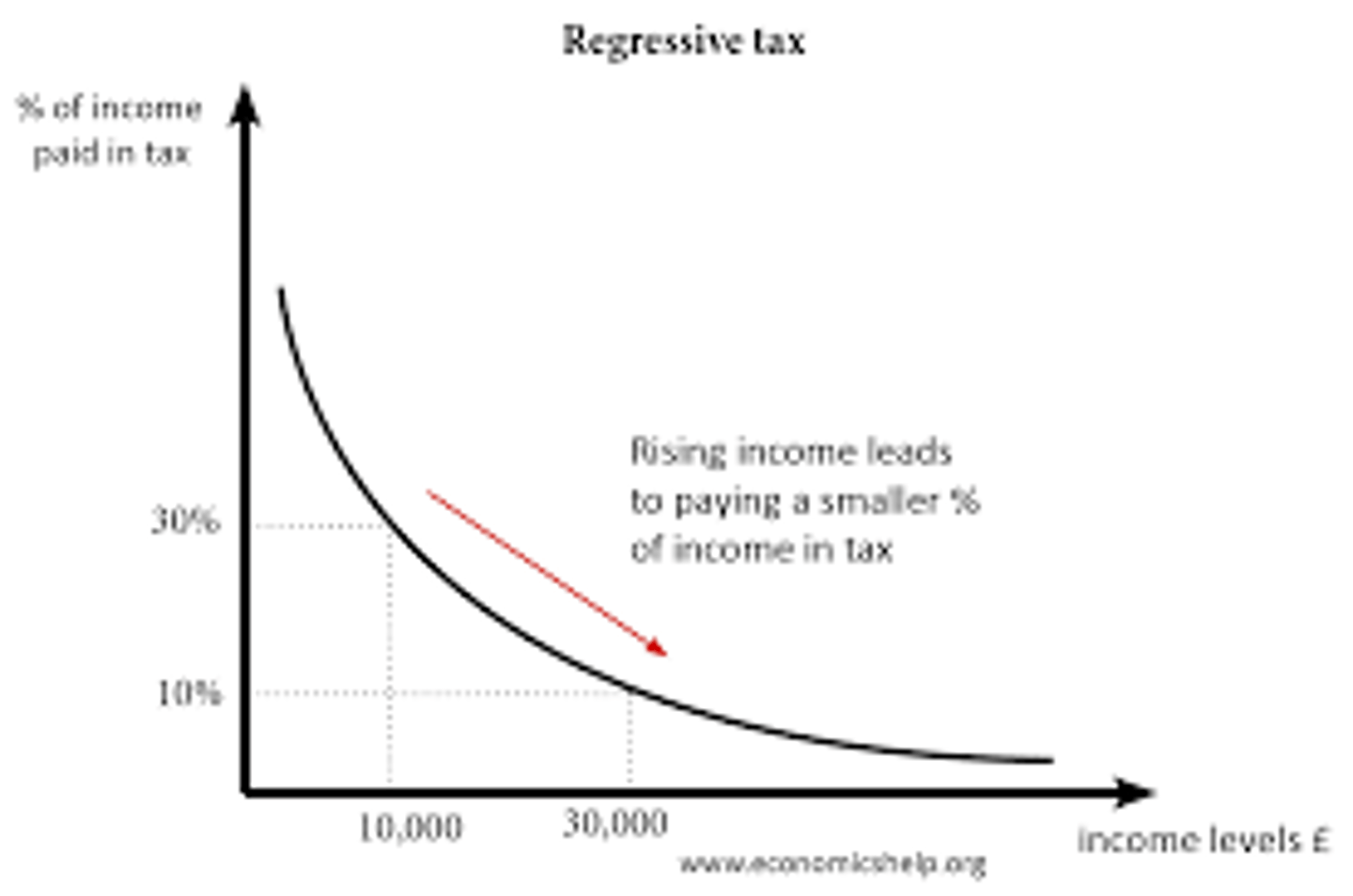
marginal tax rate
the extra taxes paid on an additional dollar of income
crowding in
increased government spending stimulates economic activity, leading to more private investment
Name 3 causes of a budget deficit
1. national emergencies
2. need for public goods and services
3. stabilisation of the economy
4. role of government in society
5. demographic factors causing state pensions to rise
6. increase interest rates on debt leading to a rise in debt service costs
crowding out
a decline in private expenditures like investment as a result of an increase in government spending
service debt
To pay the interest and capital repayment in accordance with the loan contract.
"fiscal deficits are not an issue" - how could you defend this?
- if you are in a recession you need to spend to get out of it
- multiplier
- gov spending on capital spending - LRAS
- cyclical defict
- small proportion of GDP
- if the money is spent on external shocks e.g COVID19
"fiscal deficits are an issue" - how could you defend this?
- in a recession, there is no guarantee of demand
- could be inflationary
- increased tax burden for future generations
- crowding out
- gov debt leads to opportunity cost and you may be denied for a loan
- large proportion of gdp
- structural deficit
automatic stabilizers
government spending and taxes that automatically increase or decrease along with the business cycle
Why should the government cut the deficit?
Less money servicing Debt -> lower oppurtunity cost
Gives you more credibility, more stable currency and increased FDI
structural deficit
The part of the budget deficit that would exist even if the economy were operating at full employment.
cyclical deficit
Caused by a recession and the consequent decline in tax revenues. This becomes an issue when it persists over time
what is fairtrade
trade between companies in developed countries and producers in developing countries in which fair prices are paid to the producers.
Benefits of fair trade
enabling farmers to receive a fair price for their harvest, ensuring a fair wage and economic independence for workers, prohibits forced and child labour, improves worker's standard of living, can plan investment
Criticisms of fair trade
Benefits some, excludes others
Amounts to redistribution, not creation of value (economic growth)
Inflates prices above market value but doesn't address root problems, e.g., oversupply, underperforming farms
prevents resources moving to more productive processes
Globalisation
The increasing international interdependence or integration of economic agents
Francis Cairncross quote on globalisation
globalisation is 'the death of distance'
Peter Jay quote on globalisation
globalisation is the 'ability to produce any G or S anywhere in the world'.
How much of overall costs do shipping costs comprise?
1% of the total cost - clearly we are very efficient and globalised nowadays!
What does globalisation look like
- increased international trade
- increasing multinational corporations (MNC's)
- increased international movement of labour
- increased specialisation
- greater dependance on the global economy
- easier movement for goods and services
- recognition of companies such as McDonald's in LIC's
- global supply chains
- trade to GDP ratios increase (Luxembourg 400%)
What causes globalisation?
- Improvement in transport
- Collapse of communism
- The movement of labour and capital
- Multinational corporations
- IT (facilitates FDI)
- Containerisation
- Trade liberalisation
'Containerisation'
Coined by Mclean in 1956:
Movement of goods using ships/transport using standard containers
Shipping costs have fallen by approximately 70-90% in real terms since the 1950s.
How much have shipping/containerisation costs fallen since the 1950s?
100%
How much has trade increased as a result of containerisation?
790%
- World trade volumes increased by approximately 790% between 1950 and 2000. Containerisation was a major contributing factor, though trade liberalisation, globalisation, and rising incomes also played a role.
benefits of globalisation for consumers
better choice
lower prices
disadvantages of globalisation for consumers
may be higher prices because increased incomes lead to increased demand
some consumers worry about the loss of culture
being driven to consume more can reduce consumer hapiness (diderot effect)
Diderot Effect
obtaining a new possession often creates a spiral of consumption which leads you to acquire more new things. As a result, we end up buying things that our previous selves never needed to feel happy or fulfilled.
advantages of globalisation for workers
migrants can provide important and highly demanded skills which can increase AD and create jobs
highly skilled workers are paid high wages
Disadvantages of globalisation for workers
increased inequality as high skilled workers are paid much more than lower skilled workers
increased international competitiveness reduces wages
increased migration leads to lower wages
some are exploited by MNCs
structural/(sometimes frictional) unemployment as trade patterns change
advantages of globalisation for producers
global supply chains means that if one market collapses they can have a supply of resources from elsewhere
can employ low skilled cheap workers for more profit
can exploit their comparative advantage in a larger market
disadvantages of globalisation for producers
global supply chains can have high transportation costs
firms who are unable to compete internationally will lose out
advantages of globalisation for government
may increase tax revenue as other firms locate in the country
increased job creation means they can pay less benefits
disadvantages of globalisation for governments
footless companies may not pay the tax as they can just leave the country
TNC's may bribe or lobby the government
Tax avoidance (e.g starbucks)
Hundrerds of billions lost annually due to transfer pricing (when a firm makes its daughter companies pay its tax in a country with low corportation tax)
impact of globalisation on the environment
- environmental degradation, resources are exploited
- pollution = climate change
- resource depletion
- increase trade = increased emissions
BUT
world can share technology to counter climate change
Impact of globalisation on economic growth
Increase in investment (tnc)
TNCs may bring techniques and technology
exploitation of comparative advantage
Increased employment -> LRAS
BUT
TNCs may support unpopular or undemocratic regimes
remittances
emerging markets
places where consumer incomes and buying power are increasing because of economic expansion. These help globalisation because they receive greater investment.
how does Nike take advantage of working in Bangladesh
no laws/regulations
lower taxes
cheaper FoPs
no MnW
deglobalisation
Decreased economic interdependence between countries e.g decline in world trade, fall in capital movements, decrease in FDI
examples of backlash to MNCs
Nike - sweatshop
Starbucks - tax avoidance
absolute advantage
the ability to produce a good using fewer inputs than another producer
comparative advantage- DAVID RICARDO
the ability to produce a good at a lower opportunity cost than another producer
theory of comparative advantage
if all countries specialise in their comparative advantage, global output will increase
Countries specialise in the goods in which they have a comparative advantage/lower opportunity cost Through trade each country can now consume more in total as they focus on what they can produce more efficiently
limitations of the theory of comparative advantage
- assumption of no trade barriers
- assumes there are only 2 economies
- assumes no transport costs
- assumes perfect knowledge
- assumption of equal quality of goods
- assumes average cost of production is constant
cost of production is not always constant
increased specialisation might result in rising average costs caused by diseconomies of scale
assumption that there are no trade barriers
trade barriers might distort comparative advantage
assumption that there are no transport costs
high transport costs (e.g 5000km between Uzbekistahn and Germany) can reduce the benefit of specialisation in your comparative advantage