Physics - Waves*
 Call Kai
 Learn
Learn Practice Test
 Spaced Repetition
 Match
Match Flashcards
 Knowt Play
1/212

There's no tags or description
Looks like no tags are added yet.
Name | Mastery | Learn | Test | Matching | Spaced | Call with Kai |
|---|
No analytics yet
Send a link to your students to track their progress
213 Terms
What are waves?
an oscillation that transfers energy from one place to another without transferring matter
What happens when a wave moves?
When a wave moves:
- The energy moves forward.
- The particles of the medium vibrate back and forth around a fixed position.
What are the different types of waves?
transverse and longitudinal
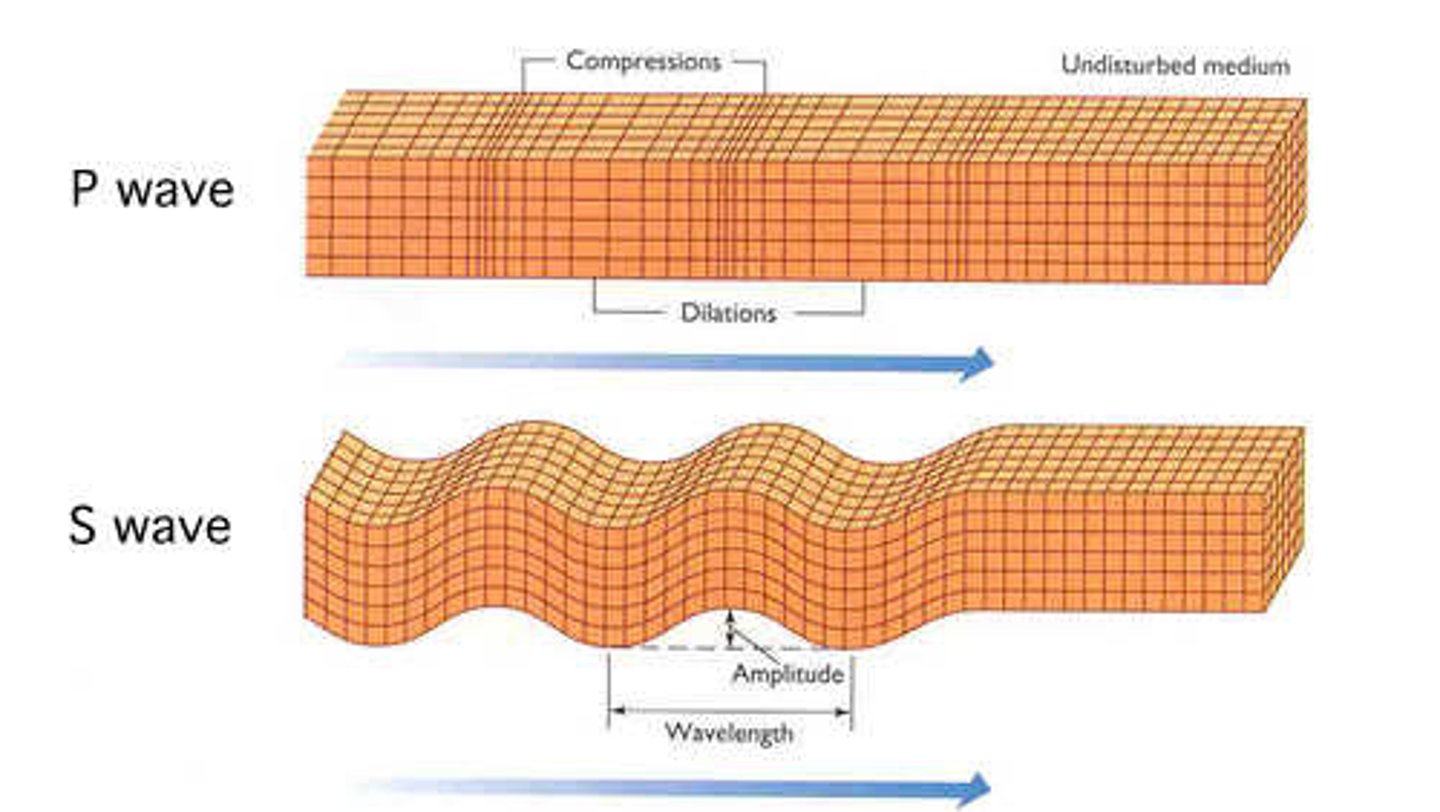
What are transverse waves?
a type of wave where the oscillations are perpendicular to the direction of energy transfer
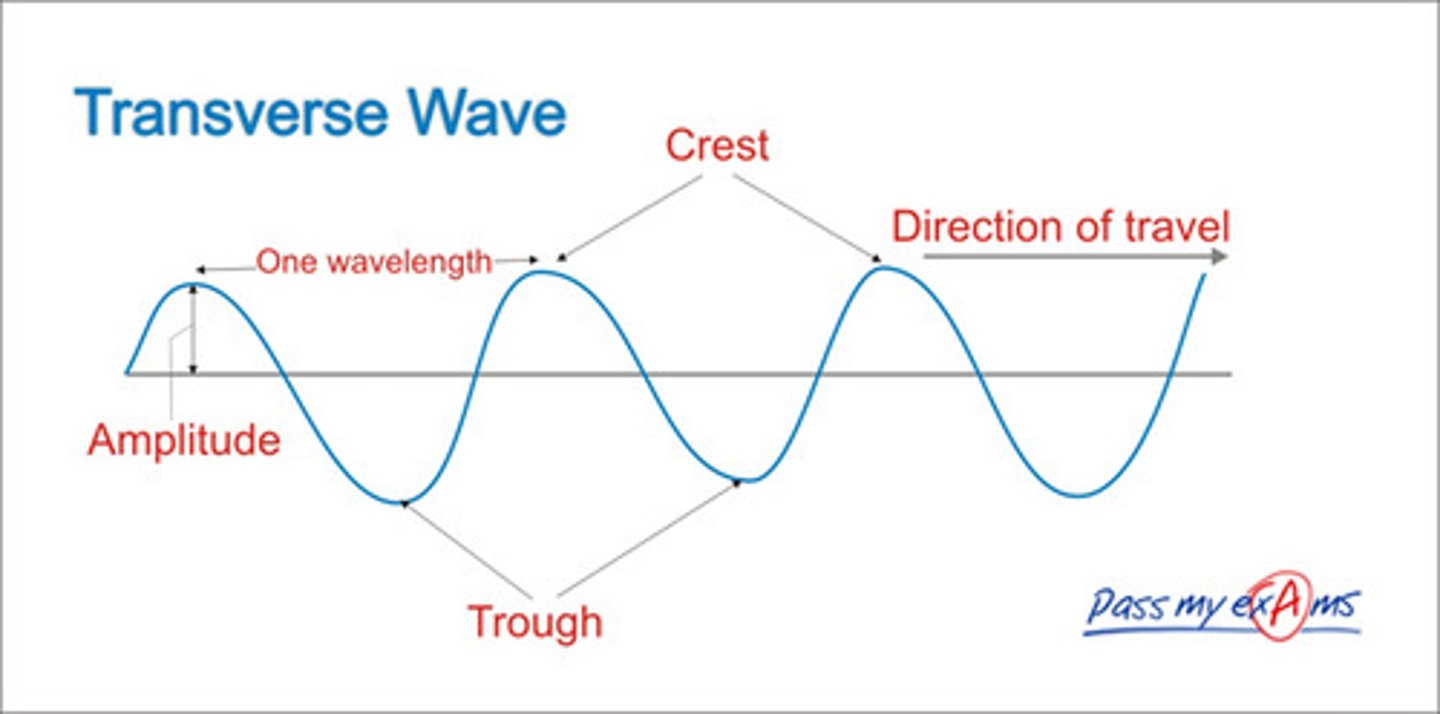
What are oscillations?
the repeated, back-and-forth vibrations of particles or fields about a central rest position
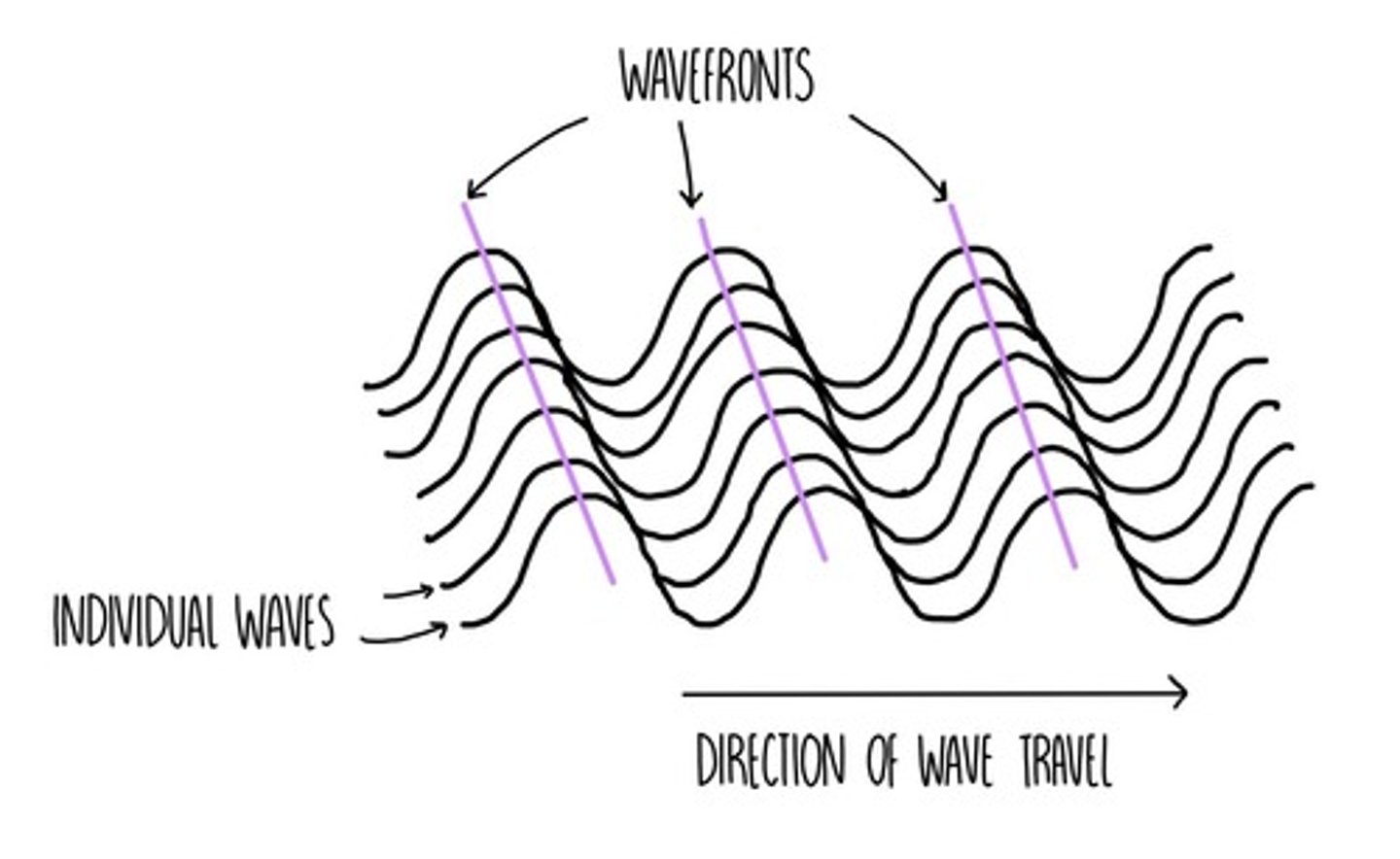
What is the wavefront of a wave?
an imaginary surface connecting all adjacent points on a wave that are in the same phase
Examples of transverse waves?
- electromagnetic waves
- Water waves
- Light waves
- s waves
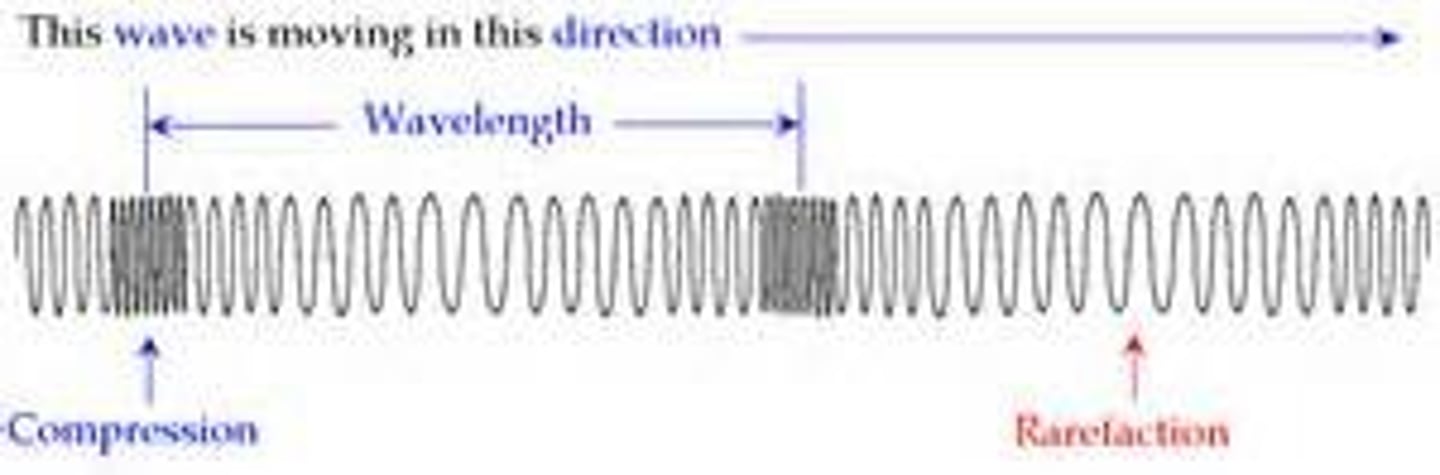
What are longitudinal waves?
a wave where the oscillations are parallel to the direction of energy transfer
Examples of longitudinal waves
- Sound waves
- p waves
What are the key features of waves?
- Wavelength (λ)
- Frequency (f)
- Amplitude
- Wave Speed (v)
- Period
Features of transverse waves?
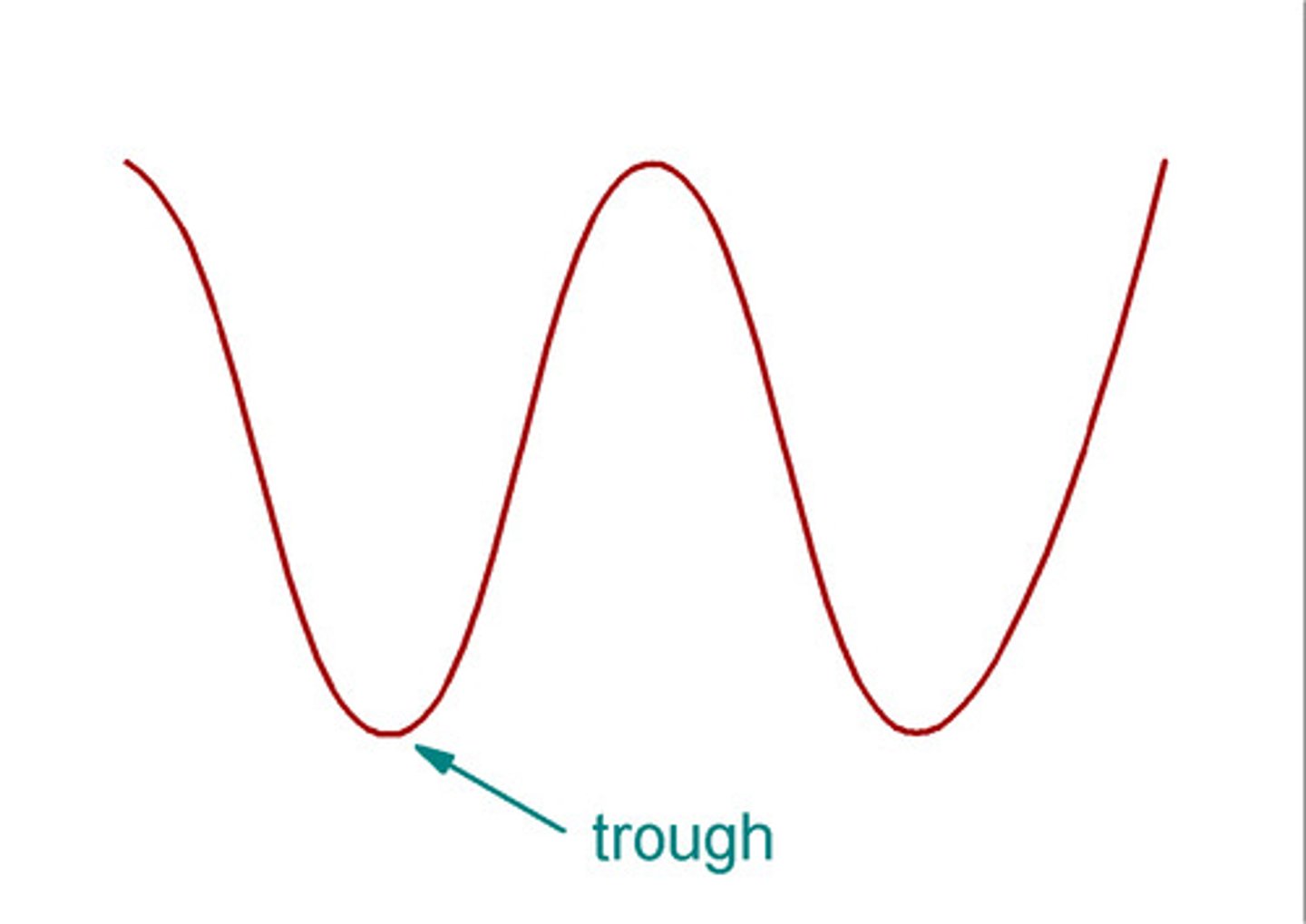
peaks and troughs
What is the crest of the wave?
The highest point of a wave
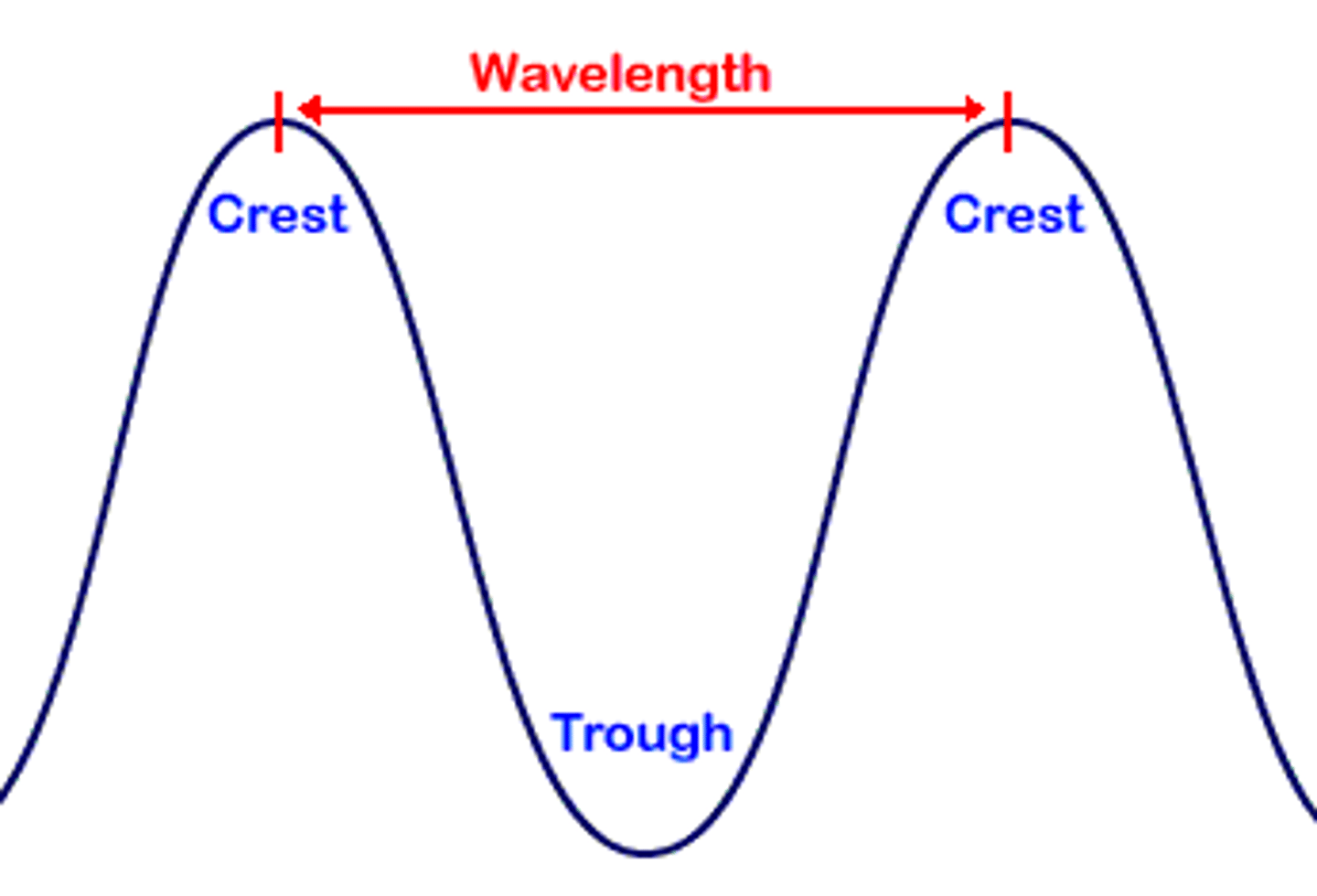
What is the trough of a wave?
the lowest part of a wave
Do longitudinal waves have crests and troughs?
no
Features of longitudinal waves?
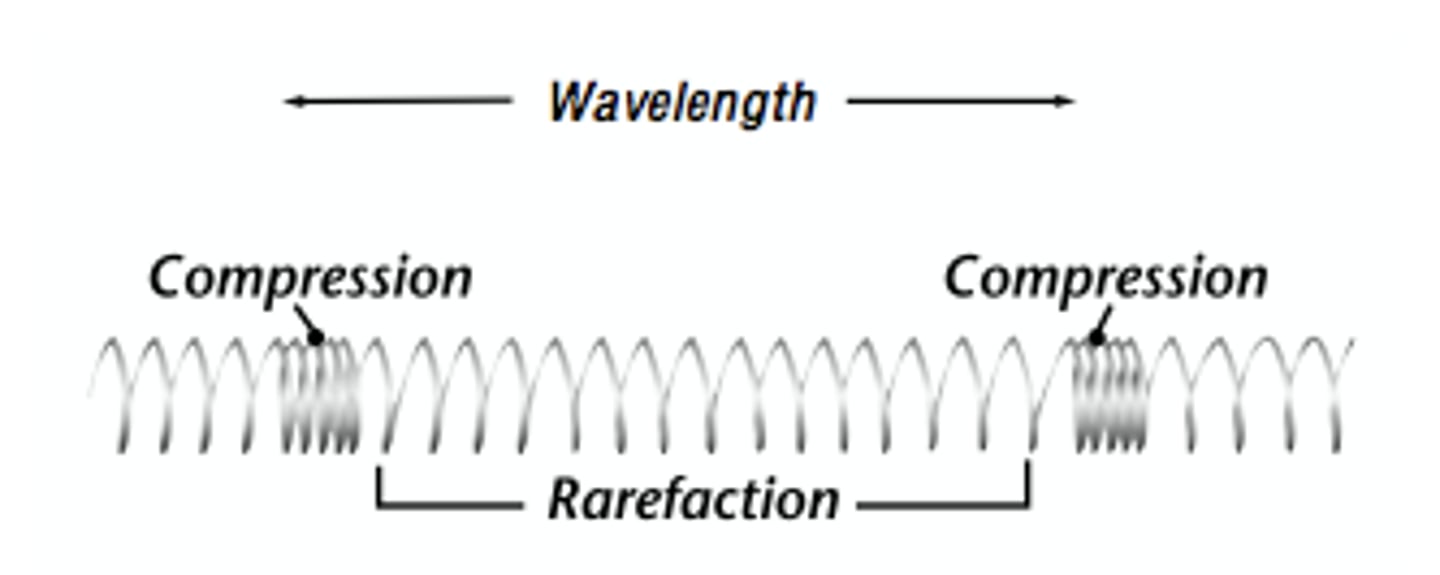
compressions and rarefactions
What are compressions of a wave?
regions of high pressure due to particles being close together
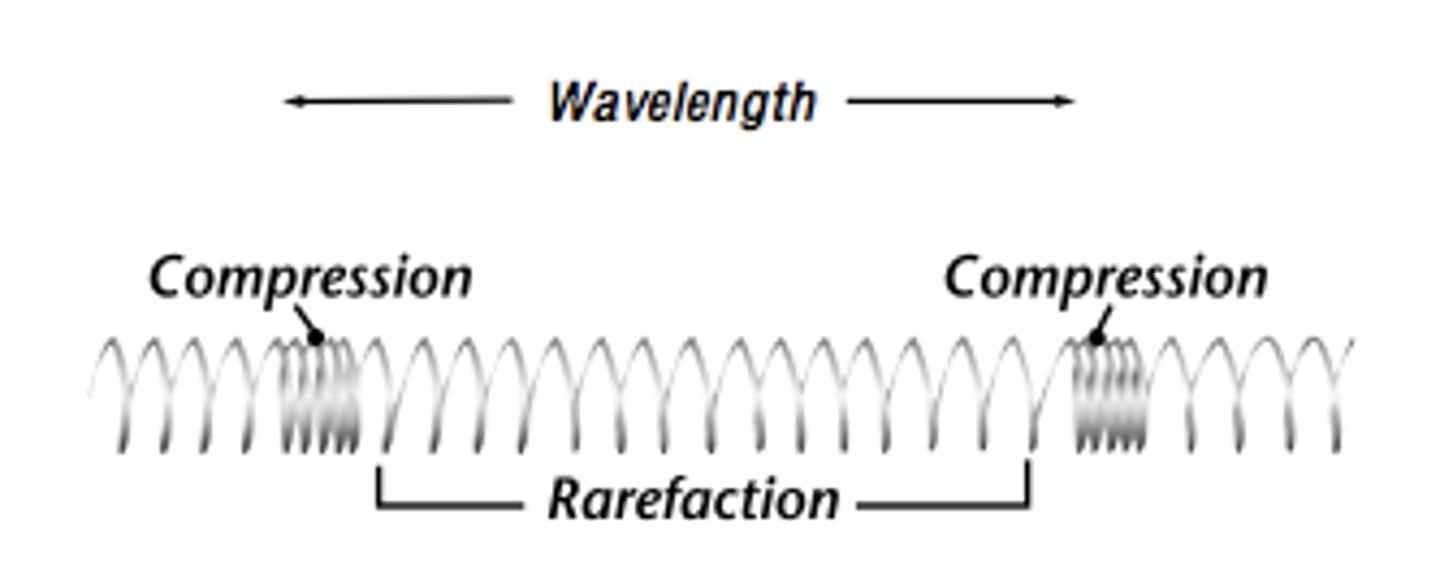
What is the rarefraction of a wave?
regions of low pressure due to particles being spread further apart
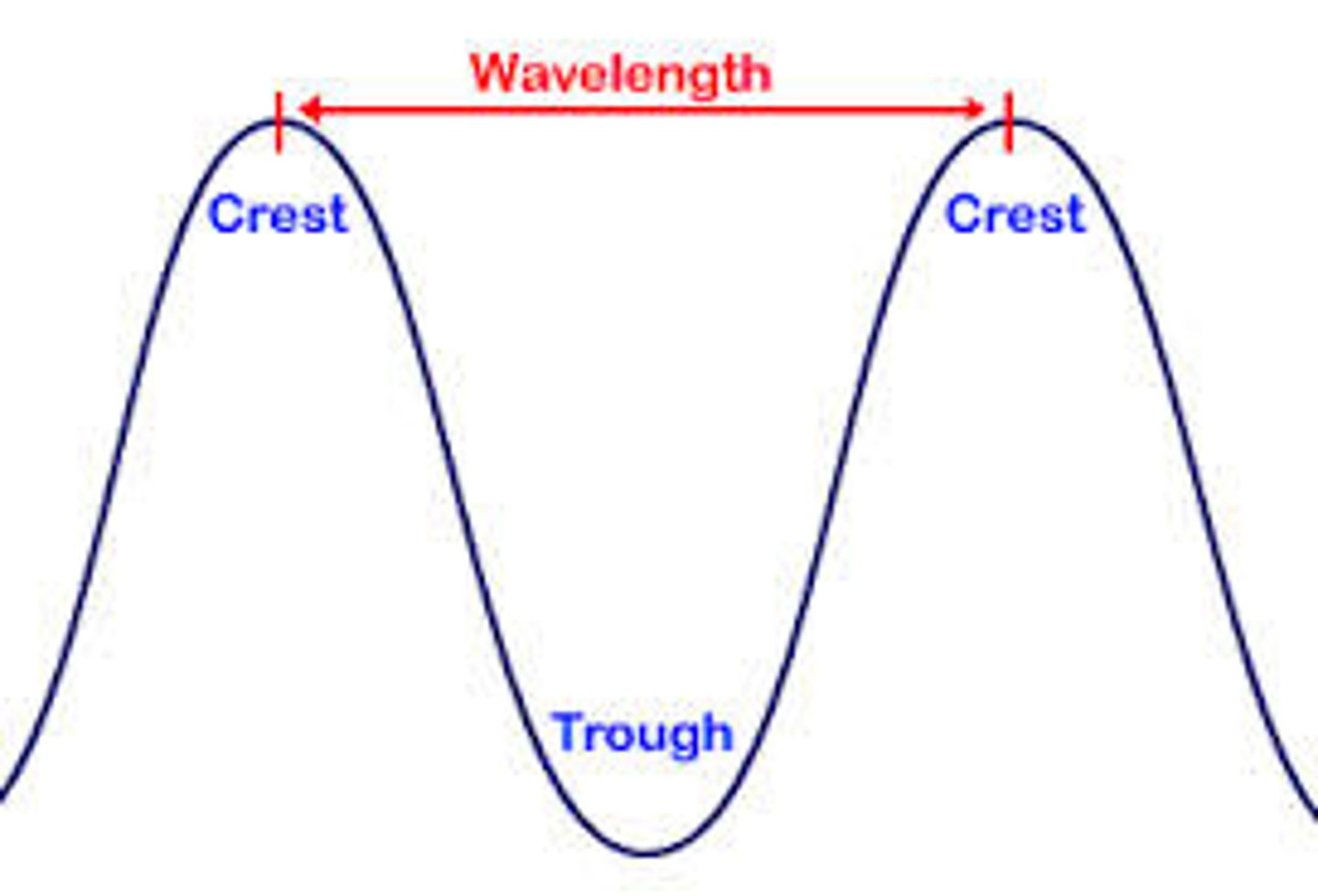
What is the wavelength (λ)?
- the distance from any point on a wave to an identical point on the next wave
- the distance between crests in transverse waves
- the distance between compression to compression in longitudinal waves
What is the frequency of a wave?
how many waves pass a point every second
What does a higher frequency mean?
More wave cycles pass a fixed point per second, resulting in a shorter wavelength and higher energy
it results in a higher pitch for sound
What is frequency measured in?
Hertz (Hz)
What is the amplitude of a wave?
- the maximum displacement or distance moved by a point on a wave from its undisturbed (rest) position
- the height of the wave from its rest position to its peak
- It shows how big the vibration is
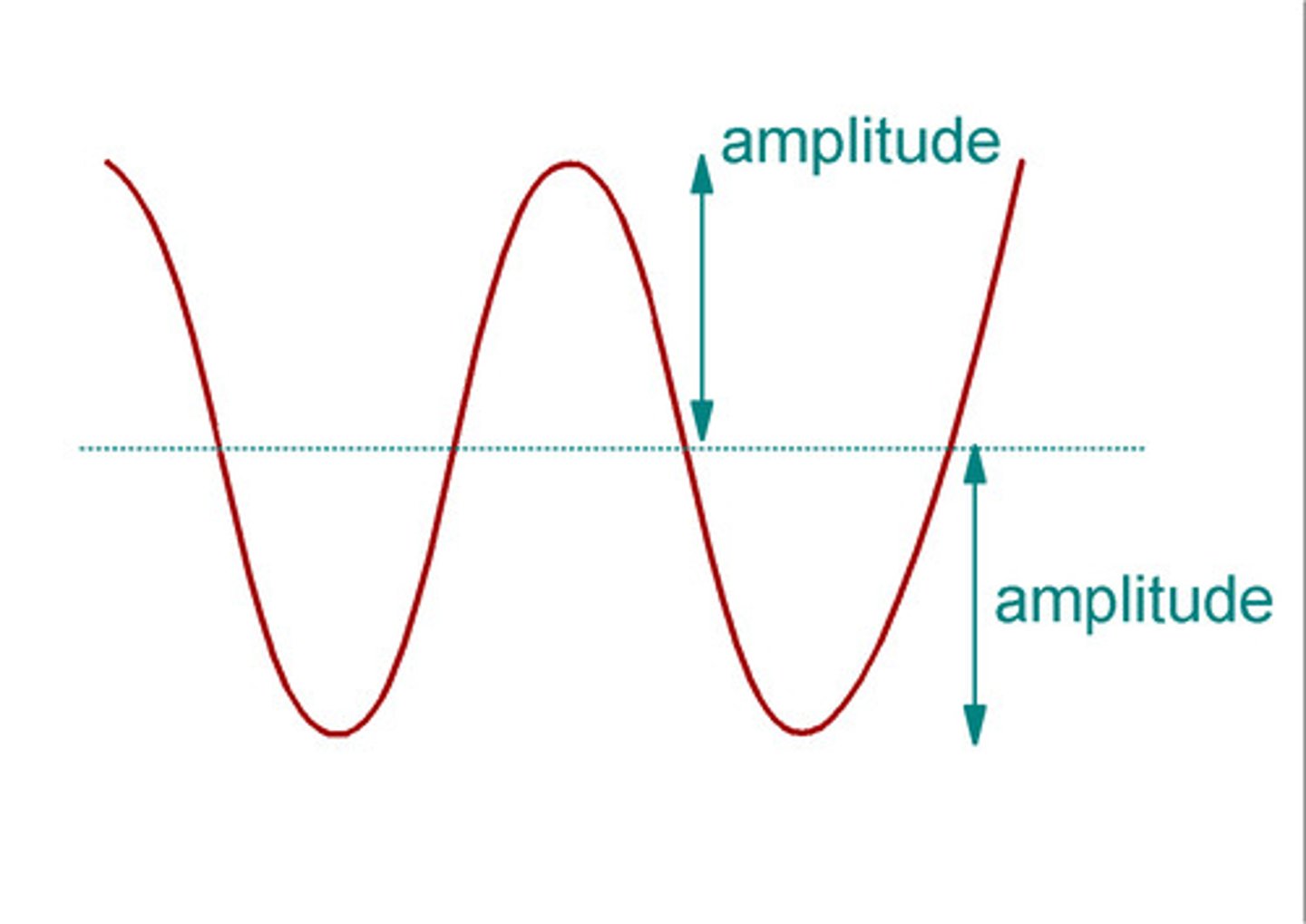
What does a bigger amplitude mean?
The wave is carrying more energy
this leads to a louder sound for sound waves or brighter light for light waves.
What is wavespeed (v)?
The speed at which energy is being transferred
What is the equilibrium position of a wave?
\- the central, undisturbed position of the medium's particles when they are not vibrating
- It represents the zero-displacement line where the medium would remain if no wave were passing through it
What is wavespeed measured in?
m/s
Formula for wavespeed?
wavespeed = frequency x wavelength
What is the period (T) of a wave?
the time taken for one complete wave cycle to pass a fixed point, or the time taken for one complete oscillation of a particle in the wave.
What are mechanical waves?
waves that require a medium through which to travel
Examples of mechanical waves
sound waves, water waves, seismic waves
What type of waves are electromagnetic waves?
transverse waves
What are electromagnetic waves?
- transverse waves produced by oscillating electric and magnetic field
- they transfer energy from a source to an absorber
- They do not require a medium
How fast do electromagnetic waves travel in a vacuum?
they travel at the speed of light (3 x 10⁸)
electromagnetic spectrum
Radio waves
Microwaves
Infrared
Visible light
Ultraviolet
X-rays
Gamma rays
What electromagnetic wave has the highest frequency?
Gamma rays
What electromagnetic wave has the lowest frequency?
Radiowaves
What electromagnetic wave has the most energy?
gamma rays
What electromagnetic wave has the least energy?
radiowaves
What electromagnetic wave has the longest wavelength?
radio waves
What electromagnetic wave has the shortest wavelength?
gamma rays
How do electrons release electromagnetic radiation?
Electrons release electromagnetic radiation when they transition from a higher energy level to a lower energy level
How do electrons absorb electromagnetic radiation?
Electrons absorb EM radiation when transition from a lower energy level to a higher energy level
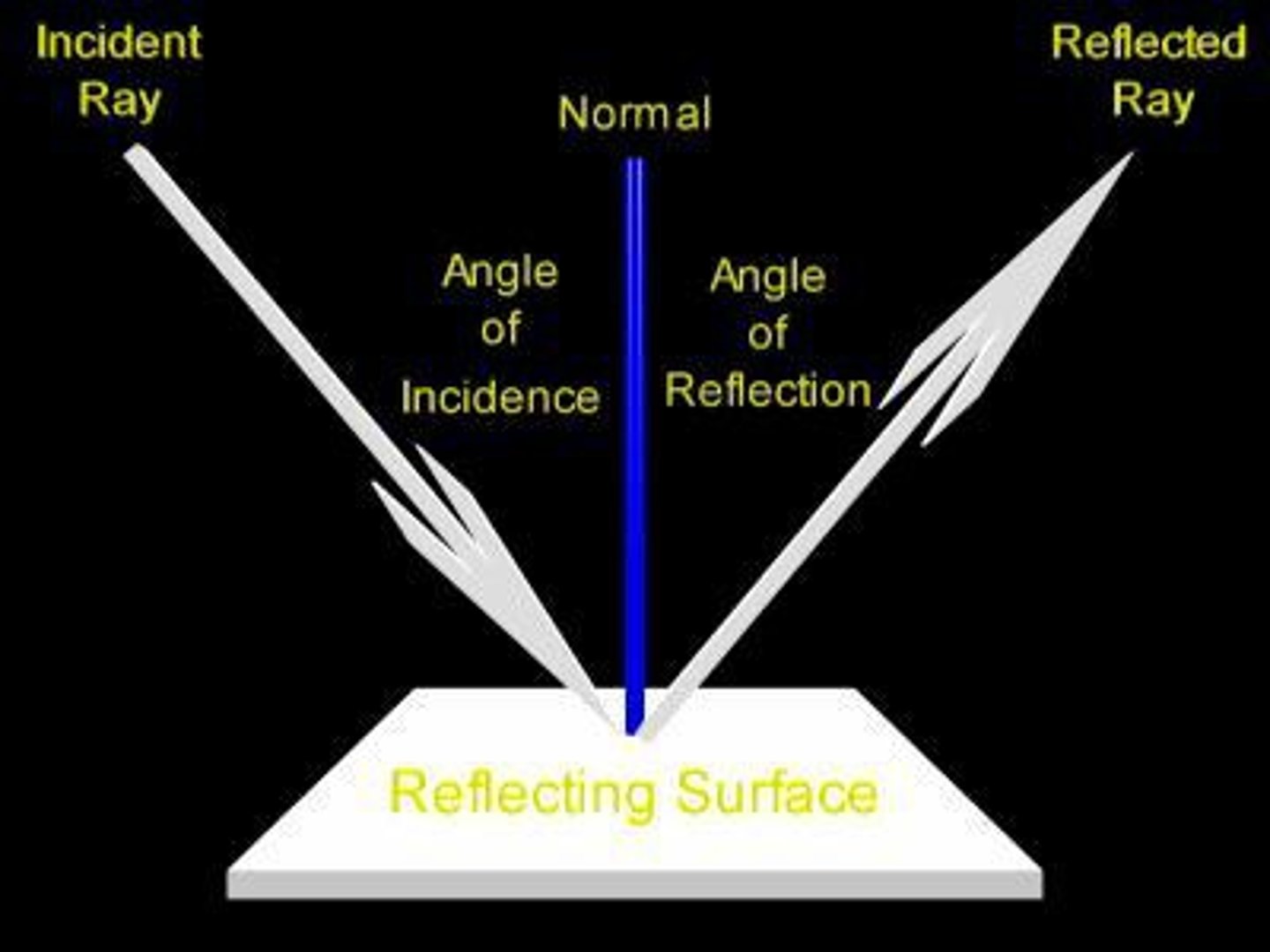
What is reflection?
the bouncing of waves (like light or sound) off a boundary between two materials, following the law that the angle of incidence equals the angle of reflection
What are the different types of reflection?
specular reflection and diffuse reflection
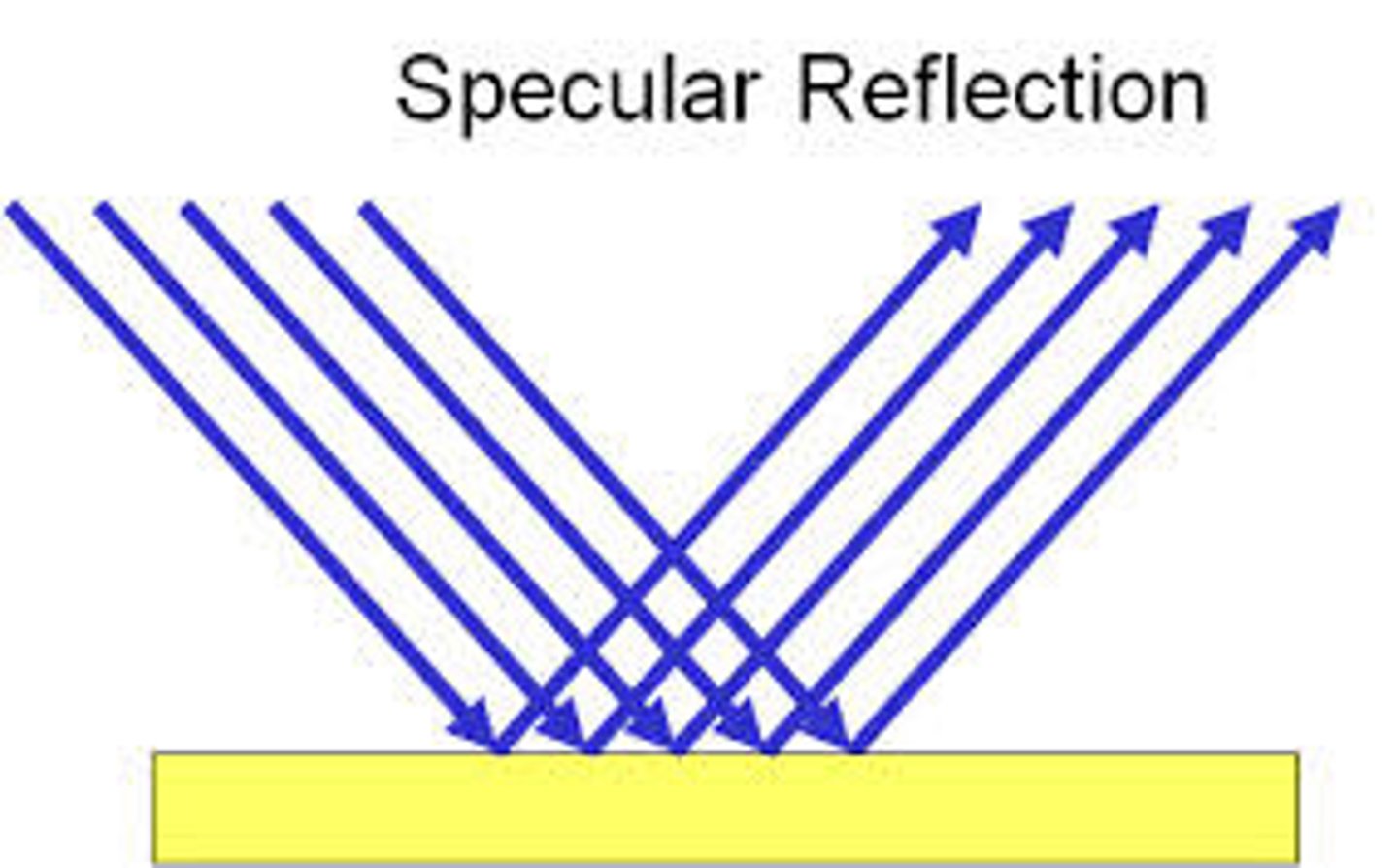
What is specular reflection?
When a wave is reflected in a single direction by a smooth surface
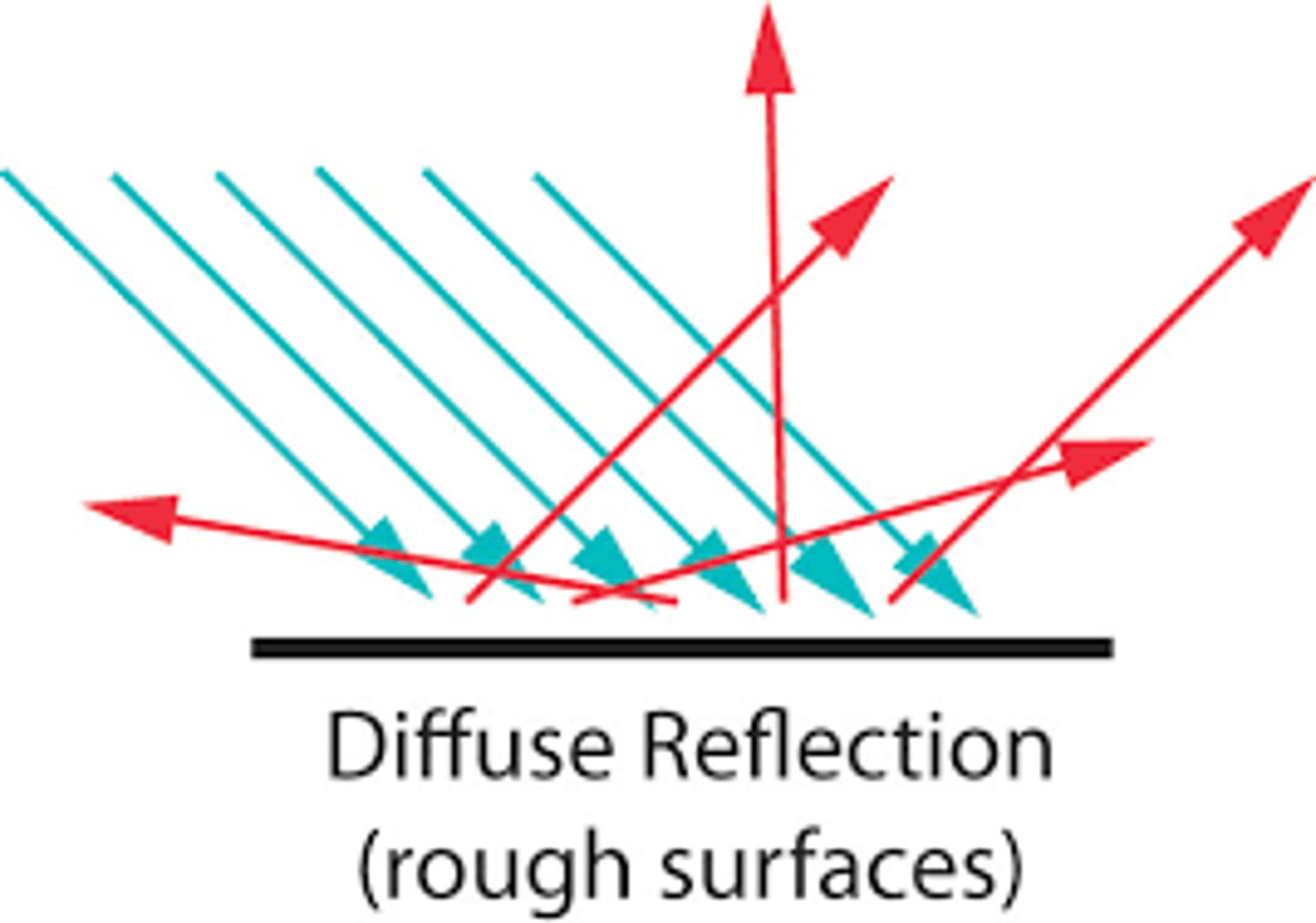
What is diffuse reflection?
- the scattering of light in many different directions when it strikes a rough or irregular surface, preventing the formation of a clear image
What is refraction?
- the bending of light (or other waves) as it passes at an angle from one transparent material into another
- This occurs because the speed of light changes depending on the density of the material, causing the light ray to change direction.
What is diffraction?
- the bending and spreading of waves when they encounter an obstacle, pass through a narrow gap, or graze an edge
- larger diffraction occurs if the gap is similar to the wavelength
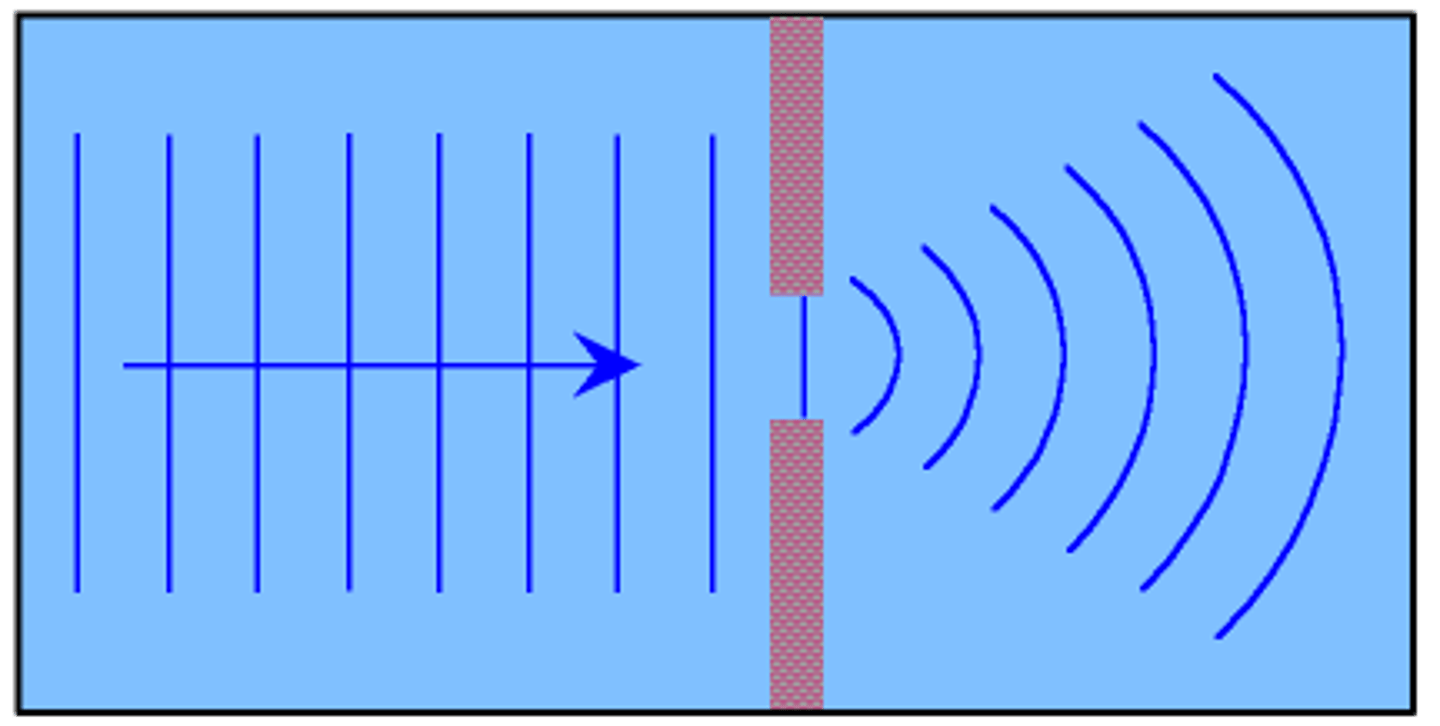
What is the law of reflection?
angle of incidence = angle of reflection
What is interference?
the combination of two or more waves that results in a single wave
Does sound travel in a vacuum?
NO, sound requires a medium; if there is nothing to compress and expand, there can be no sound
Are sound waves a transverse or longitudinal wave?
longitudinal
How is sound made?
When an object vibrates it gives off energy producing a longitudinal wave.
What is pitch?
How high or low a sound is
What is pitch determined by?
- the frequency of sound waves (which refers to how rapidly an object vibrates.)
- Higher frequencies (more vibrations per second) produce a higher pitch
- while lower frequencies (fewer vibrations per second) produce a lower pitch.
In what state does sound travel the fastest?
in solids
What is pitch measured in?
Hertz (Hz)
Why does sound travel fastest through a solid?
because particles in a solid are packed tightly together and strongly bonded, allowing vibrations to pass between them rapidly
What does a bigger amplitude mean in sound waves?
The waves have more energy, producing a louder sound
How do we hear sound?
1. Sound waves enter the ear.
2. They make the eardrum vibrate.
3. Vibrations are passed to tiny bones in the middle ear.
4. The brain interprets the signals as sound.
What is the auidible range for humans?
frequencies between 20 Hz to 20,000 Hz (20 kHz)
What is infrasound?
Sound waves with a frequency below 20Hz
What is ultrasound?
Sound waves beyond the range of human hearing - 20,000Hz
What are ultrasounds used for?
- Medical scans (e.g. pregnancy scans)
- Detecting cracks in metals
- Measuring depth in water (SONAR)
How is ultrasound used in medical scans?
A transducer emits pulses that reflect off tissue boundaries; a computer calculates depth using the speed of sound and return time, displaying them as images
How is ultrasound used in measuring depth in water?
- A transducer on the bottom of a boat emits a pulse of ultrasound (sound with a frequency higher than 20,000 Hz) towards the seabed.
- The sound waves travel through the water and reflect (bounce back) when they hit the boundary between the water and the seabed.
- The same transducer, acting as a detector, records the time it takes for the echo to return to the boat
Formula for calculating depth using ultrasound
depth = speed of sound x time/2
advantages of using ultrasound
1. non-ionising
2. Good for imaging soft tissue + you can obtain real-time images (can be done using XR Fluroscopy but that uses a lot of ionising rad)
3. Relatively cheap and portable unlike MR scanners
4. Scan is quick and patient can move
Disadvantages of using ultrasound
1. Doesnt penetrate bone so cant be used to detect fractures
2. Cannot pass through air spaces so can't produce images from behind the lungs
3. Poor resolution
4. Cannot give info about solid masses found
What are seismic waves?
vibrations that travel through Earth carrying the energy released during an earthquake
What are the two types of seismic waves?
Primary (P) waves and Secondary (S) waves
What are P waves?
- They are longitudinal, seismic waves produced by earthquakes
- their particles vibrate parallel to the direction of travel
- they can move through solids, liquids and gases
- they arrive first at seismic detectors
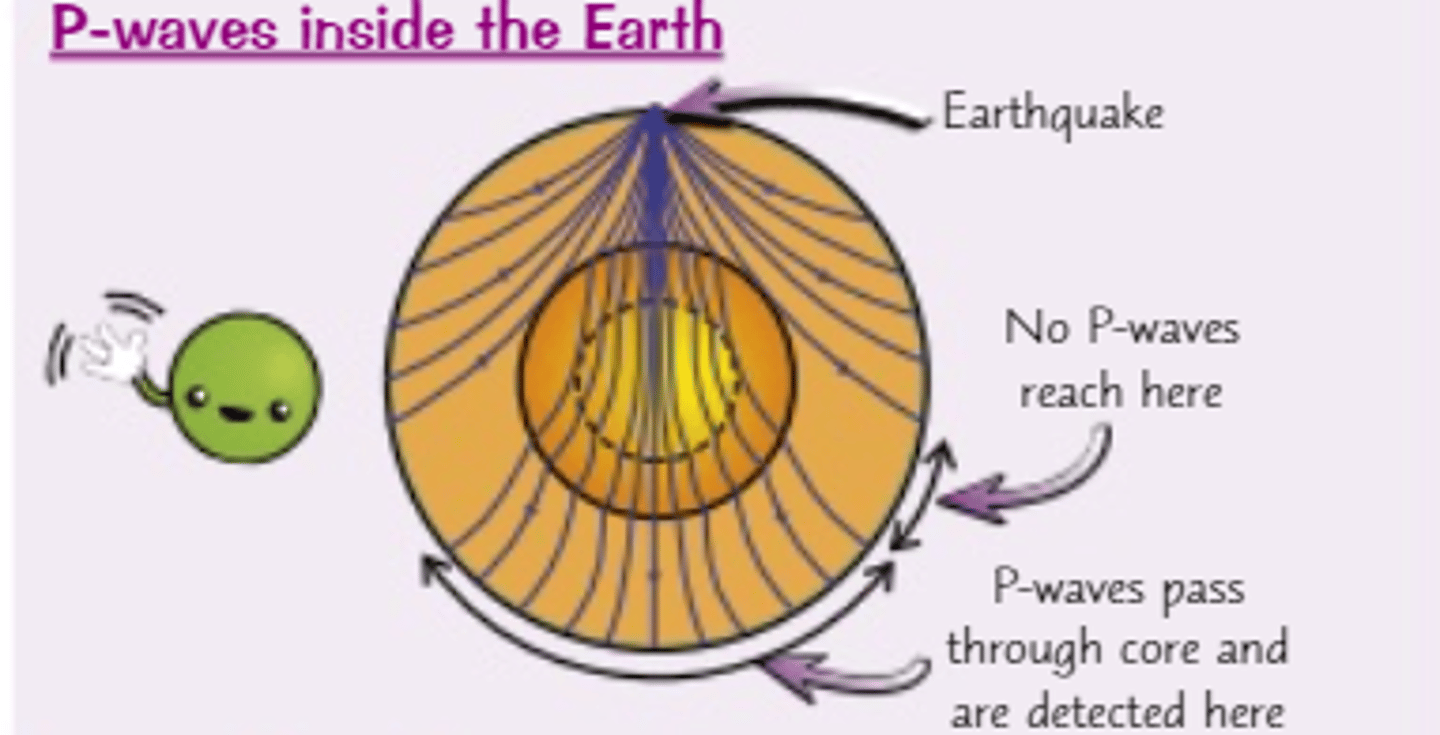
What type of seismic wave travels the fastest?
P wave
Which medium does a P wave travel through?
solids, liquids and gases
How do P-waves move the ground?
by compressing and expanding it in the same direction that the wave is travelling
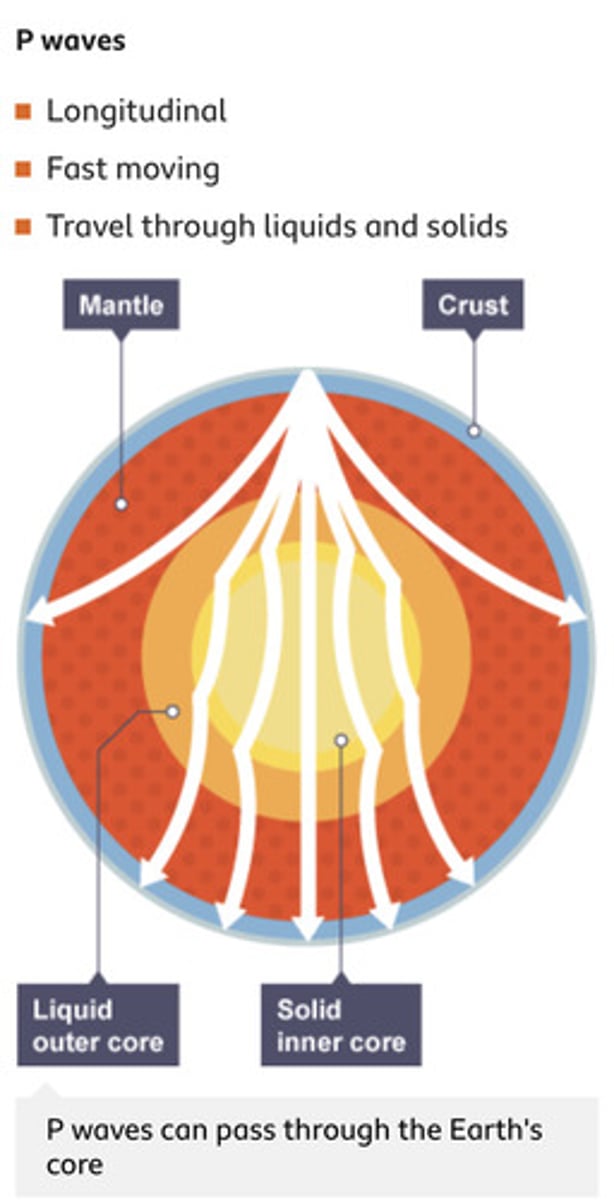
How do P-waves travel through the Earth?
Travel in curved paths, through the Earth's mantle and core, refracting (bending) as they change speed between different density layers.
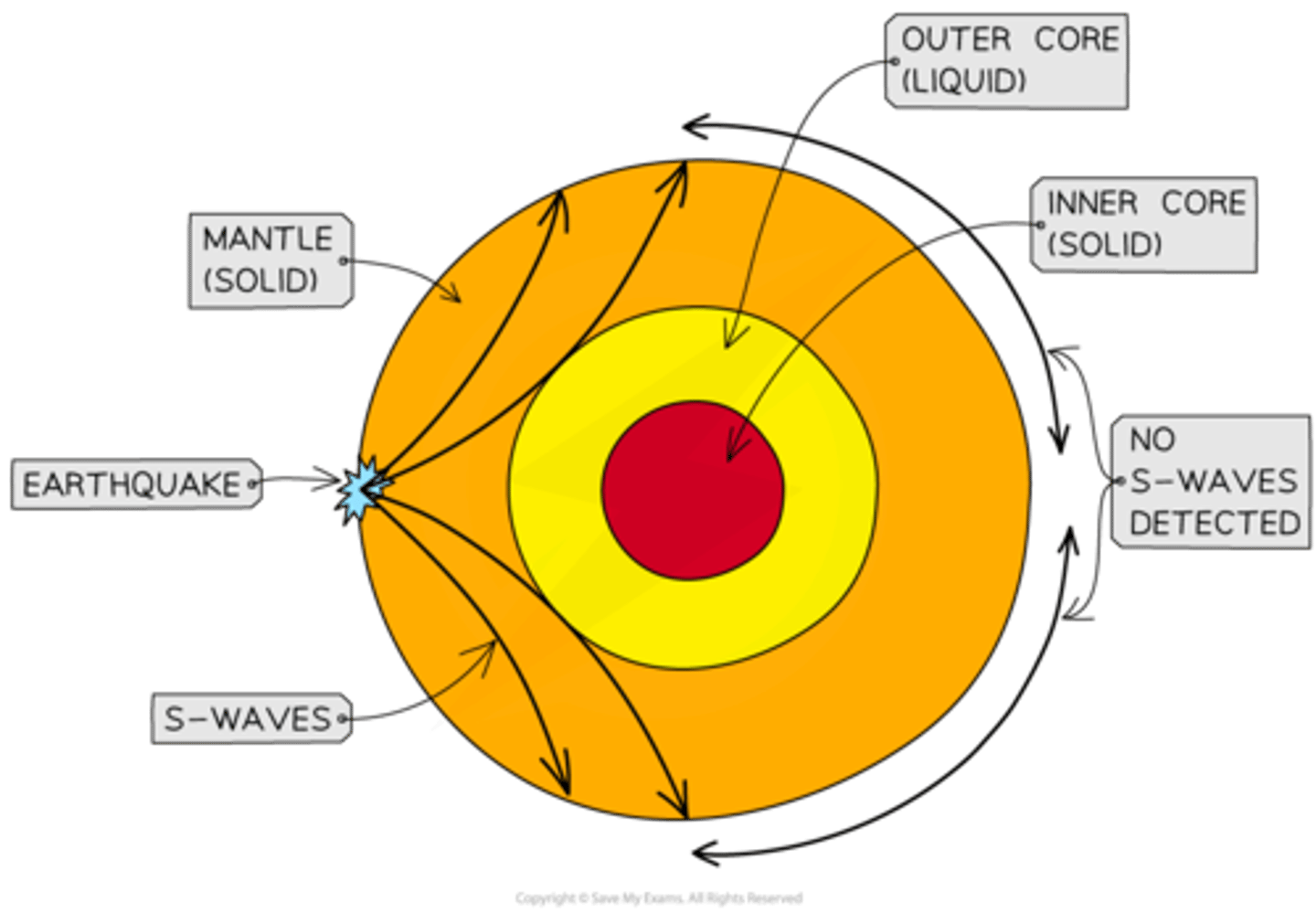
What are s-waves?
- Transverse, seismic waves produced by earthquakes
- the particles vibrate perpendicular to the direction of travel
- They travel slower than P-waves
- Can only move through solids
- Cannot travel through liquids
What part of the Earth do S-waves travel through?
The solid crust and mantle
What part of the Earth do p-waves travel through?
the solid crust, solid mantle, liquid outer core, and solid inner core
How do S-waves move the ground?
they shake the ground up-and-down or side-to-side, moving particles perpendicular to the direction of wave propagation
What are l-waves (surface waves)?
- Slow transverse waves that travel through the crust and cause violent movement.
- They are slower than P and S waves
-They cause the most damage during an earthquake
How are seismic waves detected?
Seismometers
Why do seismic waves bend as they travel through the mantle?
because the mantle's physical properties, like its density, temperature, and elasticity, change with depth, causing the wave velocity to increase as they go deepe
Why do waves move faster in denser materials?
because the molecules are packed more tightly together, allowing them to transfer kinetic energy and vibrational signals faster than in less dense, spread-out materials like gases.
Why do p-waves refract as they travel through the earth?
because they pass through layers of varying density and composition (crust, mantle, core), which change the wave's speed
What is a seisometre?
a scientific instrument used to detect and record ground vibrations (seismic waves) caused by earthquakes, volcanic eruptions, or explosions
What do seisometres measure?
- The time difference between P and S waves
- The size (amplitude) of the waves
This helps measure:
- The location of the earthquake
- Its magnitude
Why can't transverse waves travel through liquids?
- because liquids lack shear strength and cannot resist sideways displacement
- Unlike solids, liquid particles cannot transfer the sideways (perpendicular) displacement required for a transverse wave, causing them to flow rather than vibrate in place
Why are electromagnetic waves electromagnetic?
because they are made up of oscillating electric and magnetic fields that vibrate at right angles (perpendicular) to each other and vibrate at right angles to the direction the wave travels
What is the speed of light?
3 x 10^8 m/s
What is visible light?
The part of the electromagnetic spectrum that our eyes can detect
What are the colours of visible light spectrum?
red, orange, yellow, green, blue, indigo, violet
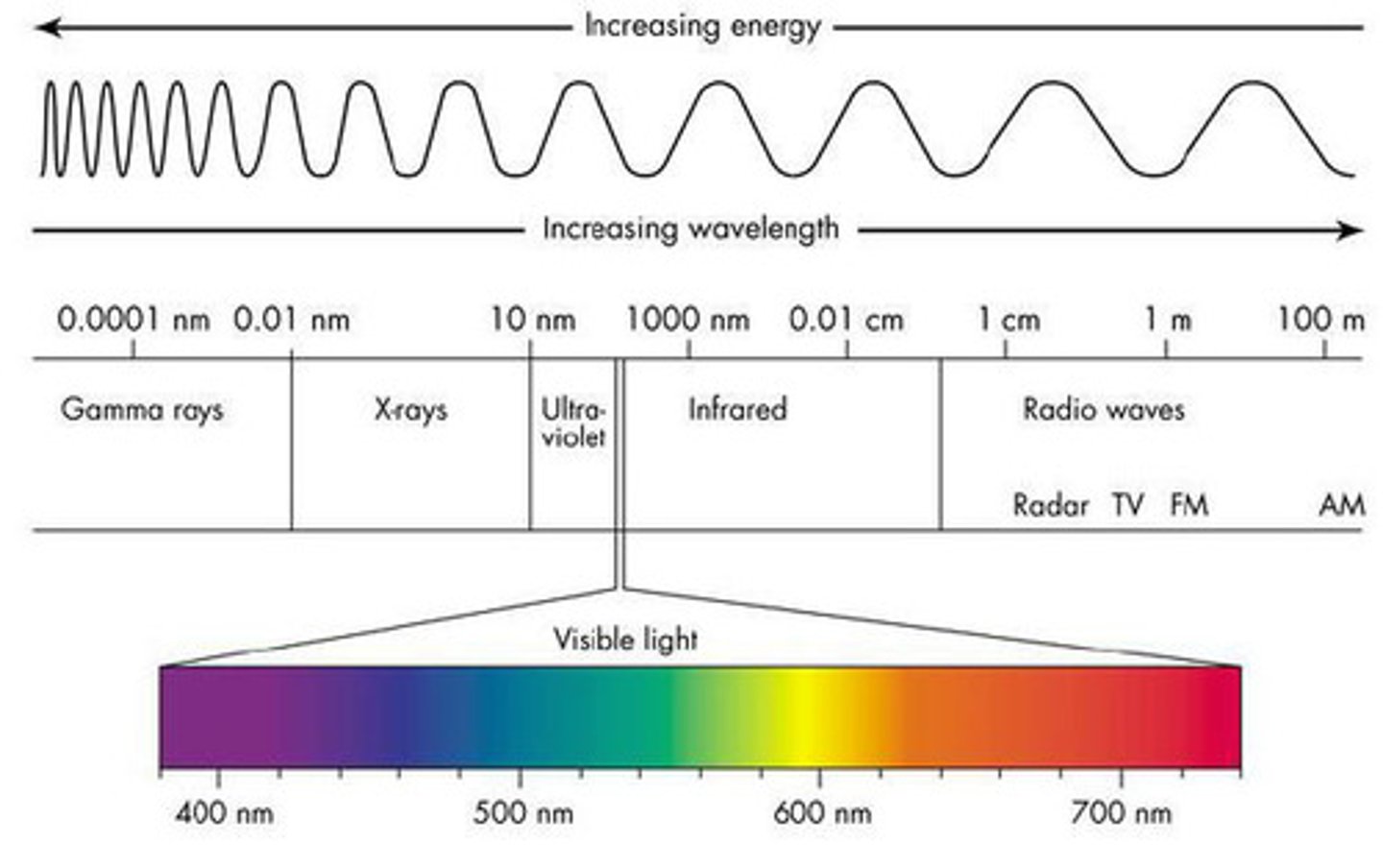
What colour of visible light spectrum has the longest wavelength?
red
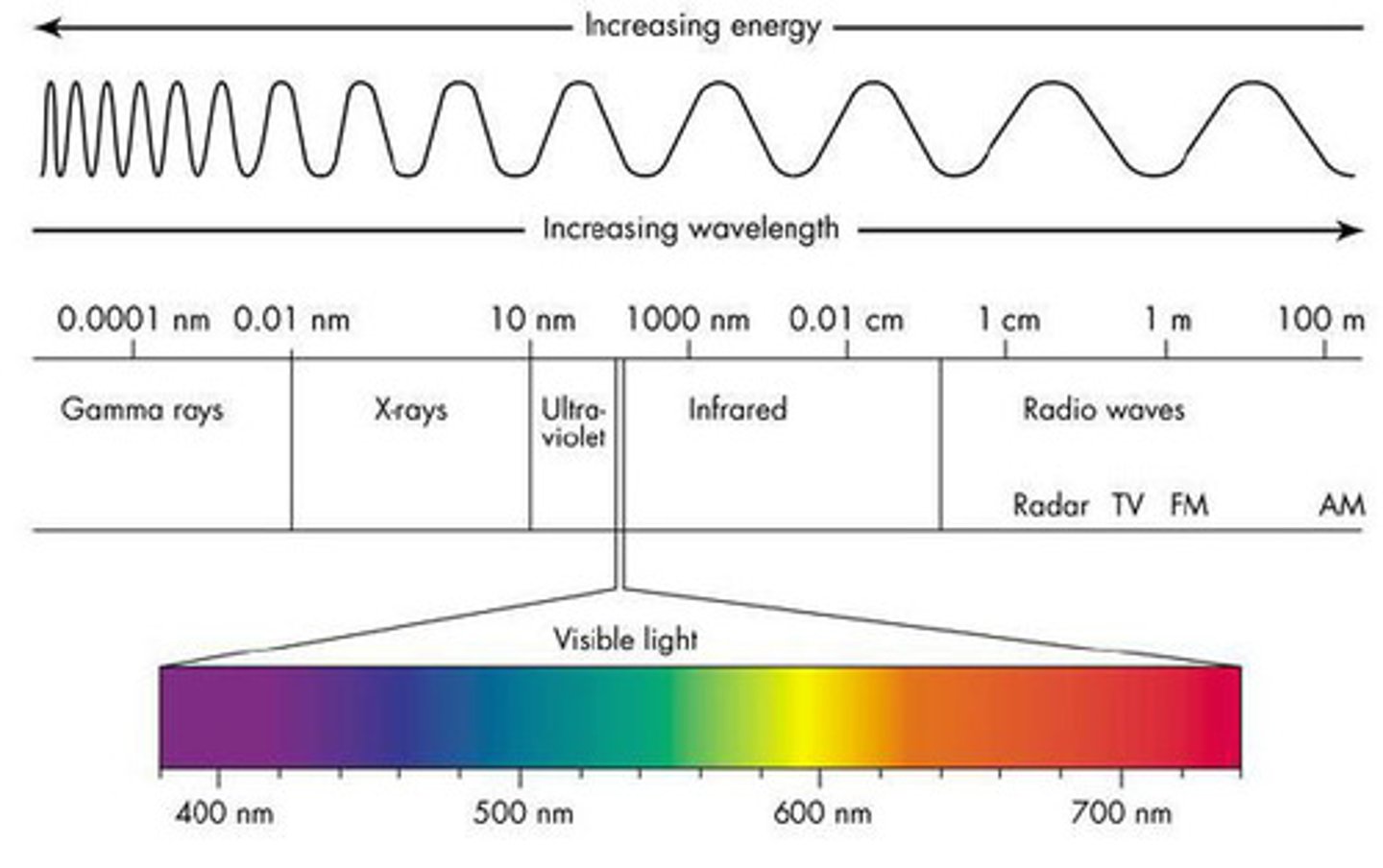
What is the visible light spectrum?
The portion of the electromagnetic spectrum that is visible to the human eye
What colour of visible light spectrum has the shortest wavelength?
violet
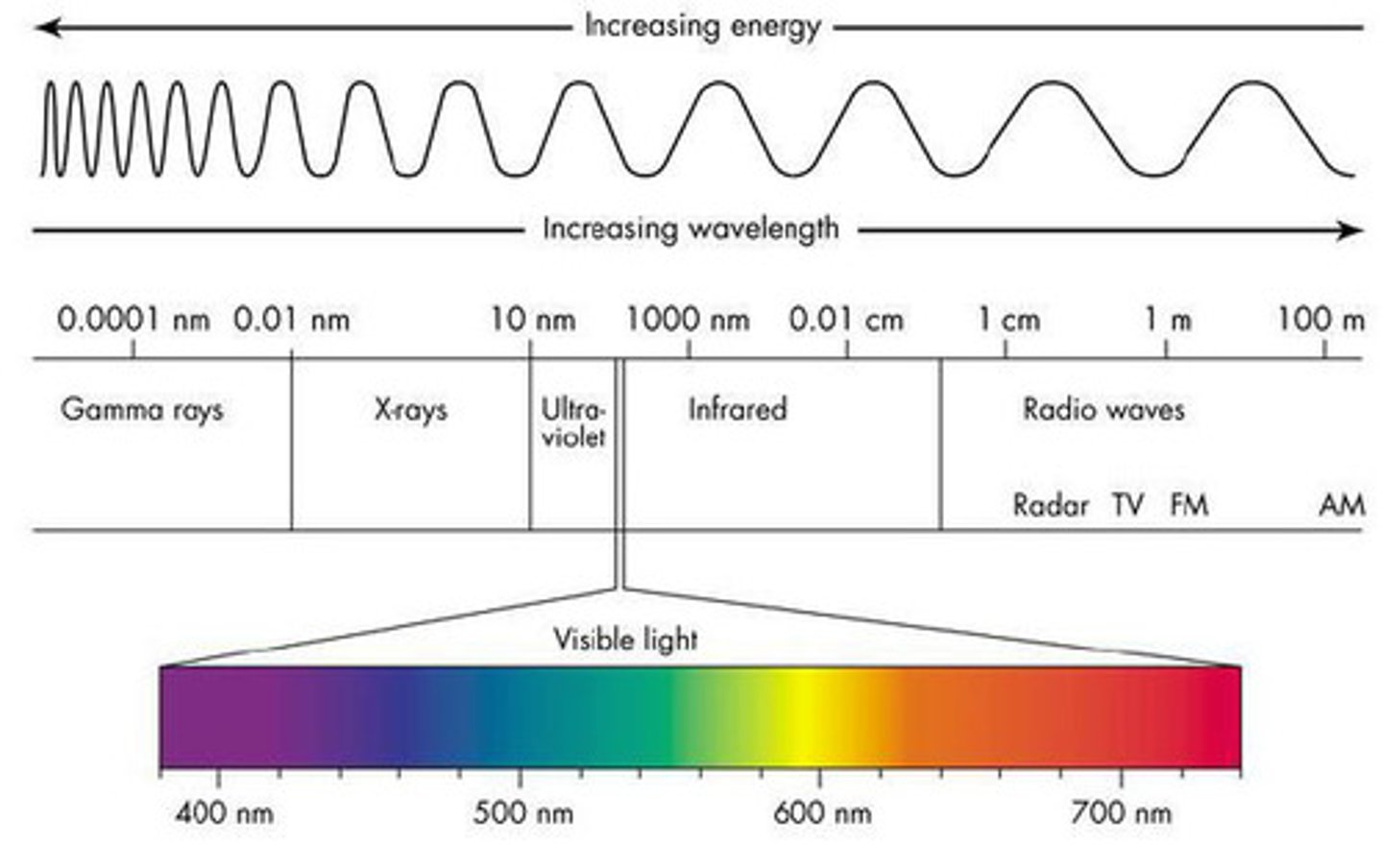
What is the wavelength of visible light?
400 nanometres (violet) to 700 nanometres (red)
What happens when wavelength decreases?
the wave's frequency and energy increase
How can visible light be separated?
through dispersion
What is dispersion?
- The splitting of white light into its component colours when passing through a medium like a glass prism or raindrops.
- It occurs because different frequencies (colours) of light travel at different speeds in the material, causing them to refract by different amounts.
What colour refracts the most?
violet