Structure determination
 Call Kai
 Learn
Learn Practice Test
 Spaced Repetition
 Match
Match Flashcards
 Knowt Play
1/53

There's no tags or description
Looks like no tags are added yet.
Name | Mastery | Learn | Test | Matching | Spaced | Call with Kai |
|---|
No analytics yet
Send a link to your students to track their progress
54 Terms
Molecules with what spin quantum number can be observed by NMR?
any number that is not 0 or an integer; odd number of nucleons
In the presence of an applied magnetic field, how many orientations can nuclei with I ≠ 0 have?
2I + 1
What are the energy states of nuclear spins a) aligned and b) opposed to an applied magnetic field?
a) α; low energy
b) β; high energy
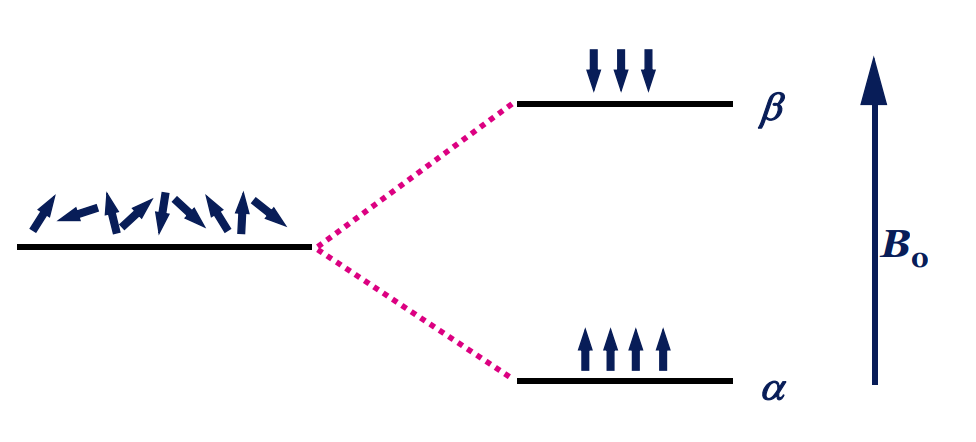
How is an NMR spectrum obtained? (4 steps)
a broad range of frequencies are applied to the sample as a pulse
some α energy state nuclei excited to higher energy
free induction decay: the excited α state nuclei return to ground state
The free induction decay is transformed mathematically into a spectrum
frequency that promotes nuclear spins from α to β of an individual nucleus
Larmor frequency: v = γ B0/2π
γ: gyromagnetic ratio unique to nucleus
B0: magnetic field strength
Greater electron cloud shielding (decreases/increases) the effect of the NMR magnetic field on the nucleus, making the shift appear more (down/up)field.
Greater electron cloud shielding (decreases/increases) the effect of the NMR magnetic field on the nucleus, making the shift appear more (down/up)field.
*upfield= right
What are the compounds used as reference in NMR?
TMS for organic/non-polar solvents
TSP for polar solvents
Double bond equivalents formula
C+1 - (H+X)/2 + N/2
How do signals for a) CH3, b) CH2, c) CH, d) CR4 appear in DEPT spectrum?
a) positive
b) negative
c) positive
d) doesn’t appear in DEPT, only proton decoupled
How is chemical shift (δ; ppm) calculated from frequency for where to appear in the HNMR spectrum?
δ = vsample - vreference / vreference
v is in Hz
Equation that relates chemical shift and frequency
δ (ppm) = vshift (Hz) / vspectrometer (MHz)
What are the two most significant types of coupling?
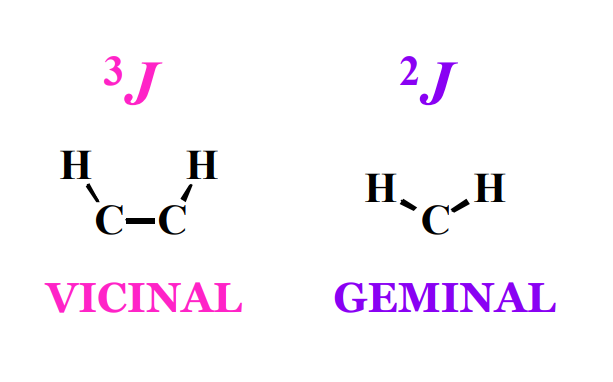
What is the 2J for a) sp3 and b) sp2 centers?
a) 20 to 6 Hz
b) 2 Hz
TRUE OR FALSE: All Hydrogens couple to each other
FALSE: identical hydrogens do not couple, ie. hydrogens that are in interchangeable positions
What is 3J for sp3 centers?
0 to 16 Hz
Karplus relation
J = J0/180 cos2 Φ - c
Where Φ is the dihedral angle between 3J coupled H:
0° ≤ Φ ≤ 90° ≤ Φ ≤ 180
What are common couplings for a) cyclohexanes and b) cyclopentanes?
a) 2-6 Hz
b) 4-13 Hz
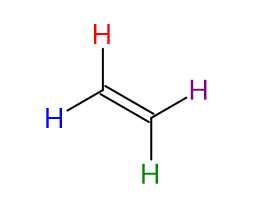
What is the Coupling constant of a) H to H and b) H to H?
a) 3-12 Hz
b) 10-20 Hz
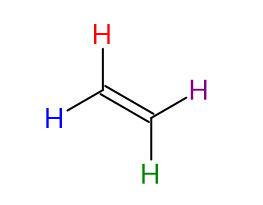
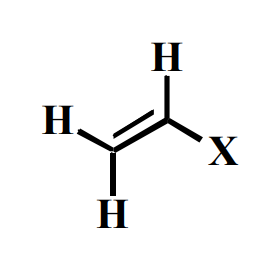
a) Which coupling constants would a more electronegative group X affect and b) how?
a) 3J
b) a more electronegative group lowers J
a) Is 3Jcis of 3Jtrans more strongly dependent on ring size of cyclic structures and b) what effect does increasing ring size have?
a) cis
b) increase in J
Substitution of a heteroatom in an aromatic system leads to (no change/decrease/increase) in Jortho across the adjacent bond.
Substitution of a heteroatom in an aromatic system leads to (no change/decrease/increase) in Jortho across the adjacent bond.
4J couplings are in what Hz range?
1-3 Hz
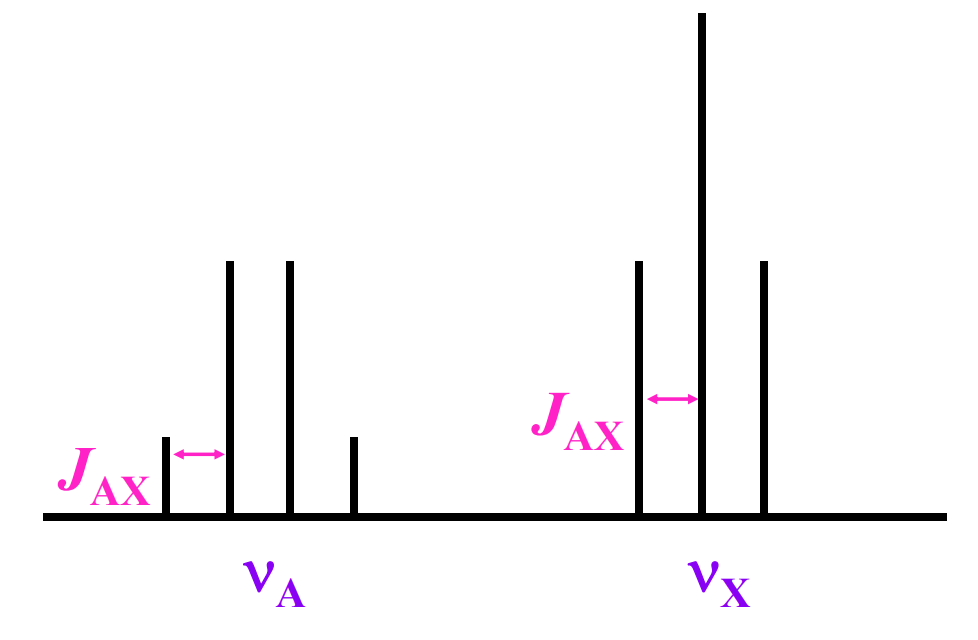
For an A2X3 system what would be a) the multiplicity of signals and b) the intensity (combined heights of all peaks)?
a) A2: quartet, X3: triplet
b) A2: 2/3, X3: 3/3
The same reasoning applies to all other combinations of AX and AMX
Nuclei are chemically equivalent if…
they are in the same chemical environment / are related by an operation of symmetry
What makes an ABX system hard to analyse? (2)
signal intensities are not 1:1
chemical shift is not at center of signals
Nuclei are magnetically equivalent if…
they are chemically equivalent and are equally coupled to neighboring nuclei
TRUE OR FALSE: Nuclei are magnetically inequivalent if they are not chemically equivalent but are equally coupled to neighboring nuclei
FALSE: if they ARE chemically equivalent but AREN’T equally coupled to neighboring nuclei
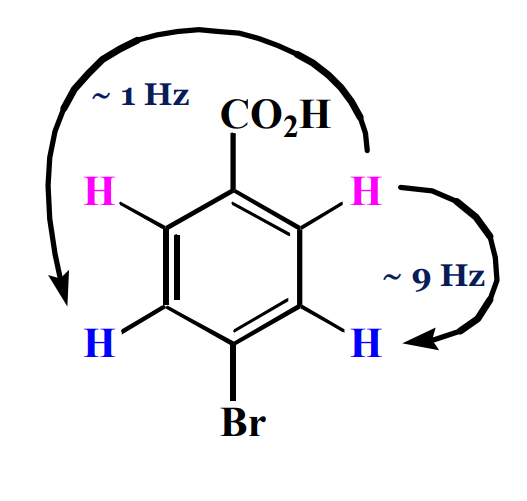
TRUE OR FALSE: in an AMX system, A is more closely related to M than X
TRUE: letter closer in the alphabet indicate shifts/frequencies closer together
What is a a) weakly and b) strongly coupled system and c) which is first order analysis applicable to?
a) Δv/J >5
b) Δv/J <5
c) a
When is first order analysis valid for coupled spin systems (eg. AMX)?
When it is a strongly coupled system ie. all Δv/J (eg. (vM - vA)/JAM) >5
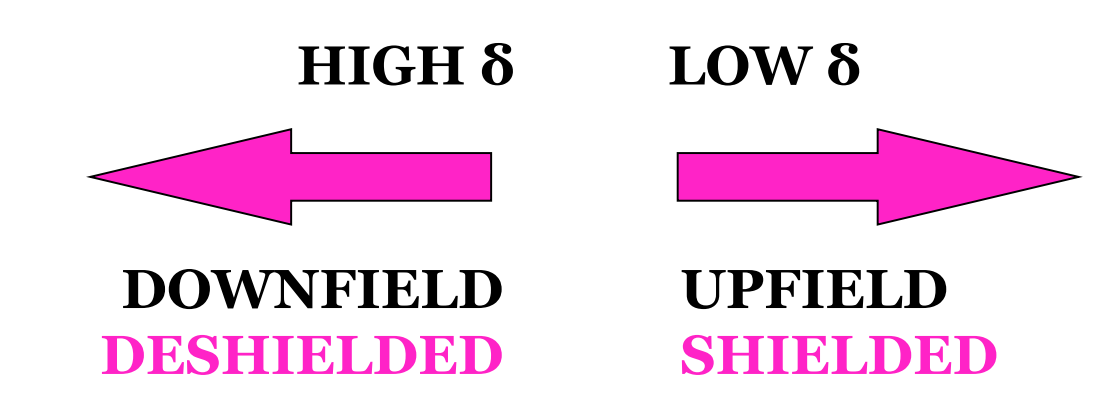
Nuclei in a region of high electron density experience a (__) magnetic field than those in a region of low electron density, and so they come into resonance (__) at (__) ppm.
Nuclei in a region of high electron density experience a weaker magnetic field than those in a region of low electron density, and so they come into resonance upfield at low ppm.
Substitution of hydrogen by an alkyl group causes what kind of shift in a) the carbon and b) attached hydrogens?
a & b) downfield (because more electronegative)
In cyclohexane, are equatorial or axial hydrogens more deshielded?
equatorial
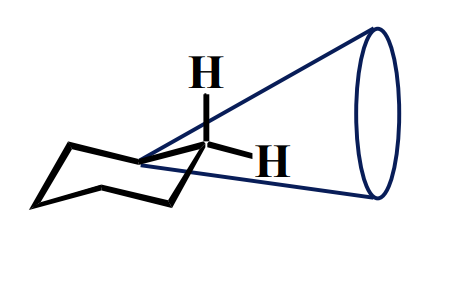
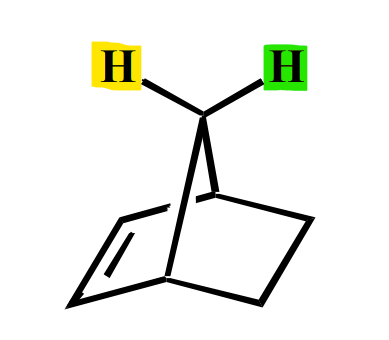
Which hydrogen will be at higher/lower ppm and why?
H will be at lower ppm than H because H is shielded by anisotropy of the pi bond
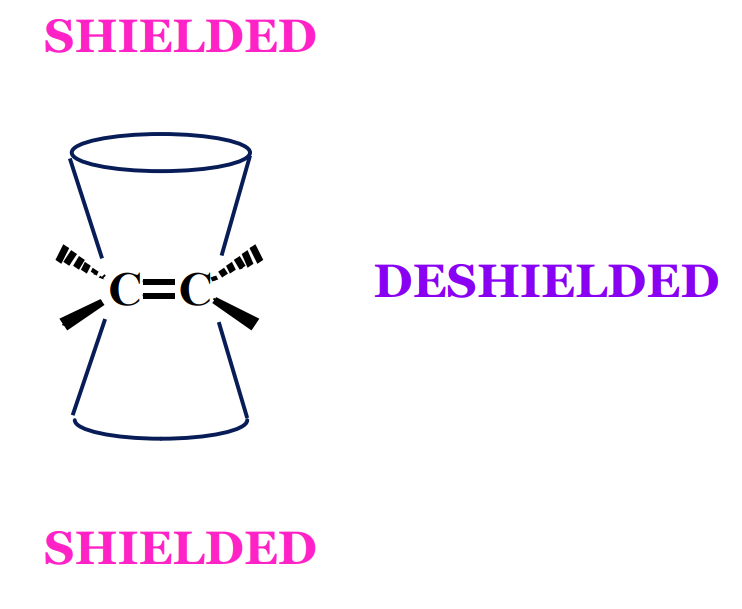

For the following molecules, rank the a) hydrogens and b) carbons from highest ppm (most deshielded) to lowest.
a) H > H > H > H
b) C > C > C > C > C
Do aromatic carbons and hydrogens have a) greater or lower shifts than non-aromatic, and b) how does increasing rings size affect this feature?
a) greater
b) increases
TRUE OR FALSE: Mass spectrometry relies on ions being in the gas phase
TRUE
What is a shortcoming(s) of mass spectrometry?
not useful for involatile sample that can’t be turned into a gas, or for high MW or heat sensitive compounds
How is mass spectrometry conducted? (3 steps)
ionization: generates cations (some cases anions) in gas phase
ion separation: Separates mixtures of gas phase ions according to their mass to charge ratio (m/z)
ion detection: detects abundance which is reflected in generated spectrum
TRUE OR FALSE: only radicals are seen by mass spectrometry
FALSE: They are not seen because they are not charged. Only cations (M+) and radical cations (M+˙) show up
What are the types of electrons that can be lost during ionisation to give a radical, from most likely to least likely
lone pair > π > σ
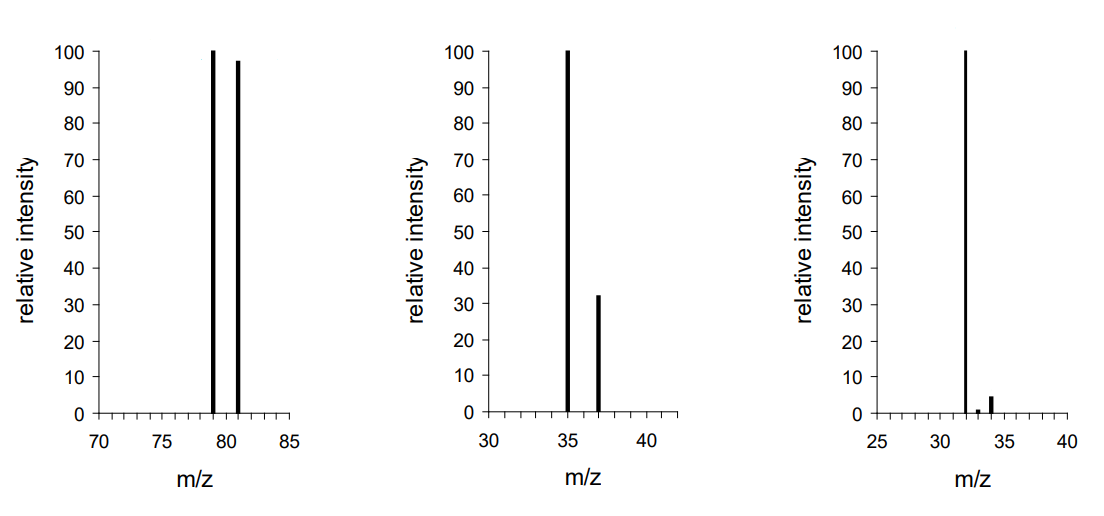
Identify the molecules that give rise to the following M with significant M+2 peaks
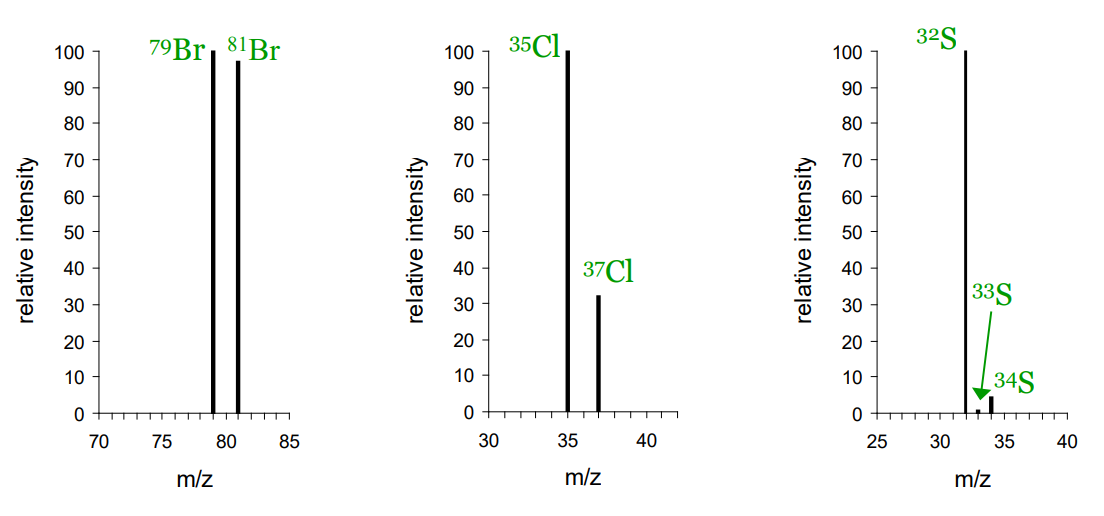
What is the relationship between m/z and N in the compound?
Even m/z = even (or 0) number of N
Odd m/z = odd number of N
*if containing only C, H, N, O, S or Halogen
Simple cleavage: C-C bond cleavage
The most stable cation (tertiary > secondary > primary) will be formed preferentially
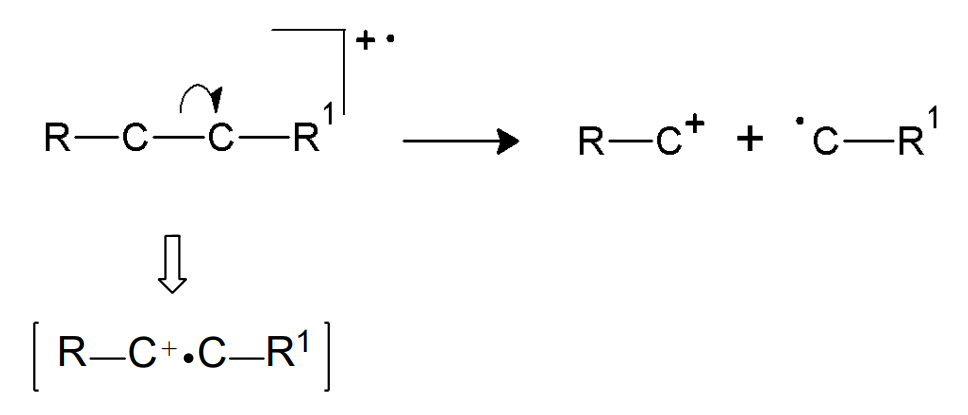
Is simple cleavage C-X bond cleavage or C-C more likely to occur in the same molecule?
C-X because the bond is weaker than for C-C
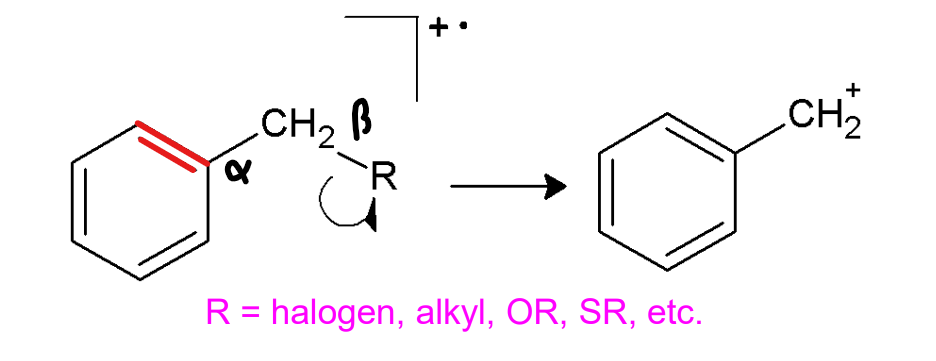
Simple cleavage: allylic/ benzylic β-cleavage
the cation is resonance stabilized
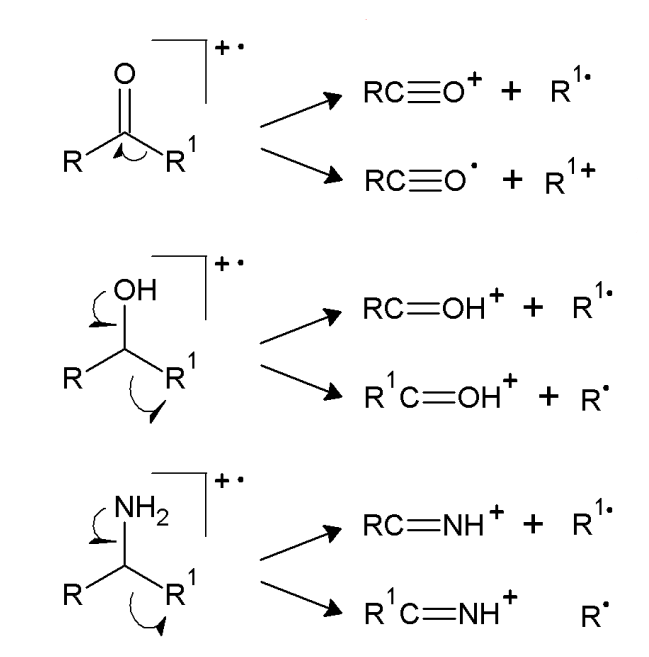
Simple cleavage: α-cleavage
homolytic breaking of the carbon-carbon bond adjacent to a functional group containing a heteroatom
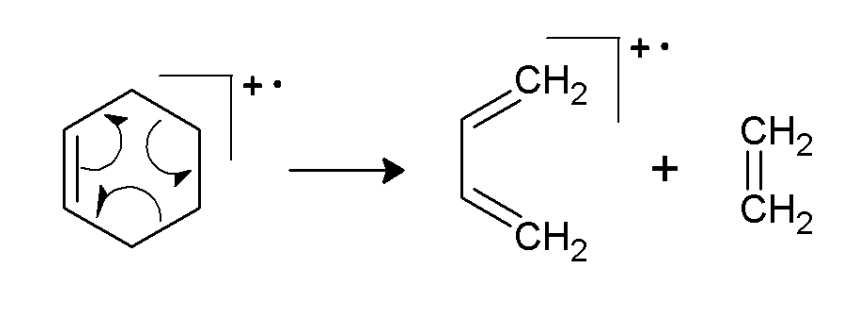
Retro Diels Alder rearrangement
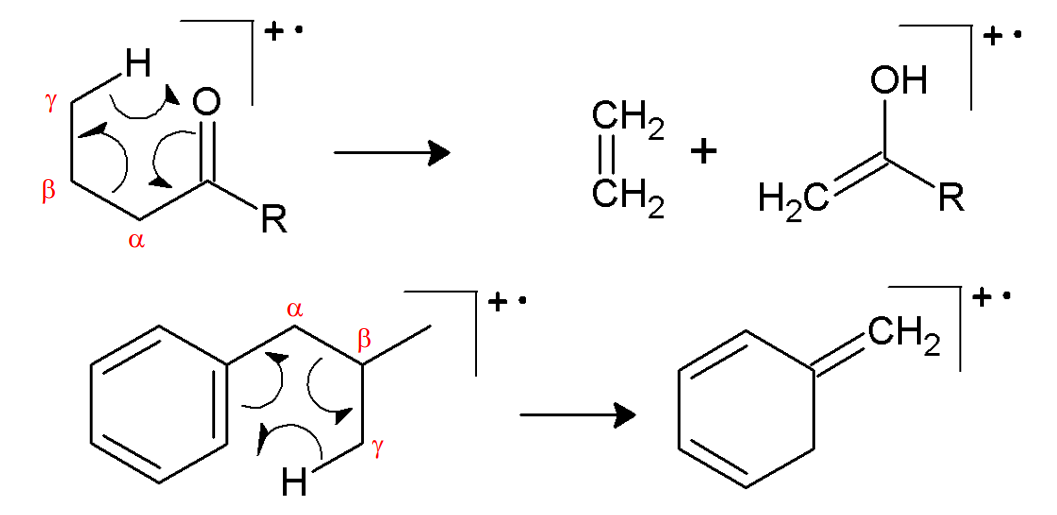
McLafferty rearrangement
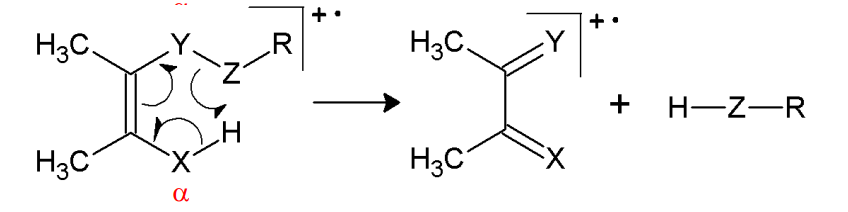
Proximity (Ortho) rearrangement
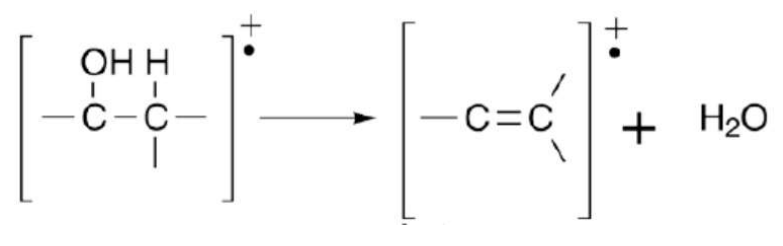
Easy way to recognize the presence of an alcohol in the MS spectrum?
loss of H2O (m/z 18)
IR characteristic peaks (12)
3500-3200: R-OH
3400-3100: Rx-NH
3350-3175: CH (alkyne)
3200-2500: carboxylic acid
3175-3000: CH (aromatic)
3000-2800: CH (alkane)
2900-2700: aldehyde
2400-2200: nitrile
2300-2100: CC (alkyne)
1750-1650: C=O
1650-1550: C=C (alkene)
1625-1500: R-NH2
1H NMR shifts (10)
13.0-10.0: carboxylic acid
10.5-9.5: aldehyde
8.5-6.0: aromatic
8.5-5.5: amide
7.0-4.5: phenol
5.5-4.5: vinylic
4.0-3.2: H-CO
4.0-3.0: H-C-X
2.8-2.0: H-C-C=O
2.5-1: H-C (sp3)
13C NMR shifts (9)
220-160: C=O
155-100: C=C, C(sp)N
90-65: alkyne, C-NO2
75-50: C-O
<60: C-X
<50: C-H (sp3)