Cycloalkanes & Chair Conformations
 Call Kai
 Learn
Learn Practice Test
 Spaced Repetition
 Match
Match Flashcards
 Knowt Play
1/10

There's no tags or description
Looks like no tags are added yet.
Name | Mastery | Learn | Test | Matching | Spaced | Call with Kai | Chat |
|---|
No analytics yet
Send a link to your students to track their progress
11 Terms
Cycloalkanes
are saturated hydrocarbons whose carbon atoms form a ring (different from aromatic rings who have double bonds).
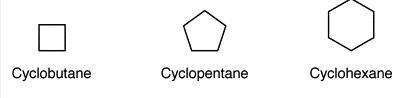
Cycloalkane formula
CnH2n
Ring Strain
A carbon atom prefers:
Bond angle = 109.5°
Staggered arrangement of bonds
When a ring forces carbons away from these ideal values, strain develops.
Chair Conformation
the most stable, three-dimensional arrangement that a six-carbon ring, such as cyclohexane, can adopt. Instead of being a flat hexagon, cyclohexane bends so that some carbons are above the plane and some are below it. This reduces strain and makes the molecule much more stable. (Basically Cyclohexane in 3D).
Axial Positions
Axial bond → points straight up or straight down
Equatorial bond → points outward, around the edge of the ring
(see image)
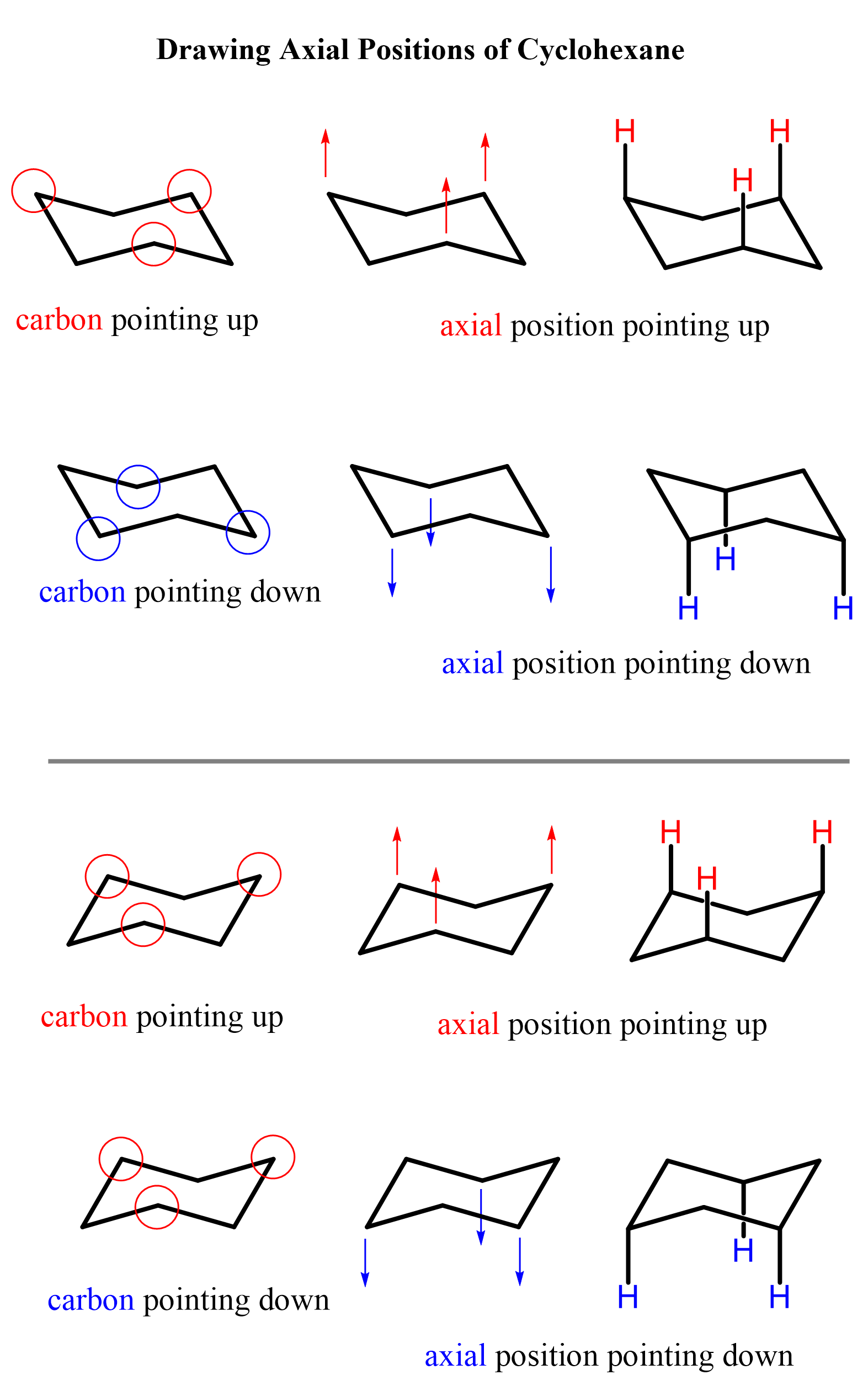
Axial
points straight up or straight down
More crowded
Higher energy
Less stable
Equatorial
points outward, around the edge of the ring
Less crowded
Lower energy
More stable
That's why larger groups usually prefer the equatorial position.
What happens during a ring flip?
The group stays attached to the same carbon, but its orientation changes. So if it was axial, it becomes equatorial.
Diaxal and Diequatorial
Two substituents facing up or two facing down, if you have one up one down it is trans. (remember to number them based on the carbon it is placed in, and count where substituents get the lowest possible number).
How to tell which Chair Conformation is more stable
Has a larger group on equatorial, more stable.
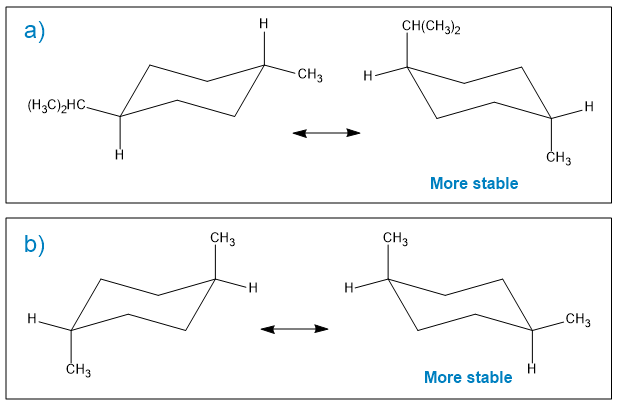
Lower energy =
Lower energy = more stable
Higher energy = less stable