VCE Biology Unit 1 AOS 2 5C
 Call Kai
 Learn
Learn Practice Test
 Spaced Repetition
 Match
Match Flashcards
 Knowt Play
1/35

There's no tags or description
Looks like no tags are added yet.
Name | Mastery | Learn | Test | Matching | Spaced | Call with Kai |
|---|
No analytics yet
Send a link to your students to track their progress
36 Terms
Purpose of the digestive system
Breaks down food into small molecules for absorption by cells.
Provides energy (from carbohydrates, fats, proteins) and nutrients (vitamins, minerals)
Animals are heterotrophs – they cannot make their own food so eat other organisms to obtain organic molecules
Carbohydrates
Provide a source of immediate energy
carbohydrates
Provide a source of immediate energy
Proteins
Structural components of cells, cell receptors, enzymes
Vitamins
vitamins are used to make enzymes
Minerals
minerals are used in structural components of organisms
digestion
The process of breaking down a substance into its basic components
digestive system
specialised tissues and organs responsible for the digestion of food and absorption of nutrients
Physical (or mechanical) digestion
the processes whereby the mechanical movement of organs and tissues causes this breakdown of food into smaller pieces.
-These movements include chewing, muscle contractions and peristalsis.
Chemical digestion
-food pieces undergo chemical digestion by enzymes and stomach acid, producing smaller molecules that are capable of being absorbed.
The three major types of digestive enzymes
amylases (which act on carbohydrates), proteases (proteins), and lipases (lipids).
What do enzymes do?
split food molecules in hydrolysis reactions, by adding water molecules.
subunit of amylase and what does it do?
amino acids, breaks down starch → maltose (sugars)
What does protease do?
Breaks down proteins into amino acids by hydrolysing (breaking a molecule using water) peptide bonds
subunit of lipase
fatty acids and glycerol
Steps of Digestion IDAE i dig all eggs
Ingestion – taking food in (mouth: teeth, saliva, tongue).
The teeth physically break down food into smaller pieces, whilst enzymes in the saliva chemically break down the food pieces into a soft mass that can be swallowed.
2.Digestion – occurs along the digestive tract, where the soft mass travels from the mouth into the body of the organism chemically and physically
3.Absorption – nutrients absorbed through plasma membranes into blood. Energy used by body
4.Elimination/Egestion – undigested food removed as faeces.
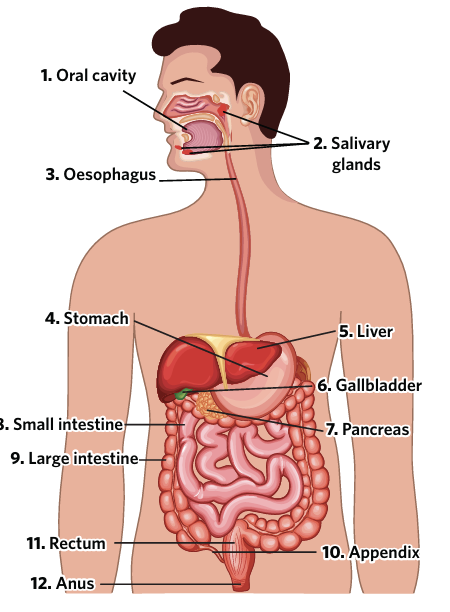
Name all 12 organs
oral cavity (mouth)
salivary glands
oesophagus
stomach
liver
gallbladder,
pancreas
small intestine
large intestine
appendix
rectum
anus
Oral cavity
-The beginning of the digestive system
--site of ingestion
-Teeth mechanically break food into small pieces
-digestive amylase enzymes in saliva start the breakdown of carbohydrates,
-lipase enzymes in the mouth start the breakdown of fats.
-The chewing of food occurs here.
Salivary glands
that produces and releases saliva into mouth and oesophagus
Oesophagus
foods pushed down A hollow tube connecting the oral cavity to the stomach
by (peristalsis)
Stomach
-A temporary storage tank where food is mixed by muscular movements known as churning.
-Protease enzymes Eg pepsin are secreted by the stomach and begin the digestion of protein .
- Digestive juices HCL are released by the stomach membrane, which creates an acidic environment.
-Peristalsis of the stomach muscles helps push food along to the small intestine.
liver functions and process
The liver is the site of bile production
roles in regulating metabolism, toxin removal, and processing nutrients.
-The liver stores excess glucose in the form of glycogen, which can be converted back to glucose when needed for energy.
6. Gallbladder
After being produced in the liver, bile is stored and further concentrated in the gallbladder before it is released into the small intestine
7. Pancreas
-Digestive enzymes (insulin and glucagon) are produced in the pancreas and are released when food reaches the first part of the small intestine.
-regulates blood sugar levels and is responsible for secreting bicarbonate, which neutralises acids in chyme.
8. Small intestine
(divided into three sections: the duodenum, the jejunum, and the ileum) is to absorb nutrients from food. (why it has enormous surface area)
function: enzymes produced in small intestine + enzymes from pancreas + bile from gallbladder AID the breakdown of food in chyme
-further breakdown of carbohydrates, proteins and fats
9.large intestines
(cecum, colon and rectum) function and process
final absorption of water, minerals and vitamins
process:
- water is reabsorbed from undigested food
- food becomes more solid and compact
- faeces ready for egestion
10.Appendinix
ocation: sits at the junction between small and large intestines.
role: acts as a 'safehouse' for beneficial gut bacteria and immune cells.
11.rectum
final area of the large intestine that stores faeces for elimination.
12.anus
the end of the digestive tract where faeces are expelled from the body.
chyme
mixture of partially digested food and digestive juices that passes from the stomach to the small intestine
peristalsis
coordinated muscular contractions and relaxations of the digestive tract wall that move food along the system
Digestion Process (Pizza Example)
. Ingestion (Mouth → Oesophagus)
Teeth physically break pizza into smaller pieces.
Saliva (amylase + lipase) starts chemical digestion (carbs + fats).
Food swallowed → moves down oesophagus by peristalsis.
2. Digestion (Stomach → Small Intestine)
Stomach:
Churning = physical digestion
HCl is released by stomach lining Acid (pH 1–3)
proteases break down proteins
Forms chyme
Small intestine (duodenum):
Bile (liver → gallbladder) → breaks fats into smaller droplets
Pancreas:
Enzymes → digest carbs, proteins, fats
Bicarbonate → neutralises acid in chyme
3. Absorption (Small Intestine)
Nutrients fully broken down:
Carbs → glucose
Proteins → amino acids
Fats → fatty acids + glycerol
Absorbed into bloodstream through villi & microvilli (↑ surface area)
4. Elimination (Large Intestine → Anus)
Water + remaining nutrients absorbed
Waste becomes faeces
Stored in rectum → exits via anus
omnivores
medium digestive tract
- digest plant + animal material
Carnivores digestive system?
Shorter, meat easy to digest
Herbivores digestive system?
Long, specialised for cellulose digestion
alimentary canal digestive tract