Endo 21 - Prognosis (Dr. Ptak)
 Call Kai
 Learn
Learn Practice Test
 Spaced Repetition
 Match
Match Flashcards
 Knowt Play
1/106

There's no tags or description
Looks like no tags are added yet.
Name | Mastery | Learn | Test | Matching | Spaced | Call with Kai |
|---|
No analytics yet
Send a link to your students to track their progress
107 Terms
What is the art or act of identifying a disease from its signs and symptoms?
diagnosis
What is the future of the course of a disease, and the chance of recovery from said disease?
prognosis
What is the process of examining whether or not interventions are associated with change (better or worse) in a patient’s health status?
outcome
Why do we evaluate outcomes?
- To assess effectiveness of procedures
- Prioritize factors that influence outcomes
- Determine protocols for treatment
Why do we care about prognosis?
- "Prediction, projection, prophesizing, or foretelling the likely outcome of treatment"
- Not well defined in endo
- Depends on endodontic, periodontal and restorative prognoses
- This can influence your treatment plan!
What are all of the following?
- Presence or absence of pulpal/periapical health/disease, pain and function
- Longevity or tooth survival
- Direct and indirect costs
- Oral health quality of life and esthetics
Types of Outcomes
Success or survival?
Based on specific criteria
success
Success or survival?
Based on how long a tooth was retained in the mouth
survival
Success or survival?
PARL healed, lack of sign and symptoms
success
Success or survival?
Retained in the mouth and functional - at times this can also indicate lack of signs and symptoms
survival
What three factors can affect prognosis?
- Patient factors
- Post-endo restorative factors
- Treatment factors
Does age influence the rates of PA healing?
No
What sex has a higher incidence of flare-ups?
female
HA1c >___% is associated with increased perioperative symptoms, lesions increase in size at faster rate, and decreased success after 2 years
8%
T/F: Patients receiving systemic steroids had decreased tooth longevity
true
T/F: Tooth type influences survival
true
Do the following reduce or increase success?
- Pre-op pain
- Presence and size of PA lesion
- Presence of sinus tract
- Swelling
- Apical resorption
reduce
Vital pulp (reduces or increases) success
increases
What are two post treatment restorative factors?
- Quality/type of restoration
- Use of teeth as abutments and occlusal contacts
What are the four main factors that influence the prognosis of Non-surgical root canal therapy (NS-RCT)?
- Pre-operative periapical radiolucency (PARL)
- Obturation quality
- Obturation length
- Satisfactory coronal seal
The following are other factors that influence the prognosis of what?
- Operator
- Isolation
- Positive culture at time of obturation
- One visit vs two visits
- Clinical attachment loss
- Complications
Non-surgical root canal therapy (NS-RCT)
The Toronto Study Part IV (De Chevigny & Friedman) found that two main factors negatively impacted NSRCT outcomes, what are they?
- Presence of pre-op PA radiolucency
- Number of roots
In the Toronto study, pts without a PARL had what % success?
93%
In the Toronto study, pts with a PARL had what % success?
82%
In the Toronto study, pts with a single root NSRCT had what % success?
93%
In the Toronto study, pts with multiple roots NSRCT had what % success?
84%
Root fillings with no voids and root fillings extending to ___mm within the radiographic apex are considered satisfactory root fillings
2mm
The Toronto Study showed that cold lateral obturation had what % success?
77%
The Toronto Study showed that continuous warm vertical obtruation had what % success?
87%
If a root canal obturation is short >2mm from radiographic apex or past radiographic apex, they had ___% less success
20%
Histologically, obturation success is highest where?
At or short of radiographic apex
What does overfilling a canal lead to?
Foreign body reaction
Ray and Trope Study: What % success?
Good endo + good restoration
91%
Ray and Trope Study: What % success?
Bad endo + good restoration
67%
Ray and Trope Study: What % success?
Good endo + bad restoration
44%
Ray and Trope Study: What % success?
Bad endo + bad restoration
18%
According to Salehrabi & Rotstein, RCT treated teeth with a coronal restoration had a ___% success
97%
According to Salehrabi & Rotstein, RCT treated teeth with a coronal restoration had a 97% success-- the 3% that were unsuccessful, ____% did not have a coronal restoration placed within 3 years
85%
The peak incidence of radiographic healing is at ___ year(s)
1 year
A _____ year follow up after NSRCT, is needed to define success or failure
4 year
Molven, Halse & Fristad study found that to evaluate late healing, more successes were recorded after a ___-__ year follow up after root canal treatment
10-17 year follow up
After a 4 year follow up period, a tooth with no PARL has what % success?
95%
After a 4 year follow up period, a tooth with a PARL has what % success?
86%
After a 8-10 year follow up period, a tooth with no PARL has what % success?
96%
After a 8-10 year follow up period, a tooth with a PARL has what % success?
86%
Salherabi and Rotstein conducted a study where they found that RCTs have a ___% survival rate
97%
T/F Studies have shown that RCT has a success rate >90% with no PARL
true
T/F Studies have shown that RCT has a success rate of about 10% lower with a PARL than without a PARL
true
What are the three main factors that influence the prognosis of RETXT?
- Prior obturation quality
- Respected canal morphology
- Presence of pre-op PARL
The Toronto Study found that outcome of orthograde RETX best when...?
the source of failure can be identified
(Ex: Perforation, Underfill, Overfill, Missed Canal, Periodontal Disease, Wrong Tooth, Fracture, Trauma, Separated Instrument, Coronal Leakage, etc.)
The Toronto Study found that orthograde RETX cases have a ___ % success
82%
The Toronto Study found that orthograde RETX cases have ___ % functional
94%
T/F: Crump and Natkin study showed that poor past fill/treatment gives a better prognosis for RETX
true
When doing RCT RETXT, if the first operated respected the internal morphology of the tooth, what % RETX success rate?
87%
When doing RCT RETXT, if the first operated altered the internal morphology of the tooth, what % RETX success rate?
47%
If there is presence of a pre-op PARL, at 2 years post RETXT, what % are successful?
80%
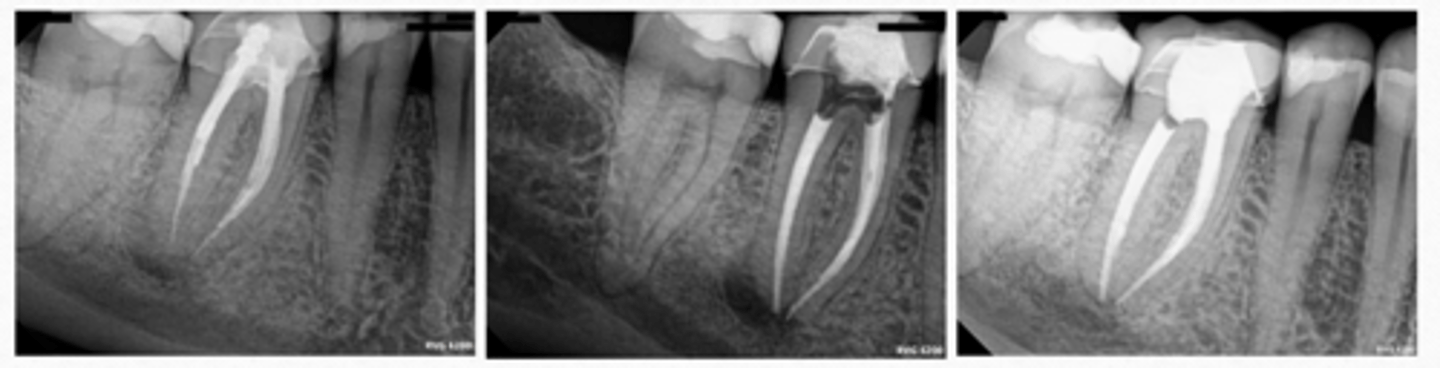
If there is presence of a pre-op PARL that was >___mm, there was seen to be statistically significant less success
>5mm
What is the RCT RETXT success rate when RCT had adequate fill?
67%
What is the RCT RETXT success rate when RCT had a PARL?
62
All of the following are treatment Factors influencing prognosis of what treatment?
- Microsurgical approach 94% vs traditional root-end surgery 59% (Kim + Kratchman)
- Small vs large (>5mm) periapical lesion
- PARL involving 1 vs 2 cortical plates
- Presence of periodontal involvement
- Absence vs presence of previous surgery
- Magnification vs not
- Minimum root end resection vs bevel
- Ultrasonic tip for retroprep vs a bur
- Use MTA vs amalgam
Surgical RCT
From the Toronto Study, what are the three main factors influencing prognosis of S-RCT?
- Age (>45 yrs 84% success, <45 yrs 68% success)
- Size of surgical crypt (>10 mm 53% success, <10 mm 80% success)
- Pre-operative filling length (Inadequate fill 84% success; adequate fill 68% success)
What is the healed success rate of S-RCT?
74%
What is the functional success rate of S-RCT?
94%
What is the success rate of microsurgery?
94%
According to Von Arx and Friedman, S-RCT has a success rate of __% at 1 year
84%
According to Von Arx and Friedman, S-RCT has a success rate of __% at 5 years
76%
According to Kvist & Reit, due to late failures in apical surgery (traditional technique)and late healing of NS retreatment, success rates of both procedures after __ years are equivalent (approximately 50%).
4 years
T/F According to Torabinejad, There are better success rates for what treatment after 4 years: NS-retreatment or S-RCT?
NS-retreatment
(83% retreatment vs. 71% for surgery after 4 years)
Which has a better success rate (24% higher)?
A) RETX + S-RCT
B) S-RCT alone
A) RETX + S-RCT
According to Zoulo, ________ before apical surgery will increase the chances for healing by 10%.
Retreatment
Re-surgery success rates can be up to ____% if you correct traditional surgical approach.
92%
All of the following are factors influencing what?
- Type of traumatic injury
- Location in the mouth
- Presence of comorbidities or other more serious injuries requiring OMFS/ENT care
- Both chronologic and dental age (stage of root development!)
- Patient compliance/recall
- Operator ability
- Time!
Prognosis of trauma
For long term CAOH direct pulp caps (vital pulp therapy), at both 5 and 10 years, were there more successes or failures?
failures
For direct pulp caps (vital pulp therapy) with MTA and Biodentine, there was a ___% success rate at 3 years
94%
For CaOH pulpotomy (vital pulp therapy), there was a __% success after 3 years
85%
Why does MTA have higher success rates with vital pulp therapy?
- Less inflammation
- More predictable dentin bridging
According to the Measures of Success in Regenerative Endodontic Procedures (AAE 2016), which goal is this?
- The elimination of symptoms and evidence of bony healing (91-94%)
primary (essential)
According to the Measures of Success in Regenerative Endodontic Procedures (AAE 2016), which goal is this?
- Increased root wall thickness and/or increased root length
secondary (desirable)
According to the Measures of Success in Regenerative Endodontic Procedures (AAE 2016), which goal is this?
- Positive response to vitality testing
tertiary
Regenerative endodontics has what % success rate?
100%
Apexification with MTA has what % success rate?
80-89%
T/F: Regeneration vs apexification has no significant difference in resolution of apical healing
true
What is more successful for increasing root lenght and root wall thickness?
A) Regeneration
B) Apexification
A) Regeneration
Define the following:
The mechanical or pathologic communication between the root canal system and the external tooth surface
Perforation
How can you detect a perforation?
- Apex locator
- Radiograph
- Blood on paper point
- Surgical operating microscope
- Periodontal probe
- CBCT
Which is better?
A) Fresh perforation
B) Old perforation
A) Fresh perforation
Which is better?
A) Small perforation
B) Large perforation
A) Small perforation
(Small usually associated with less tissue destruction, healing is more predictable, easier to seal effectively without forcing material into surrounding tissue)
Which is better?
A) Crestal perforation
B) Apical/coronal perforation
B) Apical/coronal perforation
What is the most important factor affecting prognosis?
Level of the crestal bone and epithelial attachment critical
What material is superior for perforation repair?
MTA
What is the success of a perforation with MTA?
86%
If the pre-op was vital and uninfected, with no apical pathology, the separated instrument (should or should not) affect the prognosis
Should not
(92% healing rate w/ retained instrument; 95% success w/o retained instrument)
T/F: Outcome is better if canal was instrumented to a smaller size before the separation occurred
False - Outcome is better if canal was instrumented to a larger size before the separation occurred.
T/F If the tooth was vital and there was no pre-op PARL, then separated instrument should not affect prognosis
true
What are three anatomical structures of concern with extrusion of an RCT?
- IAN
- Mental foramen
- Maxillary sinus
Prognosis of Extrusion depends on what 2 factors?
- Type of material (gutta percha, calcium hydroxide, bioceramics)
- Proximity to anatomic structures
All of the following are true from studies about extrusion EXCEPT:
A) Extrusion of obturation material caused foreign body reaction
B) When sealer and/ or the gutta percha are extruded into the periapical tissue, there was always a severe inflammatory reaction including a foreign body reaction
C) Extrusion increases intra-appointment pain, especially in non-vital teeth
D) A sealer puff indicates thorough and complete cleaning, shaping, and obturation of canal system
C) Extrusion increases intra-appointment pain, especially in non-vital teeth (should be VITAL teeth)
T/F: Success rates are equivalent for RCT and implants (94%) however implant need 5-12% more surgical intervention.
true
The size of the lesion influences the outcome of the RCT. Larger lesions are more likely to be of _______ origin
Cystic
A study from Weiger stated that a lesion that is larger than ___mm has less chance to heal w/o surgical intervention. Whereas another study from Sandqvist and Bystrom stated that the size of the lesion does not affect prognosis.
5mm