Introduction and overview of development and cell specification
 Call Kai
 Learn
Learn Practice Test
 Spaced Repetition
 Match
Match Flashcards
 Knowt Play
1/37

Earn XP
Description and Tags
Embryology lecture 1 specifically PNU curriculum
38 Terms
What is the main difference between you and a machine
machines arent required to function until after its built. organisms on the other hand function as theyre built
Definition of Embryology according to science
the study of growth, formation , and difference that takes place in living organisms
Embryology is considered by some reserachers to
study the life cycle of and individual from fertilization to sexual maturity
Branches of Embryology
Descriptive
Comparative
Development
Experiment
Ontogeny
Molecular
Teratology
Descriptive Embroylogy
Seeks to explain the morphology. example : formation of gametes, fertilization operations, etc..
Comparative Embryology
Compares descriptive studies between different colonies
Experimental Embryology
Focuses on the research and lab experiment. example ; Subjecting different stages of fetus to experiments, and Interpretation and analysis, etc….
How did scientists bridge the gap between the inacuracy of using animal fetus and the unethical use of human fetus for human experiments ?
The used cell and tissue culture from a skin graft and reverse engineered it to its primative self
Development Biology
Includes all branches of life science
Molecular Embryology
studies all stages of embryogensis at a molecular level
Ontogeny
studies the stages of embryonic formation of the individual example: Doctors only studying human embryology
Teratology
studies the causes that lead to congenital malformation such as chemicals, hormones etc..
The Cycle of Life
Most animals pass through similar stages of development
embryogenesis
the stages between fertilization and hatching
The stages of development
fertilization
Cleavage
Gastrulation
Organogenesis
Hatching / Birth
Metamorphosis
Gametogensis
Fertilization
Involves the fusion of mature sex cells
Cleavage
A series of mitotic divisions that immediately follows fertilization. Starts of as Blastomeres and ends as 100s of blastula
Gastrulation
The Blastomeres undergo dramatic movements and change their position relative to one another.
The embryo in the gastrulation stage is called
gastrula stage
The result of gastrulation
the embryo contains three germ layers (endoderm, ectoderm, mesoderm) that will interact with interact to generate the organ of the organ of the body.
Organogensis
The production of tissue and organ. This stage includes chemical signals between the cells of the germ layers
What are the cells that undergo migrations
precursors of blood cells, lymph cells, pigment cells and gametes
Metamorphosis
when the organism hatches / is born but yet to be sexually mature
Gametogenesis
precursors of the gametes, and is often one of the first differentiations to occur during animal development
how do cells become specified to a specific fate
specification
determination
differentiation
Specification
Capable of differentiating autonomously when placed in an environment that is neutral with respect to the developmental pathway. It is still capable of being reversed
Determination
The stage of commitment, irreversible, capable of differentiating autonomously even when placed into a non-neutral environment
Differentiation
Unspecialized cell becomes specialized into one of the many cell types that make up the body
Mechanisms of Developmental Patterning
Autonomous
Conditional
Syncytial
Autonoumous Specification
Cells develop only according to early fate
without receiving external signals
If a section is removed, the surrounding cells will still produce the same cells they intended to
Prospective potency = Prospective fate
Shows mosaic development
Seen in invertebrates

Autonoumous Specification
Conditional Identity
Depends on the surrounding cells
Found in Vertebrates and a few invertebrates
Inductive signal is responsible for fate determination
Regulative development
Prospective potency > Prospective fate
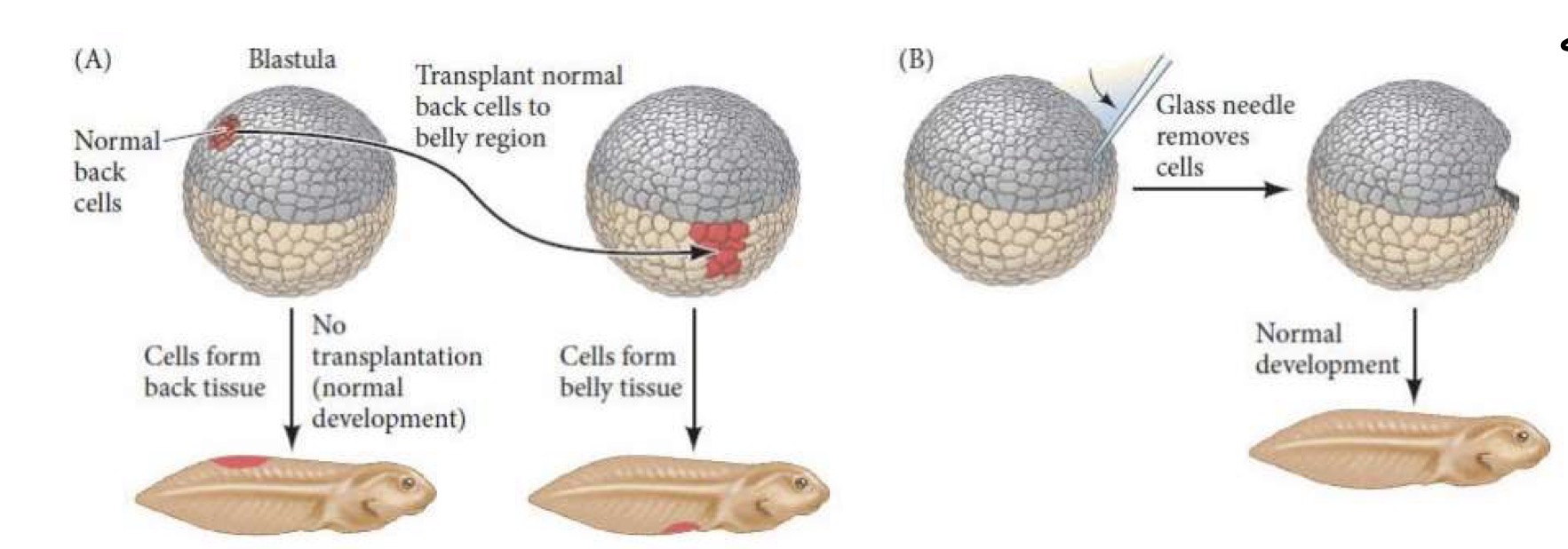
Conditional Identity
Syncytium
the nuclear division which is not followed by cell division
Cellularization
The process of creating individual cells out of a multinucleated cell by separating the nuclei by cell membranes
Syncytial specification
Interactions between regions of cells before cellularization
No specific cell fate before cellularization
a mix of both auto and conditional, but mostly conditional after cellularization
The morphogens can affect nuclei in a concentration dependent fashion
Mostly in insects
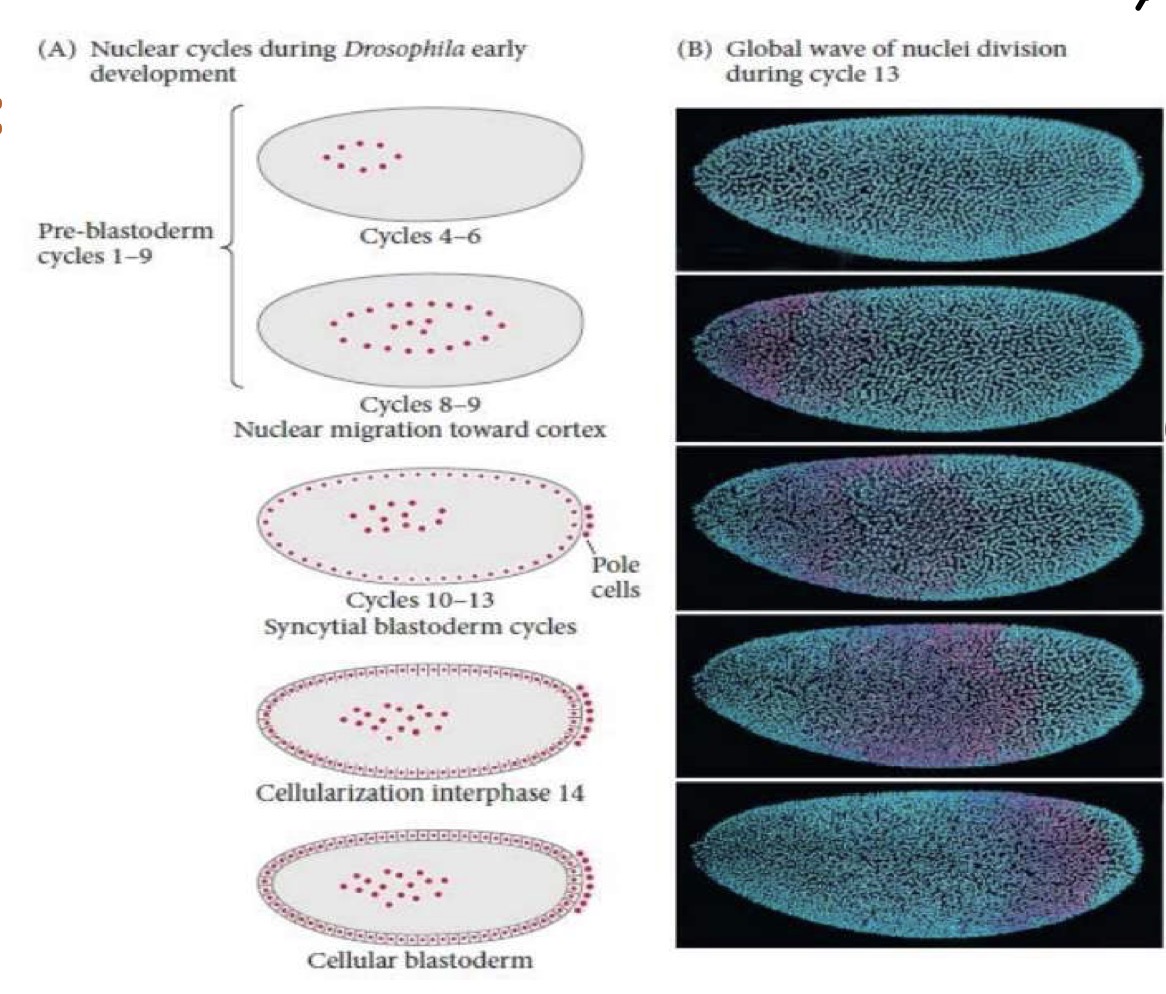
Syncytial specification

Mechanism of developmental patterning