RC4 - Strategic risk communication (keyterms, mp + scenario questions)
0.0(0)
Studied by 1 person Call Kai
 Learn
Learn Practice Test
 Spaced Repetition
 Match
Match Flashcards
 Knowt Play
Card Sorting
1/30

There's no tags or description
Looks like no tags are added yet.
Last updated 2:47 PM on 5/29/26
Name | Mastery | Learn | Test | Matching | Spaced | Call with Kai |
|---|
No analytics yet
Send a link to your students to track their progress
31 Terms
1
New cards
What is an actor in risk communication?
Any individual or organization that plays a role in shaping how a risk is created, perceived, experienced, communicated, and managed within society
2
New cards
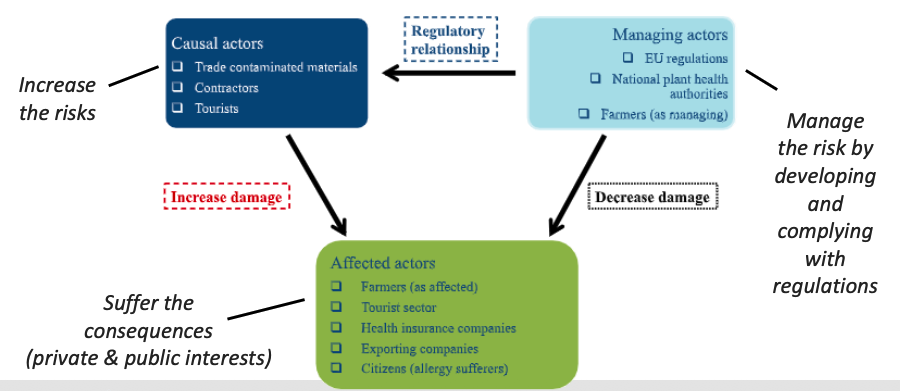
What are the three types of actors in risk management?
1. Causal actors (increase the risk) 2. Affected actors (suffer the consequences) 3. Managing actors (try to control or reduce the risk)
3
New cards
What is the role of causal actors?
They are the source or cause of a risk — they increase the likelihood or severity of harm (e.g., traders spreading invasive species through contaminated materials)
4
New cards
What is the role of affected actors?
They suffer the consequences of a risk, representing both private and public interests (e.g., farmers, citizens, health insurance companies)
5
New cards
What is the role of managing actors?
They develop and comply with regulations and strategies to control or reduce damage (e.g., EU regulations, national health authorities)
6
New cards
What are the three levels of actor analysis?
Supranational (global, vague, abstract), country/subnational (national and regional), and individual (local, specific, concrete)
7
New cards
Why is multi-level actor analysis important for risk communication?
Global risks feel abstract and irrelevant to individuals; local human interest stories make risks more tangible and personally relevant, helping people connect to the information
8
New cards
What is Strategic Risk Communication?
A conceptual framework supporting the systematic identification, categorization, and analysis of the needs and interests of different actors across multiple levels, linked to the incentives that drive their actions
9
New cards
Why do complex risks require Strategic Risk Communication?
Because they have multiple causes, affect multiple actors at multiple levels, have multiple consequences, and require multiple solutions from different stakeholders
10
New cards
What is an issue arena?
A place where stakeholders and organizations discuss and compete to shape the dominant understanding of a societal issue or risk (Luoma-aho & Vos, 2010)
11
New cards
How can issue arena research be useful?
It reveals which actors dominate the discussion on a risk topic and how different actors frame the issue to align it with their own interests
12
New cards
What is framing in risk communication?
Selecting certain aspects of a perceived reality and making them more salient in a message in order to promote a particular interpretation, causal attribution, or solution
13
New cards
Give an example of how different actors use different frames for the same risk
The bicycle helmet debate: VeiligheidNL frames helmets as reducing head injury risk; Fietsersbond frames the real problem as dangerous road design and argues for bike lane obligations instead
14
New cards
What is the Social Amplification of Risk Framework (SARF)?
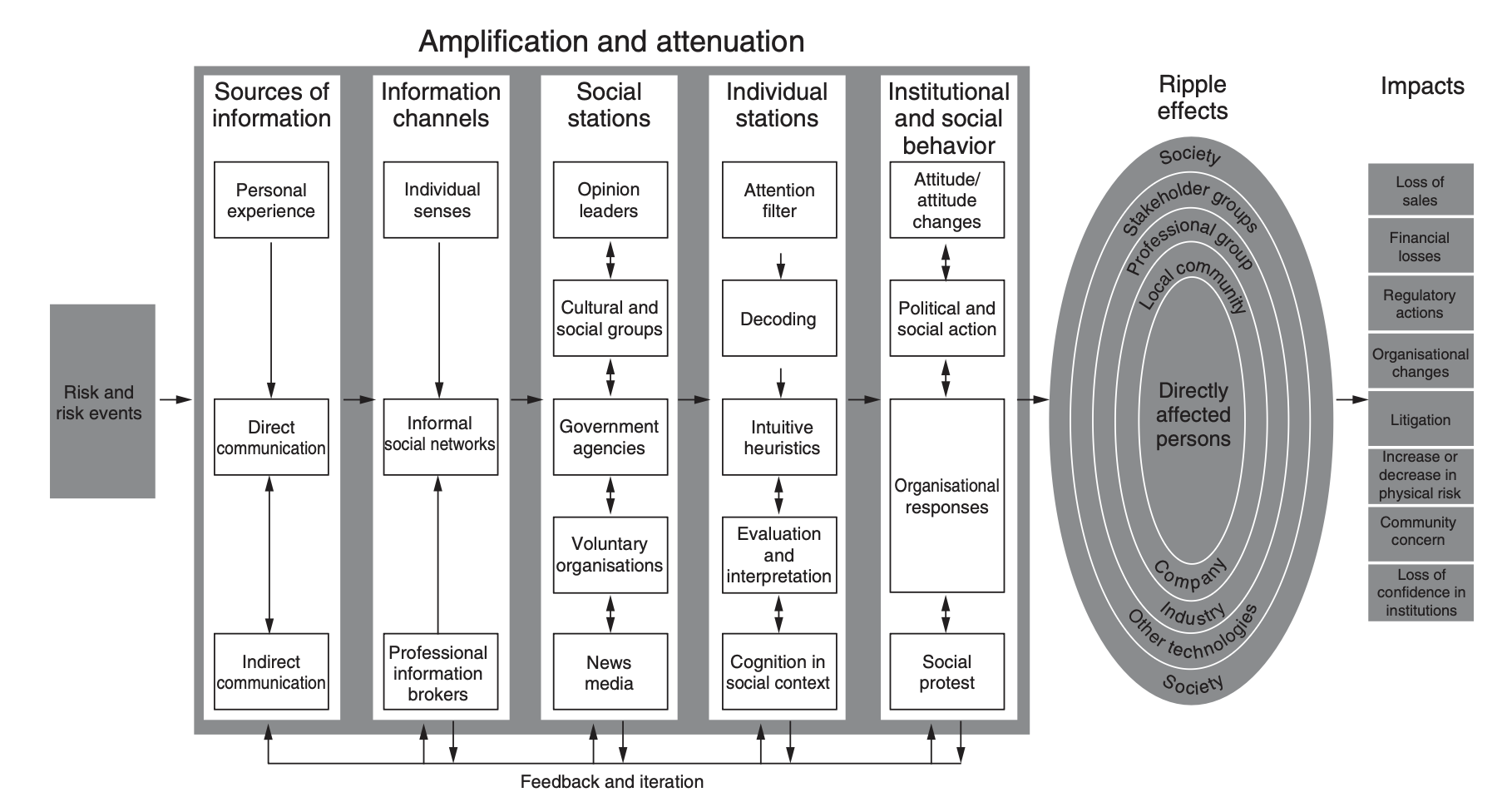
A framework describing how information processes, institutional structures, social-group behavior, and individual responses shape the social experience of risk, amplifying or attenuating public responses (Renn et al., 1992)
15
New cards
What is the core assumption of SARF?
Hazards interact with psychological, social, institutional, and cultural processes in ways that amplify or attenuate public responses — risk messages are filtered at multiple stages
16
New cards
What are the two types of stations in SARF?
Social stations (e.g., scientists, news media, government agencies, opinion leaders, social media) and individual stations (e.g., attention filters, heuristics, personal interpretation)
17
New cards
What are ripple effects in SARF?
The secondary consequences of amplified or attenuated risk perception — spreading beyond directly affected individuals to layers of society, including business losses, political pressure, regulatory changes, or loss of trust in institutions
18
New cards
How has social media changed ripple effects in SARF?
Ripples can now spread globally within minutes, massively accelerating and broadening the reach of amplification or attenuation
19
New cards
What is resonance in SARF?
When a risk aligns with the values, interests, or concerns of a particular system or group, that system pays more attention and amplifies the risk more strongly
20
New cards
Give an example of resonance in the political system
Climate change resonates strongly with green parties (amplification) but is downplayed by parties protecting fossil fuel interests (attenuation)
21
New cards
What are the four social systems and their resonance media?
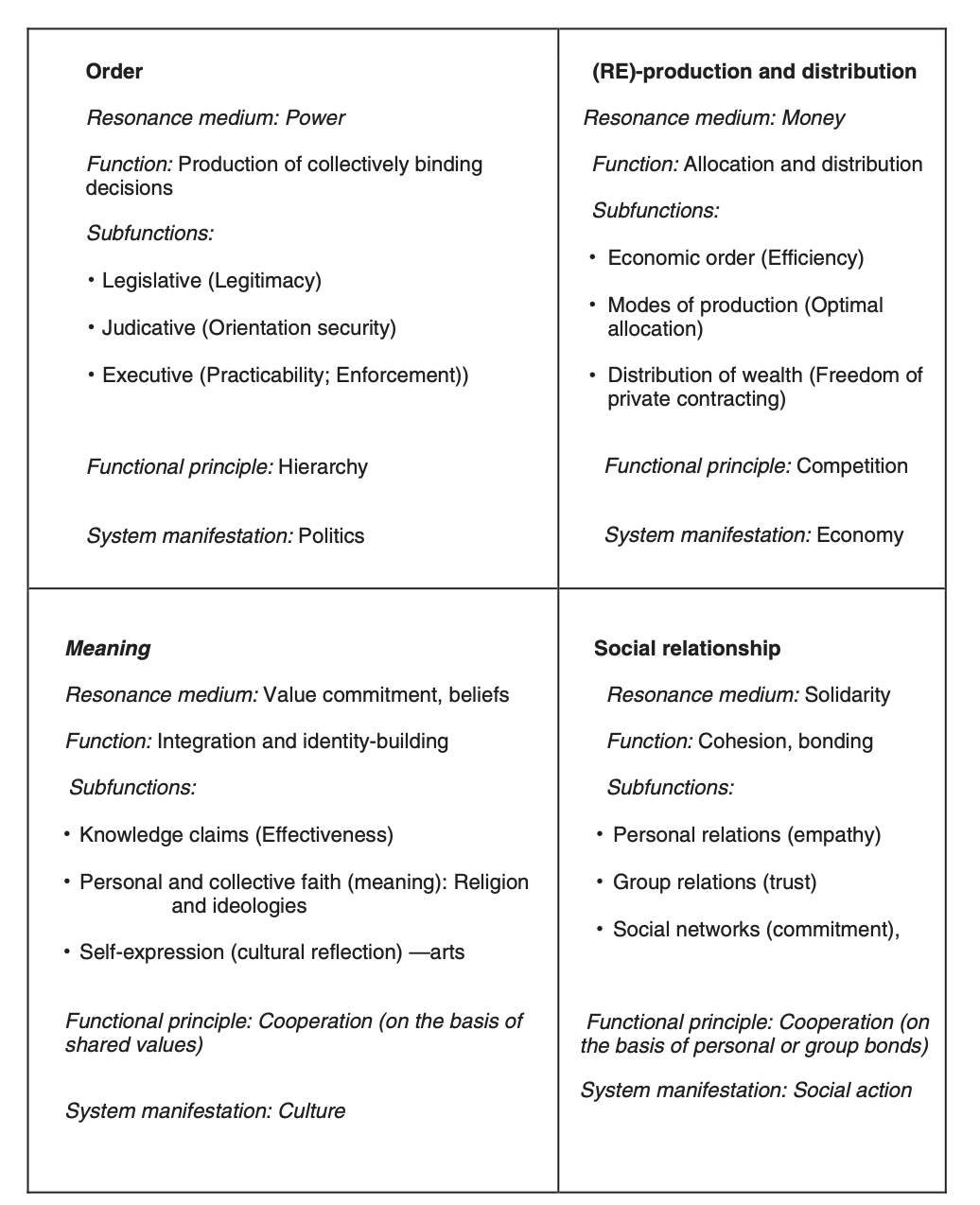
1. Order (resonance medium: power) 2. (Re)production and distribution (resonance medium: money) 3. Meaning (resonance medium: value commitment/beliefs) 4. Social relationship (resonance medium: solidarity)
22
New cards
What is the common pool dilemma and how does it relate to risk amplification?
Shared resources that are free to use lead to overuse; individuals amplify or attenuate risks based on whether they are personally motivated to take the risk seriously — relevant for collective risks like climate change
23
New cards
What are the SARF conclusions?
SARF describes individual and social factors amplifying or attenuating risk perceptions, generating secondary effects; risks gain meaning through iterative interactions between actors in the social structure
24
New cards
What is the key criticism of SARF?
It is a descriptive framework, not a theory — it has no predictive relationships between components and cannot causally explain what gets amplified or attenuated, or why
25
New cards
What three tools answer the question of how to strategically manage actors in risk communication?
Actor analysis (mapping roles and interests), issue arena (identifying who dominates the debate), and framing (understanding how actors shape the narrative)
26
New cards
Explain why the same risk can be amplified by one actor and attenuated by another
Because different actors have different interests, values, and resonance media — a risk that threatens one group's economic interests will be downplayed, while the same risk will be amplified by those whose values or livelihoods align with taking it seriously
27
New cards
What distinguishes Strategic Risk Communication from standard risk communication?
It explicitly maps the roles, needs, interests, and incentives of all actors across multiple levels — not just the message content — recognizing that complex risks involve competing perspectives and stakeholders
28
New cards
What is the full process flow of SARF?
Risk/risk event → sources of information (personal experience, direct/indirect communication) → information channels (individual senses, informal networks, professional brokers, news media) → social stations (opinion leaders, cultural groups, government agencies, news media) → individual stations (attention filter, decoding, heuristics, evaluation, social context) → institutional and social behavior → ripple effects → impacts
29
New cards
What are examples of social stations in SARF?
Opinion leaders, cultural and social groups, government agencies, voluntary organisations, and news media — each can amplify or attenuate the risk signal as it passes through
30
New cards
What are examples of individual stations in SARF?
Attention filter, decoding, intuitive heuristics, evaluation and interpretation, and cognition in social context
31
New cards
What are examples of impacts in SARF?
Loss of sales, financial losses, regulatory actions, organisational changes, litigation, increase or decrease in physical risk, community concern, loss of confidence in institutions