PSYCH 1-A FREUD AND ADLER (Lesson 4.1 and 4.2
 Call Kai
 Learn
Learn Practice Test
 Spaced Repetition
 Match
Match Flashcards
 Knowt Play
1/80

There's no tags or description
Looks like no tags are added yet.
Name | Mastery | Learn | Test | Matching | Spaced | Call with Kai |
|---|
No analytics yet
Send a link to your students to track their progress
81 Terms
Puberty to Adulthood Physical sexual changes reawaken repressed needs Restricted by social rules
GENITAL STAGE
6 year old to Puberty Latent means “hidden” Focused on school works, hobbies, and friendships
LATENCY STAGE
For women, the primary motive is penis envy. Consequently, they are continuously striving for superiority over men. Such women are considered to be "castrating females.
ELECTRA COMPLEX
In males, it is a reaction to severe castration anxiety; they behave in a reckless, resolute, and self-assured manner. Overvaluing of the penis is reflected in excessive vanity and exhibitionism.
OEDIPUS COMPLEX
2 complex in the phallic stage?
Electra Complex and Oedipus Complex
3-6 years of age
◎ Erogenous zone: Genitals
◎ Child becomes aware of anatomical sex differences
◎ Conflict comes from erotic attraction, resentment, rivalry, jealousy and fear
PHALLIC STAGE
Obsessive in cleanliness, stingy. characterized by the tendency to cope with conflicts later in life by demonstrating an extreme sense of cleanliness and orderliness
anal retentive
messy, lack of commitment
ANAL REPULSIVE
1 to 3 years of age Erogenous zone: anus The chief pleasures for the child involve feces retention or expulsion of
anal stage
fixation in the anal stage
anal repulsive and anal retentive
fixations in the oral stage
oral receptive and oral aggressive
shouting, nagging, being sarcastic, being argumentative
oral aggressive
overeating, gullible, smoking, nail-biting
oral receptive
BIRTH TO 1 year old ◎ Erogenous zone: mouth ◎ Satisfaction comes from putting all sorts of things in the mouth ◎ Activities are sucking, biting, swallowing
oral stage
Stages of Psychosexual Development (OAPHALAGE)
Oral, Anal, Phallic, Latency, Genital
As a person grows physically certain areas of their body become sources of potential frustration, pleasure or both.
EROGENOUS ZONES
a person’s libidinal energy may remain fixed at an earlier stage of development
FIXATION
Due to constant battle between an id demanding instant gratification and a superego demanding constant restraint ¡ Rational and reasonable ¡ Reality Principle:
ego
Right and wrong ¡ Develops at age 5 or 6 ¡ Learned from others
superego
Raw, unorganized, inborn part of personality ¡ Primitive desires of hunger, sex, and aggression ¡ Works with Pleasure Principle ¡ Satisfaction is the ultimate goal ¡ Its only resource is to form mental images of what it wants, a process called wish fulfillment
ID
structures if personality
id, superego, ego
plays a relatively minor role in Freudian theory.
conscious term
Conscious ideas stem from either the perception of external stimuli (our perceptual conscious system) or from the unconscious and preconscious after they have evaded censorship
conscious
contains images that are not in awareness but that can become conscious either quite easily or with some level of difficulty
preconscious
includes drives and instincts that are beyond awareness but that motivate most human behaviors. Dream Images ◉ Slips of the Tongue (Freudian Slip) ◉ Neurotic Symptoms
unconscious
mental representation of an inner bodily source of excitement
DRIVE
Freud saw mental functioning as operating on three levels
preconscious, conscious, unconscious
He believed that "the goal of all life is death" (Freud, 1952b, p. 652), that human beings strive to return to an inorganic state of balance that preceded life, in which there is no painful struggle to satisfy biological needs.
death (thanatos)
These instinctive urges seek to preserve life. Each of us is motivated to satisfy our hunger, thirst, and sexual needs. Without food and water, we could not survive
life (eros)
A measure of the demand made upon the mind for gratifying bodily needs. largely govern our behavior.
Instinct
Austrian neurologist and the founder of psychoanalysis.
Sigmund Freud
Psychodynamic theory points that nothing in mental life happens by chance—that there is no such thing as a random thought, feeling, motive, or behavior
Assumption 3: Psychic Causality
posits that early childhood events play a role in shaping personality Ø early experiences—including those occurring during the first weeks or months of life—set in motion personality processes that affect us years, even decades, later
Assumption 2: Critical Importance of Early Experiences
contend that the majority of psychological processes take place outside conscious awareness Øthe activities of the mind (or psyche) are presumed to be largely unconscious
Assumption 1: Primacy of the Unconscious
assumption 1: primary of unconscious, assumption 2: critical importance of early experiences, assumption 3: psychic causality
3 Core Assumptions of the Psychodynamic Perspective
States that events in our childhood have a great influence on our adult lives, shaping our personality
Psychodynamic theory
Austrian medical doctor, psychotherapist, and founder of the school of individual psychology.
alfred adler
did not agree on Freud’s view that all our present behaviors are determined by our past experiences.
Alfred Adler
Adler believed that people actively seek to improve themselves.
true
We are all born with a sense of inferiority which motivates us to improve ourselves and achieve our
self ideal
An expression of the fictional goal of the personality, which is an image of success and the organizing principle of the style of living.
self ideal
excessive feelings of inferiority (overcompensation)
inferiority complex
People’s ability to freely shape their behavior and create their own personality.
creative power
Socially nonproductive attempt to gain personal superiority
SUPERIORITY COMPLEX / STRIVING FOR SUPERIORITY
Psychologically healthy people who are motivated by social interest and the success of all humankind. Capable of helping others without demanding or expecting a personal payoff
striving for success
“community feeling” or “social interest” a feeling of oneness with all humanity
Gemeinschaftsgefühl
The term Adler used to refer to the flavor of a person’s life. It includes a person’s goal, self-concept, feelings for others, and attitude toward the world. Product of the interaction of the environment, heredity, and creative power of a person.
STYLES OF LIFE
rgas - styles of life
RULING TYPE
GETTING TYPE
AVOIDING TYPE
SOCIALLY-USEFUL TYPE
These people feed exclusively on feelings of insignificance and are hostile. They’re resentful, mistrustful, and need to have control over others so that they supply what they can’t provide for themselves. Their way of living, thinking, relating, and behaving is always problematic. It can even be pathological (narcissism, aggressiveness, etc.).
RULING TYPE Selfish Lifestyle
Dependent people who take rather than give. Pampered. The getting type of personality hasn’t overcome their feelings of inferiority. This leads of life dependence to relationships of and absolute submission. They lack self-concept, have few values, and feel no love for themselves.
GETTING TYPE Pampered Style
People who try to escape life's problems and take little part in socially constructive activity. They feed on the playful as an escape and never put their feet on the ground. In fact, they prefer to have their heads in the clouds than face reality. Their lifestyle is chaotic in all spheres: social, work, and personal. They’re unstable, thoughtless, and usually act on impulse.
AVOIDING TYPE Neglected Style of life
People with a great deal of social interest and activity. Socially useful individuals are those who work every day to improve themselves, iron out their fears, enhance their strengths, and deactivate selfishness. Only then, can they connect with others in an authentic way.
SOCIALLY-USEFUL TYPE
consist of parents, family, and extended family members
family constellation
Leader Responsible Controlling Achiever Motivated Cautious Perfectionist Reliable Conscientious Bossy
First Born
Peacemaker More Competitive Wants To Overatake First Born Try To Outdo Everyone May Become Rebel Successful Some Competition Can Deteriorate Into Rivalry
second born
Adaptable Independent Feels Left Out Peacemaker Go-between Can Be Rebellious Social
middle born
Social Fun Outgoing Seeks Attention Charming Uncomplicated Manipulative Self-centered
last born
Conscientious Leader Center Of Attention Responsible Sensitive Confident Seek Approval Perfectionist Mature For Their Age
only child
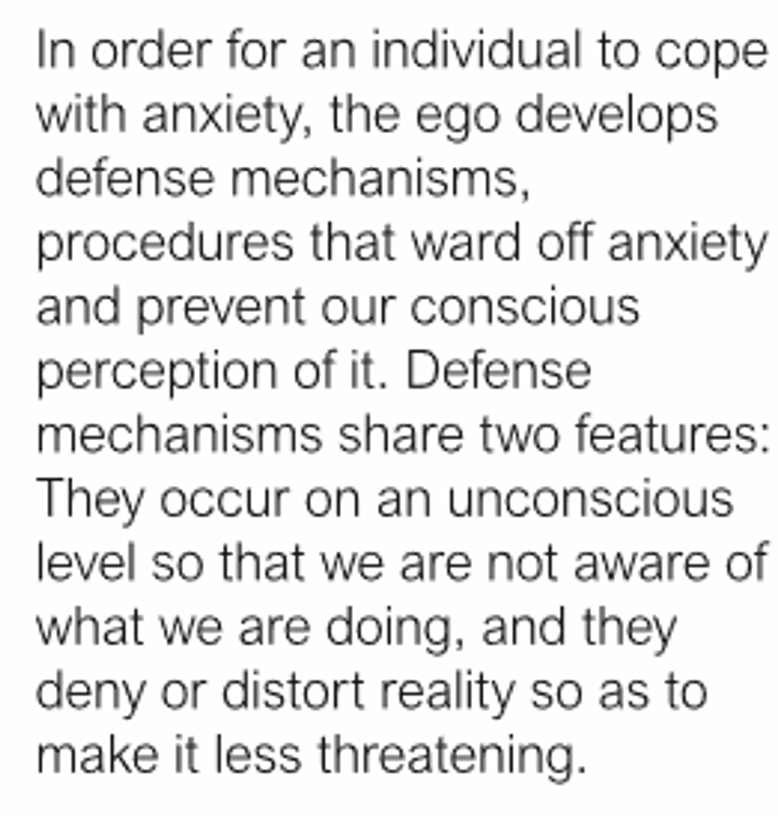
In order for an individual to cope with anxiety, the ego develops defense mechanisms, procedures that ward off anxiety and prevent our conscious perception of it. _________ share two features: They occur on an unconscious level so that we are not aware of what we are doing, and they deny or distort reality so as to make it less threatening
defense mechanism
The most basic defense mechanism. Whenever the ego is threatened by undesirable id impulses, it protects itself by repressing those impulses; that is, it forces threatening feelings into the unconscious. In many cases the repression is then perpetuated for a lifetime
repression
Denial refers to a person's refusal to perceive an unpleasant event in external reality. In adults, the use of denial may be normal during times of extreme stress
denial
a person is attributing his or her undesirable characteristics to others, whereas he/she might throw hate to others
(p1 said ang ingay mo, but in reality the person p1 is noisy)
projection

reaction formation
mature to immature
regression
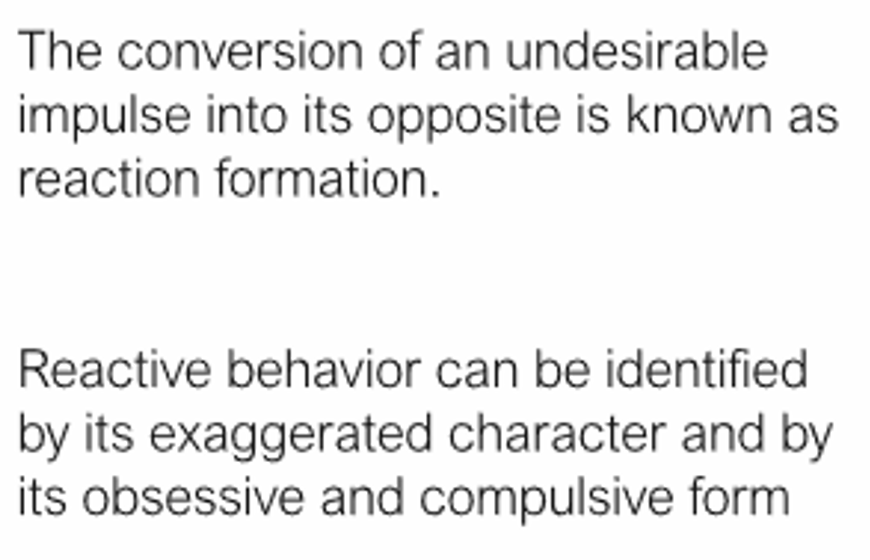
reaction formation
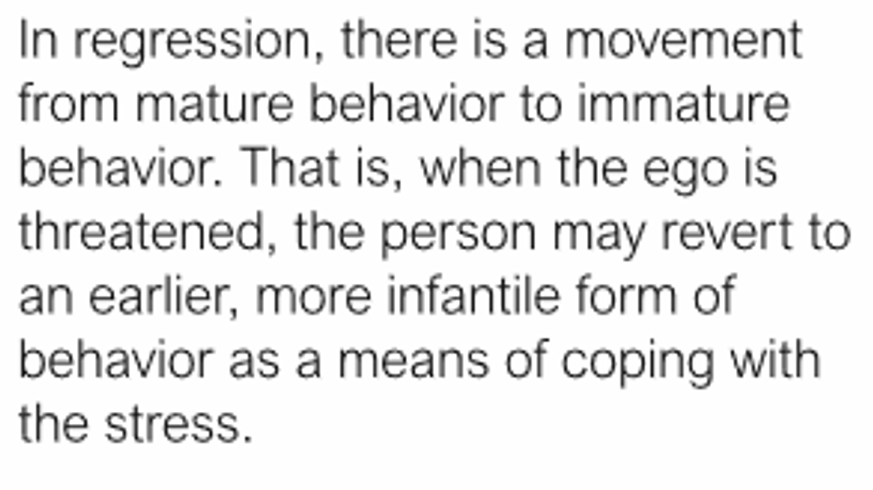
regression
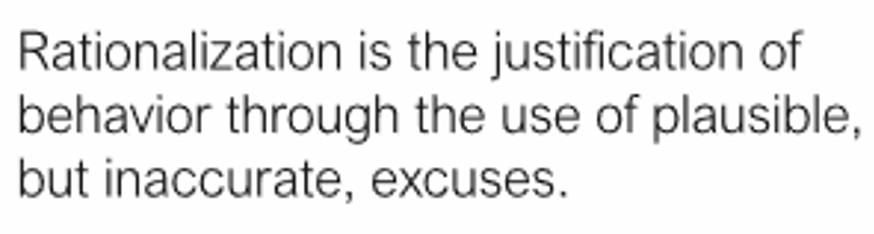
rationalization
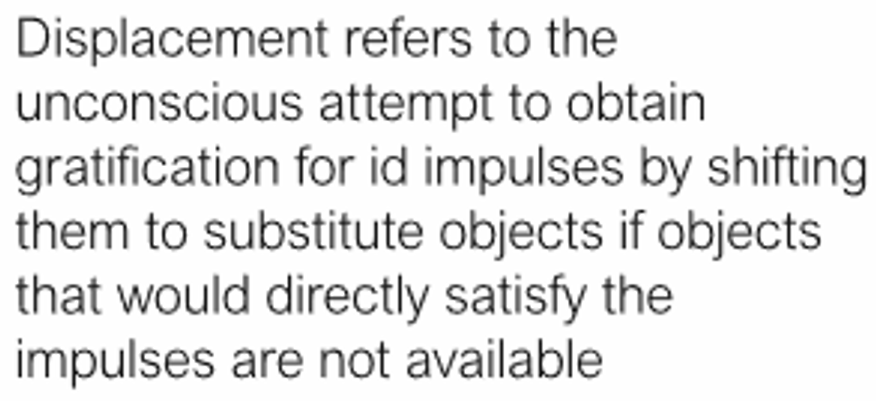
displacement
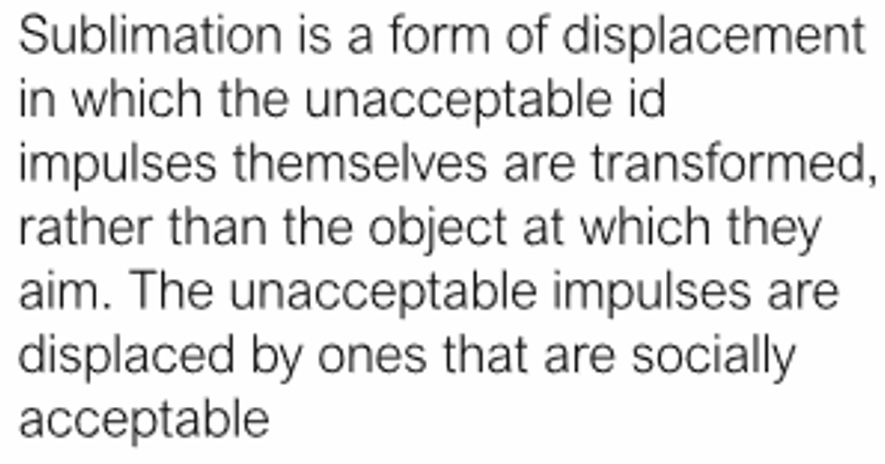
sublimation
types of defense mechanism:
PROJECTION, REACTION FORMATION, REGRESSION, RATIONALIZATION, REPRESSION, DENIAL, DISPLACEMENT, SUBLIMATION
rationalization
justification of a behavior
injection
putting the desirable characteristic of yourself to others
sweet lemon
Suppose a person planned a beach vacation, but the weather turned out to be rainy and cold. Instead of feeling disappointed, they decide to appreciate the opportunity to enjoy a relaxing day indoors, relishing the sound of the rain and the peaceful environment. This is
sour grape
That is, initial failure made people underestimate how good it would feel to succeed in the future.
sour grape
The fox who was unable to reach a cluster of delicious grapes, decided that he did not want them after all because they were probably sour. this is