ANS FINAL
 Call Kai
 Learn
Learn Practice Test
 Spaced Repetition
 Match
Match Flashcards
 Knowt Play
1/125

There's no tags or description
Looks like no tags are added yet.
Name | Mastery | Learn | Test | Matching | Spaced | Call with Kai |
|---|
No analytics yet
Send a link to your students to track their progress
126 Terms
What % of an animal’s body mass is comprised of muscle?
30-40%
What are the primary functions of meat in animals?
necessary for body processes
movement
support/ structure (heart)
maintenance of body temp (metabolic activity produces heat)
dietary protein source (muscle foods)
What are the 3 types of muscles?
smooth
cardiac
skeletal
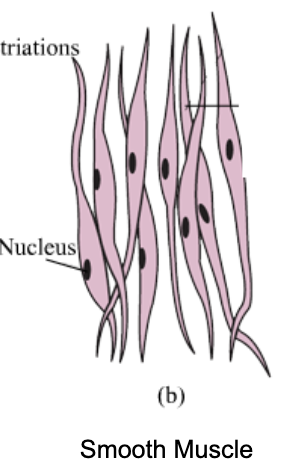
What does the Smooth muscle look like and what is it responsible for?
un-striated, elongated, cigar-shaped
responsible for sustained contractions in vascular system & GI-tract, NOT voluntary
slow & controlled by autonomic nervous system
mononucleated
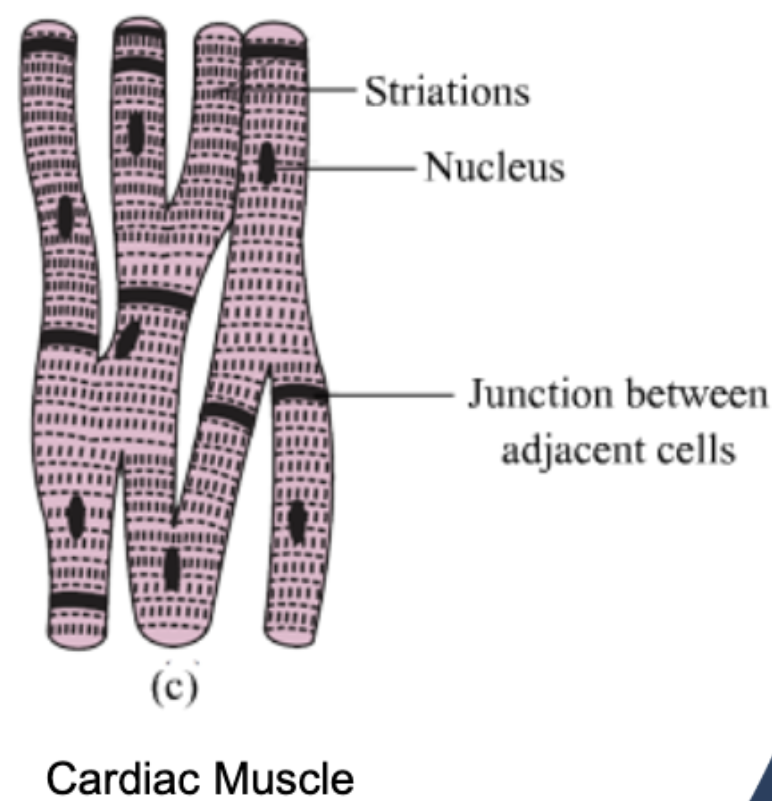
What does the Cardiac muscle look like and what is it responsible for?
striated, shorter, branched fibers; forming networks
responsible for pumping blood; NOT voluntary
mononucleated
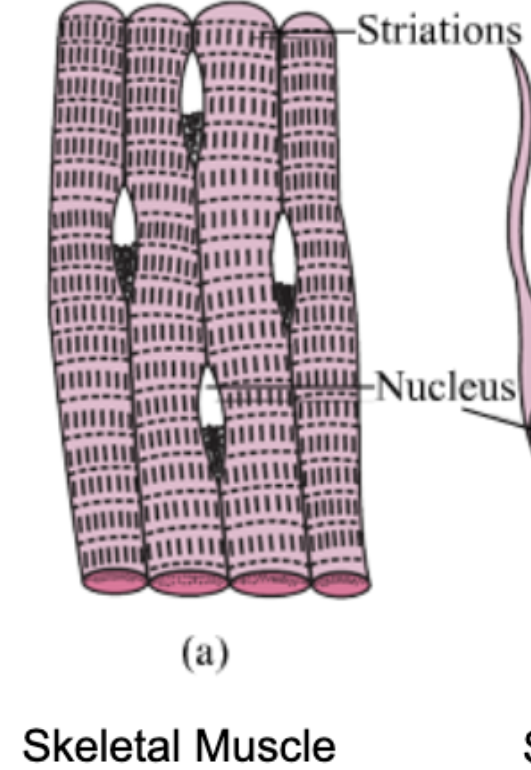
What does the Skeletal muscle look like and what is it responsible for?
striated, long, cylindrical, unbranched; mostly seen in meat
responsible for movement; voluntary
multinucleated; located at the periphery (outermost boundary)
What is marbling in meat?
- fat portion of meat
What is a Myocyte?
- muscle cell or fiber (big)
multinucleated
What are Myofibrils?
- smallest functional unit of a muscle (medium) (within Myocytes)
What is a Sarcomere?
- the building block unit of a Myofibril (small)
What are Fasciculi?
- bundles of myocytes
What are the 3 types of connective tissue within the Skeletal muscle?
Epimysium (external)
Perimysium (intermediate)
Endomysium (internal)
What is the Sarcolemma of a Myocyte?
- the cell membrane
attaches muscle fiber to connective tissue
(endomysium)
What is the Sarcoplasm of a Myocyte?
- the cytoplasm of muscle
stores Glycogen (used for energy) & Myoglobin (protein; responsible for red color, stores Oxygen)
What are the Transverse Tubules? (T-tubules) of a Myocte?
- the “communication channel” into interior of muscle fiber
responsible for voluntary movement in skeletal muscle.
What is the Sarcoplasmic Reticulum (SR) of a Myocyte?
- membrane bound organelle in muscle cells/fibers
responsible for storing Ca++ in relaxed muscle (all contractions require Calcium & ATP)
What is the Mitochondria of a Myocyte?
- the powerhouse of the cell
responsible for ATP production
What is the function of Myofibrils within a Myoctye?
responsible for contractile machinery/ functional unit of a Myocyte
What structural features within Myofibrils cause the distinct alternation of light & dark bands (striations) visible in the skeletal & cardiac muscle tissues?
The precise overlapping arrangement of 2 major finalments (thin & thick)
What are the roles & compositions of the Z line, A-band, I-band, H-zone, & M-line in a Sarcomere?
Z line: primary structural element of the Myofibril; forms the lateral boundaries of each Sarcomere
A-Band: contains both thin & thick filaments
I-Band: contains ONLY thin filaments
H-zone: contains ONLY thick filaments
M-line: located at the center of the sarcomere (holds thick filaments together)
Myocytes are composed of what 2 fibrous proteins?
Actin (thin filament)
Myosin (thick filament)
run along length of muscle fiber; have microstructure that allows for contraction
when Myofibrils contract, Myocyte contracts as well
when parallel Myocytes contract, the entire muscle contracts
True or False: Myofibrils run along the entire length of a muscle fiber and contain the microstructure necessary for contraction
True
True or False: When myofibrils contract, the Myocyte contracts as well.
True
True or False: The contraction of a single Myocyte is sufficient to cause the entire muscle to contract.
False
True or False: When many parallel Myocytes contract together, the entire muscle contracts.
True
True or False: Myofibrils are responsible for generating the force that leads to muscle contraction.
True
True or False: When a muscle is relaxed, the myosin-binding sites on actin are covered by regulatory proteins.
True
True or False: Calcium ions help expose the binding sites on actin needed for muscle contraction.
True
True or False: Calcium binds directly to myosin to initiate muscle contraction.
False
True or False: When calcium binds to a regulatory protein, it triggers a change that exposes binding sites on actin.
True
True or False: Myosin can bind to actin only after the binding sites on actin are exposed.
True
True or False: The exposure of actin binding sites allows myosin to attach and begin the contraction process.
True
True or False: Muscle contraction involves shortening of Sarcomeres
True
thick & thin myofilaments “slide” across one another, bringing Z-lines closer together
True or False: Myosin must be activated by ATP before it can participate in muscle contraction.
True
True or False: After myosin binds to actin, the myosin head returns to its original position, generating force.
True
True or False: The power stroke causes the thin filament to move toward the M line at the center of the sarcomere.
True
True or False: During contraction, the thin filaments slide away from the M line.
False
True or False: The sliding of thin filaments toward the M line shortens the sarcomere and contributes to muscle contraction.
True
True or False: During muscle contraction, all bands and zones of the sarcomere become shorter.
False
True or False: The A-band shortens during muscle contraction.
False
True or False: The A band remains the same length during muscle contraction because the thick filaments do not change length.
True
True or False: The I band becomes shorter during muscle contraction.
True
True or False: The H zone becomes shorter during muscle contraction.
True
True or False: The I band and H zone move toward the center of the sarcomere (the M line) during contraction.
True
True or False: The entire Sarcomere shortens during muscle contraction.
True
True or False: Muscle contraction occurs because the actin and myosin filaments themselves become shorter.
False
entire Sarcomere becomes shorter
True or False: The shortening of the sarcomere is caused by thin filaments sliding toward the M line.
True
True or False: The Z lines move closer together during muscle contraction.
True
True or False: Skeletal Myocytes are multinucleated because they are formed by the fusion of multiple precursor cells during development.
True
True or False: When precursor cells fuse to form a skeletal Myocyte, they lose their nuclei.
False
True or False: Skeletal Myocytes retain the nuclei from the precursor cells that fused together.
True
True or False: The large size of skeletal Myocytes is one reason they require multiple nuclei to support protein synthesis.
True
True or False: Cardiac muscle cells are multinucleated for the same reason as skeletal muscle fibers.
False
True or False: Cardiac muscle cells form by the fusion of precursor cells.
False
True or False: Multiple nuclei in skeletal muscle fibers help support the high demand for protein synthesis throughout the large cell.
True
What are the 3 Pathways that provide ATP for Muscle Contraction & Relaxation?
Fastest Pathway:
Direct Phosphorylation
Metabolic Pathways & Major Sources:
Anaerobic Glycolysis
Oxidative Phosphorylation
What Molecule is used in Direct Phosphorylation to rapidly regenerate ATP?
Creatine Phosphate
fastest process & source of energy
limited
What are the 2 major Metabolic Pathways that use Glucose to generate ATP?
Anaerobic Glycolysis (w/out oxygen)
Oxidative Phosphorylation (w/ constant oxygen)
How many ATP Molecules are produced from Anaerobic Glycolysis per Glucose?
2 ATP per Glucose
limited energy source as it produces ATP quickly but inefficiently
Which Pathway provides the most long-lasting source of ATP for muscle activity?
Oxidative Phosphorylation
Which ATP Source/Pathway would be most important/ long-lasting source of ATP for muscle activity/prolonged endurance exercise?
Oxidative Phosphorylation
Which ATP source would be most important during the first few seconds of intense muscle activity?
Direct phosphorylation using creatine phosphate.
What is the pH of normal muscle in Living Animals?
7 (neutral)
keeps homeostasis
What is the process Exsanguination?
- the process of blood removal
True or False: Exsanguination interrupts the supply of O2 to Muscles
True
True or False: Exsanguination shifts energy metabolism from anaerobic to an aerobic pathway
False
shift from aerobic to an anaerobic pathway
How does Exsanguination prevents the recycling of metabolic byproducts?
Exsanguination removes the blood that normally transports metabolic byproducts to organs for processing and removal. Without blood circulation, wastes accumulate in the tissues and cannot be recycled or cleared. Oxygen is also unavailable for aerobic metabolism.
What are the 2 primary energy sources for maintaining Post-Mortem Homeostasis?
Creatine Phosphate (through direct phosphorylation)
Glycogen (through anaerobic glycolysis)
What molecule is produced from Muscle Byproducts?
Lactic acid is produced when Myocytes break down Glucose(through Glycolysis) w/ out enough Oxygen available (anaerobic metabolism)
pyruvate created through glycolysis is converted into lactate (lactic acid)
What is the pH of red meat?
pH= 5.5
acidic
What causes pH to decline after death?
- accumulation of lactate & Hydrogen ions (H+) causes muscle pH to decline
7.0-7.2 → 5.4-5.5
neutral → acidic
Approximately what % of muscle weight is Glycogen in a normal animal before death?
≈ 1% of Muscle weight
To what percentage is Muscle Glycogen Reduced after Post-Mortem Glycolysis?
≈ 0.1% of Muscle weight
What are the 3 types of Water found in Muscle?
Bound water
held tightly by charged hydrophilic groups on Muscle protein
will NOT get lost even through physical force
5% of total water in muscle
Immobilized water
held by weaker attractive forces near charged proteins
85-90% of total water in muscle
Free water
held ONLY by Capillary forces
independent of charged proteins
What is Bound Water in muscle?
- Water that is held tightly by charged hydrophilic groups on muscle proteins.
Approximately what % of total muscle water is bound water?
≈ 5%
Can bound water be removed by physical force?
No, it is held too tightly to be lost through physical force.
What is immobilized water in muscle?
Water held near charged proteins by weaker attractive forces.
Approximately what % of total muscle water is immobilized water?
≈ 85-90%
What is free water in muscle?
Water held only by capillary forces and not associated with charged proteins.
Which type of muscle water makes up the largest proportion of total muscle water?
Immobilized water.
Rank bound water, immobilized water, and free water from most tightly held to least tightly held.
Bound water → Immobilized water → Free water.
What is Water Holding Capacity (WHC)?
the ability of meat to retain water during application of external forces such as cutting, heating, grinding, or pressing
Define Purge
- excess water in commercial meat or cooked meat
Immobilized water -> free water
Contains lots of myoglobin resulting in red color
When is Muscle Holding Capacity of meat the lowest?
when pH nears the Isoelectric Point
≈ pH 5.1
Because muscle proteins have no net charge it reduces their ability to attract and hold water.
What is the isoelectric point of a protein?
The pH at which the # of positive and negative charges on the protein is equal.
What type of water remains tightly bound to muscle proteins even when water-holding capacity decreases?
Bound water.
What happens to immobilized water when muscle pH is near the isoelectric point?
The muscle cannot hold it effectively, so it is more easily lost.
True or False: Pale meat is caused by a lack of myoglobin.
False
Lower pH (closer to isoelectric point) meaning muscle cannot hold as much water as before; water comes out of meat , staying on surface of meat; reflecting more light causing colors to become paler and loss of microbes
What does "exudative" mean? In PSE
Excessive moisture loss from meat
Why is high-pH meat darker in color?
It retains more water, resulting in less light reflection.
How does high pH affect water-holding capacity?
It increases water-holding capacity because the pH is farther from the isoelectric point.
How does low pH affect water-holding capacity?
Water-holding capacity decreases as pH approaches the isoelectric point.
Are PSE and dark-cutting meats food safety concerns?
No, neither condition creates a food safety issue.
What causes PSE pork?
An extremely rapid pH decline while muscle temperature remains high.
Why is PSE pork pale?
Excess surface water reflects more light.
What causes the dark-cutting condition?
Depletion of muscle glycogen stores before harvest.
Less glycogen means less postmortem lactic acid production, so pH does not decline normally.
Why is dark-cutting meat darker in color?
High pH increases water retention and decreases light reflection.
What is Rigor Mortis?
- When creatine phosphate & glycogen stores have been exhausted, the muscle slowly depletes ATP, & permanent actomyosin cross-bridges are formed - accompanied by loss of extensibility & muscle shortening
(process of harvesting animal -> meat)
What are the 3 Phases of Rigor Mortis?
Delay
Onset
Completion