oat orgo unit 4
 Call Kai
 Learn
Learn Practice Test
 Spaced Repetition
 Match
Match Flashcards
 Knowt Play
1/35

Earn XP
Description and Tags
they call me runny poop the way i trickle down your legs
Name | Mastery | Learn | Test | Matching | Spaced | Call with Kai |
|---|
No analytics yet
Send a link to your students to track their progress
36 Terms
nucleophile
attracted to positively charged or electron deficient species and likely have a partial negative charge.
nucleophile examples

electrophile
attracted to electrons and likely have a partial positive charge.
electrophiles examples
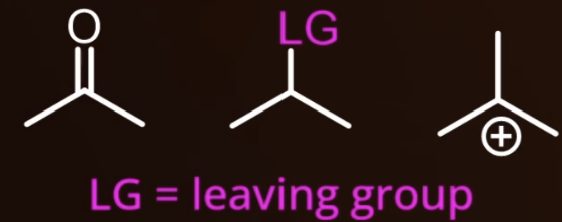
common leaving groups
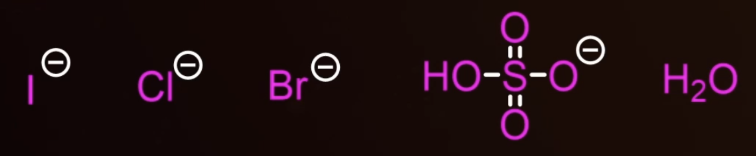
nucleophilicity
the rate at which nucleophiles donate a pair of electrons to an electrophile.
polar protic solvent
has hydrogens attached to O or N atoms, allowing them to form hydrogen bonds
larger ions make better nucleophiles
polar aprotic solvent
has polar bonds, but no bonds between H and O/N.
Smaller ions are better nucleophiles.
nucleophilicity factors
Increases when the anion (nucleophile) is less stable
Polar aprotic solvent reactivity: C > N > O > F > Cl > Br > I
Polar protic solvent reactivity: C > N > O > F and I > Br > Cl > F
SN2 process
Nucleophile attacks electrophile and leaving group leaves at the same time.
Electrophile always has four atoms bonded to it, and at least one must be hydrogen.
Rate law equation: Rate = k[Nuc][Elec] ← BIMOLECULAR
There is a pentavalent transition state.
Concerted reaction: all bond breaking and forming occurs during the same step.
SN2 reaction mechanism
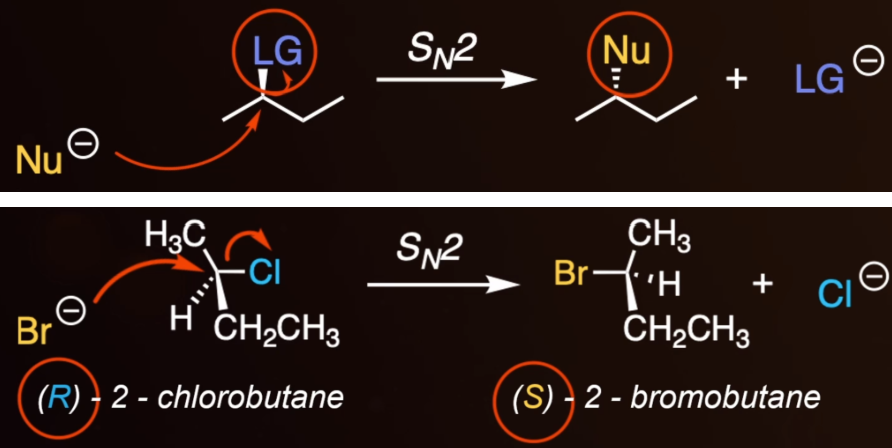
SN2 arrows
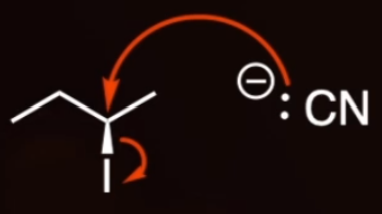
SN1 process
Step 1: Leaving group leaves electrophile (rate limiting step)
Step 2: Carbocation rearrangement if possible (moving (+) to more stable position.
Step 3: Nucleophile later attacks electrophile.
Rate law equation: Rate = k[Elec] ← UNIMOLECULAR
Multistep reaction with a carbocation intermediate.
Can only happen with secondary or tertiary substrates (primary is too unstable)
carbocation stability

SN1 reaction mechanism
Nucleophile will attack either the front or back of electrophile.
If electrophile is chiral, there will be a racemic mixture.

Elimination reactions
always result in alkene or pi bond products, caused by a leaving group and a hydrogen leaving a molecule.
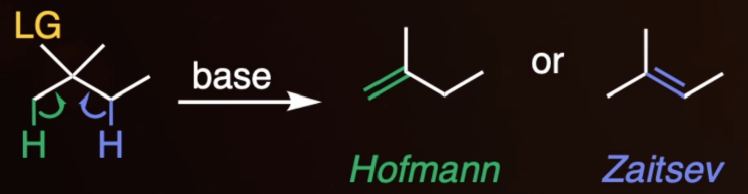
Hofmann vs Zaitsev product
Zaitsev = more substituted alkene & more stable; only for small, nonsterically hindered bases
Hofmann = less substituted alkene & less stable; only for large, sterically hindered bases.
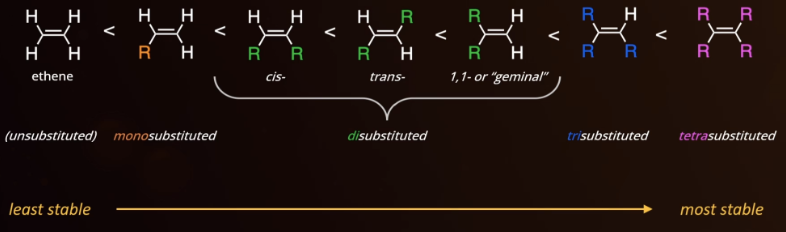
alkene stability
more substituted = more stable
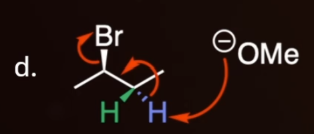
E2 reaction properties
Bimolecular rate law: Rate = k[Base][Elec]
LG and Beta proton have to be antiperiplanar (pointed opposite directions)
Concerted reaction (1 step)
Cyclic: LG and BP must also be axial.
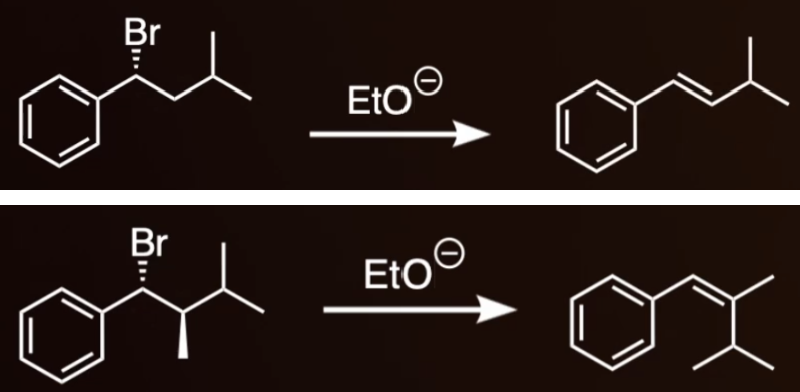
Stereoselectivity: E product is favored due to less steric hindrance, but Z is still possible.
E2 stereoselectivity
Draw Newman projection on potential pi bond.
Rotate a single bond to have the LG and BP in antiperiplanar positioning.
Replace LG and BP with double bond, and draw final product (with rotated bonds taken into account)
E2 mechanism arrows
E1 reaction properties
LG leaves, making a carbocation intermediate. Then, a base takes off a hydrogen to make a double bond.
There can be carbocation rearrangements, which makes the reaction faster.
Unimolecular rate law: Rate = k[Elec]
E1 carbocation rearrangement

E1 and E2 differences
E2 favors strong bases, E1 favors weak bases
E2: LG and BP must be antiperiplanar
E1: Carbocation is formed
Heat
will favor E1 reactions over SN1 reactions.
acid catalyzed dehydration of alcohols
must have a strong acid and an alcohol.
Acid protonates alcohol, making H2O+-R (good LG)
Next, E1 reaction happens if 2o or 3o, E2 if 1o.
Gives both Zaitsev (major) and Hofmann (minor) products.
hydride shift
Hydrogen swaps with a neighboring carbocation to stabilize the carbocation.

methyl shift
Methyl swaps with a neighboring carbocation to stabilize the carbocation.

reaction mechanism factors
Degree of substitution of substrates
Strength of Base/Nucleophile
Steric Hindrance of Base/Nucleophile
Solvent Effects
Temperature
substrate substitution for determining mechanism
Primary - SN2 and E2 are possible. SN1 and E1 are not because primary carbocations are too unstable.
Secondary - All SN and E mechanisms.
Tertiary - SN1, E1, and E2 are possible. SN2 is not possible due to steric hindrance.
Base/nucleophile strength for determining mechanism
Nucleophiles are used in substitution, while bases are used in eliminations (attacking electrophilic carbon vs removing a proton)
Negatively charged = strong base/nucleophile = SN2 and E2 are favored.
Neutral charge = weak base/nucleophile = SN1 and E1 are favored.
Steric hindrance = acts as a base and E2 is favored.
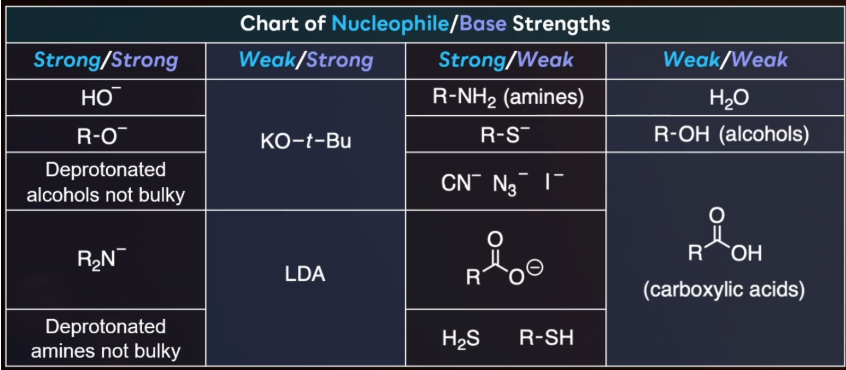
solvent effects for determining reaction mechanism
Polar protic solvent - stabilizes carbocation intermediate
Polar aprotic solvent - doesn’t hydrogen bond, so no interaction.
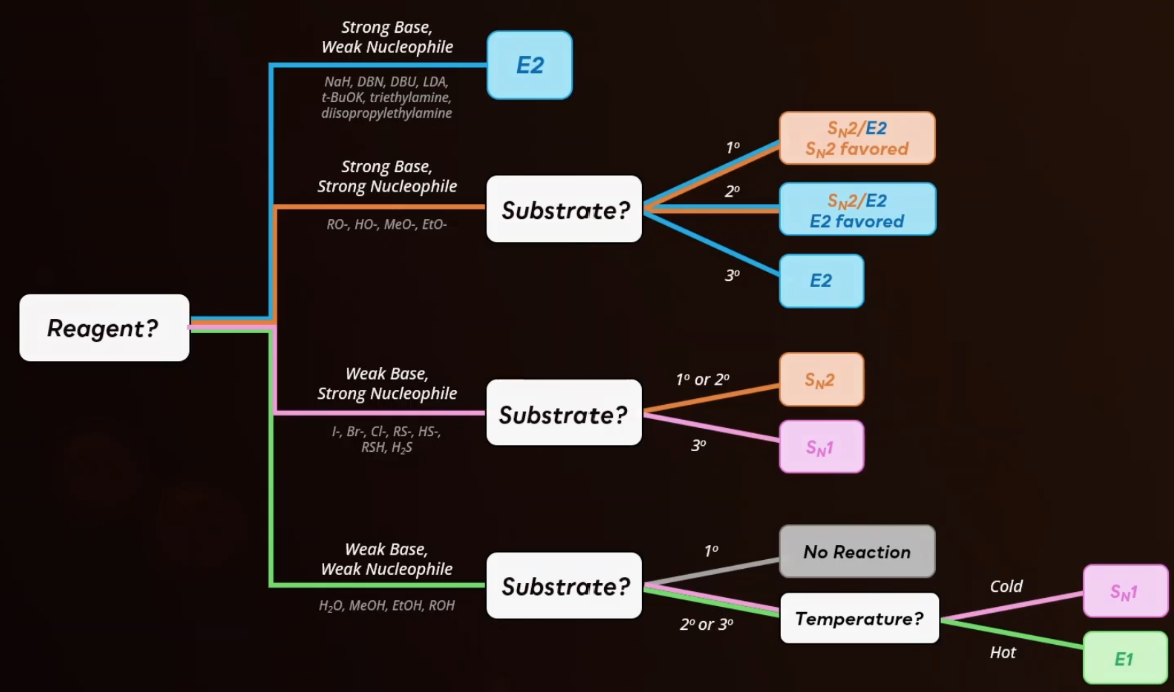
mechanism flow chart
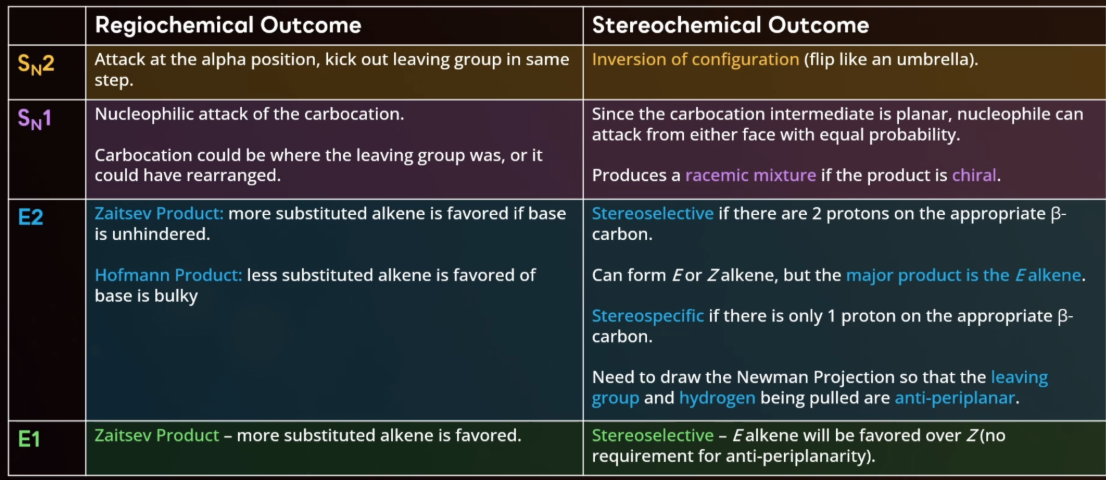
regiochemical and stereochemical chart
alcohol reactions
Alcohol + Hydrohalic acid = SN1 or SN2
Alcohol + Concentrated acid + heat = E1 or E2
2o or 3o = E1 = Zaitsev
1o = E2
fart
elimination of a methane out of my butt molecule