5.1 Homeostasis and 5.2 The Human Nervous System
 Call Kai
 Learn
Learn Practice Test
 Spaced Repetition
 Match
Match Flashcards
 Knowt Play
1/47

There's no tags or description
Looks like no tags are added yet.
Name | Mastery | Learn | Test | Matching | Spaced | Call with Kai |
|---|
No analytics yet
Send a link to your students to track their progress
48 Terms
Define homeostasis
Regulation of a cell or organism to maintain optimum conditions for function, in response to internal and external changes
What factors are controlled by homeostasis?
-Temperature (core body temp. approx. 37°C)
-pH levels (blood pH is approx. 7.4)
-Blood glucose concentration
-Water levels of blood
-Ion concentration of blood
-Concentration of waste materials (e.g CO₂, urea)
Why does temperature need to be controlled?
-Maintain optimum temperature for enzymes
-Enzymes denature at high temperatures
-Enzymes work too slowly at low temperatures
Why does blood glucose concentration nee to be controlled?
Glucose needed as it is the main substance for respiration to provide energy for metabolic processes
Why do water levels of blood need to be controlled?
Need to prevent water movement into or out of cells by osmosis
-Too high - water moves into cells causing them to burst
-Too low - water moves out of cells causing them to plasmolyse (shrivel)
Why do ion levels of blood need to be controlled?
Water will move into or out of cells by osmosis if this is incorrect
-Too high - water moves out of cells causing the to plasmolyse
-Too low - water moves into cells causing the to burst
Why does the concentration of waste materials need to be controlled?
These are usually poisonous and need to be removed from the body before they build up to toxic levels and cause damage to cells
Why does CO₂ need to be removed from the body?
When dissolved it forms an acidic solution, so it needs to be removed as it would affect the activity of enzymes
When is urea produced?
Produced in the liver from the breakdown of excess amino acids which cannot be stored or used for energy
How is urea removed from the body?
-The amine group is removed and converted into urea, but this is poisonous and would damage cells if levels build up
-Urea is filtered from blood by the kidneys and removed from the body in urine along the excess salts and water
What do organisms need to be constantly monitoring?
Changes in the world around them (external environment) and changes inside them (internal environment)
What are the two types of automatic systems?
-Nervous responses (nervous systems)
-Chemical responses (hormone/endocrine system)
What is the function of the receptors?
Cell that detect changes in the internal/external environment (stimuli)
What is the function of coordination centres?
Receive and process the information from the receptors, and then coordinate the response - examples include the brain, spinal chord and organs such as the pancreas
What is the function of effectors?
Muscles or glands which bring about a response when it receives a message from the brain
Define stimulus
a change that can be detected
What is a response?
What happens as a result of the stimulus
What is a sensory neurone?
sends electrical impulses from the receptors in the sense organs, to the brain (central nervous system)
What is a coordinator?
The brain and spinal column, also known as the central nervous system. This processes the information from sensory neurones
What is a motor neurone?
Sends electrical impulses from the brain to the muscles and glands (effectors)
What is the path of a nerve impulse?
1.Stimulus detected by receptor
2.Nerve impulse passed along sensory neurone
3.Nerve impulse passes across synapses
4.Nerve impulses reaches coordinator which processes the information
5.Nerve impulses passes along motor neurone
6.Impulse reaches the effector causing the response
What is a neurone?
Sends electrical impulse from sensory receptor which detects a stimulus
What is a nerve impulse?
Waves of electrochemical changes across neurones that assist in the formation of an action potential in response to a stimulus
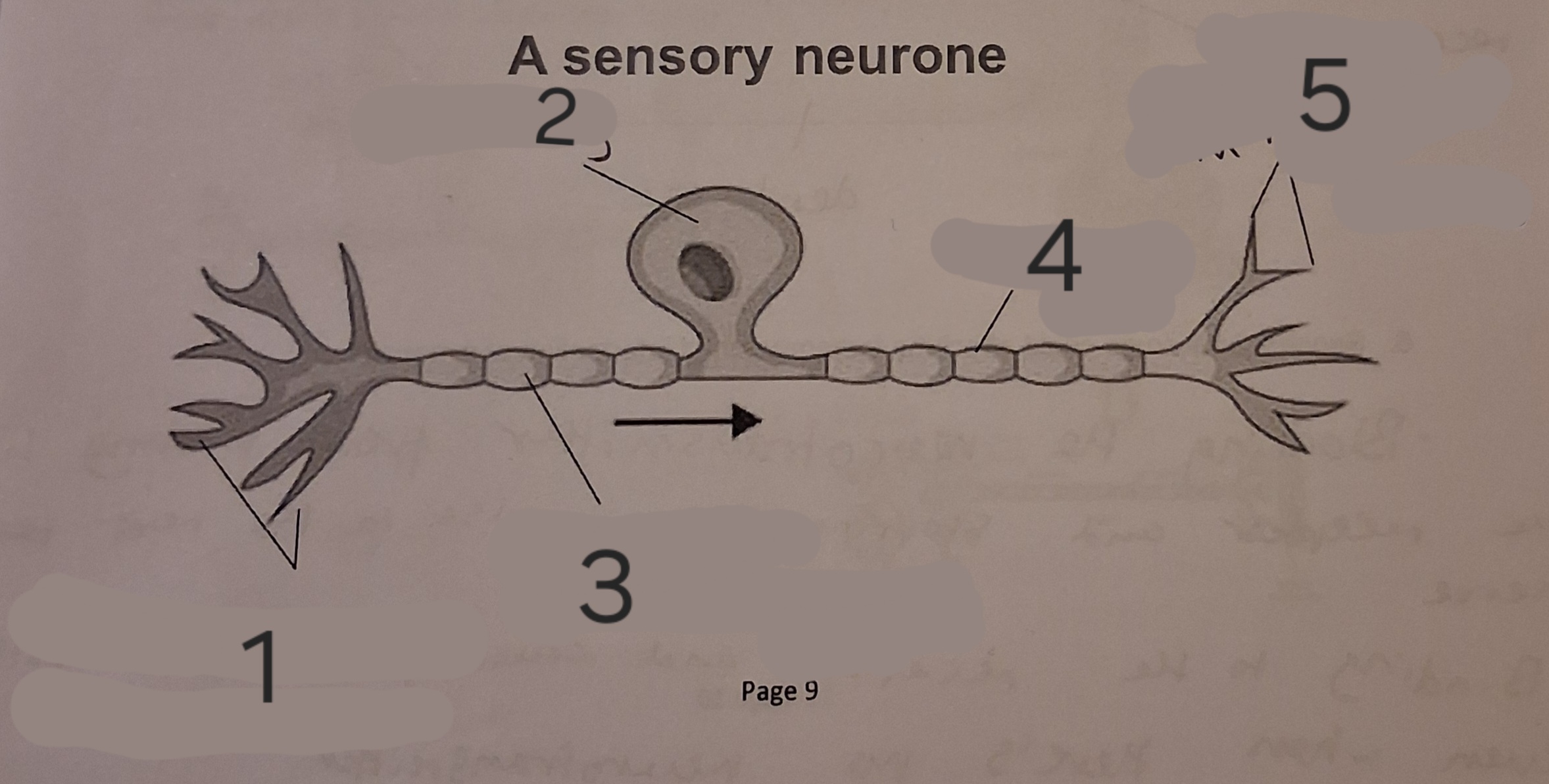
Label the diagram
1.Dendrites (connect with receptors)
2.Cell body
3.Myelin sheath (insulator)
4.Axon (nerve fibre)
5.Nerve endings (connect with relay neurones)
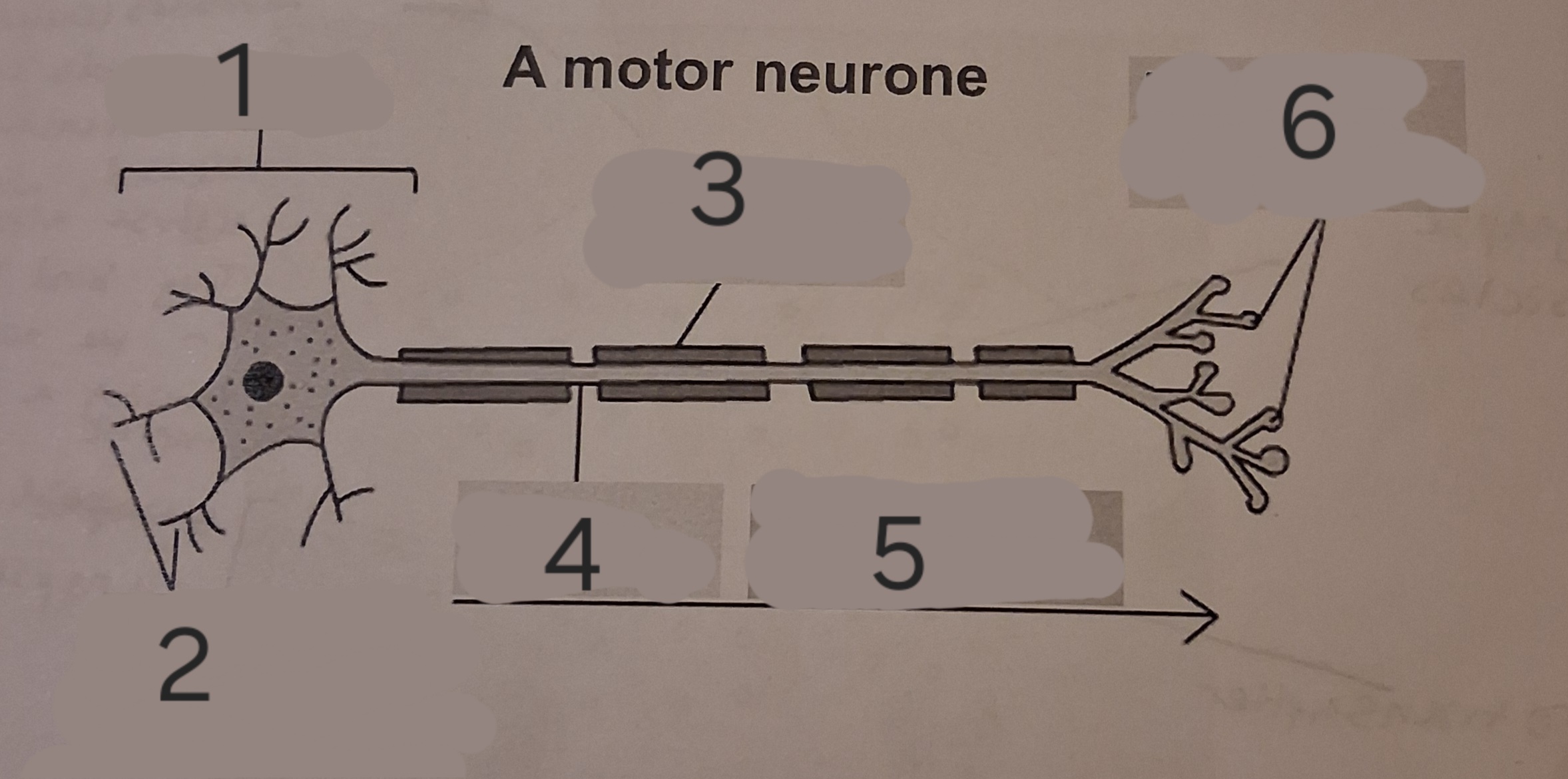
Label the diagram
1.Cell body
2.Dendrites (connect with other neurones)
3.Myelin sheath (insulator)
4.Axon (nerve fibre)
5.Direction of nerve impulse
6.Nerve endings (connect with muscle or gland)
What is a synapse?
junctions between neurones that electrical impulses cross
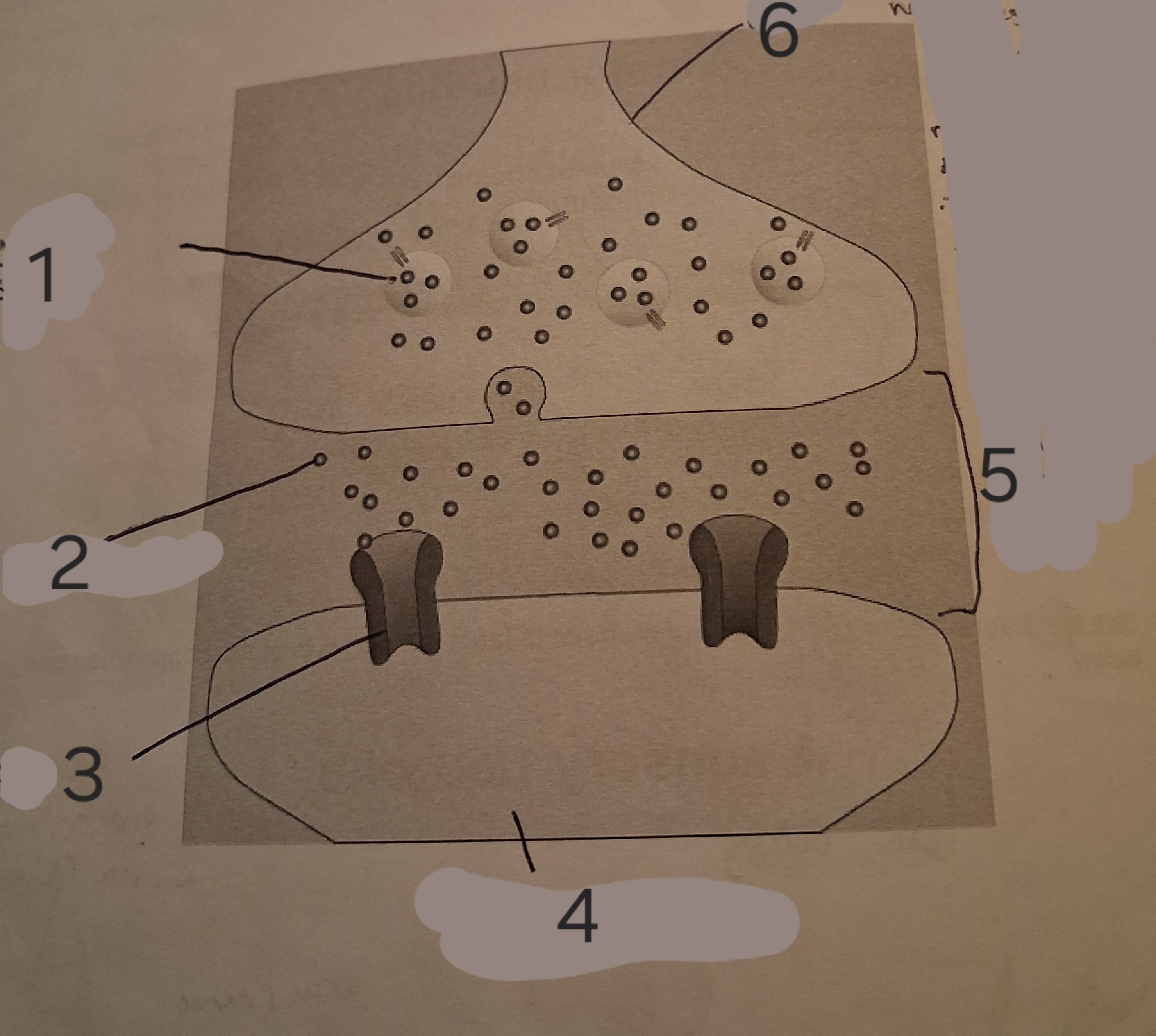
Label the diagram
1.synapse vesicles
2.neurotransmitter
3.receptor
4.dendrites
5.synapse
6.axon
How do nerve impulses cross synapses?
-The electrical nerve impulses cannot cross the gaps between neurones (synapses)
-Chemicals called neurotransmitters are released, which can diffuse across the gap
-They bind to receptors in the next neurone causing a new nerve impulse
How can drugs affect the transmission of information at synapses?
-Block the neurotransmitter from binding to the receptor and stopping the impulse in the next nerve
-Binding to the receptor and causing a new impulse even when there’s no neurotransmitter
Define reflex action
Rapid automatic responses of the nervous system that do not involve conscious thought
What are some examples of reflex actions?
-Touching something hot or sharp
-Breathing
-Digesting
-Blinking
-Kneejerk reflex
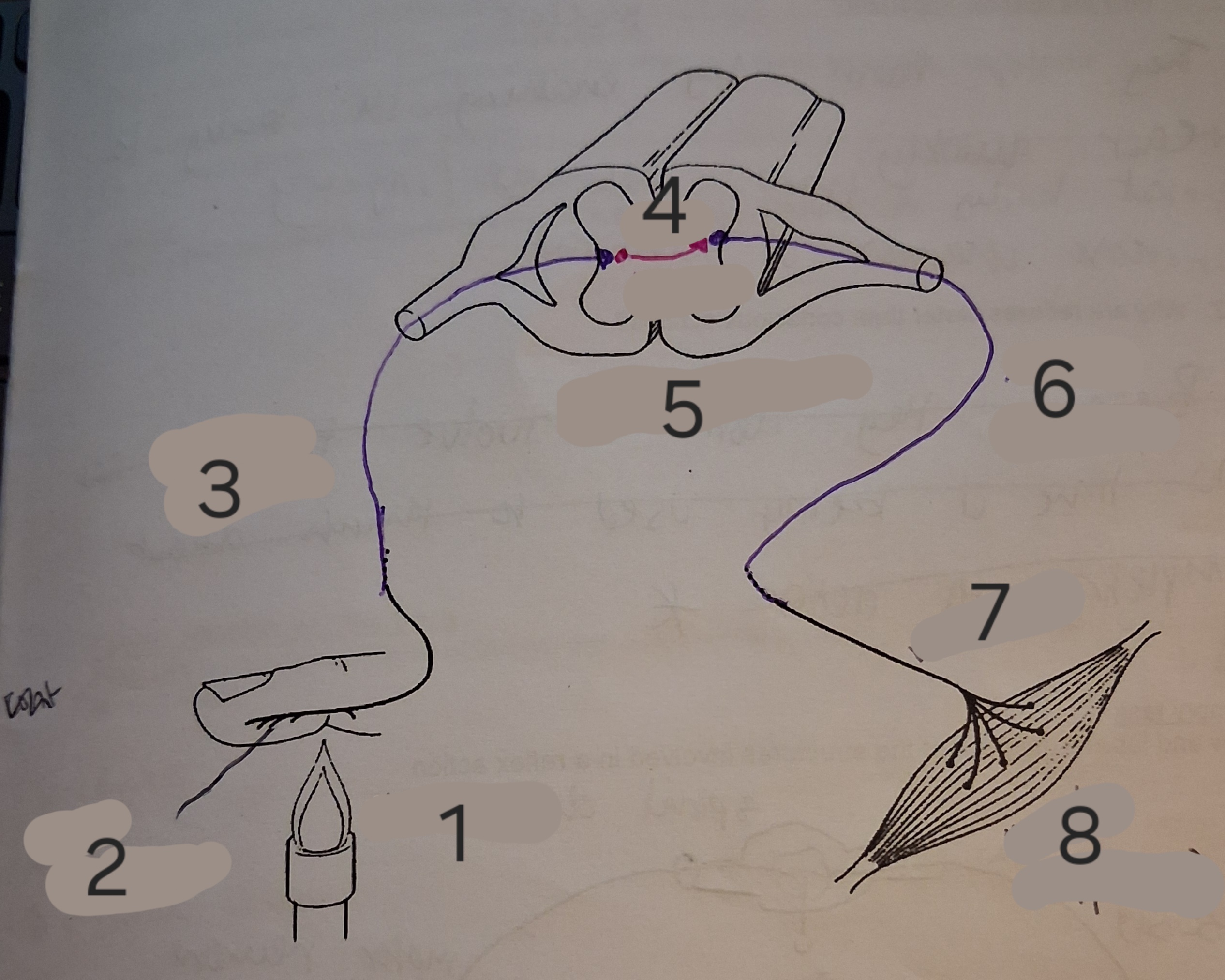
Label the diagram
1.Stimulus
2.Pain receptors
3.Sensory neurone
4.Relay neurone
5.Spinal chord
6.Motor neurone
7.Neurone
8.Muscle (effector)
Why are reflexes important?
Faster than conscious actions therefore:
-They stop harm by enabling the body to react quickly
-Protect the body from damage/injury
-Increase chances of survival
Why are reflexes faster than conscious actions?
There is only one relay neurone (either in the spinal chord or the brain) in a reflex whereas conscious actions may have many relay neurones
-Therefore reflex actions involve fewer synapses
-Diffusion of neurotransmitters across a synapse is slower than an electrical impulse
What factors affect reaction time?
-Tiredness
-Age
-Physical health
-Distractions
-Drugs
-Alcohol
-Left or right handedness
What is the equipment list for the required practical of reaction times?
-30cm ruler
-1m ruler
-Conversion chart
What is the method for the rp reaction time?
1.Person doing test sits in a chair with arm resting over the edge of a desk
2.Use the 30cm ruler to ensure their thumb and first finger are a set distance apart e.g 5cm
3.Line up the 0cm of the 1m ruler with their hand
4.Without warning, drop the 1m ruler
5.Record the distance of the ruler at the point they catch it
6.Use the conversion chart to convert distance into reaction time
What is the independent variable of the reaction time rp?
A factor that effects reaction time e.g left vs right hand, drinking caffeine
Can investigate:
-different ages
-increasing number of practices
-sex
-effect of sugar
-effect of distractions
What is the dependent variable of the reaction time rp?
Distance on ruler when caught
What are the control variables of the reaction time rp?
-Distance between first finger and thumb - use a ruler to keep this constant
-Hight dropped from - line up 0cm of the 1m ruler with their hand
-Distractions - keep to a minimum
What is the risk assessment for the reaction time rp?
-Hazard ruler: ruler
-Risk: could bounce and hit someone in the face
-Control measures: don’t throw the ruler down with force - just drop it
What is the expected results or trends and the explanation for the results of the reaction time rp?
-In general people have faster reaction time with their dominant hand/had caffeine
-It is not a reflex but a learned action, so more likely to be faster with dominant hand and caffeine increases reaction time
What are the possible sources of error in the reaction time rp?
-Distractions
-Difficulty in deciding distance on ruler if between measurements
-Ruler hits hand on way down
-May improve with practice
What are the ways of improving the method to reduce sources of error in the reaction time rp?
-Use ear muffs to remove noise distractions
-Be consistent - either use top or bottom of fingers to decide distance
-Have finger and thumb far enough apart to reduce likelihood of ruler hitting hand as it falls
-Leave gaps between tests to reduce effect of practicing
Is reaction time a reflex?
No - electrical impulses go to the conscious part of the brain
Why is it better to record the distance on the ruler, rather than try to time using a stopwatch?
Reaction time will be too short to measure accurately - likely to massively overestimate
How can the experiment be improved to increase the accuracy?
Use a computer programme where you touch a button when the screen changes, rather than testing with a ruler
How can the experiment be improved to increase the precision?
Carry out lots of repeats -discard anomalies - then calculate a mean