Common Plants in New Zealand Agriculture and Horticulture

0.0(0)
Studied by 0 people
call kaiCall Kai
learnLearn
examPractice Test
spaced repetitionSpaced Repetition
heart puzzleMatch
flashcardsFlashcards
GameKnowt Play
Card Sorting

1/99

flashcard set

Earn XP

Description and Tags

A collection of flashcards covering key terms and concepts regarding common plants in New Zealand agriculture and horticulture.

Last updated 2:07 AM on 4/22/26
Name
Mastery
Learn
Test
Matching
Spaced
Call with Kai

No analytics yet

Send a link to your students to track their progress

100 Terms

1
New cards

perennial ryegrass

Plant family: Poaceae
Life cycle: Perennial
Key persistence/spread: Tillering from basal buds; seed
Farming systems: Dairy, sheep, beef — dominant permanent pasture grass

How to identify

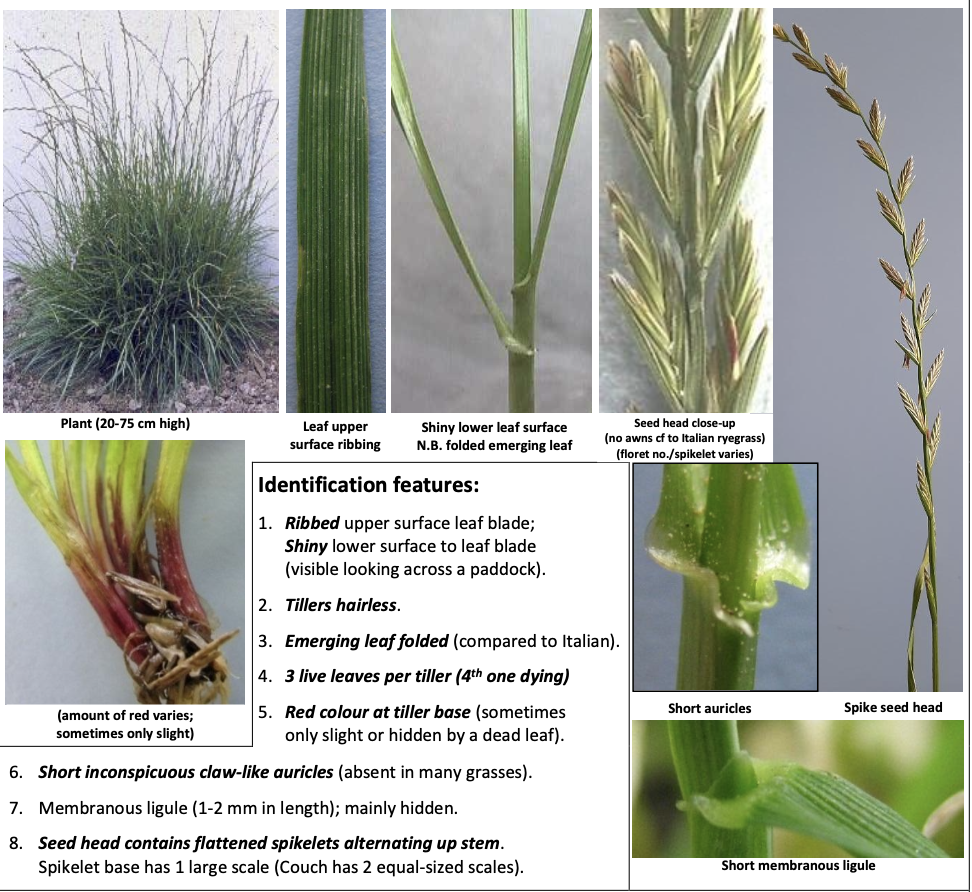
Forms dense, dark‑green, fine‑textured swards that tolerate frequent grazing. The upper leaf surface is ribbed while the lower surface is glossy and shiny, which is easiest to see when looking horizontally across a paddock in sunlight.

The emerging leaf is folded, not rolled — this is one of the most important diagnostic features and must be checked at the growing point. At the junction of leaf blade and sheath, short, claw‑like auricles are present but can be hard to see. The ligule is very short and membranous, often hidden.

At the base of the tiller, there is often a reddish or purplish colouring, though this may be faint or obscured by dead leaf material. Tillers are hairless.

The seed head is a flat spike with spikelets attached edge‑on to the stem. There are no awns — this is critical when distinguishing it from Italian ryegrass.

Commonly confused with Italian ryegrass, tall fescue, and prairie grass. Differs by having folded emerging leaves, short auricles, glossier leaves, and no awns.
<p><strong>Plant family:</strong> Poaceae<br><strong>Life cycle:</strong> Perennial<br><strong>Key persistence/spread:</strong> Tillering from basal buds; seed<br><strong>Farming systems:</strong> Dairy, sheep, beef — dominant permanent pasture grass</p><p><strong> How to identify </strong></p><p>Forms dense, dark‑green, fine‑textured swards that tolerate frequent grazing. The upper leaf surface is ribbed while the lower surface is glossy and shiny, which is easiest to see when looking horizontally across a paddock in sunlight.</p><p>The emerging leaf is folded, not rolled — this is one of the most important diagnostic features and must be checked at the growing point. At the junction of leaf blade and sheath, short, claw‑like auricles are present but can be hard to see. The ligule is very short and membranous, often hidden.</p><p>At the base of the tiller, there is often a reddish or purplish colouring, though this may be faint or obscured by dead leaf material. Tillers are hairless.</p><p>The seed head is a flat spike with spikelets attached edge‑on to the stem. There are no awns — this is critical when distinguishing it from Italian ryegrass.</p><p>Commonly confused with Italian ryegrass, tall fescue, and prairie grass. Differs by having folded emerging leaves, short auricles, glossier leaves, and no awns.</p>
2
New cards

Italian Ryegrass

Plant family: Poaceae
Life cycle: Annual to biennial
Key persistence/spread: Seed
Farming systems: Cropping rotations; winter and early spring feed

How to identify

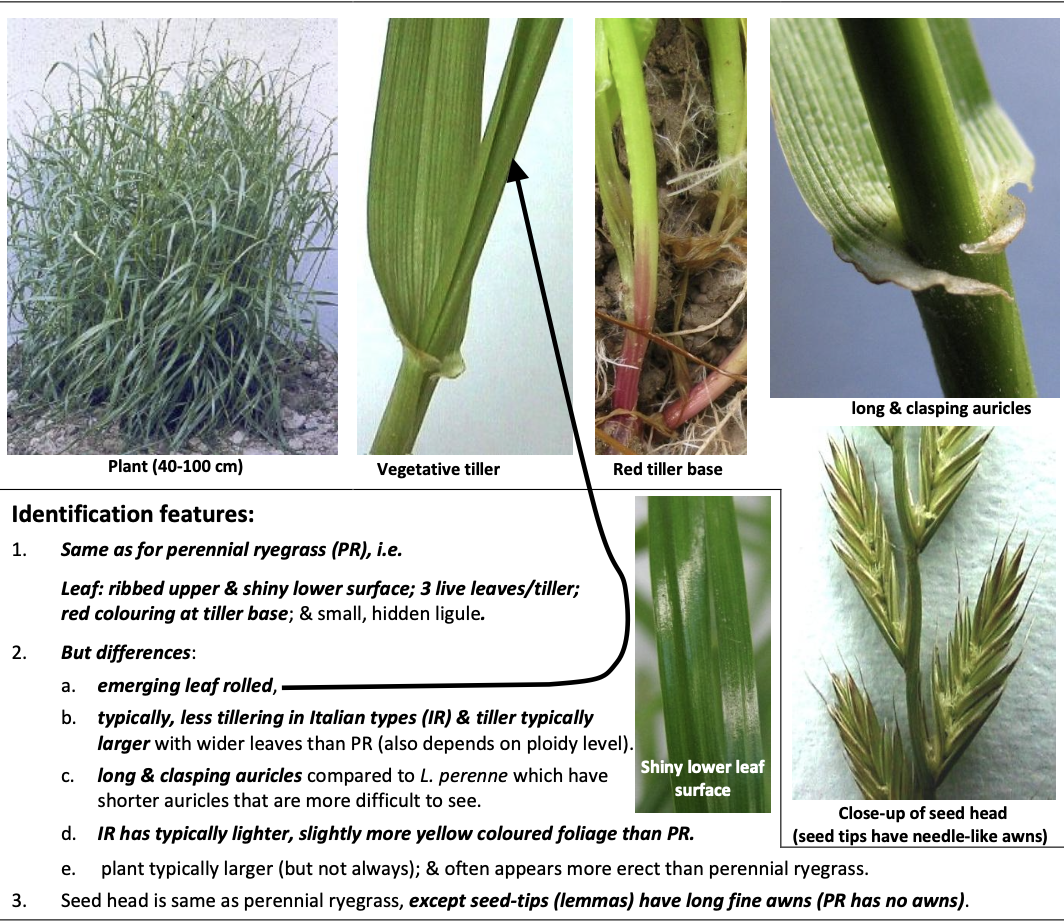
Is larger, more erect, and more open than perennial ryegrass. Leaves are broader and paler green, and plants generally look less densely tillered.

The key vegetative feature is the emerging leaf being rolled, not folded. This must be checked at the growing point. The auricles are long, conspicuous, and clasp tightly around the stem, making them much easier to see than those of perennial ryegrass.

Leaf surfaces are ribbed above and shiny below (like perennial ryegrass), so auricles and leaf emergence are essential for correct ID.

Seed heads are similar in structure to perennial ryegrass but the lemmas have fine awns, which are absent in perennial ryegrass.

Often confused with perennial ryegrass and tall fescue. The rolled leaf and long auricles are decisive.
<p><strong>Plant family:</strong> Poaceae<br><strong>Life cycle:</strong> Annual to biennial<br><strong>Key persistence/spread:</strong> Seed<br><strong>Farming systems:</strong> Cropping rotations; winter and early spring feed</p><p><strong>How to identify</strong></p><p>Is larger, more erect, and more open than perennial ryegrass. Leaves are broader and paler green, and plants generally look less densely tillered.</p><p>The key vegetative feature is the emerging leaf being rolled, not folded. This must be checked at the growing point. The auricles are long, conspicuous, and clasp tightly around the stem, making them much easier to see than those of perennial ryegrass.</p><p>Leaf surfaces are ribbed above and shiny below (like perennial ryegrass), so auricles and leaf emergence are essential for correct ID.</p><p>Seed heads are similar in structure to perennial ryegrass but the lemmas have fine awns, which are absent in perennial ryegrass.</p><p>Often confused with perennial ryegrass and tall fescue. The rolled leaf and long auricles are decisive.</p>
3
New cards

Tall Fescue

Plant family: Poaceae
Life cycle: Perennial
Key persistence/spread: Deep root system; tillers; endophyte‑assisted persistence
Farming systems: Sheep and beef; dry or cold regions

How to identify

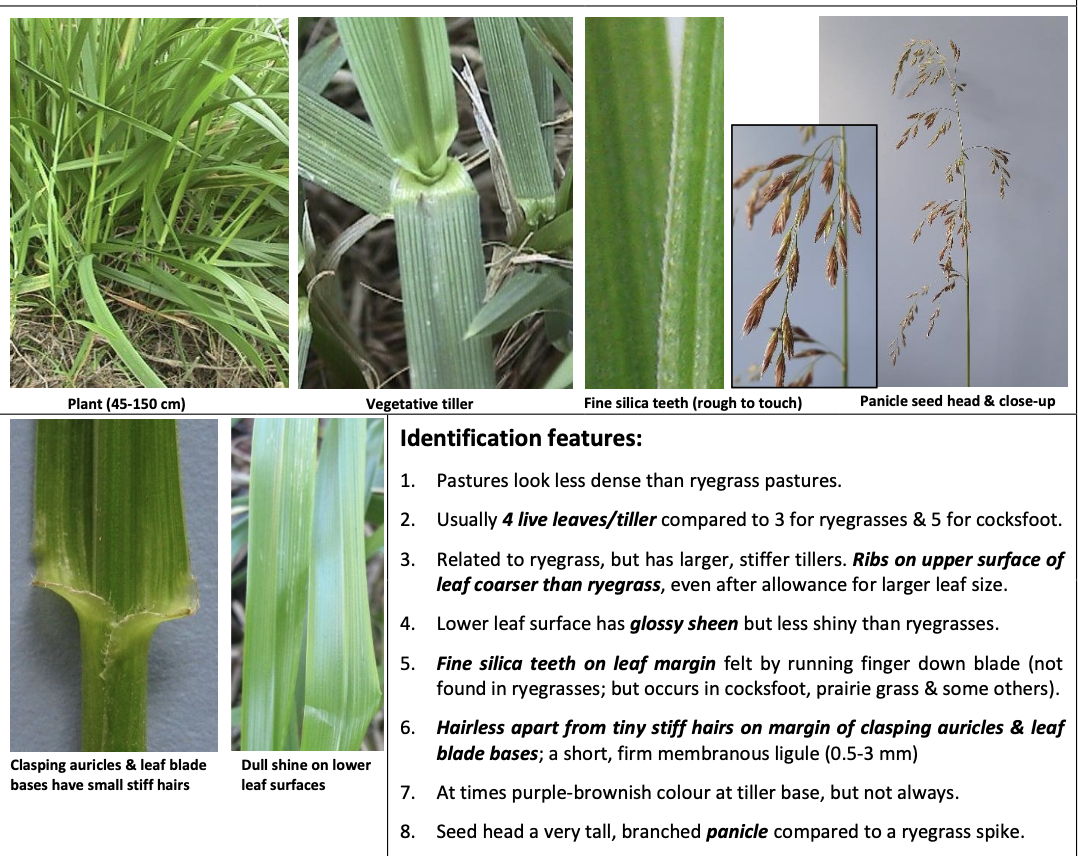
Produces coarser, less dense pastures than ryegrass. Leaves are broader, thicker, and stiffer, and the plant generally appears more upright and open.

The edges of the leaves feel rough or sandpapery due to silica teeth — this is a very reliable tactile feature. The lower leaf surface has a dull sheen, not the bright gloss of ryegrass.

Usually has four live leaves per tiller (compared to three in ryegrass). Auricles are short and often difficult to see.

The seed head is a large, upright, branched panicle, very different from the spike‑type seed head of ryegrasses.

Frequently misidentified as Italian ryegrass or prairie grass. Confirm by rough leaf margins, panicle seed head, and overall coarseness.
<p><strong>Plant family:</strong> Poaceae<br><strong>Life cycle:</strong> Perennial<br><strong>Key persistence/spread:</strong> Deep root system; tillers; endophyte‑assisted persistence<br><strong>Farming systems:</strong> Sheep and beef; dry or cold regions</p><p><strong> How to identify</strong></p><p>Produces coarser, less dense pastures than ryegrass. Leaves are broader, thicker, and stiffer, and the plant generally appears more upright and open.</p><p>The edges of the leaves feel rough or sandpapery due to silica teeth — this is a very reliable tactile feature. The lower leaf surface has a dull sheen, not the bright gloss of ryegrass.</p><p>Usually has four live leaves per tiller (compared to three in ryegrass). Auricles are short and often difficult to see.</p><p>The seed head is a large, upright, branched panicle, very different from the spike‑type seed head of ryegrasses.</p><p>Frequently misidentified as Italian ryegrass or prairie grass. Confirm by rough leaf margins, panicle seed head, and overall coarseness.</p>
4
New cards

Cocksfoot

Plant family: Poaceae
Life cycle: Perennial
Key persistence/spread: Dense tillering; crown buds; seed
Farming systems: Sheep and beef; hill country; lower fertility soils

How to identify

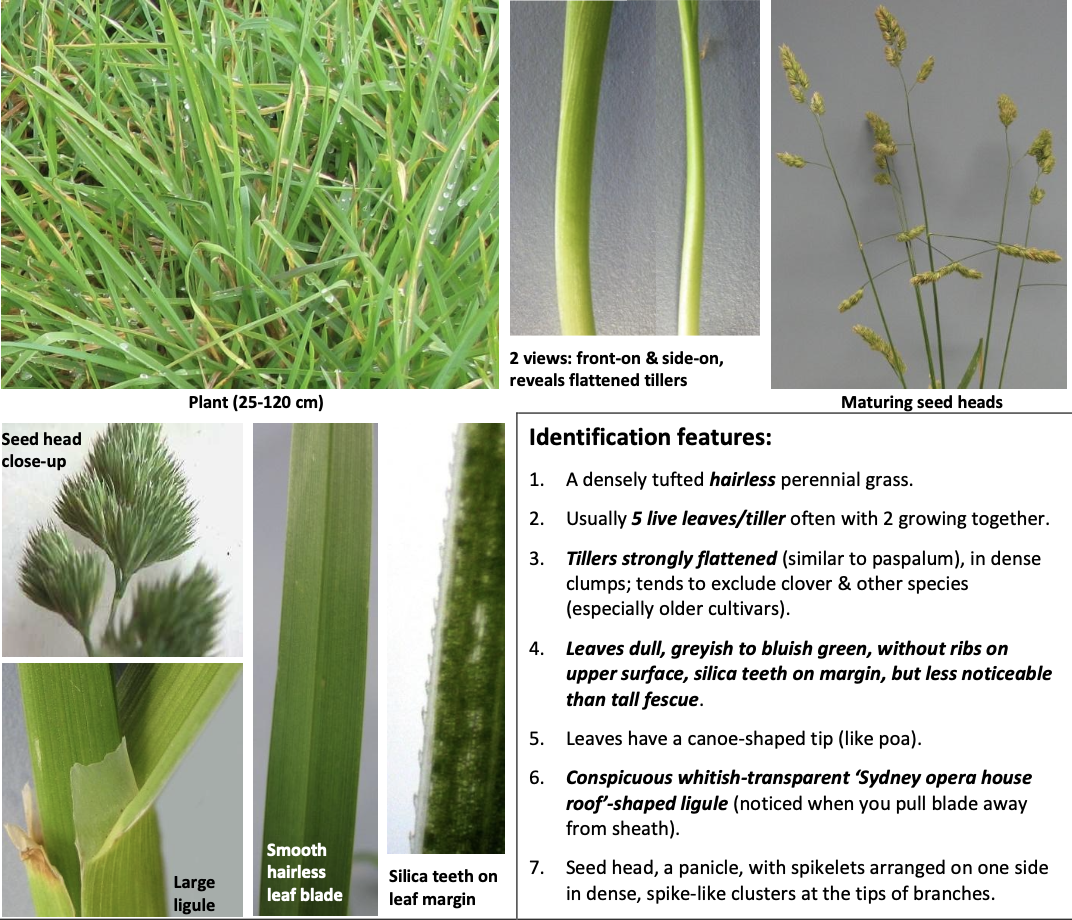
Grows in distinct tufted clumps, often excluding other species over time. The tillers are strongly flattened, which can be seen by slicing the base of the plant.

Leaves are dull blue‑green, not shiny, and lack ribbing. The leaf tips are often canoe‑shaped, similar to Poa species.

The ligule is very large, white, and membranous, often described as resembling the Sydney Opera House roof — this is one of the most diagnostic features and should always be checked.

Seed heads are panicles with clustered spikelets arranged on one side of branches.

Often confused with tall fescue or prairie grass but differs by flattened tillers, dull colour, large ligule, and clump growth form.
<p><strong>Plant family:</strong> Poaceae<br><strong>Life cycle:</strong> Perennial<br><strong>Key persistence/spread:</strong> Dense tillering; crown buds; seed<br><strong>Farming systems:</strong> Sheep and beef; hill country; lower fertility soils</p><p><strong> How to identify</strong></p><p>Grows in distinct tufted clumps, often excluding other species over time. The tillers are strongly flattened, which can be seen by slicing the base of the plant.</p><p>Leaves are dull blue‑green, not shiny, and lack ribbing. The leaf tips are often canoe‑shaped, similar to Poa species.</p><p>The ligule is very large, white, and membranous, often described as resembling the Sydney Opera House roof — this is one of the most diagnostic features and should always be checked.</p><p>Seed heads are panicles with clustered spikelets arranged on one side of branches.</p><p>Often confused with tall fescue or prairie grass but differs by flattened tillers, dull colour, large ligule, and clump growth form.</p>
5
New cards

Prairie Grass

Plant family: Poaceae
Life cycle: Short‑lived perennial
Key persistence/spread: Large seeds; self‑seeding
Farming systems: Dryland sheep and beef finishing

How to identify

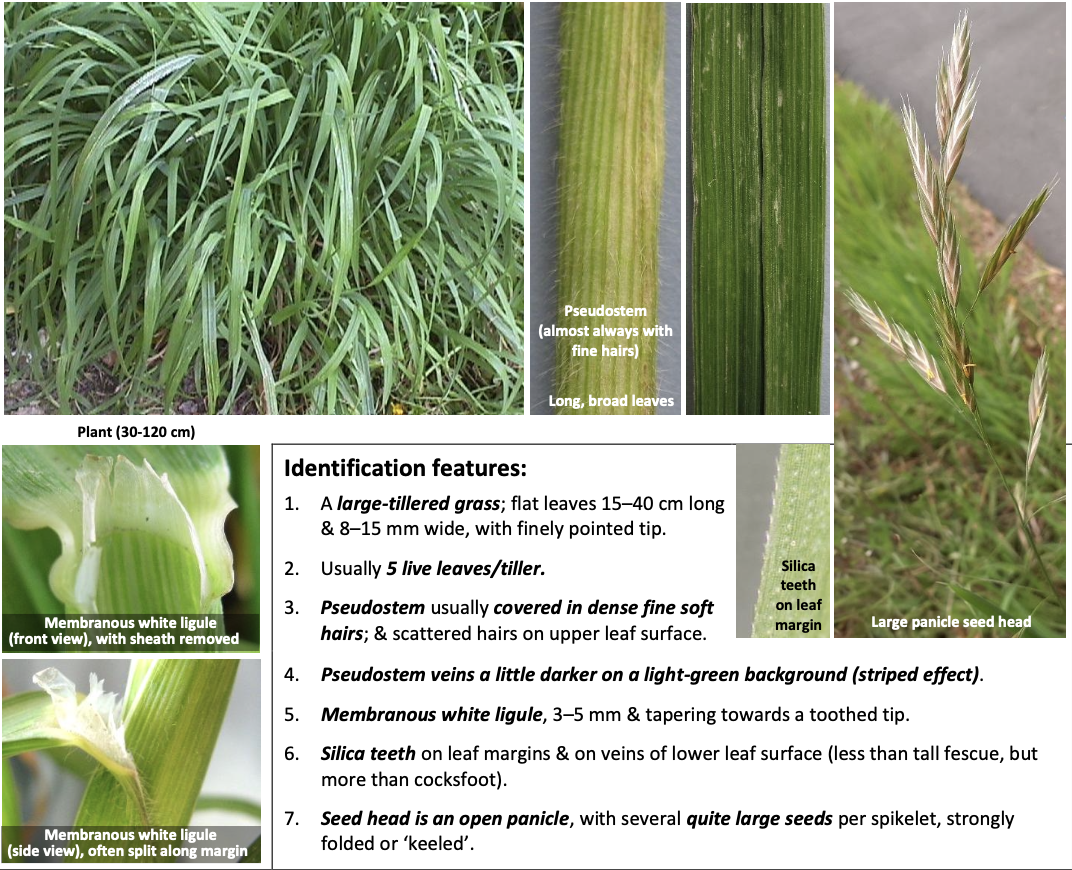
Has very broad, soft leaves compared to ryegrass and a generally lush appearance. The pseudostem and leaf sheaths are often covered in fine soft hairs, which is a critical feature.

Leaves are flat, wide, and can be up to several centimetres across. The ligule is white, membranous, and jagged at the tip.

The seed head is a large, open panicle with big seeds, and the seeds themselves are often eaten by stock.

Often confused with tall fescue or Italian ryegrass. The combination of hairiness, broadness, and large open panicle distinguishes it.
<p><strong>Plant family:</strong> Poaceae<br><strong>Life cycle:</strong> Short‑lived perennial<br><strong>Key persistence/spread:</strong> Large seeds; self‑seeding<br><strong>Farming systems:</strong> Dryland sheep and beef finishing</p><p><strong>How to identify</strong></p><p>Has very broad, soft leaves compared to ryegrass and a generally lush appearance. The pseudostem and leaf sheaths are often covered in fine soft hairs, which is a critical feature.</p><p>Leaves are flat, wide, and can be up to several centimetres across. The ligule is white, membranous, and jagged at the tip.</p><p>The seed head is a large, open panicle with big seeds, and the seeds themselves are often eaten by stock.</p><p>Often confused with tall fescue or Italian ryegrass. The combination of hairiness, broadness, and large open panicle distinguishes it.</p>
6
New cards

Paspalum

Plant family: Poaceae
Life cycle: Perennial (C₄ grass)
Key persistence/spread: Rhizomes; seed
Farming systems: Northern dairy and beef systems

How to identify

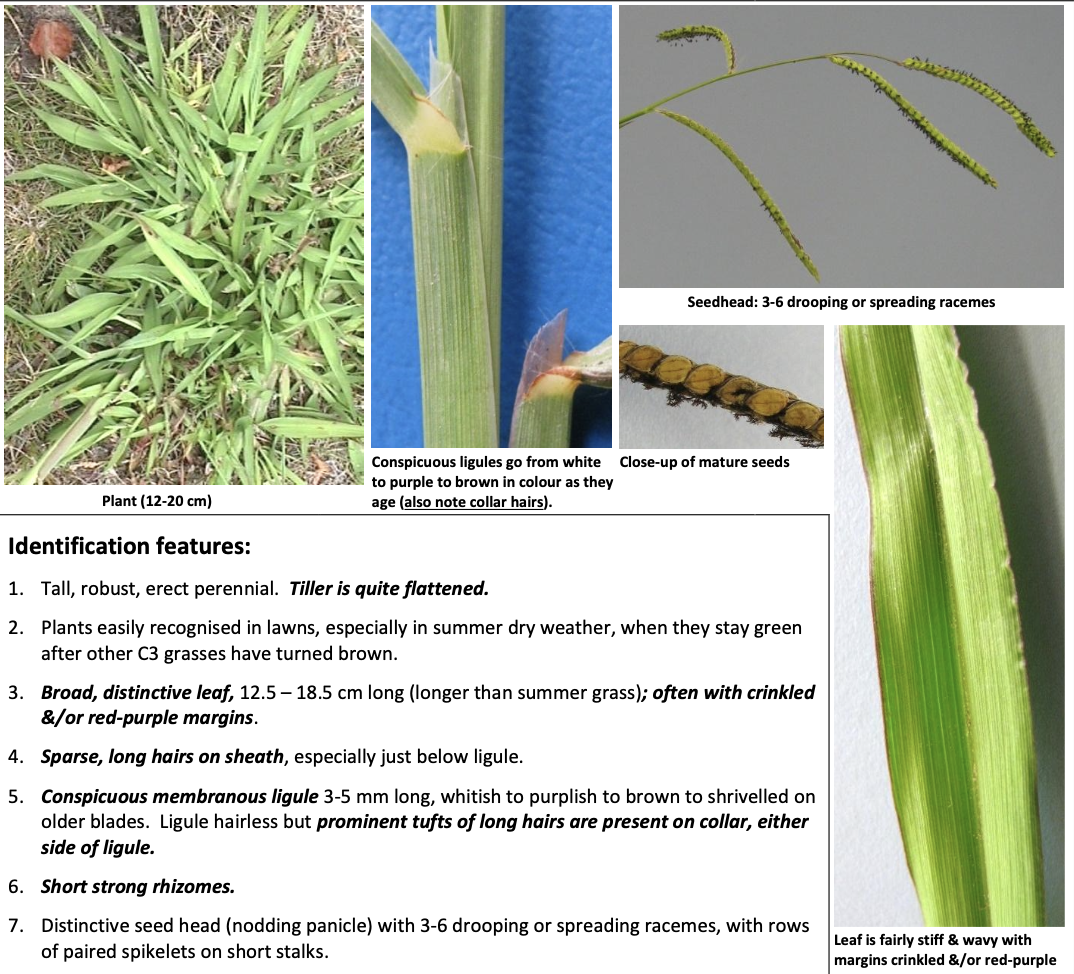
Is most noticeable in summer, when it remains green after ryegrass browns off. Plants are robust, coarse, and upright, with flattened tillers similar in shape to cocksfoot.

Leaves are broad and often have crinkled margins with occasional purple tinges. At the collar region, there are tufts of long hairs, and the membranous ligule is prominent.

The seed head is very distinctive: 3–6 drooping, finger‑like racemes radiating from the stem.

Often confused with kikuyu or summer grass. It is upright and tufted, whereas kikuyu creeps.
<p><strong>Plant family:</strong> Poaceae<br><strong>Life cycle:</strong> Perennial (C₄ grass)<br><strong>Key persistence/spread:</strong> Rhizomes; seed<br><strong>Farming systems:</strong> Northern dairy and beef systems</p><p><strong>How to identify</strong></p><p>Is most noticeable in summer, when it remains green after ryegrass browns off. Plants are robust, coarse, and upright, with flattened tillers similar in shape to cocksfoot.</p><p>Leaves are broad and often have crinkled margins with occasional purple tinges. At the collar region, there are tufts of long hairs, and the membranous ligule is prominent.</p><p>The seed head is very distinctive: 3–6 drooping, finger‑like racemes radiating from the stem.</p><p>Often confused with kikuyu or summer grass. It is upright and tufted, whereas kikuyu creeps.</p>
7
New cards

Kikuyu

Plant family: Poaceae
Life cycle: Perennial (C₄ grass)
Key persistence/spread: Stolons and rhizomes
Farming systems: Northern and coastal pastures

How to identify

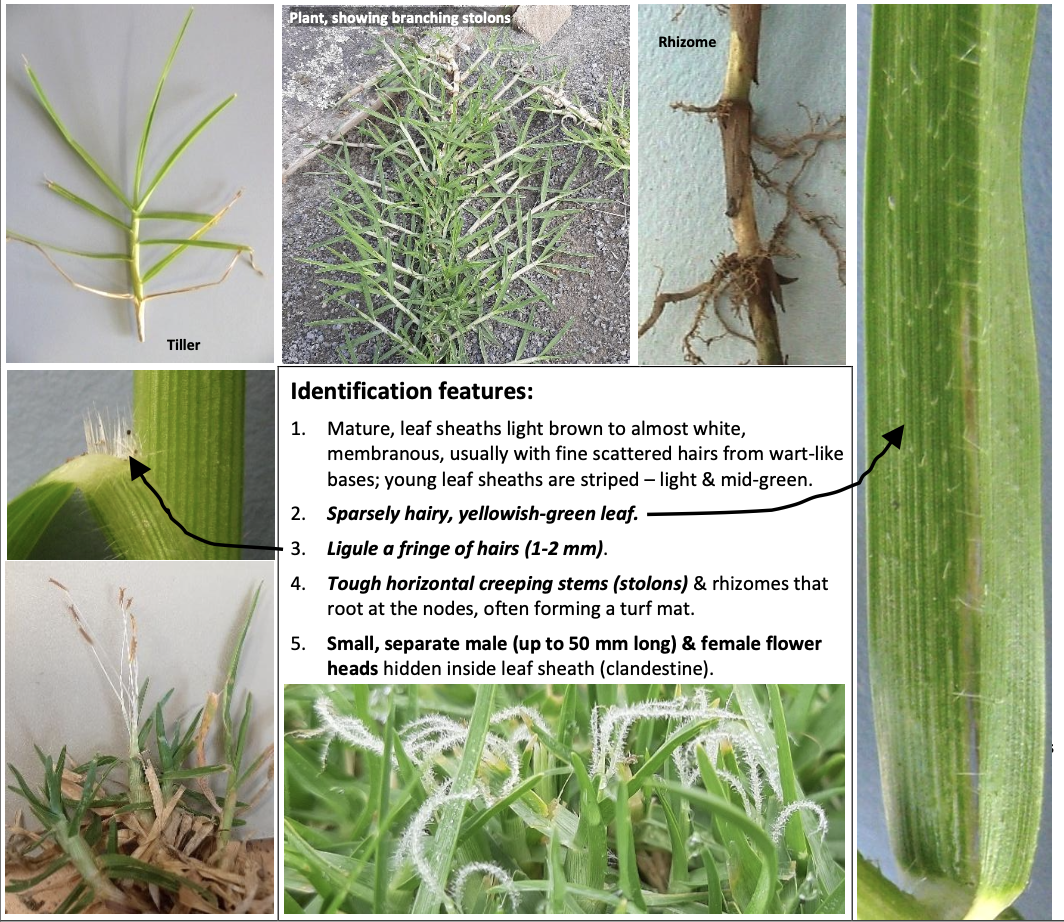
Forms dense creeping mats that spread horizontally across the soil and climb fences and trees. It produces thick stolons above ground and rhizomes below ground, rooting at the nodes.

Leaves are tough, yellow‑green, and sparsely hairy. The ligule is a fringe of short hairs, not membranous.

Flowers are rarely noticed, as they are hidden inside the leaf sheath (“clandestine”).

Extremely invasive once established and often dominates summer pastures. Distinguished from paspalum by creeping growth habit.
<p><strong>Plant family:</strong> Poaceae<br><strong>Life cycle:</strong> Perennial (C₄ grass)<br><strong>Key persistence/spread:</strong> Stolons and rhizomes<br><strong>Farming systems:</strong> Northern and coastal pastures</p><p><strong> How to identify</strong></p><p>Forms dense creeping mats that spread horizontally across the soil and climb fences and trees. It produces thick stolons above ground and rhizomes below ground, rooting at the nodes.</p><p>Leaves are tough, yellow‑green, and sparsely hairy. The ligule is a fringe of short hairs, not membranous.</p><p>Flowers are rarely noticed, as they are hidden inside the leaf sheath (“clandestine”).</p><p>Extremely invasive once established and often dominates summer pastures. Distinguished from paspalum by creeping growth habit.</p>
8
New cards

Browntop

Plant family: Poaceae
Life cycle: Perennial
Key persistence/spread: stolons, rhizomes, and seed
Farming systems: Hill country; low-fertility pastures

How to identify

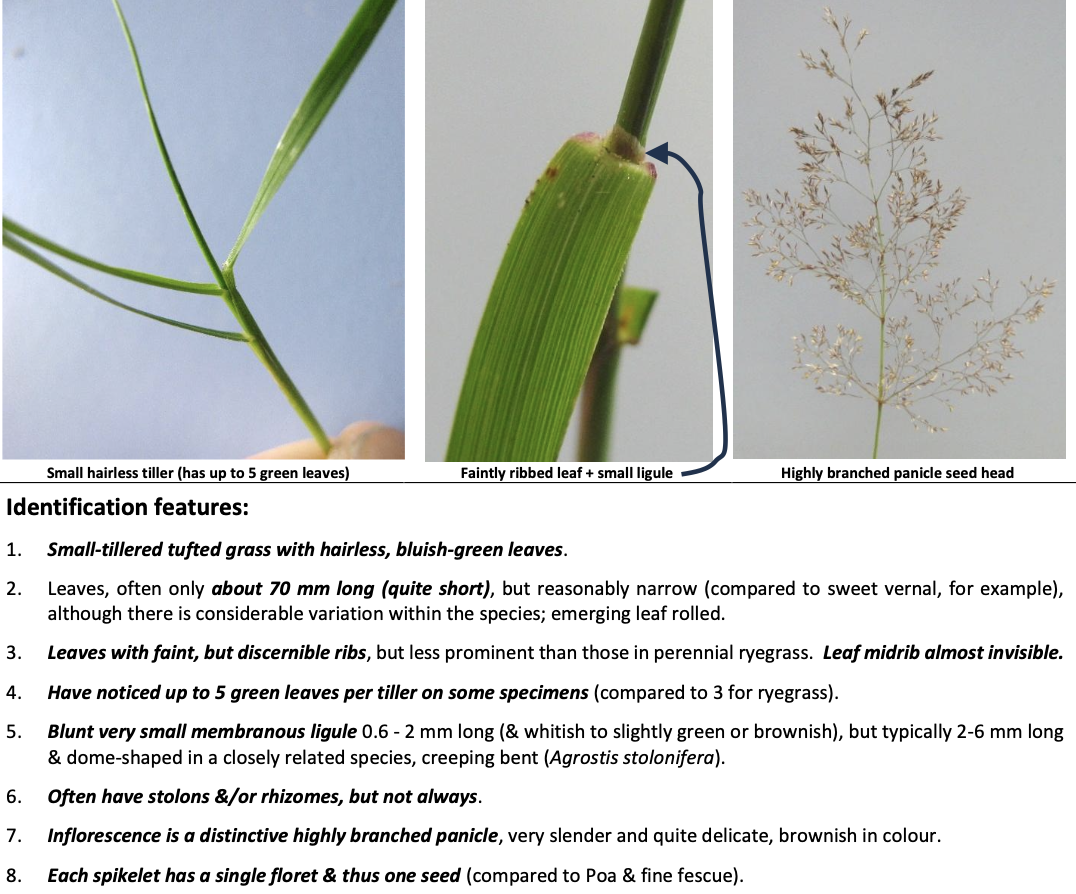
Forms fine, low‑density swards and tolerates poor soil. Leaves are fine, short, and dull bluish‑green. The midrib is indistinct.

The seed head is a very fine, airy, highly branched panicle that looks delicate and brownish when mature.

May have stolons or rhizomes, but these are variable and not always visible.

Often confused with sweet vernal or fine fescues, it lacks a strong smell and has finer panicles.
<p><strong>Plant family:</strong> Poaceae<br><strong>Life cycle:</strong> Perennial<br><strong>Key persistence/spread:</strong> stolons, rhizomes, and seed<br><strong>Farming systems:</strong> Hill country; low-fertility pastures</p><p><strong> How to identify</strong></p><p>Forms fine, low‑density swards and tolerates poor soil. Leaves are fine, short, and dull bluish‑green. The midrib is indistinct.</p><p>The seed head is a very fine, airy, highly branched panicle that looks delicate and brownish when mature.</p><p>May have stolons or rhizomes, but these are variable and not always visible.</p><p>Often confused with sweet vernal or fine fescues, it lacks a strong smell and has finer panicles. </p>
9
New cards

Sweet Vernal

Plant family: Poaceae
Life cycle: Perennial
Key persistence/spread: Seed
Farming systems: Dry slopes; low fertility pastures

How to identify

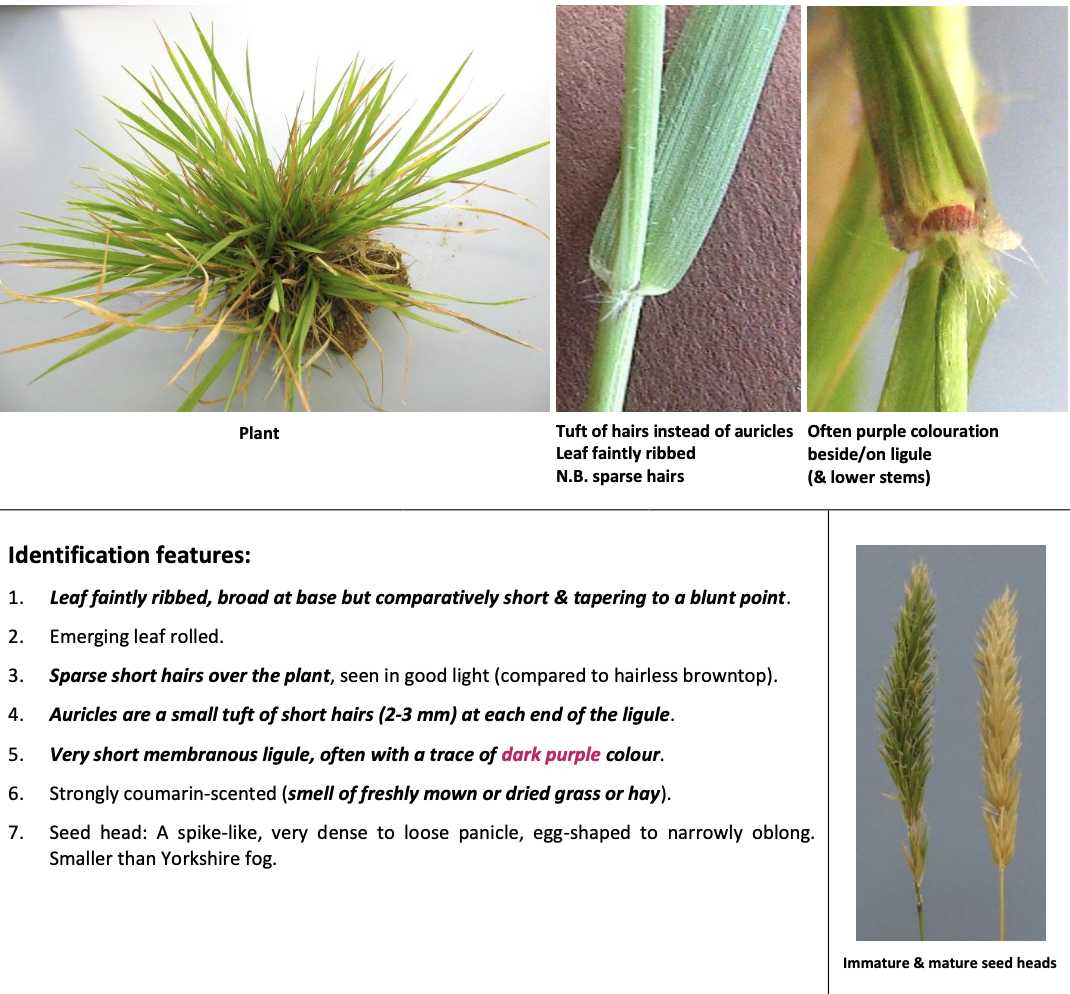
Is best known for its distinct sweet hay smell when crushed or dried. Leaves are short and relatively broad at the base, tapering to a blunt tip.

The plant has sparse fine hairs and small tufts of hair instead of auricles. The ligule is very short and often tinged purple.

Seed heads are short, compact, and spike‑like compared with browntop.

Smell is often the fastest way to confirm identity.
<p><strong>Plant family:</strong> Poaceae<br><strong>Life cycle:</strong> Perennial<br><strong>Key persistence/spread:</strong> Seed<br><strong>Farming systems:</strong> Dry slopes; low fertility pastures</p><p><strong> How to identify</strong></p><p>Is best known for its distinct sweet hay smell when crushed or dried. Leaves are short and relatively broad at the base, tapering to a blunt tip.</p><p>The plant has sparse fine hairs and small tufts of hair instead of auricles. The ligule is very short and often tinged purple.</p><p>Seed heads are short, compact, and spike‑like compared with browntop.</p><p>Smell is often the fastest way to confirm identity.</p>
10
New cards

Yorkshire Fog

Plant family: Poaceae
Life cycle: Perennial
Key persistence/spread: Seed
Farming systems: Wet pastures; forestry blocks

How to identify

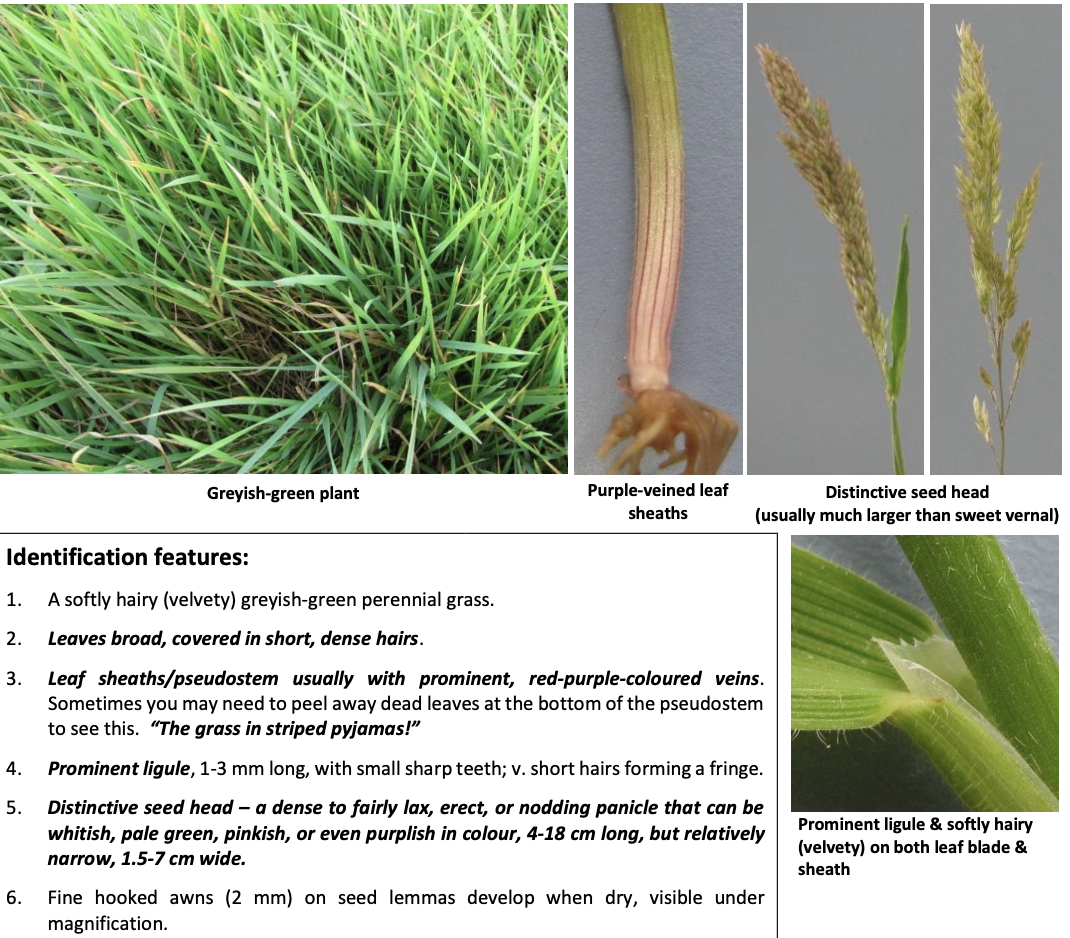
Is soft, velvety, and pale grey-green. Leaves and sheaths are covered in dense hairs, making the plant feel fuzzy.

Leaf sheaths often show purple‑red striping, a very distinctive feature (“grass in striped pyjamas”).

The ligule is relatively prominent and toothed. Seed heads are fluffy panicles, usually pale pink or white when young.

Easily confused with prairie grass at a distance, but it is much softer and more hairy.
<p><strong>Plant family:</strong> Poaceae<br><strong>Life cycle:</strong> Perennial<br><strong>Key persistence/spread:</strong> Seed<br><strong>Farming systems:</strong> Wet pastures; forestry blocks</p><p><strong> How to identify</strong></p><p>Is soft, velvety, and pale grey-green. Leaves and sheaths are covered in dense hairs, making the plant feel fuzzy.</p><p>Leaf sheaths often show purple‑red striping, a very distinctive feature (“grass in striped pyjamas”).</p><p>The ligule is relatively prominent and toothed. Seed heads are fluffy panicles, usually pale pink or white when young.</p><p>Easily confused with prairie grass at a distance, but it is much softer and more hairy.</p>
11
New cards

White Clover

Plant family: Fabaceae
Life cycle: Perennial
Key persistence/spread: Stolons rooting at nodes; seed
Farming systems: Dairy, sheep, beef — virtually all NZ pastures

How to identify

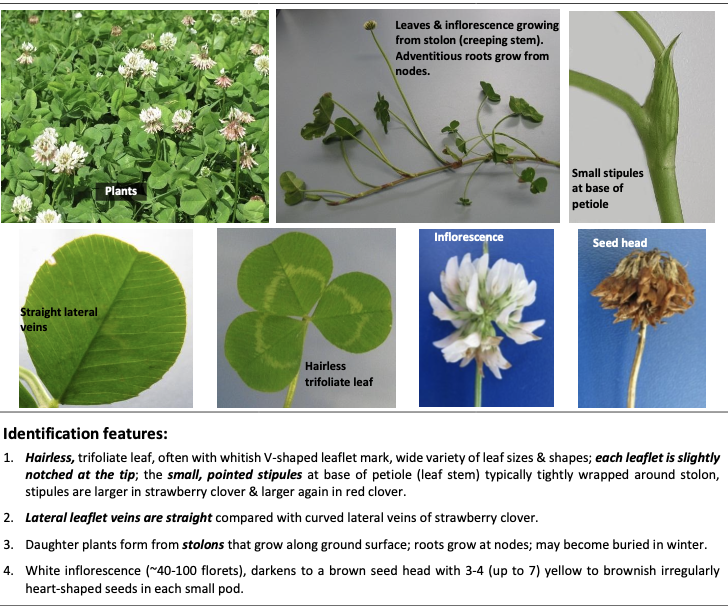
Is a low‑growing, creeping legume that spreads by above‑ground stolons, which root at the nodes. This creeping habit is the most important feature distinguishing it from other clovers. Individual plants are hard to define because stolons constantly fragment and re‑root.

Leaves are trifoliate and hairless, with leaflets usually bearing a white or pale V‑shaped marking, though this can vary by cultivar and environment. Each leaflet has a small notch at the tip, which is subtle but characteristic. The leaf stalk (petiole) emerges directly from the stolon.

At the base of each petiole are small, pointed stipules, often wrapped tightly around the stolon. This helps distinguish it from strawberry clover (larger stipules) and red clover (much larger stipules and upright growth).

Flower heads are white, rounded, and borne on separate stalks, well above the leaves. After flowering, heads turn brown as seeds mature.

Commonly confused with:

  • Subterranean clover → Subterranean clover is hairy and does not form stolons.

  • Red clover → red clover is upright with hairy leaves and no stolons.
<p><strong>Plant family:</strong> Fabaceae<br><strong>Life cycle:</strong> Perennial<br><strong>Key persistence/spread:</strong> Stolons rooting at nodes; seed<br><strong>Farming systems:</strong> Dairy, sheep, beef — virtually all NZ pastures</p><p><strong> How to identify</strong></p><p>Is a low‑growing, creeping legume that spreads by above‑ground stolons, which root at the nodes. This creeping habit is the most important feature distinguishing it from other clovers. Individual plants are hard to define because stolons constantly fragment and re‑root.</p><p>Leaves are trifoliate and hairless, with leaflets usually bearing a white or pale V‑shaped marking, though this can vary by cultivar and environment. Each leaflet has a small notch at the tip, which is subtle but characteristic. The leaf stalk (petiole) emerges directly from the stolon.</p><p>At the base of each petiole are small, pointed stipules, often wrapped tightly around the stolon. This helps distinguish it from <u>strawberry</u> clover (larger stipules) and red clover (much larger stipules and upright growth).</p><p>Flower heads are white, rounded, and borne on separate stalks, well above the leaves. After flowering, heads turn brown as seeds mature.</p><p>Commonly confused with:</p><ul><li><p>Subterranean clover → Subterranean clover is hairy and does <em>not</em> form stolons.</p></li><li><p>Red clover → red clover is upright with hairy leaves and no stolons.</p></li></ul><p></p>
12
New cards

Red Clover

Plant family: Fabaceae
Life cycle: Short‑lived perennial
Key persistence/spread: Taproot; seed
Farming systems: Grazed pasture, silage and hay systems

How to identify

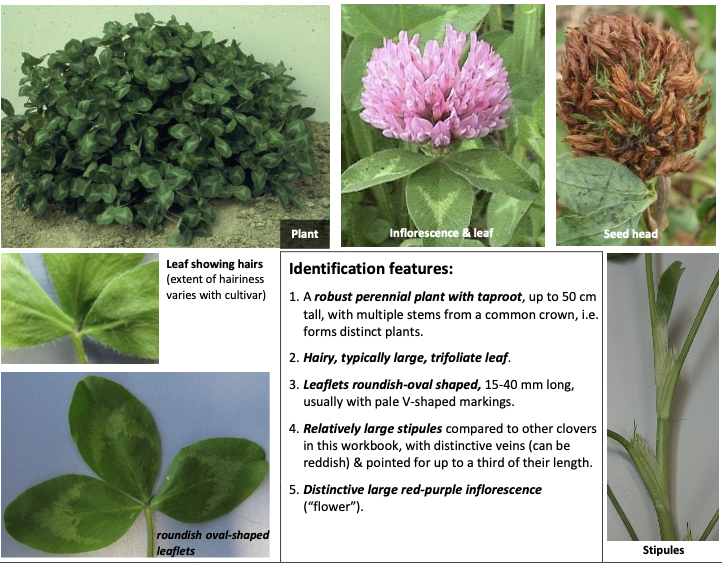
Grows as a distinct upright plant with multiple stems arising from a central crown connected to a strong taproot. Unlike white clover, it does not creep via stolons.

Leaves are trifoliate and hairy, noticeably larger than white clover leaves. Leaflets are oval to round, often with a pale V or crescent marking. The hairs are especially noticeable along leaf margins and petioles.

A key diagnostic feature is the large, veined stipules at the base of each leaf stalk; these are much bigger than in white clover and often pointed for a significant portion of their length.

Flower heads are large, dense, and red to purple, sitting above the foliage. Stems are thicker and more robust than white clover.

Often confused with:

  • White clover → white clover creeps and is hairless.

  • Subterranean clover → sub clover is prostrate and annual.
<p><strong>Plant family:</strong> Fabaceae<br><strong>Life cycle:</strong> Short‑lived perennial<br><strong>Key persistence/spread:</strong> Taproot; seed<br><strong>Farming systems:</strong> Grazed pasture, silage and hay systems</p><p><strong>How to identify</strong></p><p>Grows as a distinct upright plant with multiple stems arising from a central crown connected to a strong taproot. Unlike white clover, it does not creep via stolons.</p><p>Leaves are trifoliate and hairy, noticeably larger than white clover leaves. Leaflets are oval to round, often with a pale V or crescent marking. The hairs are especially noticeable along leaf margins and petioles.</p><p>A key diagnostic feature is the large, veined stipules at the base of each leaf stalk; these are much bigger than in white clover and often pointed for a significant portion of their length.</p><p>Flower heads are large, dense, and red to purple, sitting above the foliage. Stems are thicker and more robust than white clover.</p><p>Often confused with:</p><ul><li><p>White clover → white clover creeps and is hairless.</p></li><li><p>Subterranean clover → sub clover is prostrate and annual.</p></li></ul><p></p>
13
New cards

Subterranean Clover

Plant family: Fabaceae
Life cycle: Winter annual
Key persistence/spread: Buried hard seed
Farming systems: Dryland sheep systems

How to identify

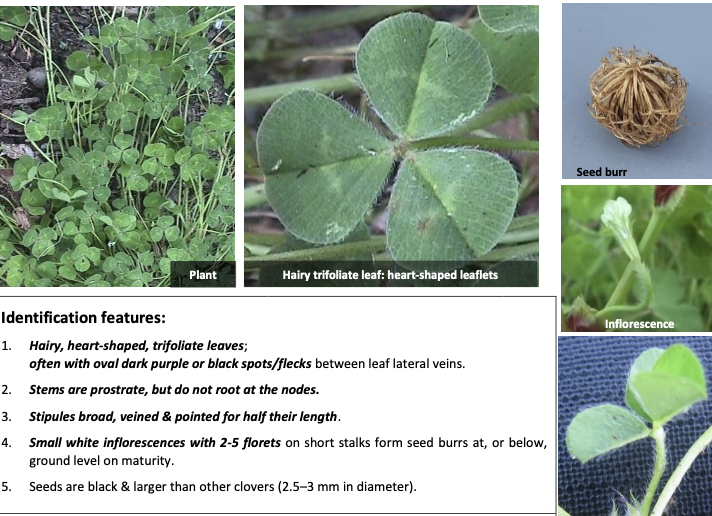
Is a low‑growing, prostrate annual that germinates in autumn and completes its life cycle in spring. It does not develop stolons like white clover.

Leaves are trifoliate and distinctly hairy, with heart‑shaped leaflets. Many cultivars have small dark purple or black spots on the leaflets, though this is variable.

Stems grow horizontally along the soil surface but do not root at the nodes. The most distinctive feature occurs after flowering: the flower stalk bends downward and pushes the developing seed burr into the soil. This trait is unique and gives the plant its name.

Seeds are large, dark, and hard‑coated, allowing persistence through dry summers.

Often confused with:

  • White clover → white clover is perennial, hairless, and stoloniferous.

  • Red clover (seedlings) → red clover becomes upright quickly and is not prostrate.
<p><strong>Plant family:</strong> Fabaceae<br><strong>Life cycle:</strong> Winter annual<br><strong>Key persistence/spread:</strong> Buried hard seed<br><strong>Farming systems:</strong> Dryland sheep systems</p><p><strong>How to identify</strong></p><p>Is a low‑growing, prostrate annual that germinates in autumn and completes its life cycle in spring. It does not develop stolons like white clover.</p><p>Leaves are trifoliate and distinctly hairy, with heart‑shaped leaflets. Many cultivars have small dark purple or black spots on the leaflets, though this is variable.</p><p>Stems grow horizontally along the soil surface but do not root at the nodes. The most distinctive feature occurs after flowering: the flower stalk bends downward and pushes the developing seed burr into the soil. This trait is unique and gives the plant its name.</p><p>Seeds are large, dark, and hard‑coated, allowing persistence through dry summers.</p><p>Often confused with:</p><ul><li><p>White clover → white clover is perennial, hairless, and stoloniferous.</p></li><li><p>Red clover (seedlings) → red clover becomes upright quickly and is not prostrate.</p></li></ul><p></p>
14
New cards

Balansa Clover

Plant family: Fabaceae
Life cycle: Winter annual
Key persistence/spread: Hard seed
Farming systems: Winter‑wet pastures, mixed sheep and beef

How to identify

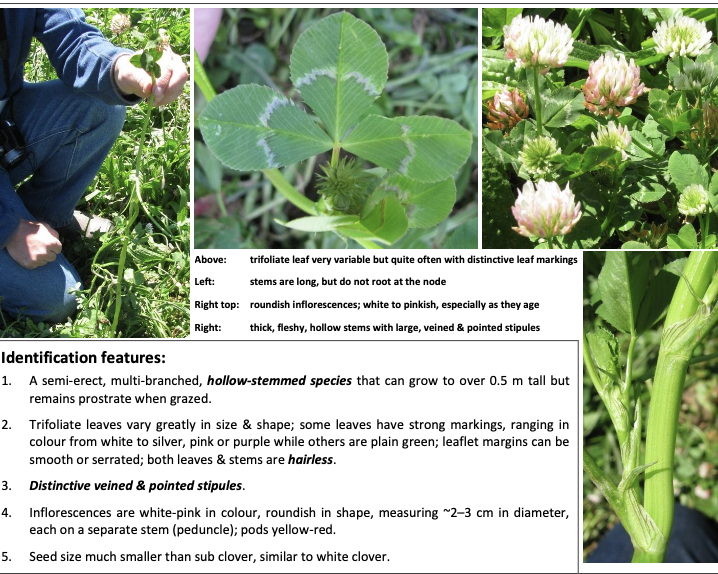
Is a semi‑erect annual clover that can appear upright when ungrazed but flattens under grazing. Unlike sub clover, plants are hairless, and stems are noticeably hollow — this is a key distinguishing feature.

Leaflets are trifoliate and highly variable in size and shape, often with prominent silver, pink, or purple markings. The leaf margins may be smooth or serrated.

Stipules are large, veined, and pointed, larger than in white clover.

Flower heads are rounded and white to pink, borne on individual stalks. Seeds are small but often hard‑coated, allowing regeneration for multiple years after seed set.

Commonly confused with:

  • White clover → white clover creeps via stolons.

  • Sub clover → sub clover is hairy and buries seed.
<p><strong>Plant family:</strong> Fabaceae<br><strong>Life cycle:</strong> Winter annual<br><strong>Key persistence/spread:</strong> Hard seed<br><strong>Farming systems:</strong> Winter‑wet pastures, mixed sheep and beef</p><p><strong>How to identify</strong></p><p>Is a semi‑erect annual clover that can appear upright when ungrazed but flattens under grazing. Unlike sub clover, plants are hairless, and stems are noticeably hollow — this is a key distinguishing feature.</p><p>Leaflets are trifoliate and highly variable in size and shape, often with prominent silver, pink, or purple markings. The leaf margins may be smooth or serrated.</p><p>Stipules are large, veined, and pointed, larger than in white clover.</p><p>Flower heads are rounded and white to pink, borne on individual stalks. Seeds are small but often hard‑coated, allowing regeneration for multiple years after seed set.</p><p>Commonly confused with:</p><ul><li><p>White clover → white clover creeps via stolons.</p></li><li><p>Sub clover → sub clover is hairy and buries seed.</p></li></ul><p></p>
15
New cards

Lucerne

Plant family: Fabaceae
Life cycle: Perennial
Key persistence/spread: Deep taproot; seed
Farming systems: Dryland grazing, hay and silage

How to identify

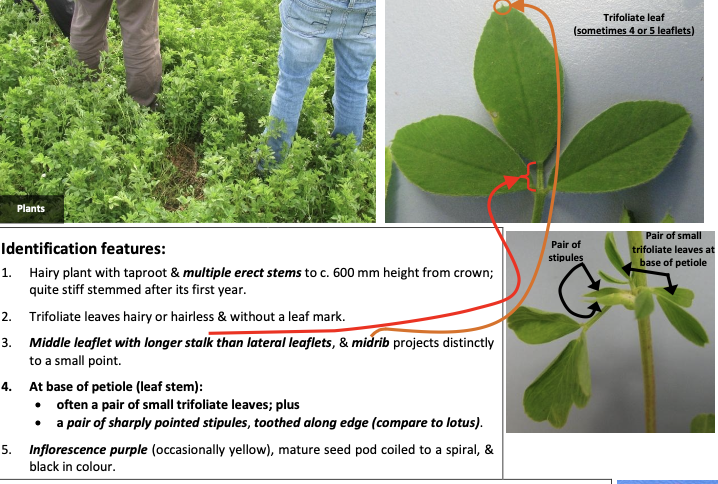
Is an upright, deep‑rooted perennial with multiple stiff stems arising from a woody crown. The taproot penetrates deeply, giving good drought tolerance.

Leaves are trifoliate, and a critical diagnostic feature is that the middle leaflet is carried on a slightly longer stalk than the side leaflets. In addition, the midrib extends beyond the leaflet tip into a small point, which is very useful for identification.

At the base of the petiole, it often has:

  • A pair of small trifoliate leaves

  • A pair of sharp‑pointed, toothed stipules

Flowers are typically purple, and seed pods are distinctive — coiled into a tight spiral.

Often misidentified as:

  • Lotus → lotus appears to have five leaflets and has yellow flowers.
<p><strong>Plant family:</strong> Fabaceae<br><strong>Life cycle:</strong> Perennial<br><strong>Key persistence/spread:</strong> Deep taproot; seed<br><strong>Farming systems:</strong> Dryland grazing, hay and silage</p><p><strong>How to identify</strong></p><p>Is an upright, deep‑rooted perennial with multiple stiff stems arising from a woody crown. The taproot penetrates deeply, giving good drought tolerance.</p><p>Leaves are trifoliate, and a critical diagnostic feature is that the middle leaflet is carried on a slightly longer stalk than the side leaflets. In addition, the midrib extends beyond the leaflet tip into a small point, which is very useful for identification.</p><p>At the base of the petiole, it often has:</p><ul><li><p>A pair of small trifoliate leaves</p></li><li><p>A pair of sharp‑pointed, toothed stipules</p></li></ul><p>Flowers are typically purple, and seed pods are distinctive — coiled into a tight spiral.</p><p>Often misidentified as:</p><ul><li><p>Lotus → lotus appears to have five leaflets and has yellow flowers.</p></li></ul><p></p>
16
New cards

Lotus

Plant family: Fabaceae
Life cycle: Perennial
Key persistence/spread: Seed (some species stoloniferous)
Farming systems: Wet soils, acid soils, forestry blocks

How to identify

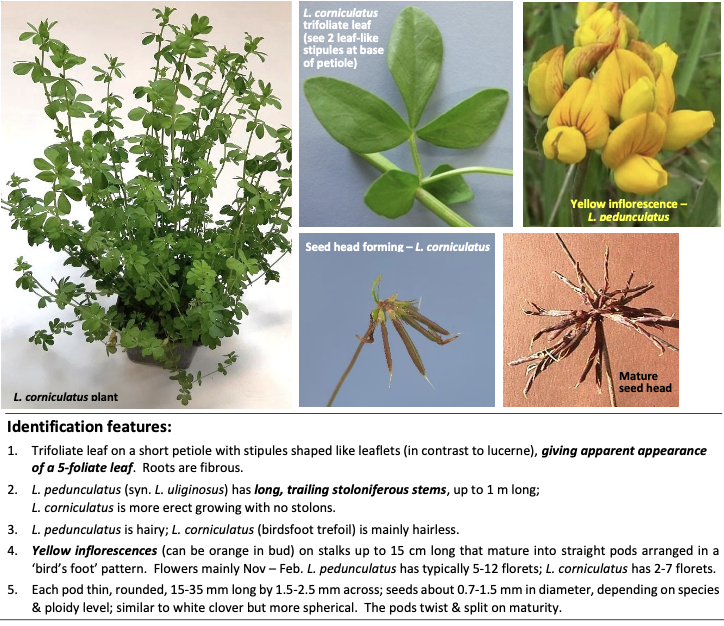
They are best recognised by the appearance of having five leaflets, when in reality they have three true leaflets plus two leaf‑like stipules attached near the base of the petiole. This feature is unique among common pasture legumes.

There are two main growth forms:

  • Pedunculatus (Maku ) — creeping, stoloniferous, hairy

  • Corniculatus (birdsfoot trefoil) — more upright, less hairy, no stolons

Flowers are bright yellow, carried in small clusters. After flowering, pods form in a distinctive “bird’s foot” arrangement.

Contains condensed tannins, making it non‑bloating, and is tolerant of wet and acidic soils.

Common confusions:

  • Lucerne → Lucerne has purple flowers and pointed leaflet tips.

  • White clover → white clover creeps more aggressively and has white flowers.
<p><strong>Plant family:</strong> Fabaceae<br><strong>Life cycle:</strong> Perennial<br><strong>Key persistence/spread:</strong> Seed (some species stoloniferous)<br><strong>Farming systems:</strong> Wet soils, acid soils, forestry blocks</p><p><strong>How to identify</strong></p><p>They are best recognised by the appearance of having five leaflets, when in reality they have three true leaflets plus two leaf‑like stipules attached near the base of the petiole. This feature is unique among common pasture legumes.</p><p>There are two main growth forms:</p><ul><li><p>Pedunculatus (Maku ) — creeping, stoloniferous, hairy</p></li><li><p>Corniculatus (birdsfoot trefoil) — more upright, less hairy, no stolons</p></li></ul><p>Flowers are bright yellow, carried in small clusters. After flowering, pods form in a distinctive “bird’s foot” arrangement.</p><p>Contains condensed tannins, making it non‑bloating, and is tolerant of wet and acidic soils.</p><p>Common confusions:</p><ul><li><p>Lucerne → Lucerne has purple flowers and pointed leaflet tips.</p></li><li><p>White clover → white clover creeps more aggressively and has white flowers.</p></li></ul><p></p>
17
New cards

Chicory

Plant family: Asteraceae
Life cycle: Short‑lived perennial
Key persistence/spread: Taproot; seed
Farming systems: Summer forage for dairy, sheep, beef

How to identify

Grows from a thick, fleshy white taproot, similar to a dandelion but much larger.

Leaves form a basal rosette initially and are large, hairless, and glossy, with margins that may be smooth or lightly toothed. A key identifying feature is that lateral veins angle away from the midrib, unlike plantain’s parallel veins.

In summer, it sends up tall flowering stems (up to 2 m) bearing multiple bright blue daisy‑like flowers. The plant becomes very upright at this stage.
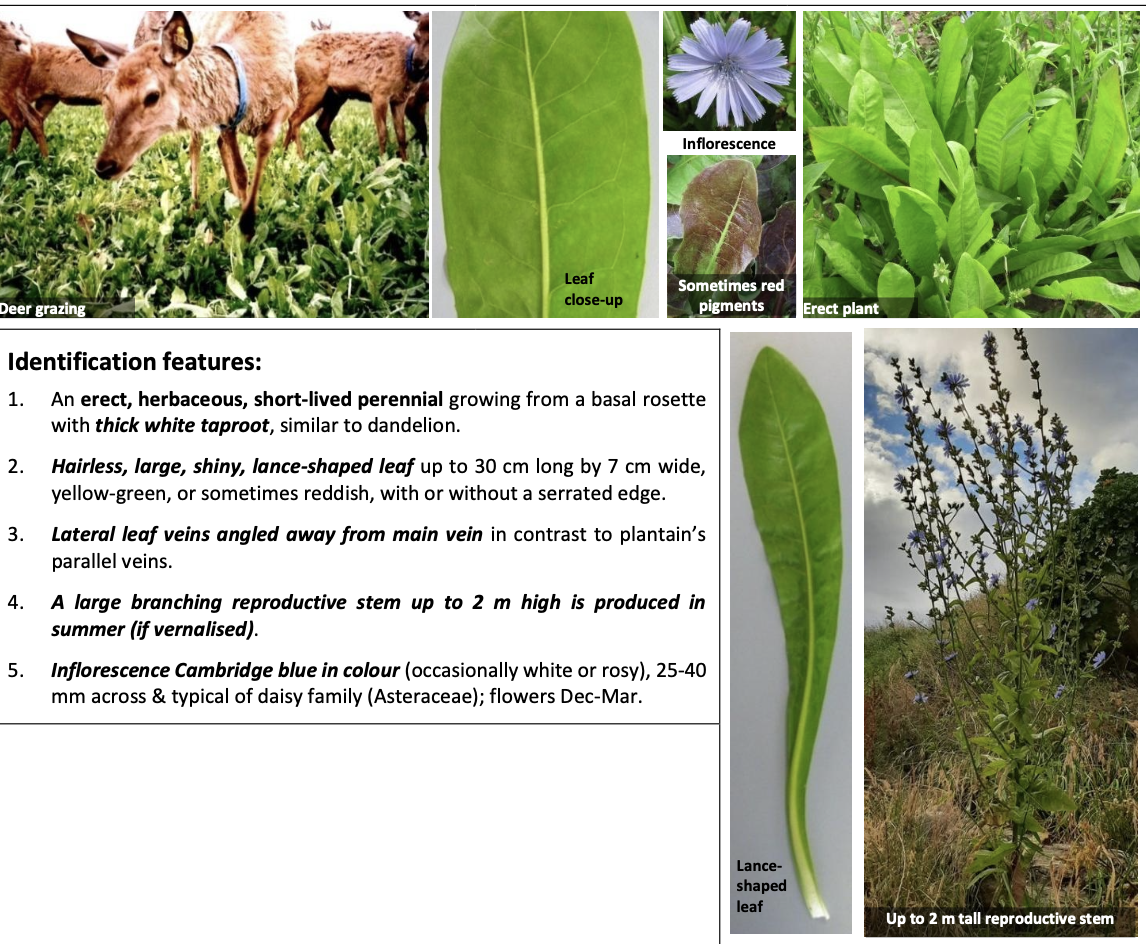
<p><strong>Plant family:</strong> Asteraceae<br><strong>Life cycle:</strong> Short‑lived perennial<br><strong>Key persistence/spread:</strong> Taproot; seed<br><strong>Farming systems:</strong> Summer forage for dairy, sheep, beef</p><p><strong> How to identify</strong></p><p>Grows from a thick, fleshy white taproot, similar to a dandelion but much larger.</p><p>Leaves form a basal rosette initially and are large, hairless, and glossy, with margins that may be smooth or lightly toothed. A key identifying feature is that lateral veins angle away from the midrib, unlike plantain’s parallel veins.</p><p>In summer, it sends up tall flowering stems (up to 2 m) bearing multiple bright blue daisy‑like flowers. The plant becomes very upright at this stage.</p><p></p>
18
New cards

Narrow-Leaved Plantain

Plant family: Plantaginaceae
Life cycle: Short‑lived perennial
Key persistence/spread: Fibrous root system; seed
Farming systems: Dairy, sheep; nitrogen‑leaching mitigation systems

How to identify

Grows as an upright basal rosette, forming a clump rather than creeping.

Leaves are long, narrow, and lance‑shaped, with very prominent parallel ribs running from base to tip. This ribbing is the most decisive identification feature and can be felt by running fingers along the leaf.

Leaves are tougher and more fibrous than chicory and may have fine hairs. Flowering stems are slender and upright, carrying dense wind‑pollinated seed heads with no showy petals.
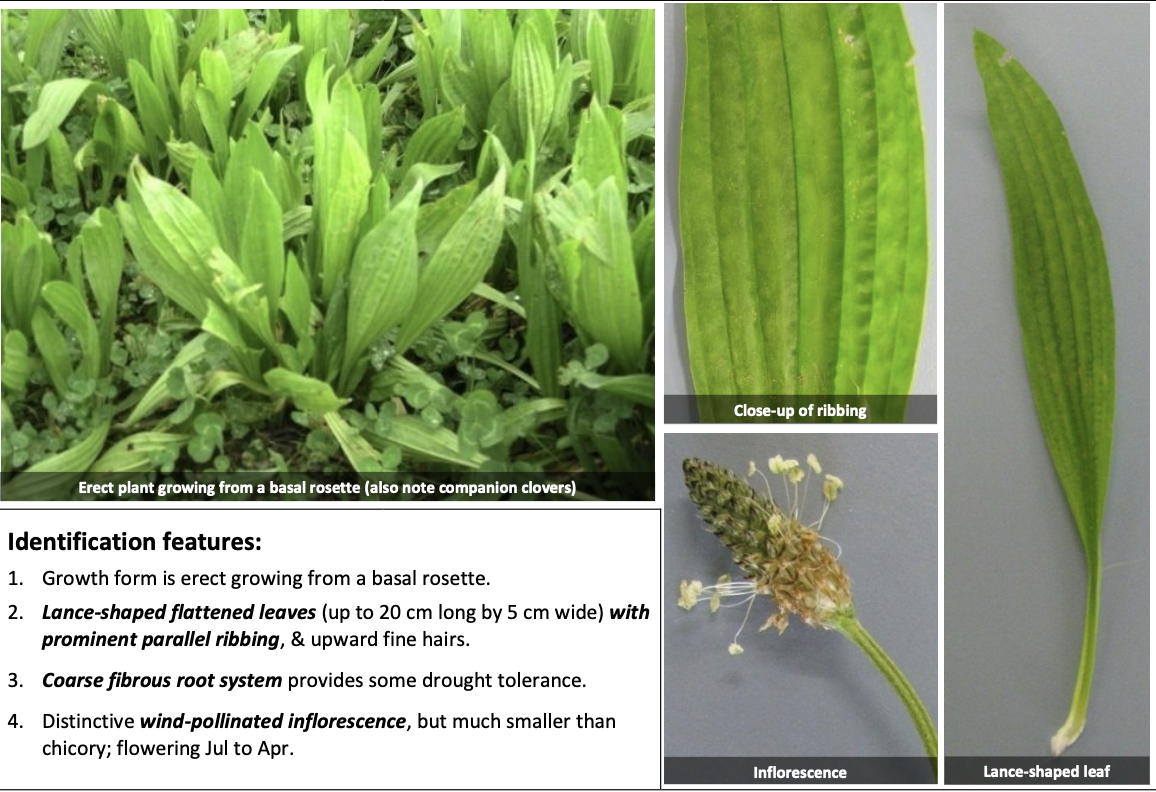
<p><strong>Plant family:</strong> Plantaginaceae<br><strong>Life cycle:</strong> Short‑lived perennial<br><strong>Key persistence/spread:</strong> Fibrous root system; seed<br><strong>Farming systems:</strong> Dairy, sheep; nitrogen‑leaching mitigation systems</p><p><strong> How to identify</strong></p><p>Grows as an upright basal rosette, forming a clump rather than creeping.</p><p>Leaves are long, narrow, and lance‑shaped, with very prominent parallel ribs running from base to tip. This ribbing is the most decisive identification feature and can be felt by running fingers along the leaf.</p><p>Leaves are tougher and more fibrous than chicory and may have fine hairs. Flowering stems are slender and upright, carrying dense wind‑pollinated seed heads with no showy petals.</p><p></p>
19
New cards

Ragwort

Plant family: Asteraceae
Life cycle: Biennial (can behave as a short‑lived perennial)
Key persistence / spread: Seed; regrowth from crown if damaged
Farming systems: Dairy pasture (especially higher rainfall regions)

How to identify

Has a two‑stage life cycle, which is critical for identification.

In its first year, the plant forms a flat rosette at ground level. Leaves are deeply divided into irregular lobes, giving them a ragged appearance. The leaves are dull green on top, sometimes reddish underneath, and are carried on short stalks. At this stage ragwort is often overlooked or confused with other rosette weeds.

In the second year, the plant bolts, producing a tall upright flowering stem that can reach over 1 m. Leaves on the stem become smaller, more narrow, and less divided as you move upward.

The flowers are bright yellow daisy‑like heads, carried in clusters at the top of the plant and are very conspicuous in midsummer.

Is avoided by cattle but eaten by sheep, which is why it is most problematic in dairy systems. Cutting or grazing without killing the crown can stimulate regrowth.

Often confused with:

  • Dandelion (but dandelion has hollow flower stalks and flowers singly)

  • Other Asteraceae rosettes, but the deep ragged leaf lobes are distinctive
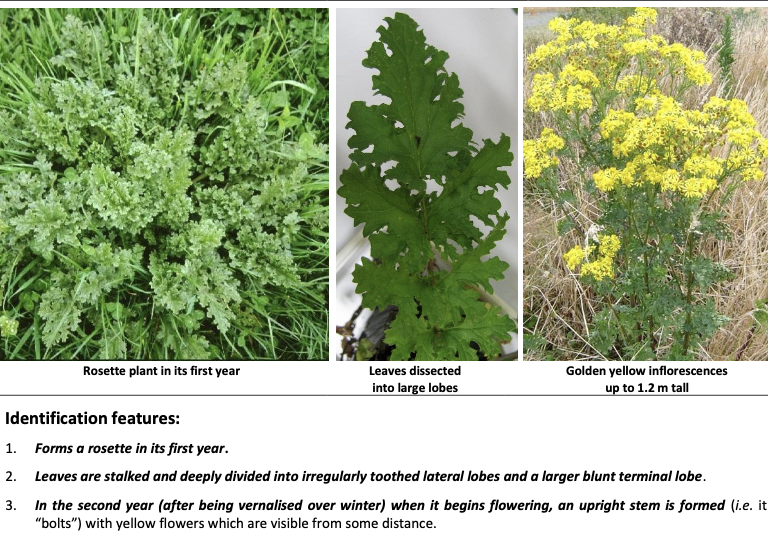
<p><strong>Plant family:</strong> Asteraceae<br><strong>Life cycle:</strong> Biennial (can behave as a short‑lived perennial)<br><strong>Key persistence / spread:</strong> Seed; regrowth from crown if damaged<br><strong>Farming systems:</strong> Dairy pasture (especially higher rainfall regions)</p><p><strong>How to identify </strong></p><p>Has a two‑stage life cycle, which is critical for identification.</p><p>In its first year, the plant forms a flat rosette at ground level. Leaves are deeply divided into irregular lobes, giving them a ragged appearance. The leaves are dull green on top, sometimes reddish underneath, and are carried on short stalks. At this stage ragwort is often overlooked or confused with other rosette weeds.</p><p>In the second year, the plant bolts, producing a tall upright flowering stem that can reach over 1 m. Leaves on the stem become smaller, more narrow, and less divided as you move upward.</p><p>The flowers are bright yellow daisy‑like heads, carried in clusters at the top of the plant and are very conspicuous in midsummer.</p><p>Is avoided by cattle but eaten by sheep, which is why it is most problematic in dairy systems. Cutting or grazing without killing the crown can stimulate regrowth.</p><p>Often confused with:</p><ul><li><p>Dandelion (but dandelion has hollow flower stalks and flowers singly)</p></li><li><p>Other Asteraceae rosettes, but the deep ragged leaf lobes are distinctive</p></li></ul><p></p>
20
New cards

Hemlock

Plant family: Apiaceae
Life cycle: Biennial
Key persistence / spread: Seed
Farming systems: Roadsides, hedgerows, pasture margins

How to identify

Is a large, poisonous umbellifer (carrot family) that must be identified confidently.

In its vegetative stage, leaves are finely divided and fern‑like, resembling carrot or parsley foliage. A key diagnostic feature is that the leaf stalks and midribs often show purple flecking.

In its second year, hemlock produces a tall hollow flowering stem, often up to 2–3 m high. The stem is smooth (not hairy) and typically marked with purple blotches or streaks — one of the most important ID features.

When crushed, the plant gives off a strong, unpleasant mouse‑like or musty smell, which helps distinguish it from fennel or wild carrot.

Flowers are small, white, and arranged in large umbrella‑shaped umbels.

Common confusions:

  • Wild carrot → wild carrot has hairy stems and lacks purple blotches

  • Fennel → fennel smells sweet/aniseed, not foul
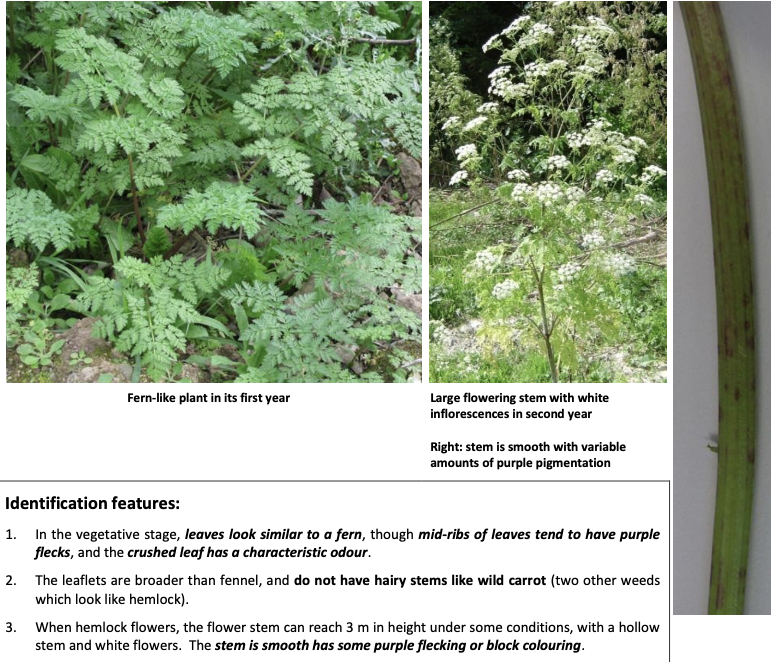
<p><strong>Plant family:</strong> Apiaceae<br><strong>Life cycle:</strong> Biennial<br><strong>Key persistence / spread:</strong> Seed<br><strong>Farming systems:</strong> Roadsides, hedgerows, pasture margins</p><p><strong> How to identify</strong></p><p>Is a large, poisonous umbellifer (carrot family) that must be identified confidently.</p><p>In its vegetative stage, leaves are finely divided and fern‑like, resembling carrot or parsley foliage. A key diagnostic feature is that the leaf stalks and midribs often show purple flecking.</p><p>In its second year, hemlock produces a tall hollow flowering stem, often up to 2–3 m high. The stem is smooth (not hairy) and typically marked with purple blotches or streaks — one of the most important ID features.</p><p>When crushed, the plant gives off a strong, unpleasant mouse‑like or musty smell, which helps distinguish it from fennel or wild carrot.</p><p>Flowers are small, white, and arranged in large umbrella‑shaped umbels.</p><p>Common confusions:</p><ul><li><p>Wild carrot → wild carrot has hairy stems and lacks purple blotches</p></li><li><p>Fennel → fennel smells sweet/aniseed, not foul</p></li></ul><p></p>
21
New cards

Bracken

Plant family: Dennstaedtiaceae
Life cycle: Perennial fern
Key persistence / spread: Extensive underground rhizomes; spores
Farming systems: Hill country, forestry, scrub redevelopment

How to identify

Is a fern, so it looks very different from flowering plants.

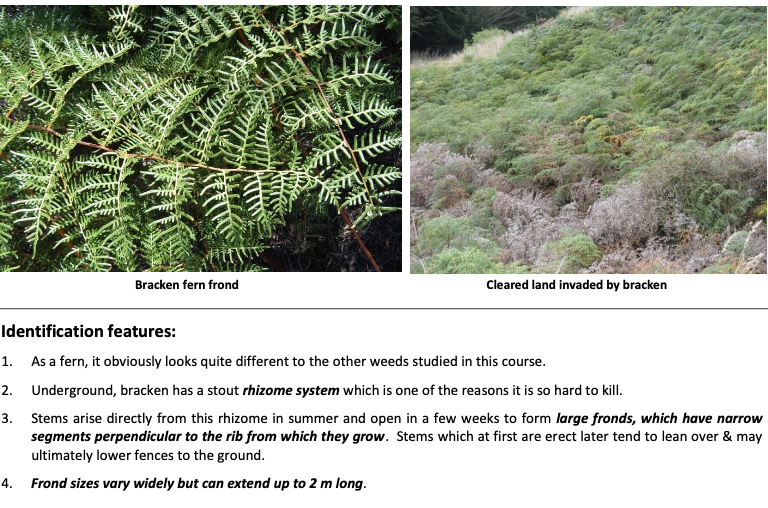
It emerges in spring as tightly coiled fiddleheads, which rapidly unfurl into large triangular fronds, often over 1 m long. Fronds are divided into many narrow segments that branch off the main rib.

The most important identification feature is the extensive underground rhizome system. Cutting or burning the above‑ground fronds does not kill the plant; new fronds emerge from rhizomes.

It often colonises burnt or cleared land, forming dense stands.

Poisoning occurs when animals ingest large amounts over time, particularly cattle.
<p><strong>Plant family:</strong> Dennstaedtiaceae<br><strong>Life cycle:</strong> Perennial fern<br><strong>Key persistence / spread:</strong> Extensive underground rhizomes; spores<br><strong>Farming systems:</strong> Hill country, forestry, scrub redevelopment</p><p><strong> How to identify</strong></p><p>Is a fern, so it looks very different from flowering plants.</p><p>It emerges in spring as tightly coiled fiddleheads, which rapidly unfurl into large triangular fronds, often over 1 m long. Fronds are divided into many narrow segments that branch off the main rib.</p><p>The most important identification feature is the extensive underground rhizome system. Cutting or burning the above‑ground fronds does not kill the plant; new fronds emerge from rhizomes.</p><p>It often colonises burnt or cleared land, forming dense stands.</p><p>Poisoning occurs when animals ingest large amounts over time, particularly cattle.</p>
22
New cards

Tutu

Plant family: Coriariaceae
Life cycle: Perennial shrub or small tree
Key persistence / spread: Seed; nitrogen‑fixing roots
Farming systems: Bush margins, regenerating scrub, steep country

How to identify

Is best identified by its leaves and venation pattern.

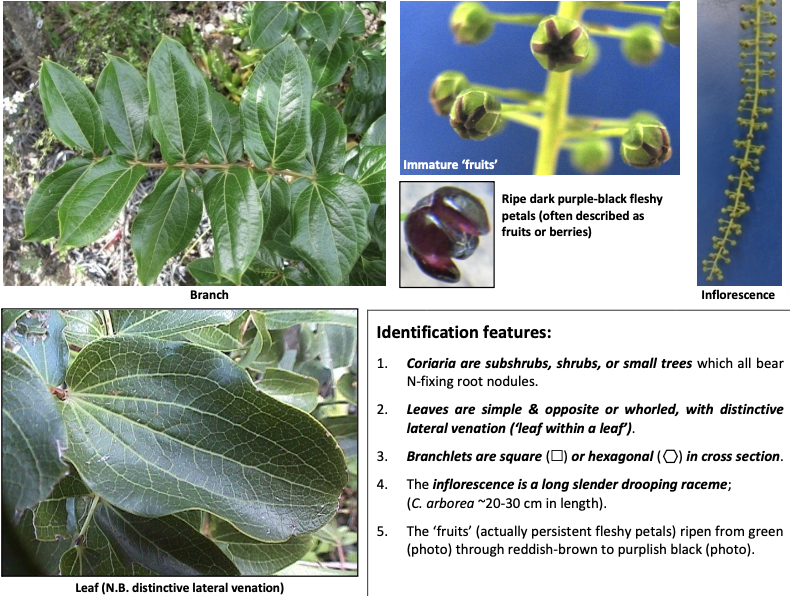
Leaves are simple, opposite, and have a very distinctive “leaf‑within‑a‑leaf” appearance caused by prominent lateral veins running nearly parallel to the leaf margin. This is one of the strongest diagnostic features.

The plant produces long, drooping flower clusters, which later develop into dark purple‑black fleshy structures often mistaken for berries. The fleshy outer parts are non‑toxic when ripe, but the seeds and all green parts are highly toxic.

It commonly grows on unstable ground, forest margins, slips, and road cuttings and can repeatedly regrow after disturbance.
<p><strong>Plant family:</strong> Coriariaceae<br><strong>Life cycle:</strong> Perennial shrub or small tree<br><strong>Key persistence / spread:</strong> Seed; nitrogen‑fixing roots<br><strong>Farming systems:</strong> Bush margins, regenerating scrub, steep country</p><p><strong> How to identify</strong></p><p>Is best identified by its leaves and venation pattern.</p><p>Leaves are simple, opposite, and have a very distinctive “leaf‑within‑a‑leaf” appearance caused by prominent lateral veins running nearly parallel to the leaf margin. This is one of the strongest diagnostic features.</p><p>The plant produces long, drooping flower clusters, which later develop into dark purple‑black fleshy structures often mistaken for berries. The fleshy outer parts are non‑toxic when ripe, but the seeds and all green parts are highly toxic.</p><p>It commonly grows on unstable ground, forest margins, slips, and road cuttings and can repeatedly regrow after disturbance.</p>
23
New cards

Yew

Plant family: Taxaceae
Life cycle: Perennial evergreen tree
Key persistence / spread: Seed
Farming systems: Amenity plantings, shelter belts

How to identify

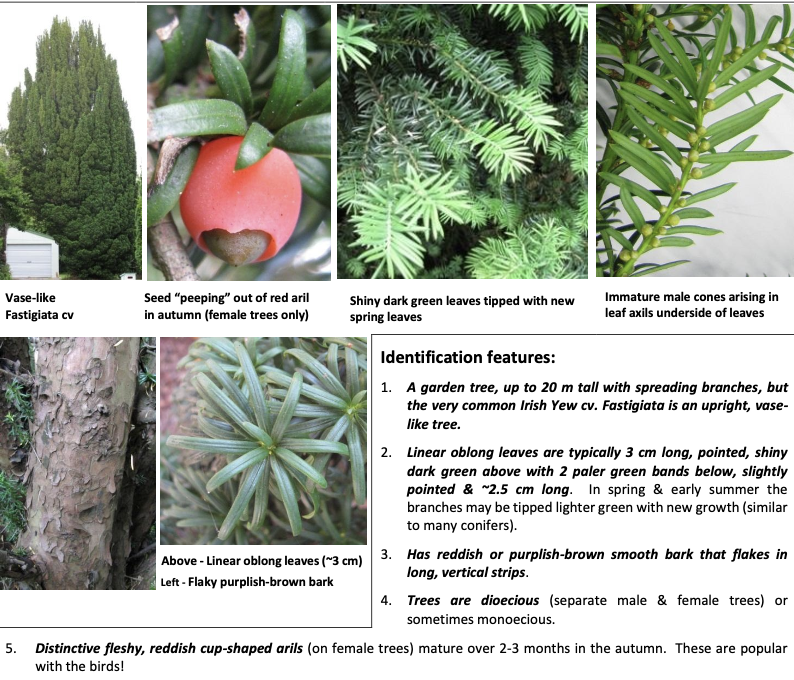
Is an evergreen conifer with soft, flat, dark green needles arranged in two ranks along the stem.

A key feature is the red fleshy aril that partially surrounds the seed. While the aril itself is not toxic, the seed inside and all foliage are extremely poisonous.

Bark is reddish‑brown and flakes off in long strips.

Most farm poisonings occur when garden prunings are thrown into paddocks.
<p><strong>Plant family:</strong> Taxaceae<br><strong>Life cycle:</strong> Perennial evergreen tree<br><strong>Key persistence / spread:</strong> Seed<br><strong>Farming systems:</strong> Amenity plantings, shelter belts</p><p><strong> How to identify</strong></p><p>Is an evergreen conifer with soft, flat, dark green needles arranged in two ranks along the stem.</p><p>A key feature is the red fleshy aril that partially surrounds the seed. While the aril itself is not toxic, the seed inside and all foliage are extremely poisonous.</p><p>Bark is reddish‑brown and flakes off in long strips.</p><p>Most farm poisonings occur when garden prunings are thrown into paddocks.</p>
24
New cards

Oak

Plant family: Fagaceae
Life cycle: Perennial deciduous or evergreen tree
Key persistence / spread: Seed (acorns)
Farming systems: Shelter trees, amenity plantings

How to identify

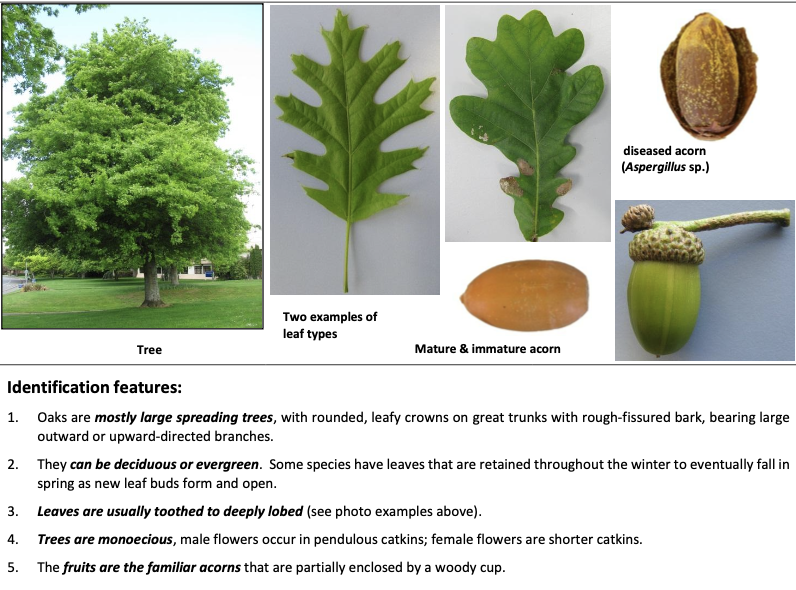
Are large trees with lobed leaves (shape varies by species). The key identifier is the production of acorns, which sit in a woody cup.

Poisoning occurs when stock consume large quantities of green (unripe) acorns, particularly after storms.

Leaves and acorns contain tannins that damage kidneys in livestock.
<p><strong>Plant family:</strong> Fagaceae<br><strong>Life cycle:</strong> Perennial deciduous or evergreen tree<br><strong>Key persistence / spread:</strong> Seed (acorns)<br><strong>Farming systems:</strong> Shelter trees, amenity plantings</p><p><strong> How to identify</strong></p><p>Are large trees with lobed leaves (shape varies by species). The key identifier is the production of acorns, which sit in a woody cup.</p><p>Poisoning occurs when stock consume large quantities of green (unripe) acorns, particularly after storms.</p><p>Leaves and acorns contain tannins that damage kidneys in livestock.</p>
25
New cards

Macrocarpa

Plant family: Cupressaceae
Life cycle: Perennial evergreen tree
Key persistence / spread: Seed
Farming systems: Shelter belts, farm plantings

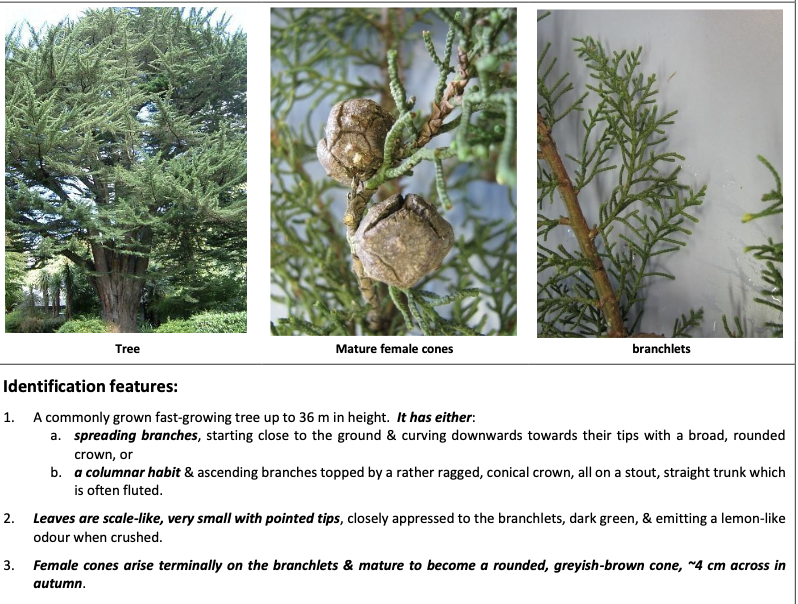
How to identify

Has scale‑like leaves tightly pressed against branchlets. If crushed, foliage gives off a distinct lemon‑like smell.

Cones are large, rounded, and woody, about the size of a tennis ball.

The major risk is abortions in cattle after ingestion of prunings or fallen branches.
<p><strong>Plant family:</strong> Cupressaceae<br><strong>Life cycle:</strong> Perennial evergreen tree<br><strong>Key persistence / spread:</strong> Seed<br><strong>Farming systems:</strong> Shelter belts, farm plantings</p><p><strong> How to identify</strong></p><p>Has scale‑like leaves tightly pressed against branchlets. If crushed, foliage gives off a distinct lemon‑like smell.</p><p>Cones are large, rounded, and woody, about the size of a tennis ball.</p><p>The major risk is abortions in cattle after ingestion of prunings or fallen branches.</p>
26
New cards

Rhododendron

Plant family: Ericaceae
Life cycle: Perennial shrub or small tree
Key persistence/spread: Seed
Farming systems: Gardens near pasture

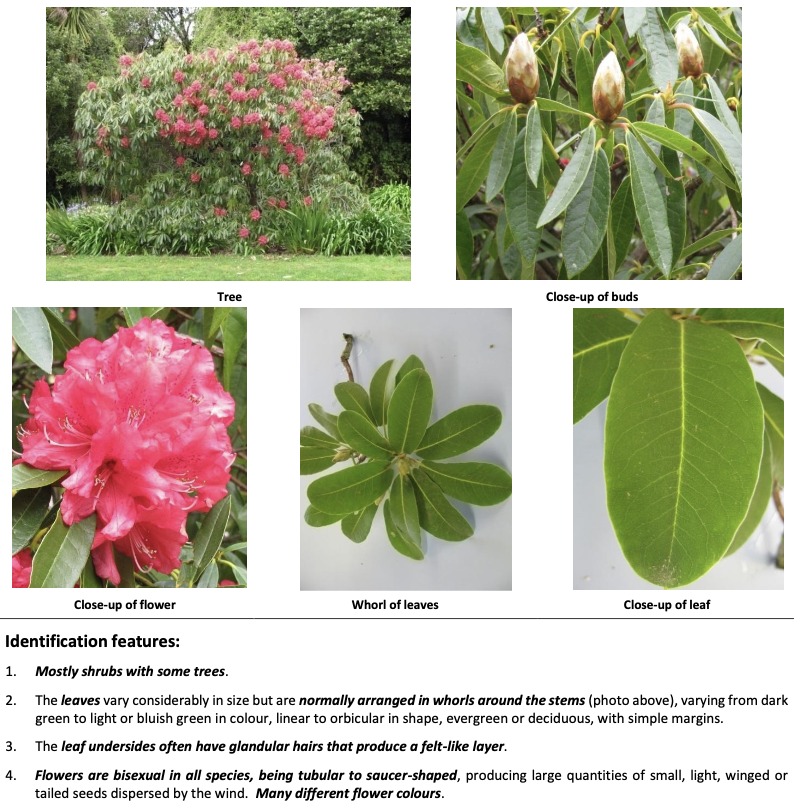
How to identify

They are evergreen shrubs with thick leathery leaves arranged in whorls at the end of branches. Many species have felt-like hairs on the underside of leaves.

Flowers are large, showy, and come in many colours.

Poisoning typically occurs when clippings are dumped into paddocks, especially affecting sheep.
<p><strong>Plant family:</strong> Ericaceae<br><strong>Life cycle:</strong> Perennial shrub or small tree<br><strong>Key persistence/spread:</strong> Seed<br><strong>Farming systems:</strong> Gardens near pasture</p><p><strong> How to identify</strong></p><p>They are evergreen shrubs with thick leathery leaves arranged in whorls at the end of branches. Many species have felt-like hairs on the underside of leaves.</p><p>Flowers are large, showy, and come in many colours.</p><p>Poisoning typically occurs when clippings are dumped into paddocks, especially affecting sheep.</p>
27
New cards

Black nightshade

Plant family: Solanaceae
Life cycle: Summer annual
Key persistence/spread: Large seed production; berries eaten and spread by birds
Farming systems: Arable cropping, new pastures, gardens

How to identify

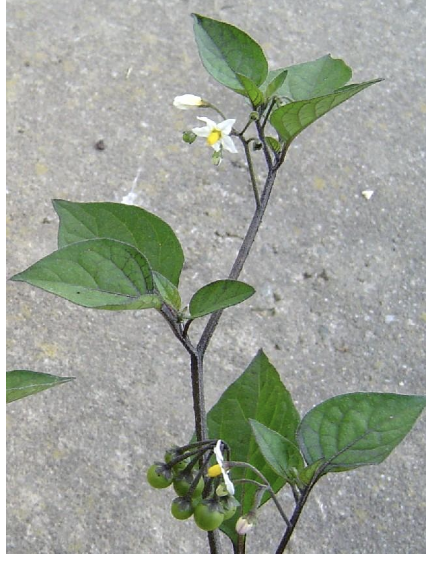
Is an upright, branching summer annual that germinates once soils warm in spring. Plant size varies greatly depending on competition, ranging from small flowering plants to dense, bushy individuals over one metre tall. Stems are soft and green, often developing a purple tint with age or stress.

Leaves are thin, soft, and oval to diamond‑shaped with smooth or slightly wavy margins. They are carried on petioles and give the plant a lush, leafy appearance. Flowers are small, white, and star‑shaped with yellow anthers, typical of the potato family, but are often overlooked.

The most diagnostic feature is the fruit: smooth, round berries carried in clusters. These ripen from green to black and persist on the plant late into the season. Birds readily eat the fruit, spreading the seed widely.
<p><strong>Plant family:</strong> Solanaceae<br><strong>Life cycle:</strong> Summer annual<br><strong>Key persistence/spread:</strong> Large seed production; berries eaten and spread by birds<br><strong>Farming systems:</strong> Arable cropping, new pastures, gardens</p><p><strong> How to identify</strong></p><p>Is an upright, branching summer annual that germinates once soils warm in spring. Plant size varies greatly depending on competition, ranging from small flowering plants to dense, bushy individuals over one metre tall. Stems are soft and green, often developing a purple tint with age or stress.</p><p>Leaves are thin, soft, and oval to diamond‑shaped with smooth or slightly wavy margins. They are carried on petioles and give the plant a lush, leafy appearance. Flowers are small, white, and star‑shaped with yellow anthers, typical of the potato family, but are often overlooked.</p><p>The most diagnostic feature is the fruit: smooth, round berries carried in clusters. These ripen from green to black and persist on the plant late into the season. Birds readily eat the fruit, spreading the seed widely.</p>
28
New cards

Cleavers

Plant family: Rubiaceae
Life cycle: Annual (often autumn/winter germinating)
Key persistence / spread: Hooked seeds and stems that cling to animals and clothing
Farming systems: Cereals, arable crops, paddocks with dense canopy

How to identify

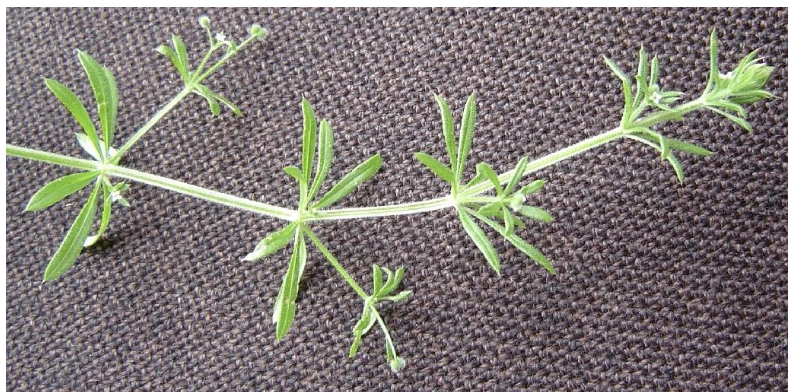
It is a weak‑stemmed, scrambling weed that relies on other plants for support. It does not stand upright on its own. Instead, it forms tangled mats through crops or pasture.

Stems are square in cross‑section and covered in minute backward‑facing hooks. Leaves are narrow, pointed, and arranged in distinct whorls (usually 6–8) around the stem — a very strong diagnostic feature.

Every part of the plant feels sticky or rough to the touch due to the hooked hairs. This tactile feature is often enough to identify it instantly.

Flowers are small and inconspicuous, but the fruits are paired, rounded structures covered in hooks, making them extremely effective at seed dispersal.

It is rarely confused once touched; no other common weed combines whorled leaves and universal stickiness.
<p><strong>Plant family:</strong> Rubiaceae<br><strong>Life cycle:</strong> Annual (often autumn/winter germinating)<br><strong>Key persistence / spread:</strong> Hooked seeds and stems that cling to animals and clothing<br><strong>Farming systems:</strong> Cereals, arable crops, paddocks with dense canopy</p><p><strong> How to identify</strong></p><p>It is a weak‑stemmed, scrambling weed that relies on other plants for support. It does not stand upright on its own. Instead, it forms tangled mats through crops or pasture.</p><p>Stems are square in cross‑section and covered in minute backward‑facing hooks. Leaves are narrow, pointed, and arranged in distinct whorls (usually 6–8) around the stem — a very strong diagnostic feature.</p><p>Every part of the plant feels sticky or rough to the touch due to the hooked hairs. This tactile feature is often enough to identify it instantly.</p><p>Flowers are small and inconspicuous, but the fruits are paired, rounded structures covered in hooks, making them extremely effective at seed dispersal.</p><p>It is rarely confused once touched; no other common weed combines whorled leaves and universal stickiness.</p>
29
New cards

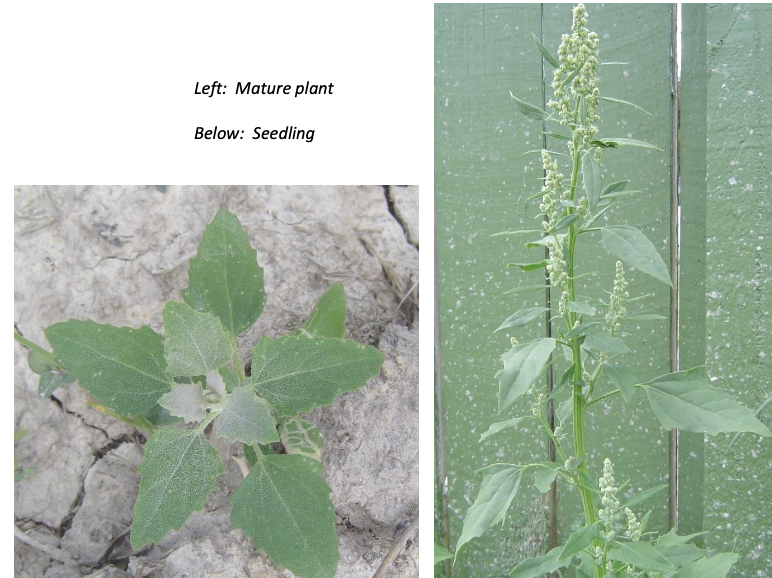
Fathen

Plant family: Amaranthaceae
Life cycle: Summer annual
Key persistence/spread: Very high seed production; persistent seed bank
Farming systems: Arable crops (especially maize)

How to identify

It is a vigorous, upright annual that emerges in large numbers from late spring onward. Seedlings may appear harmless initially but rapidly outgrow crops if unchecked.

Leaves are triangular, diamond‑shaped, or irregular, and the young foliage is often coated in a distinct white, flour‑like powder, especially on the underside and growing tips. This powdery bloom is one of the best early identification features.

Stems are thick, erect, and branched, usually green but occasionally flushed with pink. Flowering structures are green and poorly differentiated from foliage, forming dense clusters at stem tips and leaf axils.

It often forms dense mono‑specific stands due to herbicide resistance issues.

Often confused with redroot; but it is paler, powdery, and less fleshy.
<p><strong>Plant family:</strong> Amaranthaceae<br><strong>Life cycle:</strong> Summer annual<br><strong>Key persistence/spread:</strong> Very high seed production; persistent seed bank<br><strong>Farming systems:</strong> Arable crops (especially maize)</p><p><strong>How to identify</strong></p><p>It is a vigorous, upright annual that emerges in large numbers from late spring onward. Seedlings may appear harmless initially but rapidly outgrow crops if unchecked.</p><p>Leaves are triangular, diamond‑shaped, or irregular, and the young foliage is often coated in a distinct white, flour‑like powder, especially on the underside and growing tips. This powdery bloom is one of the best early identification features.</p><p>Stems are thick, erect, and branched, usually green but occasionally flushed with pink. Flowering structures are green and poorly differentiated from foliage, forming dense clusters at stem tips and leaf axils.</p><p>It often forms dense mono‑specific stands due to herbicide resistance issues.</p><p>Often confused with redroot; but it is paler, powdery, and less fleshy.</p>
30
New cards

Hedge Mustard

Plant family: Brassicaceae
Life cycle: Annual
Key persistence/spread: Seed
Farming systems: Crops, disturbed pastures

How to identify

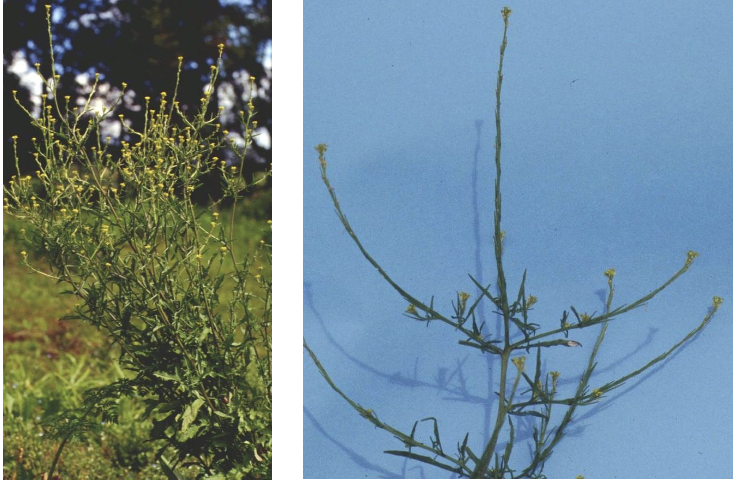
It begins as a basal rosette with irregularly lobed leaves, often tinged purple in cool conditions. As it matures, it bolts into a tall, upright plant with slender but very tough stems.

Upper leaves are narrow and less lobed than basal leaves. Flowers are small, pale yellow, and typical of the brassica family. They are produced in loose clusters near the ends of stems.

The most important identifying feature is the seed pods, which are long, thin, and held tight against the main stem, running almost parallel to it. This gives the plant a wiry, spiky appearance as pods mature.

It is distinguished from wild turnip by the absence of a swollen root and by smaller flowers.
<p><strong>Plant family:</strong> Brassicaceae<br><strong>Life cycle:</strong> Annual<br><strong>Key persistence/spread:</strong> Seed<br><strong>Farming systems:</strong> Crops, disturbed pastures</p><p><strong>How to identify</strong></p><p>It begins as a basal rosette with irregularly lobed leaves, often tinged purple in cool conditions. As it matures, it bolts into a tall, upright plant with slender but very tough stems.</p><p>Upper leaves are narrow and less lobed than basal leaves. Flowers are small, pale yellow, and typical of the brassica family. They are produced in loose clusters near the ends of stems.</p><p>The most important identifying feature is the seed pods, which are long, thin, and held tight against the main stem, running almost parallel to it. This gives the plant a wiry, spiky appearance as pods mature.</p><p>It is distinguished from wild turnip by the absence of a swollen root and by smaller flowers.</p>
31
New cards

Nettle

Plant family: Urticaceae
Life cycle: Annual
Key persistence / spread: Seed
Farming systems: Thin pastures, stock camps, shaded areas

How to identify

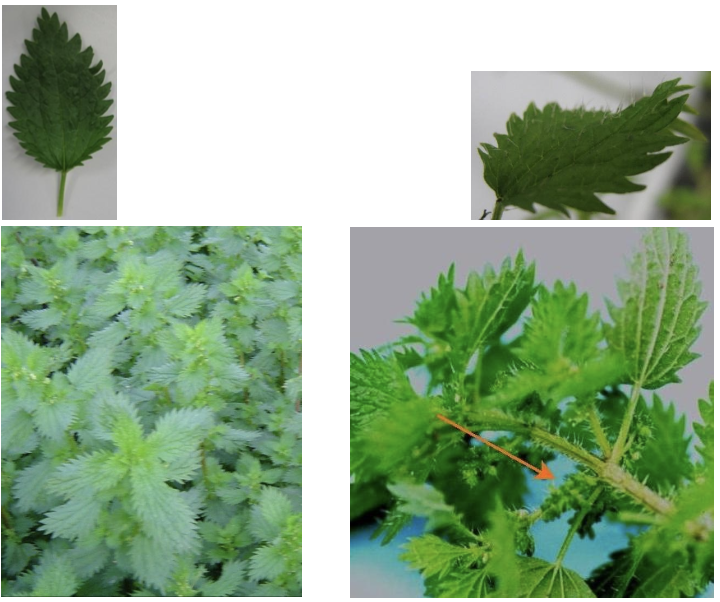
It is an upright herbaceous plant covered in fine stinging hairs. Leaves are opposite, broadly oval to triangular, and have coarse serrated margins.

The stinging hairs are the defining feature. When touched, they break and inject irritating chemicals into the skin, causing a sharp burning sensation. This reaction usually confirms identification immediately.

Flowers are small, green, and produced in clusters at leaf axils. Plants commonly grow in nutrient‑rich areas where pasture cover is poor.

It is smaller and less woody than tree nettle and completes its life cycle within one season.
<p><strong>Plant family:</strong> Urticaceae<br><strong>Life cycle:</strong> Annual<br><strong>Key persistence / spread:</strong> Seed<br><strong>Farming systems:</strong> Thin pastures, stock camps, shaded areas</p><p><strong>How to identify</strong></p><p>It is an upright herbaceous plant covered in fine stinging hairs. Leaves are opposite, broadly oval to triangular, and have coarse serrated margins.</p><p>The stinging hairs are the defining feature. When touched, they break and inject irritating chemicals into the skin, causing a sharp burning sensation. This reaction usually confirms identification immediately.</p><p>Flowers are small, green, and produced in clusters at leaf axils. Plants commonly grow in nutrient‑rich areas where pasture cover is poor.</p><p>It is smaller and less woody than tree nettle and completes its life cycle within one season.</p>
32
New cards

Redroot

Plant family: Amaranthaceae
Life cycle: Summer annual
Key persistence / spread: Seed
Farming systems: Arable cropping, warm regions

How to identify

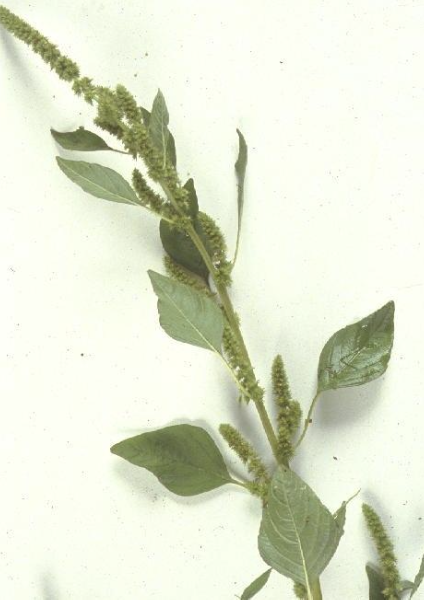
It is a robust, upright summer annual that thrives in warm, fertile soils. Growth is rapid once established, and plants can become dominant late in the season.

Stems are thick and fleshy and often display a distinct red or pink coloration, especially near the base. Leaves are oval to lance‑shaped, smooth, and carried on long petioles, giving the plant a heavy appearance.

Flowering structures are dense and coarse, forming prickly clusters at stem tips and in leaf axils. These clusters later produce large quantities of seed.

Early seedlings can be identified by the small notch present on the tip of the first true leaves.
<p><strong>Plant family:</strong> Amaranthaceae<br><strong>Life cycle:</strong> Summer annual<br><strong>Key persistence / spread:</strong> Seed<br><strong>Farming systems:</strong> Arable cropping, warm regions</p><p><strong> How to identify</strong></p><p>It is a robust, upright summer annual that thrives in warm, fertile soils. Growth is rapid once established, and plants can become dominant late in the season.</p><p>Stems are thick and fleshy and often display a distinct red or pink coloration, especially near the base. Leaves are oval to lance‑shaped, smooth, and carried on long petioles, giving the plant a heavy appearance.</p><p>Flowering structures are dense and coarse, forming prickly clusters at stem tips and in leaf axils. These clusters later produce large quantities of seed.</p><p>Early seedlings can be identified by the small notch present on the tip of the first true leaves.</p>
33
New cards

Stinking Mayweed

Plant family: Asteraceae
Life cycle: Annual
Key persistence/spread: Seed
Farming systems: Pastures, pugged or disturbed soils

How to identify

It forms an upright, branching plant with finely divided, fern‑like leaves. The foliage resembles that of yarrow or chamomile at a glance.

The most diagnostic feature is the strong, unpleasant smell released when leaves are crushed. This odour easily separates it from similar‑looking species.

Flowers resemble small daisies with white petals and a yellow centre. Plants commonly establish in damaged pastures and persist despite grazing.

It taints milk and is poorly eaten by stock.
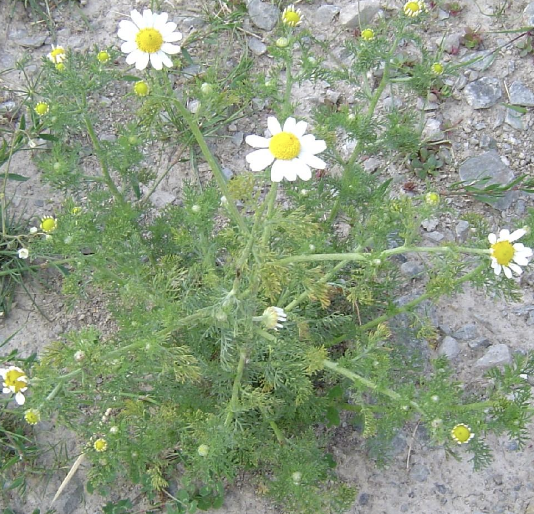
<p><strong>Plant family:</strong> Asteraceae<br><strong>Life cycle:</strong> Annual<br><strong>Key persistence/spread:</strong> Seed<br><strong>Farming systems:</strong> Pastures, pugged or disturbed soils</p><p><strong> How to identify</strong></p><p>It forms an upright, branching plant with finely divided, fern‑like leaves. The foliage resembles that of yarrow or chamomile at a glance.</p><p>The most diagnostic feature is the strong, unpleasant smell released when leaves are crushed. This odour easily separates it from similar‑looking species.</p><p>Flowers resemble small daisies with white petals and a yellow centre. Plants commonly establish in damaged pastures and persist despite grazing.</p><p>It taints milk and is poorly eaten by stock.</p>
34
New cards

Water Pepper

Plant family: Polygonaceae
Life cycle: Summer annual
Key persistence / spread: Seed
Farming systems: Wet pastures, poorly drained areas

How to identify

It grows in wet soils and along stream margins. Stems are jointed and often reddish, with a papery sheath (ocrea) surrounding each node.

Leaves are narrow, elongate, and pointed, resembling willow leaves. When chewed, leaves have a sharp peppery taste, which is a definitive identification feature (used only when appropriate in training).

Flowers are small and greenish and appear in loose clusters. The plant is rarely found outside wet environments.
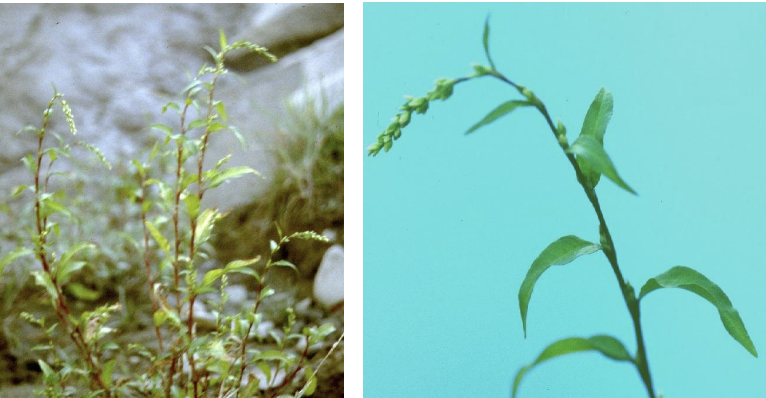
<p><strong>Plant family:</strong> Polygonaceae<br><strong>Life cycle:</strong> Summer annual<br><strong>Key persistence / spread:</strong> Seed<br><strong>Farming systems:</strong> Wet pastures, poorly drained areas</p><p><strong> How to identify</strong></p><p>It grows in wet soils and along stream margins. Stems are jointed and often reddish, with a papery sheath (ocrea) surrounding each node.</p><p>Leaves are narrow, elongate, and pointed, resembling willow leaves. When chewed, leaves have a sharp peppery taste, which is a definitive identification feature (used only when appropriate in training).</p><p>Flowers are small and greenish and appear in loose clusters. The plant is rarely found outside wet environments.</p>
35
New cards

Willow Weed

Plant family: Polygonaceae
Life cycle: Summer annual
Key persistence / spread: Seed
Farming systems: Moist crops and pastures

How to identify

It is an upright annual with jointed stems and narrow, spear‑shaped leaves. Leaves often show a darker blotch near the centre.

A papery ocrea surrounds the stem at each node, confirming its polygonaceae identity. Flowers are pink and tightly clustered at the ends of stems.

Unlike water pepper, it lacks a peppery taste and prefers slightly drier soils.
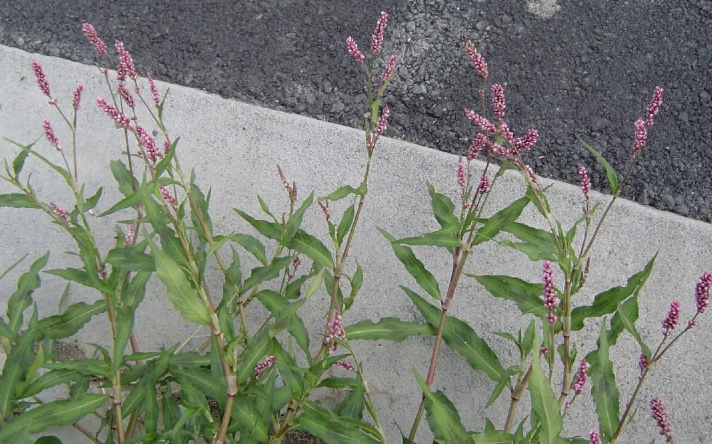
<p><strong>Plant family:</strong> Polygonaceae<br><strong>Life cycle:</strong> Summer annual<br><strong>Key persistence / spread:</strong> Seed<br><strong>Farming systems:</strong> Moist crops and pastures</p><p><strong> How to identify</strong></p><p>It is an upright annual with jointed stems and narrow, spear‑shaped leaves. Leaves often show a darker blotch near the centre.</p><p>A papery ocrea surrounds the stem at each node, confirming its polygonaceae identity. Flowers are pink and tightly clustered at the ends of stems.</p><p>Unlike water pepper, it lacks a peppery taste and prefers slightly drier soils.</p>
36
New cards

Wild Turnip

Plant family: Brassicaceae
Life cycle: Annual
Key persistence / spread: Seed
Farming systems: Brassica crops, arable land

How to identify

It begins as a rosette with coarse, hairy leaves and develops a small swollen taproot. This swelling distinguishes it from many other brassica weeds.

As the plant matures, stems elongate and upper leaves become smoother. Flowers are bright yellow with four petals and are typical of brassicas.

Seed pods are long and cylindrical. It becomes very visible once flowering begins.
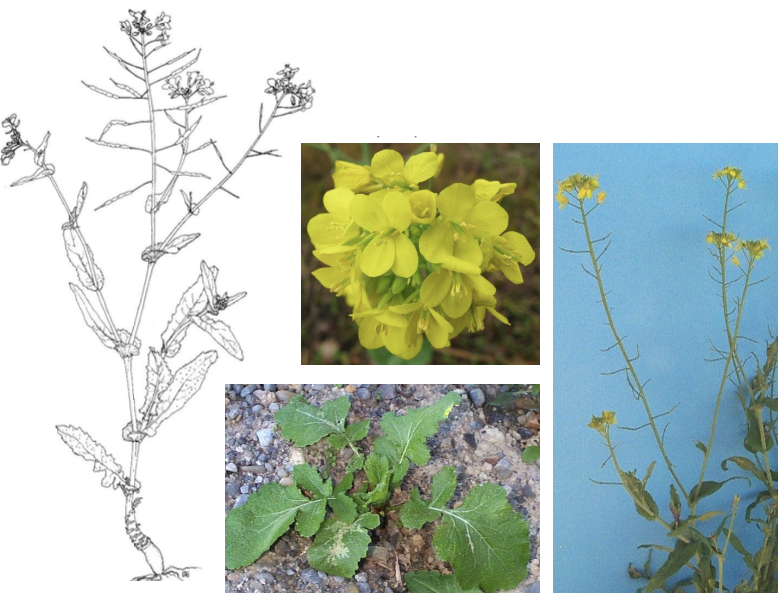
<p><strong>Plant family:</strong> Brassicaceae<br><strong>Life cycle:</strong> Annual<br><strong>Key persistence / spread:</strong> Seed<br><strong>Farming systems:</strong> Brassica crops, arable land</p><p><strong> How to identify</strong></p><p>It begins as a rosette with coarse, hairy leaves and develops a small swollen taproot. This swelling distinguishes it from many other brassica weeds.</p><p>As the plant matures, stems elongate and upper leaves become smoother. Flowers are bright yellow with four petals and are typical of brassicas.</p><p>Seed pods are long and cylindrical. It becomes very visible once flowering begins.</p>
37
New cards

Broad-Leaved Fleabane

Plant family: Asteraceae
Life cycle: Annual to biennial
Key persistence / spread: Wind‑dispersed seed
Farming systems: Pastures, roadsides, waste areas

How to identify

It begins as a flat basal rosette with oval to spoon‑shaped leaves. The leaf margins are shallowly toothed, with teeth pointing toward the leaf tip rather than back toward the base. Leaves are softly hairy and slightly sticky to touch.

As the plant bolts, it produces one or more tall, upright stems that are mostly unbranched until near the top. Leaves on the stem become progressively smaller and narrower.

Flower heads are small and not showy, lacking obvious white petals. The plant becomes most noticeable when seed is released, as masses of fine wind‑blown seed spread rapidly.

Often confused with daisy rosettes, but the rosette leaves are broader and less deeply lobed.
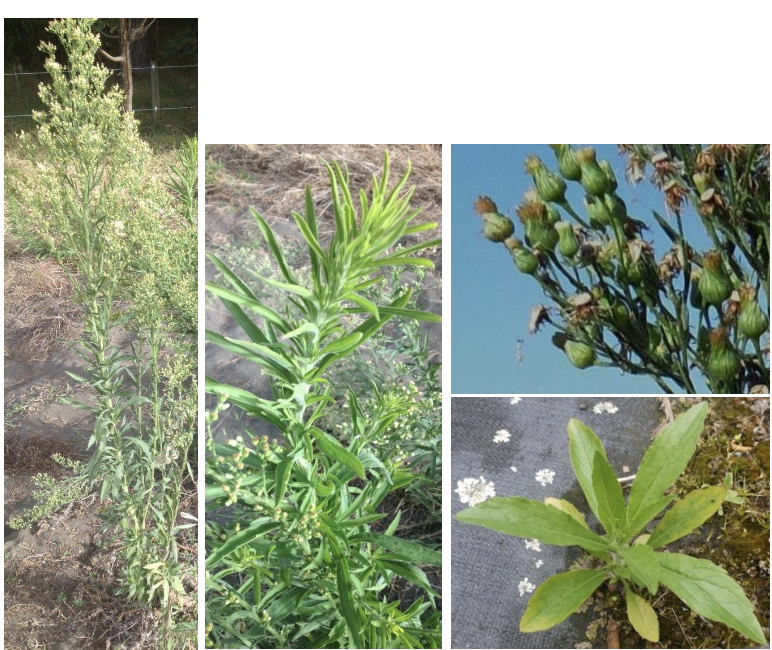
<p><strong>Plant family:</strong> Asteraceae<br><strong>Life cycle:</strong> Annual to biennial<br><strong>Key persistence / spread:</strong> Wind‑dispersed seed<br><strong>Farming systems:</strong> Pastures, roadsides, waste areas</p><p><strong> How to identify</strong></p><p>It begins as a flat basal rosette with oval to spoon‑shaped leaves. The leaf margins are shallowly toothed, with teeth pointing toward the leaf tip rather than back toward the base. Leaves are softly hairy and slightly sticky to touch.</p><p>As the plant bolts, it produces one or more tall, upright stems that are mostly unbranched until near the top. Leaves on the stem become progressively smaller and narrower.</p><p>Flower heads are small and not showy, lacking obvious white petals. The plant becomes most noticeable when seed is released, as masses of fine wind‑blown seed spread rapidly.</p><p>Often confused with daisy rosettes, but the rosette leaves are broader and less deeply lobed.</p>
38
New cards

Californian Thistle

Plant family: Asteraceae
Life cycle: Perennial
Key persistence / spread: Extensive creeping root system
Farming systems: Pastures, cropping land

How to identify

It rarely occurs as single plants; instead, it appears in distinct patches created by underground spreading roots. New shoots can emerge metres away from the parent plant.

Leaves are bright green and lobed with sharp spines only along the margins, never on the leaf surface. Leaves are soft between spines, unlike Scotch thistle.

Stems are upright and branch near the top. Flower heads are smaller and more numerous than Scotch thistle and may be purple or pale depending on plant sex.

Unlike biennial thistles, it regrows repeatedly after cutting due to its root system.
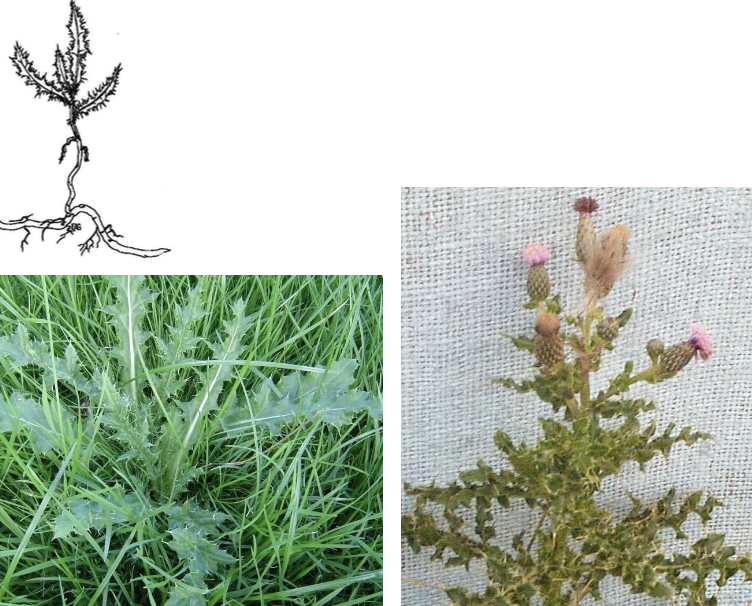
<p><strong>Plant family:</strong> Asteraceae<br><strong>Life cycle:</strong> Perennial<br><strong>Key persistence / spread:</strong> Extensive creeping root system<br><strong>Farming systems:</strong> Pastures, cropping land</p><p><strong> How to identify</strong></p><p>It rarely occurs as single plants; instead, it appears in distinct patches created by underground spreading roots. New shoots can emerge metres away from the parent plant.</p><p>Leaves are bright green and lobed with sharp spines only along the margins, never on the leaf surface. Leaves are soft between spines, unlike Scotch thistle.</p><p>Stems are upright and branch near the top. Flower heads are smaller and more numerous than Scotch thistle and may be purple or pale depending on plant sex.</p><p>Unlike biennial thistles, it regrows repeatedly after cutting due to its root system.</p>
39
New cards

Catsear

Plant family: Asteraceae
Life cycle: Perennial
Key persistence / spread: Deep taproot
Farming systems: Pastures

How to identify

It forms a persistent basal rosette with thick, leathery leaves that are covered in stiff bristle‑like hairs. Leaf lobes are irregular but do not point backward toward the crown.

Flower stems are solid (not hollow) and usually branch above the rosette. Each stem carries multiple yellow, dandelion‑like flower heads.

The taproot allows it to survive dry periods and repeated grazing. Sheep graze it readily, which can reduce flowering.

Commonly confused with dandelion, but it always has branched, solid flowering stems.
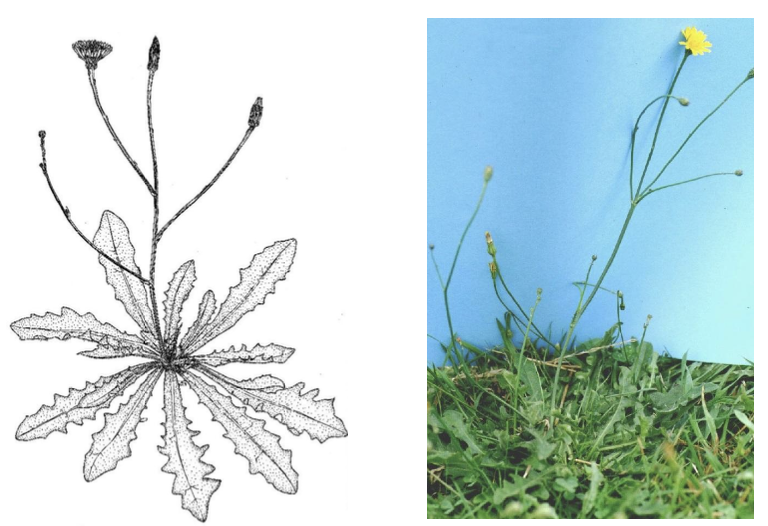
<p><strong>Plant family:</strong> Asteraceae<br><strong>Life cycle:</strong> Perennial<br><strong>Key persistence / spread:</strong> Deep taproot<br><strong>Farming systems:</strong> Pastures</p><p><strong> How to identify</strong></p><p>It forms a persistent basal rosette with thick, leathery leaves that are covered in stiff bristle‑like hairs. Leaf lobes are irregular but do not point backward toward the crown.</p><p>Flower stems are solid (not hollow) and usually branch above the rosette. Each stem carries multiple yellow, dandelion‑like flower heads.</p><p>The taproot allows it to survive dry periods and repeated grazing. Sheep graze it readily, which can reduce flowering.</p><p>Commonly confused with dandelion, but it always has branched, solid flowering stems.</p>
40
New cards

Dandelion

Plant family: Asteraceae
Life cycle: Perennial
Key persistence / spread: Deep taproot; wind‑dispersed seed
Farming systems: Pastures, lawns, cropping

How to identify

It grows as a basal rosette with deeply lobed leaves whose lobes point backward toward the plant base. This backward orientation is a key distinction from catsear.

Each flower is borne singly on a hollow, unbranched stem that contains milky sap when broken. Flower heads are bright yellow and very familiar.

After flowering, the seed head forms a spherical “clock” of wind‑dispersed seeds. The strong taproot makes mechanical control difficult.

It is usually found as individual plants rather than dense patches.
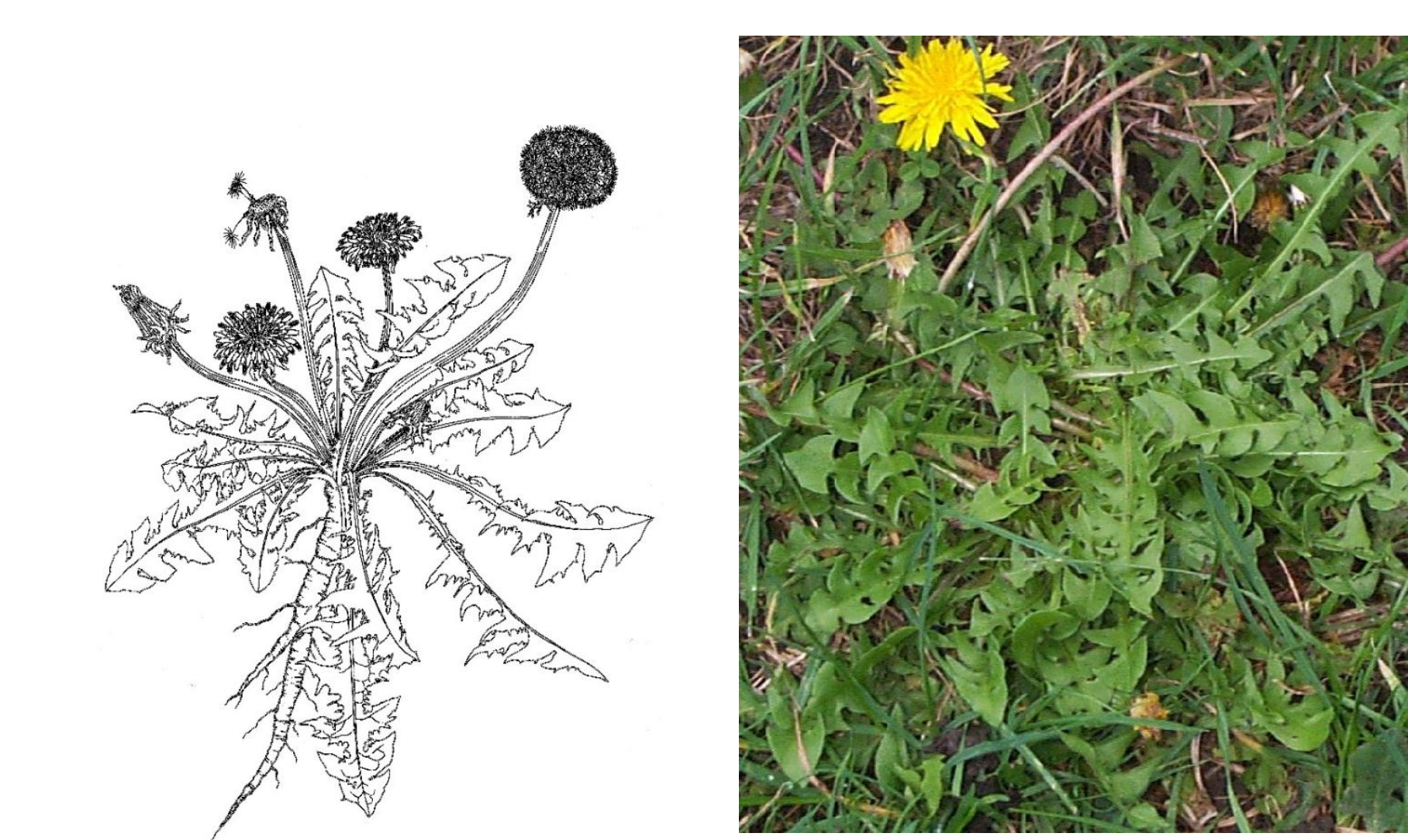
<p><strong>Plant family:</strong> Asteraceae<br><strong>Life cycle:</strong> Perennial<br><strong>Key persistence / spread:</strong> Deep taproot; wind‑dispersed seed<br><strong>Farming systems:</strong> Pastures, lawns, cropping</p><p><strong> How to identify</strong></p><p>It grows as a basal rosette with deeply lobed leaves whose lobes point backward toward the plant base. This backward orientation is a key distinction from catsear.</p><p>Each flower is borne singly on a hollow, unbranched stem that contains milky sap when broken. Flower heads are bright yellow and very familiar.</p><p>After flowering, the seed head forms a spherical “clock” of wind‑dispersed seeds. The strong taproot makes mechanical control difficult.</p><p>It is usually found as individual plants rather than dense patches.</p>
41
New cards

Hawksbeard

Plant family: Asteraceae
Life cycle: Annual to biennial
Key persistence / spread: Seed
Farming systems: Pastures, arable land

How to identify

It begins as a basal rosette similar to dandelion or catsear but soon develops upright, branched flowering stems with leaves present along the stem.

Leaves are thinner and less bristly than catsear and less deeply lobed than dandelion. Stem leaves clasp slightly but not strongly.

Flower heads are yellow and smaller than dandelion, produced in clusters rather than singly. Stems are solid, not hollow.

The presence of leaves on flowering stems is the most important distinguishing feature.
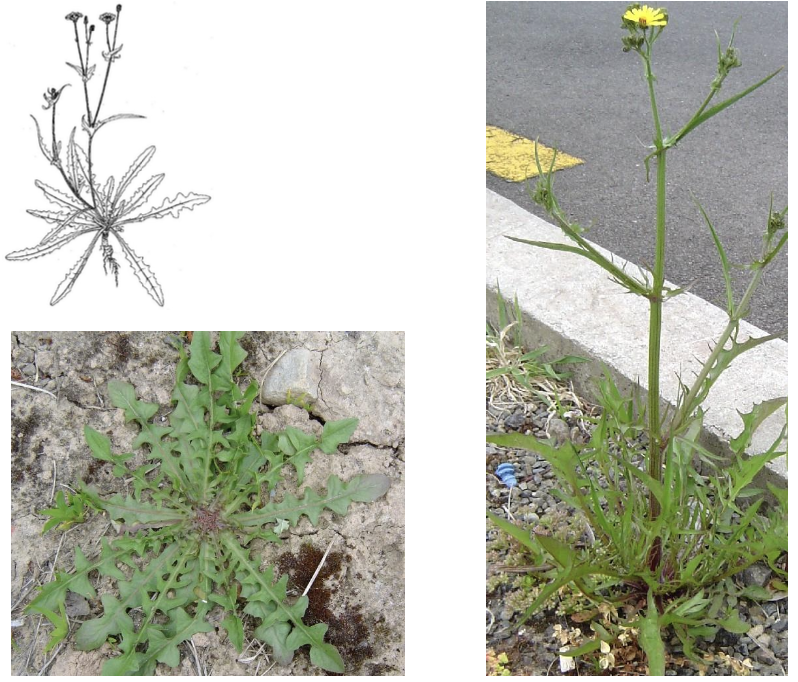
<p><strong>Plant family:</strong> Asteraceae<br><strong>Life cycle:</strong> Annual to biennial<br><strong>Key persistence / spread:</strong> Seed<br><strong>Farming systems:</strong> Pastures, arable land</p><p><strong> How to identify</strong></p><p>It begins as a basal rosette similar to dandelion or catsear but soon develops upright, branched flowering stems with leaves present along the stem.</p><p>Leaves are thinner and less bristly than catsear and less deeply lobed than dandelion. Stem leaves clasp slightly but not strongly.</p><p>Flower heads are yellow and smaller than dandelion, produced in clusters rather than singly. Stems are solid, not hollow.</p><p>The presence of leaves on flowering stems is the most important distinguishing feature.</p>
42
New cards

Scotch Thistle

Plant family: Asteraceae
Life cycle: Biennial
Key persistence / spread: Seed
Farming systems: Pastures, waste land

How to identify

In the first year, it forms a very large, flat rosette with leaves that are heavily armed. Spines occur on both the leaf margins and the leaf surface, which is unusual.

In the second year, it bolts into a tall, branching plant often exceeding two metres. Stems have spiny wings running along their length.

Flower heads are large, purple, and solitary or in small clusters. The plant is extremely conspicuous when flowering.

The size and surface spines clearly distinguish it from Californian thistle.
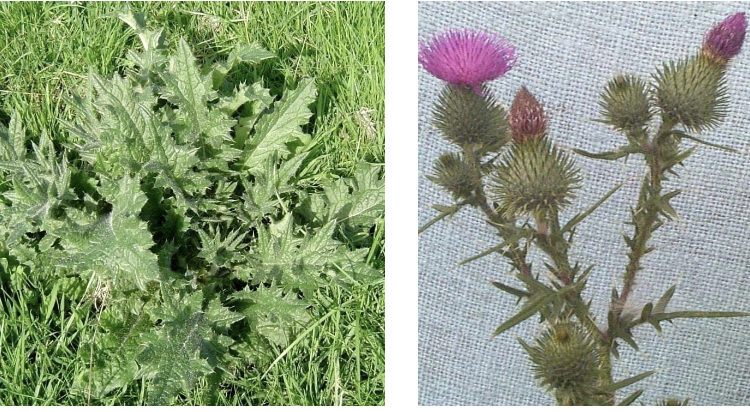
<p><strong>Plant family:</strong> Asteraceae<br><strong>Life cycle:</strong> Biennial<br><strong>Key persistence / spread:</strong> Seed<br><strong>Farming systems:</strong> Pastures, waste land</p><p><strong> How to identify</strong></p><p>In the first year, it forms a very large, flat rosette with leaves that are heavily armed. Spines occur on both the leaf margins and the leaf surface, which is unusual.</p><p>In the second year, it bolts into a tall, branching plant often exceeding two metres. Stems have spiny wings running along their length.</p><p>Flower heads are large, purple, and solitary or in small clusters. The plant is extremely conspicuous when flowering.</p><p>The size and surface spines clearly distinguish it from Californian thistle.</p>
43
New cards

Sow Thistle

Plant family: Asteraceae
Life cycle: Annual
Key persistence / spread: Large quantities of wind‑dispersed seed
Farming systems: Pastures, arable crops, waste areas

How to identify

It is a fast‑growing, soft‑stemmed annual that typically establishes in spring and summer where light reaches bare soil. It grows rapidly and can reach over one metre tall if left ungrazed or uncut.

Stems are hollow, soft, and easily snapped, and when broken release a milky white sap, which is an important identification feature across the Asteraceae family. Leaves are bluish‑green, thin, and relatively soft compared with true thistles. They clasp the stem, forming ear‑like lobes around it, but lack hard spines.

Leaves are irregularly lobed with rounded margins rather than sharp points. The plant has a lax, floppy appearance compared to Scotch or Californian thistles.

Flowers are yellow and dandelion‑like but occur in clusters at the tops of branches rather than singly. After flowering, large numbers of light, fluffy seeds are produced and dispersed long distances by wind.

Often confused with dandelion, but dandelion has no stem leaves, flowers on single hollow stalks, and a basal rosette only.
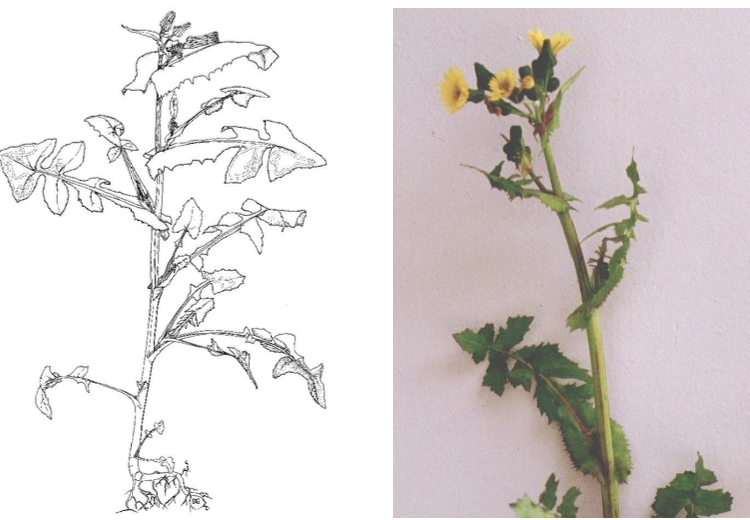
<p><strong>Plant family:</strong> Asteraceae<br><strong>Life cycle:</strong> Annual<br><strong>Key persistence / spread:</strong> Large quantities of wind‑dispersed seed<br><strong>Farming systems:</strong> Pastures, arable crops, waste areas</p><p><strong> How to identify</strong></p><p>It is a fast‑growing, soft‑stemmed annual that typically establishes in spring and summer where light reaches bare soil. It grows rapidly and can reach over one metre tall if left ungrazed or uncut.</p><p>Stems are hollow, soft, and easily snapped, and when broken release a milky white sap, which is an important identification feature across the Asteraceae family. Leaves are bluish‑green, thin, and relatively soft compared with true thistles. They clasp the stem, forming ear‑like lobes around it, but lack hard spines.</p><p>Leaves are irregularly lobed with rounded margins rather than sharp points. The plant has a lax, floppy appearance compared to Scotch or Californian thistles.</p><p>Flowers are yellow and dandelion‑like but occur in clusters at the tops of branches rather than singly. After flowering, large numbers of light, fluffy seeds are produced and dispersed long distances by wind.</p><p>Often confused with dandelion, but dandelion has no stem leaves, flowers on single hollow stalks, and a basal rosette only.</p>
44
New cards

Spurrey

Plant family: Caryophyllaceae
Life cycle: Annual
Key persistence / spread: Long‑lived seed in the soil
Farming systems: Crops, new pastures, light soils

How to identify

It is a low‑growing, fine‑textured annual weed that often forms sprawling mats close to the ground. It prefers acidic, low‑fertility soils, which makes its presence a useful soil indicator.

Stems are thin, highly branched, and weak. Leaves are very fine, stiff, and needle‑like, arranged in whorls along the stem. This needle‑leaf appearance is one of the most important identification cues, as very few pasture weeds have such fine foliage.

Flowers are small, white, and star‑shaped but are often unnoticed due to their size. Seed capsules form quickly after flowering and release large numbers of small seeds.

It is most common in young pastures and recently cultivated paddocks. It is rarely grazed due to its low palatability and delicate structure.
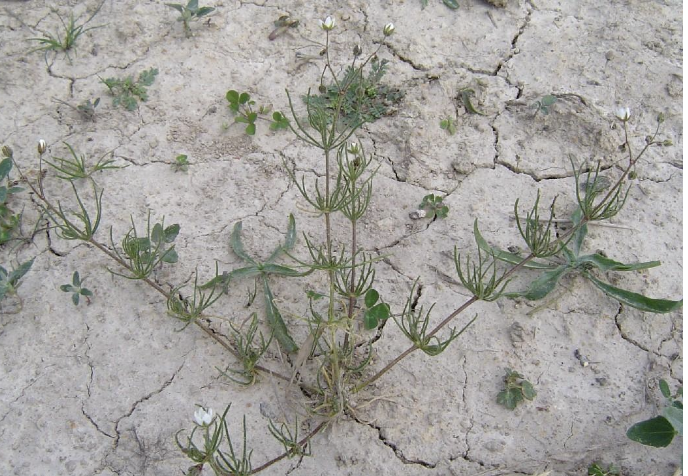
<p><strong>Plant family:</strong> Caryophyllaceae<br><strong>Life cycle:</strong> Annual<br><strong>Key persistence / spread:</strong> Long‑lived seed in the soil<br><strong>Farming systems:</strong> Crops, new pastures, light soils</p><p><strong> How to identify</strong></p><p>It is a low‑growing, fine‑textured annual weed that often forms sprawling mats close to the ground. It prefers acidic, low‑fertility soils, which makes its presence a useful soil indicator.</p><p>Stems are thin, highly branched, and weak. Leaves are very fine, stiff, and needle‑like, arranged in whorls along the stem. This needle‑leaf appearance is one of the most important identification cues, as very few pasture weeds have such fine foliage.</p><p>Flowers are small, white, and star‑shaped but are often unnoticed due to their size. Seed capsules form quickly after flowering and release large numbers of small seeds.</p><p>It is most common in young pastures and recently cultivated paddocks. It is rarely grazed due to its low palatability and delicate structure.</p>
45
New cards

Twin Cress

Plant family: Brassicaceae
Life cycle: Annual
Key persistence / spread: Seed
Farming systems: New pastures, arable paddocks

How to identify

It is a small, low‑growing brassica weed that establishes rapidly on bare or disturbed ground, particularly during pasture renewal.

It begins as a basal rosette with irregularly lobed leaves, often with unequal lobes on opposite sides of the leaf. Leaves are soft but produce a strong mustard‑like smell when crushed, confirming identification as a brassica.

The defining identification feature appears at seed set: the plant produces paired seed pods (“twins”) rather than single pods. These twin pods sit closely together on short stalks and are unique among common pasture weeds.

The plant remains relatively short but sets seed readily, allowing it to persist across seasons if not controlled before flowering.
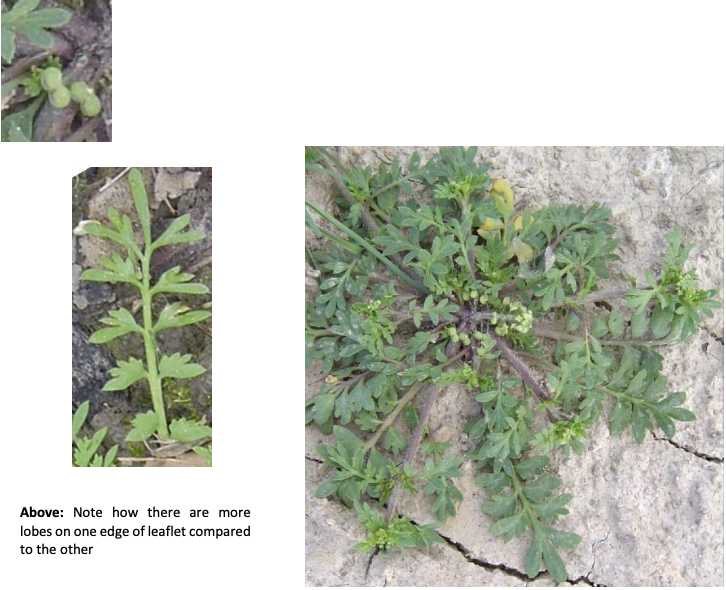
<p><strong>Plant family:</strong> Brassicaceae<br><strong>Life cycle:</strong> Annual<br><strong>Key persistence / spread:</strong> Seed<br><strong>Farming systems:</strong> New pastures, arable paddocks</p><p><strong> How to identify</strong></p><p>It is a small, low‑growing brassica weed that establishes rapidly on bare or disturbed ground, particularly during pasture renewal.</p><p>It begins as a basal rosette with irregularly lobed leaves, often with unequal lobes on opposite sides of the leaf. Leaves are soft but produce a strong mustard‑like smell when crushed, confirming identification as a brassica.</p><p>The defining identification feature appears at seed set: the plant produces paired seed pods (“twins”) rather than single pods. These twin pods sit closely together on short stalks and are unique among common pasture weeds.</p><p>The plant remains relatively short but sets seed readily, allowing it to persist across seasons if not controlled before flowering.</p>
46
New cards

Blackberry

Plant family: Rosaceae
Life cycle: Perennial
Key persistence / spread: Woody canes; bird‑dispersed seed
Farming systems: Hill country, gullies, forestry margins

How to identify

It is a woody perennial shrub that forms dense, spreading thickets. It grows through long, arching canes that may reach several metres in length.

Canes are tough and armed with strong, backward‑facing thorns, making stands difficult for stock or humans to penetrate. When canes bend down and touch the soil, they often root at the tip, creating new plants.

Leaves are compound, typically with five serrated leaflets, and the underside of the leaf midrib often bears small spines. In spring, it produces white five‑petalled flowers, followed by berries later in summer.

Birds readily consume the berries, spreading seed widely, especially into gullies and fence lines.
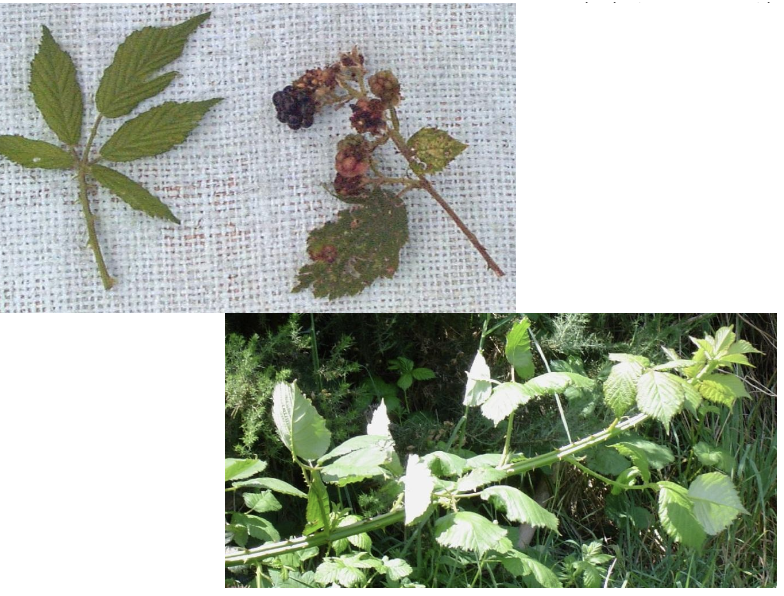
<p><strong>Plant family:</strong> Rosaceae<br><strong>Life cycle:</strong> Perennial<br><strong>Key persistence / spread:</strong> Woody canes; bird‑dispersed seed<br><strong>Farming systems:</strong> Hill country, gullies, forestry margins</p><p><strong> How to identify</strong></p><p>It is a woody perennial shrub that forms dense, spreading thickets. It grows through long, arching canes that may reach several metres in length.</p><p>Canes are tough and armed with strong, backward‑facing thorns, making stands difficult for stock or humans to penetrate. When canes bend down and touch the soil, they often root at the tip, creating new plants.</p><p>Leaves are compound, typically with five serrated leaflets, and the underside of the leaf midrib often bears small spines. In spring, it produces white five‑petalled flowers, followed by berries later in summer.</p><p>Birds readily consume the berries, spreading seed widely, especially into gullies and fence lines.</p>
47
New cards

Broad-Leaved Dock

Plant family: Polygonaceae
Life cycle: Perennial
Key persistence / spread: Very large taproot; prolific seed production
Farming systems: Dairy pastures, compacted soils

How to identify

It is a strongly persistent perennial that grows as a large basal rosette. Leaves are very large, broad, and blunt‑tipped, with a leathery texture that resists tearing.

Leaves have pronounced veins, and leaf margins are often smooth or gently wavy. It thrives in compacted, nitrogen‑rich soils, particularly dairy pastures and stock camps.

A deep, fleshy taproot allows plants to survive drought, grazing, and repeated cutting. Simply removing the top growth rarely kills the plant.

In spring and summer, it produces tall flower stalks with dense clusters of brown seed, which remain visible long after flowering. These seed stalks are often the first sign of infestation.
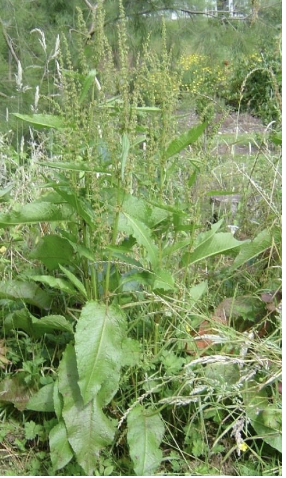
<p><strong>Plant family:</strong> Polygonaceae<br><strong>Life cycle:</strong> Perennial<br><strong>Key persistence / spread:</strong> Very large taproot; prolific seed production<br><strong>Farming systems:</strong> Dairy pastures, compacted soils</p><p><strong> How to identify</strong></p><p>It is a strongly persistent perennial that grows as a large basal rosette. Leaves are very large, broad, and blunt‑tipped, with a leathery texture that resists tearing.</p><p>Leaves have pronounced veins, and leaf margins are often smooth or gently wavy. It thrives in compacted, nitrogen‑rich soils, particularly dairy pastures and stock camps.</p><p>A deep, fleshy taproot allows plants to survive drought, grazing, and repeated cutting. Simply removing the top growth rarely kills the plant.</p><p>In spring and summer, it produces tall flower stalks with dense clusters of brown seed, which remain visible long after flowering. These seed stalks are often the first sign of infestation.</p>
48
New cards

Broom

Plant family: Fabaceae
Life cycle: Perennial shrub
Key persistence / spread: Long‑lived hard seed bank
Farming systems: Hill country, forestry, marginal land

How to identify

It is a perennial shrub with green, ridged stems that carry out most of the plant’s photosynthesis. Leaves are present only as small leaflets on young growth and are quickly lost as the plant matures.

The shrub produces large numbers of bright yellow, pea‑like flowers, usually in spring. These flowers develop into black seed pods that split explosively when mature, throwing seed several metres.

Seeds are extremely hard‑coated and can survive in the soil for decades, enabling it to re‑establish long after adult plants are removed.

Unlike gorse, it has few or no spines and smoother stems.
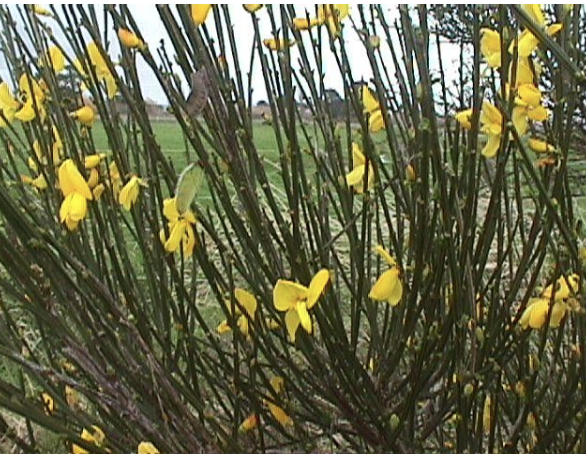
<p><strong>Plant family:</strong> Fabaceae<br><strong>Life cycle:</strong> Perennial shrub<br><strong>Key persistence / spread:</strong> Long‑lived hard seed bank<br><strong>Farming systems:</strong> Hill country, forestry, marginal land</p><p><strong>How to identify</strong></p><p>It is a perennial shrub with green, ridged stems that carry out most of the plant’s photosynthesis. Leaves are present only as small leaflets on young growth and are quickly lost as the plant matures.</p><p>The shrub produces large numbers of bright yellow, pea‑like flowers, usually in spring. These flowers develop into black seed pods that split explosively when mature, throwing seed several metres.</p><p>Seeds are extremely hard‑coated and can survive in the soil for decades, enabling it to re‑establish long after adult plants are removed.</p><p>Unlike gorse, it has few or no spines and smoother stems.</p>
49
New cards

Creeping Buttercup

Plant family: Ranunculaceae
Life cycle: Perennial
Key persistence / spread: Stolons rooting at nodes
Farming systems: Wet or poorly drained pastures

How to identify

It is a low‑growing perennial that spreads aggressively through above‑ground runners. These stolons root at nodes, allowing the plant to rapidly colonise open pasture.

Leaves are trifoliate, with the middle leaflet on a longer stalk than the side leaflets. Leaf edges are toothed, and leaves are carried on long petioles.

Flowers are shiny, bright yellow, and produced singly on long stalks above the foliage. Plants prefer damp soils and are commonly found in pugged paddocks.

The presence of runners is the key feature separating creeping buttercup from giant buttercup.
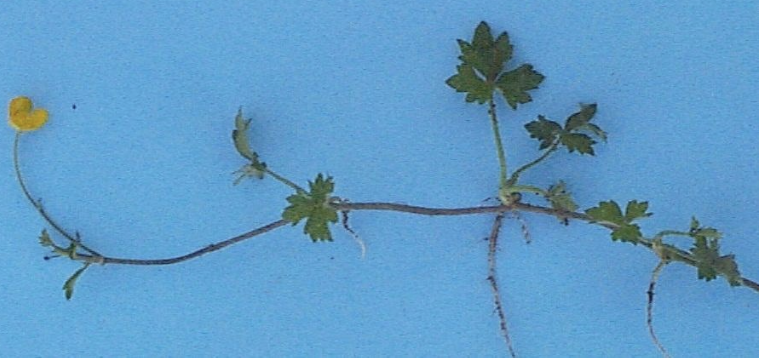
<p><strong>Plant family:</strong> Ranunculaceae<br><strong>Life cycle:</strong> Perennial<br><strong>Key persistence / spread:</strong> Stolons rooting at nodes<br><strong>Farming systems:</strong> Wet or poorly drained pastures</p><p><strong>How to identify</strong></p><p>It is a low‑growing perennial that spreads aggressively through above‑ground runners. These stolons root at nodes, allowing the plant to rapidly colonise open pasture.</p><p>Leaves are trifoliate, with the middle leaflet on a longer stalk than the side leaflets. Leaf edges are toothed, and leaves are carried on long petioles.</p><p>Flowers are shiny, bright yellow, and produced singly on long stalks above the foliage. Plants prefer damp soils and are commonly found in pugged paddocks.</p><p>The presence of runners is the key feature separating creeping buttercup from giant buttercup.</p>
50
New cards

Giant Buttercup

Plant family: Ranunculaceae
Life cycle: Perennial
Key persistence / spread: Short underground rhizome; seed
Farming systems: Dairy pastures (especially high rainfall)

How to identify

It grows as a large, upright perennial rather than a creeping plant. Leaves are large, deeply lobed, and glossy, forming a conspicuous clump.

Unlike creeping buttercup, there are no stolons. Regrowth occurs from a short underground rhizome, making plants persistent once established.

Flowers are bright yellow, larger than those of creeping buttercup, and held well above pasture height. Cattle strongly avoid grazing it due to bitterness, which gives it a competitive advantage.

Most common in high‑rainfall dairy regions.
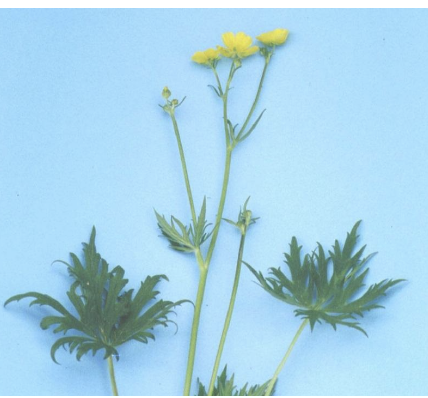
<p><strong>Plant family:</strong> Ranunculaceae<br><strong>Life cycle:</strong> Perennial<br><strong>Key persistence / spread:</strong> Short underground rhizome; seed<br><strong>Farming systems:</strong> Dairy pastures (especially high rainfall)</p><p><strong>How to identify</strong></p><p>It grows as a large, upright perennial rather than a creeping plant. Leaves are large, deeply lobed, and glossy, forming a conspicuous clump.</p><p>Unlike creeping buttercup, there are no stolons. Regrowth occurs from a short underground rhizome, making plants persistent once established.</p><p>Flowers are bright yellow, larger than those of creeping buttercup, and held well above pasture height. Cattle strongly avoid grazing it due to bitterness, which gives it a competitive advantage.</p><p>Most common in high‑rainfall dairy regions.</p>
51
New cards

Gorse

Plant family: Fabaceae
Life cycle: Perennial shrub
Key persistence / spread: Extremely long‑lived hard seed bank
Farming systems: Hill country, forestry, marginal land

How to identify

It is a dense, woody shrub where leaves are replaced by sharp green spines. Young plants have soft trifoliate leaves initially, but these quickly transform into spines as the plant matures.

Bright yellow pea‑like flowers are produced mainly in spring but can appear at other times. These develop into pods that explosively release seed.

Seeds can survive in the soil for 30–40 years, making gorse extremely persistent. Dense thickets exclude pasture and stock.

Distinguished from broom by the presence of spines.
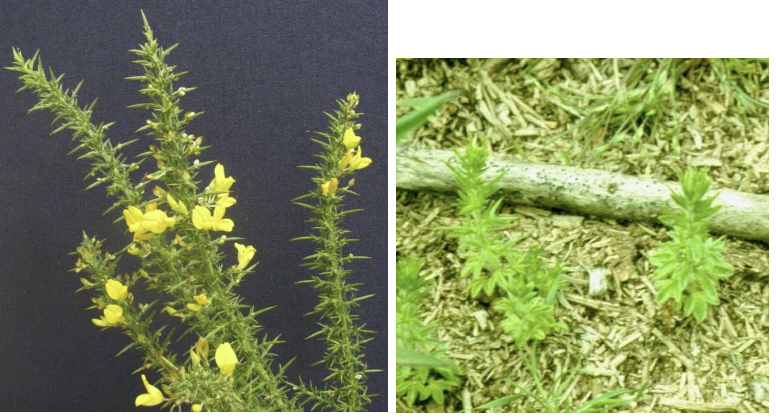
<p><strong>Plant family:</strong> Fabaceae<br><strong>Life cycle:</strong> Perennial shrub<br><strong>Key persistence / spread:</strong> Extremely long‑lived hard seed bank<br><strong>Farming systems:</strong> Hill country, forestry, marginal land</p><p><strong> How to identify</strong></p><p>It is a dense, woody shrub where leaves are replaced by sharp green spines. Young plants have soft trifoliate leaves initially, but these quickly transform into spines as the plant matures.</p><p>Bright yellow pea‑like flowers are produced mainly in spring but can appear at other times. These develop into pods that explosively release seed.</p><p>Seeds can survive in the soil for 30–40 years, making gorse extremely persistent. Dense thickets exclude pasture and stock.</p><p>Distinguished from broom by the presence of spines.</p>
52
New cards

Mouse-Ear Hawkweed

Plant family: Asteraceae
Life cycle: Perennial
Key persistence/spread: Stolons and seed
Farming systems: High‑country and dry grasslands

How to identify

It is a low‑growing perennial forming flat rosettes. Leaves are narrow, soft, and densely hairy, giving them a felt‑like texture.

Plants spread via thin stolons that extend horizontally across the soil surface. This allows rapid colonisation of open ground.

Flower stems are slender and carry small yellow flowers similar to dandelions but much smaller and more delicate.

Most problematic in low‑fertility, dry, high‑country environments.
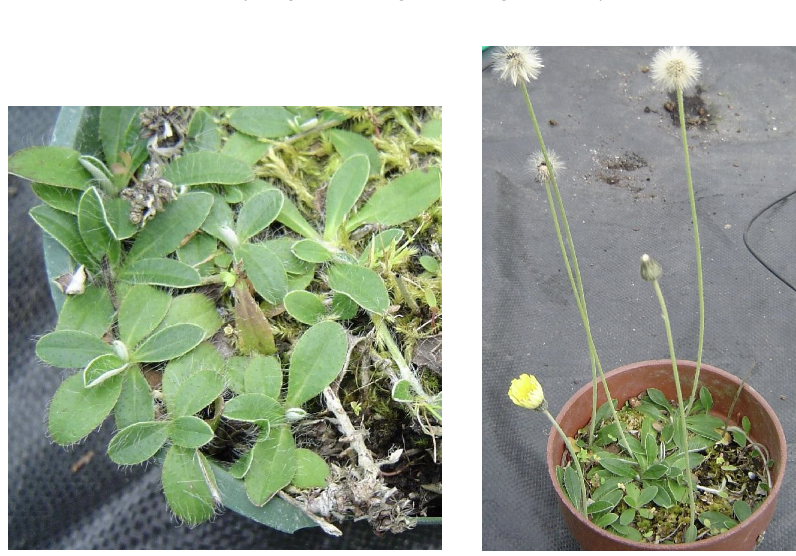
<p><strong>Plant family:</strong> Asteraceae<br><strong>Life cycle:</strong> Perennial<br><strong>Key persistence/spread:</strong> Stolons and seed<br><strong>Farming systems:</strong> High‑country and dry grasslands</p><p><strong>How to identify</strong></p><p>It is a low‑growing perennial forming flat rosettes. Leaves are narrow, soft, and densely hairy, giving them a felt‑like texture.</p><p>Plants spread via thin stolons that extend horizontally across the soil surface. This allows rapid colonisation of open ground.</p><p>Flower stems are slender and carry small yellow flowers similar to dandelions but much smaller and more delicate.</p><p>Most problematic in low‑fertility, dry, high‑country environments.</p>
53
New cards

Pennyroyal

Plant family: Lamiaceae
Life cycle: Perennial
Key persistence / spread: Stolons
Farming systems: Wet pastures, damp depressions

How to identify

It is a creeping perennial mint that spreads across damp ground via stolons. Stems are square in cross‑section, which is characteristic of the mint family.

Leaves are opposite, soft, and oval. When crushed, they release a strong mint scent, which is a critical identification feature.

Small purple flowers occur in clusters in the leaf axils rather than at stem tips. It thrives in wet conditions and often indicates poor drainage.
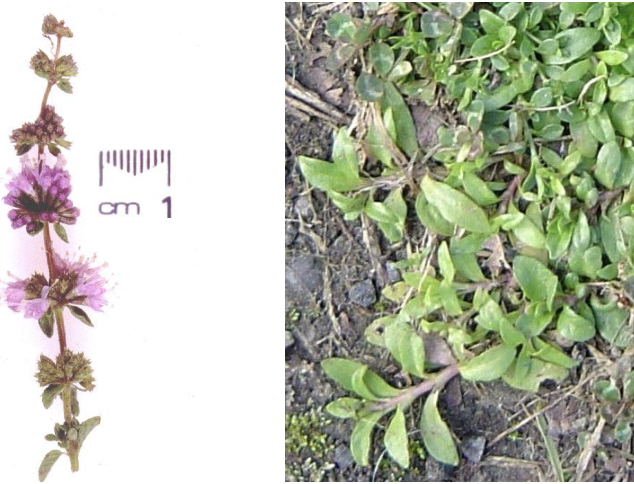
<p><strong>Plant family:</strong> Lamiaceae<br><strong>Life cycle:</strong> Perennial<br><strong>Key persistence / spread:</strong> Stolons<br><strong>Farming systems:</strong> Wet pastures, damp depressions</p><p><strong> How to identify</strong></p><p>It is a creeping perennial mint that spreads across damp ground via stolons. Stems are square in cross‑section, which is characteristic of the mint family.</p><p>Leaves are opposite, soft, and oval. When crushed, they release a strong mint scent, which is a critical identification feature.</p><p>Small purple flowers occur in clusters in the leaf axils rather than at stem tips. It thrives in wet conditions and often indicates poor drainage.</p>
54
New cards

Sheep’s Sorrel

Plant family: Polygonaceae
Life cycle: Perennial
Key persistence / spread: Creeping underground roots
Farming systems: Acidic, low‑fertility soils

How to identify

It is a low‑growing perennial with very distinctive arrow‑shaped leaves, each with two backward‑pointing lobes at the base.

Plants are often reddish, particularly under nutrient stress or dry conditions. Leaves have a sharp sour taste due to oxalic acid.

The plant spreads via underground roots, forming patches in poor soils where pasture competition is weak.

It is an indicator of low fertility.
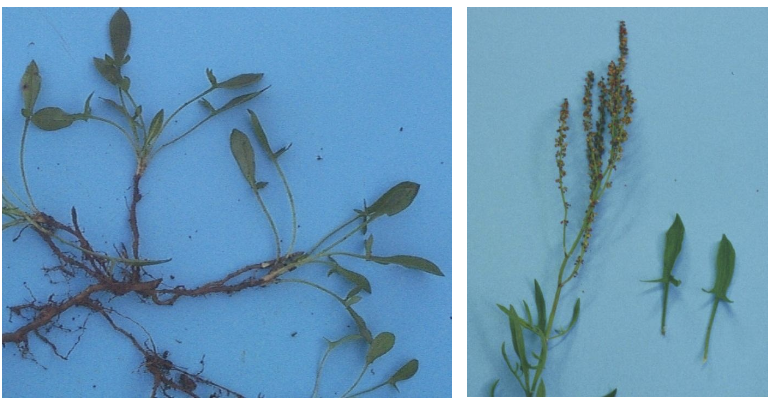
<p><strong>Plant family:</strong> Polygonaceae<br><strong>Life cycle:</strong> Perennial<br><strong>Key persistence / spread:</strong> Creeping underground roots<br><strong>Farming systems:</strong> Acidic, low‑fertility soils</p><p><strong> How to identify</strong></p><p>It is a low‑growing perennial with very distinctive arrow‑shaped leaves, each with two backward‑pointing lobes at the base.</p><p>Plants are often reddish, particularly under nutrient stress or dry conditions. Leaves have a sharp sour taste due to oxalic acid.</p><p>The plant spreads via underground roots, forming patches in poor soils where pasture competition is weak.</p><p>It is an indicator of low fertility.</p>
55
New cards

Yarrow

Plant family: Asteraceae
Life cycle: Perennial
Key persistence / spread: Rhizomes and seed
Farming systems: Pasture margins, disturbed areas

How to identify

It is an upright perennial with finely divided, feathery leaves that give it a soft, fern‑like appearance. Leaves are aromatic and smell pleasant when crushed.

The plant spreads via underground rhizomes, allowing it to form small colonies rather than single plants.

Flower heads are small and white, arranged in flat‑topped clusters held above the foliage. It persists well under light grazing and disturbance.

Often confused with stinking mayweed, but it has underground spread and a pleasant smell.
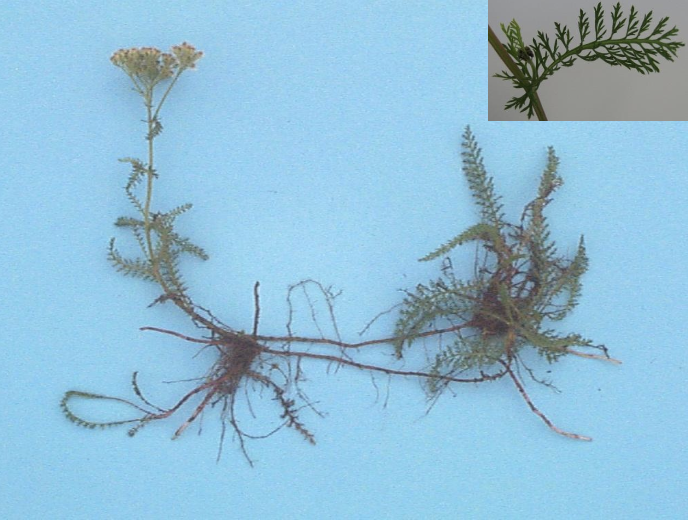
<p><strong>Plant family:</strong> Asteraceae<br><strong>Life cycle:</strong> Perennial<br><strong>Key persistence / spread:</strong> Rhizomes and seed<br><strong>Farming systems:</strong> Pasture margins, disturbed areas</p><p><strong> How to identify</strong></p><p>It is an upright perennial with finely divided, feathery leaves that give it a soft, fern‑like appearance. Leaves are aromatic and smell pleasant when crushed.</p><p>The plant spreads via underground rhizomes, allowing it to form small colonies rather than single plants.</p><p>Flower heads are small and white, arranged in flat‑topped clusters held above the foliage. It persists well under light grazing and disturbance.</p><p>Often confused with stinking mayweed, but it has underground spread and a pleasant smell.</p>
56
New cards

Mallow

Plant family: Malvaceae
Life cycle: Annual or short‑lived perennial
Key persistence / spread: Seed
Farming systems: Tracks, yards, lucerne paddocks

How to identify

It is a spreading or low‑growing plant with rounded, palmately lobed leaves that resemble small geranium leaves. Leaves are softly hairy and carried on long petioles.

Stems are prostrate to ascending and tough. Flowers are showy compared with most weeds, with five petals that are white, pink, or purple.

After flowering, the plant produces distinctive wheel‑shaped seed pods, made of wedge‑shaped segments arranged in a ring.

It thrives in compacted or disturbed soil and is tolerant of trampling.
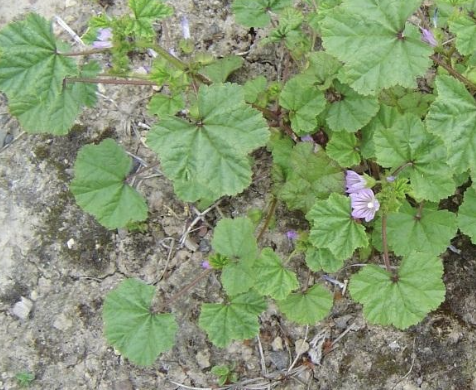
<p><strong>Plant family:</strong> Malvaceae<br><strong>Life cycle:</strong> Annual or short‑lived perennial<br><strong>Key persistence / spread:</strong> Seed<br><strong>Farming systems:</strong> Tracks, yards, lucerne paddocks</p><p><strong> How to identify</strong></p><p>It is a spreading or low‑growing plant with rounded, palmately lobed leaves that resemble small geranium leaves. Leaves are softly hairy and carried on long petioles.</p><p>Stems are prostrate to ascending and tough. Flowers are showy compared with most weeds, with five petals that are white, pink, or purple.</p><p>After flowering, the plant produces distinctive wheel‑shaped seed pods, made of wedge‑shaped segments arranged in a ring.</p><p>It thrives in compacted or disturbed soil and is tolerant of trampling.</p>
57
New cards

Barley

Plant family: Poaceae
Life cycle: Annual
Key persistence / spread: Seed only
Farming systems: Arable cropping (grain, silage, feed barley)

How to identify

It is an upright annual cereal that germinates in autumn or spring depending on sowing time. It establishes quickly and forms a relatively open canopy compared with wheat. Plants are usually pale to medium green and less dense than oats.

Leaves are long and flat with a rough feel along the margins. At the junction of leaf blade and sheath, barley has short auricles that clasp the stem. The emerging leaf is rolled.

The most distinctive feature is the seed head. Barley produces a stiff, erect spike with very long, coarse awns extending well beyond the seed head. These awns give flowering crops a bristly appearance and can cause eye or mouth irritation to stock.

It is commonly confused with wheat, but wheat awns (if present) are much shorter, and the head appears thicker and less bristly.
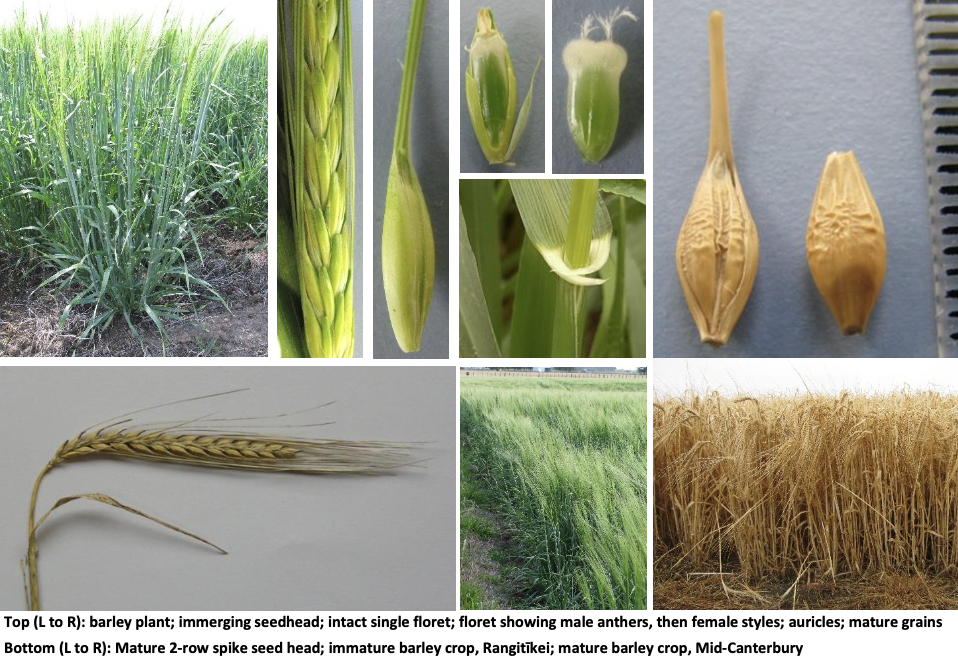
<p><strong>Plant family:</strong> Poaceae<br><strong>Life cycle:</strong> Annual<br><strong>Key persistence / spread:</strong> Seed only<br><strong>Farming systems:</strong> Arable cropping (grain, silage, feed barley)</p><p><strong> How to identify</strong></p><p>It is an upright annual cereal that germinates in autumn or spring depending on sowing time. It establishes quickly and forms a relatively open canopy compared with wheat. Plants are usually pale to medium green and less dense than oats.</p><p>Leaves are long and flat with a rough feel along the margins. At the junction of leaf blade and sheath, barley has short auricles that clasp the stem. The emerging leaf is rolled.</p><p>The most distinctive feature is the seed head. Barley produces a stiff, erect spike with very long, coarse awns extending well beyond the seed head. These awns give flowering crops a bristly appearance and can cause eye or mouth irritation to stock.</p><p>It is commonly confused with wheat, but wheat awns (if present) are much shorter, and the head appears thicker and less bristly.</p>
58
New cards

Wheat

Plant family: Poaceae
Life cycle: Annual
Key persistence/spread: Seed only
Farming systems: Arable cropping (grain production)

How to identify

It is an erect, tillering cereal with a denser growth habit than barley or oats. Stands are often uniform and medium to dark green, forming a closed canopy under good nutrition.

Leaves are flat and smooth to slightly rough. Wheat has short auricles that clasp the stem, but they are usually smaller and less obvious than those of barley. The emerging leaf is rolled, not folded.

The seed head is a compact spike, thicker than barley. Depending on cultivar, awns may be absent or short and fine. Even awned, it never appears as bristly as barley.

It is most easily confused with barley at early growth stages; at heading, the shorter or absent awns and thicker head distinguish it.
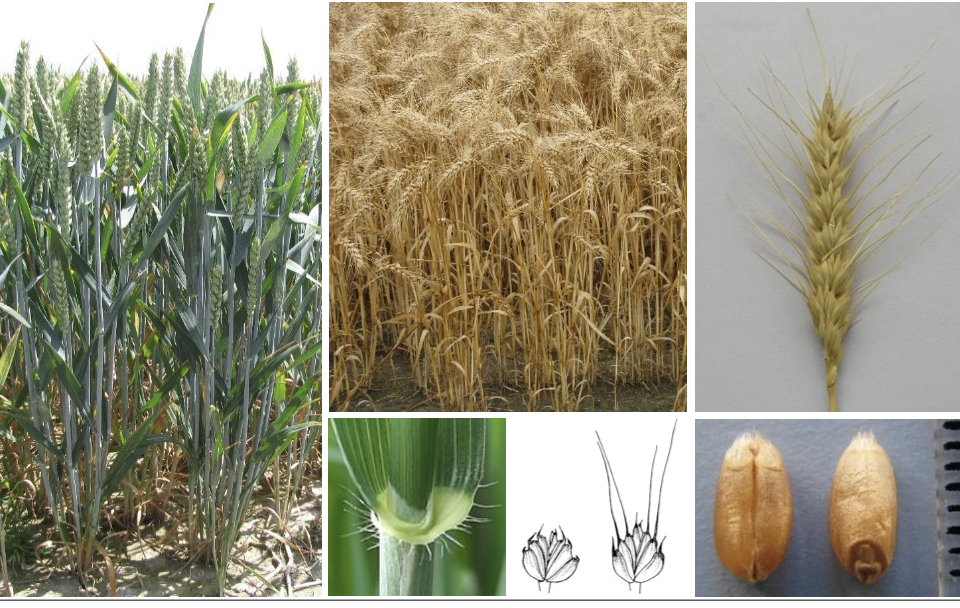
<p><strong>Plant family:</strong> Poaceae<br><strong>Life cycle:</strong> Annual<br><strong>Key persistence/spread:</strong> Seed only<br><strong>Farming systems:</strong> Arable cropping (grain production)</p><p><strong> How to identify</strong></p><p>It is an erect, tillering cereal with a denser growth habit than barley or oats. Stands are often uniform and medium to dark green, forming a closed canopy under good nutrition.</p><p>Leaves are flat and smooth to slightly rough. Wheat has short auricles that clasp the stem, but they are usually smaller and less obvious than those of barley. The emerging leaf is rolled, not folded.</p><p>The seed head is a compact spike, thicker than barley. Depending on cultivar, awns may be absent or short and fine. Even awned, it never appears as bristly as barley.</p><p>It is most easily confused with barley at early growth stages; at heading, the shorter or absent awns and thicker head distinguish it.</p>
59
New cards

Oats

Plant family: Poaceae
Life cycle: Annual
Key persistence/spread: Seed only
Farming systems: Greenfeed, silage, grain

How to identify

They are an annual cereal with a looser, more open growth habit than wheat or barley. Plants tend to look softer and less rigid, particularly in the leaves and stems.

Leaves are broad, flat, and soft, often bluish‑green. They lack auricles entirely, which is a key diagnostic feature when compared with wheat and barley. The emerging leaf is rolled.

The most distinctive feature is the seed head, which is a branched, drooping panicle rather than a spike. Individual spikelets hang on long stalks, giving flowering oats a relaxed, nodding appearance.

They are rarely confused with other cereals once the panicle is visible.
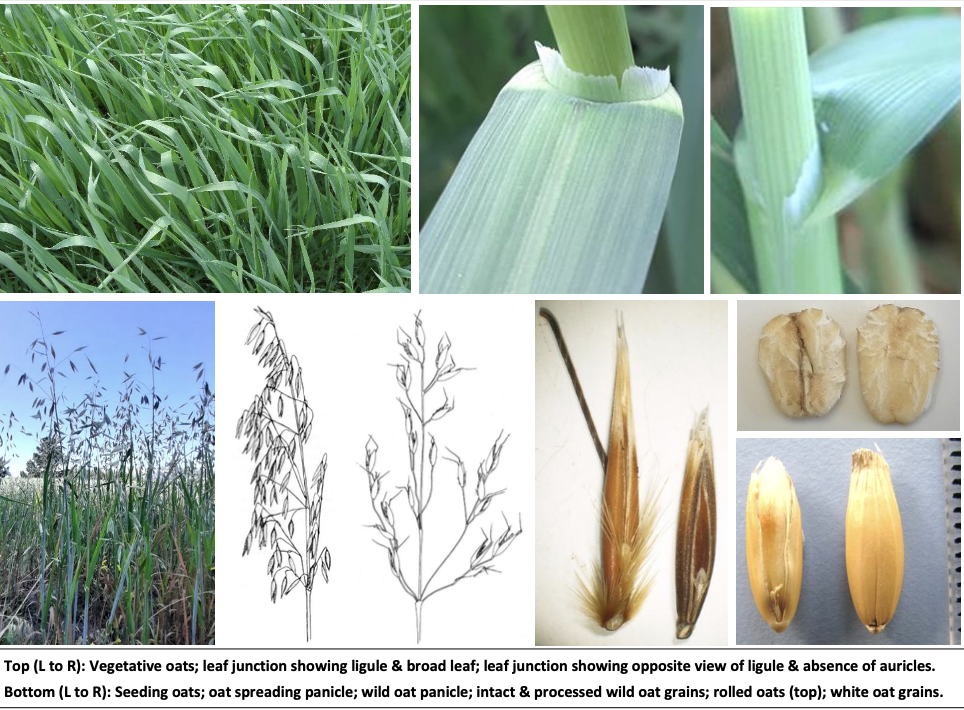
<p><strong>Plant family:</strong> Poaceae<br><strong>Life cycle:</strong> Annual<br><strong>Key persistence/spread:</strong> Seed only<br><strong>Farming systems:</strong> Greenfeed, silage, grain</p><p><strong>How to identify</strong></p><p>They are an annual cereal with a looser, more open growth habit than wheat or barley. Plants tend to look softer and less rigid, particularly in the leaves and stems.</p><p>Leaves are broad, flat, and soft, often bluish‑green. They lack auricles entirely, which is a key diagnostic feature when compared with wheat and barley. The emerging leaf is rolled.</p><p>The most distinctive feature is the seed head, which is a branched, drooping panicle rather than a spike. Individual spikelets hang on long stalks, giving flowering oats a relaxed, nodding appearance.</p><p>They are rarely confused with other cereals once the panicle is visible.</p>
60
New cards

Maize

Plant family: Poaceae
Life cycle: Summer annual
Key persistence / spread: Seed only
Farming systems: Silage, grain maize, forage crops

How to identify

It is a tall, coarse, warm‑season grass that germinates only after soils warm in late spring. It grows rapidly under warm conditions and can exceed three metres in height.

Stems are thick, solid, and cane‑like, with obvious nodes. Leaves are very broad, with a prominent midrib, and are arranged alternately along the stem. Leaves wrap around the stem in a sheath.

It produces separate male and female flowers. The male flower forms the tassel at the top of the plant, while the female flower develops into a cob borne along the stem, identifiable by the long silks.

It is unmistakable once established and not confused with other arable species in NZ.
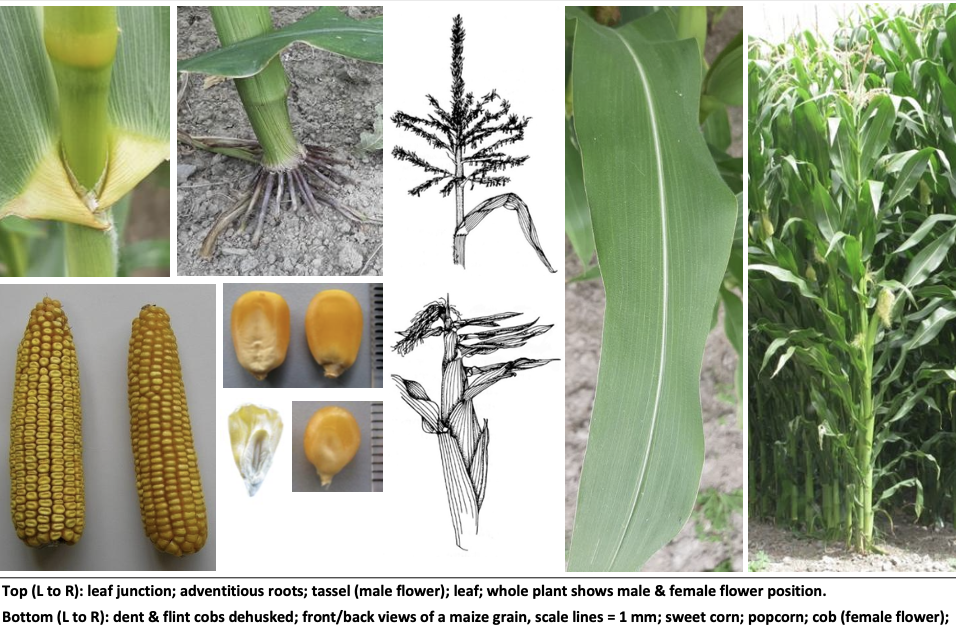
<p><strong>Plant family:</strong> Poaceae<br><strong>Life cycle:</strong> Summer annual<br><strong>Key persistence / spread:</strong> Seed only<br><strong>Farming systems:</strong> Silage, grain maize, forage crops</p><p><strong> How to identify</strong></p><p>It is a tall, coarse, warm‑season grass that germinates only after soils warm in late spring. It grows rapidly under warm conditions and can exceed three metres in height.</p><p>Stems are thick, solid, and cane‑like, with obvious nodes. Leaves are very broad, with a prominent midrib, and are arranged alternately along the stem. Leaves wrap around the stem in a sheath.</p><p>It produces separate male and female flowers. The male flower forms the tassel at the top of the plant, while the female flower develops into a cob borne along the stem, identifiable by the long silks.</p><p>It is unmistakable once established and not confused with other arable species in NZ.</p>
61
New cards

Peas

Plant family: Fabaceae
Life cycle: Annual
Key persistence / spread: Seed only
Farming systems: Arable cropping, feed and processing crops

How to identify

They are soft‑stemmed annual legumes that establish in cool conditions. Plants are weak‑stemmed and typically require support from neighbouring plants or crop density to remain upright.

Leaves are composed of paired leaflets and terminate in tendrils, which wrap around adjacent plants or supports. Large triangular stipules at the base of leaf stalks are a prominent feature and often contribute most of the leaf area.

Flowers are typically white or pale purple and pea‑shaped. After flowering, the plant produces elongated pods containing round seeds.

They are easily distinguished from cereals by their tendrils, broad stipules, and lack of grassy leaves.
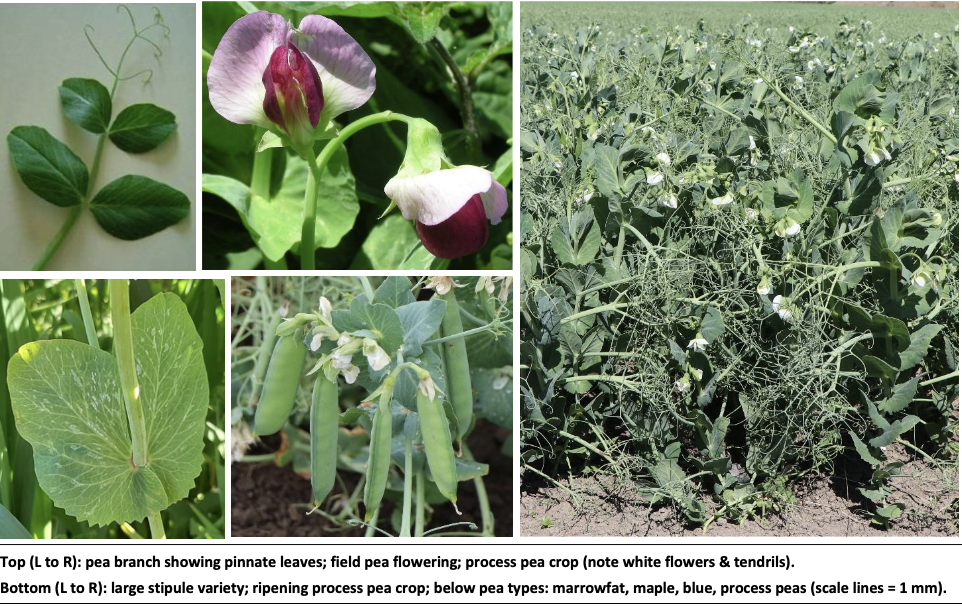
<p><strong>Plant family:</strong> Fabaceae<br><strong>Life cycle:</strong> Annual<br><strong>Key persistence / spread:</strong> Seed only<br><strong>Farming systems:</strong> Arable cropping, feed and processing crops</p><p><strong> How to identify</strong></p><p>They are soft‑stemmed annual legumes that establish in cool conditions. Plants are weak‑stemmed and typically require support from neighbouring plants or crop density to remain upright.</p><p>Leaves are composed of paired leaflets and terminate in tendrils, which wrap around adjacent plants or supports. Large triangular stipules at the base of leaf stalks are a prominent feature and often contribute most of the leaf area.</p><p>Flowers are typically white or pale purple and pea‑shaped. After flowering, the plant produces elongated pods containing round seeds.</p><p>They are easily distinguished from cereals by their tendrils, broad stipules, and lack of grassy leaves.</p>
62
New cards

Forage Rape

Plant family: Brassicaceae
Life cycle: Biennial (grown as an annual)
Key persistence / spread: Seed only
Farming systems: Summer and early autumn forage (sheep, cattle)

How to identify

It is an upright brassica grown primarily for leafy forage rather than for a bulb. After emergence it quickly produces a strong central stem with large leaves borne alternately up the stem.

Leaves are broad, flat, and usually dark green and glossy, with smooth or lightly serrated margins. Lower leaves may be lightly lobed, while upper leaves are narrower and more firmly attached to the stem. The plant has a noticeable brassica smell when crushed.

Unlike turnips or swedes, it does not form a swollen underground bulb. Feeding value comes from the leaf and upper stem, not from a root.

If allowed to mature fully, forage rape produces tall flowering stems with yellow four‑petalled flowers, typical of the brassica family. It is most commonly confused with kale, but rape has a softer stem and is shorter growing.
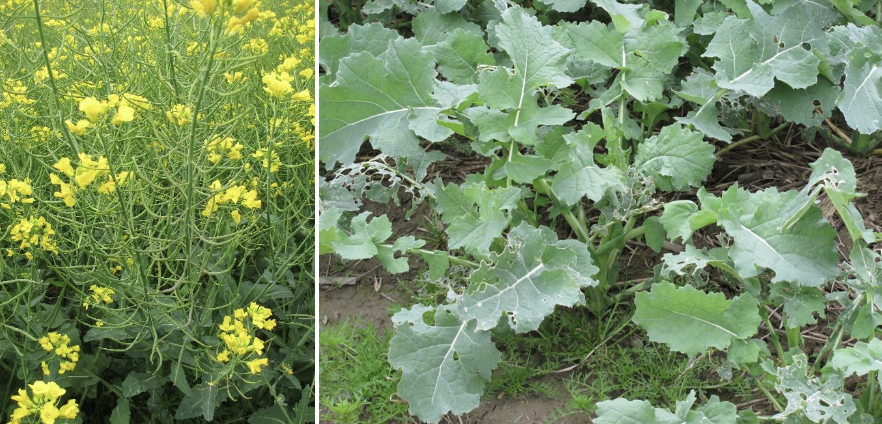
<p><strong>Plant family:</strong> Brassicaceae<br><strong>Life cycle:</strong> Biennial (grown as an annual)<br><strong>Key persistence / spread:</strong> Seed only<br><strong>Farming systems:</strong> Summer and early autumn forage (sheep, cattle)</p><p><strong> How to identify</strong></p><p>It is an upright brassica grown primarily for leafy forage rather than for a bulb. After emergence it quickly produces a strong central stem with large leaves borne alternately up the stem.</p><p>Leaves are broad, flat, and usually dark green and glossy, with smooth or lightly serrated margins. Lower leaves may be lightly lobed, while upper leaves are narrower and more firmly attached to the stem. The plant has a noticeable brassica smell when crushed.</p><p>Unlike turnips or swedes, it does not form a swollen underground bulb. Feeding value comes from the leaf and upper stem, not from a root.</p><p>If allowed to mature fully, forage rape produces tall flowering stems with yellow four‑petalled flowers, typical of the brassica family. It is most commonly confused with kale, but rape has a softer stem and is shorter growing.</p>
63
New cards

Turnips

Plant family: Brassicaceae
Life cycle: Biennial (grown as an annual)
Key persistence / spread: Seed only
Farming systems: Summer and autumn forage

How to identify

They are forage brassicas that produce a distinct swollen storage root at or above the soil surface. After establishment, growth is initially leaf‑focused before root swelling occurs.

Leaves are large and coarse. Lower leaves are hairy and deeply lobed, while upper leaves are smoother and less divided. Leaf stalks arise from the crown above the bulb.

The bulb is typically round to flat and partially exposed above ground. Skin colour varies by cultivar and may be white, purple‑topped, or green.

If allowed to flower, they bolt and produce yellow brassica flowers. They are distinguished from swedes by their smaller size, lighter leaf colour, and more exposed bulbs.
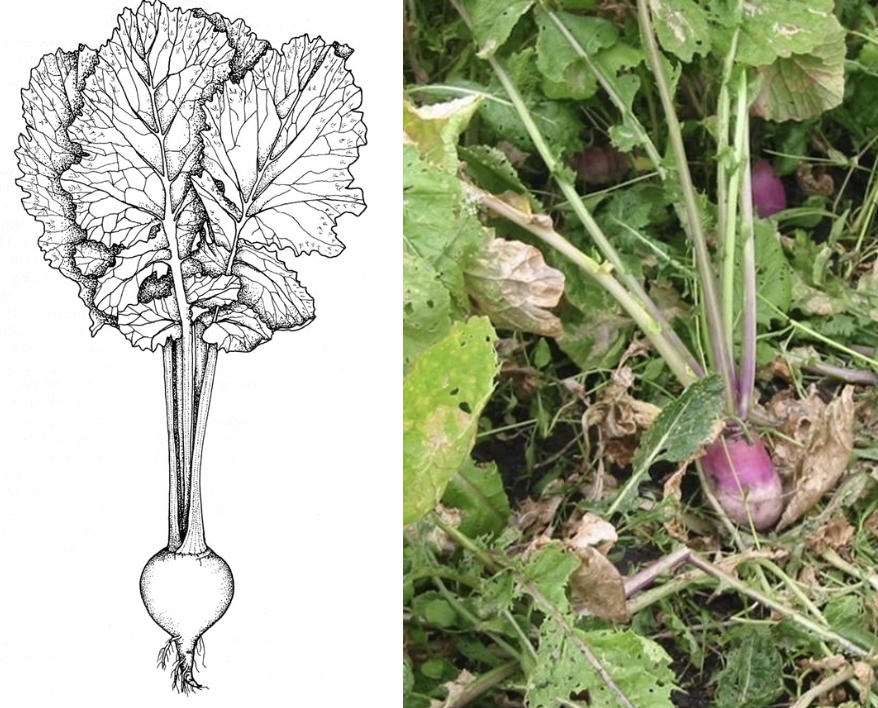
<p><strong>Plant family:</strong> Brassicaceae<br><strong>Life cycle:</strong> Biennial (grown as an annual)<br><strong>Key persistence / spread:</strong> Seed only<br><strong>Farming systems:</strong> Summer and autumn forage</p><p><strong> How to identify</strong></p><p>They are forage brassicas that produce a <strong>distinct swollen storage root</strong> at or above the soil surface. After establishment, growth is initially leaf‑focused before root swelling occurs.</p><p>Leaves are large and coarse. <strong>Lower leaves are hairy and deeply lobed</strong>, while upper leaves are smoother and less divided. Leaf stalks arise from the crown above the bulb.</p><p>The bulb is typically round to flat and partially exposed above ground. Skin colour varies by cultivar and may be white, purple‑topped, or green.</p><p>If allowed to flower, they bolt and produce yellow brassica flowers. They are distinguished from swedes by their <strong>smaller size</strong>, lighter leaf colour, and more exposed bulbs.</p>
64
New cards

Swede

Plant family: Brassicaceae
Life cycle: Biennial (grown as an annual)
Key persistence / spread: Seed only
Farming systems: Winter forage (mainly sheep and cattle)

How to identify

They are large forage brassicas grown primarily for winter feed. Like turnips, they form a storage root, but the bulb is larger, firmer, and usually more submerged in the soil.

Leaves are blue‑green and waxy, giving them a duller appearance than turnip leaves. Leaves are less hairy than turnips and often form a more upright rosette.

The bulb is typically spherical, heavy, and dense and may show a purple or bronze top depending on the cultivar. Flesh is usually yellow.

They develop more slowly than turnips and are more cold-tolerant. They are mainly confused with turnips but are distinguished by size, waxy leaves, and winter use.
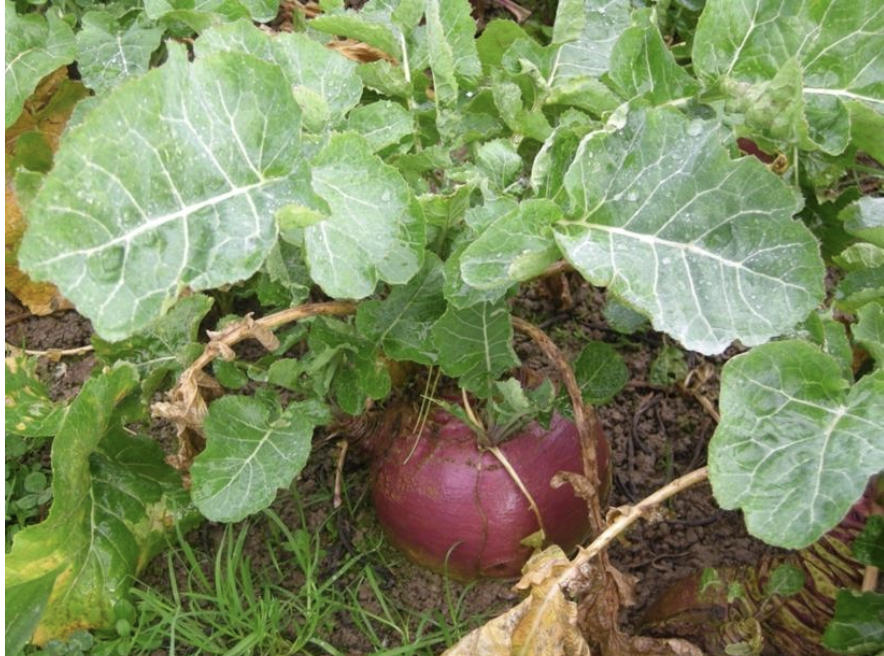
<p><strong>Plant family:</strong> Brassicaceae<br><strong>Life cycle:</strong> Biennial (grown as an annual)<br><strong>Key persistence / spread:</strong> Seed only<br><strong>Farming systems:</strong> Winter forage (mainly sheep and cattle)</p><p><strong> How to identify</strong></p><p>They are large forage brassicas grown primarily for winter feed. Like turnips, they form a storage root, but the bulb is larger, firmer, and usually more submerged in the soil.</p><p>Leaves are blue‑green and waxy, giving them a duller appearance than turnip leaves. Leaves are less hairy than turnips and often form a more upright rosette.</p><p>The bulb is typically spherical, heavy, and dense and may show a purple or bronze top depending on the cultivar. Flesh is usually yellow.</p><p>They develop more slowly than turnips and are more cold-tolerant. They are mainly confused with turnips but are distinguished by size, waxy leaves, and winter use.</p>
65
New cards

Kale

Plant family: Brassicaceae
Life cycle: Biennial (grown as an annual)
Key persistence/spread: Seed only
Farming systems: Winter forage, especially for cattle

How to identify

It is a tall, upright forage brassica that does not form a bulb. Instead, feed comes from the leaves and upper stem.

Plants develop a thick, woody stem that can exceed one metre in height. Leaves are large, coarse, and cabbage‑like, emerging along the stem rather than from a ground‑level rosette.

Leaves are typically blue‑green and waxy, with thick veins and strong petioles. The stem becomes increasingly lignified as the plant matures.

It is easily distinguished from rape by its greater height, thicker stem, and winter feeding role. It is never confused with turnips or swedes due to the absence of a bulb.
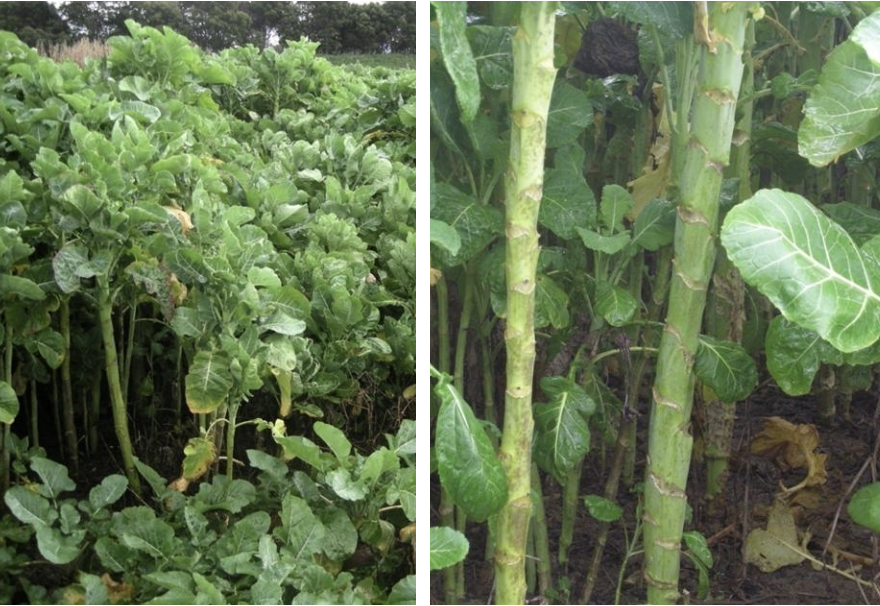
<p><strong>Plant family:</strong> Brassicaceae<br><strong>Life cycle:</strong> Biennial (grown as an annual)<br><strong>Key persistence/spread:</strong> Seed only<br><strong>Farming systems:</strong> Winter forage, especially for cattle</p><p><strong> How to identify</strong></p><p>It is a tall, upright forage brassica that does not form a bulb. Instead, feed comes from the leaves and upper stem.</p><p>Plants develop a thick, woody stem that can exceed one metre in height. Leaves are large, coarse, and cabbage‑like, emerging along the stem rather than from a ground‑level rosette.</p><p>Leaves are typically blue‑green and waxy, with thick veins and strong petioles. The stem becomes increasingly lignified as the plant matures.</p><p>It is easily distinguished from rape by its greater height, thicker stem, and winter feeding role. It is never confused with turnips or swedes due to the absence of a bulb.</p>
66
New cards

Fodder Beet

Plant family: Amaranthaceae (formerly Chenopodiaceae)
Life cycle: Annual
Key persistence/spread: Seed only
Farming systems: Winter forage (primarily dairy)

How to identify

It is a large-rooted forage crop with extremely high yield and energy content. It develops a very large swollen taproot, often with a significant portion exposed above ground.

Leaves are glossy, bright green, and carried on long, thick petioles arising from the crown of the bulb. Leaf veins are prominent and often red‑tinged, especially in some cultivars.

The bulb is smooth, firm, and can be spherical or slightly elongated. Skin colour varies from white to orange or red depending on variety.

It looks similar to sugar beet but is bred for animal feed rather than sugar production. It is easily distinguished from brassicas by leaf shape, vein colour, and lack of brassica smell.
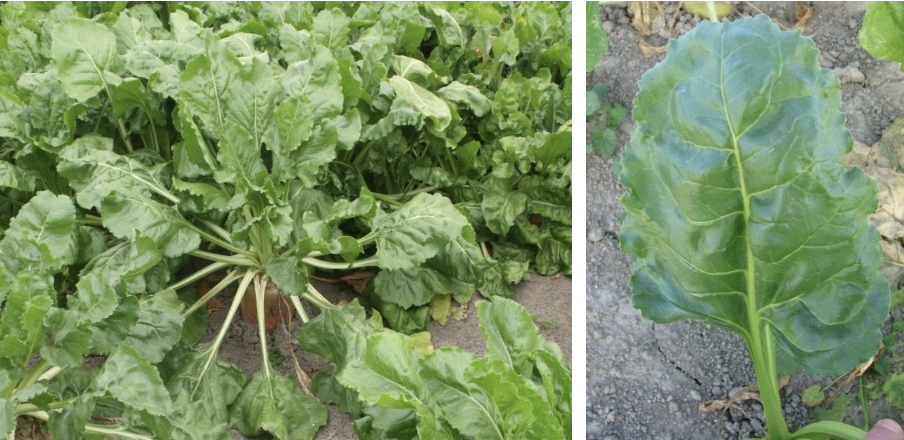
<p><strong>Plant family:</strong> Amaranthaceae (formerly Chenopodiaceae)<br><strong>Life cycle:</strong> Annual<br><strong>Key persistence/spread:</strong> Seed only<br><strong>Farming systems:</strong> Winter forage (primarily dairy)</p><p><strong> How to identify</strong></p><p>It is a large-rooted forage crop with extremely high yield and energy content. It develops a very large swollen taproot, often with a significant portion exposed above ground.</p><p>Leaves are glossy, bright green, and carried on long, thick petioles arising from the crown of the bulb. Leaf veins are prominent and often red‑tinged, especially in some cultivars.</p><p>The bulb is smooth, firm, and can be spherical or slightly elongated. Skin colour varies from white to orange or red depending on variety.</p><p>It looks similar to sugar beet but is bred for animal feed rather than sugar production. It is easily distinguished from brassicas by leaf shape, vein colour, and lack of brassica smell.</p>
67
New cards

Potato

Plant family: Solanaceae
Life cycle: Perennial (grown as an annual)
Key persistence / spread: Underground tubers used for propagation
Farming systems: Arable cropping, horticulture

How to identify

This crop grows as an upright, leafy herb with multiple soft green stems arising from a single point. Leaves are compound, made up of several irregularly sized leaflets arranged along a central stalk, giving a slightly uneven appearance. Leaf surfaces may be smooth or lightly hairy.

The plant produces white, pink, or purple star‑shaped flowers with yellow anthers. Below ground, swollen modified stems form at the ends of underground stolons; these are smooth‑skinned storage organs rather than true roots.

Damage to foliage often results in rapid regrowth from the base. When foliage is disturbed, plants lack a strong smell, unlike some other members of the same family.
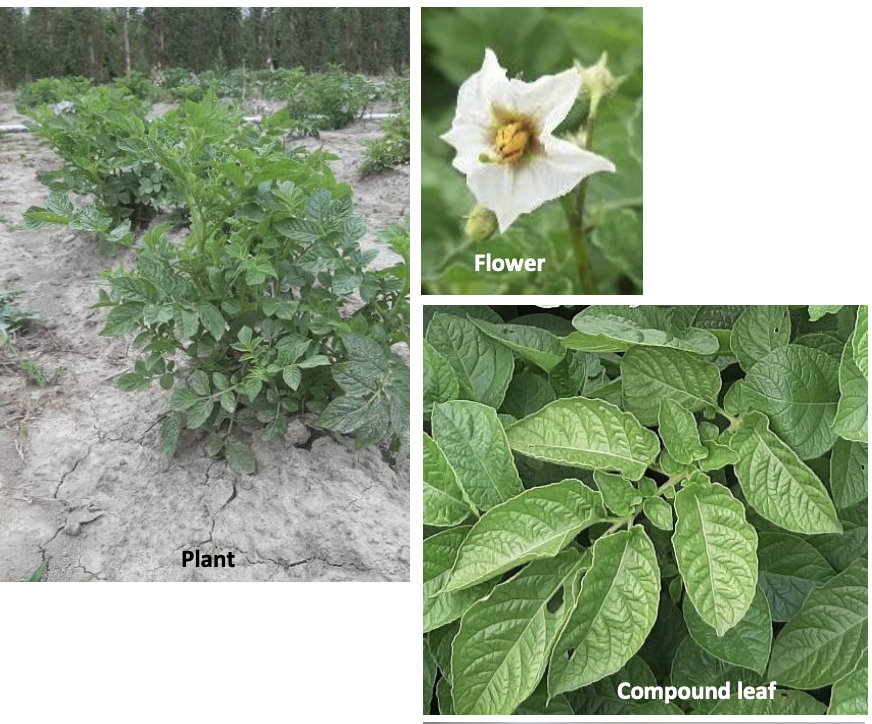
<p><strong>Plant family:</strong> Solanaceae<br><strong>Life cycle:</strong> Perennial (grown as an annual)<br><strong>Key persistence / spread:</strong> Underground tubers used for propagation<br><strong>Farming systems:</strong> Arable cropping, horticulture</p><p><strong> How to identify</strong></p><p>This crop grows as an upright, leafy herb with multiple soft green stems arising from a single point. Leaves are compound, made up of several irregularly sized leaflets arranged along a central stalk, giving a slightly uneven appearance. Leaf surfaces may be smooth or lightly hairy.</p><p>The plant produces white, pink, or purple star‑shaped flowers with yellow anthers. Below ground, swollen modified stems form at the ends of underground stolons; these are smooth‑skinned storage organs rather than true roots.</p><p>Damage to foliage often results in rapid regrowth from the base. When foliage is disturbed, plants lack a strong smell, unlike some other members of the same family.</p>
68
New cards

Squash

Plant family: Cucurbitaceae
Life cycle: Annual
Key persistence / spread: Seed only
Farming systems: Vegetable cropping, horticulture

How to identify

This is a sprawling plant with long, creeping vines that spread across the soil surface. Stems are thick, angular, and covered in coarse hairs. Leaves are very large, broad, and often deeply lobed, with a rough texture.

Bright yellow flowers are large and showy, occurring singly on long stalks. Male and female flowers are separate but borne on the same plant.

Fruits develop on the ground and vary greatly in size and shape depending on the cultivar. Tendrils are often present, helping vines anchor and spread outward.
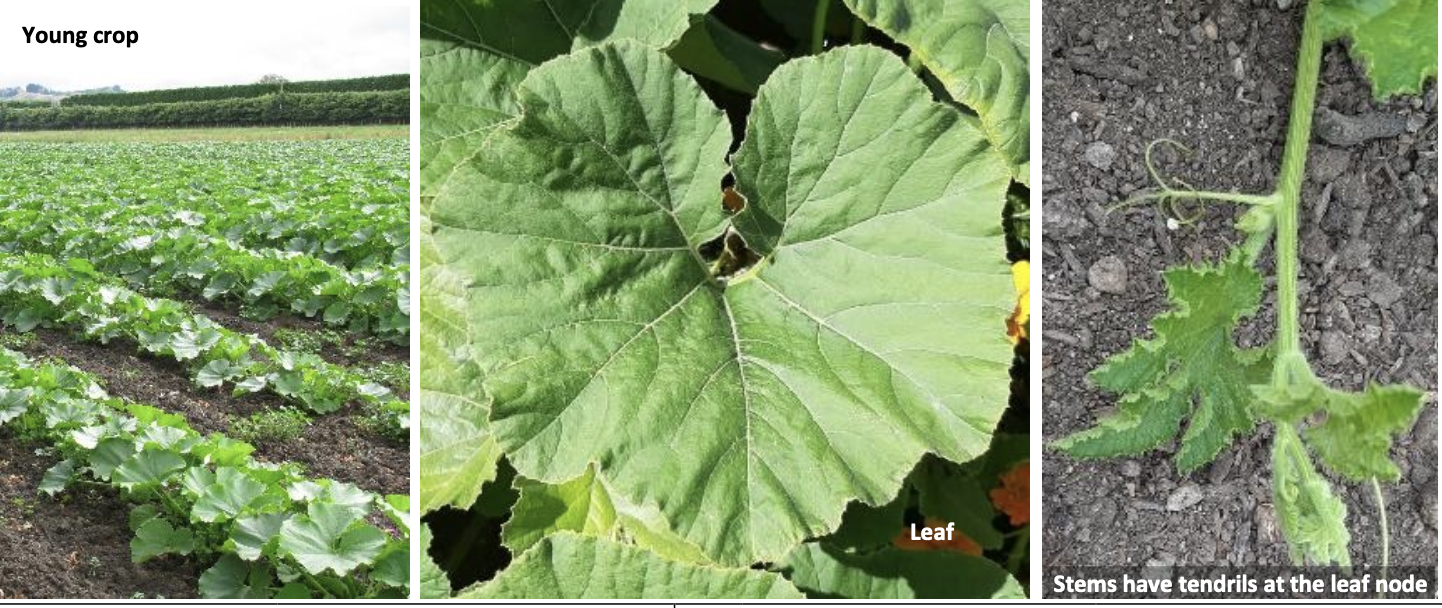
<p><strong>Plant family:</strong> Cucurbitaceae<br><strong>Life cycle:</strong> Annual<br><strong>Key persistence / spread:</strong> Seed only<br><strong>Farming systems:</strong> Vegetable cropping, horticulture</p><p><strong> How to identify</strong></p><p>This is a sprawling plant with long, creeping vines that spread across the soil surface. Stems are thick, angular, and covered in coarse hairs. Leaves are very large, broad, and often deeply lobed, with a rough texture.</p><p>Bright yellow flowers are large and showy, occurring singly on long stalks. Male and female flowers are separate but borne on the same plant.</p><p>Fruits develop on the ground and vary greatly in size and shape depending on the cultivar. Tendrils are often present, helping vines anchor and spread outward.</p>
69
New cards

Onion

Plant family: Alliaceae
Life cycle: Biennial (grown as an annual)
Key persistence / spread: Bulb and seed
Farming systems: Vegetable cropping

How to identify

This crop produces narrow, upright leaves that are hollow and tubular, arising directly from a swollen underground structure. Leaves are blue‑green and waxy, with no branching.

All above‑ground parts emit a strong, unmistakable smell when crushed. Leaves grow vertically rather than spreading, forming sparse canopies compared with leafy vegetables.

If allowed to complete its life cycle, a tall flowering stalk develops, ending in a round globe of small white flowers.
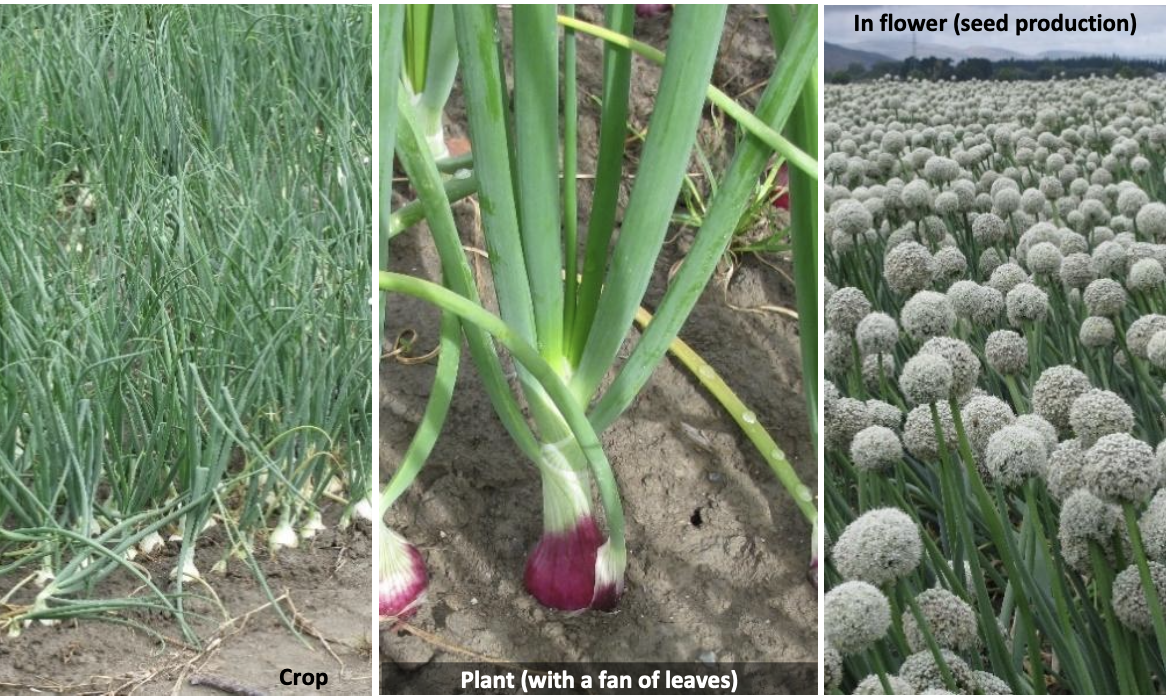
<p><strong>Plant family:</strong> Alliaceae<br><strong>Life cycle:</strong> Biennial (grown as an annual)<br><strong>Key persistence / spread:</strong> Bulb and seed<br><strong>Farming systems:</strong> Vegetable cropping</p><p><strong> How to identify</strong></p><p>This crop produces narrow, upright leaves that are hollow and tubular, arising directly from a swollen underground structure. Leaves are blue‑green and waxy, with no branching.</p><p>All above‑ground parts emit a strong, unmistakable smell when crushed. Leaves grow vertically rather than spreading, forming sparse canopies compared with leafy vegetables.</p><p>If allowed to complete its life cycle, a tall flowering stalk develops, ending in a round globe of small white flowers.</p>
70
New cards

Brassica Vegetables (Cabbage,Broccoli,Cauliflower)

Plant family: Brassicaceae
Life cycle: Biennial (grown as an annual)
Key persistence / spread: Seed only
Farming systems: Vegetable cropping

How to identify

These crops grow as compact plants with thick stems and large, waxy blue‑green leaves. Leaves are broad, heavy, and often have prominent pale veins. A white powdery bloom may be present on the leaf surface.

Growth is initially rosette‑based, with leaves layered tightly around the central growing point. The edible portion differs depending on type, forming either a dense leafy head or a compact flower mass.

When crushed, foliage produces a strong brassica smell. If bolting occurs, tall flowering stems with yellow flowers develop rapidly.
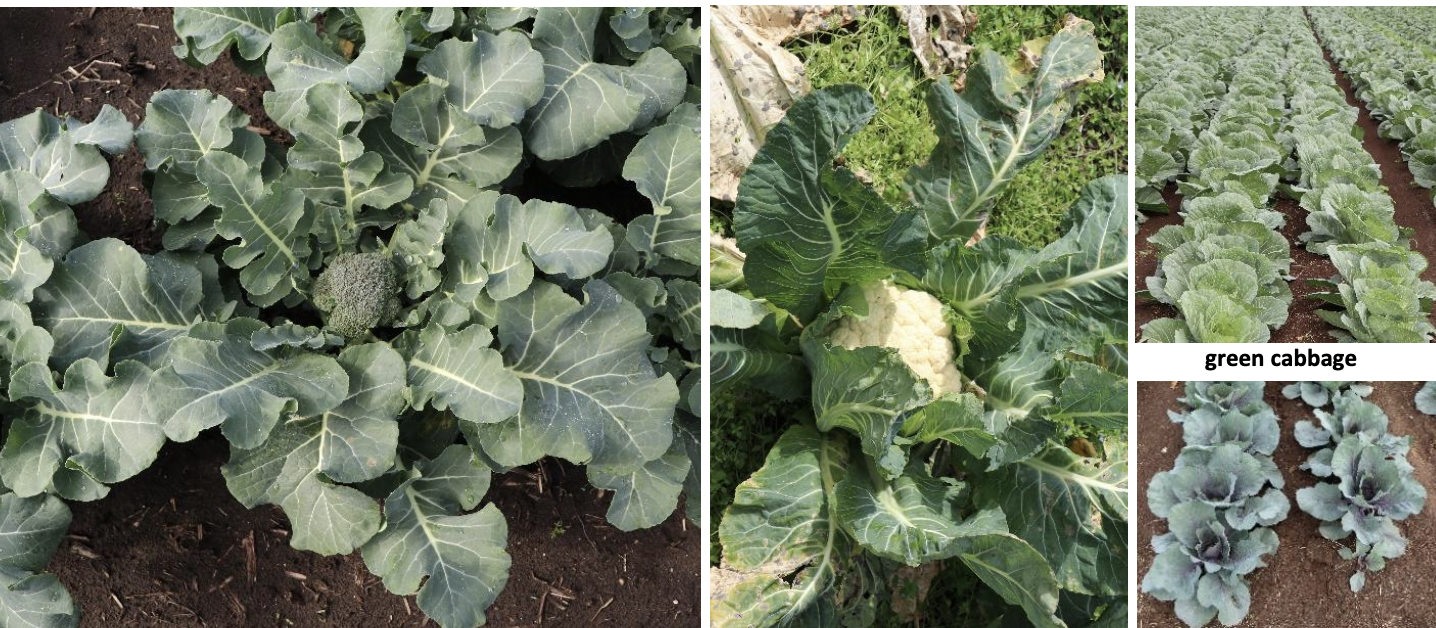
<p><strong>Plant family:</strong> Brassicaceae<br><strong>Life cycle:</strong> Biennial (grown as an annual)<br><strong>Key persistence / spread:</strong> Seed only<br><strong>Farming systems:</strong> Vegetable cropping</p><p><strong> How to identify</strong></p><p>These crops grow as compact plants with thick stems and large, waxy blue‑green leaves. Leaves are broad, heavy, and often have prominent pale veins. A white powdery bloom may be present on the leaf surface.</p><p>Growth is initially rosette‑based, with leaves layered tightly around the central growing point. The edible portion differs depending on type, forming either a dense leafy head or a compact flower mass.</p><p>When crushed, foliage produces a strong brassica smell. If bolting occurs, tall flowering stems with yellow flowers develop rapidly.</p>
71
New cards

Carrot

Plant family: Apiaceae
Life cycle: Biennial (grown as an annual)
Key persistence / spread: Seed only
Farming systems: Vegetable cropping

How to identify

Foliage consists of finely divided, fern‑like leaves emerging from a central crown. Leaves are soft, bright green, and carried on slender hollow stalks.

Below ground, the plant develops a single elongated taproot with a smooth surface. When foliage or root is damaged, a distinctive sweet, earthy smell is released.

If not harvested, the plant forms a tall flowering stem in its second year, producing clusters of small white flowers arranged in umbrella‑like structures.
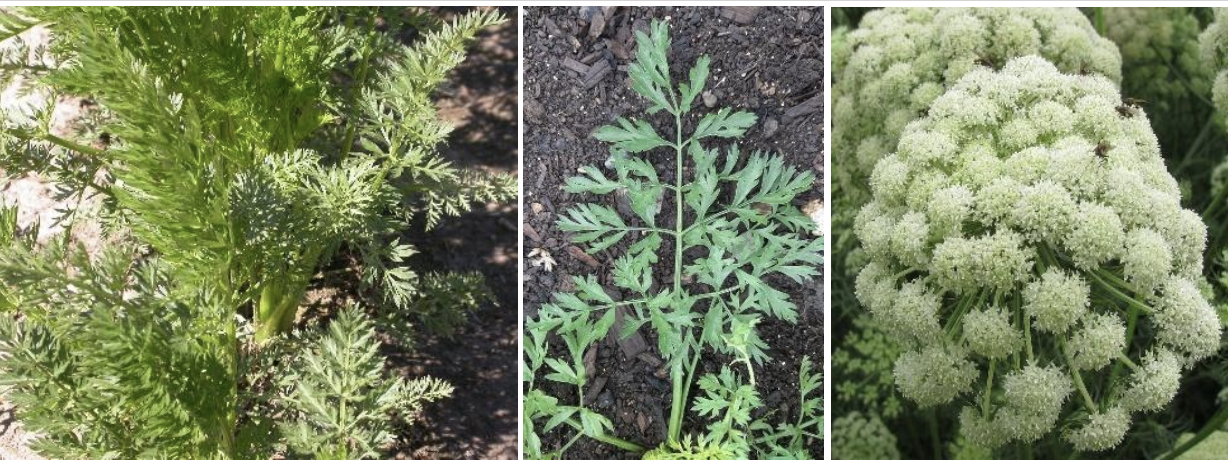
<p><strong>Plant family:</strong> Apiaceae<br><strong>Life cycle:</strong> Biennial (grown as an annual)<br><strong>Key persistence / spread:</strong> Seed only<br><strong>Farming systems:</strong> Vegetable cropping</p><p><strong> How to identify</strong></p><p>Foliage consists of finely divided, fern‑like leaves emerging from a central crown. Leaves are soft, bright green, and carried on slender hollow stalks.</p><p>Below ground, the plant develops a single elongated taproot with a smooth surface. When foliage or root is damaged, a distinctive sweet, earthy smell is released.</p><p>If not harvested, the plant forms a tall flowering stem in its second year, producing clusters of small white flowers arranged in umbrella‑like structures.</p>
72
New cards

Kumara (Sweet Potato)

Plant family: Convolvulaceae
Life cycle: Perennial (grown as an annual)
Key persistence / spread: Vegetative cuttings and tubers
Farming systems: Horticulture

How to identify

This crop grows as a low, creeping vine that spreads horizontally across the soil surface. Stems root at nodes where they contact the ground. Leaves are broad and variable in shape, commonly heart‑shaped or lobed.

The plant produces little upright growth, forming mats rather than stands. Underground, enlarged storage tubers form along the root system rather than directly beneath the stem base.

Flowers are uncommon in commercial systems but resemble morning glory flowers when present.
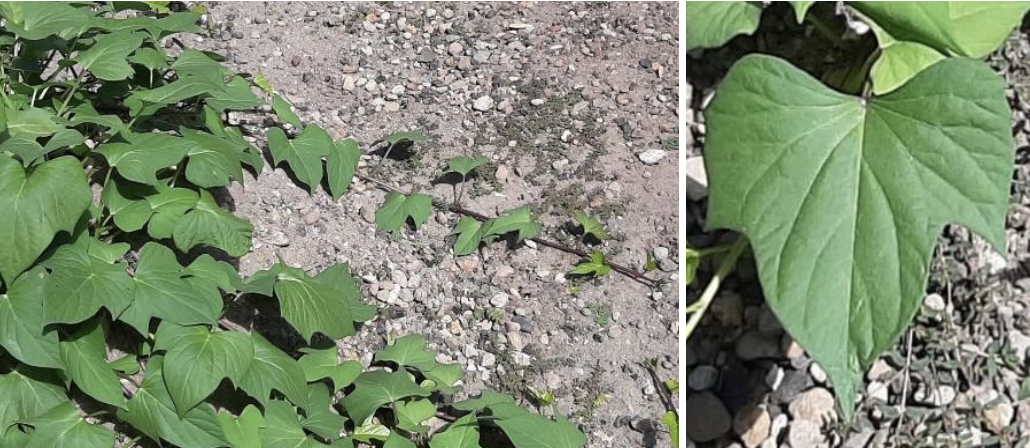
<p><strong>Plant family:</strong> Convolvulaceae<br><strong>Life cycle:</strong> Perennial (grown as an annual)<br><strong>Key persistence / spread:</strong> Vegetative cuttings and tubers<br><strong>Farming systems:</strong> Horticulture</p><p><strong> How to identify</strong></p><p>This crop grows as a low, creeping vine that spreads horizontally across the soil surface. Stems root at nodes where they contact the ground. Leaves are broad and variable in shape, commonly heart‑shaped or lobed.</p><p>The plant produces little upright growth, forming mats rather than stands. Underground, enlarged storage tubers form along the root system rather than directly beneath the stem base.</p><p>Flowers are uncommon in commercial systems but resemble morning glory flowers when present.</p>
73
New cards

Lettuce

Plant family: Asteraceae
Life cycle: Annual
Key persistence / spread: Seed only
Farming systems: Vegetable cropping

How to identify

This is a low‑growing leafy crop forming a soft rosette of overlapping leaves. Leaves are thin, brittle, and vary widely in shape from smooth to frilled.

Plants form dense leafy heads or loose rosettes depending on cultivar. Leaves contain milky sap when broken, characteristic of the family.

If temperatures rise or plants are stressed, rapid bolting occurs, sending up a tall flowering stem with many small yellow flowers and fluffy wind‑borne seed.
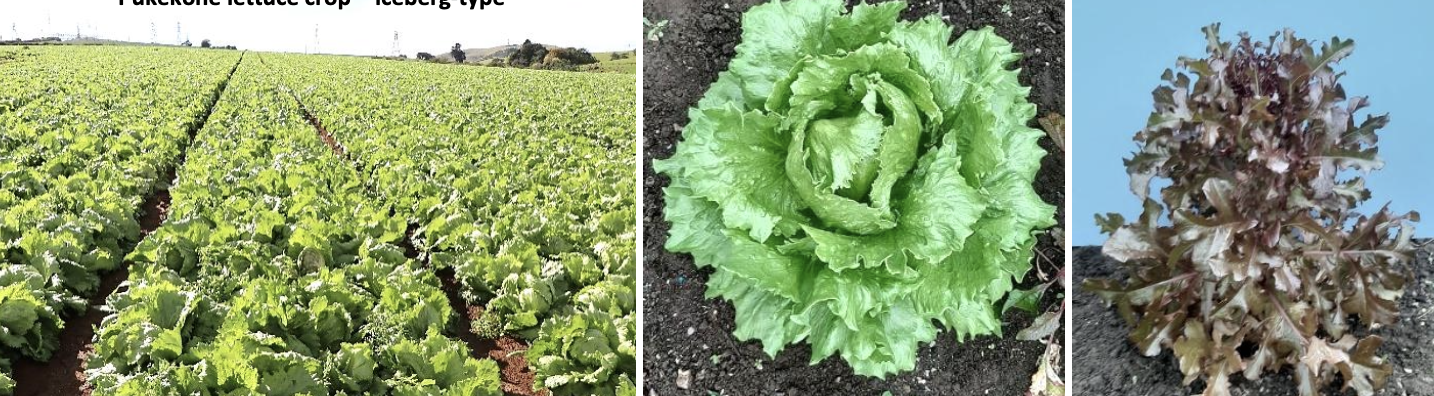
<p><strong>Plant family:</strong> Asteraceae<br><strong>Life cycle:</strong> Annual<br><strong>Key persistence / spread:</strong> Seed only<br><strong>Farming systems:</strong> Vegetable cropping</p><p><strong> How to identify</strong></p><p>This is a low‑growing leafy crop forming a soft rosette of overlapping leaves. Leaves are thin, brittle, and vary widely in shape from smooth to frilled.</p><p>Plants form dense leafy heads or loose rosettes depending on cultivar. Leaves contain milky sap when broken, characteristic of the family.</p><p>If temperatures rise or plants are stressed, rapid bolting occurs, sending up a tall flowering stem with many small yellow flowers and fluffy wind‑borne seed.</p>
74
New cards

Tomato

Plant family: Solanaceae
Life cycle: Annual
Key persistence / spread: Seed only
Farming systems: Vegetable cropping, protected cultivation

How to identify

This plant grows as an upright to sprawling herb with soft, hairy stems that often require support. Leaves are compound with irregularly sized leaflets, giving a jagged appearance.

Foliage has a strong, distinctive smell when crushed. Yellow star‑shaped flowers are produced in clusters along the stem.

Fruits develop from flowers into fleshy, smooth‑skinned berries. As plants mature, lower leaves often yellow and die back while upper growth continues.
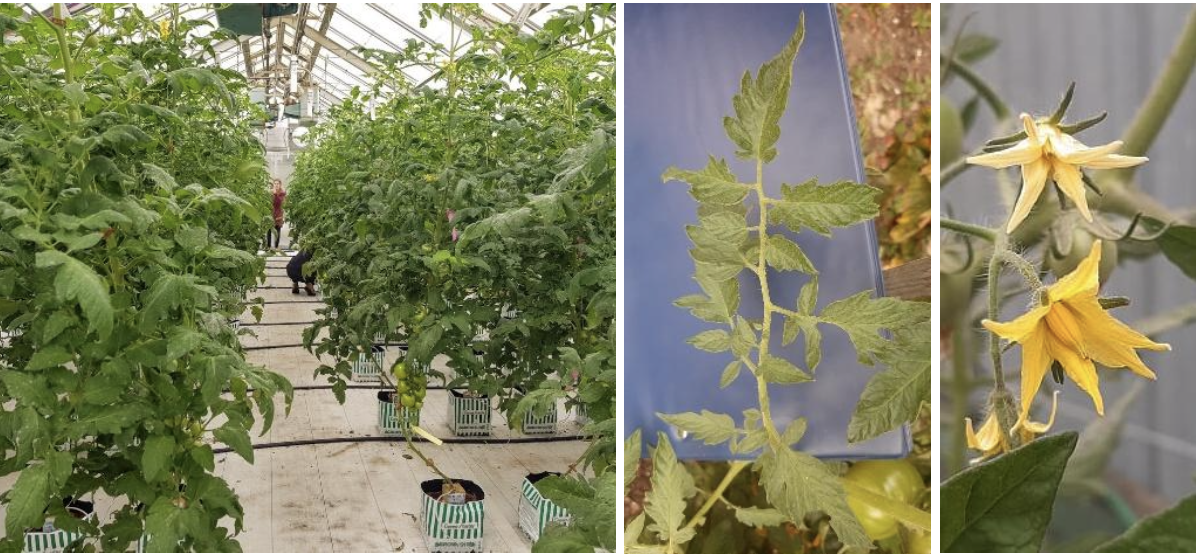
<p><strong>Plant family:</strong> Solanaceae<br><strong>Life cycle:</strong> Annual<br><strong>Key persistence / spread:</strong> Seed only<br><strong>Farming systems:</strong> Vegetable cropping, protected cultivation</p><p><strong> How to identify</strong></p><p>This plant grows as an upright to sprawling herb with soft, hairy stems that often require support. Leaves are compound with irregularly sized leaflets, giving a jagged appearance.</p><p>Foliage has a strong, distinctive smell when crushed. Yellow star‑shaped flowers are produced in clusters along the stem.</p><p>Fruits develop from flowers into fleshy, smooth‑skinned berries. As plants mature, lower leaves often yellow and die back while upper growth continues.</p>
75
New cards

Kiwifruit

Plant family: Actinidiaceae
Life cycle: Perennial
Key persistence/spread: Vegetative propagation from cuttings and grafted plants
Farming systems: Orchards, intensive horticulture

How to identify

This crop grows as a vigorous woody vine that requires permanent support structures such as trellises. Stems thicken and become woody with age, forming a permanent framework.

Leaves are large, broad, and heart‑shaped with a soft, slightly hairy surface, particularly on young foliage. New growth is lighter green and softer than mature leaves.

Plants are usually either male or female. Flowering occurs in spring, producing large, creamy white flowers carried singly in leaf axils.

Fruits develop from female flowers and hang individually or in small numbers. The plant is deciduous and drops its leaves in autumn.
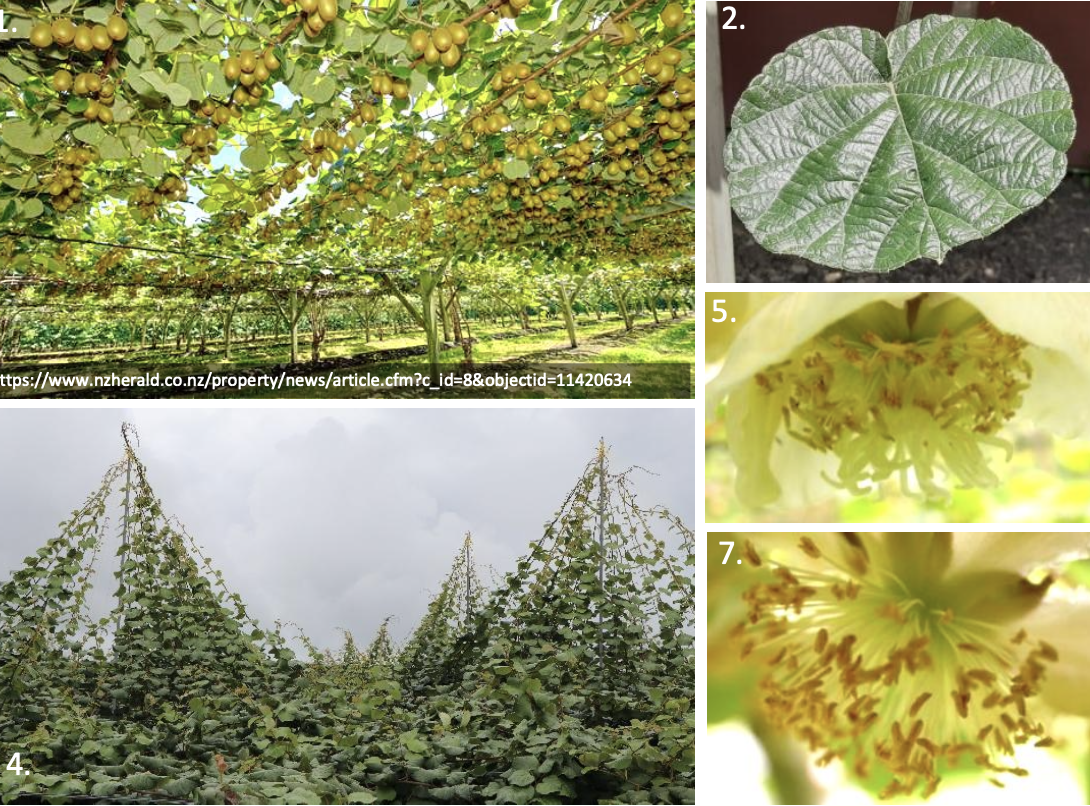
<p><strong>Plant family:</strong> Actinidiaceae<br><strong>Life cycle:</strong> Perennial<br><strong>Key persistence/spread:</strong> Vegetative propagation from cuttings and grafted plants<br><strong>Farming systems:</strong> Orchards, intensive horticulture</p><p><strong> How to identify</strong></p><p>This crop grows as a vigorous woody vine that requires permanent support structures such as trellises. Stems thicken and become woody with age, forming a permanent framework.</p><p>Leaves are large, broad, and heart‑shaped with a soft, slightly hairy surface, particularly on young foliage. New growth is lighter green and softer than mature leaves.</p><p>Plants are usually either male or female. Flowering occurs in spring, producing large, creamy white flowers carried singly in leaf axils.</p><p>Fruits develop from female flowers and hang individually or in small numbers. The plant is deciduous and drops its leaves in autumn.</p>
76
New cards

Grape

Plant family: Vitaceae
Life cycle: Perennial
Key persistence/spread: Vegetative propagation from cuttings
Farming systems: Vineyards

How to identify

This is a woody climbing vine that produces a permanent trunk and annually renewed fruiting canes. Growth is structured and pruned to a defined framework.

Leaves are broad, usually palmately lobed, with a rough upper surface and clearly visible veins. Leaf size and shape vary by cultivar, but the lobed structure is consistent.

Slender tendrils grow opposite the leaves and wrap around wires for support. These tendrils are a key identification feature.

Flowers are small and inconspicuous, forming loose clusters that later develop into hanging bunches of fleshy fruit.
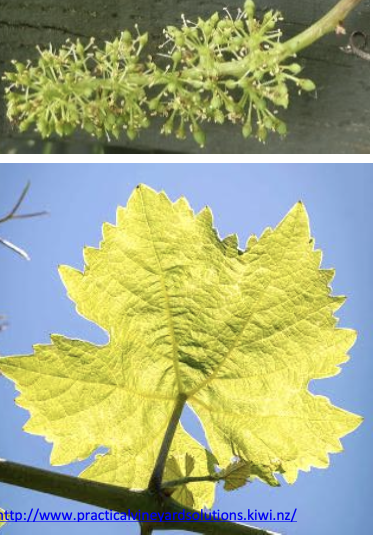
<p><strong>Plant family:</strong> Vitaceae<br><strong>Life cycle:</strong> Perennial<br><strong>Key persistence/spread:</strong> Vegetative propagation from cuttings<br><strong>Farming systems:</strong> Vineyards</p><p><strong> How to identify</strong></p><p>This is a woody climbing vine that produces a permanent trunk and annually renewed fruiting canes. Growth is structured and pruned to a defined framework.</p><p>Leaves are broad, usually palmately lobed, with a rough upper surface and clearly visible veins. Leaf size and shape vary by cultivar, but the lobed structure is consistent.</p><p>Slender tendrils grow opposite the leaves and wrap around wires for support. These tendrils are a key identification feature.</p><p>Flowers are small and inconspicuous, forming loose clusters that later develop into hanging bunches of fleshy fruit.</p>
77
New cards

Apple

Plant family: Rosaceae
Life cycle: Perennial
Key persistence / spread: Grafting onto rootstocks
Farming systems: Orchards

How to identify

This plant grows as a medium‑sized deciduous tree with a spreading canopy. Growth is woody, with clear annual ring development in branches.

Leaves are oval with fine serrated margins and a slightly hairy underside when young. Leaves emerge in spring and are shed in autumn.

Flowering occurs in spring with clusters of white to pink blossoms arising from short spurs on older wood.

Fruit develops from these spurs and remains attached on short stalks. Spur‑based fruiting and regular pruning patterns are characteristic.
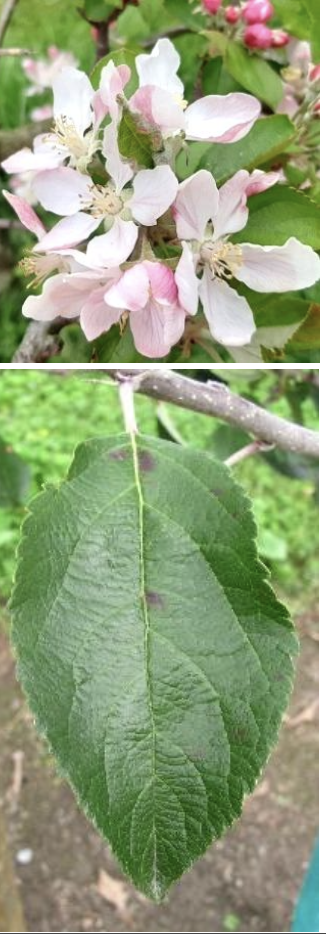
<p><strong>Plant family:</strong> Rosaceae<br><strong>Life cycle:</strong> Perennial<br><strong>Key persistence / spread:</strong> Grafting onto rootstocks<br><strong>Farming systems:</strong> Orchards</p><p><strong> How to identify</strong></p><p>This plant grows as a medium‑sized deciduous tree with a spreading canopy. Growth is woody, with clear annual ring development in branches.</p><p>Leaves are oval with fine serrated margins and a slightly hairy underside when young. Leaves emerge in spring and are shed in autumn.</p><p>Flowering occurs in spring with clusters of white to pink blossoms arising from short spurs on older wood.</p><p>Fruit develops from these spurs and remains attached on short stalks. Spur‑based fruiting and regular pruning patterns are characteristic.</p>
78
New cards

Avocado

Plant family: Lauraceae
Life cycle: Perennial
Key persistence / spread: Grafting onto seedling rootstocks
Farming systems: Orchards

How to identify

This is an evergreen tree with a dense, rounded canopy. Growth is upright when young, later spreading as branches thicken.

Leaves are large, leathery, and glossy, usually oval to lance‑shaped with smooth margins. Leaves persist year‑round and drop gradually rather than seasonally.

Small greenish flowers are produced in large numbers, opening in distinct male and female phases. Most flowers do not develop into fruit.

Fruits are large and pear‑shaped to round, hanging individually from branches rather than in clusters.
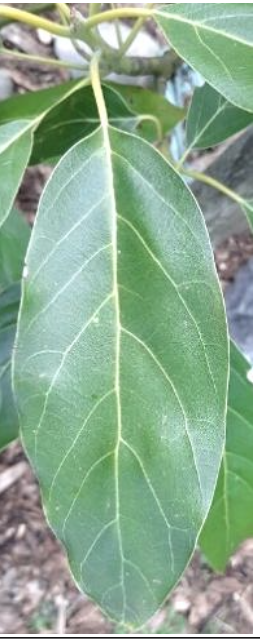
<p><strong>Plant family:</strong> Lauraceae<br><strong>Life cycle:</strong> Perennial<br><strong>Key persistence / spread:</strong> Grafting onto seedling rootstocks<br><strong>Farming systems:</strong> Orchards</p><p> How to identify</p><p>This is an evergreen tree with a dense, rounded canopy. Growth is upright when young, later spreading as branches thicken.</p><p>Leaves are large, leathery, and glossy, usually oval to lance‑shaped with smooth margins. Leaves persist year‑round and drop gradually rather than seasonally.</p><p>Small greenish flowers are produced in large numbers, opening in distinct male and female phases. Most flowers do not develop into fruit.</p><p>Fruits are large and pear‑shaped to round, hanging individually from branches rather than in clusters.</p>
79
New cards

Sweet Cherry

Plant family: Rosaceae
Life cycle: Perennial
Key persistence / spread: Grafting
Farming systems: Orchards

How to identify

This crop grows as a deciduous tree with an upright growth habit when young, gradually forming a rounded canopy.

Leaves are glossy, bright green, and oval with sharply serrated edges. New growth is often reddish before turning green.

In early spring, clusters of white flowers emerge before or alongside leaf growth, making flowering trees very conspicuous.

Fruits develop on short stalks and mature rapidly. The tree enters a complete dormancy during winter.
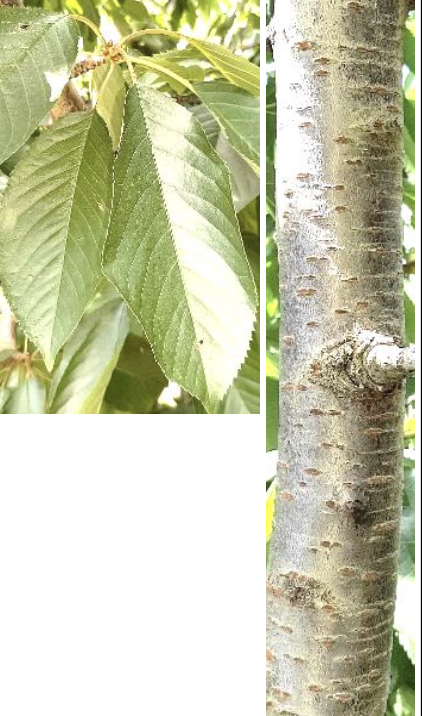
<p><strong>Plant family:</strong> Rosaceae<br><strong>Life cycle:</strong> Perennial<br><strong>Key persistence / spread:</strong> Grafting<br><strong>Farming systems:</strong> Orchards</p><p><strong> How to identify</strong></p><p>This crop grows as a deciduous tree with an upright growth habit when young, gradually forming a rounded canopy.</p><p>Leaves are glossy, bright green, and oval with sharply serrated edges. New growth is often reddish before turning green.</p><p>In early spring, clusters of white flowers emerge before or alongside leaf growth, making flowering trees very conspicuous.</p><p>Fruits develop on short stalks and mature rapidly. The tree enters a complete dormancy during winter.</p>
80
New cards

Blueberry

Plant family: Ericaceae
Life cycle: Perennial
Key persistence / spread: Cuttings and layering
Farming systems: Berry production systems

How to identify

This crop grows as a low, woody shrub rather than a tree. Multiple stems arise from the base, forming an open bush.

Leaves are small, narrow, and oval, often with smooth margins. Foliage may turn red or orange before leaf fall in autumn.

Flowers are small, pale, and bell‑shaped, produced in clusters along the stems. These later develop into round berries.

Plants thrive only in acidic soils, and this soil requirement often helps confirm identification in the field.
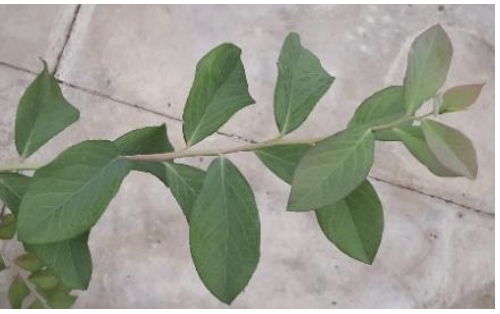
<p><strong>Plant family:</strong> Ericaceae<br><strong>Life cycle:</strong> Perennial<br><strong>Key persistence / spread:</strong> Cuttings and layering<br><strong>Farming systems:</strong> Berry production systems</p><p><strong> How to identify</strong></p><p>This crop grows as a low, woody shrub rather than a tree. Multiple stems arise from the base, forming an open bush.</p><p>Leaves are small, narrow, and oval, often with smooth margins. Foliage may turn red or orange before leaf fall in autumn.</p><p>Flowers are small, pale, and bell‑shaped, produced in clusters along the stems. These later develop into round berries.</p><p>Plants thrive only in acidic soils, and this soil requirement often helps confirm identification in the field.</p>
81
New cards

Lemon

Plant family: Rutaceae
Life cycle: Perennial
Key persistence / spread: Grafting
Farming systems: Orchards, lifestyle blocks

How to identify

This evergreen tree has a compact, spreading form with stiff branches. Many branches carry short thorns, particularly on younger growth.

Leaves are glossy, oval, and aromatic when crushed. Leaf stalks may be slightly winged.

Flowers are white with purple tinges and have a strong fragrance. Flowering can occur multiple times per year.

Fruit is held on the tree for extended periods and develops from green to yellow as it matures.
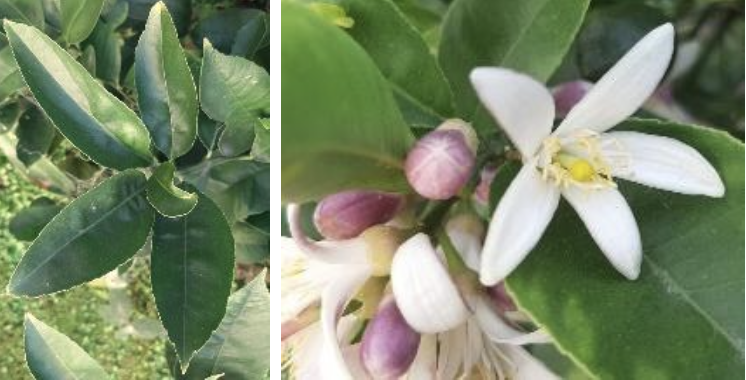
<p><strong>Plant family:</strong> Rutaceae<br><strong>Life cycle:</strong> Perennial<br><strong>Key persistence / spread:</strong> Grafting<br><strong>Farming systems:</strong> Orchards, lifestyle blocks</p><p><strong> How to identify</strong></p><p>This evergreen tree has a compact, spreading form with stiff branches. Many branches carry short thorns, particularly on younger growth.</p><p>Leaves are glossy, oval, and aromatic when crushed. Leaf stalks may be slightly winged.</p><p>Flowers are white with purple tinges and have a strong fragrance. Flowering can occur multiple times per year.</p><p>Fruit is held on the tree for extended periods and develops from green to yellow as it matures.</p>
82
New cards

Walnut

Plant family: Juglandaceae
Life cycle: Perennial
Key persistence / spread: Seed and grafted cultivars
Farming systems: Nut orchards

How to identify

This is a large deciduous tree with an open, spreading canopy. Branches are thick and widely spaced.

Leaves are large and compound, made up of several oval leaflets arranged along a central stalk. Leaves emit a strong smell when crushed.

Flowers are produced separately as male catkins and inconspicuous female flowers. Wind pollination is dominant.

Fruits develop within a thick green husk that later splits to reveal a hard shell.
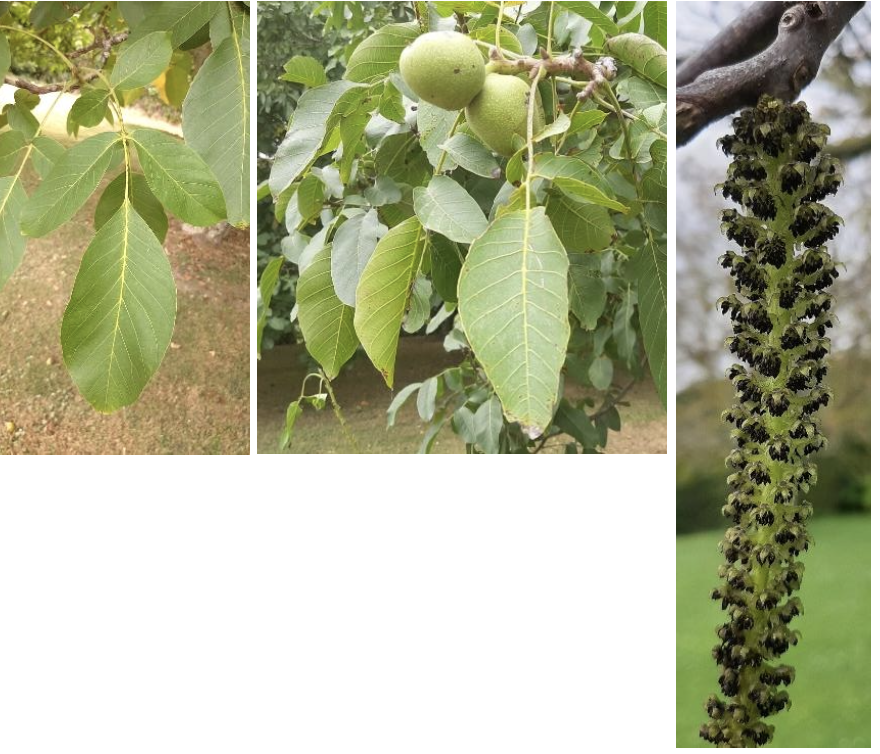
<p><strong>Plant family:</strong> Juglandaceae<br><strong>Life cycle:</strong> Perennial<br><strong>Key persistence / spread:</strong> Seed and grafted cultivars<br><strong>Farming systems:</strong> Nut orchards</p><p><strong> How to identify</strong></p><p>This is a large deciduous tree with an open, spreading canopy. Branches are thick and widely spaced.</p><p>Leaves are large and compound, made up of several oval leaflets arranged along a central stalk. Leaves emit a strong smell when crushed.</p><p>Flowers are produced separately as male catkins and inconspicuous female flowers. Wind pollination is dominant.</p><p>Fruits develop within a thick green husk that later splits to reveal a hard shell.</p>
83
New cards

Rushes

Plant family: Juncaceae
Life cycle: Perennial
Key persistence / spread: Rhizomes and seed
Farming systems: Wetlands, poorly drained paddocks, riparian areas

How to identify

These plants form dense clumps in waterlogged or poorly drained soils and are often found in standing water. Stems are round and solid, not hollow, and lack obvious joints.

Leaves are reduced or absent, with photosynthesis mainly occurring in the stems. When present, leaves are narrow and cylindrical rather than flat.

Flowers are small, brown, and inconspicuous, usually appearing on the side of the stem near the top rather than at the tip.

They are commonly mistaken for grasses, but the round, solid stems and wet‑site preference are key distinguishing features.
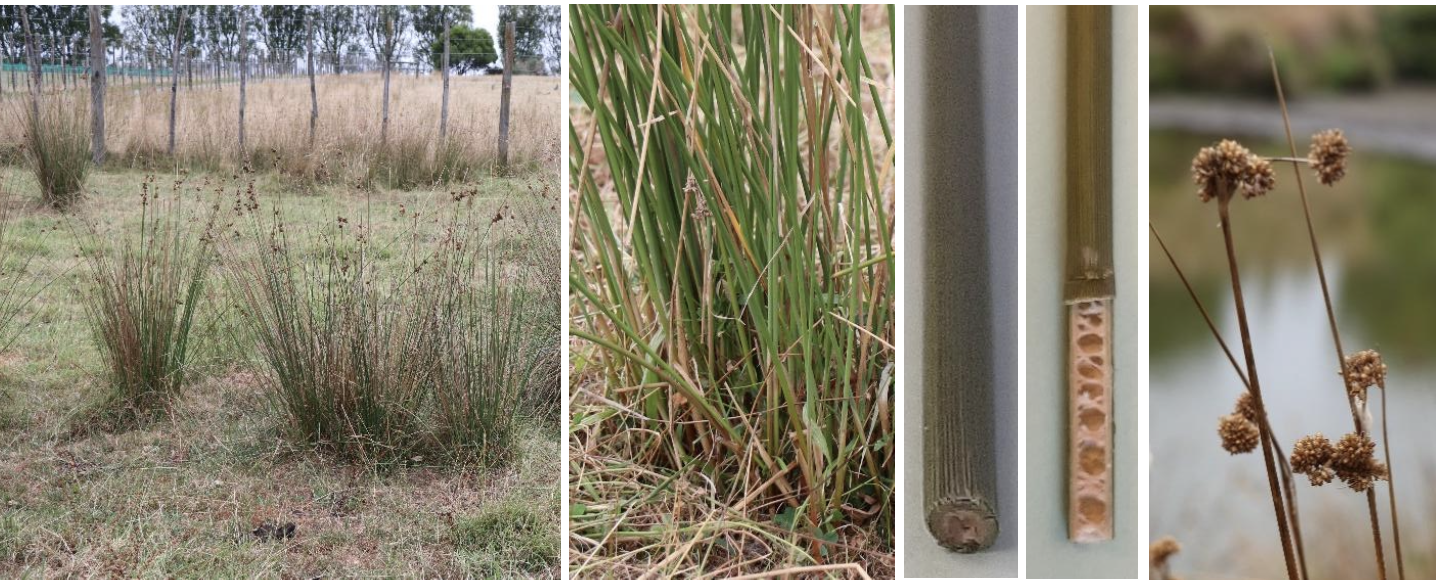
<p><strong>Plant family:</strong> Juncaceae<br><strong>Life cycle:</strong> Perennial<br><strong>Key persistence / spread:</strong> Rhizomes and seed<br><strong>Farming systems:</strong> Wetlands, poorly drained paddocks, riparian areas</p><p><strong> How to identify</strong></p><p>These plants form dense clumps in waterlogged or poorly drained soils and are often found in standing water. Stems are round and solid, not hollow, and lack obvious joints.</p><p>Leaves are reduced or absent, with photosynthesis mainly occurring in the stems. When present, leaves are narrow and cylindrical rather than flat.</p><p>Flowers are small, brown, and inconspicuous, usually appearing on the side of the stem near the top rather than at the tip.</p><p>They are commonly mistaken for grasses, but the round, solid stems and wet‑site preference are key distinguishing features.</p>
84
New cards

Sedges

Plant family: Cyperaceae
Life cycle: Perennial
Key persistence / spread: Rhizomes and seed
Farming systems: Wetlands, stream margins, damp paddocks

How to identify

These grass‑like plants grow in wet to damp soils and often dominate swampy areas. Stems are distinctly triangular in cross‑section, which can be felt by rolling the stem between fingers.

Leaves are narrow and arranged in three ranks around the stem, giving the plant a stiff, upright appearance. Leaves usually emerge from the base.

Flowers are small and grouped into spikes, lacking the obvious seed heads of grasses.

A useful rule is “sedges have edges,” referring to the sharp triangular stem shape.
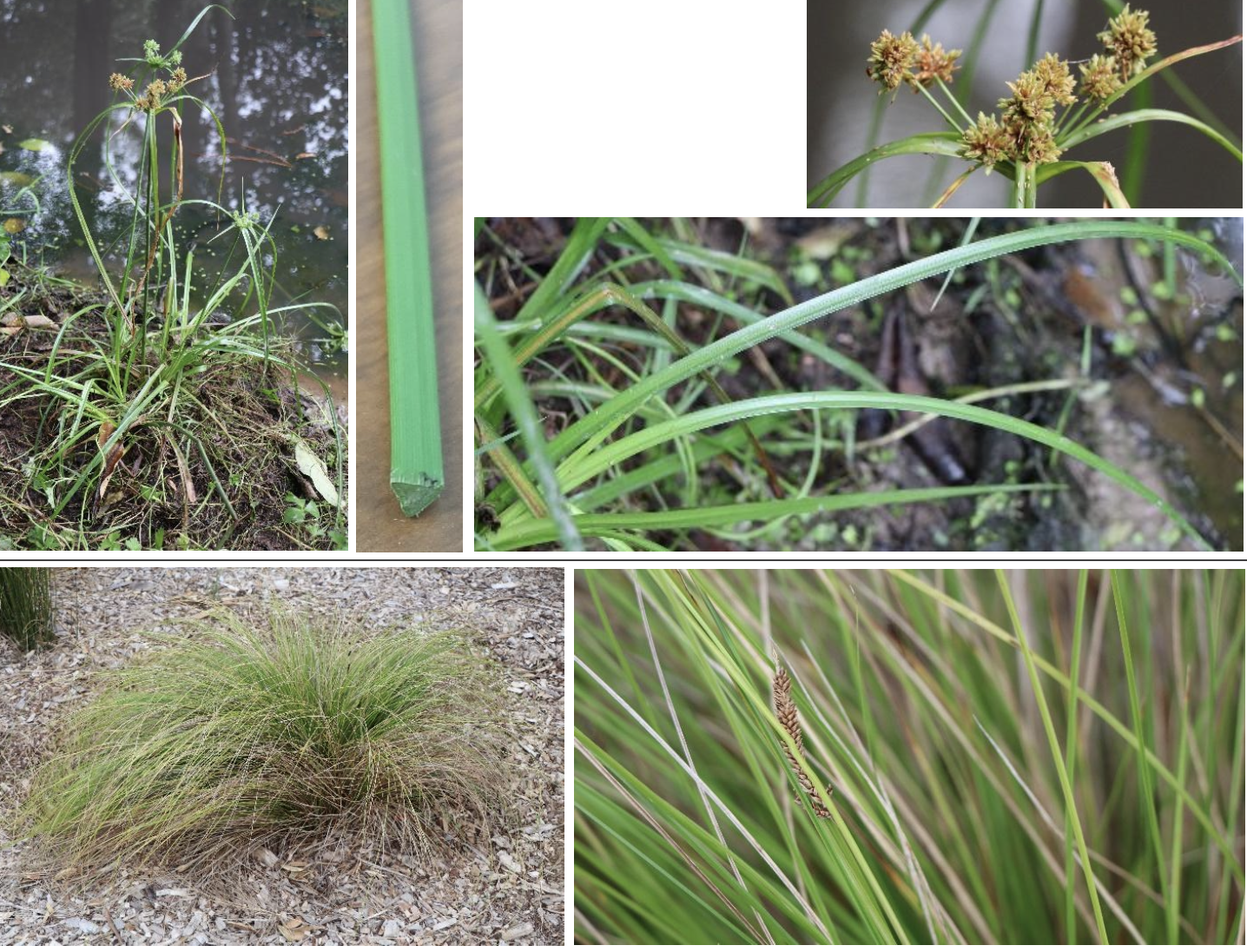
<p><strong>Plant family:</strong> Cyperaceae<br><strong>Life cycle:</strong> Perennial<br><strong>Key persistence / spread:</strong> Rhizomes and seed<br><strong>Farming systems:</strong> Wetlands, stream margins, damp paddocks</p><p><strong> How to identify</strong></p><p>These grass‑like plants grow in wet to damp soils and often dominate swampy areas. Stems are distinctly triangular in cross‑section, which can be felt by rolling the stem between fingers.</p><p>Leaves are narrow and arranged in three ranks around the stem, giving the plant a stiff, upright appearance. Leaves usually emerge from the base.</p><p>Flowers are small and grouped into spikes, lacking the obvious seed heads of grasses.</p><p>A useful rule is “sedges have edges,” referring to the sharp triangular stem shape.</p>
85
New cards

Harakeke (nz flax)

Plant family: Hemerocallidaceae
Life cycle: Perennial
Key persistence/spread: Rhizomes forming clumps
Farming systems: Conservation plantings, riparian margins

How to identify

This plant forms large, fan‑shaped clumps of long, stiff, sword‑like leaves arising from a thick base. Leaves are tough, fibrous, and often arch outward.

Leaf margins may cut skin if handled roughly. Leaves grow in a distinctive fan arrangement rather than spiralling around a stem.

Tall flowering stalks are produced above the foliage, bearing tubular flowers that are rich in nectar. These stalks are rigid and easily seen from a distance.

Plants persist for many years and expand slowly outward through underground growth.
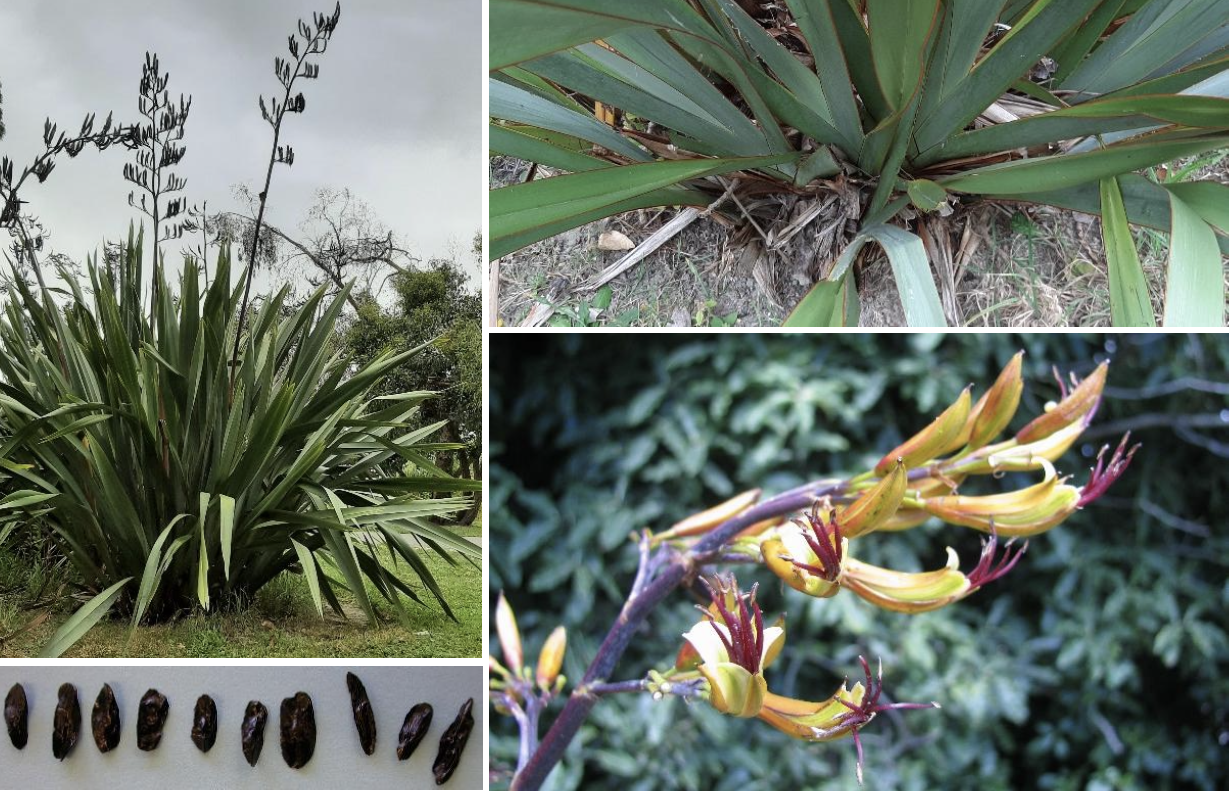
<p><strong>Plant family:</strong> Hemerocallidaceae<br><strong>Life cycle:</strong> Perennial<br><strong>Key persistence/spread:</strong> Rhizomes forming clumps<br><strong>Farming systems:</strong> Conservation plantings, riparian margins</p><p><strong> How to identify</strong></p><p>This plant forms large, fan‑shaped clumps of long, stiff, sword‑like leaves arising from a thick base. Leaves are tough, fibrous, and often arch outward.</p><p>Leaf margins may cut skin if handled roughly. Leaves grow in a distinctive fan arrangement rather than spiralling around a stem.</p><p>Tall flowering stalks are produced above the foliage, bearing tubular flowers that are rich in nectar. These stalks are rigid and easily seen from a distance.</p><p>Plants persist for many years and expand slowly outward through underground growth.</p>
86
New cards

Tarata (lemonwood)

Plant family: Pittosporaceae
Life cycle: Perennial
Key persistence / spread: Seed
Farming systems: Shelter belts, environmental planting

How to identify

This is a small to medium evergreen tree with a dense, rounded canopy. Leaves are oval, smooth‑edged, and leathery, giving the tree a tidy appearance.

When crushed, leaves release a strong lemon‑like scent, which is the most reliable identification feature.

New growth is lighter green than mature foliage. Small greenish flowers are produced in clusters, followed by woody seed capsules.

The tree is commonly used in revegetation and shelter plantings.
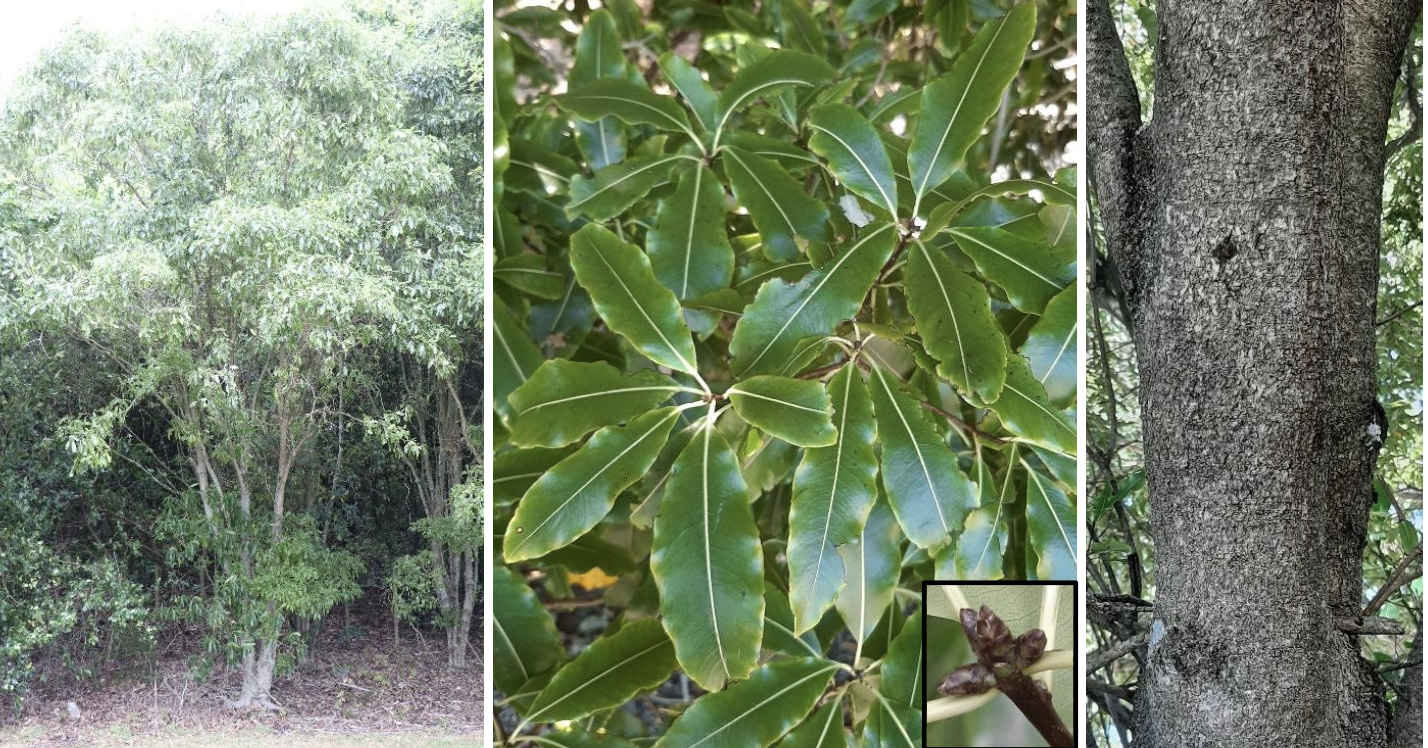
<p><strong>Plant family:</strong> Pittosporaceae<br><strong>Life cycle:</strong> Perennial<br><strong>Key persistence / spread:</strong> Seed<br><strong>Farming systems:</strong> Shelter belts, environmental planting</p><p><strong>How to identify</strong></p><p>This is a small to medium evergreen tree with a dense, rounded canopy. Leaves are oval, smooth‑edged, and leathery, giving the tree a tidy appearance.</p><p>When crushed, leaves release a strong lemon‑like scent, which is the most reliable identification feature.</p><p>New growth is lighter green than mature foliage. Small greenish flowers are produced in clusters, followed by woody seed capsules.</p><p>The tree is commonly used in revegetation and shelter plantings.</p>
87
New cards

Radiata Pine

Plant family: Pinaceae
Life cycle: Perennial
Key persistence / spread: Seed
Farming systems: Plantation forestry

How to identify

This is a tall, fast‑growing evergreen tree with a straight trunk and conical shape when young. Bark becomes thick and fissured with age.

Needles are long and stiff and occur in bundles of three, a key identification feature. Needles are bright green and clustered toward branch ends.

Cones are large, hard, and woody, remaining on the tree for several years. The tree sheds needles rather than leaves.

It dominates plantation forestry due to rapid growth and timber qualities.
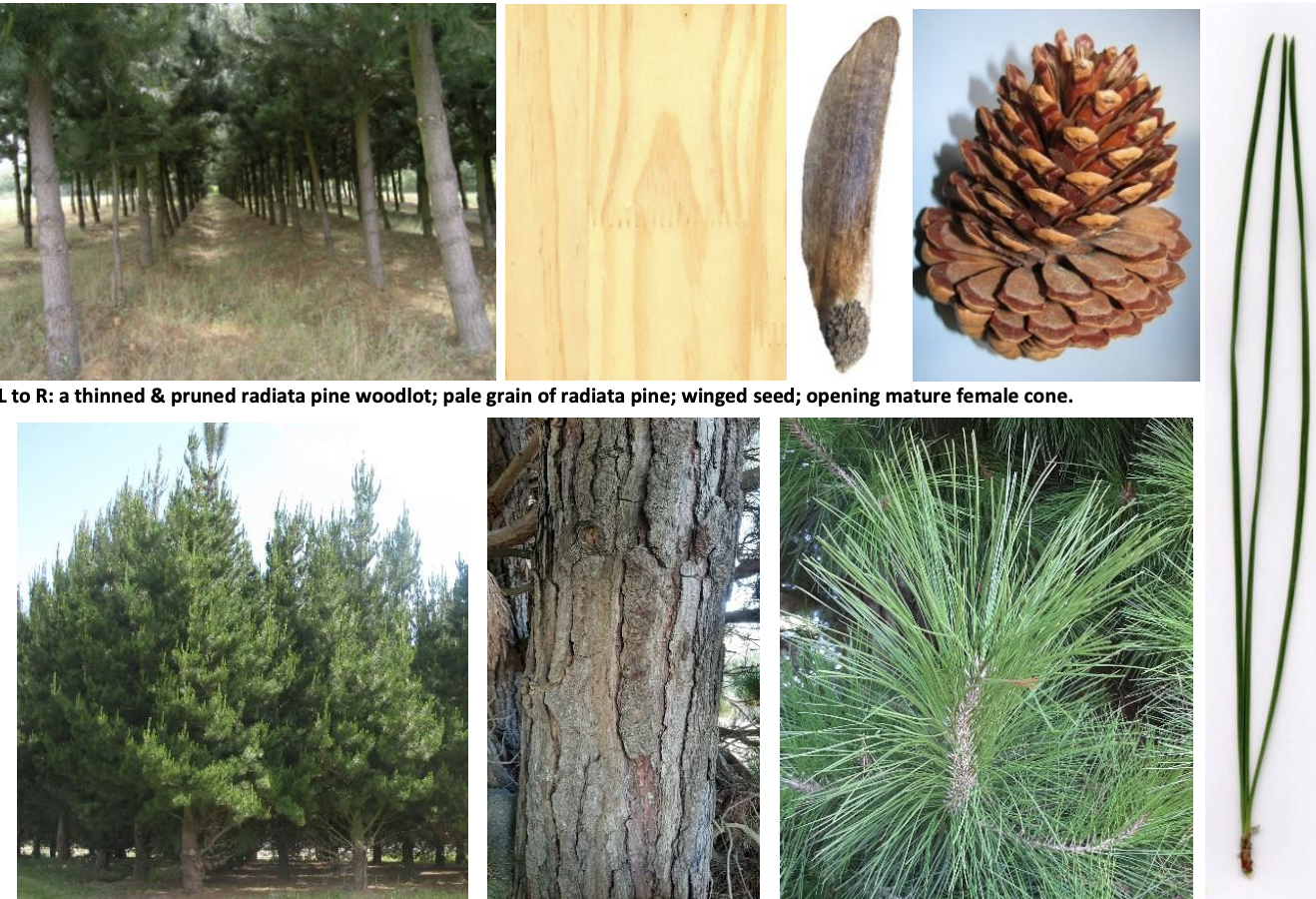
<p><strong>Plant family:</strong> Pinaceae<br><strong>Life cycle:</strong> Perennial<br><strong>Key persistence / spread:</strong> Seed<br><strong>Farming systems:</strong> Plantation forestry</p><p><strong> How to identify</strong></p><p>This is a tall, fast‑growing evergreen tree with a straight trunk and conical shape when young. Bark becomes thick and fissured with age.</p><p>Needles are long and stiff and occur in bundles of three, a key identification feature. Needles are bright green and clustered toward branch ends.</p><p>Cones are large, hard, and woody, remaining on the tree for several years. The tree sheds needles rather than leaves.</p><p>It dominates plantation forestry due to rapid growth and timber qualities.</p>
88
New cards

Douglas Fir

Plant family: Pinaceae
Life cycle: Perennial
Key persistence / spread: Seed
Farming systems: Plantation forestry, shelter

How to identify

This tall evergreen tree has a narrow, conical growth form with a strong central leader. Branches are more horizontal than those of other conifers.

Needles are flat, soft, and singly attached, not bundled. When crushed, needles may give off a citrus‑like smell.

Cones are distinctive, bearing protruding three‑pointed bracts that resemble small tails.

Often planted in cooler or higher altitude forestry areas where growth is slower but timber quality is high.
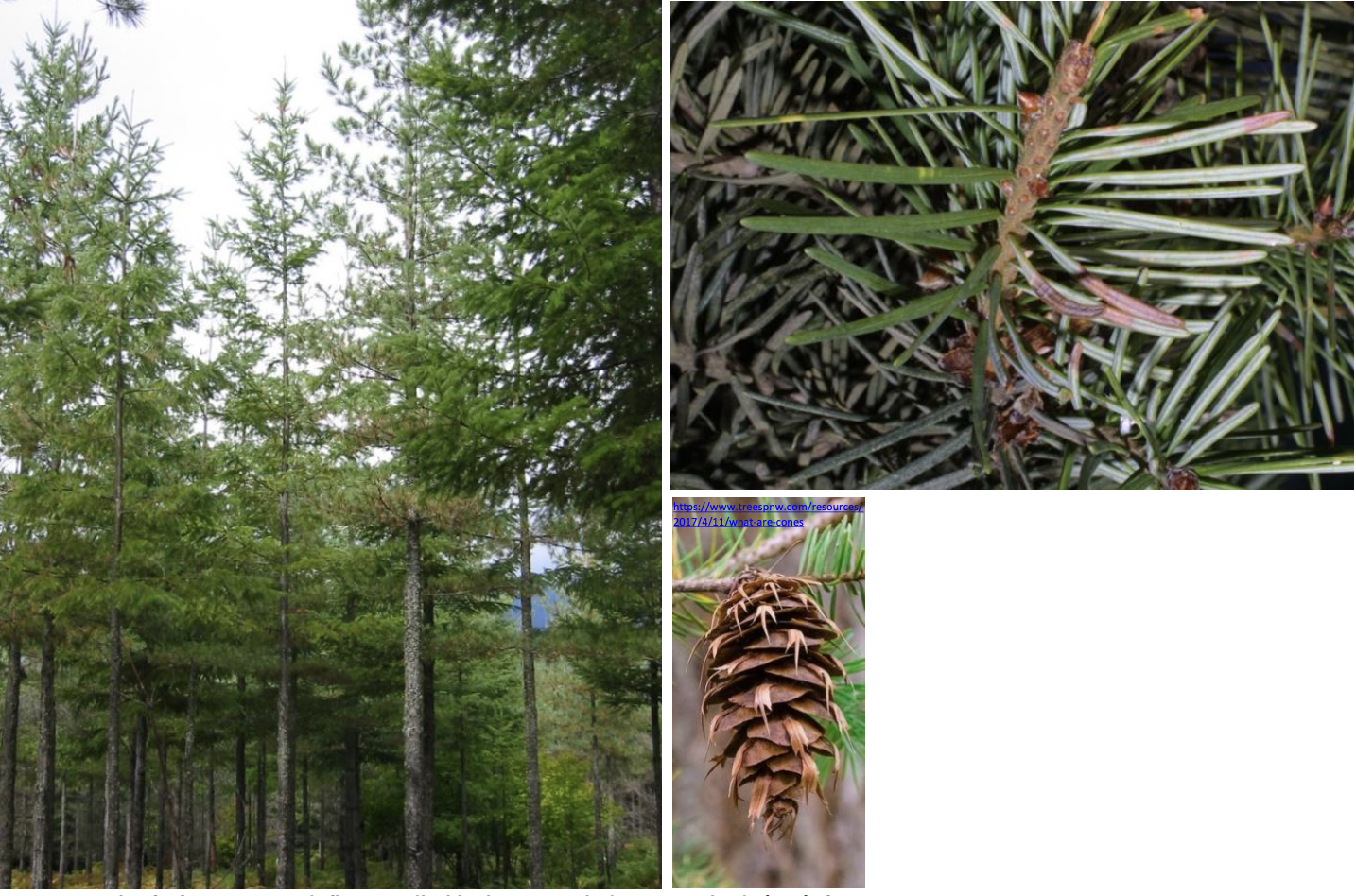
<p><strong>Plant family:</strong> Pinaceae<br><strong>Life cycle:</strong> Perennial<br><strong>Key persistence / spread:</strong> Seed<br><strong>Farming systems:</strong> Plantation forestry, shelter</p><p><strong> How to identify</strong></p><p>This tall evergreen tree has a narrow, conical growth form with a strong central leader. Branches are more horizontal than those of other conifers.</p><p>Needles are flat, soft, and singly attached, not bundled. When crushed, needles may give off a citrus‑like smell.</p><p>Cones are distinctive, bearing protruding three‑pointed bracts that resemble small tails.</p><p>Often planted in cooler or higher altitude forestry areas where growth is slower but timber quality is high.</p>
89
New cards

Eucalyptus

Plant family: Myrtaceae
Life cycle: Perennial
Key persistence / spread: Seed
Farming systems: Plantation forestry, farm woodlots

How to identify

These trees vary greatly in size and form but are united by aromatic foliage. Leaves contain oil glands and release a strong smell when crushed.

Young plants often have round or oval juvenile leaves, while mature trees have long, narrow leaves hanging vertically.

Bark type varies by species and may be smooth and peeling or rough and fibrous. Flowers are showy and produce woody capsules rather than soft fruit.

Trees grow rapidly and are commonly planted for timber, shelter, or erosion control.
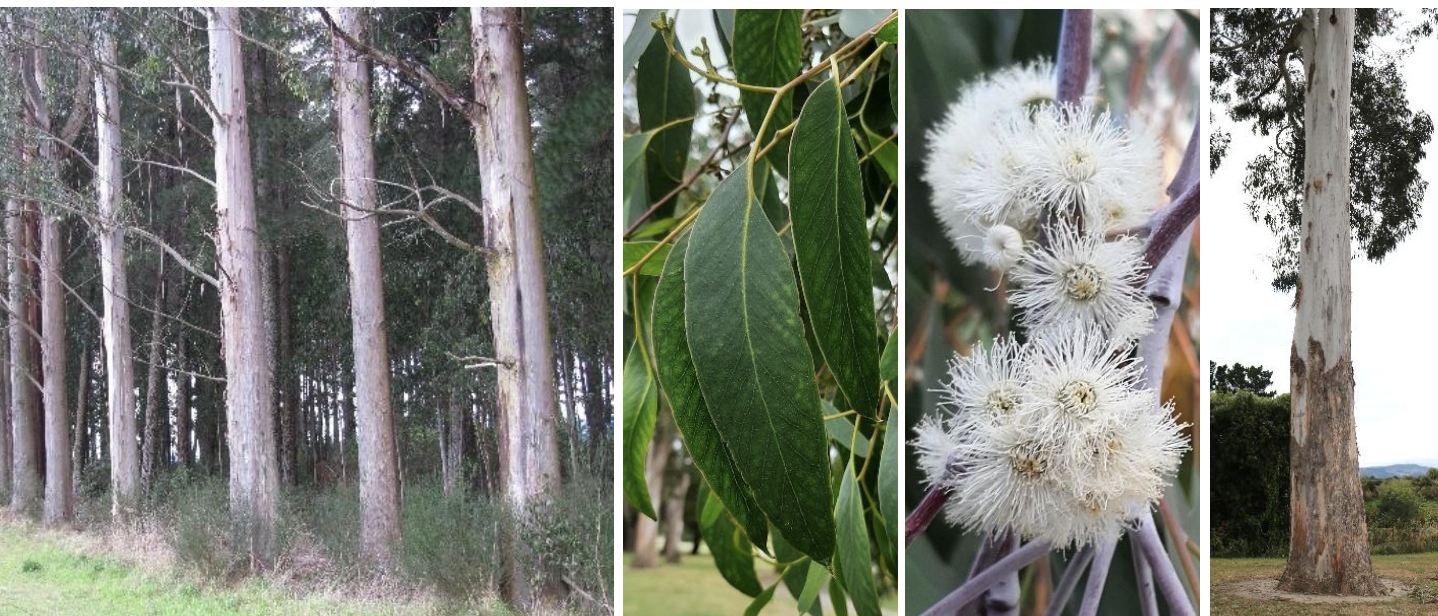
<p><strong>Plant family:</strong> Myrtaceae<br><strong>Life cycle:</strong> Perennial<br><strong>Key persistence / spread:</strong> Seed<br><strong>Farming systems:</strong> Plantation forestry, farm woodlots</p><p><strong> How to identify</strong></p><p>These trees vary greatly in size and form but are united by aromatic foliage. Leaves contain oil glands and release a strong smell when crushed.</p><p>Young plants often have round or oval juvenile leaves, while mature trees have long, narrow leaves hanging vertically.</p><p>Bark type varies by species and may be smooth and peeling or rough and fibrous. Flowers are showy and produce woody capsules rather than soft fruit.</p><p>Trees grow rapidly and are commonly planted for timber, shelter, or erosion control.</p>
90
New cards

Manuka

Plant family: Myrtaceae
Life cycle: Perennial
Key persistence / spread: Seed
Farming systems: Hill country, regeneration, conservation

How to identify

This shrub or small tree has a dense, bushy growth form with many thin branches. Leaves are small, stiff, and pointed, often prickly to touch.

Foliage is aromatic when crushed. Leaves are arranged alternately and are much smaller than those of similar native shrubs.

White flowers with numerous stamens are produced in abundance during flowering, attracting insects. Seed capsules persist on the plant after flowering.

It commonly colonises disturbed land and plays an important role in natural regeneration.
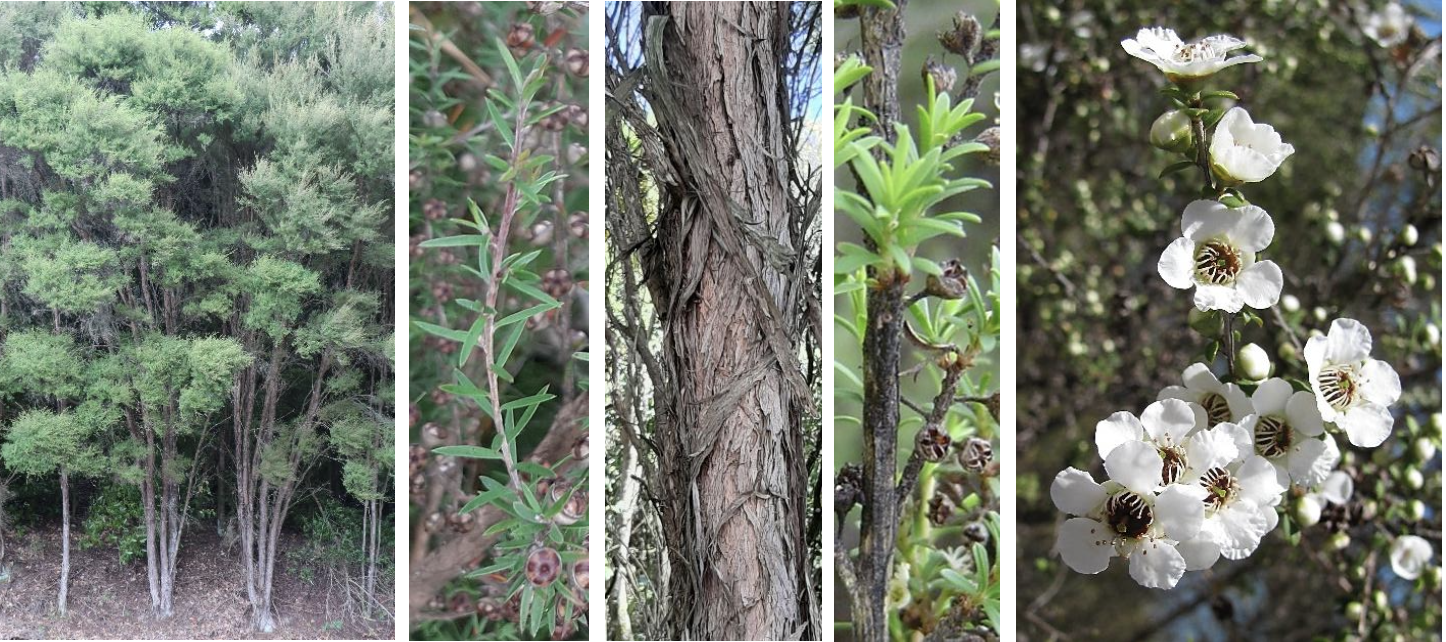
<p><strong>Plant family:</strong> Myrtaceae<br><strong>Life cycle:</strong> Perennial<br><strong>Key persistence / spread:</strong> Seed<br><strong>Farming systems:</strong> Hill country, regeneration, conservation</p><p><strong> How to identify</strong></p><p>This shrub or small tree has a dense, bushy growth form with many thin branches. Leaves are small, stiff, and pointed, often prickly to touch.</p><p>Foliage is aromatic when crushed. Leaves are arranged alternately and are much smaller than those of similar native shrubs.</p><p>White flowers with numerous stamens are produced in abundance during flowering, attracting insects. Seed capsules persist on the plant after flowering.</p><p>It commonly colonises disturbed land and plays an important role in natural regeneration.</p>
91
New cards

Grass Grub

Type: Insect (beetle larva)
Life cycle: Annual
Key persistence / spread: Eggs laid in soil; larvae live underground
Farming systems: Pastures (especially dairy and sheep)

How to identify

Damage appears first as patches of pasture that yellow, thin, and lift easily from the soil, particularly in late summer and autumn. Affected areas are often irregular and expand year by year.

When turf is pulled back, white, C‑shaped larvae are found just below the soil surface. These larvae have brown heads and three pairs of legs near the head end.

Bird activity, such as heavy pecking, often indicates infestation. Damage worsens in dry conditions when roots are already stressed.

Adults are brown beetles that fly at dusk in spring, but damage is caused almost entirely by the larval stage.
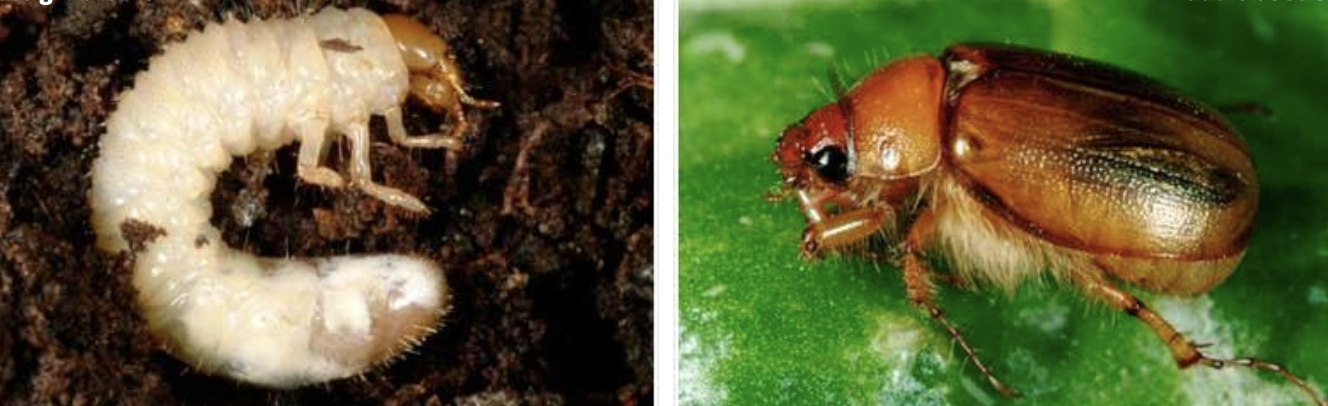
<p><strong>Type:</strong> Insect (beetle larva)<br><strong>Life cycle:</strong> Annual<br><strong>Key persistence / spread:</strong> Eggs laid in soil; larvae live underground<br><strong>Farming systems:</strong> Pastures (especially dairy and sheep)</p><p><strong> How to identify</strong></p><p>Damage appears first as patches of pasture that yellow, thin, and lift easily from the soil, particularly in late summer and autumn. Affected areas are often irregular and expand year by year.</p><p>When turf is pulled back, white, C‑shaped larvae are found just below the soil surface. These larvae have brown heads and three pairs of legs near the head end.</p><p>Bird activity, such as heavy pecking, often indicates infestation. Damage worsens in dry conditions when roots are already stressed.</p><p>Adults are brown beetles that fly at dusk in spring, but damage is caused almost entirely by the larval stage.</p>
92
New cards

Porina

Type: Insect (moth larva)
Life cycle: Annual
Key persistence / spread: Eggs laid on pasture; larvae live in soil burrows
Farming systems: Pastures

How to identify

Pasture damage appears as bare or thinned patches, often noticed in winter or early spring. Unlike root‑feeding damage, plants appear grazed rather than uprooted.

Larvae live in vertical burrows in the soil and emerge at night to feed on leaves. Damage is rarely seen during the day.

Larvae are long, smooth caterpillars, brown to greenish, and may retreat quickly into burrows when disturbed.

Presence is often confirmed by inspecting pasture at night with a torch.
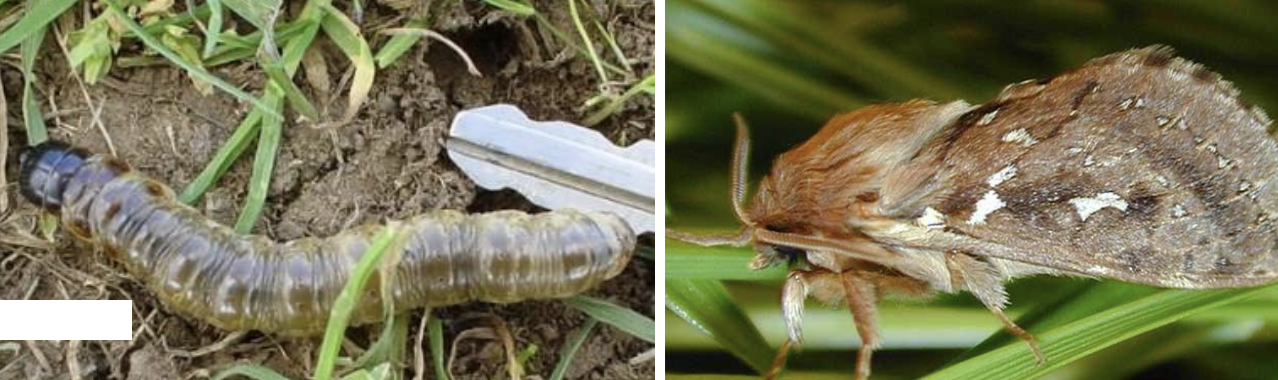
<p><strong>Type:</strong> Insect (moth larva)<br><strong>Life cycle:</strong> Annual<br><strong>Key persistence / spread:</strong> Eggs laid on pasture; larvae live in soil burrows<br><strong>Farming systems:</strong> Pastures</p><p><strong> How to identify</strong></p><p>Pasture damage appears as bare or thinned patches, often noticed in winter or early spring. Unlike root‑feeding damage, plants appear grazed rather than uprooted.</p><p>Larvae live in vertical burrows in the soil and emerge at night to feed on leaves. Damage is rarely seen during the day.</p><p>Larvae are long, smooth caterpillars, brown to greenish, and may retreat quickly into burrows when disturbed.</p><p>Presence is often confirmed by inspecting pasture at night with a torch.</p>
93
New cards

Codling Moth

Type: Insect (moth larva)
Life cycle: Annual
Key persistence/spread: Larvae overwinter in bark crevices
Farming systems: Orchards

How to identify

Damage is first noticed in fruit, where larvae tunnel into the centre, producing brown crumbly frass near entry points.

Affected fruit may drop prematurely or appear sound externally but contain internal tunnels and decay.

Adult insects are small grey moths active at dusk, but these are rarely noticed. Larvae are creamy‑pink caterpillars found inside fruit.

Damage is highly specific to fruiting trees and does not occur on leaves.
<p><strong>Type:</strong> Insect (moth larva)<br><strong>Life cycle:</strong> Annual<br><strong>Key persistence/spread:</strong> Larvae overwinter in bark crevices<br><strong>Farming systems:</strong> Orchards</p><p><strong> How to identify</strong></p><p>Damage is first noticed in fruit, where larvae tunnel into the centre, producing brown crumbly frass near entry points.</p><p>Affected fruit may drop prematurely or appear sound externally but contain internal tunnels and decay.</p><p>Adult insects are small grey moths active at dusk, but these are rarely noticed. Larvae are creamy‑pink caterpillars found inside fruit.</p><p>Damage is highly specific to fruiting trees and does not occur on leaves.</p>
94
New cards

Diamondback Moth

Type: Insect (moth larva)
Life cycle: Multiple generations per year
Key persistence / spread: Wind‑assisted adult movement
Farming systems: Brassica crops

How to identify

Leaf damage consists of small irregular holes, often described as “shot holes", particularly on the underside of leaves.

Larvae are small, green, and tapered at both ends, often wriggling violently when disturbed. They may drop on silk threads.

Adults are small grey moths with a distinct diamond pattern when wings are folded but are rarely seen closely.

Heavy infestations can skeletonise leaves, severely reducing forage or crop quality.
<p><strong>Type:</strong> Insect (moth larva)<br><strong>Life cycle:</strong> Multiple generations per year<br><strong>Key persistence / spread:</strong> Wind‑assisted adult movement<br><strong>Farming systems:</strong> Brassica crops</p><p><strong> How to identify</strong></p><p>Leaf damage consists of small irregular holes, often described as “shot holes", particularly on the underside of leaves.</p><p>Larvae are small, green, and tapered at both ends, often wriggling violently when disturbed. They may drop on silk threads.</p><p>Adults are small grey moths with a distinct diamond pattern when wings are folded but are rarely seen closely.</p><p>Heavy infestations can skeletonise leaves, severely reducing forage or crop quality.</p>
95
New cards

Brown Marmorated Stink Bug

Type: Insect
Life cycle: Annual
Key persistence / spread: Overwintering adults; high mobility
Farming systems: Horticulture (biosecurity pest)

How to identify

Adults are shield‑shaped insects, mottled brown, about the size of a fingernail. When disturbed, they emit a strong unpleasant odour.

Damage includes pierced and distorted fruit, with corky internal tissue resulting from feeding damage.

Nymphs resemble small, rounded versions of adults and occur in clusters.

This insect is primarily identified by appearance rather than symptoms and is monitored as a high‑risk invasive pest.
<p><strong>Type:</strong> Insect<br><strong>Life cycle:</strong> Annual<br><strong>Key persistence / spread:</strong> Overwintering adults; high mobility<br><strong>Farming systems:</strong> Horticulture (biosecurity pest)</p><p><strong> How to identify</strong></p><p>Adults are shield‑shaped insects, mottled brown, about the size of a fingernail. When disturbed, they emit a strong unpleasant odour.</p><p>Damage includes pierced and distorted fruit, with corky internal tissue resulting from feeding damage.</p><p>Nymphs resemble small, rounded versions of adults and occur in clusters.</p><p>This insect is primarily identified by appearance rather than symptoms and is monitored as a high‑risk invasive pest.</p>
96
New cards

Apple Scab

Type: Fungal disease
Life cycle: Seasonal, recurring annually
Key persistence / spread: Spores overwinter on fallen leaves
Farming systems: Orchards

How to identify

Symptoms first appear as dark olive or black spots on leaves, often velvety in texture. As infection progresses, leaves may curl or drop prematurely.

Fruit develops rough, cracked lesions that reduce market quality. Infections occur early in the growing season under humid conditions.

The disease spreads rapidly in wet weather and is closely linked to leaf litter presence.

Symptoms are most obvious in spring and early summer.
<p><strong>Type:</strong> Fungal disease<br><strong>Life cycle:</strong> Seasonal, recurring annually<br><strong>Key persistence / spread:</strong> Spores overwinter on fallen leaves<br><strong>Farming systems:</strong> Orchards</p><p><strong> How to identify</strong></p><p>Symptoms first appear as dark olive or black spots on leaves, often velvety in texture. As infection progresses, leaves may curl or drop prematurely.</p><p>Fruit develops rough, cracked lesions that reduce market quality. Infections occur early in the growing season under humid conditions.</p><p>The disease spreads rapidly in wet weather and is closely linked to leaf litter presence.</p><p>Symptoms are most obvious in spring and early summer.</p>
97
New cards

Poplar Rust

Type: Fungal disease
Life cycle: Annual
Key persistence / spread: Wind‑borne spores
Farming systems: Shelter trees, erosion control plantings

How to identify

Bright orange to yellow powdery pustules develop on the underside of leaves. The upper surface may show pale yellow spotting.

Infected leaves often drop early, reducing tree vigour. Symptoms are most obvious in late summer and autumn.

The disease spreads rapidly between nearby trees under warm, humid conditions.

Usually confined to host species and does not affect pasture plants.
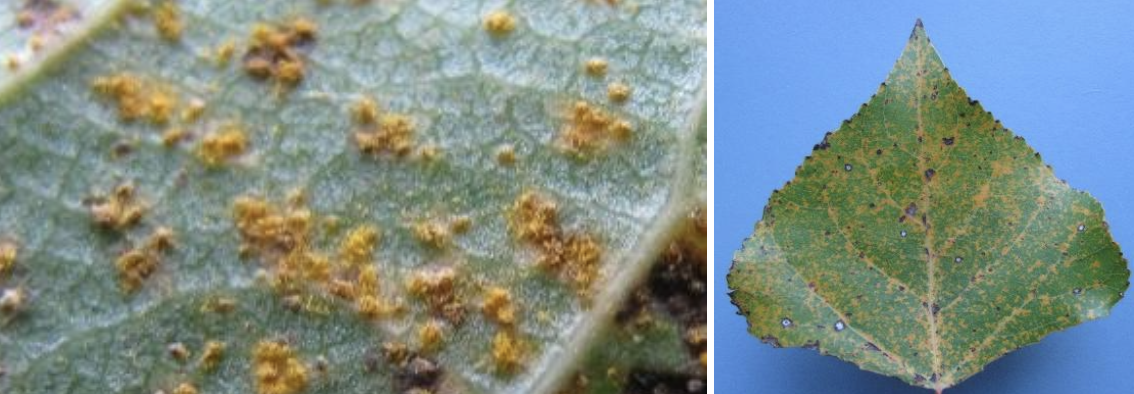
<p><strong>Type:</strong> Fungal disease<br><strong>Life cycle:</strong> Annual<br><strong>Key persistence / spread:</strong> Wind‑borne spores<br><strong>Farming systems:</strong> Shelter trees, erosion control plantings</p><p><strong> How to identify</strong></p><p>Bright orange to yellow powdery pustules develop on the underside of leaves. The upper surface may show pale yellow spotting.</p><p>Infected leaves often drop early, reducing tree vigour. Symptoms are most obvious in late summer and autumn.</p><p>The disease spreads rapidly between nearby trees under warm, humid conditions.</p><p>Usually confined to host species and does not affect pasture plants.</p>
98
New cards

Cucurbit Powdery Mildew

Type: Fungal disease
Life cycle: Annual
Key persistence / spread: Airborne spores
Farming systems: Vegetable crops

How to identify

Leaves develop a white powdery coating on the surface, often beginning on older foliage.

As disease progresses, leaves turn yellow, dry out, and collapse. Fruit exposure and sunscald may occur due to leaf loss.

Unlike many fungal diseases, this condition develops in dry weather with high humidity.

The white coating wipes off easily, confirming identification.
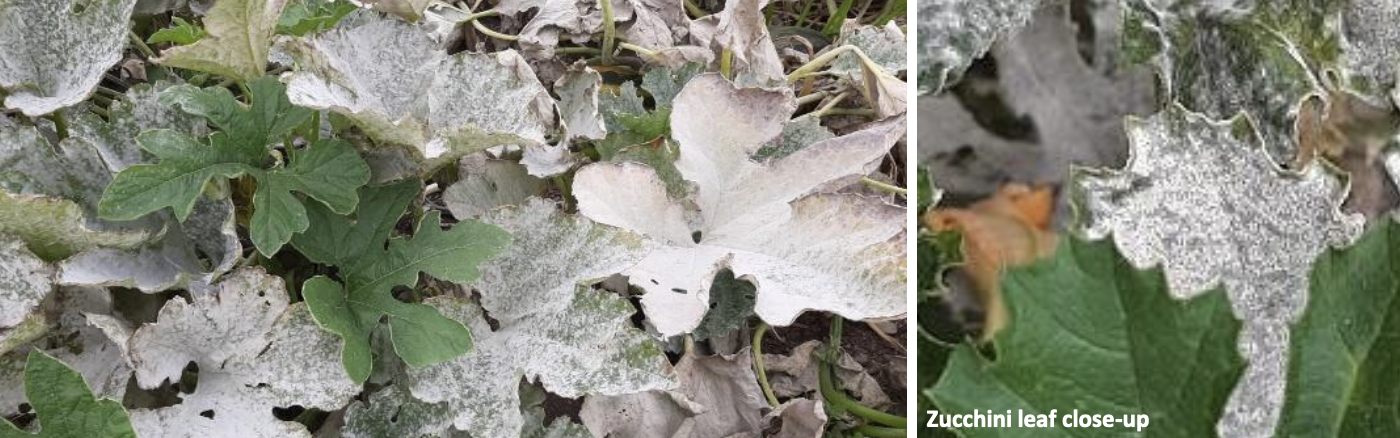
<p><strong>Type:</strong> Fungal disease<br><strong>Life cycle:</strong> Annual<br><strong>Key persistence / spread:</strong> Airborne spores<br><strong>Farming systems:</strong> Vegetable crops</p><p> How to identify</p><p>Leaves develop a <strong>white powdery coating</strong> on the surface, often beginning on older foliage.</p><p>As disease progresses, leaves turn yellow, dry out, and collapse. Fruit exposure and sunscald may occur due to leaf loss.</p><p>Unlike many fungal diseases, this condition develops in dry weather with high humidity.</p><p>The white coating wipes off easily, confirming identification.</p>
99
New cards

Kiwifruit Canker

Type: Bacterial disease
Life cycle: Persistent
Key persistence / spread: Rain splash, pruning wounds
Farming systems: Orchards

How to identify

Symptoms include dark sunken cankers on vines and leaders. In wet conditions, red or milky bacterial ooze may be visible.

Leaves may develop angular spots surrounded by yellow halos. Flower buds may die before opening.

Vines show progressive dieback from infected sites, especially after stressful weather.

Damage is most severe in cool, wet conditions.
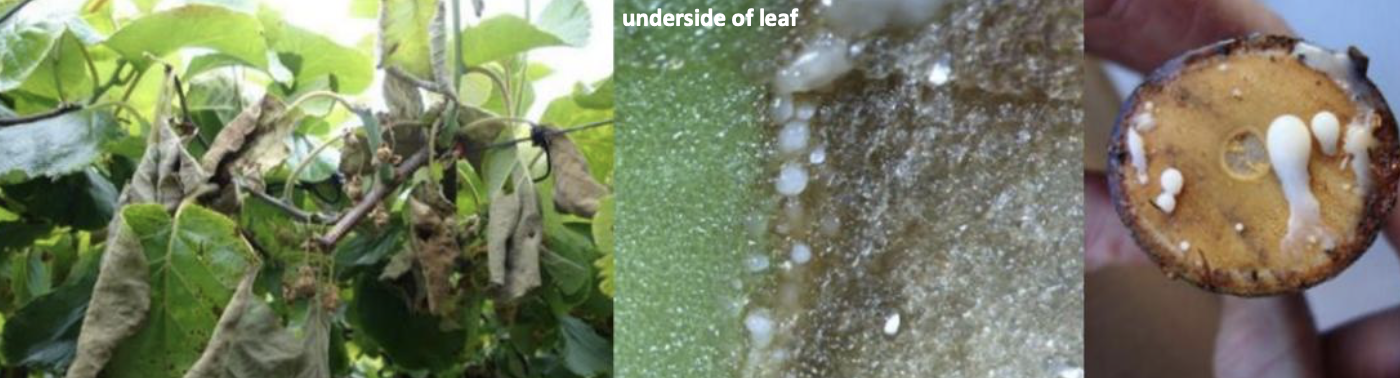
<p><strong>Type:</strong> Bacterial disease<br><strong>Life cycle:</strong> Persistent<br><strong>Key persistence / spread:</strong> Rain splash, pruning wounds<br><strong>Farming systems:</strong> Orchards</p><p><strong> How to identify</strong></p><p>Symptoms include dark sunken cankers on vines and leaders. In wet conditions, red or milky bacterial ooze may be visible.</p><p>Leaves may develop angular spots surrounded by yellow halos. Flower buds may die before opening.</p><p>Vines show progressive dieback from infected sites, especially after stressful weather.</p><p>Damage is most severe in cool, wet conditions.</p>
100
New cards

Grapevine leafroll virus

Type: Viral disease
Life cycle: Persistent
Key persistence / spread: Infected plant material; insect vectors
Farming systems: Vineyards

How to identify

Leaves show upward rolling of the margins, combined with colour change. In red varieties, leaves redden while veins remain green.

White varieties develop yellowing rather than red colouring. Symptoms are most obvious late in the growing season.

Fruit ripening is delayed and sugar accumulation reduced, lowering crop quality.

The disease persists for the life of the plant once infected.
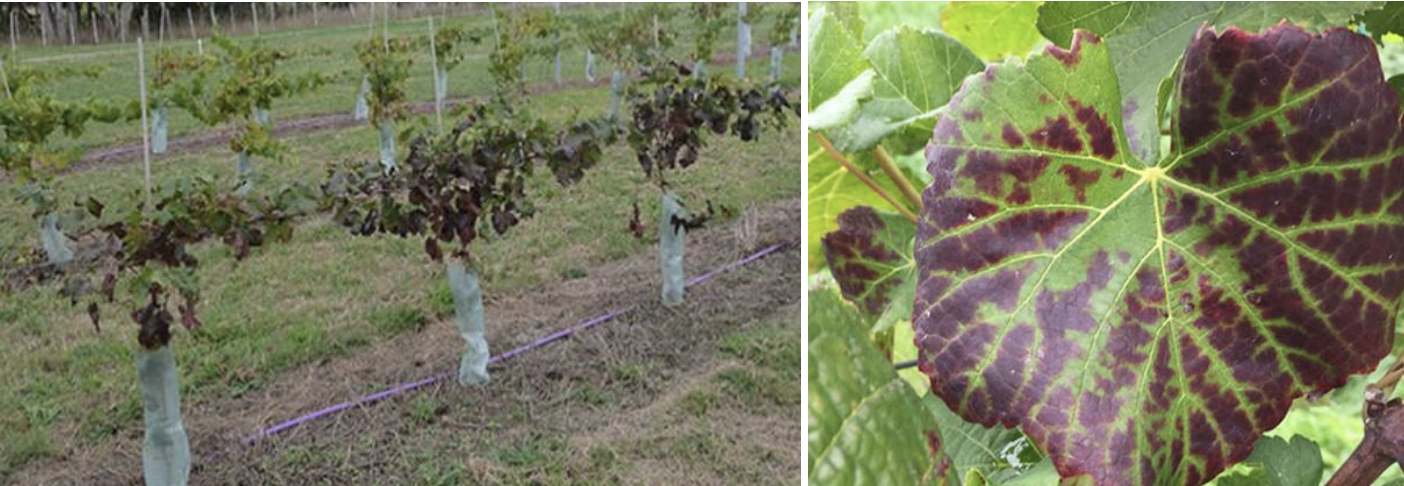
<p><strong>Type:</strong> Viral disease<br><strong>Life cycle:</strong> Persistent<br><strong>Key persistence / spread:</strong> Infected plant material; insect vectors<br><strong>Farming systems:</strong> Vineyards</p><p><strong> How to identify</strong></p><p>Leaves show upward rolling of the margins, combined with colour change. In red varieties, leaves redden while veins remain green.</p><p>White varieties develop yellowing rather than red colouring. Symptoms are most obvious late in the growing season.</p><p>Fruit ripening is delayed and sugar accumulation reduced, lowering crop quality.</p><p>The disease persists for the life of the plant once infected.</p>



