Injections & Withdrawals (2)
 Call Kai
 Learn
Learn Practice Test
 Spaced Repetition
 Match
Match Flashcards
 Knowt Play
1/3

There's no tags or description
Looks like no tags are added yet.
Name | Mastery | Learn | Test | Matching | Spaced | Call with Kai |
|---|
No analytics yet
Send a link to your students to track their progress
4 Terms
What can money do ?
Money can enter or leave the circular flow of income in an economy
What do injections do ?
Injections add money into the circular flow of income and increase its size
Increased government spending (G)
Increased investment (I)
Increased exports (X)
What do withdrawals do ?
Withdrawals or leakages remove money from the circular flow of income and reduce its size
Increased savings by households (S)
Increased taxation by the government (T)
Increased import purchases (M)
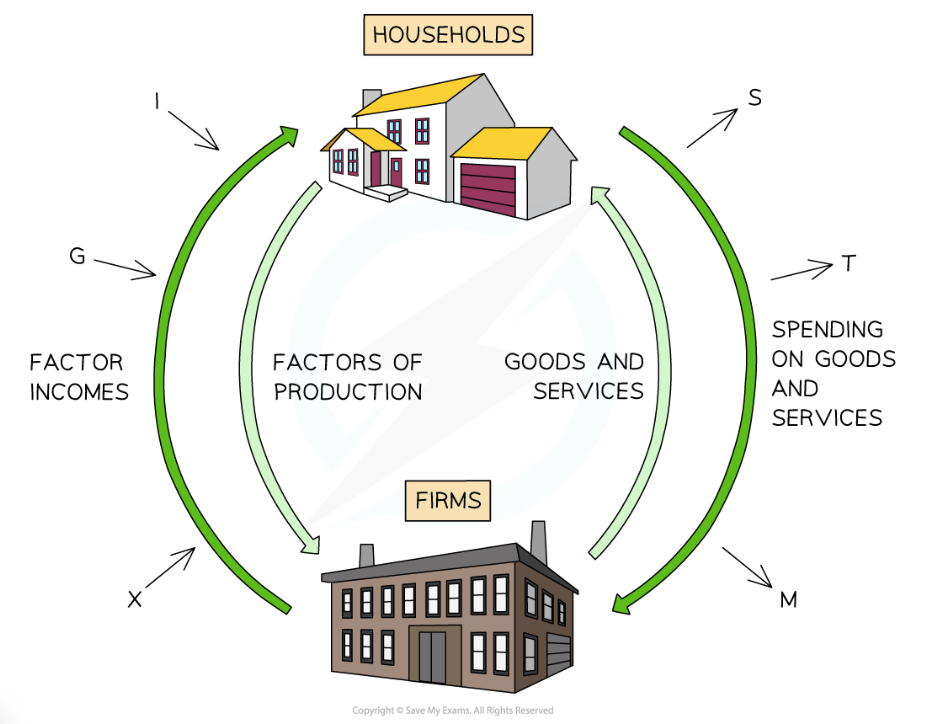
A diagram that shows the injections and withdrawals that influence the relative size of the circular flow of income - Diagram Analysis
The relative size of the injections and withdrawals impacts the size of the economy:
Injections > withdrawals = economic growth
Withdrawals > injections = fall in real GDP
Injections represent new income in the economy
The multiplier effect can cause the economy to grow by a greater amount than the size of the injection
E.g. If government spending increases, the money becomes income for households who then spend it purchasing goods/services from firms, who then spend some of it on purchasing raw materials
Changes to any of the factors that influence government spending, investment, consumption and net exports will increase/decrease the relative size of the circular flow of income
E.g. An increase in interest rates will increase savings (withdrawal), and reduce consumption and investment