Materials T5 - Ceramics
 Call Kai
 Learn
Learn Practice Test
 Spaced Repetition
 Match
Match Flashcards
 Knowt Play
1/44

There's no tags or description
Looks like no tags are added yet.
Name | Mastery | Learn | Test | Matching | Spaced | Call with Kai |
|---|
No analytics yet
Send a link to your students to track their progress
45 Terms
Ceramic Composition
Mixture of metal and non-metal with mixed bonds (ionic and covalent)
Cation
Positively charged ion with missing e- and smaller atomic radius
Anion
Negatively charged ion with extra e- and larger atomic radius
Ionic Crystal Composition
Determined by charge neutrality and physical stability
Less Stable
Effect of greater size difference in atoms within ionic bond
AX-Type Crystal Structure
1:1 ratio of cations and anions, e.g. NaCl
AmXp-Type Crystal Structure
1:2 ratio of cations and ions to maintain charge neutrality, e.g. CaF2
AmBnXp-Type Crystal Structure
Has more than one type of cation, e.g. BaTiO3
Rock Salt Structure
AX-type with FCC anion packing (6 cations, 6 anions)
Cesium Chloride
AX-type with simple cubic anion packing (8 cations, 8 anions)
Zinc Blende (sphalerite)
AX-type with FCC anion packing (4 cations, 4 anions)
Fluorite
AX2 with simple subic anion packing (8 cations, 4 anions)
Perovskite
ABX3 with FCC anion packing (12 A cations, 6 B cations, 6 anions)
Spinel
AB2X4 with FCC anion packing (4 A cations, 6 B cations, 4 anions)
Anion Vacancy
Missing anion
Cation Vacancy
Missing cation
Cation Interstitial
Additional cation in interstitial space
Frenkel Defect
Cation moved into another interstitial (vacancy + cation interstitial)
Shottky Defect
Equal amount of cations and anions missing, charge neutrality maintained
Intertitial Impurity Atom
Additional cation of different element
Substitutional Impurity Atom
Anion substituted with different element
Effect of Porosity
Changes fracture behaviour, detrimental for tension as cracks are pulled apart
Compression
Best type of stress for ceramic
Brittle Fracture
Type of fracture experienced by ceramics before plastic deformation
Reasons for Brittle Fracture
Ceramics have restricted slip, electrostatic repulsion difficult to break, and covalent/ionic bonds are very strong
Slipping of Amorphous Ceramics
Impossible due to not having crystal planes
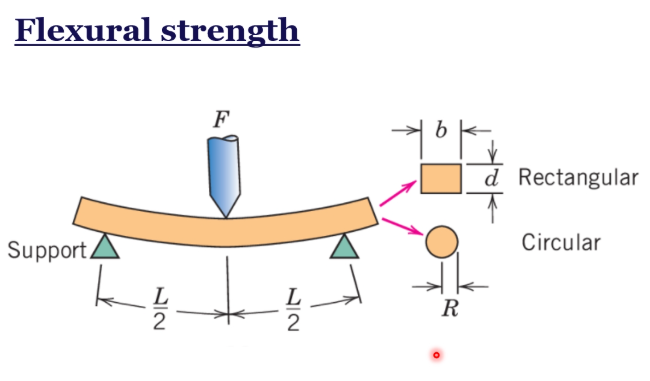
Flexural Strength
Maximum stress when break occurs (similar to UTS)
Weibull Modulus
Width of stress/fracture frequency graph, wider = ceramic
Concrete
A composite comprised of cement, aggregate and water
Hydration of Cement
Water is added to cement, causing minerals to dissolve
Cement Setting
C-S-H crystals interconnnect and form solid structure
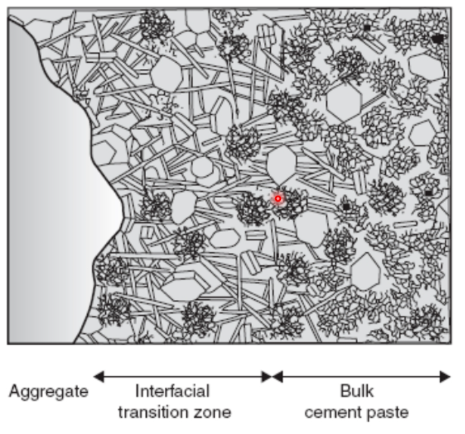
Interfacial Transition Zone
Transition between aggregate/cement
Properties of Interfacial Transition Zone
Has larger crystals + porosity and weaker than cement bulk (cracks follow transition zone during fracture)
Increased Relative Strength
Higher curing temperature
Silica Glass
Amorphous network former composed of SiO2
Fused Silica
Glass made of pure SiO2, silicon atom connected to tetrahedrom of oxygem atoms
Si-O Bonds
Strong, high melting temperature (Tm)
Oxide Additive in Glass
Breaks network bonds and becomes network modifier, which lowers melting point and decreases viscosity
Carbon Black
Amorphous carbon
Diamond
Covalently bonded carbon in cubic structure
Graphite
Hexagonal close-packed carbon structure
Graphite Structure
Covalent bonds within sheets, Van der Waal’s forces between sheets
Graphene
Single sheet of graphite
Highly Conductive
Conductivity of graphite due to p-orbitals forming cloud of delocalised e- on surface
Causes of Graphite Strength
Covalent bonding, short bond length, and no grain boundaries/porosity