choice under risk/ uncertainty
 Call Kai
 Learn
Learn Practice Test
 Spaced Repetition
 Match
Match Flashcards
 Knowt Play
1/18

There's no tags or description
Looks like no tags are added yet.
Name | Mastery | Learn | Test | Matching | Spaced | Call with Kai |
|---|
No analytics yet
Send a link to your students to track their progress
19 Terms
risk
probabilities are known
e.g. coint toss: P(heads) = 0.5
uncertainty
probabilities are unknown/ subjecive
excpected value
average monetary payoff
pi= probability
xi= payoff
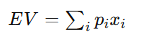
st petersburg paradox
lottery:
first heads = £2
second heads =£4
third head = £8
etc
excpected value - see image
but people will not pay infinite money to play
this meas ev alone cannot explain behaviour

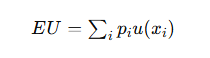
excpected utility theory
people maxamise utility not money
u(x)= utility from money x
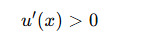
marginal utility
extra utility from one more unit
more money increases utility
diminishing marginal utility
each extra unit gives less happiness
thus risk aversion
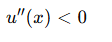
risk avesion condition
concave utility
u”(X)<0
certainty equivilent
guaranteed amount giving same utility as lottery
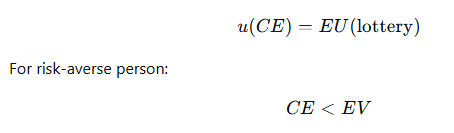
risk premium
amount willing to pay to avoid risk
RP = EV-CE
risk loving
prefers gamble over EV
convex utility
u”(X)>0
risk neutral
linear utility
u”(X)= 0
independence axiom
if p>q then mixing both with same third party preserves ranking
very important!!!

archmedean axiom
no lottery infinitely better than another
ambiguity
situations where probability of outcome is unkown or subjective
subjective excpected utility
a theory where decision makers form their own subjective excpectations of probabilities and choose the act with the highest utility
calculating utility of an act
f = act
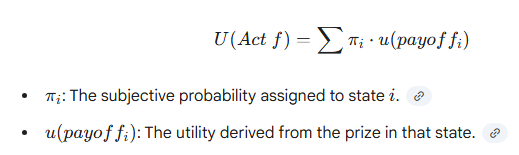
act
an action defined by the specifc outcome it provdies in each possible state of the world
states of the world
an exclusive and exhastive list of all possible outcomes in a given scenario