1.2 - Monetary model
 Call Kai
 Learn
Learn Practice Test
 Spaced Repetition
 Match
Match Flashcards
 Knowt Play
1/27

There's no tags or description
Looks like no tags are added yet.
Name | Mastery | Learn | Test | Matching | Spaced | Call with Kai |
|---|
No analytics yet
Send a link to your students to track their progress
28 Terms
Floating ER - assumptions
AS curve vertical
price is flexible
Supply Side factors which make up AS not modelled (tech or K accumulation)
Small local economy
Foreign variables taken as given
Simple Demand for money
Not dependent on interest rates
Only depends on real income
PPP holds
SP* = P
demand for real money balance - equation
Md / p = kY
kY - Share of total output
Money market equilibrium
MS = Md
Simple AD relation - equation
MS = kPY
Md / P = kY → Md = kPY
MS = Md
Simple AD relation - graphically
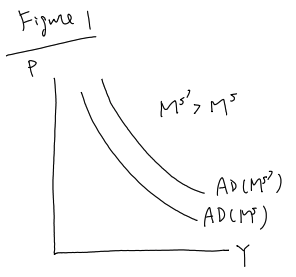
PPP holds - graph
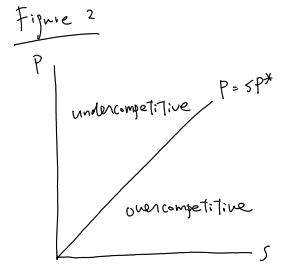
Monetary model equilibrium
Using AD-AS relation
MS = MD = kPY → P = MS / kY
PPP holds by assumption
P = SP*
MS / kY = SP* → S = MS / kP*Y
What changes Model equilibrium
If MS rises, S rises (depreciation)
If output (Y) rises, S falls (appreciation)
If foreign price (P*) rises, S falls (appreciation)
Money Supply increase effects on equilibrium - graph + explanation
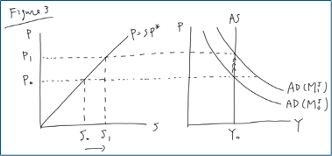
If MS increases (treat MS as exogenous):
At initial p (p0 = S0P*) there is excess D for goods
Since Y fixed (Y0), p rises → dom goods now relatively more expensive
D for H goods & H currency falls
Dom currency depreciates to keep competitiveness for PPP to be preserved
decrease proportional to increase in MS
Income increase effects on equilibrium - graph + explanation
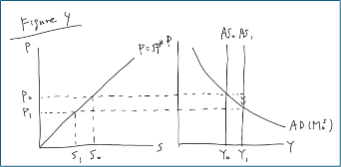
Income (Y) increases (Y exogenous in model):
At original p (p0) there is excess supply
p falls to keep money market in equilibrium
Exchange rate appreciates (S falls) – to restore competitiveness of F goods
Balance sheet of a Central Bank (CB)
Assets
Domestic-currency bonds (D)
Foreign exchange reserves (F)
Liabilities
High powered money (H)
Ms in a fixed ER
Ms = hH = h(F+D)
h - money multiplier
assume h = 1 (Money consists of currency only)
If CB holding of D increases -> monetary base increases -> MS increases through the money multiplier (expansionary MP)
Ms = F+D
Fixed ER assmptions
Dom Output (Y) + Foreign price (P*) - Exogenous
MS no longer exogenous
CB adjusts Foreign reserves (F) to preserve ER
When other exogenous variables change (shock)
Money supply increase (↑ in D) - graph + explanation
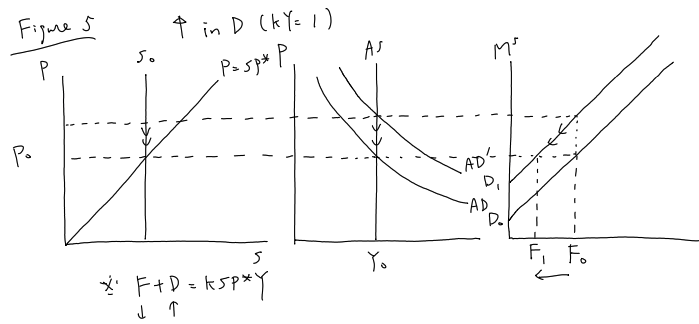
An increase in govt bonds (D) leads to increase in MS (expansionary MP)
Shifts AD upwards from the excess demand -> increases P (domestic price index)
Dom goods become under-competitive → Which leads to demand falling + D for dom currency falls
Without CB intervention, dom currency would depreciate to correct competitiveness (floating ER)
To preserve fixed exchange rate, CB buys dom currency using Foreign reserves (F)
F falls till competitiveness restored
An increase in D is exactly offset by a decrease in F (MS falls so movement along AS curve)
F = kS0P*Y – D
Asset composition changes (F falls but D increases)
PPP doesn’t shift at all so p & output (Y) doesn’t change
Income increase with fixed ER - G + E
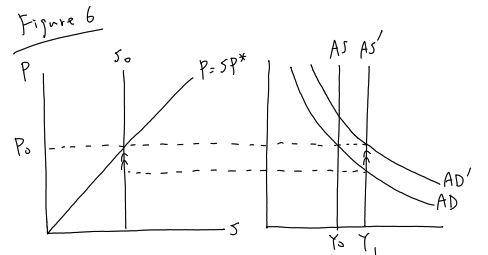
Shock to income (Y)
dont need MS diagram as assumed kY = 1 implicitly (so always consistent)
Y increases due to supply side shock → AS curve shifts right
At initial price (p0) there is excess supply → Dom price falls and dom goods become over-competitive as they are cheaper
Demand for home currency increases -> Without CB intervention Dom currency would appreciate to correct competitiveness
CB increases F reserves (F) -> Issue dom currency & buy F currency to keep exchange rate constant
F increases for given D → MS increases → AD shifts upwards until PPP restored
Output (Y) increase BUT price fixed + CB now hold more F
Asset price approach
Dynamic version of the model with nominal exchange rate viewed as an asset price
PPP still holds
Money demand function with nominal interest rate - dynamic

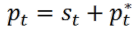
PPP in logs - dynamic
Rational expectations
Rational expectations use all information available
Peoples subjective expectations conditional on all information available today

UIP with expectation

Combine UIP with logs equation
Difference in H & F interest rate should be equal to expectation of depreciation rate


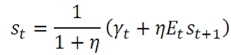
What does γt equal

Combined equation - st
law of iterated expectations

Expanded st with 1 level of expectations

Expanded using Law of iterated expectations
Expanded st with all levels of expectations & iteration

Asset bubble restriction (on iteration)
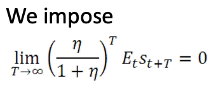
The assumption rules out a bubble situation where p keeps increasing at a fast rate
limit of present discounted value of terminal ERs
Non-bubble condition hold if s increasing at slower rate than (n/1+n)^t inverse
Final st equation
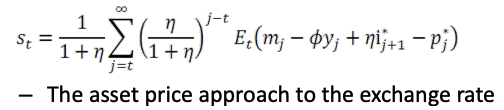
Exchange rate today is a function of:
Expectation of future money S + output in the future + future foreign interest rate + future foreign p