Classic Research- Watson & Rayner
 Call Kai
 Learn
Learn Practice Test
 Spaced Repetition
 Match
Match Flashcards
 Knowt Play
1/19

There's no tags or description
Looks like no tags are added yet.
Name | Mastery | Learn | Test | Matching | Spaced | Call with Kai |
|---|
No analytics yet
Send a link to your students to track their progress
20 Terms
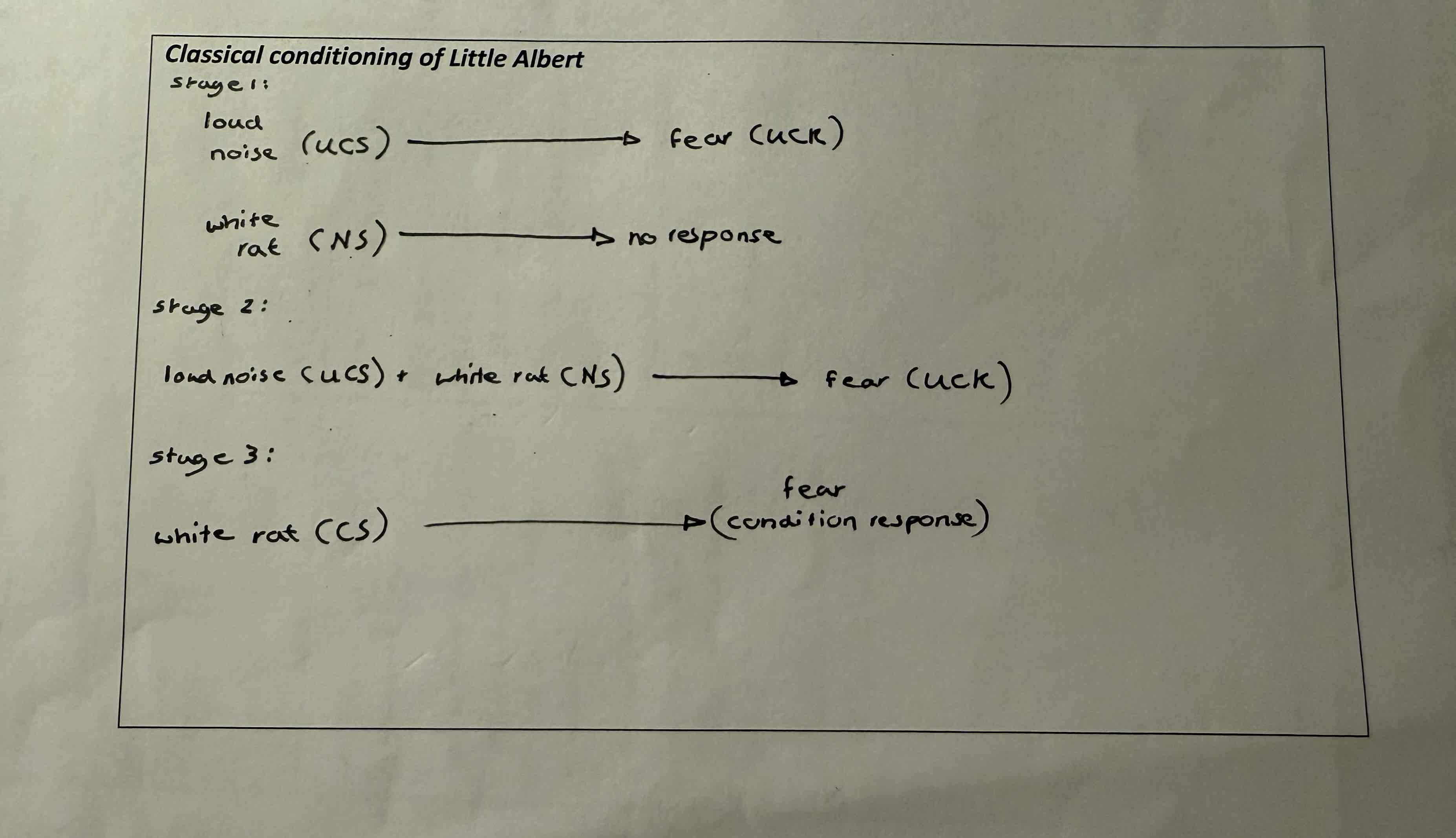
How did classical conditioning work on little Albert?
Who was the participant?
Albert B, known as little Albert
Why was he selected?
He was “stoic and unemotional” Relatively emotionally stable. “His stability was one of the principal reasons for using him as a subject in this test”
How should we describe the method?
A controlled observation- they filmed the study & made notes
What was the procedure?
Little Albert was brought up in a hospital environment because his mother was a wet nurse at the hospital
At approx 9 months old tested little Albert’s reactions to white rabbit, a dog, a monkey, a mask, cotton wool and a burning newspaper
No point did Albert show fear to any of these objects
Testing began when Albert was 11 months old
Procedure- Controlled observation 1, 11 months, 3 days
White rat presented to Albert as he reaches out metal bar struck behind him just as his hand was abt to touch the rat again; bat was struck again
No further tests were given for 1 week
Findings- 11 months, 3 days
1st time he reached for the rat- fell forward & buried his face in the mattress,
2nd time he fell forward he whimpered
Procedure- Controlled observation 11 months, 10 days
Rat presented alone
Rat placed nearer to Albert
blocks given to play with as a distraction task
Repeated joint presentations of rat & bar (loud noise)
Findings- 11 months, 10 days
Played happily with the blocks
When showed rat- fell & whimpered instantly, shown rat repeatable fell to left raised on all fours n crawled away
Procedures- 11 months 15 days
Rabbit & dog presented alone with blocks in between
Fur coat & cotton wool alone
Watson put his hair in front of Albert
Santa Claus mask alone
Findings- 11 months 15 days
Played with blocks
rat- fell over
rabbit- whimpered cried
dog- turned head & began to cry
Cotton wool- kicked away with feet
Watson hair- ignored but played with others
Santas mask- reacted negatively
Producure- 11 months 20 days
Change location (well lit lecture room- 4 ppl)
Rat rabbit & dog alone
Rat alone
Joint presentations of rat and bat
Rat alone twice, blocks presented inbetween
Rabbit & dog alone, dog barked loudly
Findings- 11 months, 20 days
Played with blocks
Rat- bent over crying
Rabbit- leaned as far to left as possible
Change of location
Rat- hands up, whimpering
Rabbit- slight fear
Dog- fell over when it barked
Procedure- 12 months 21 days
Santa Claus mask present
Fur coat laid on Albert’s lap blocks
Rat alone, then placed on his arm & crawled on his chest
Rabbit placed in his lap, hand placed on rabbit h again on his lap
Dog then pushed closed to him
Findings- 1 year, 4 days
SC mask- whimpered, cried
Fur coat- withdrew body,
Rat/ leaned back, covered eyes
Rabbit- shuddered
Dog- cried with both hands over face
what were the incidental findings?
thumb sucking- noticed whenever he was about to cry or was afraid would put his thumb in his mouth to block fear, comfort himself. Whenever he was playing with blocks he’d suck his thumb. In return W&R would pull out his thumb out of his mouth whenever he sucked it to remove his sense of comfort
conclusions- can fear of a previously neutral stimulus be conditioned by presenting it simultaneously with an established negative stimulus
yes, when Albert was tested at 9 months, no fear was shown to any of the stimuli. However,after conditioning fear responses were seen. Study shows conclusively that directly conditioned emotional responses do occur where there was previously no response
Can the conditioned response be transferred to other animals or objects?
yes the conditioned responses were transferred to other objects AND also in a different location.
stimulus generation-fear response to rat was generalised to rabbit, dog,fur coat.
does the conditioned response change over time?
it continued after a period of 1 week. Even a month later the responses persisted & transferred to other stimuli. The view is that the response will persist and modify personality throughout life
if after a reasonable time, the emotional responses haven’t died out how might they be removed?
Opportunity to remove the conditioned response was denied. Albert left the hospital. However it is likely that the responses persist indefinitely. Had they had the opportunity W&R would have attempted to recondition Albert by feeding him candy when animal shown