Physics Motion and Relativity
 Call Kai
 Learn
Learn Practice Test
 Spaced Repetition
 Match
Match Flashcards
 Knowt Play
1/35

There's no tags or description
Looks like no tags are added yet.
36 Terms
Uniform Circular Motion (UCM)
Refers to an object moving at a constant speed in a circular path. Speed is constant but velocity changes with time.
Why is UCM an accelerated motion
As its direction and velocity changes
Where is the direction of acceleration in circular motion
Towards the center of the circle and is called centripetal acceleration.
The force causing centripetal acceleration is ______ to the instantaneous velocity. E.g. ____
Perpendicular. E.g. gravity, friction, tension
Force =
mass x velocity² / radius
Banked Curves
Some roads have banked curves to reduce the chance of skidding as it reduces the reliance on friction to provide centripetal acceleration
Design speed
The speed where no friction is required for a vechicle of any mass to safely navigate the curved path
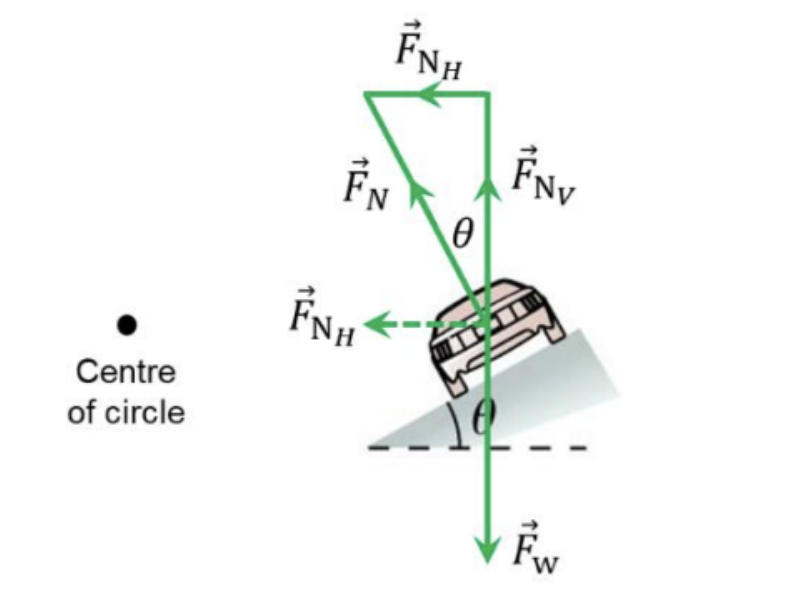
Explain the cause of the centripetal acceleration that enables the car to travel round the banked curve without moving up or down the slope of the road surface.
Banking the curve produces components of the normal force. The horizontal component of the normal force supplies the centripetal acceleration which reduces the reliance on friction.
Gravity
The attractive force between the center of two masses
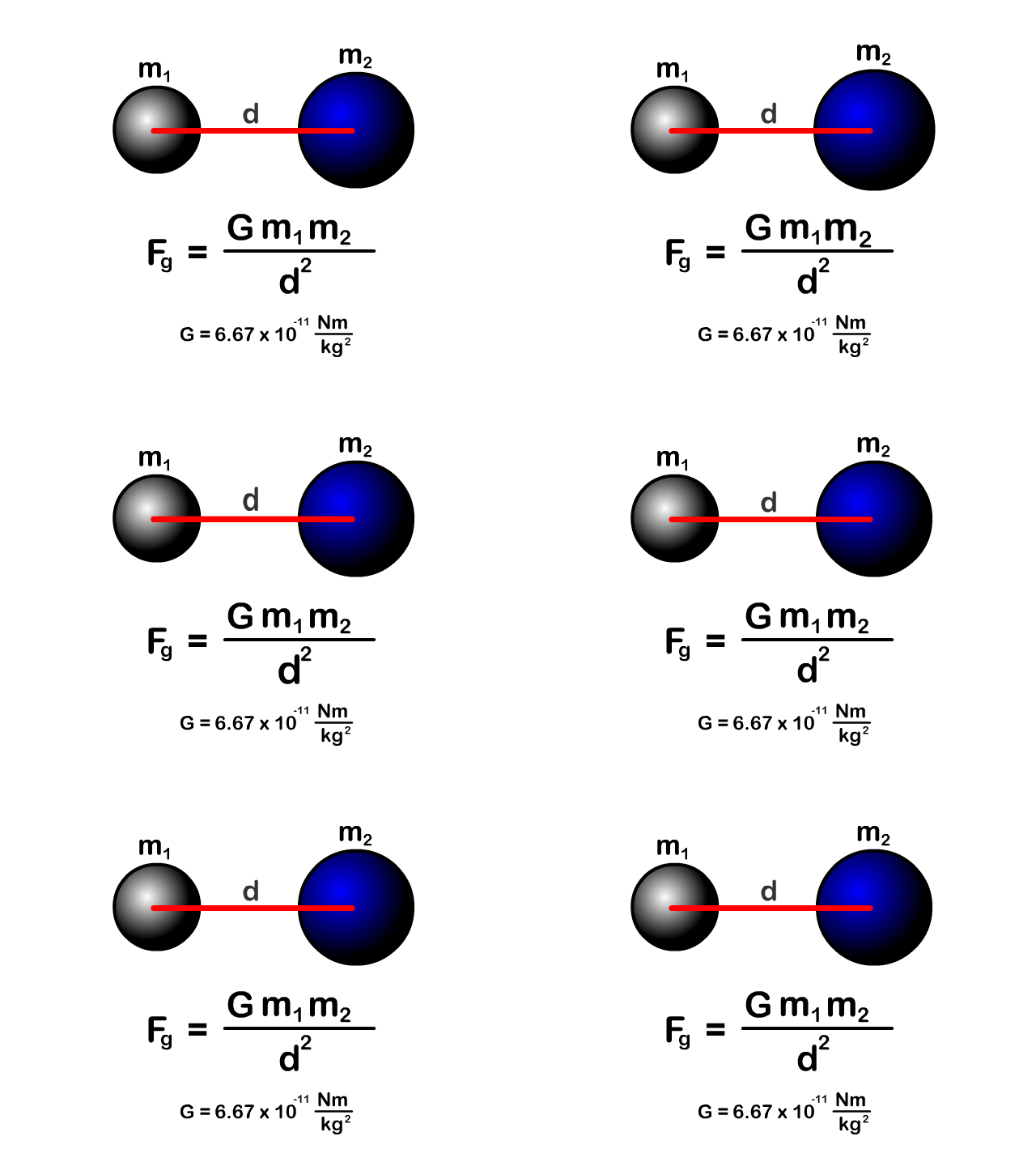
Newton’s Law of Universal Gravitation
Every particle in the universe attracts every other particle with a force directly proportional to the product of their masses and inversely proportional to the square of the distance between their centers
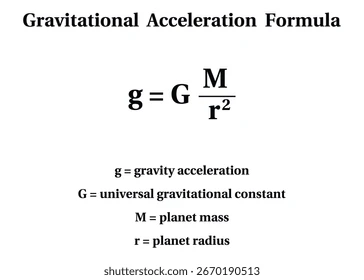
The gravitational force
Causes acceleration and is dependent on the mass and radius of the planet, moon or star
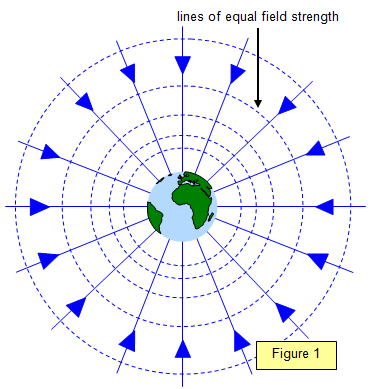
Laplace’s Model of Gravitational field
All masses produce a gravitational field in the space that surrounds them. A mass experiences a gravitational force when it is in a field of another mass
Gravitational field strength
Net force per unit mass at a given point in a gravitational field and is equal to the acceleration due to gravity
Satellites
A smaller mass in orbit around a larger mass where gravity supplies the centripetal acceleration. Can be natural or artificial
Newtons cannonball
If launch speed of a projectile is sufficiently large, the curve of the trajectory becomes parallel to the curve of the planet and starts to orbit.
Orbit
The curved, repetitive path an object in space (like a planet, moon, or satellite) takes around another body due to gravity, typically elliptical in shape
Keplers First Law of Planetary Motion
All planets move in elliptical orbits with the sun at one focus. The elliptical orbit explain the observation of planets travelling faster when nearer to the sun and slower when further from the sun
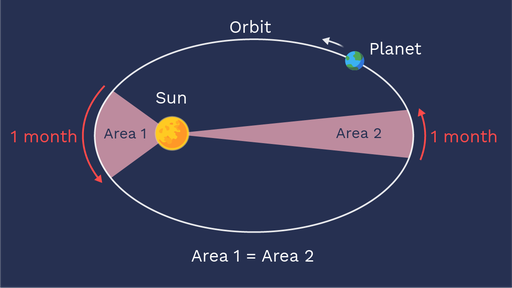
Keplers Second Law of Planetary Motion
As planets move in orbit, it sweeps out an equal amount of area in an equal amount of time. This means that planets change its speed during orbit. It has its fastest speed when closer to the sun and lowest speed when away from the sun
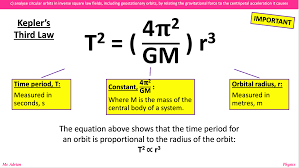
Keplers Third Law of Planetary Motion
The period of any satellite depends upon the average radius of its orbit (or average of the distance of a planet from the sun) and that T² is directly proportional to R³
A gravitational field
A region of space surrounding a mass that causes another mass to experience a gravitational force
Geostationary Earth Orbit
Orbits above the equation and moves with the earth (from west to east) so its period is equal to one earth day. Relative constant position in the sky. Large radius
Polar Orbits
Orbit above the geographic north and south poles of the Earth. Orbit a number of times a day. High speeds and low altitudes.
Why does a satellite in a geostationary orbit have an equatorial orbit that coincides with the centre of the Earth.
The gravitational force supplies the centripetal acceleration needed to keep a satellite in a geostationary orbit above the equator. The gravitational force acts between the centres of the satellite and Earth.
Why does a satellite in a geostationary orbit have a relatively large radius of orbit.
The orbital radius must be large to produce an orbital period of 24 hours.
Why does a satellite in a geostationary orbit have an orbit in the same direction as the Earth’s rotation.
To maintain the same position above Earth's surface, a satellite in geostationary orbit must in the same direction as Earth's
State two primary uses of a geostationary orbit satellite and justify the use of orbit for each application.
Weather: Geostationary satellites view one hemisphere of the planet at all times which allows them to monitor changes in weather patterns over a large geographical land mass.
Communications: The fixed position of the satellite allows ground antennas to be aimed at the satellite without their having to track the satellite's motion.
SPOT 5 is used for monitoring human activities and weather patterns. Justify the use of a polar orbit for monitoring human activities.
Polar orbit satellites such as SPOT 5 have low altitudes above Earth's surface. The low altitude allows the satellite to capture high resolution images of the area beneath its motion.
Relativity
Motion can only be measured relative to an observer. Length and time are relative quantities dependent of the observers reference fram
Inertial frame of reference
Acceleration of observer is zero (observer has a constant speed or no speed). Laws of physics are valid.
Non-inertial frame of reference
Acceleration of observer is not zero. Laws of physics are not valid
Principal of relativity given by Galileo
Laws of motion are the same for all observers in uniform motion.
The reference frame in which observer is at rest or in uniform motion is called an inertial frame of reference
Therefore, laws of motion are the same in all inertial reference frames
Galilean transformations give the relative velocity of 2 reference frames
Einsteins theory of special relativity
Laws of physics in every inertial reference frame are the same - discovered using the law of electromagnetic induction
Speed of light in a vacuum is the same in all inertial reference frames and is independent of the motion of the source - discovered using Galileo, Newton’s work and the Michelson - Morley experiment
Special relativity related to time
States that time is not absolute. Observers in different reference frames may disagree on the simultaneity or time intervals between events.
Time dilation
At relativistic speeds, time intervals in a moving reference frames are dilated when observed from a stationary reference frame
Lorentz Factor
The value of y increases as velocity becomes closer to the speed of light so when a frame of reference is moving with a speed close to the speed of light its time will slow down by a larger factor. The value of Lorentz factor is always greater than 1
Length Contraction
The length of an object moving at relativistic speeds appear shorter to an observer in a stationary reference frame. Occurs in direction of motion