MICROBIO 4000 Lab Quiz 5
 Call Kai
 Learn
Learn Practice Test
 Spaced Repetition
 Match
Match Flashcards
 Knowt Play
1/45

There's no tags or description
Looks like no tags are added yet.
Name | Mastery | Learn | Test | Matching | Spaced | Call with Kai |
|---|
No analytics yet
Send a link to your students to track their progress
46 Terms
Ex. 3.4-3.6
Definition of the constructive process
Organisms are added to produce certain food items (intended)
Ex. 3.4-3.6
Definition of the destructive process
Organisms that cause food spoilage (not intended)
Ex. 7.4
Definition of Precipitin Reaction
Antibodies react with soluble antigens to form a complex precipitate
e.g. soluble antigens cause Lyme disease
Ex. 3.4
Purpose of Pasteurization
Control the growth of unwanted microbes
Ex. 3.4
How to view microbes originating from solid food on agar plates?
A suspension of it made in a blender/stomacher
Ex. 3.4
What is the Pour-plate Technique (juice sample)?
1. Add the juice sample on an empty Petri dish
2. Pour Liquefied Potato Dextrose Agar (PDA, 45 °C) and mix it with the sample
3. Incubation after solidified
Ex. 3.4
How buttermilk is made
adding selected material cultures to milk and incubating the mixture until it sours
Ex. 3.5
What is the minimal growth media used in cheese/beef dilution
Peptone Water
Ex. 3.5
What type the Eosin Methylene Blue (EMB used for beef) is?
Selective-differential agar
Ex. 3.4-3.6
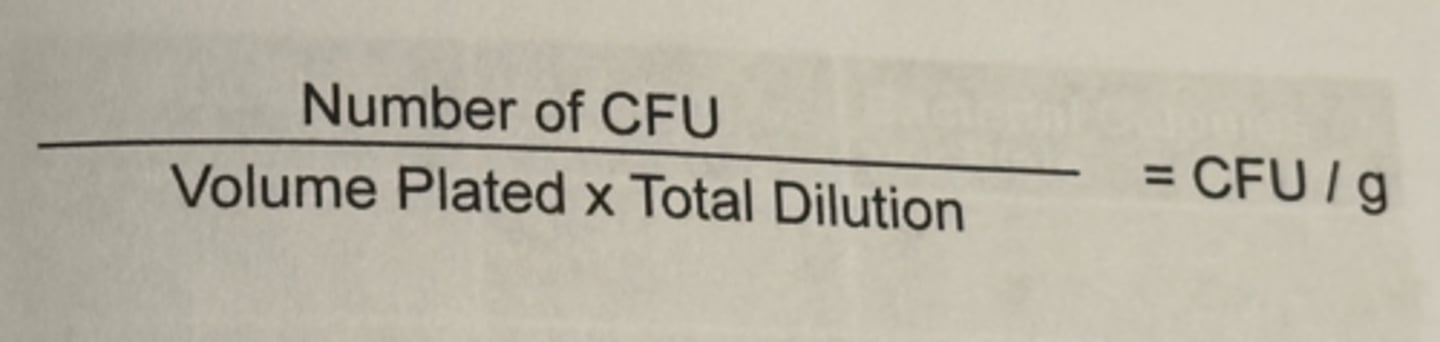
Don't forget how to calculate CFU/g
Ex. 3.6
What is the product and reactant in the Yogurt production
Lactose to Lactic Acid via fermentation with S. thermophilus and L. bulgaricus
Ex. 3.6
Role of S. thermophilus and L. bulgaricus in the yogurt production
First phase: S. thermophilus stimulated and becomes predominant organism
Second Phase: A drop of pH makes L. bulgaricus to become dominant
End phase: pH drops to 4.2-4.3 indicating the termination of fermentation
Ex. 6.6
Definition of Transient Microbiota on skin
The bacteria, mold spores, etc. that are the,temporality found on our skin as a result of touching objects in our environment
Ex. 6.6
Definition of Normal microbiota on skin
The bacteria that usually inhabit our body (either on the skin or internally), and they cause us no harm under normal circumstances
Ex. 6.6
Protection factors of skin
1. Low pH
2. Low moisture
3. Urea, salts, etc. secreted by the sweat and oil glands
Ex. 6.8
Definition of Antiseptics
Used on living things
Ex. 6.8
Definition of Disinfectants
Not used on living things and may cause damage to living tissue
Ex. 6.10
Definition of Antibiotics
Chemicals that are naturally produce by some soil bacteria and fungi and either inhibit or kill other microbial organisms
Ex. 6.9
General mode of actions of antibiotics on bacteria (4)
1. Inhibition of Cell Wall Synthesis
2. Inhibition of Protein Synthesis
3. Inhibition of Nucleic-acid Synthesis
4. Negative alteration of the Plasma Membrane
Ex. 6.9
Definition of the minimum inhibitory concentration (MIC)
the lowest concentration (in μg) of an antibiotic needed to inhibit the growth of a particular organism under laboratory conditions
Ex 6.9
Disadvantages (2) of the minimum inhibitory concentration (MIC)
1. MIC is assessed in vitro (outside of the body)
2. The determined MIC may not suitable in body
Ex 6.9
What does the Kirby-Bauer method test for?
Microbial sensitivity to antibiotics
Ex 6.9
What is an Etest strip
A strip with a concentration gradient of a given antibiotic impregnated on one side (can read MIC)
Ex. 6.7-6.8
What method was used for testing the effect of Mouthwashes/Disinfectants/Antiseptics
Filter disk method (Disks that are saturated with a given antimicrobial agent)
Ex. 6.7-6.8
The effect of Mouthwashes/Disinfectants/Antiseptics is measured by?
Zones of inhibition
Ex. 6.9
What is responsible for the Resistance to Ampicillin in Plasmid A
Bla gene that codes for the enzyme beta-lactamase
Ex. 6.9
What is responsible for the green fluorescent in Plasmid A
Production of the green fluorescent protein GFP
Ex. 6.9
What is responsible for the Resistance to Kanamycin in Plasmid B
KanR gene
EX 6.9
Clinical interpretations of the zone of inhibition
Based on the diameter, rated at Susceptible, Intermediate, or Resistant
Ex. 7.3
Definition of Inflammatory Response
Pathogens penetrating the external defense systems of the human body trigger a series of non-specific host defense mechanisms
Ex. 7.3
Major component of the inflammatory response
White blood cells (leukocytes)
Ex. 7.3
Leukocytes recruited to the site of infection (2)
Macrophages and Neutrophils
*Both are phagocytes
Ex. 7.4
Two ways of enhancing phagocytosis
1. Antibodies
2. Complement system
Ex. 7.3-7.4
Definition of Opsonization
Antibodies and complements bind to invading bacteria and attract phagocytes to the site of infection
Ex. 7.3-7.5
What helps the bacteria to evade immune response?
VIrulence factors
Ex. 7.3-7.5
How to determine the virulence of an organism?
The degree of pathogenicity, or the ability of an organism to cause disease
Ex. 7.3
Function of DNase
Hydrolyzes Free DNA present in pus, it does not affect the DNA of living cells
Ex. 7.4
What does coagulase do?
Catalyzes the conversion of fibrinogen (soluble) to fibrin (insoluble)
Ex. 7.3
Bacterial Hemolysins (3)
1. α-hemolysin: Reduce the number of functional RBC
2. β-hemolysin: Damage other cells and tissues in the immediate area
3. γ-hemolysin: Breakdown RBC
Ex. 7.3
How to evaluate if the formation of a plasma clot occurred?
Tipped the tube at a steep angle
Clumps: coagulase produced
Fluidity: No coagulase produced
Ex. 7.3
Hemolysin test results interpretations
1. α-hemolysin: Greenish spot
2. β-hemolysin: Clear spot
3. γ-hemolysin: No change
Ex. 7.4
Definition of Agglutination Reaction
Antibodies react with insoluble antigens to form a clump
Ex. 7.4
Definition of Complement Fixation
Ag-Ab complex triggers the complement system and cause lysis in organism
Ex. 7.4
ABO blood type Agglutination test results
A blood type: A antigens binds with Anti-A antibodies (in B/O blood type)
B blood type: B antigens binds with Anti-B antibodies (in A/O blood type)
O blood type: No antigens
AB blood type: A+B antigens binds with Anti-A/B antibodies (in A/B/O blood type)
Ex. 7.5
Definition of Epidemic
An infectious disease that rapidly spread within a relatively short period of time and present at a high frequency in a community
Ex. 7.5
Advantage of ELISA test
More precise than precipitin and agglutination tests, which detects in the picogram (10^-12) level