Rokas Second Exam
 Call Kai
 Learn
Learn Practice Test
 Spaced Repetition
 Match
Match Flashcards
 Knowt Play
1/190

There's no tags or description
Looks like no tags are added yet.
Name | Mastery | Learn | Test | Matching | Spaced | Call with Kai |
|---|
No analytics yet
Send a link to your students to track their progress
191 Terms
Microevolutionary studies
Examine how processes such as mutation, natural selection, recombination, migration, non random mating, and genetic drift determine as well as change the genetic composition of populations
Mutation
Generates new variants/new alleles
Recombinations
Responsible for introducing new combinations of alleles in the population (does not introduce new alleles.
Mutations
are changes in the nucleotide sequence of DNA and can involve changes of one (point mutations) or many nucleotides
can cause new genes or alleles to arise
How are mutations distinguished
synonymous: mutations that don’t change the encoded amino acid
non synonymous: changes in nucleotides that change amino acids
Mutations can be
Beneficial —> Increases fitness of population
harmful (deleterious) —> Decreases fitness of population or increases the population’s susceptibility to disease
neutral—> Neither good nor bad effects for the population
Mutation is a
weak evolutionary force because point mutation rates are generally low with one mutation every 100,000 genes per generation
Mutations that are known to be harmful or deleterious and why
Chromosomal mutations that delete disrupt or rearrange loci such as deletions, duplications, translocations and inversions are harmful and deleterious
When mutations leave genes left in tact they can be
neutral or beneficial
If a mutation is beneficial
it can be naturally selected to maintain the fitness of the population
Mutation is a
random process with no foresight
In humans the rate of point mutations is 5x higher in
sperm then eggs so dads contribute the most harmful mutations
why?
In sperm maturation there is more divisions and DNA replications so there is more of an opportunity for an error to occur.
Generation time in the variation in rates of mutation
Single celled organisms and viruses have many more generations per unit of time than larger ones
Environmental impact on variation in the rate of mutation
Many environmental conditions can directly increase the mutation rate. For example carcinogens, and other human made substances can increase mutation rate
Stress impact on the variation in rates of mutation
Under some conditions, stress increases rates of mutation to appear adaptive.
In some cases such as in microbial organisms, they notice when survival is low and stress is high so they increase their mutation rates hoping that particular mutations appear that will be adaptive and will be favored for individuals to survive until the next generation
When is mutation common?
On a per gamete or per genome
When is mutation rare?
Mutation is rare per gene
Mutations with phenotypic effects are usually
harmful (deleterious) and recessive (hidden)
Mutation on its own
has a very little effect on HW equilibrium because it takes many generations for one particular mutation to take rise in a population so in order for it to spread in a population and reach a proper frequency it takes a while
but it provides the ultimate raw material for selection and evolution
What are mutation rates affected by?
Stress, sex, generation time, the environment, and psychological stress
Assortative mating
(non-random mating) like genotypes mate with each other or avoid each other
Inbreeding
(Nonrandom mating) mating among individuals that are more closely related than individuals drawn by chance in the population
Positive assortative mating
Like genotypes mate with like genotypes
decreases heterozygosity for genes affecting that trait
example AAxAA or aaxaa or AaxAa
What happens to allele frequencies during positive assortative mating?
They remain the same because both the dominant and recessive allele are increased by the same fraction
Heterozygotes decrease if similar genotypes are pairing but only for
the loci affecting the trait
With complete positive assortative mating heterozygotes are
decreased by half each generation
Negative assortative mating
Mating is with unlike phenotypes
Example: AaxAA
Increase in heterozygosity in the population
On average heterozygotes increase if
dissimilar genotypes are pairing
Even though positive assortative mating and inbreding both involve like genotypes mating with like what is the difference between them.
Inbreeding affects all loci in the genome not just a singular locus like in positive assortative mating
Inbreeding changes genotype frequencies by
increasing the proportion of homozygotes and reducing the proportion of heterozygotes across the whole genome
Most extreme case of inbreding
Selfing
What happens to allele frequencies under inbreeding each generation?
Allele frequencies stay the same but the actual number of homozygotes increases while the number of heterozygotes decreases
The genotype changes caused by assortative mating
affect only the loci contributing to that phenotype
The genotype changes produced by inbreeding
affect all loci in the genome
Inbreeding results in a
genome wide loss of diversity due to the loss of heterozygosity
Why are the effects of inbreeding and associative mating able to be reversed with one generation of random mating?
Inbreeding and associative mating only affect genotype frequencies not allelic ones so their effects are quite ephemeral/temporary
Why does inbreeding decrease fitness?
It generates offspring that are homozygous for deleterious alleles at times. This causes an inbreeding depression.
Genetic Drift
Sampling error in the production of offspring genotypes from the parental gene pool that results in random changes in allele frequencies.
What are the consequences of genetic drift?
-Genetic drift leads to a loss of variation in a population if the population is finite
-Genetic drift has a bigger effect on small populations
-Genetic drift leads to differentiation
Long term patterns of genetic drift are sensitive to periods of
small population size
Population Bottleneck
When a population goes through a period of unusually small population size
Founder Effect
When a population goes through this period of unusually small population size at a time when it arrives to a new uncolonized area.
Founder effect
When a colony is started by a few members of the original population, the small population size of the colony means that it may have
-A non random sample of the genes present in the original population
-Reduced genetic variation from the original population
Founder effect by definition
The establishment of a new population by a few original founders (in an extreme case, by a single fertilized female) which carry only a small fraction of the total genetic variation of the parental population
Why does genetic drift have such a substantial effect on bottle neck populations?
because allele frequencies in the population are likely to change just by random chance and many genes may be lost from the population, reducing the population’s genetic variation
Effects of genetic drift
-Genetic drift is significant in small populations
-Genetic drift can cause allele frequencies to change at random (causes microevolution)
-Genetic drift can lead to a loss of genetic variation within population s
-Genetic drift can lead to differentiation among populations
-Genetic drift can cause harmful alleles to become fixed in the population
Gene flow
the transfer of alleles into or out of a population due to the movement of fertile individuals or their gametes and gene flow can also change allele frequencies and it can do so quite dramatically
Gene flow can
change allele frequencies quite dramatically
What can gene flow do within a population?
It can introduce or reintroduce alleles which increases its genetic variation
By moving genes around what can gene flow do?
It can make distant populations genetically similar to one another which reduces the chance of divergence
Gene flow has the opposite effect of
genetic drift. Gene flow reduces the chance of divergence to create homogenized populations and it reduces variation among populations over time.
What causes deviations from HWE?
Non random mating
Mutation and sexual recombination produce
the variation in gene pools that contributes to differences among individuals
Selection is a blend of
chance and sorting
Sorting
Beneficial alleles are favored by natural selection whereas deleterious one are removed
Natural Selection is not
random
Adaptive evolution is generated from
natural selection choosing alleles to increase the frequency of (these alleles provide a reproductive advantage.
Adaptations
traits that have evolved through the mechanism of natural selection
ADHF allele
breaks down ethanol in food in fruit flies
Natural Selection increases
the frequencies of alleles that enhance survival and reproduction
Adaptive evolution occurs as
the match between an organism and its environment increases
Adaptive evolution is a
continuous process because the environment can change
Selection sees and favors specific phneotypes which results in
changes of the frequencies of their corresponding genotypes
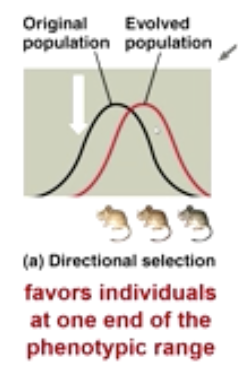
Directional Selection/Mode of Selection
favors individuals at one end of the phenotypic range
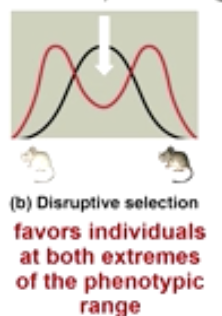
Disruptive Selection
favors individuals at both extremes of the phenotypic range.
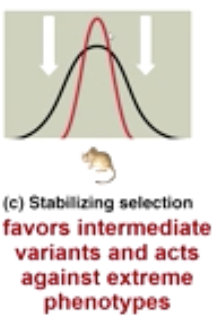
Stabilizing Selection
Favors intermediate variants and acts against extreme phenotypes
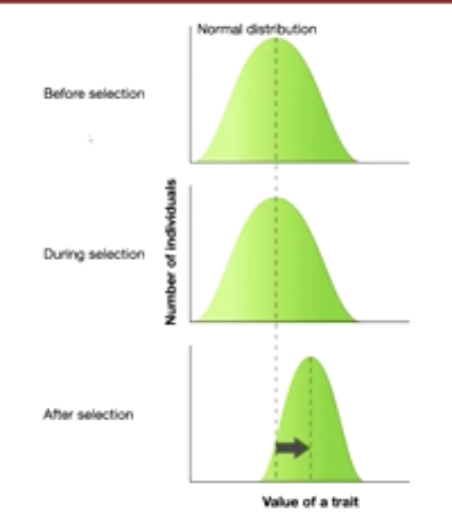
Directional selection causes
change in the mean value of a character in a population that is either higher or lower than its current mean value which results in a shift in the plot of trait frequency
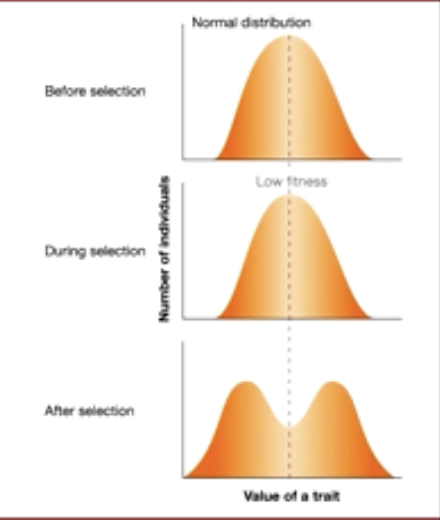
Disruptive selection
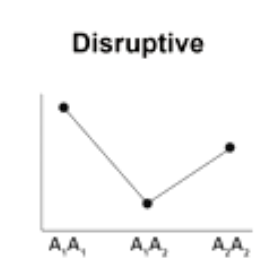
increases variation by favoring extreme phenotypic values even if the mean of the distribution does not change; two peaks
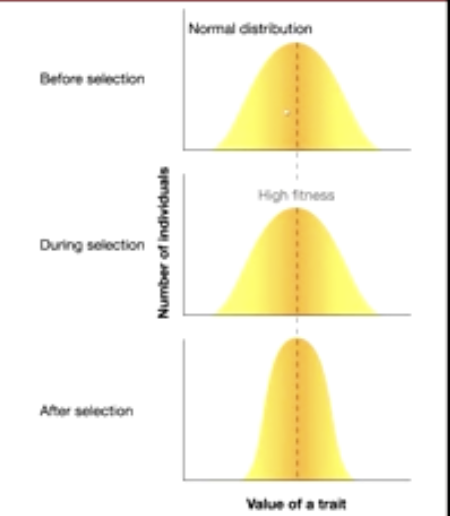
Stabilizing selection
decreases variation and stabilizes the mean of trait in a population around a particular usually optimal value
1977 drought causes
large hard seeds in Galapagos islands and as a result individuals with longer and harder beaks to survive and reproduce. EXAMPLE OF DIRECTIONAL SELECTION
Example of Stabilizing Selection
Lowest death rate of fetuses occurs at exactly at 40 weeks of gestation which is when birth of child usually occurs.
Struggle for existence and survival of the fittest
are commonly used t describe natural selection but can be misleading.
Fitness is
the contribution an individual makes to the gene pool of the next generation
Relative fitness (W)
The contribution of a genotype to the next generation compared with contributions of alternative genotypes for the same locus. Basically the most fit genotype in a population W=1
Selection coefficient (s)
a measure of the relative intensity of selection against a given genotype
s=1-W
In the case where the A1 allele is dominant
natural selection will quickly increase its frequency but then start there for a long time
In case where the A1 allele is recessive
and the A2 deleterious allele is dominant, then selection will take a long time to increase the frequency of the A1 allele in the population because most of the copies of the A1 allele are hiding in heterozygotes and since heterozygotes have the deleterious phenotype they are removed by selection so it takes a very long time for selection to act but once it does it does quickly and fixes the frequency of the A1 allele
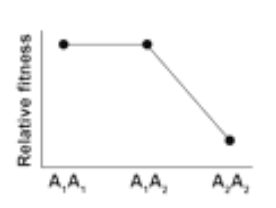
Directional Selection Fitness
W11=W12> W22
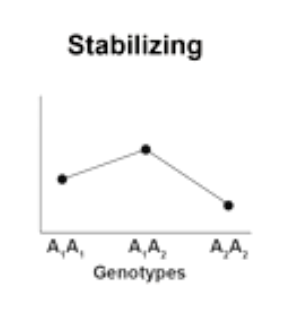
Stabilizing Selection Fitness
W11<W12> W22
Disruptive Selection Fitness
W11>W12<W22
Heterozygote Advantage (over dominance)
Heterozygotes have greater fitness than homozygotes and results in a balanced polymorphism
Heterozygote disadvantage (under dominance)
heterozygote has lower fitness than either homozygote
What only results in adaptive evolution?
Natural Selection of Evolutionary forces
Industrial Melanism
The peppered moth- classic study in the development of the theory of natural selection and evolution
typica → light, peppered, recessive
carbonaria → dark, melanic, dominant
How do you arrive at the genotype frequencies of the next generation?
We divide by the mean fitness of the population —-w
What are the effects of natural selection on HWE?
-Selection can cause allele frequencies to change from one generation to the next
-Selection can cause deviation from HW genotype frequencies
-Selection is deterministic (predictable). Selection will attempt to remove the deleterious allele from the population
-Selection can be a strong evolutionary force (compared to mutation) by changing allele frequencies from generation to generation
What were the postulates of Darwin in evolution by Natural Selection?
-Individuals vary
-At least some variation is heritable
-Some individuals leave more progeny than others due to the fit of some variants being better than others in the environment t
-The variation in survival and reproduction is not random but depends on heritable trait variation '
Outcome: Genetic variants with greater survival/reproduction increase in frequency in the population
What preserves genetic variation in natural populations?
-Much of the variation observed in generations is due to the combined action of mutation and genetic drift NOT selection
-Diploidy maintains genetic variation in the form of recessive alleles hidden from selection in heterozygotes. Diploidy masks deleterious alleles
Balancing selection examples
Heterozygote advantage
Frequency dependent selection
Balancing selection
occurs when natural selection maintains stable frequencies of two or more phenotypic forms in a population leading to a state called balanced polymorphism
Heterozygote Advanatge
Individuals who are heterozygotes at a particular locus have a greater fitness than homozygotes.
Natural selection will maintain two or more alleles at that locus when heterozygote advantage occurs.
Frequency Dependent Selection
The fitness of any morph declines if it becomes too common in th population
Example: prey species come to expect attacks in the direction that the majority of the scale eaters attack from at any given time
Natural Selection summary
-Natural Selection is differential success in reproduction from interaction between individuals that vary in heritable traits and their environments
-Natural Selection produces an increase over time in adaption of organisms to their environment
-If an environment changes over time then natural selection may result in adaptations to these new conditions
Natural Selection does not imply perfection
1.Selection can only act on existing variation
2.Evolution is limited by historical constraints
3. Adaptations are often comprises for instance the sickle cell allele confers resistance to malaria but then causes a weak immune system
4.Chance, natural selection and enviornwmnt interact and give rise to the variation that we observe
Sexual Selection
Natural Selection for mating success
What does sexual selection cause?
Sexual Dimorphism
Sexual Dimorphism
Marked Differences between the sexes in secondary sexual characteristics
What are the two types of sexual selection?
Intrasexual Selection
Intersexual Selection
Intrasexual Selection
direct competition among individuals of one sex (often males) for mates of the opposite sex
Example: male southern elephant seals fighting for the right to mate
Male stalk eyed flies face off for female attention
Intersexual Selection
often called mate choice; occurs when individuals of one sex (often females) are choosy in selecting their mates
Example: which male has the fanciest tail in peacocks will be chosen by females