Speciation - level 3
0.0(0)
Studied by 0 people Call Kai
 Learn
Learn Practice Test
 Spaced Repetition
 Match
Match Flashcards
 Knowt Play
Card Sorting
1/91

Earn XP
Description and Tags
Last updated 9:36 PM on 11/15/22
Name | Mastery | Learn | Test | Matching | Spaced | Call with Kai |
|---|
No analytics yet
Send a link to your students to track their progress
92 Terms
1
New cards
Evidence for evolution
-fossils
-homologous structures
-analogous structures
-vestigial structures
-biogeography
-genetic analysis
-homologous structures
-analogous structures
-vestigial structures
-biogeography
-genetic analysis
2
New cards
Parallel evolution
When two or more related groups evolve among similar lines. just independently from one another.
3
New cards
Coevolution
In which a feature of one speices acts as a selection pressure for another species.
4
New cards
What is the importance of genetic variation?
It increases the chance that some individuals will have an allele or trait suited to a change in environment or selection pressure, increasing the chance of survival of the population.
5
New cards
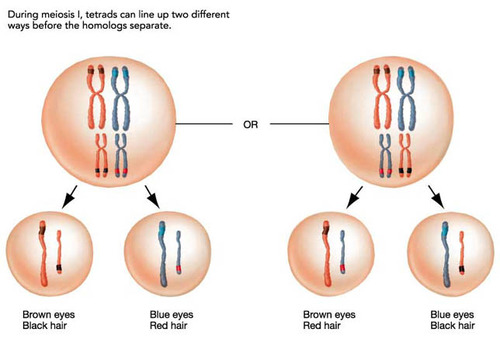
Independent assortment
occurs during metaphase 1 and is when the chromosomes line up randomly along the equator of the cell so the chromosomes are randomly divide in anaphase 1.
6
New cards
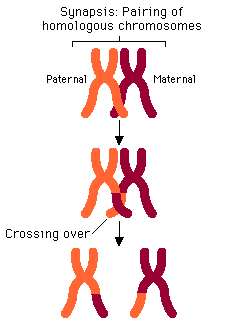
Crossing over
When chromosomes exchange segments of dna at a locus, resulting in a new combination of alleles on each chromatid - occurs during prophase 1.
7
New cards
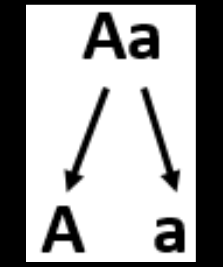
Segregation
When the chromosomes line up randomly, single file and the chromatids separate randomly so that each gamete receives a single copy of each allele, resulting in unique allele combinations.
8
New cards
Define mutation and explain its importance
a permanent change in the base sequence of DNA.
A mutation is the only form of new alleles.
mutations are the only form of variation which can occur during mitosis.
A mutation is the only form of new alleles.
mutations are the only form of variation which can occur during mitosis.
9
New cards
Harmful mutation
mutation results in a trait which prevents reproduction and/or survival until reproductive age. the mutation will be selected against and will be less likely to be established in the gene pool.
10
New cards
Silent mutation
Provides neither an advantage or disadvantage towards survival or reproduction.
11
New cards
Beneficial mutation
Mutation results in a trait which will increase chance of survival or reproduction so will be selected for and trait will have an increased presents in the gene pool over many generations.
12
New cards
Gene flow
Is the change in allele type and frequency within a population over time.
13
New cards
Genetic drift
Describes the change in allele frequency or allele type due to chance events rather than selection pressures.
14
New cards
Founder effect
Occurs when a small number of individuals emigrate from a population or become geographically isolated from their original population.
15
New cards
Bottleneck effect
When a population's numbers decline drastically due to a random catastrophic event.
16
New cards
What are the effects of a genetic drift?
- bottleneck and founder effect
- bottleneck and founder effect
So the allele type and frequency likely differ from the orintifal population/ the remaining population is not representative of the whole population's alleles .
- reduction in genetic diversity.
- reduction in genetic diversity.
17
New cards
Natural selection
Natural selection occurs when populations are subject to selection pressures. The organism which contains the most favourable allele are more likely to:
- Survive to reproductive age
- Finding a mate and producing offspring → passing on their favourable alleles.
- Survive to reproductive age
- Finding a mate and producing offspring → passing on their favourable alleles.
18
New cards
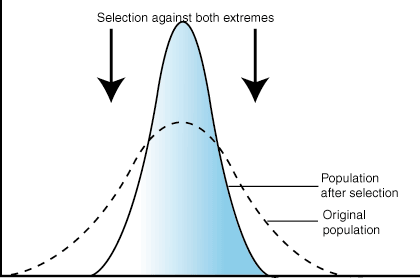
Stabilizing selection
When selective pressure selects against the two extremes of a trait, the median phenotypes become more common.
19
New cards
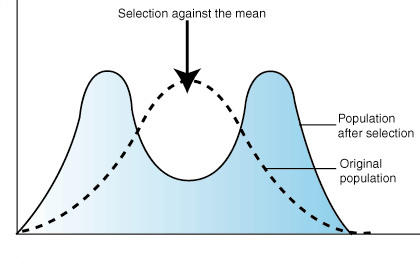
Disruptive selection
When the selection pressure favours parents at opposite extremes of the rait. Intermediate phenotypes are selected against.
20
New cards
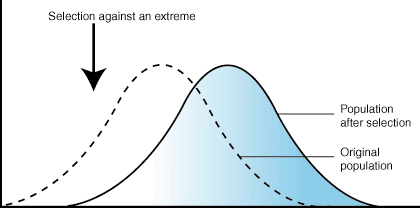
Directional selection
When selective pressure selects against one extreme of the traint, the populations traint distribution shifts towards the other extreme
21
New cards
Dimorphism
When male and females display different physical traits.
- These traits may appear disadvantageous as they make the animals more visible to predators, hinder movements and are energy intensive to grow and maintal so it would be thought that these traits would be naturally selected against.However these traits increase an individual's ability to reproduce
- These traits may appear disadvantageous as they make the animals more visible to predators, hinder movements and are energy intensive to grow and maintal so it would be thought that these traits would be naturally selected against.However these traits increase an individual's ability to reproduce
22
New cards
Species
A group of individuals that are able to successfully interbreed and produce fertile offspring, and are reproductively isolated from other species.
23
New cards
Evolution
Evolution is an umbrella word which describes a population's selection for or against specific alleles over time in response to a changing environment.
24
New cards
Cline
Is a pattern of gradual variation between individuals over a geographical area, usually as a result of environmental differences.
25
New cards
Population
Is a group of organisms of a single species, living in the same geographical area.
26
New cards
Deme
Is a subset of a population that has limited gene flow with members of the larger population.
27
New cards
Ring species
When individuals on each end of a cline are unable to breed, however neigbouring clines are able to interbreed allowing gene flow to occur between the whole population.
28
New cards
Speciation
The formation of a new species.
29
New cards
RIM's
Reproductive isolation mechanisms (RMS's) are barriers that prevent one member of a species from mating with different species.
30
New cards
Decribe prezygotic RIM's
- acronym
- acronym
Occur before the egg is fertilized.
- 6 different types (EGG BMT)
- 6 different types (EGG BMT)
31
New cards
Geographical isolation
Species occur in different areas with no geographical overlap.
32
New cards
Ecological isolation
species occupy different habitats within the same area.
33
New cards
Behavioural isolation
Different courtship rituals, sounds, calls or colouration
34
New cards
Temporal isolation
Activity, mating or flowering occurs at different time of the day, month or year
35
New cards
Mechanical isolation
Reproductive structures are incompatible nd prevent the delivery or acceptance of gametes
36
New cards
Gametic isolation
Gametes are incompatible and unable to fuse and produce a viable zygote.
37
New cards
Postzygotic RIM's
- acronym
- acronym
If two species manage to overcome prezygotic isolating mechanisms there are many RIM which occur after a zygote has formed.
- h BIS
- h BIS
38
New cards
hybrid breakdown
Hybrids may be viable, fertile and capable of producing offspring.
- There offspring have extreme genetic abnormalities
- Offspring has reduced fitness and fertility
- There offspring have extreme genetic abnormalities
- Offspring has reduced fitness and fertility
39
New cards
Hybrid inviability
The hybrid embryos are often not viable because the genes of the two species are incompatible.
- The hybrid dies
- Or the hybrid does not reach reproductive age.
- The hybrid dies
- Or the hybrid does not reach reproductive age.
40
New cards
Hybrid sterility
Hybrid offspring that do survive birth and reach sexual maturity
- are sterile so cannot produce gametes.
- are sterile so cannot produce gametes.
41
New cards
Allopatric speciation
Occurs when two populations become geographically isolated from each other. Continued geographical isolation may lead to reproductive isolation and perhaps ultimately the formation of a new species (speciation).
- Geographical isolation
- Gene pool
- Behavioral isolation
- Reproductive isolation
- Competition
- Geographical isolation
- Gene pool
- Behavioral isolation
- Reproductive isolation
- Competition
42
New cards
Sympatric speciation
Is the formation of a new species without geographical isolation. The new species become reproductively isolated even though they are surrounded by their parent population.
- Occurs mostly in plants through polyploidy.
- may occur in animals to reduce intraspecific competition within a population.
- Occurs mostly in plants through polyploidy.
- may occur in animals to reduce intraspecific competition within a population.
43
New cards
What results in instant speciation?
Polyploidy
44
New cards
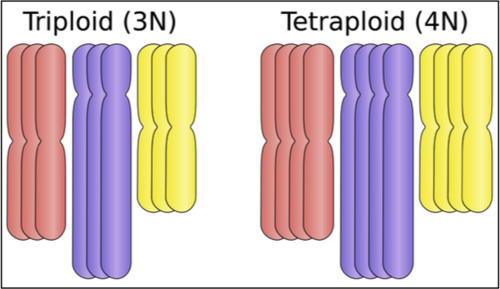
Polyploidy
Is caused by errors during cell division that result in the cell having more than two copies of each chromosome (>2n). The resulting organism is genetically and thus reproductively unique (creating a new species).
- However this is not necessary a problem in plant species because they can carry both male and female sex organs and can thus reproduce through self fertilization.
- However this is not necessary a problem in plant species because they can carry both male and female sex organs and can thus reproduce through self fertilization.
45
New cards
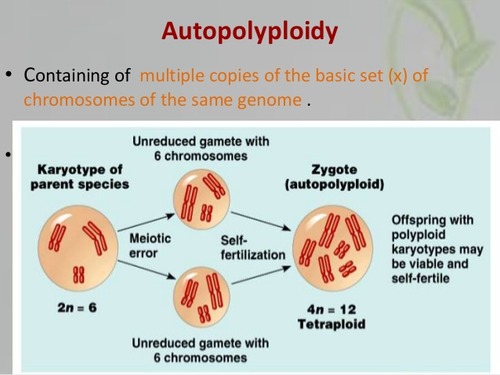
Autopolyploidy
Occurs when the spindle fibers fail to separate (nondisjunction) during anaphase 1 resulting in non-reduced diploid gametes instead of haploid games.
- If these diploid gametes fuse with a normal haploid gamete during fertilization, the result will be a triploid organism (3 sets of chromosomes).
- If the diploid gamete fuses with another diploid gamete (potentially self fertilization) the resulting zygote will be tetraploid.
- If these diploid gametes fuse with a normal haploid gamete during fertilization, the result will be a triploid organism (3 sets of chromosomes).
- If the diploid gamete fuses with another diploid gamete (potentially self fertilization) the resulting zygote will be tetraploid.
46
New cards
Allopolyploid
Is the process where two different species produce an infertile hybrid. The two parent chromosomes are not identical.
Typically non identical chromosomes cannot pair up during meiosis. As a result the hybrids are sterile.
However if the germinal cells in the new hybrid species undergo chromosome doubling (autopolyploidy) then the meiosis can occur usually.
- When this happens the hybrid species will be able to produce fertile gametes that obtain chromosomes from both paternal species.
Typically non identical chromosomes cannot pair up during meiosis. As a result the hybrids are sterile.
However if the germinal cells in the new hybrid species undergo chromosome doubling (autopolyploidy) then the meiosis can occur usually.
- When this happens the hybrid species will be able to produce fertile gametes that obtain chromosomes from both paternal species.
47
New cards
Aneupolyploidy
Is the process where an individual inherits one, two or less chromosome/s. This mechanism is usually the result of a failure of chromosomes to seperate(Non-disjuction)
during meiosis.
Most individuals are infertile because the chromosomes are unable to pair properly during meiosis.
during meiosis.
Most individuals are infertile because the chromosomes are unable to pair properly during meiosis.
48
New cards
Genome duplication
an event which creates an organism with additional copies of the genome or set of all DNA.
-Aneupolyploidy can be overcome by genome duplication, enabling individuals to become fertile.
-Aneupolyploidy can be overcome by genome duplication, enabling individuals to become fertile.
49
New cards
Non-disjuction
a failure of chromosome pairs to separate properly during cell division resulting in an imbalance of chromosomes in daughter cells
50
New cards
Monosomy
Chromosomal abnormality consisting of the absence of one chromosome from the normal diploid number
51
New cards
Trisomy
a condition in which an extra copy of a chromosome is present in the cell nuclei, causing developmental abnormalities.
52
New cards
Advantages of polyploidy
- More chromosomes so larger cell nuclei → larger cells → larger leaves, stems, fruits, flowers etc.
- May allow plants to grow in a wider array of habitats and be more resistant to pests and diseases
- May allow plants to grow in a wider array of habitats and be more resistant to pests and diseases
53
New cards
Disadvantages of polyploidy
- If a plant contains an uneven number of chromosomes they will be sterile, so resulting fruits will be seedless.
54
New cards
Evidence of evolution acronym
Fossil Evidence
Biogeography (species distribution)
Comparative anatomy
Comparative embryology
Genetic Evidence
Biochemical Evidence
Biogeography (species distribution)
Comparative anatomy
Comparative embryology
Genetic Evidence
Biochemical Evidence
55
New cards
Genetic evidence
Comparison of genetic sequences between two species.
56
New cards
Biochemical evidence
Comparison of the amino acid sequence or protein structure between two species.
57
New cards
Comparative embryology
Is the comparison of embryos between different species.
58
New cards
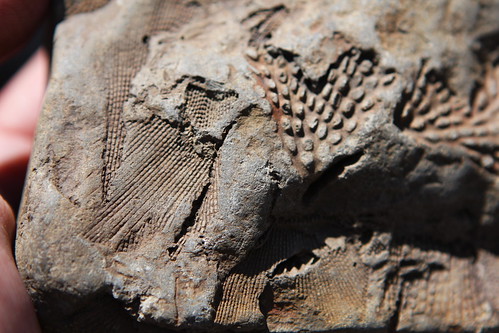
Fossils
Are the preserved remains of organisms which have been buried in sediment and imprinted into casts or molds.
59
New cards
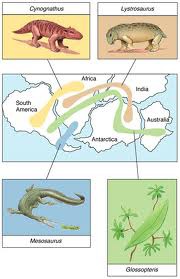
Biogeography
The study of the geographic distribution of species across the planet and through geological time shows a distinctive pattern.
60
New cards
Comparative anatomy
Is the comparison of body structures in different species
61
New cards
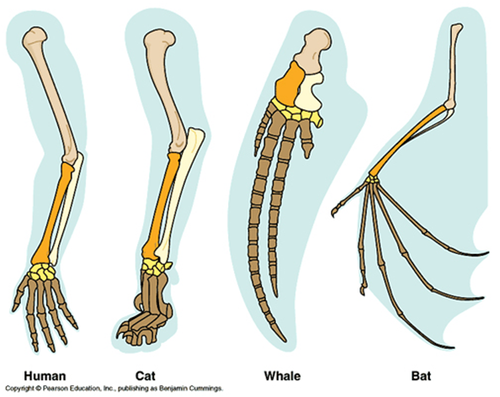
homologous structures
- Occurs through the evolution of species into many other species
- The ancestral and modern species will have similar structures but these structures may take on different functions/ adapted for a different purpose for different species to suit their specific selection pressures.
- The ancestral and modern species will have similar structures but these structures may take on different functions/ adapted for a different purpose for different species to suit their specific selection pressures.
62
New cards
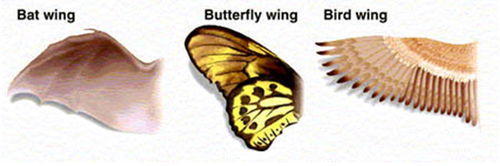
Analogus structures
Describes how unrelated species may have similar traits or functions even when they are not from the same heritage. Analogous structures evolve because the species will have similar selection pressures and fill - similar ecological roles.
Similar selection pressures → The same adaptations are favoured → beneficial adaptations have survival advantage.
- May indicate convergent evolution
Similar selection pressures → The same adaptations are favoured → beneficial adaptations have survival advantage.
- May indicate convergent evolution
63
New cards
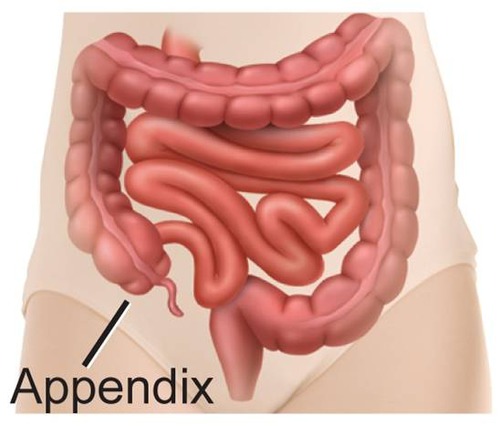
Vestigal structures
Decibels tissues, bones or organs which are functionless to an organism. These structures are the remains of features that served an important function in ancestral species.
64
New cards
Nucleotide sequence
Includes analysis and comparison of the nucleotide sequence of a particular gene. The number of differences (mutations) can be considered a measure of time.
- If the nucleotides of two species are very different from one another (they contain my mutations) it is likely that they did not share a recent common ancestor because mutations take a long time to accumulate.
- If two species have a very similar nucleotide sequence for the same gene then it is likely that they shared a recent common ancestor.
- If the nucleotides of two species are very different from one another (they contain my mutations) it is likely that they did not share a recent common ancestor because mutations take a long time to accumulate.
- If two species have a very similar nucleotide sequence for the same gene then it is likely that they shared a recent common ancestor.
65
New cards
mtDNA analysis
Mitrondra contains their own DNA; since mitochondria are found outside of the nucleus, they are not subject to meiosis.
- The only form of genetic variation of mDNA is through mutations.
- Mutations accumulate at a fairly constant rate
- Thus the number of mutations present in the mtDNA is proportional to the time since divergence of the two organisms.
-Sperm cells do not pass on any mtDNA so all mtDNA passed onto sons or daughters comes from the ovum.
- The only form of genetic variation of mDNA is through mutations.
- Mutations accumulate at a fairly constant rate
- Thus the number of mutations present in the mtDNA is proportional to the time since divergence of the two organisms.
-Sperm cells do not pass on any mtDNA so all mtDNA passed onto sons or daughters comes from the ovum.
66
New cards
Y chromosome
Due to the difference in size between the y and the x chromosomes, during meiosis t can only exchange alleles from the very tips (pseudoautosomal regions) of the chromosome
- 95% of the Y chromosome is conserved and passed on from father to son
- Any changes that occur are due to mutations which occur at a consistent rate and can be traced back to their origin.
- 95% of the Y chromosome is conserved and passed on from father to son
- Any changes that occur are due to mutations which occur at a consistent rate and can be traced back to their origin.
67
New cards
Divergent evolution
An ancestral population divided into two or more increasingly distinct species
- Occurs when gene flow between populations is blocked resulting in the accumulation of different characteristics though natural selection
- Homologous structures are evidence for divergent evolution
- Occurs when gene flow between populations is blocked resulting in the accumulation of different characteristics though natural selection
- Homologous structures are evidence for divergent evolution
68
New cards
adaptive radiation
Is a type of divergent evolution which describes the process of a large number of new species evolving in a relatively short amount of time from a common ancestor.
- Usually occurs following a major tectonic process, natural disaster, extension events or colonisation of a new unexplored habitat.
- As new neiches become available the population adapts to fill the new habitat and poteintaily form new species.
- Usually occurs following a major tectonic process, natural disaster, extension events or colonisation of a new unexplored habitat.
- As new neiches become available the population adapts to fill the new habitat and poteintaily form new species.
69
New cards
convergent evolution
Similar traits arise in two or more unrelated species.
- Occurs because the species are reacting to similar selection pressures. These similar niches which they fill in their uiue environment cause similar problems requiring similar solutions
- Analogous structures are evidence of convergent evolution.
- Occurs because the species are reacting to similar selection pressures. These similar niches which they fill in their uiue environment cause similar problems requiring similar solutions
- Analogous structures are evidence of convergent evolution.
70
New cards
Coevolution
Describes an evolutionary relationship between unrelated species which occupy the same environment but different niches in that environment.
- One species develops an adaptive advantage → acts as a selection pressure against another species → triggering the other species to naturally select for another charistic which reduces the effect of the selection pressure → this change may then cause another evolutionary change in species 1.
- This relationship can also be mutualistic where the two species benefit from the relationship.
- One species develops an adaptive advantage → acts as a selection pressure against another species → triggering the other species to naturally select for another charistic which reduces the effect of the selection pressure → this change may then cause another evolutionary change in species 1.
- This relationship can also be mutualistic where the two species benefit from the relationship.
71
New cards
gradualism (rate of speciation)
When evolutionary change occurs gradually over a long period of time.
- Accumulation of change due to natural selection, at a fairly constant rate until the species is considered a unique species.
- Fossil records contain many transitional forms.
- Accumulation of change due to natural selection, at a fairly constant rate until the species is considered a unique species.
- Fossil records contain many transitional forms.
72
New cards
puncuated equilibrium (rate of speciation)
When evolutionary change occur rapidly
Species are 'punctuated' by periods of rapid evolution after long periods of relative stability.
- Occurs as a result of a rapidly changing environment where new niches are created or populations become geographically or reproductively isolated
- The sudden appearance of species in the fossil record would support this.
Species are 'punctuated' by periods of rapid evolution after long periods of relative stability.
- Occurs as a result of a rapidly changing environment where new niches are created or populations become geographically or reproductively isolated
- The sudden appearance of species in the fossil record would support this.
73
New cards
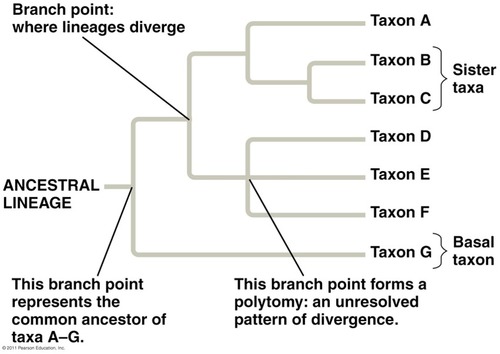
Phylogenetic tree
Diagram that depicts the lines of evolutionary descent of different species, organisms, or genes from a common ancestor.
74
New cards
Genetic distance
Measure of the genetic divergence between species or between populations within a species.
75
New cards
Immigration
When new individuals enter the population.
76
New cards
Emigration
When individuals leave the population.
77
New cards
Gene pool
A gene pool is the sum total of the genes (and their alleles) present in a population.
78
New cards
Allele frequency
A measure of how common a certain allele is in the population.
79
New cards
Genetic equilibrium and factors that affect allele frequency
• Genetic Drift
• Natural Selection
• Artificial Selection
• Sexual Selection
• Gene Flow (Immigration & Emigration)
• Mutations
• Founder Effect
• Population Bottlenecks
• Natural Selection
• Artificial Selection
• Sexual Selection
• Gene Flow (Immigration & Emigration)
• Mutations
• Founder Effect
• Population Bottlenecks
80
New cards
Artifical selection
Selection by humans for breeding of useful traits from the natural variation among different organisms
81
New cards
Sexual selection
A form of natural selection in which individuals with certain inherited characteristics are more likely than other individuals to obtain mates.
82
New cards
Mutations
Random errors in gene replication that lead to a change in the sequence of DNA. Has the potential to lose function/characteristic.
83
New cards
Selection pressures
Are external agents which affect an organism's ability to survive in a given environment. Selection pressures can be negative (decreases the occurrence of a trait) or positive (increases the proportion of a trait)
84
New cards
Sexual demorphism
the distinction in appearance of male and female organisms. Can be size differance, adornment, color etc.
85
New cards
Inbreeding
A selective breeding method in which two individuals with identical or similar sets of alleles are crossed.(Offspring has the potential to be affected by a recessive disorder)
86
New cards
Variation
Variation in the features (phenotypes) of individuals within a population is the result of both genetic and environmental influences.
87
New cards
Non-heritable variation
This variation is responsible for any acquired differences in the phenotypes of individuals in a population. These differences are usually the result of environmental influences or the actions of individuals.
88
New cards
What is an advatage of genetic variation?
Individuals are better adapted to their environment than others. Others who are less adapted are less likely to survive and reproduce, leading to speciation---evolution.
89
New cards
What are the different types of environmental changes?
Changes in climate
The introduction of a new predator
Changes in prey / availability of different food sources
Disease (the emergence of a new disease or strain)
The introduction of a new predator
Changes in prey / availability of different food sources
Disease (the emergence of a new disease or strain)
90
New cards
What are key points to evolution?
-Evolution does not occur within a single generation. No individuals can "adapt" to their environment.
-Only large groups (populations) can evolve adaptations over long periods of time (many generations).
-No one can chose or try to adapt. It's purely up to chance whether or not an individual has inherited a combination of adaptations that will help them survive and reproduce.
-Only large groups (populations) can evolve adaptations over long periods of time (many generations).
-No one can chose or try to adapt. It's purely up to chance whether or not an individual has inherited a combination of adaptations that will help them survive and reproduce.
91
New cards
Instant speciation
Is the production of a single individual (or the offspring of a single mating) that is reproductively isolated from the species to which the parental stock belongs and that is reproductively and ecologically capable of establishing a new species population.
92
New cards
Selection pressure
When environmental factors such as predation, herbivorism .etc. affect the survival of a species.