exam four
 Call Kai
 Learn
Learn Practice Test
 Spaced Repetition
 Match
Match Flashcards
 Knowt Play
1/63

There's no tags or description
Looks like no tags are added yet.
Name | Mastery | Learn | Test | Matching | Spaced | Call with Kai |
|---|
No analytics yet
Send a link to your students to track their progress
64 Terms
vertebrates possess the folllowing characteristsics
Four-chambered heart, Endothermic and homeothermic, Hair. Mammary glands, Heterodont teeth, Three inner ear bones
Endothermy
the ability to generate metabolic heat independent of the outside environment
Homeothermy
refers to the ability to maintain a constant body temperature
mammary glands
produce milk to feed young offspring
hair is used for
insulation, protection, comouflage, communication
what group is thought to be the ancestors of mammals
cynodonts
monotremes (prototheria)
platypus and echidnas, egg-laying mammals, lack teeth, spurs on hind limbs
marsupials (metatheria)
opposums, kangaroos, koalas, wombats, etc., short gestation; fetal birth, development within pouch, yolk-sac placenta
placental mammals (eutheria)
wide range of adaptations for burrowing, flying, swimming, hunting, running, and climbing, long gestation; development within complex placenta, gestation inside of uterus
Monotreme Reproduction
leathery egg shells, platypuses lay 1-3 eggs, echidnas lay a single egg, retain eggs about two-thirds of developmental perod and then lay them in nests, babies hatch in fetal stage and complete development in nest
Monotremes: Platypus
leathery “duck bill”, paddle-like tail, webbed feet, auatice, constructs nest burrows in banks of rivers, males with venemous spur on hind limb, used in mle-male combat over mates
Monotremes: Echidnas
covered with coarse hair and keratinized spines, long slender snout with small mouth, eats earthworms, ants, termites, etc.
Chorioallantoic placenta
a large chorion tissue fused with a large allantois; interfaces maternal and embryonic tissues
evolutonary advantages of a Chorioallantoic placenta
increases size and development of young at birthm reduces “helpless period”, reduces dependence on natal sites such as dens and burrows
Proboscidea - Elephants
largest land mammals ever, three living species, most of this diverse group is extinct, ecosystem engineers
Sirenia
manatees, dugongs, sea cows, fully aquatic (both freshwater and marine, herbivorous, four living species
Xenathra
ateaters, sloths, and armadillos, unique limb and vetevral joints, bone structure, and teeth, extinct ground sloths
Lagomorpha
rabbits, hares, and pikas, 109 living species, four incisors in upper jaw
Rodentia
rodents, 40% of all mammal species, single pair of continuously growing incisors in each of the upper and lower jaw
Odd-toed ungulates
rhinoceroses, tapirs, horses, larger herbivores that hav reduced weight-bearing toes to 3 or 1
Even-toed ungulates
pigs, peccaries, hippopotamuses, antelopes, deer, giraffes, camels, llamas, alpacas, sheep, goats, cattle, Large herbivores that have reduced weight-bearing toes to 2 (hooves)
Even-toed ungulates - Cetaceans
whales and dolphins, evolved from common ancestor with hippos, fully aquatic, large streamlined bodies, includes the largest animal ever known to have existed (blue whale)
Carnivora
dogs, cats, bears, seals, otters, skunks, etc., diverse group specialized for eating other animals, carnasial teeth
Chiroptera
Bats, forelimbs adapted for sustained flight, highly developed echolocation system used for hunting and navigation
Primate Characteristics
large brains, increased reliance on sight, color vision, decreased reliance on smell, use of tools, highly developed social behaviors
prosimians
lemurs, lorises, bush babies, pottos, mostly nocturnal, large olfactory centers in the brain than anthropoids, smaller size and smaller brain than anthropoids
monkeys
mostly diurnal, rely on vision more than smell, new world monkeys: broad noses, prehnsile tails, old world monkeys: narrow downward-pointed noses, no prehensile tails
apes
tailess, large-bodied, high brain-body size ratio
Australopithecus afarensis
longest existing and best known fossil hominids, bipedal footprint trails, small canine teeth, long strong arms, apelike face
Paranthropus
cousins, short stout bodies, skulls adapted for chewing, large chewing muscles, large molars
Homo habilis
first early homo species to use stone tools, walk on the ground on two legs, had arched feet, elongate arms
Homo erectus
“upright man”, oldest known early humans to have modern human-like body proportions, first species to widely expand its range out of africa, use of tools, hearths for cooking, evidence of care for old/weak
Archaic Humans
recent human evolution very complex, multiple closely related species that inbred repeatedly
Modern Humans
Genetic evidence indicates that modern
humans shared a single common ancestor in
east Africa
biosphere
all of the parts of Earth inhabited by life
biomes
large areas of habitat with similar climate, flora, and fauna
Temperate Forests
Deciduous trees are those that lose their leaves in Fall and Winter, Cool, moist winters, Warm, moist summers, Dominant habitat of eastern USA, Pennsylvania = “Penn’s Forest Land”
Boreal Forest/Taiga
World’s largest terrestrial biome, Mostly evergreen forest, dominated by spruce, fir, and pines, 29% of all forest cover on earth, Short, cool, wet summers, Long, cold, wet winters, short growing season
Tropical Rainforests
Evergreen wet forests between the Tropics of Cancer and Capricorn, highest biodiversity of any terrestrial biome, 21% of all forest cover on earth, Warm all year, Wet all year, Low soil fertility
Grasslands
Grasslands and prairies in temperate zones, Warm, wet summers, Cold, dry winters
Savannas
Tropical grasslands with sparse trees, Hot, wet summers, Warm, dry winters
Deserts
Cool to mild winters, Warm to hot summers, Dry all year, Often extreme day-night temperature variation
Tundra
Arctic grasslands with permafrost layer, Permafrost – Permanently
frozen soils, Cold all year, Short, wet summers, Long, dry winters
Aquatic Biomes
Oceans make up 71% of the entire surface area of the Earth, Aquatic Biomes are separated into marine (salt-water, ocean-associated) and freshwater (associated with lakes and streams)
Abiotic Factors Influencing Aquatic Biomes
energy sources, temperature, type and changes in water, nutrients and inorganic materials
Estuaries
the areas where rivers meet the ocean, Mangroves are salt-tolerant trees that line estuaries and tidal areas in the tropics, Nutrient-rich and highly productive, Physiologically challenging for inhabitants, Critical habitat for coastal flood protection (ecosystem service value)
Coral Reefs
Ridges in photic zone created by Cnidarians (corals) and Molluscs, High biodiversity- “Rainforests of the ocean”, Provide critical habitat for thousands of species, Nursery areas for larger ocean-going species
Pelagic Realm
Largest of earth’s biomes, due to volume, The entire ocean other than the coast and the ocean floor (the benthic zone), The average depth of the ocean is ~2.5 miles
Freshwater Biomes
Includes lentic (standing water) and lotic (flowing water) ecosystems, Lakes, ponds, rivers, streams, wetlands
Freshwater Lotic Systems
Flowing freshwater systems – streams, creeks, rivers, Uni-directional flow, Constant physical change, Variety of microhabitats (pools, riffles, large rocks, gravel beds, etc)
Freshwater Lentic Systems
Standing water systems (ponds, lakes, wetlands), Can be permanent or seasonal/temporary (vernal pools and ephemeral ponds)
What are the six characteristics that distinguish mammals from other vertebrates. Provide a description of each characteristic and include details of each.
Four-chambered heart: allowing for high metabolic rates by ensuring oxygenated blood is effectively delivered to the body
Endothermic and homeothermic: create and store their own heat
Hair: used for insulation, protection, camouflage, and communication
Mammary glands: produce milk to feed young offspring
Heterodont teeth: speciealized teeth with varying shapes for different functions
Three inner ear bones: Malleus, incus, stapes, Derived from two small jaw bones
Compare and contrast reproduction in the three major groups of mammals (monotremes, marsupials, and eutherians). Include details of the young at birth, development, and type of placenta in each group.
Monotremes: egg-laying mammals, leathery egg shells, yolk-sac placenta, hatch in fetal state and complete development in nest
Marsupials: short gestation; fetal birth, development within pouch, yolk-sac placenta but no egg shell
Placental mammals: long gestation; development inside of uterus within complex placenta that connects fetus to mother
Which group of mammals contains some of the largest land animals ever to live?
Proboscidea
What group of animals includes the largest animals to have ever lived (and is alive today)?
Even-toed ungulates - cetaceans
_____________ is the group that includes the only species of venomous mammal.
Monotremes
Which group of mammals has a single pair of continuously growing incisors in each of the upper and lower jaws, which it has to constantly chew and gnaw with to keep from overgrowing?
Rodentia
Which group of mammals has four incisors in their upper jaw, with the second pair growing behind the first and referred to as "peg teeth"?
Lagomorpha
What are six shared characteristics of primates that differentiate them from other mammals?
rotating shoulder joint, big toe and thumbs widely separated from other toes and fingers, stereoscopic vision, brains larger than most other mammals, claws modified into flattened nails, typically only one offspring per pregnancy
What are Prosimians? What are three ways they differ from Anthropoid primates?
they are Lemurs, lorises, bush babies, pottos
1) Mostly nocturnal
2) larger olfactory centers in the brain than anthropoids
3) smaller size and smaller brain than anthropoids
List the four genera of living great apes.
Genus Pan, Genus Gorilla, Genus Pongo, Genus Homo
In your own concise words, describe the evolutionary history of our species (Homo sapiens) since our lineage diverged from the last common ancestor with the Pan lineage ~6 million years ago. Include mention of Australopithecus afarensis, Paranthropus, Homo habilis, Homo erectus, and archaic humans.
6 million years ago, the human lineage split from the ancestors of chimpanzees. Early hominins like Australopithecus afarensis were bipedal with small brains; later, Paranthropus evolved specialized chewing traits and went extinct. Homo habilis showed early tool use, followed by Homo erectus, which had human-like body proportions and spread out of Africa. Archaic humans evolved from these populations, interbred repeatedly, leading to modern Homo sapiens.
What two abiotic factors shape the distribution and extent of terrestrial biomes on Earth?
annual mean temperature and annual mean precipitation
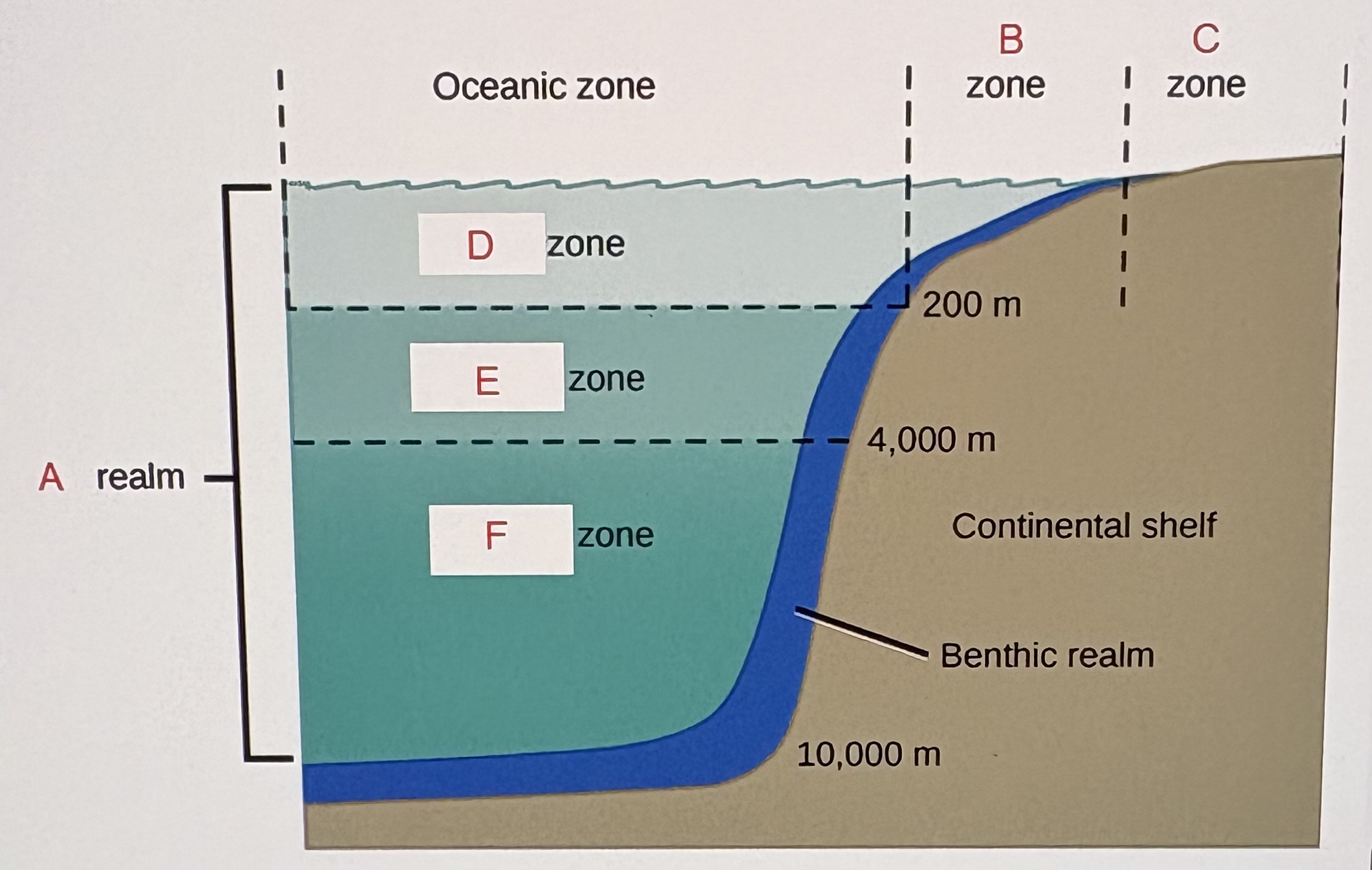
Label and briefly define each of the six oceanic biomes in the above diagram.
A: Pelagic Realm - the open ocean
B: Neritic Zone – From intertidal zone to edge of continental shelf, where waters are <200 m deep
C: Intertidal Zone – zone between low and high tide
D: Photic zone – part of pelagic zone where light penetrates (to about 200 m)
E: Aphotic zone – part of pelagic zone where no light penetrates (below about 200 m)
F: Abyssal zone – deepest ocean (>4000 m deep), extreme pressure and cold