DMH 2) Language and the Brain Practice
 Call Kai
 Learn
Learn Practice Test
 Spaced Repetition
 Match
Match Flashcards
 Knowt Play
1/40

Earn XP
Description and Tags
A set of 30 vocabulary-style flashcards based on lecture notes regarding reading, writing, the mental lexicon, and grammatical processing in the brain.
Name | Mastery | Learn | Test | Matching | Spaced | Call with Kai |
|---|
No analytics yet
Send a link to your students to track their progress
41 Terms
Reading
Information-processing involving the decoding of printed symbols into speech sounds or visual representations to derive meaning.
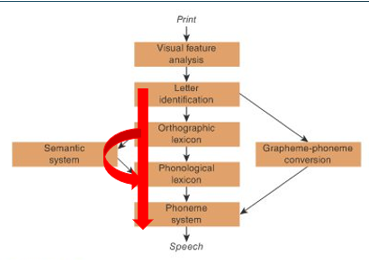
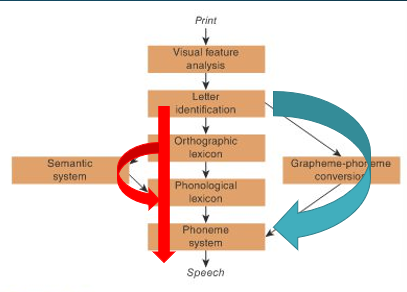
Lexical Route
A reading process that involves looking up kinown words in long-term memory to retrieve knowledge about their spelling and pronunciation.
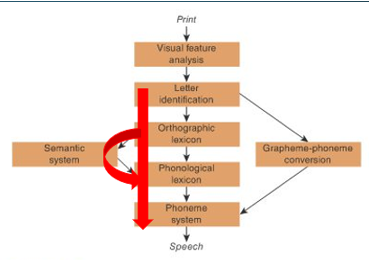
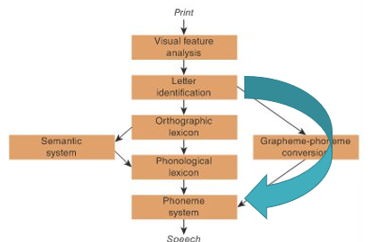
Non-lexical Route
An indirect reading process that maps graphemes to phonemes using rules without referencing the mental lexicon. Used for novel, unknown and non-words.
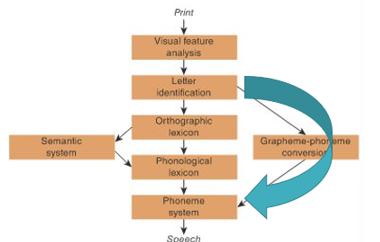
Graphemes
The basic units of word form used in the reading and writing systems.
Phonemes
The basic units of word sound that comprise the acoustic structure of words.
GPC (graphmeme-to-phoneme conversion) Rules
Maps the smallest units of sound in a spoken word (phonemes) to the written letters or letter combinations that represent them (graphemes)
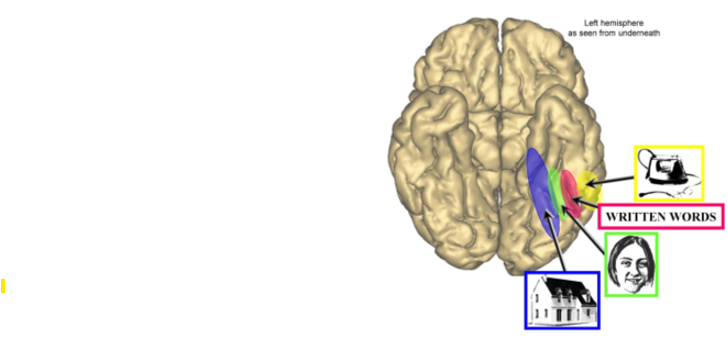
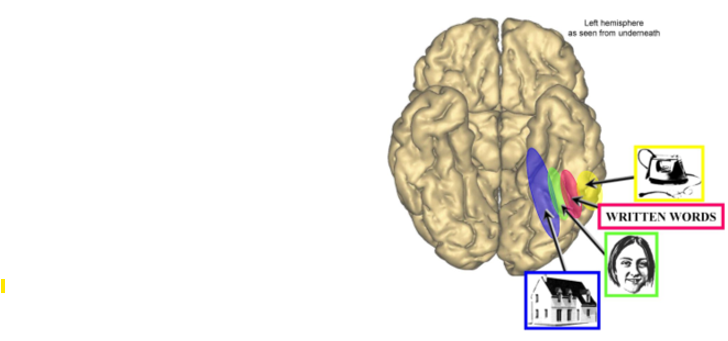
VWFA
Visual Word Form Area; a region in the occipital-temporal sulcus selectively activated for word recognition.
Acquired Dyslexia (Alexia)
The partial or complete loss of the ability to read resulting from brain damage, such as a stroke or tumour.
Developmental Dyslexia
A chronic impairment in the acquisition of the ability to read.
Peripheral Dyslexia
A reading disorder caused by defects in early visual analysis, often referred to as word blindness.
Central Dyslexia
Reading disorders caused by defects in word representation following the initial visual word form analysis.
Pure Alexia
A condition caused by damage to the VWFA characterized by slow, letter-by-letter reading.
Spatial Neglect Dyslexia
A failure to identify initial or final letters of a word, typically associated with a parietal lesion.
Surface Dyslexia
A disorder where irregular words are read with regular pronunciations, signifying damage to the lexical route.
Phonological Dyslexia
A condition characterized by great difficulty reading non-words due to damage to the non-lexical route.
Grapheme Buffer
The part of working memory that maintains the appearance and position of letters online during the writing process.
Allographic Conversion
The part of the writing process where abstract letters are converted into concrete forms, such as upper or lower case.
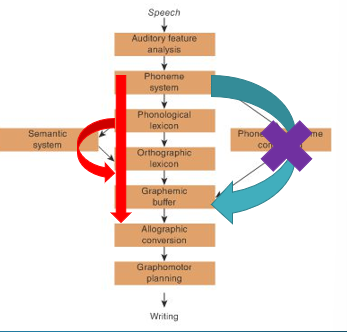
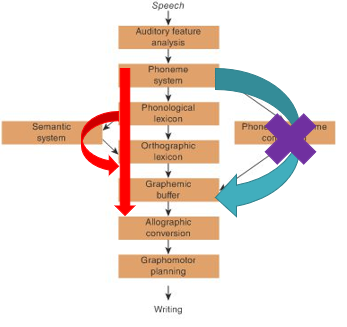
Phonological Dysgraphia
A writing disorder characterized by difficulty writing unknown or non-words while real word writing remains intact.
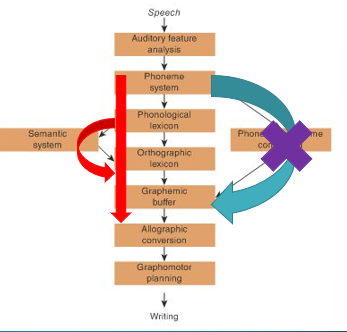
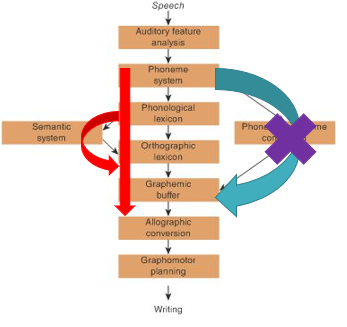
Surface Dysgraphia
A writing impairment where the individual has difficulty writing real words with irregular spelling.
Mental Lexicon
A collection of known lexical entries containing semantic, syntactic, and morphological information.
Open Class Words
Word classes with no fixed number of entries, such as nouns, verbs, adjectives, and adverbs.
Closed Class Words
Word classes with a finite number of items, including articles, pronouns, prepositions, and conjunctions.
Age of Acquisition (AoA)
The principle that words learned earlier in life are recognized and produced faster than those learned later.
Baker Paradox
A memory phenomenon where recalling a profession is easier than recalling the same word when used as a proper surname.
Morpheme
The smallest meaningful element in a language that cannot be divided into smaller meaningful parts.
Bound Morphemes
Morphemes that do not appear in isolation and must be attached to a free morpheme, such as prefixes and suffixes.
Derivation
A morphological transformation that results in the creation of a new lexical entry.
Dual-system Model
Pinker and Ullman's theory that irregular verbs are retrieved from the lexicon while regular verbs are computed online using rules.
N400
An ERP component starting around 250ms and peaking at 400ms that is typically elicited by semantic violations.
P600
An ERP component starting around 550ms and peaking at 600ms that is typically elicited by syntactic violations.
Orthographic Dyslexia
A reading disorder characterized by difficulty recognizing the spelling of words, leading to errors in reading and writing.
Rapid Automatized Naming (RAN)
A measure of how quickly a person can name a series of familiar items, which is often used in assessing reading skills.
Contextual Reading
Reading that relies on the context to give meaning to the words, facilitating comprehension of the text.
Contextual Reading
Reading that relies on the context to give meaning to the words, facilitating comprehension of the text.
Dyslexia
Learning disability that impairs one’s ability to read
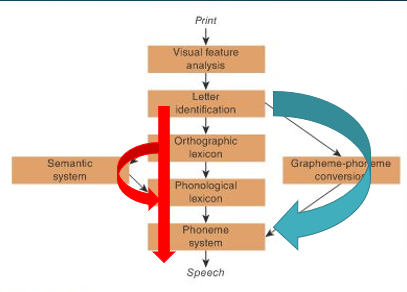
Dual route system
Model explaining the two pathways the brain uses to process written words: the lexical route and the non-lexical route.
Mr C.(1892)
A patient known for significant language impairments following a stroke resulting in brain injury in 1887, mkaing him unable to read but his spelling and oral language was intact.
Mr C.’s brain
Examined by French neurologist Jospeh-Jules Dejerine. Dejerine concluded that Mr C.’s “word blindness” may resulted forma disconnection between primary visual areas dealing with letters and words. We now know that this region is in the ventral-temporal region namely the VWFA
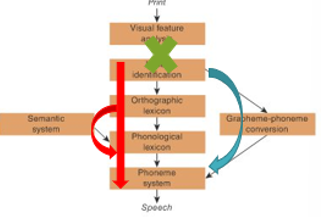
Pure Alexia
A neurological condition characterized by the inability to read despite the ability to write and spell correctly, often resulting from damage to the ventral visual pathways.
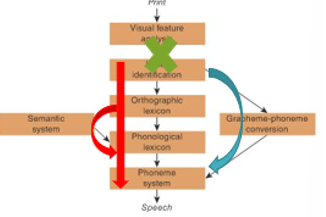
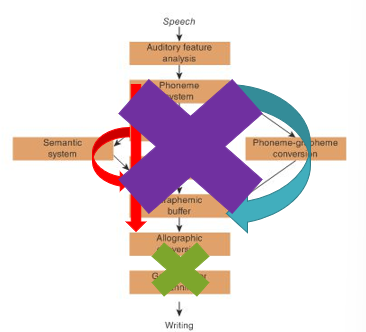
Dysgraphia
A neurological disorder that affects the ability to write coherently, often characterised by poor handwriting, spelling errors, and difficulties in organising thoughts on paper. It can result from brain injury.
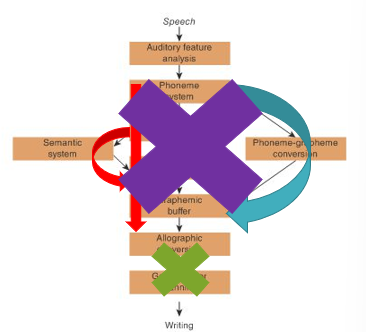
Reading in Braille
The Braille cells are scanned with the fingers, and the position and amount of raised dots help recognise letters and words, allowing individuals who are blind or visually impaired to read.