L10 The global burden of substance use
 Call Kai
 Learn
Learn Practice Test
 Spaced Repetition
 Match
Match Flashcards
 Knowt Play
1/34

Earn XP
Description and Tags
MC only
Name | Mastery | Learn | Test | Matching | Spaced | Call with Kai | Chat |
|---|
No analytics yet
Send a link to your students to track their progress
35 Terms
Suggest 2 countries which have the highest tobacco use rates in the world
Indonesia, Myanmar
Which factors does the following refers to in explaining the geographic differences in Tobacco use ?
In many Asian countries, smoking is deeply ingrained in the culture and is often seen as a symbol of masculinity or social status. This can contribute to higher smoking rates among men.
Cultural Norms
Which factors does the following refers to in explaining the geographic differences in Tobacco use ?
For example, many countries in Europe have implemented comprehensive smoke-free laws, high tobacco taxes, and public education campaigns, which can lead to lower smoking rates.
Tobacco Control Policies
Which factors does the following refers to in explaining the geographic differences in Tobacco use ?
The affordability of tobacco products varies widely between regions. In some low- and middle-income countries, tobacco may be more affordable relative to the local cost of living, leading to higher consumption rates.
Economic Factors
Which factors does the following refers to in explaining the geographic differences in Tobacco use ?
In some Asian countries, regulations on tobacco advertising might be less stringent, leading to greater exposure and normalization of tobacco use.
Tobacco Industry Targeting
Which factors does the following refers to in explaining the geographic differences in Tobacco use ?
Countries that are major tobacco producers may have higher smoking rates, in part because of easier access and the economic importance of tobacco to these regions.
Agricultural Practices
Which factors does the following refers to in explaining the sex differences in Tobacco use ?
especially in Asia, there is a significant stigma associated with women smoking, whereas it is more socially acceptable for men. This results in lower smoking rates among women.
Cultural Attitudes
Which factors does the following refers to in explaining the sex differences in Tobacco use ?
Tobacco marketing often targets men, especially in regions where there are cultural taboos against women smoking. This can reinforce the gender disparity in smoking rates.
Targeted Marketing
Which factors does the following refers to in explaining the sex differences in Tobacco use ?
Women may also be more health-conscious and aware of the risks associated with smoking, which can influence their decision to avoid tobacco use.
Health Awareness
Which factors does the following refers to in explaining the sex differences in Tobacco use ?
In some regions, women may have less economic independence and therefore less disposable income to spend on tobacco products compared to men.
Economic independence
Which factors does the following refers to in explaining the sex differences in Tobacco use ?
Some regions have been more proactive in educating the public about the dangers of smoking and enforcing laws that protect non-smokers, which can influence smoking rates differently across genders.
Legislation and Education
what is the mechanism of Electronic cigarettes ?
No burning or use of tobacco leaves
E-cig vaporise a solution called e-liquid to generate aerosol for inhalation
The e-liquid usually contain nicotine and other additives, e.g., flavoring
What does Gateway Hypothesis suggest about Electronic Cigarettes ? Further explain it (5)
It suggests that using e-cigarettes can lead to the subsequent use of traditional combustible cigarettes, especially among youth and young adults. Reasons:
Nicotine Addiction: E-cigarettes can serve as an introduction to nicotine, with the potential to lead users to seek out stronger nicotine delivery systems, such as conventional cigarettes.
Youth Experimentation: The availability of flavored e-liquids and the marketing tactics 策略 of e-cigarette companies can appeal to youths, increasing the likelihood of experimentation due to perceived harm reduction compared to traditional cigarettes.
Lower Risk Perception: The belief that e-cigarettes are a safer alternative to smoking may lower the barrier for non-smokers, particularly adolescents, to try nicotine products, potentially leading to a transition to smoking.
Social Mimicry: E-cigarette use can mimic the behavioral aspects of smoking, such as the hand-to-mouth action, which may facilitate a switch to smoking actual cigarettes as a natural progression.
Tobacco Industry Practices: Some tobacco companies are involved in the e-cigarette market, and there are concerns that these companies may use e-cigarettes as a tool to maintain or even expand their customer base, potentially leading to dual use or a switch to traditional tobacco products.
List the potential harms of Shisha (7)
High Levels of Toxicants: Shisha smoke contains many of the same harmful constituents as cigarette smoke, including tar, carbon monoxide, heavy metals, and carcinogens.
Longer Smoking Sessions: Hookah sessions often last longer than smoking a cigarette, which can lead to greater exposure to toxic substances.
Misleading Water Filtration: The water in hookah does not effectively filter out harmful components, contrary to common belief.
Addictive Substance: Shisha tobacco contains nicotine, which is an addictive substance, leading to potential dependence.
Secondhand Smoke: Hookah smoking produces secondhand smoke, which can be a health hazard to non-smokers, particularly in indoor environments.
Risk of Infectious Disease: Sharing hookah mouthpieces can increase the risk of transmission of diseases such as tuberculosis, herpes, and hepatitis.
Alcohol Consumption: Shisha sessions are frequently social events where participants may also consume alcoholic beverages, potentially leading to riskier behaviors and greater overall health risks.
Rank the top 3 common type of drug abused by adolescent below 21
Cannabis
Cocaine
Space oil (Etomidate)
What is the harmful effects of Etomidate in E-cigarette ?
The feeling from space oil only lasts for five to 10 minutes, but the toxin from the drug can persist for a week, potentially disrupting the adrenal glands’ ability to produce steroid hormones
What is MPOWER policy package ?
six key strategies to implement effective tobacco control measures:
Monitor tobacco use and prevention policies.
Collect data on tobacco consumption and the effectiveness of policies.
Helps allocate resources effectively for interventions.
Protect people from tobacco smoke.
Implement smoke-free laws to reduce secondhand smoke exposure
Offer help to quit tobacco use.
Provide cessation programs, national quit lines, and access to nicotine replacement therapies
Warn about the dangers of tobacco.
Use graphic warnings on tobacco packaging. e.g. Pictorial health warnings (PHWs)
Run public awareness campaigns on tobacco-related harm.
Enforce bans on tobacco advertising, promotion, and sponsorship.
Prohibit advertising in all media, sponsorship of events, and product promotions.
Prevents normalization of tobacco use.
Raise taxes on tobacco.
Which country enforced a nationwide generational tobacco prohibition ?
Maldives 馬爾地夫
banned young people born on or after 1 January 2007 from smoking tobacco
What is the purpose & requirement of using Pictorial Health Warning (PHWs) as a tobacco control measure as stated by WHO ?
to warn the public about the harm of smoking.
Large PHWs can improve the public knowledge on the hazards of tobacco use and restrict the tobacco industry making use of the cigarette pack to promote smoking.
PHWs with large, visible, clear and legible messages on at least 50% of principal areas of tobacco packs.
What are the possible effects of drinking large or small amount of alcohol
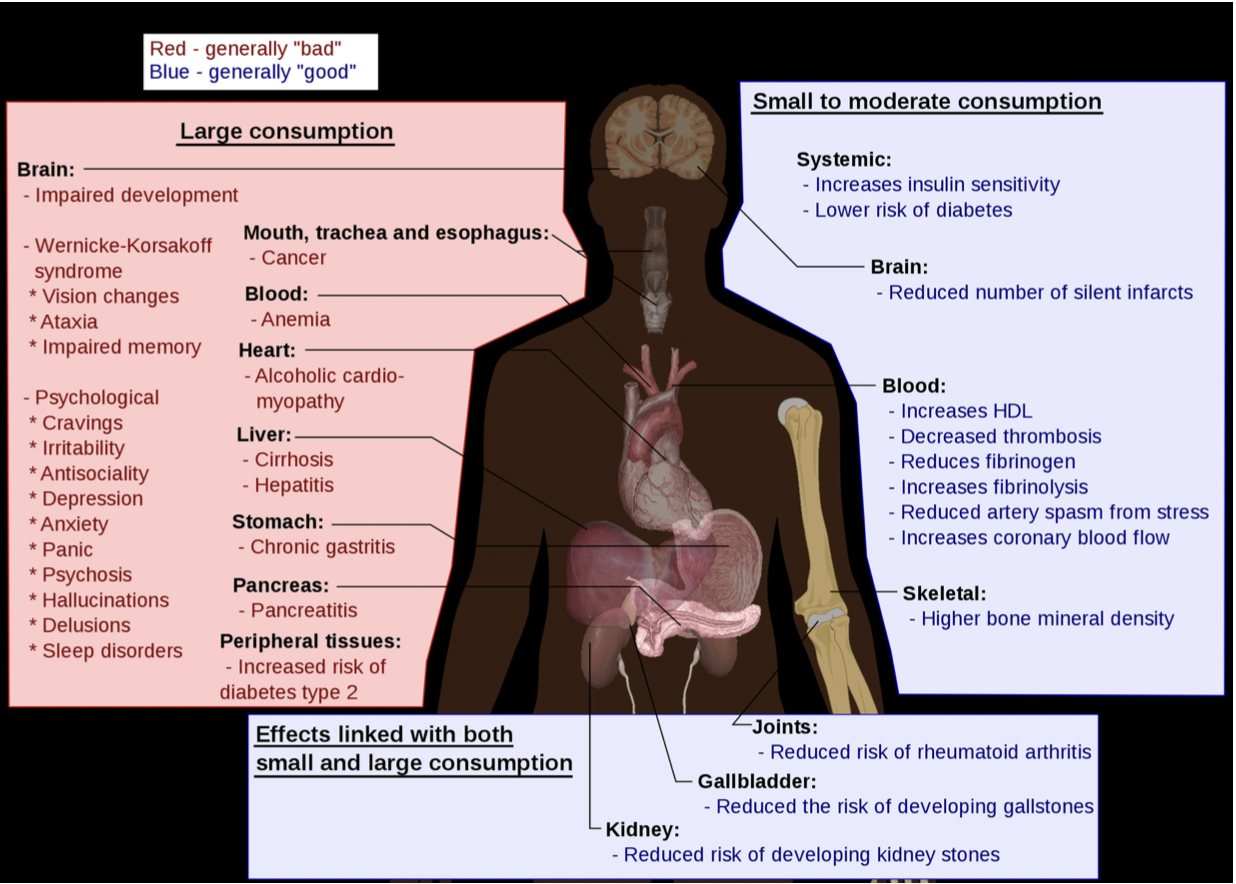
Which country has relatively low and high alcohol consumption respectively ?
LOW: North Africa & Middle East
HIGH: Europe
List out the aspect & explain the geographic differences in average per capita alcohol consumption (11)
Cultural and Religious Factors
North Africa and the Middle East, the predominant religions, such as Islam, typically prohibit or discourage the consumption of alcohol, significantly impacting consumption behaviors.
Legal Restrictions (strict)
Many countries in North Africa and the Middle East have strict laws regulating the sale and consumption of alcohol, with some countries implementing complete bans
Social Norms
In Europe, drinking alcohol is often deeply ingrained in social customs and daily life, including dining culture, celebrations, and as a routine leisure activity
Economic Factors
Higher income levels in European countries may lead to increased disposable income, allowing for more expenditure on alcohol
Climate and Agriculture
The favorable climate for vineyards 葡萄園 in many parts of Europe supports wine production as a traditional and economic practice, influencing consumption patterns.
Tourism
Countries like Czechia, Lithuania, and Moldova may have higher alcohol consumption partly due to tourism, with visitors partaking in local drinking customs
Government Policies
European governments may have more liberal policies regarding alcohol production, sale, and advertising, facilitating higher consumption
Alcohol Education and Public Health
Some European countries may lack effective alcohol education programs
Historical Factors
Historical consumption patterns, such as those in wine-producing regions, have established long-standing traditions of alcohol consumption
Availability
The availability of alcohol in terms of number and type of retail outlets can affect consumption patterns, with Europe generally having a high density of outlets.
Drinking Age Laws
Legal drinking ages are lower in many European countries compared to other parts of the world, which can lead to earlier initiation into alcohol use
What is standard drink ?
It is a measure that represents a typical serving of alcohol that contains a fixed amount of pure alcohol.
This measure is used to help people understand how much alcohol they are consuming and to stay within safe drinking limits.
14 grams (0.6 ounces) of pure alcohol in the United States
10 grams of pure alcohol in Australia
8 grams of pure alcohol in the United Kingdom
Which form of excessive drinking is more common ?
Binge 狂歡 drinking
How to define binge drinking of women and men respectively ?
If women consuming 4 or more drinks in a single occasion
If men consuming 5 or more drinks in a single occasion
How to define heavy drinking of women and men respectively ?
If women consuming 8 or more drinks a week
If men consuming 15 or more drinks a week
What is moderate drinking ?
adults of legal drinking age can choose not to drink, or to drink in moderation by limiting intake to 2 drinks or less in a day for men or 1 drink or less in a day for women
Which type of people is not recommended to drink alcohol ? (6)
Younger than age 21.
Pregnant or may be pregnant.
Driving, planning to drive, or participating in other activities requiring skill, coordination, and alertness.
Taking certain prescription or over-the-counter medications that can interact with alcohol.
Suffering from certain medical conditions.
Recovering from alcoholism or are unable to control the amount they drink.
List out the aspect & explain why men drink more than women (9)
Sociocultural Norms
Traditional gender roles often condone or even encourage alcohol consumption among men as a sign of masculinity, whereas women may face more social stigma for drinking.
Peer Influence
Men, especially in groups, might be more susceptible to peer pressure to drink, and social situations involving men often revolve around alcohol consumption.
Stress and Coping Mechanisms
men are often encouraged to be less expressive about their troubles and may turn to alcohol as a socially acceptable outlet
Risk-Taking Behavior
Marketing and Advertising
Alcoholic beverages, especially beer and spirits, are frequently marketed directly to men, associating drinking with male-oriented themes such as sports, power, and success.
Availability and Accessibility
In many cultures, alcohol is more readily available to men, both legally and socially, contributing to higher consumption rates.
Mental Health
Men may be less likely to seek help for mental health issues due to stigma, and instead, might self-medicate with alcohol
Leisure Activities
Recreational activities for men often involve drinking. For example, watching sports can be associated with consuming alcohol.
Alcohol as a Reward
Men are often culturally conditioned to view alcohol as a reward after a hard day's work, reinforcing daily or regular drinking habits
List the reasons why changing trends in women’s alcohol consumption (6)
Changing Gender Roles
women may be adopting behaviors previously more common among men, including alcohol consumption.
Increased Social Acceptance
Marketing Strategies
Economic Empowerment
Female-Focused Drinking Venues
wine bars, "ladies' nights," and other female-friendly drinking environments
Equality Movements
Explain why women face higher risks than men when drinking alcohol, ie:
have alcohol-related problems sooner and at lower drinking levels than men
On average, women weigh less than men. Also, alcohol resides predominantly in body water, women have less water in their bodies than men.
This means that after a woman and a man of the same weight drink the same amount of alcohol, the woman’s blood alcohol concentration (BAC, the amount of alcohol in the blood) will tend to be higher, putting her at greater risk for harm.
Another biological differences may due to estrogen, which women have higher estrogen level then men,
Alcohol increases circulating estrogens in both men and women.
For women, this has a harsh effect on the nervous system and immune function.
Studies show that women who drink excessively are more likely to have breast cancer, liver issues, mental health problems, cognitive and neurological deterioration.
What does alcohol myopia theory suggest about ?
It suggests that alcohol intoxication (getting drunk) decreases the amount of information that individuals can process (ie. cognitive function), it may also cause:
Attention deficit —> impaired driving
Impulsive behaviour —> immediate pleasure (e.g., unsafe sex ) at the expense of future risk (e.g., potentially contracting an STD or causing a pregnancy)
Aggression —> alcohol increases the level of aggression in response to provocation.
What is the purpose of AUDIT (Alcohol use disorders identification test), a tool used in secondary prevention.
To screen for excessive drinking and identify potential alcohol problems
What are the advantages of screening and brief intervention (SBI) in reducing alcohol consumption ? (4)
Early identification
Cost-effective: By preventing alcohol-related illnesses and injuries, SBI can save healthcare costs in the long run
Time-efficient: elatively short amount of time to administer, often requiring only 5 to 15 minutes, making them easy to integrate into routine healthcare visits.
Flexibility: can be adapted to a variety of healthcare settings, including primary care clinics, emergency departments, and psychiatric services.
Explain which one, individually-delivered Brief Alcohol Interventions (BAIs) or group-delivered BAIs is effective for adolescents ?
Individual one is more effective, while group may not
Personalization: Individual sessions allow interventions to be tailored to the specific needs, motivations, and circumstances of each adolescent, which can be more impactful than a one-size-fits-all group approach.
Privacy and Confidentiality: Adolescents may be more willing to discuss sensitive issues related to their alcohol use in a private setting rather than in a group where they may fear judgment from peers.
Focused Attention: In individual settings, the provider can give their undivided attention to one adolescent, which may foster a greater understanding and more effective support for behavior change.
Peer Pressure: Group interventions may inadvertently reinforce drinking behaviors through peer pressure or the normalization of drinking stories shared among group members.
Engagement and Participation: Adolescents may be more engaged in individual interventions and more willing to participate actively, whereas in group settings, they might disengage or defer to more dominant group members.