Bch210 exam L13
 Call Kai
 Learn
Learn Practice Test
 Spaced Repetition
 Match
Match Flashcards
 Knowt Play
1/25

Earn XP
Description and Tags
Oxidative Phosphorylation
Name | Mastery | Learn | Test | Matching | Spaced | Call with Kai |
|---|
No analytics yet
Send a link to your students to track their progress
26 Terms
Mitochondrial Oxidative Phosphorylation
NADH and FADH2 carry e- to ETC
their energy used to create conformational change in protein complex
pump protons from matrix into intermembrane space
proton gradient used by ATP synthase to make ATP in matrix
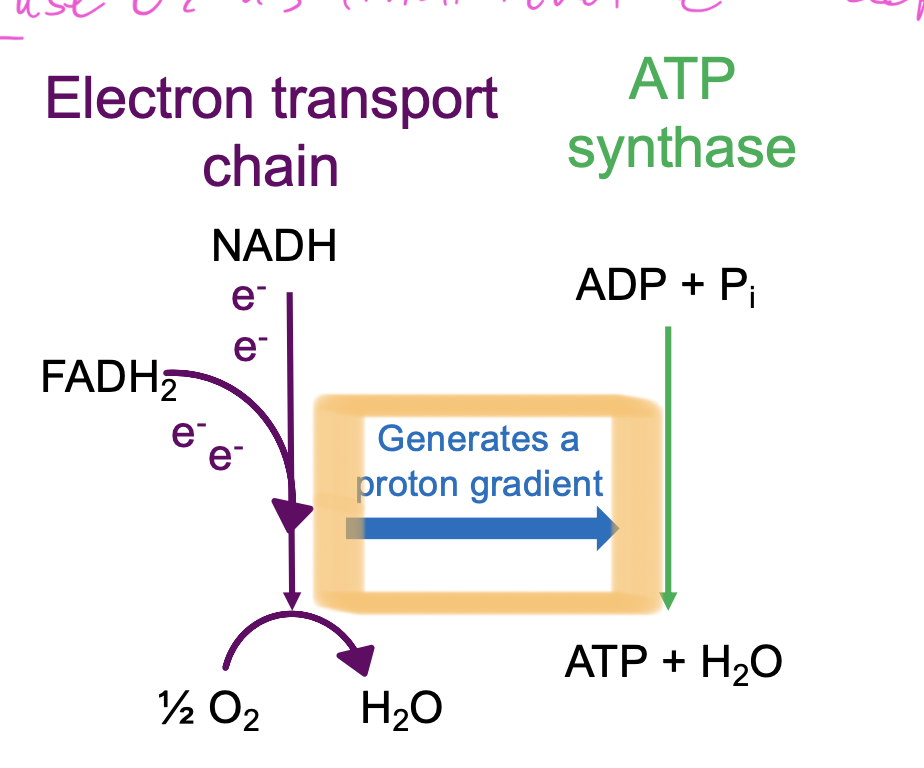
Oxidative phosphorylation
pump h+ into intermembrane space from matrix using the energy (e-) from NADH and FADH2
o2 will then be the final e- acceptor and take the e- forming 2 h2o molecules
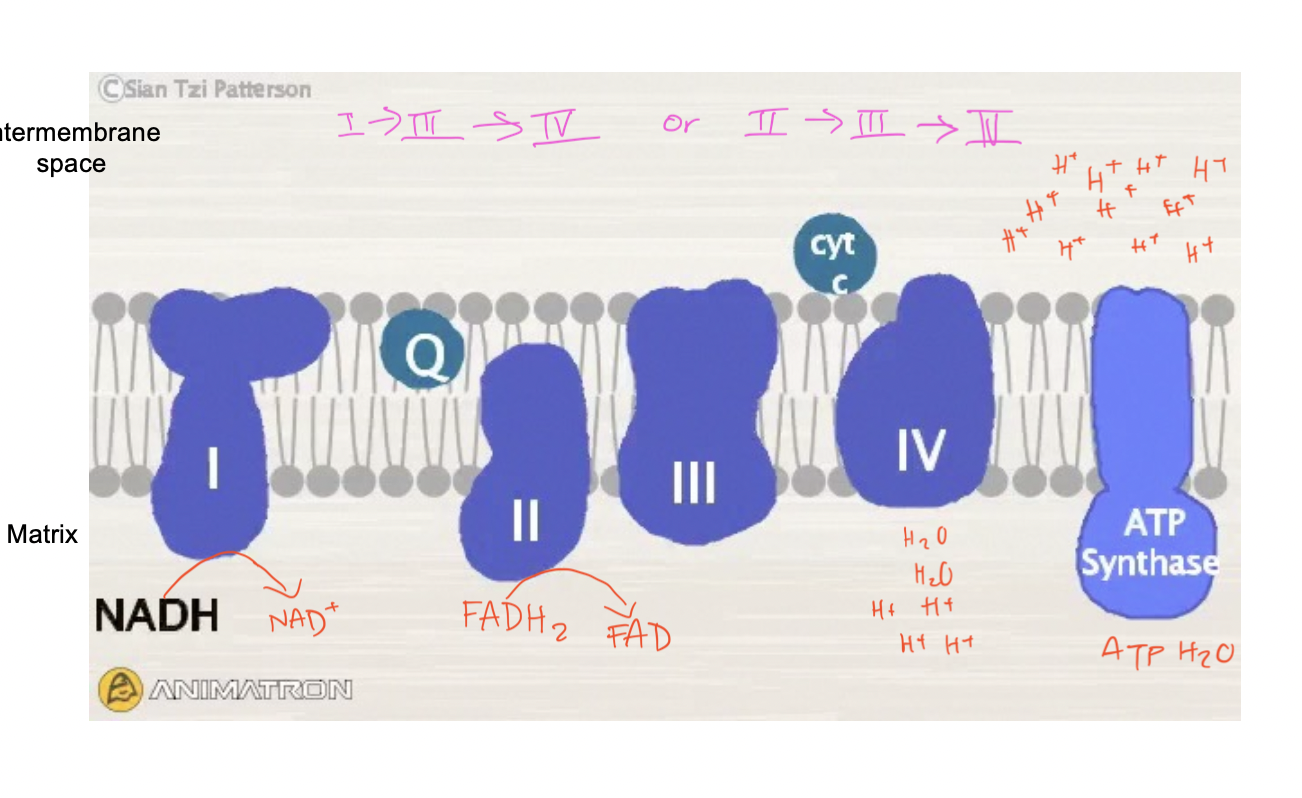
Oxidative phosphorylation: e- passing and H+ pumping
NADH
complex 1
2 e- to complex Q
release 4 protons
FADH2
complex 2
2 e- to complex Q
Q
pass e- to complex iii
4 protons released
Complex iii passes to cyt c which passes to complex 4 before releaseing 2 protons
finally O2 picks up e-
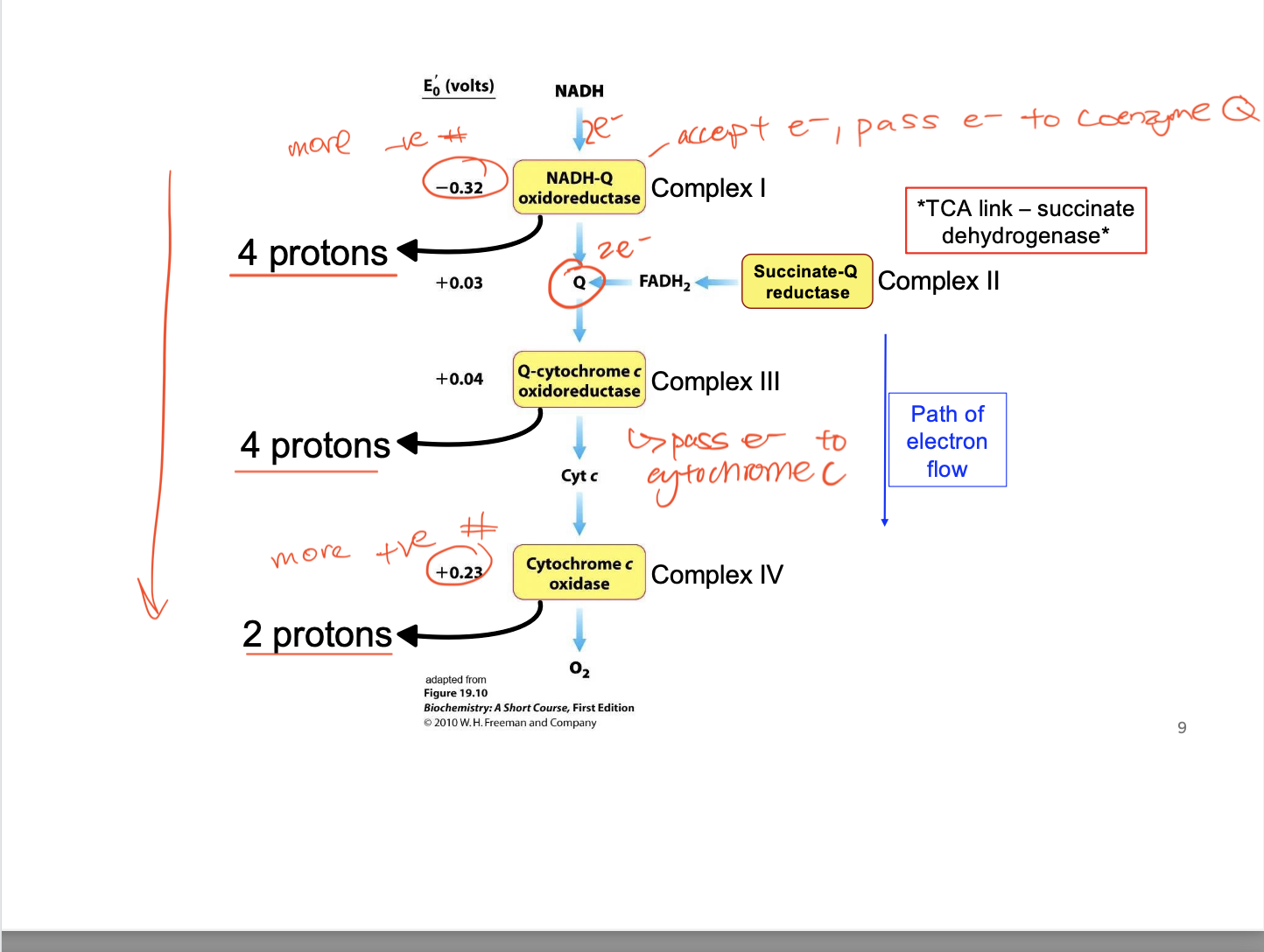
Electron Transfer Potential: Standard Reduction Potential (E ́o)
A molecule’s tendency to be oxidized or reduced.
more -ve = loses e- more easily (negative E ́0 values.)
more +ve = gains e- more easily
e- flow from more -ve to +ve
Standard Reduction Potential (E ́o) formula
F = Faraday constant = 96,485 J/Vmol n = number of electrons
ΔG°’ = - n F ΔE ́o
The Electron Transport ‘Chain’ conformational changes
Passage of electrons through the ‘chain’ (from – ve to +ve) results in a free energy change that drives conformational changes in the complexes to set up a proton gradient for ATP synthase.
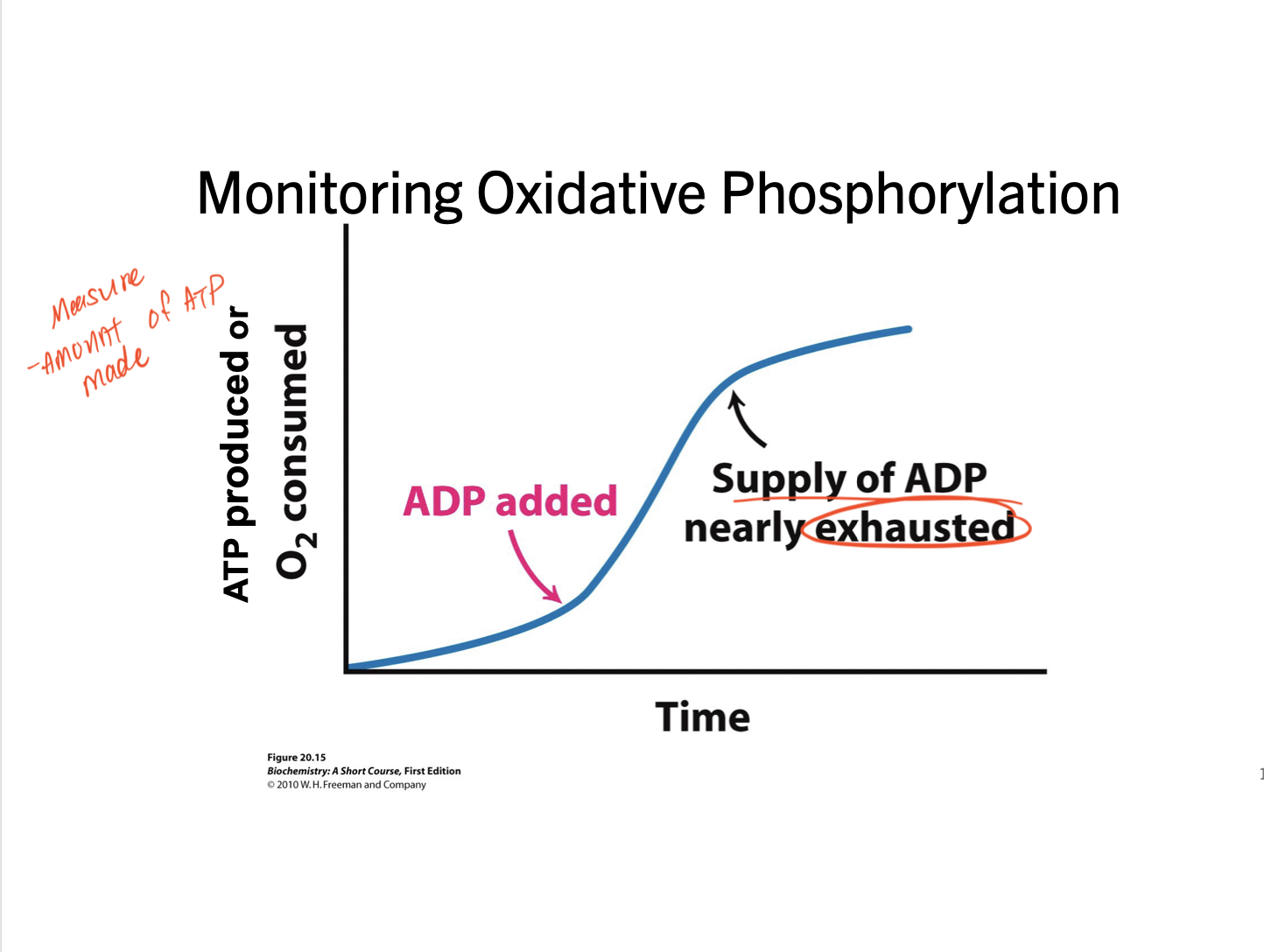
What is the experimental evidence that Oxidative Phosphorylation exists, and that the electron transport chain is linked to ATP synthesis?
Mitochondrial O2 experiment
measure amount of O2 consumed
Monitoring Oxidative Phosphorylation
measure amount of ATP made
Oxidative Phosphorylation Inhibitors: Rotenone and amytal
inhibit electron flow from complex I to CoQ .
Oxidative Phosphorylation Inhibitors: Complex III
Antimycin A
Oxidative Phosphorylation Inhibitors: Complex IV
Cyanide, azide and CO
Oxidative Phosphorylation Inhibitors: ATP synthase (complex V).
Oligomycin
uncouplers disrupt the H+ gradient
Uncouplers
molecules that have hydrophobic groups that allow them to cross the membrane.
acidic group can bind to H+ and move them from high - low conc that disrupts H+ gradient and ATP synthesis
How does ATP synthase make ATP from a proton gradient? Peter Mitchell’s Chemiosmotic Hypothesis:
ATP synthesis arrives due to electrochemical gradient across mitochondrial inner membrane
H+ gradient prod by ETC using suitable e- donor
conformation change in atp synthase
reversible
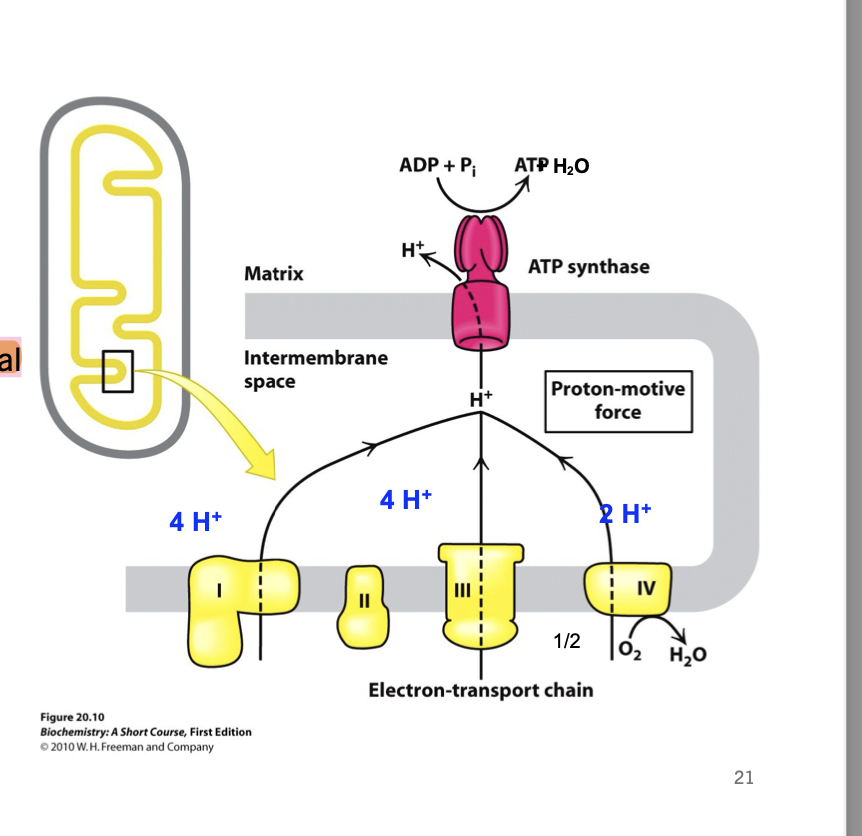
ATP synthase: F1
F1: peripheral protein unit that carries out catalytic synthesis of ATP in matrix
conformational changes in F1 beta subunit responsible for ATP synthase
ATP synthase: F0
integral membrane protein unit that anchors the enzyme complex in the inner mitochondrial membrane
H+ flow through rotor that cause rotation in ring of y subunit of F0
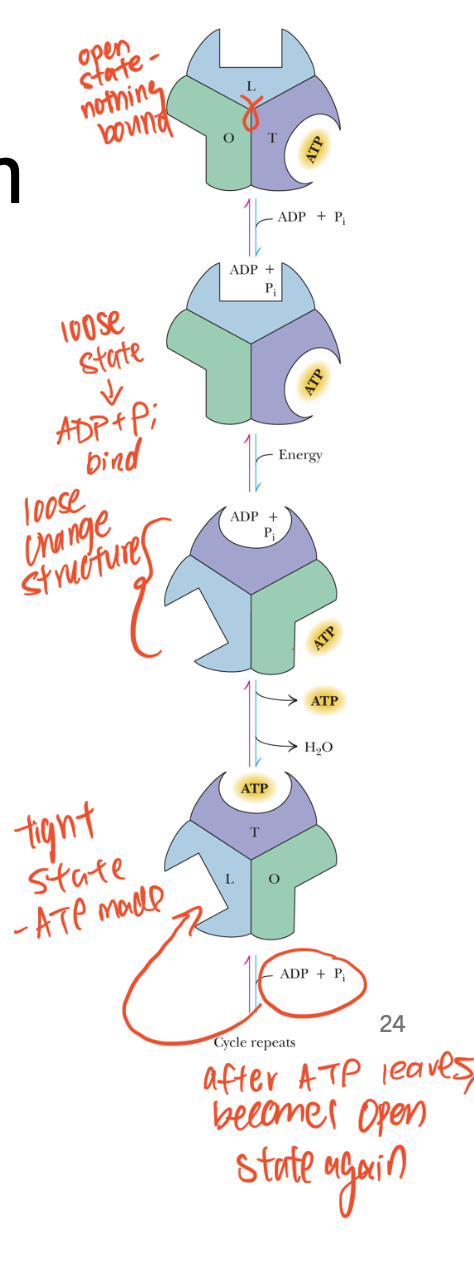
Boyer’s Binding Change Mechanism
beta subunit functions independently and 3 diff rxns occur simultaneously
The binding of H+ in the rotor rotates the γ subunit and induces a conformational change in the β subunits.
Each β subunit undergoes a conformational change between 3 states:
• Open or Empty/exit (ATP leaves)
• Loose - ADP and Pi bound
• Tight - ATP bound
ATP Synthase is Reversible
ATP hydrolysis can also be used to reverse the reaction mechanism.
form of active transport that can be used to drive proton transport across the membrane in the opposite direction using a similar rotation mechanism.
recombinant fusion proteins and fluorescence microscopy
Imaging techniques can be used to visualize this rotation in the F1 unit
How many ATPs are made?
NADH and FADH2 each donate 2 e- to etc
1 NADH can make 2.5 atp (10h+ pumped)
1 fadh2 can make 1.5 atp (6 h+ pumped)
round down if needed
Water formation in Oxidative Phosphorylation
IN ETC at complex 4
1 H2O at last step
IN ATP SYNTHASE
Water ratio: 3.5 for NADH, 2.5 for FADH2 (or NADHcyt.)
Overall summary equation for the complete oxidation of glucose
6 co2 +30 ATP + 36 H2O
Why is hypoxia life threatening? (low O2)
mito matrix makes 95% of ATP, glycolysis only makes 2ATP total
Anaerobic Metabolism
periods of low o2, etc shits down and anaerobic metabolism occurs
PDC & CAC also slow down
ONLY glycolysis will generate ATP
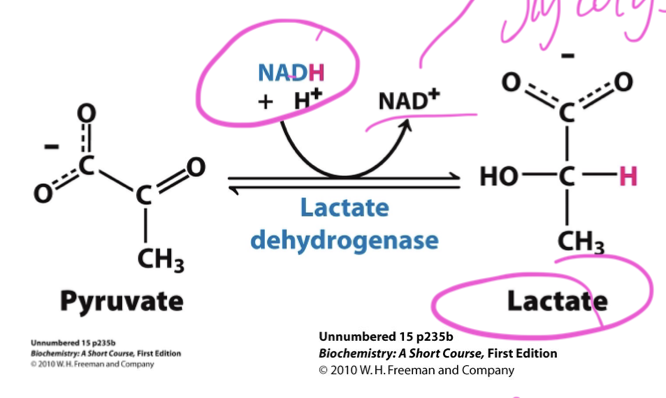
Lactate dehydrogenase
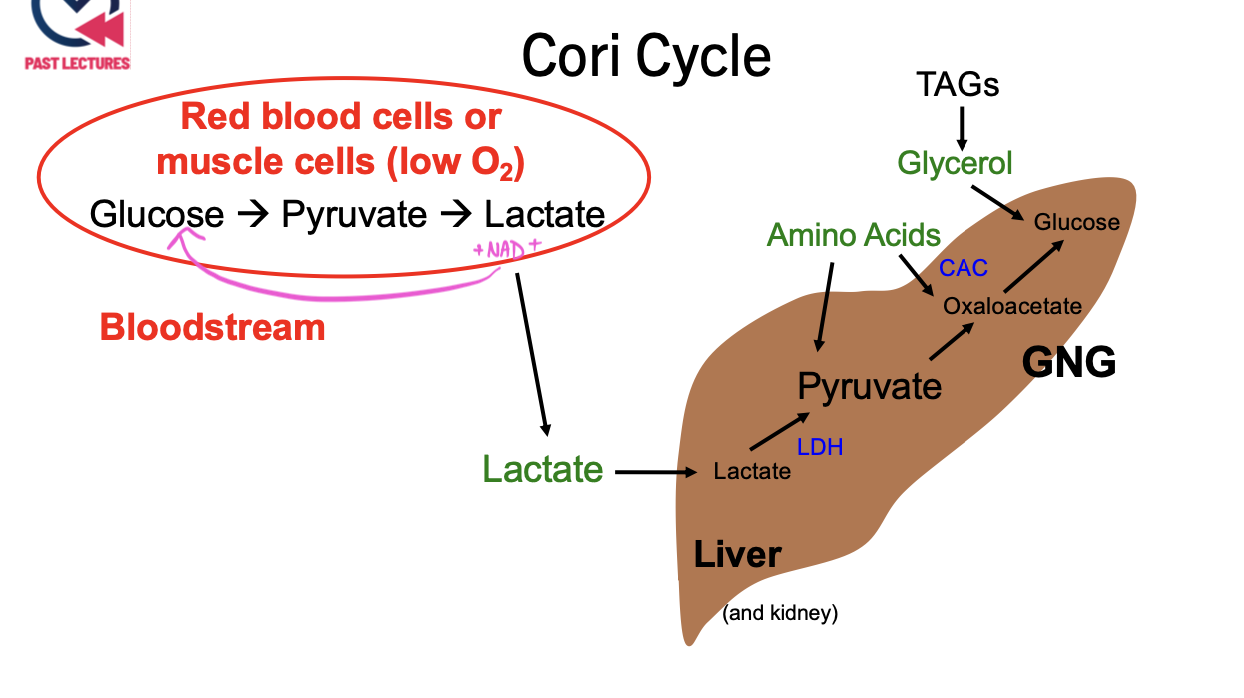
uses NADH made in glycolysis in the cytoplasm to replenishing NAD+ for glycolysis to continue.
Lactate can be used by liver cells in GNG.
Cori Cycle
Lactate, produced by anaerobic glycolysis in muscles, travels through the bloodstream to the liver