APHGUnit6
 Call Kai
 Learn
Learn Practice Test
 Spaced Repetition
 Match
Match Flashcards
 Knowt Play
1/36

There's no tags or description
Looks like no tags are added yet.
Name | Mastery | Learn | Test | Matching | Spaced | Call with Kai |
|---|
No analytics yet
Send a link to your students to track their progress
37 Terms
Megacities
Have a high degree of economic and cultural reach and influence, thereby exerting high levels of influence and power in their country's economies. They interconnect with other megacities.
Metacities
Classification of cities with a population of more than 20 million. Mumbai, Tokyo, Delhi, Mexico City, Jakarta, Sāo Paulo, Lagos
Shock cities
Megacities experiencing infrastructural challenges related to massive and rapid urbanization.
Squatter settlements (barriadas)
Makeshift, unsafe housing constructed from any scraps they find on the land that they neither rent nor own.
Urban sprawl
The diffusion of urban land use and lifestyle into formerly non-urban, often agricultural lands.
Edge cities
Self-sufficient, urban villages that often develop at highway exits and are part of a larger, metropolitan complex.
Suburbanization
After World War 2, many returning veterans were eligible for subsidies to buy homes, leading to a rapid increase in home construction in the 1950s and 1960s.
Suburbanization sprawl
The expansion of housing and commercial developments in the urban periphery.
Boomburbs
As suburban areas rapidly grew, contributing to the core city's overall population boom.
Counter-urbanization
The increase in rural populations that results from the out-migration of city residents from their city and suburban homes in search of non-urban lifestyles.
Exurbs (extraurbanization)
Or rings of wealthier rural communities that grew just outside of the suburbs and were hot beds of continued urban growth and developments.
New urbanism
Promotes environmentally friendly habits by creating walkable neighborhoods containing a wide range of housing and job types.
Gated communities
A residential area with controlled access for pedestrians, bicycles, and vehicles.
World cities
Powerful cities that control a disproportionately high level of the world's economic, political, and cultural activites.
Global cities
World cities have a high degree of centrality or influence in the global system.
Rank-size rule
the country's nth-largest settlement is 1/n the population of the size of region's largest city's population. For example, the 4th largest city in a region is predicted to be 1/4th the size of the region's largest city's population size.
Primate cities
More than two times the size of the next largest city and exert significant social, political, and economic influences.
Christaller's Central Place Theory
Means of studying the geographical patterns of urban land use, specifically looking to explain and predict the pattern of urban land use across the map. Based on the assumption of a flat land surface, a uniformly distributed rural population, equal transportation methods, spread throughout the space, and an evolutionary movement torward the growth of cities.
Urban hierarchy
A system of cities consisting of various levels, with few cities at the top level and increasingly more settlements at each lower level.
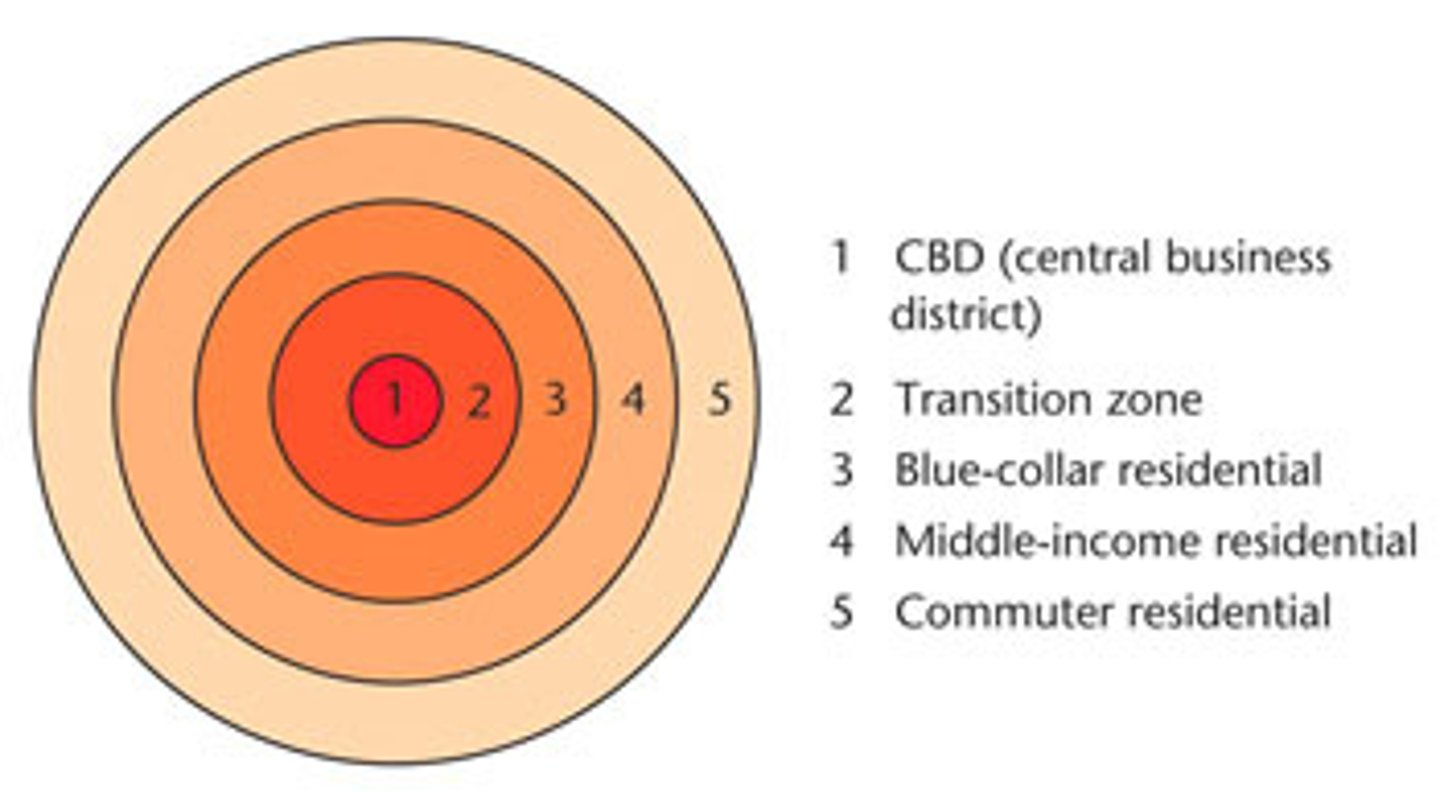
Burgess's Concentric Zone Model
Developed in the 1920's by E.W. Burgess, the concentric zone model was the first model to explain and predict urban growth. Central business district, light manufacturing and whoelsale, lower-class residential, middle class residential, most exclusive residential.
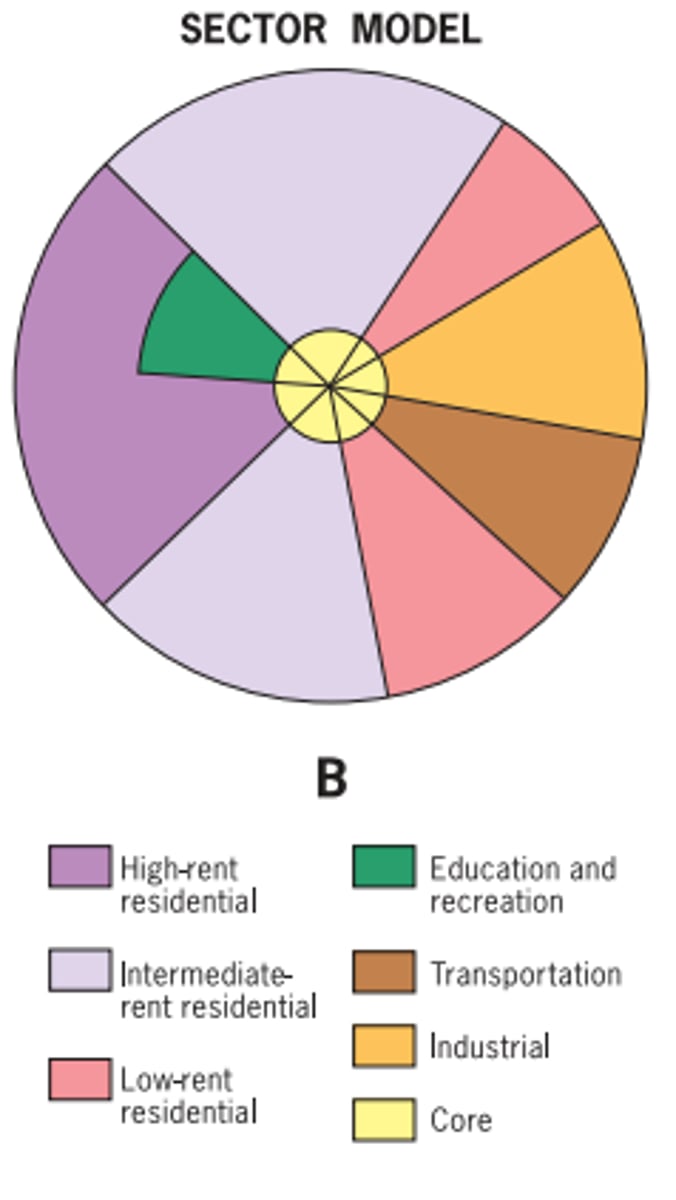
Hoyt's Sector Model
In the 1930's, Home Hoyt discovered a twist on the concentric zone pattern, known as the sector mdoel.
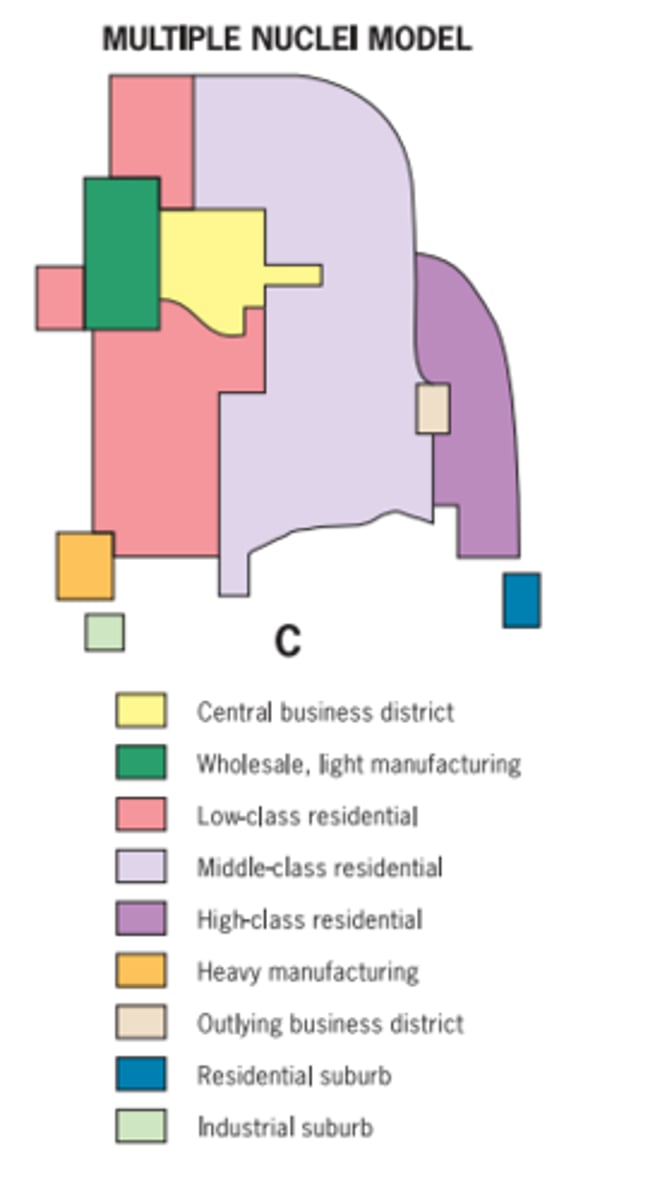
The Harris and Ullman Multiple-Nuclei Model
In 1945, Chauncy Harris and Edward Ullman created a new model of urban growth in North American cities: the multiple nuclei model. Central business district, light manufacturing and wholesale, lower class residential, industrial park, heavy industry
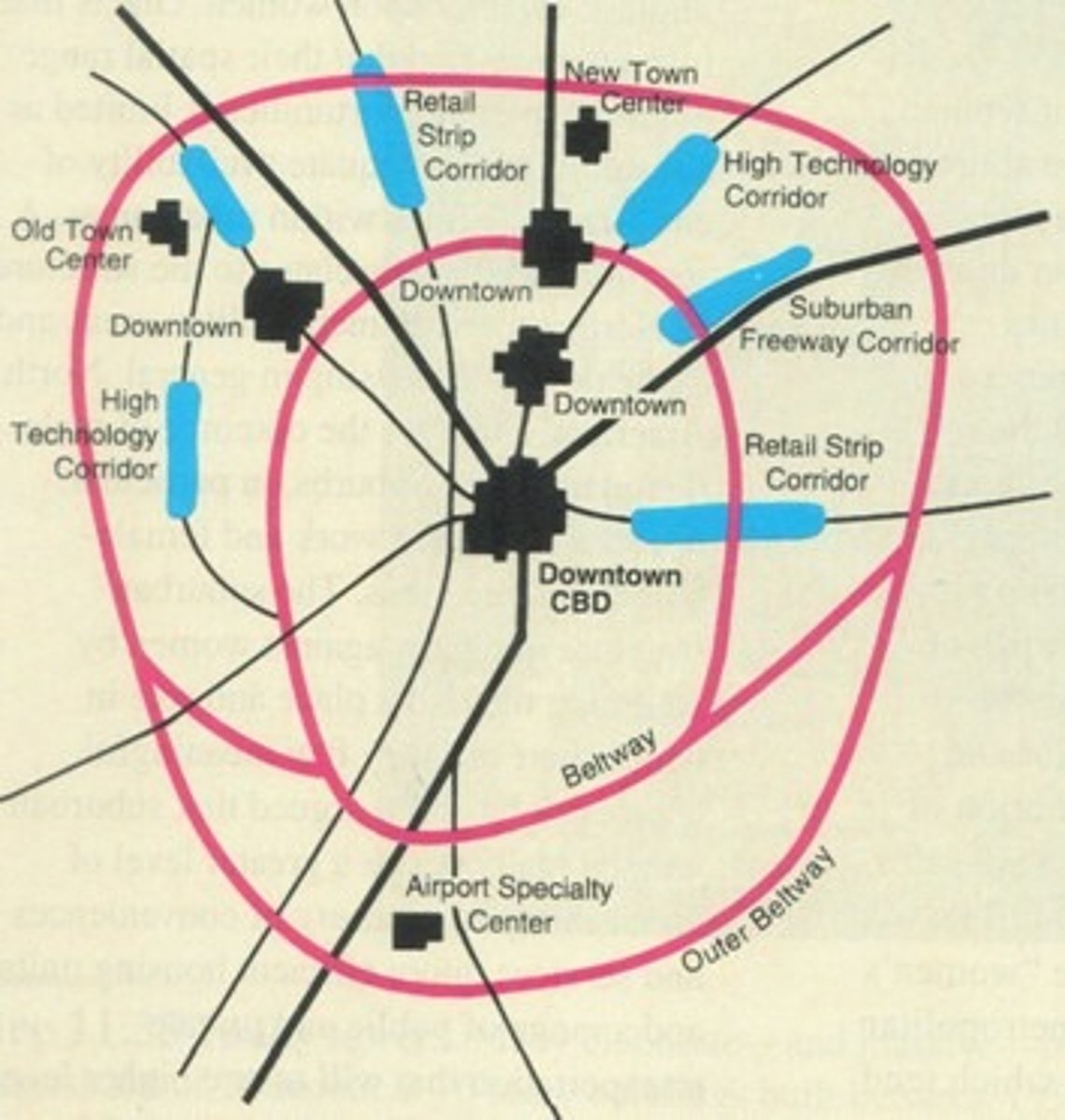
Galactic city model
Developed by Chauncy Harris, coathour of the multiple nuclei model, accounts for rising urban sprawl and the functional importance of the automobile beltway or highway in shaping the urban pattern.
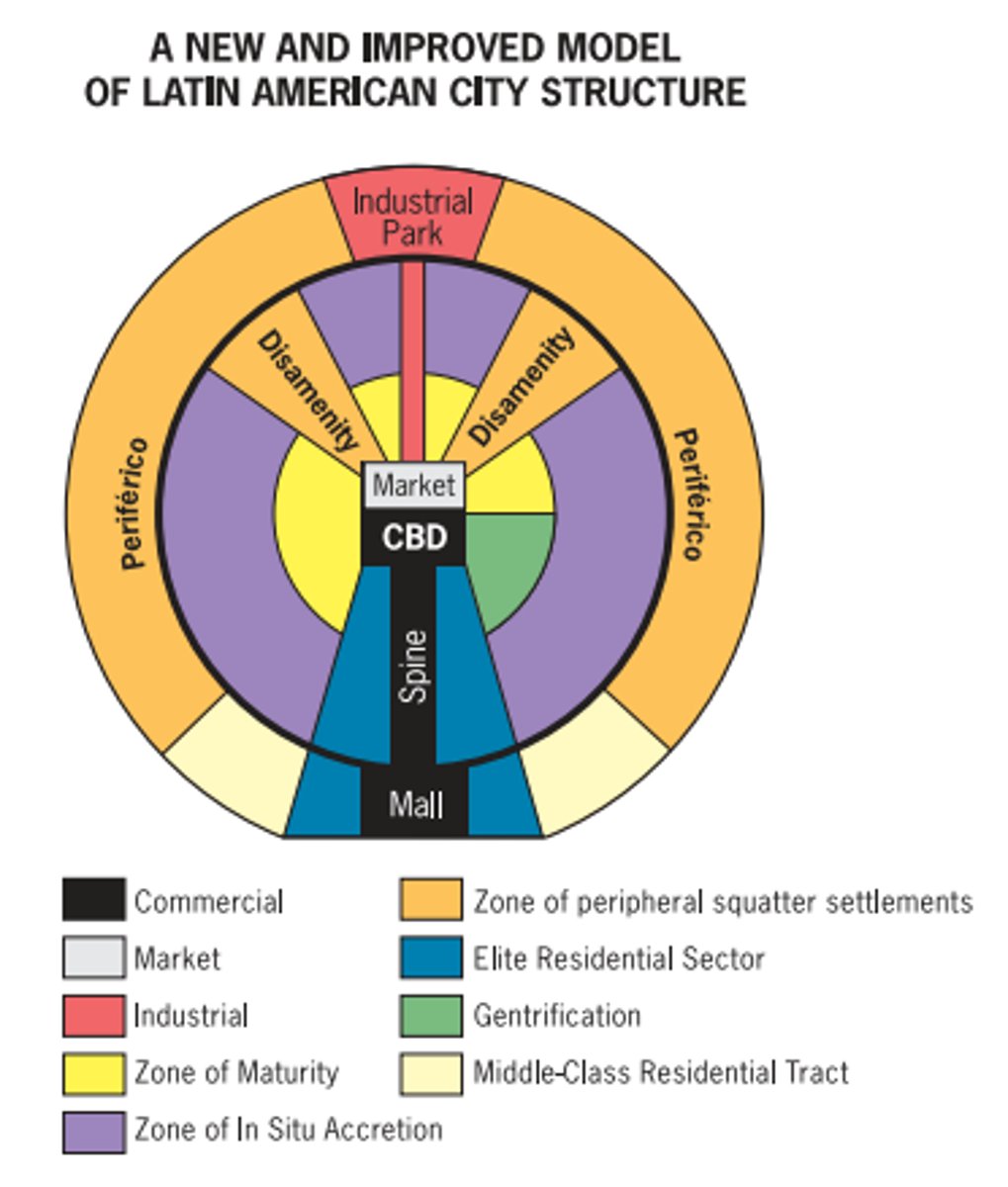
Latin American city model
Larry Ford and Earnest Griffin created a model of the pattern urban growth in Latin America, particularyly the regions colonized by Span.
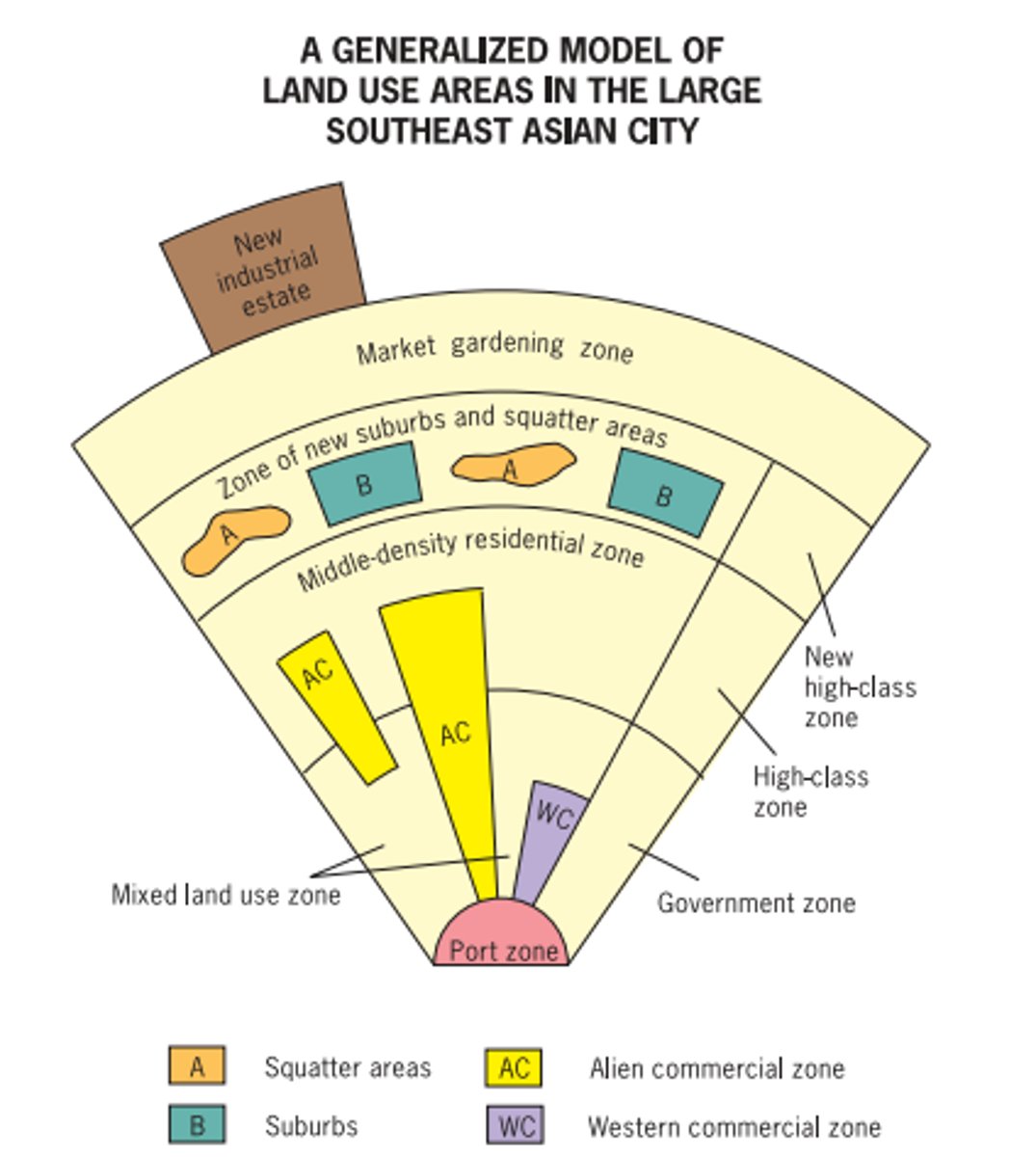
Southeast Asia Model
Developed by T.G. McGee, the Southeast Asian urban model explains and predicts urban land use in Southeast Asian cities.
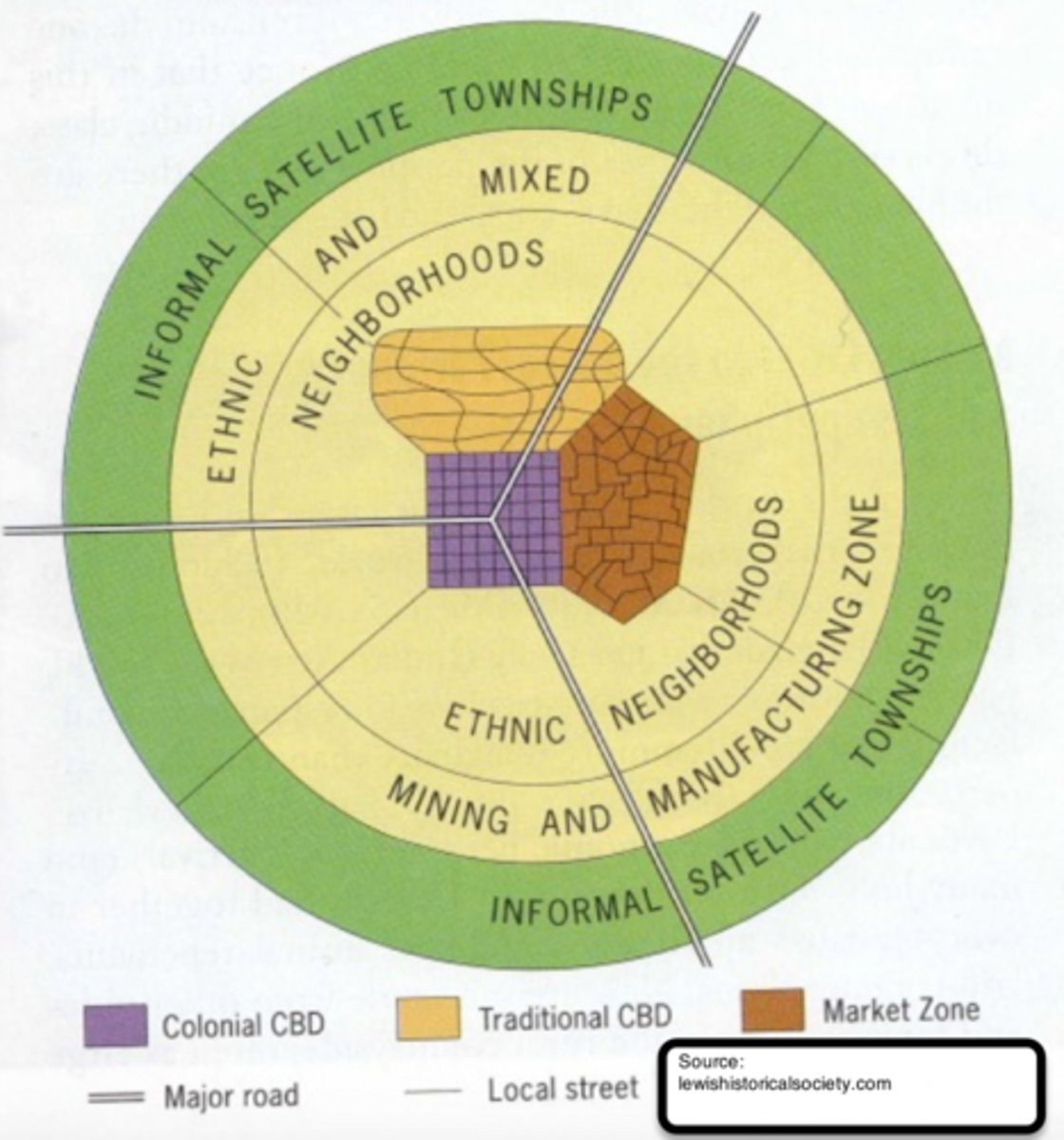
African city model
Developed by H. de Blij, the African city model predicts that Africa have not one central business district but three: a colonial CBD, a traditional marketplace, and a modernizing CBD. Cities in parts of Africa such as Nairobi, Kenya, are rapidly urbanizing.
Housing and residential land use
In contemporary cities, land use and residential housing usually have a higher density as one gets closer to the central business district. Because of the bid-rent curve's influence, housing closer to the CBD is also more expensive. Inversely, as you travel farther away from the CBD, housing is often less dense and less expensive per square foot. With modern transportation systems, bid rents can spike at major intersections and other places with greater accessibility.
Urban infilling
When cities develop areas inside of urban areas that are not yet developed or built out.
Urban geomancy
When a developer or government boldly designs a new development to reflect a cultural value.
Infrastructure
The system and structures that support the population, such as public transportation, emergency health services fire prevention, roads, airports, energy, water, sewer, sanitation, safety, and communication systems.
Blockbusting
When real estate agents and developers used racism to "bust up" a block by bringing a minority family into a predominantly white neighborhood and then profiting from all of the real estate turnover that followed.
racial steering
When real estate agents would intentionally or unintentionally steer people to buy a home in a neighborhood based on their race, which contributed to racially segregated housing patterns or de facto segregation.
Redlining
When banks would refuse to give loans to certain minority-occupied neighborhoods that were "redlined", a practice which further entrenched the spaces in urban poverty.
Inclusionary zoning or inclusionary housing practices
Involve city policies that require a certain percentage of new construction to be made specifically for people with low or moderate incomes.
Gentrification
Older urban zones are "rediscovered and renovated" by poeple who move back into the inner city from the suburban fringes.
Governmental fragmentation
As urban sprawl continues, urban areas are increasingly fragmenting their governmental design. For example, many urban areas now have state governments, county governments, city governments, and even neighborhood governments.
Uneven development
urban development that is not spread equally among a city's areas, leaving some areas richly developed and others continually poor and decrepit.