Chem 7LM - Final
 Call Kai
 Learn
Learn Practice Test
 Spaced Repetition
 Match
Match Flashcards
 Knowt Play
1/72

Earn XP
Name | Mastery | Learn | Test | Matching | Spaced | Call with Kai |
|---|
No analytics yet
Send a link to your students to track their progress
73 Terms
What are systemic error (Determinate)
Always in the same direction and can (in theory) identify origin
What are random errors (indeterminate)
Results not always same despite seemingly identical conditions. They tend to shift in both directions, have a gaussian distribution, and statistical methods can be used to analyze the data
What are gross errors
They are blunders/mistakes that often leads to outliers
What error affects accuracy
Systemic errors - cause a uniform bias in a set of measurements where results are consistently too high or low.
What error affects random errors
Random errors - cause results to spread ABOVE and BELOW a central value
What is the normal Gauss distribution rule
68-95-99.7
What were you given, your goal, and what chemistry was involved in experiment 2?
Given an aqueous solution of Al(NO3)3 with unknown concentration. The goal was to determine the concentration of Al3+. Solubility was inolved.
What method was used to accomplish the goal of experiment 2
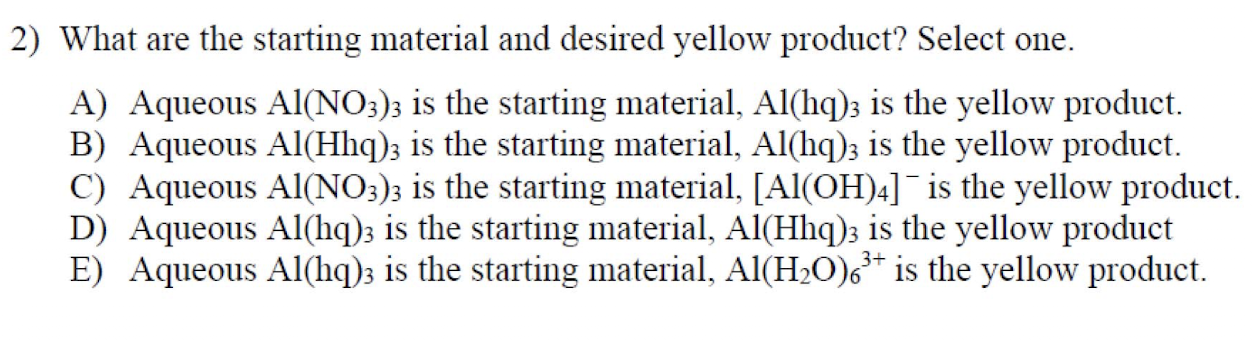
Convert Al³+ (soluble,clear) to Al(hq)3 - insoluble, yellow
Al(NO3)3 9H2O of unknown concentration Al3+ heated. Ammonium acetate buffer added to raise/control pH. Add 6M HCl to help dissolve precipitate. Precipitate forms, and solution covered overnight. Solid vacuum filtrated and weighed
Why did experiment 2 need a pH around 5
Low pH: soluble, but excess H^+ + hq → Hhq
High pH: Correct protonation → hq, but insoluble
Very high pH: 4OH- + Al3+ -→ [Al(OH)4]-
Neutral pH: Hhq (insoluble)
Why was ammonium acetate buffer added to Al3+ + Hhq reaction?
to adjust pH to ~4 and promote Al(hq)₃ precipitation
Calculations done in experiment 2, specifically for the concentration of Al3+
(mass of crucible + precipitate) - (mass of crucible) = mass of precipitate
(mass of precipitate)/(molar mass) → mol of Al(hq)3 = mol of Al³+
mol of Al³+/volume = concentration of Al³+
What were you given, your goal, and chemistry involved in experiment 3
Given an unknown acid, goal was to determine the identity of the acid HA, and will take advantage of acid-base reaction
What method was used for experiment 3
1.) Standarized 0.100M NaOH with KHP
2.) Titrations to identify the molar mass of the acid
3.) Do another titration with a pH meter, tracking pH to identify the pKa
What are the sig figs after calculating a log
Sig figs of answer = number of decimal places
What calculations were done in experiment 3
(volume NaOH)(molar conc. of NaOH) = moles of NaOH = moles of unknown
(mass of unknown)/(moles of unknown) = molar mass
1st derivative → greatest rate of change = eq. point
What equation was used in experiment 3
Henderson-Hasselbalch Equation: pKa=pH-log[A-]/[HA]
What was given, the goal, and the chemistry used for experiment 4?
Were given Fe(NH4)2(SO4)2 and mass percent of oxalate. The goal is to synthesize Kw[Fex(C2O4)y] zH2O or also known as the Fe(III)-oxalate green crystals and deterime its empirical formula. The chemistry used was spectroscopy. W
What was the method used for experiment 4
Water bath
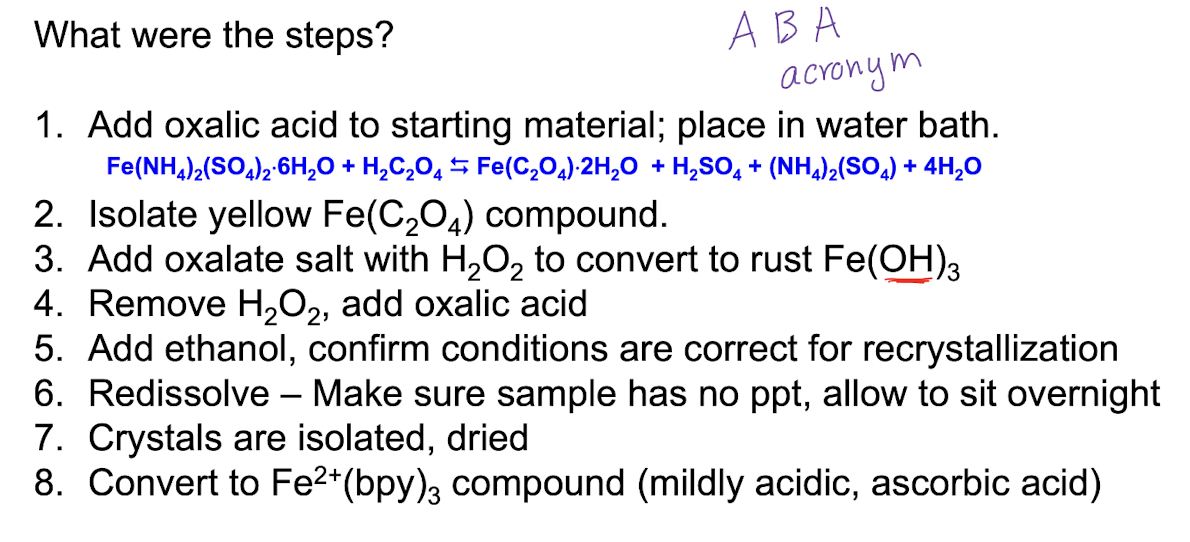
Add sulfuric acid and oxalic acid (C2H2O4) to starting material (white) → Fe(C2O4) 2H2O (yellow; Fe(II)-oxalate)
Oxidize Fe(II)-oxalate to Fe(III)-oxalate
Add potasium oxalate salt (K2C2O4) and hydrogen peroxide (H2O2) → Fe3+(OH)3 (brown; rust)
Remove hydrogen peroxide by boiling
Add oxalic acid → Fe(III) oxalate (green; Kw[Fex(C2O4)y])
Crystalize + recrystallize Fe(III)-oxalate
Add ethanol (decreases solubility) → crystals
Dissolve in water + heat → crystals
Vacuum filtration
Release oxalate ligands
Add calcium(II) → Fe3+ ions
Fe(II)-bpy is more intensely colored
Reduce Fe (III) to Fe(II)
Add ascorbic acid → Fe2+ ions
Add bpy (w/acetate buffer) → Fe(II)-bpy (red)
Primary stock: starting material + water
Secondary stock: primary + ascorbic acid + bpy
Unknown: crystals + water + CaCl2 + ascorbic acid + bpy
Add ascorbic acid to secondary stock to match unknown for spectroscopy (any errors will cancel out)
What calculations were made in experiment 4
Calibration cuve (Fe2+ cocnentratiojn vs. absorbance)
% mass of oxalate = given
% mass of iron = calculated from calibration curve
% mass of potassium = calculated from charge
% mass of water = leftover mass
Molecular weight → % yield (>100% due to contaminants)
How do you go from transmittance to absorbance
Abs = -log(transmittance)
What was the goal of experiment 1
Identify glassware that dispenses a specifc volume most accurately and demonstrate that the effect of number of trials on assessment of measurement precision
What happens when n becomes very large to approach N
The value of average should approach the true value of mu
How was the volume of water measures determined in experiment 1
First, mass of empty glass vials was measure. Water was dispensed, then the glass vials were weighed with the water. The mass of water was calculated by subtracting mass full - mass vial. Mass was converted to volume by dividing value by density at recorded temperature
Formula for sample standard deviation
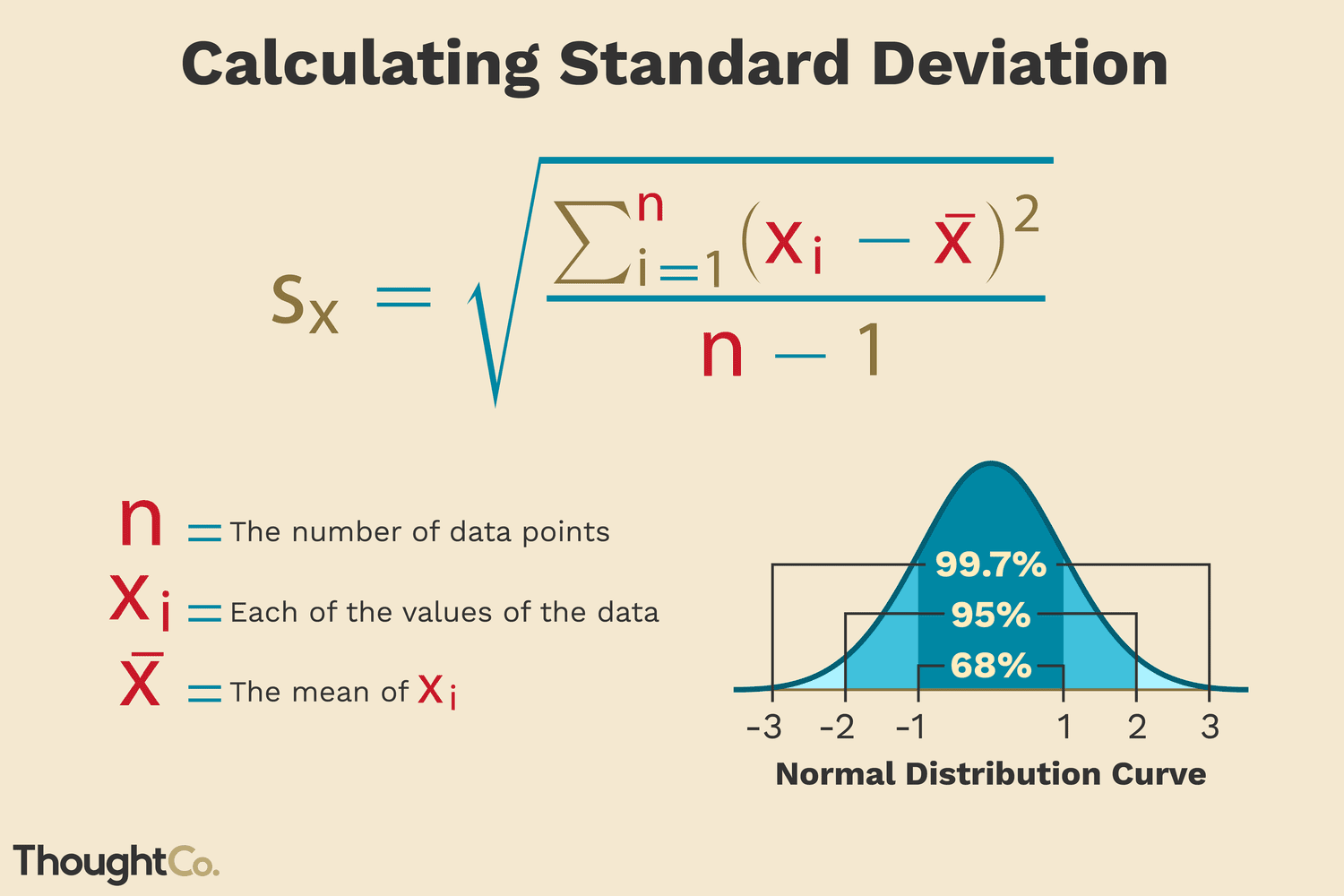
What is the formula for RSD
(standard deviation / average)*100W
What is the percent error formula
|(experimental value) - (true value)| / true value
What is gravimetric analysis
Technique to determine the amount of substance (analyte) dissolved in solution by converting it into solid that can be isolated and weighed
What is a ligand and bidentate ligans
Molecule that donates electron pairs to a metal ion to bind and form a coordination complex. A bidentate ligand can form two bonds to a metal ion
What occues with the hq ligand in experiment 2
The hq ligans deprotonated and bound Al3+ at two sites, forming Al(hq)3 precipitate I
In experiment 2, why is low pH not ideal for ligand binding
Low pH protonates hq, trying up the nitrogen lone pair so it cannot bind Al3+
In experiment 2, why is high pH not ideal for ligand binding
hq binds well, but Al³⁺ forms side products like Al(OH)₃ and Al(OH)₄ instead of the desired precipitate
In experiment 2, what pH of the Al(hq)3 reaction solution was aimed for, and why
pH ~4: because it allowed hq to bind Al³⁺ while minimizing formation of aluminum hydroxide side products, promoting formation of the desired Al(hq)₃ precipitate.
In experiment 2, what was the visual appearance of the Al(hq)3 precipitate after the addition of HCl (expt 2)?
clear, dark orange color
What was the visual appearance of the Al(hq)3 precipitate after the addition of ammonium acetate buffer (expt 2)?
darker yellow color, opaque, contained little floating yellow particles
What is volumetric analysis
Technique to determine identity or concentration of a substance by measuring the volume of a solution that reacts with it
What is a standard solution
a chemical mixture containing a precisely known and highly accurate concentration of a specific solute
What are the limiting and excess reagents of experiment 2
Al3+ = limiting
Hq- = excess
Expt 2: You start with an empty filter flask, and begin to filter trial 1. Halfway through the filtration process of the first trial, you notice that the filter flask contains liquid and yellow solid. What should you do?
Stop what you are doing. Transfer the contents of the filter flask to a secondary beaker and pass the contents of the secondary beaker through the vacuum filtration apparatus again.
Why was the dessicator prepared with anhydrous CaSo4 in experiment 2
To remove moisture from the dessicator to allow the crucibles to cool without absorbing water vapor, which would lead to artificially high mass measurements
Why were the crucibles heated in oven overnight
removes adsorbed moisture from crucible and filter paper to produce a constant dry mass for accurate weighing
Why were the crucibles cooled in the desicator before weighing
Cooling prevents convection errors during weighing (artificially low mass)
How do you calculate a dilution ratio
(value of added)/(value added + total)
How do you read a tritration curve for pH and pka
pH is at the equivalance point. Cut that volume in half, which results at the pKa
Why are buffers important in precipitation reactions
If the pH is not in the desired range, another complex may form contaminating the sample
What can be gained from a semi-mirco scale experiment
Simple procedures (less materials, less waste, and thus greener and more economical chemistry) and quicker analysis (no exact measruments needed only observations)
Why would you do a recrystallization, experiment 4
Recrystallization is a laboratory technique for purifying solids. The key features of this technique is causing a solid to go into solution, and then gradually allowing the dissolved solid to crystallize
- product is not pure
- heat up solution to dissolve both the product and impurities
- when solution cools, the products crashes out and impurities are left behind
- must use the appropriate solvent: pick a compound that will completely dissolve the impurity/contamination
In experiment 4, why was EtOH used instead of water
It does not dissolve crystals, less polar than water, and decreases the solubility of compounds (so crystals don’t dissolve)
In experiment 4, why can’t spectrophotometry be used directly
If the color intensity is weak, the analysis won't be sensitive enough
What does gravimetric analysis rely on?
Precipitate must be of low solubility, high purity, known composition, easy to separate from mixture
Why were was recryslatilzation left overnight
Leave precipitate undisturbed overnight to allow for fewer, larger, and higher purity crystals
What does it mean to do a quantitative transder
all solid in container transferred to another so none is lost, usually using DI water or another specified liquid and a glass rod to guide the solid
In experiment 3, why do we dry the KHP before use
if wet, the mass will be overestimated --> overestimate moles and concentration of NaOH
When it H2O2 a reduced or oxidized
In acidic conditions (low pH), gets reduced
In basic conditions (high pH), gets oxidized
In experiment 4, why must H2O2 be added slowly
if added too quickly, the heat liberated from it will decompose it --> the iron will not be completely oxidized, yield will be off
What steps were taken for the syntehsis in experiment 4
How is transmittance (T) calculated

Break down what everything stands for in Beer-Lambert Law
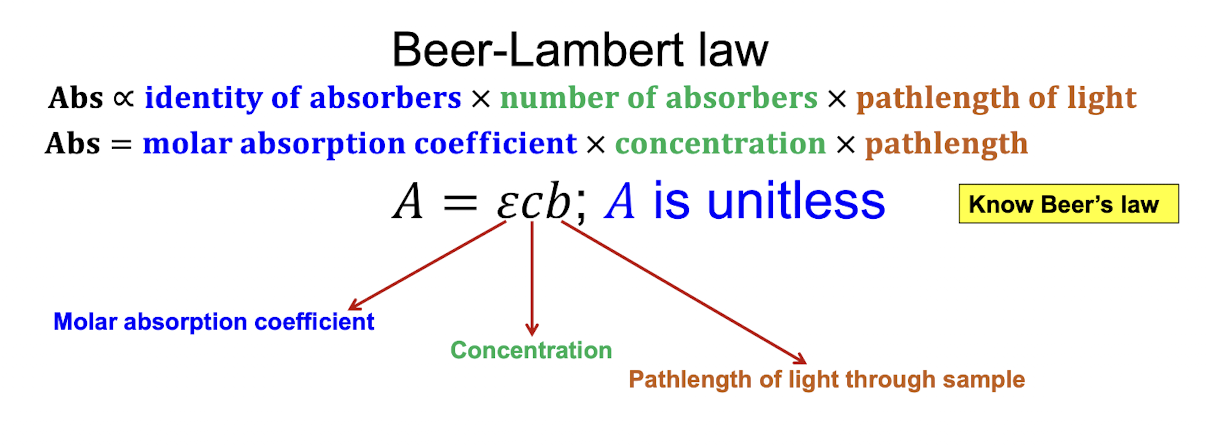
What is the relationship between absorbance with concentration and path length in a spectroscopy. What does it do to transmitted light
Absorbance (not % transmittance) is linear with respect to concentration

Absorbance (not % transmittance) is linear with respect to pathlength

What are key points for a calibration curve
Calibration curve should be linear
The 7L instrument is most reliable 10% to 90%T (1.00 to 0.05 Abs)
Your data points should fall within the highest and lowest values of the calibration points, which should be subset of 10% to 90% T
The calibration curve should have an intercept close to zero
Check the 100% T and 0% T reading intermittently, at least at the end of the experiment
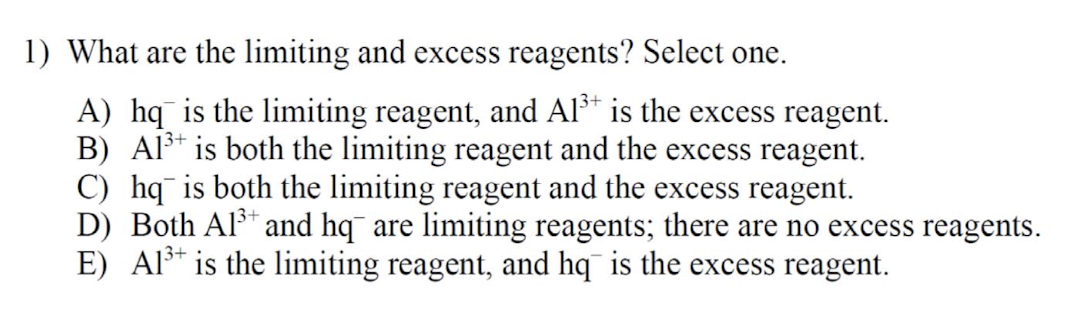
E
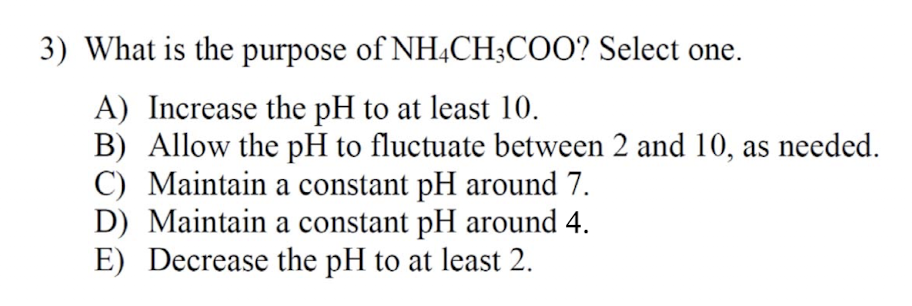
D.) Maintain a constant pH to at least 2
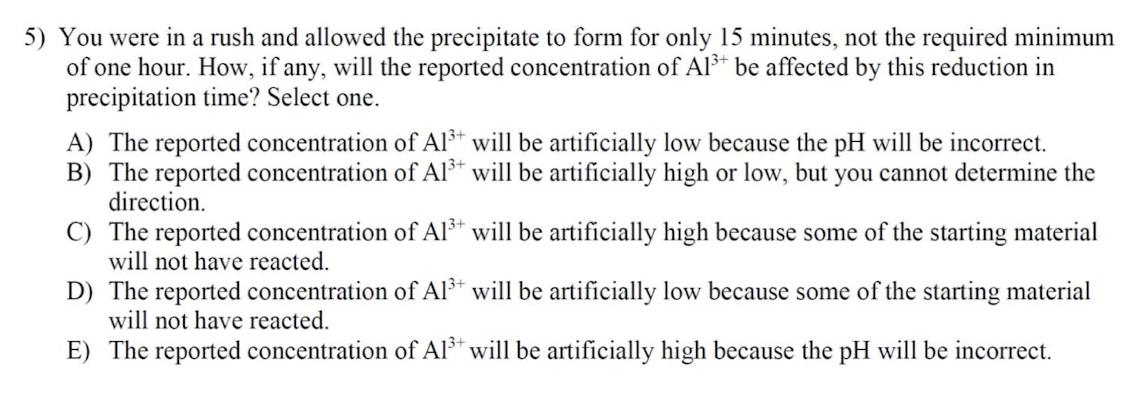
D.) The reported concentration of Al3+ will be artificially low because some of the starting material will not have reacted
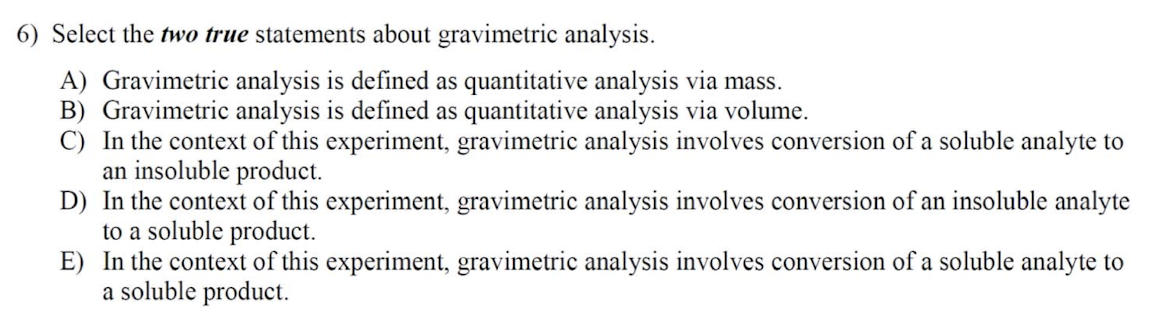
A.) Gravimetric analysis is defined as quantitative analysis via mass
C.) In the context of this experiment, gravimetric analysis analysis involves conversion of a soluble analyte to an insoluble products
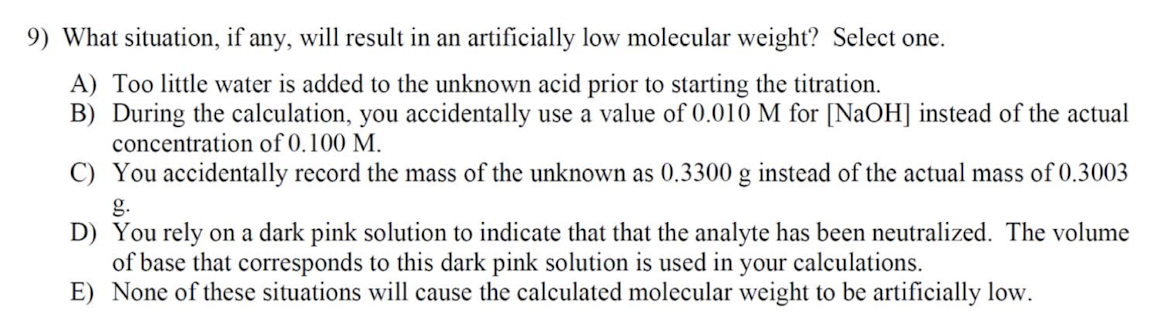
D.) You rely on a dark pink solution to indicate that the analyte has been neutralized. The volume of base that corresponds to this dark pink solution is used in your calculations
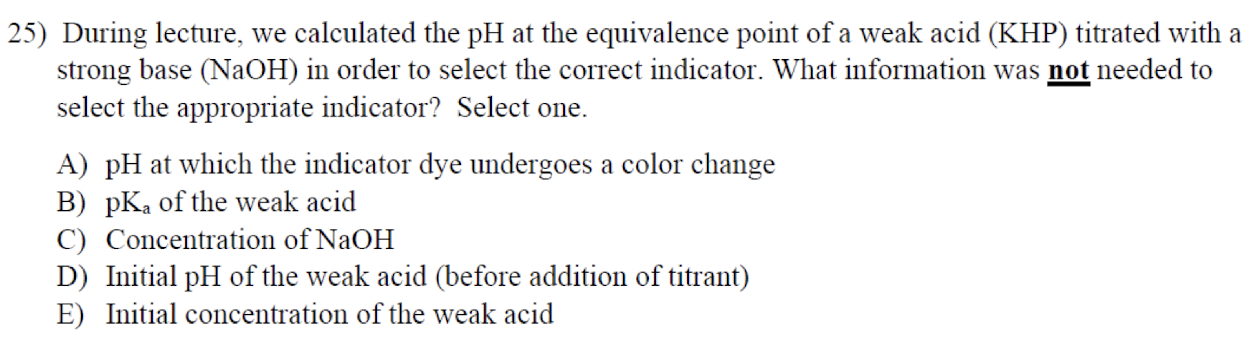
D.) Initial pH of the weak acid (before addition of titrant)

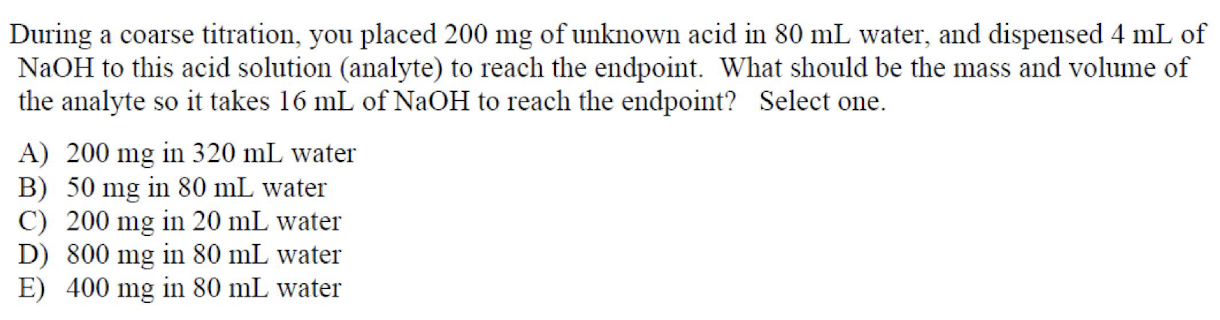
D.) 800mg in 80 mL water
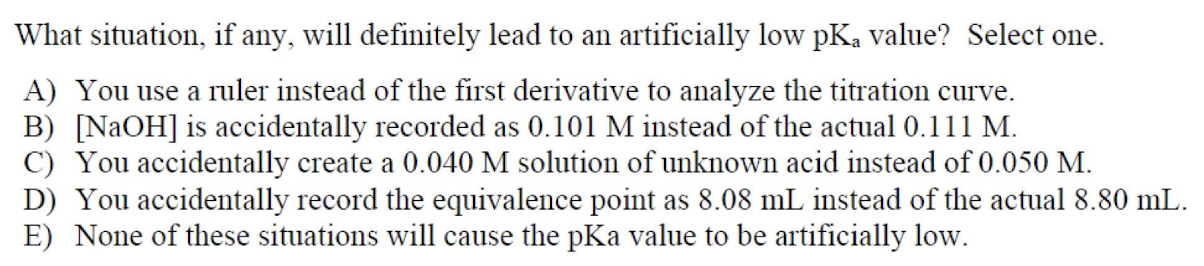
D.) You accidentally record the equivalence point as 8.08mL instead of the actual 8.80mL
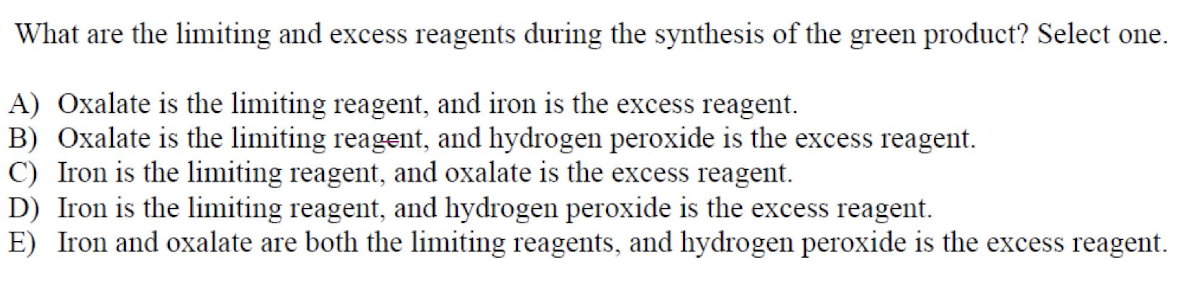

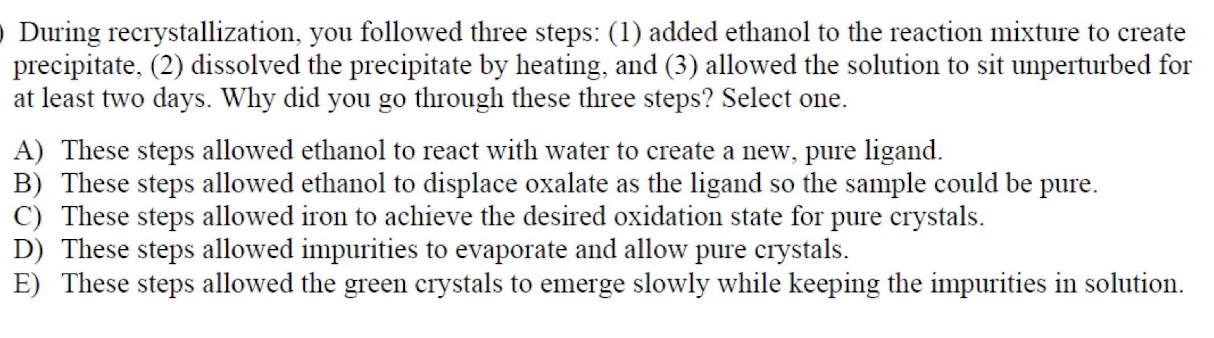
E.) These steps allowed the green crystals to emerge slowly while keeping the impurities in solution
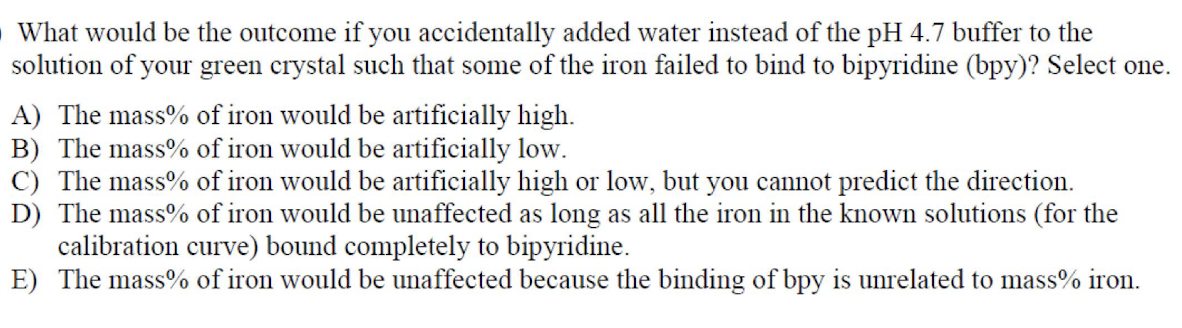
B.) The mass % of iron would be artificially low
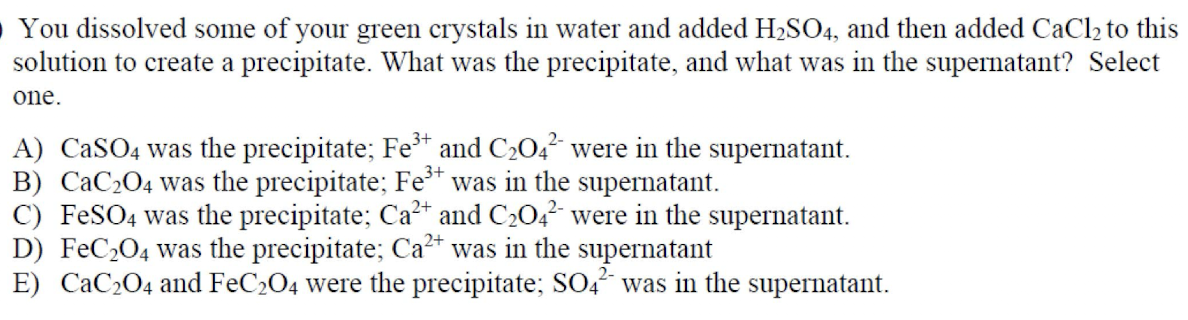
B
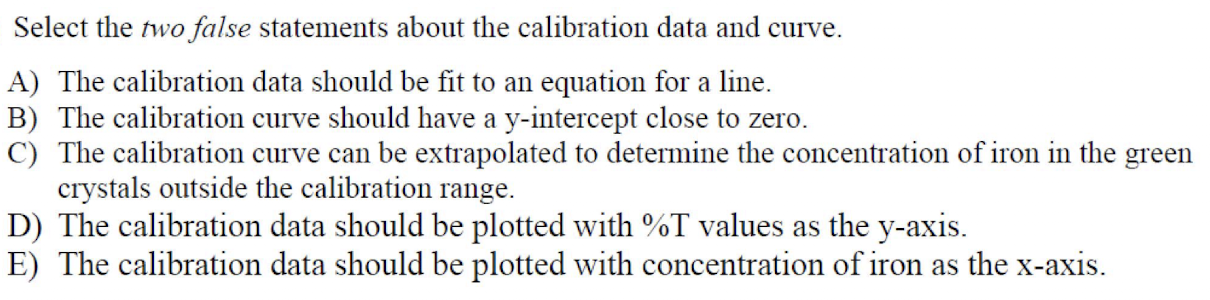
C and D