Endocrine System
 Call Kai
 Learn
Learn Practice Test
 Spaced Repetition
 Match
Match Flashcards
 Knowt Play
1/37

There's no tags or description
Looks like no tags are added yet.
Name | Mastery | Learn | Test | Matching | Spaced | Call with Kai |
|---|
No analytics yet
Send a link to your students to track their progress
38 Terms
What is the name of the signal molecule released by a neuron from the endocrine signaling?
Neurohormone
Hypothalamic Regulatory Hormones
(no need to memorize hormones, but they’re either releasing/inhibiting hormones)
Organ: Hypothalamus
Water or Lipid: Water soluble
Target: APG
Oxytocin
Organ: Hypothalamus (make), PPG (releases)
Water soluble
Stimulus: Neural
Target:
Myometrium (smooth muscle of uterus) to contract during childbirth
Myoepithelial (smooth muscle in mammary gland) to contract + release milk
Limbic system to promote bonding, love
Hyposecretion: Less bonding
Hypersecretion: No negative impact
Antidiuretic Hormone (ADH) Vasopressin
Organ: Hypothalamus (make), PPG (release)
Water soluble
Stimulus:
Neural (low BP)
Hormonal (angiotensin II)
Humoral (low H2O, Na+)
Target:
Collecting tubules of nephron to increase water reabsorption
Smooth muscle of tunica media of arteries to vasoconstrict
Hyposecretion: Diabetes insipidus
Hypersecretion: SIADH (Syndrome of Inappropriate Antidiuretic Hormone secretion)
Hyposecretion of ADH
Central diabetes insipidus: NO ADH secretion
Nephrogenic diabetes insipidus: ADH receptors defective
Symptoms: polyuria, intense thirst
Hypernatremia: cells shrivel, high Na+ —> hyperpolarized
Hypersecretion of ADH
SIADH
Symptoms: retain H2O, edema, cerebral edema
Hyponatremia: cells swell/burst, depolarize
Growth Hormone
Organ: APG
Water soluble
Stimulus: Hormonal —> regulatory neurohormone from hypothalamus
Target: Liver —> secrete insulin growth like factor 1 (IGF 1)
Which stimulates bones, muscle, cartilage to grow
—> Lipolysis
—> Gluconeogenesis (increased blood glucose)
Hyposecretion: Child = Pituitary dwarfism
Hypersecretion: Child = Gigantism (even proportions), Adult = Acromegaly (hands, feet, face only)
Prolactin
Organ: APG
Water soluble
Stimulus: Hormonal —> from hypothalamus
Target: Mammary glands to produce milk
Hyposecretion: Less milk production
Hypersecretion: Galactorrhea —> excess milk production (bf females), Impotence (males)
Thyroid Stimulating Hormone
Organ: APG
Water soluble
Stimulus: Hormonal —> from hypothalamus
Target: Thyroid gland to stimulate production of thyroid hormones
(Hypo/hyper covered later)
Adrenocorticotropic Hormone
Organ: APG
Water soluble
Stimulus: Hormonal —> from hypothalamus
Target: Cortex of adrenal gland to release corticosteroid hormones
(Hypo/hyper covered later)
Follicle Stimulating Hormone
Organ: APG
Water soluble
Stimulus: Hormonal —> from hypothalamus
Target:
Male: Sertoli cells in testes to release androgen binding protein for sperm production
Female: Granulosa cells to produce estrogen to mature primary follicle + ovary to release mature egg during ovulation
Hyposecretion: Failure to sexually mature
Hypersecretion: None
Luteinizing Hormone
Organ: APG
Water soluble
Stimulus: Hormonal —> from hypothalamus
Target:
Male: Leydig cells in testes to produce testosterone
Female: Theca cells in ovary to produce estrogen + ovary to release mature egg during ovulation
Hyposecretion: Failure to sexually mature
Hypersecretion: None
Melatonin
Organ: Pineal gland
Water soluble
Stimulus: Neural —> low light stimulate production
Target: Brain to produce sleep
Hyposecretion: Insomnia
Hypersecretion: Seasonal affective disorder, tired, depressed
Thyroid
Has follicles
Circle of cells surrounding a fluid center, fluid is called colloid
Follicle cells make thyroglobulin
Thyroglobulin goes into colloid where iodine is adding/making T3 & T4
T3 & T4 leave follicle into blood
Thyroid Hormones - T3 & T4
Organ: Thyroid
***Lipid soluble (uses facilitated diffusion to attach receptor inside cell) (uses a protein carrier to travel in blood - made by liver)
Stimulus: Hormonal (low TH —> hypothalamus release regulatory hormone —> APG to release TSH —> Thyroid to release TH)
Target: Most cells to stimulate cell metabolism
Hyposecretion: low energy, weight gain, goiter
Hashimoto’s disease - Type 4 HS, attack follicle cells
Myxedema —> low TH release
Goiter - low iodine, follicle makes thyroglobulin, sends to colloid but no iodine so T3 + T4 cannot be made and colloid swells resulting in goiter
Hypersecretion: high metabolism, weight loss, bulging eyes
Grave’s disease - Type 4 HS, mimics TSH
Hypocalcemia
RMP -70mV
Neuron RMP: less Ca2+, more positive (e.g. -60mV), easier to reach threshold potential (-55mV) so, spontaneous AP, seizures
Heart: Weak, low HR
Muscle contraction: Weak
Skeletal: Weak bones
Hypercalcemia
Neuron RMP: more negative, greater stimulus to reach threshold potential
Heart: Tachycardia, HF
Muscle contraction: Increased
Bone Cells & Matrix
Matrix —> calcium phosphate
Osteogenic cell - stem cell
Osteoblast - make matrix
Osteoclast - breakdown matrix
Osteocyte - surrounded by matrix, maintain matrix
Calcitonin
Organ: Thyroid
Water soluble
Stimulus: Humoral —> high blood calcium
Target: (both to lower calcium levels)
Inhibit osteoclasts
PCT to inhibit Ca2+ reabsorption
Hyposecretion: Hypercalcemia
Hypersecretion: Hypocalcemia
*Trick to remember: Calcitonin —> “tone” it down
Parathyroid Hormone
Organ: Parathyroid
Water soluble
Stimulus: Humoral —> low blood calcium
Target: (to increase blood calcium)
Stimulates osteoclasts
DCT + Collecting tubules to reabsorb Ca2+, and PCT to secrete phosphate
Kidneys to convert cholecalciferol to calcitrol (active vitamin D) to target small intestines to increase Ca2+ absorption
Hyposecretion: Hypocalcemia
Hypersecretion: Hypercalcemia
Hyponatremia
Cells: Swells or burst/lyse (hypotonic) (too much water inside cell)
Glucose absorption: Decreased absorption
Nervous RMP: Little impact, but decreased depolarization
Heart: Arrythmias
BP: Hypotension
Skeletal muscle contraction: Weak
Hypernatremia
Cells: Cremate or shrivel (hypertonic) (less water inside cell)
Glucose absorption: Increased absorption
Nervous RMP: Hyperpolarized
Heart: Arrythmias
BP: Hypertension
Hypokalemia
pH: alkaline
Nervous RMP: Hyperpolarized, slower repolarization
Heart: Hyperpolarized, arrhythmias
Skeletal muscle contraction: Weaker
Hyperkalemia
pH: acidosis
Nervous RMP: Depolarized, less negative, closer to threshold
Heart: Increase T wave (ventricle repolarization), arrhythmias, HF
Skeletal muscle contraction: Weaker
Mineralocorticoids - Aldosterone (most abundant)
Organ: Adrenal cortex - zona glomerulosa
Lipid soluble (uses a protein carrier to travel in blood)
Stimulus: Hormonal —> angiotensin II
Targets: DCT + CT of nephrons to reabsorb Na+ and H2O and secrete K+
Hyposecretion: Addison’s disease (see cortisol)
Hypersecretion: Aldosteronism (edema, hypertension, hypokalemia)
Glucocorticoids - Cortisol (most abundant)
Organ: Adrenal cortex - zona fasiculata
Lipid soluble (uses a protein carrier to travel in blood)
Stimulus: Hormonal
Regulatory hormone of hypothalamus —> ACTH by APG —> Cortisol by adrenal cortex
Targets:
Liver + Kidneys for glycogenolysis, gluconeogenesis (to increase blood glucose: vasoconstriction, anti-inflammatory, decrease immune system/ low WBCs)
Brain to wake from sleep - circadian rhythm
Hyposecretion: Addison’s disease
Low aldosterone + low cortisol
Bronzed skin (increased melanin)
Low BP
Weight loss
Salt craving
Hypersecretion: Cushing’s disease
Steroid diabetes - temporary hyperglycemia caused by use of corticosteroid meds
Buffalo hump
Moon face
High BP
Weight gain
Facial and body hair
Gonadotropins - Androgen
Organ: Adrenal cortex - zona reticularis
Lipid soluble - protein carrier
Stimulus: Hormonal —> ACTH
Targets: Unclear, libido
Hyposecretion: Unknown
Hypersecretion: Masculinization in females
Epinephrine & Norepinephrine
Organ: Adrenal medulla
Water soluble
Stimulus: Neural
Targets: Sympathetic NS - fight or flight —> short term stress vs cortisol is long term stress
Hyposecretion: Unknown
Hypersecretion: HTN, prolonged fight or flight response
Glucagon
Organ: Pancreas
Water soluble
Stimulus: Humoral - low blood glucose levels
Targets: Liver to perform glycogenolysis to increase blood glucose levels
Hyposecretion: Unknown
Hypersecretion: Unknown
Insulin
Organ: Pancreas
Water soluble
Stimulus: Humoral - high blood glucose levels
Targets:
Cells to take in glucose (and K+)
Liver to stimulate glycogenesis
Hyposecretion: DM
Hypersecretion: Hyperinsulinism (anxiety, nervousness)
Testosterone
Organ: Testes
Lipid soluble - carrier protein
Stimulus: Hormonal - LH
Targets:
Spermatogonium to perform meiosis
All cells for various cell metabolism and secondary traits (e.g. muscle mass, deep voice)
Hyposecretion: Less masculine traits, low sperm production, potential infertility
Hypersecretion: Aggression, low sperm, infertility
Spermatogenesis Pathway
Stimulus: Low testosterone, low sperm
Hypothalamus to release regulatory hormone
APG to release FSH + LH
(2 things)
FSH targets Sertoli cells in testes to release androgen binding protein (ABP)
LH targets Leydig cells in testes to make testosterone
Testosterone + ABP signal spermatogonium to develop into sperm
(2 things)
High levels of testosterone inhibit hypothalamus to turn off pathway
High sperm stimulates cells in testes to make inhibin, which also inhibits the hypothalamus to turn off pathway
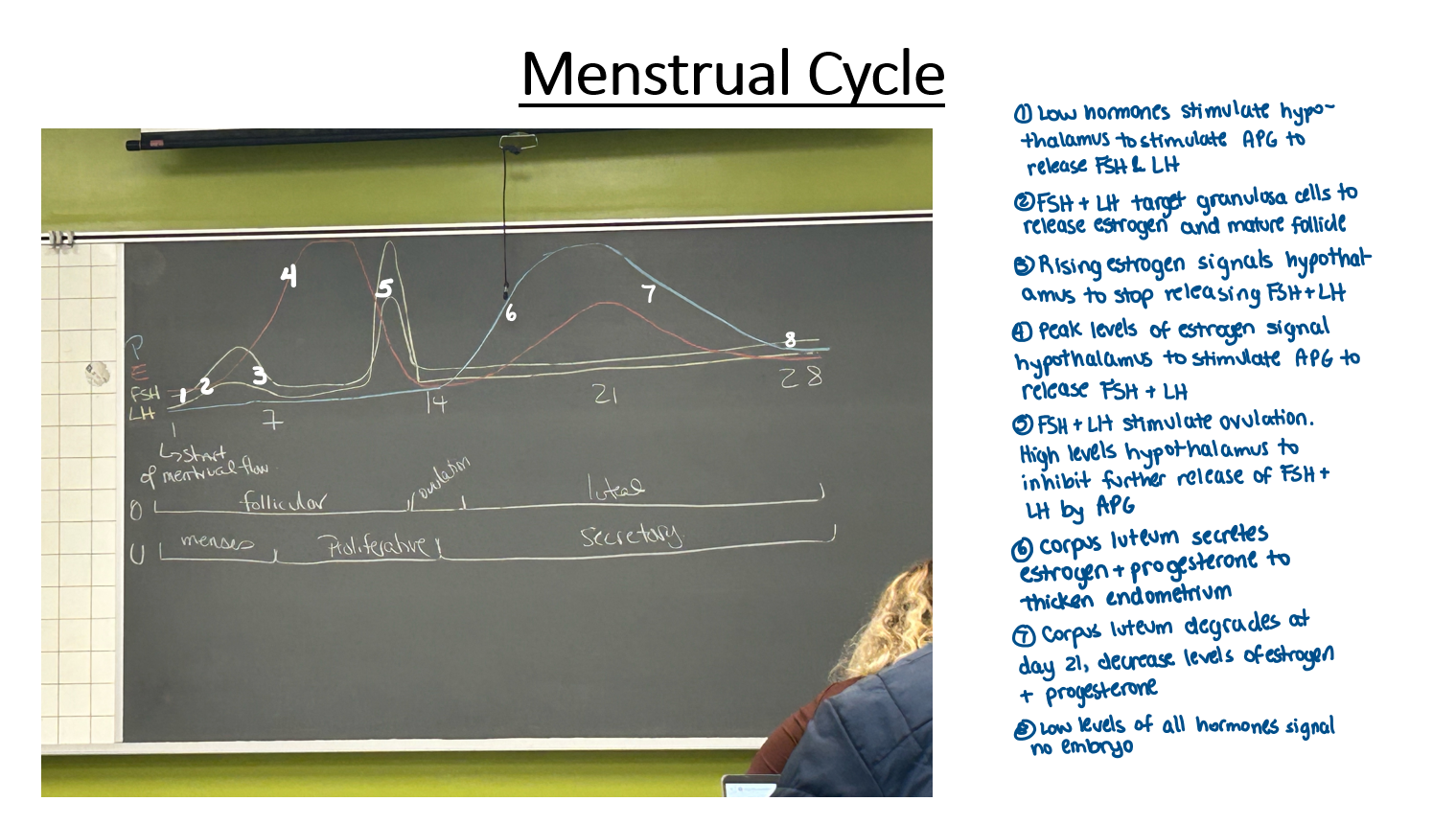
Estrogen
Organ: Ovaries
Lipid soluble - carrier protein
Stimulus: Hormonal - FSH + LH
Targets:
Primary follicle to mature
Endometrium to thicken
All cells for cell metabolism and secondary traits (e.g. fat deposits, breast development)
Hyposecretion: Infertility, no menstrual flow
Hypersecretion: Infertility
Progesterone
Organ: Ovaries (corpus luteum)
Lipid soluble - carrier protein
Stimulus: Hormonal - LH
Targets: Endometrium to thicken
Hyposecretion: Infertility, irregular menstruation
Hypersecretion: Unknown
Ovarian Cycle —> changes in ovary
1-3 —> follicular —> mature follicle
14 —> ovulation —> egg released into oviduct
15-18 —> corpus luteum secreting estrogen+ proges. + then dives up
Uterine Cycle —> changes in endometrium
1-7 —> menses —> shedding of endometrium
8-14 —> proliferative —> thicken endometrium
15-28 —> secretory —> thicken + maintain endometrium
Menstrual Cycle