Cognitive explanation of depression
 Call Kai
 Learn
Learn Practice Test
 Spaced Repetition
 Match
Match Flashcards
 Knowt Play
1/33

There's no tags or description
Looks like no tags are added yet.
Name | Mastery | Learn | Test | Matching | Spaced | Call with Kai |
|---|
No analytics yet
Send a link to your students to track their progress
34 Terms
What do cognitive explanations of depression believe that the disorder is the result of?
disturbance in thinking
What did Aaron Beck come up with?
Beck’s Cognitive Theory of Depression
When did he come up with Beck’s Cognitive Theory of Depression?
1967
Beck’s Cognitive Theory of Depression (1967): what did he suggest?
that some people are more vulnerable to depression than others - This is due to their cognitions (the way they think)
The 3 parts to this cognitive vulnerability?
faulty informational processing, negative self schema and negative triad
Faulty information processing?
Beck believed that people who are depressed make fundamental errors in logic
Faulty informational processing 2 examples?
attending to and dwelling on the negative and absolutist thinking
Negative self schema: what is a schema?
a building block of knowledge, a ‘package’ of ideas and information that has developed with experience
Negative self schema: what is a self-schema?
the collection of information about yourself
Negative self schema: what is a negative self-schema?
the information you think about yourself is negative - interpret all information about ourselves in a negative way
Negative triad: what did Beck suggest that people with depression become trapped in?
a cycle of negative thoughts
Negative triad: the 3 parts of it?
negative view of the self, negative view of the world and negative view of the future
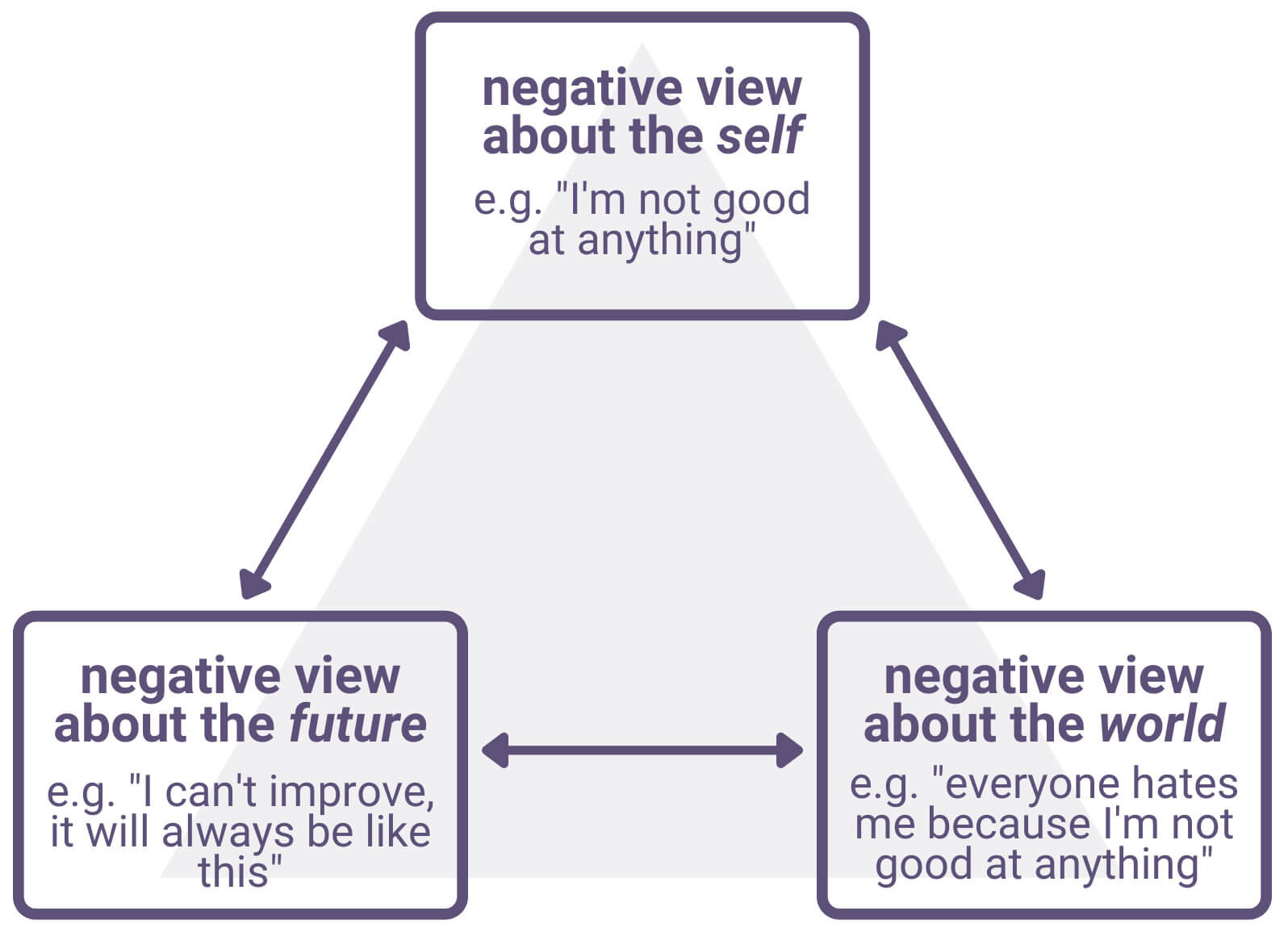
Negative triad: what all feeds into each other?
all the negative views
What did Albert Ellis propose?
Ellis’s ABC model
Ellis’s ABC model: what did he propose that good mental health is the result of?
irrational thoughts
Ellis’s ABC model: what did he suggest conditions such as depression were the result of?
irrational thoughts
Ellis’s ABC model: what are irrational thoughts?
thoughts that interfere with us being happy and free of pain
Ellis’s ABC model: What did he use this model to explain?
how these irrational thoughts affect our behaviour
Ellis’s ABC model: A?
activating event
Ellis’s ABC model: B?
Belief
Ellis’s ABC model: C?
consequence
Ellis’s ABC model: activating event?
any event that could trigger an irrational thought
Ellis’s ABC model: belief?
an irrational thought that is not supported by reality
Ellis’s ABC model: Consequence?
a behaviour or emotion that results from an irrational thought
Beck’s theory ✔ - P: what has it led to be developed?
treatments
Beck’s theory ✔ - Ex1: what treatment has been developed from this explanation of depression?
the development of CBT (cognitive behavioural therapy)
Beck’s theory ✔ - Ex2: what can be identified and challenged by CBT?
all of the cognitive aspects of depression
Beck’s theory ✔ - Ev: specifically, what can be challenged by the therapist?