Food Packaging Interactions
 Call Kai
 Learn
Learn Practice Test
 Spaced Repetition
 Match
Match Flashcards
 Knowt Play
1/23

There's no tags or description
Looks like no tags are added yet.
Name | Mastery | Learn | Test | Matching | Spaced | Call with Kai |
|---|
No analytics yet
Send a link to your students to track their progress
24 Terms
What are packaging interactions?
Permeation —> through the packaging (gasses)
Migration —> out of the packaging (monomers and additives)
Absorption (scalping) —> into the packaging (Aroma compounds. fats, organic acids, pigments)
Which law governs migration from pastic into food?
Ficks second law (concentration changes vs time)
What are the mechanisms of Migration?
migrant must diffuse through the polymer matrix
partition across the polymer-food interface
diffuse through the food
How can you accelerate migration?
short-contact, high-temp. situations
What are they key influencing factors at the polymer side?
crystallinity —> lower crystallinity diffusivity increases
Molecular weight (Mw) —> high molecular weight makes it still lowers diffusivity
additive content —> generally low Mw which gives flexibilty
thickness —> increased thickness diffusivity decreases
polarity (polyester higher than polyolefinic) —> affinity matters
glass transition temperature (Tg)
What is the glass transition temperature?
Rubbery polymers —> high diffusion
glassy polymers —> low diffusion (stiff)
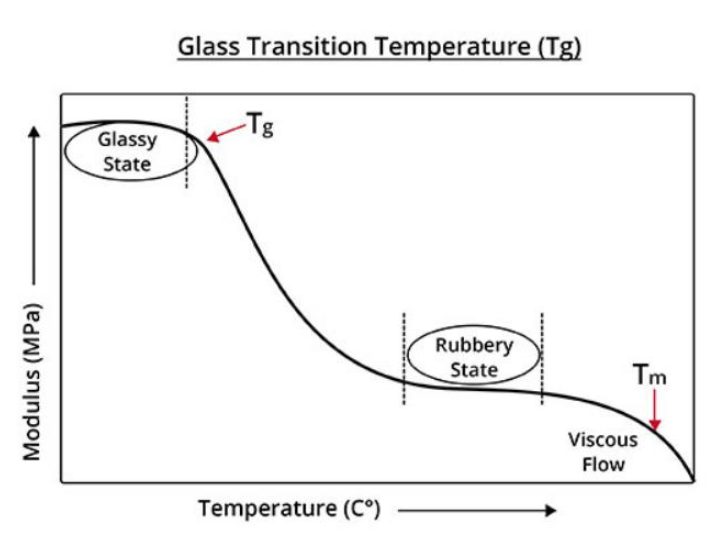
Why does retort processing matter in cans (Bisphenol A (BPA))?
BPA from can epoxy coatings only mobilizes when the can is heated above the Tg of resin (150 degrees)
What are the key influencing factors at the migrant side?
molecular size (smaller —> faster)
Polarity (lipophilic migrants go into fatty foods much faster)
volatility
What are the key influencing factors at the food side?
Antioxidant additives —> can migrate intentionally (active packagining) and unintentionally
BHT
Why does migration usually increase with temperature?
Diffusion coefficient increases
Which polymer property usually reduces migration?
High crystallinity
What are key migrants?
Glass packaging:
silicates
heavy metals
Metal packaging:
tin dissolution from plain tinplate into tomato products
Paper and board:
BP photoinitiator migrant from UV-cured inks
printing inks
Plastics:
risidual monomers
plasticizers
antioxidants
risidual solvents
low Mw compounds
decomposition products
What is an example of residual monomers?
Vinyl chloride monomer (VCM) from PVC
correlation between VCM inhalation and cancer
Styrene monomer from PS
taste threshold in orange juice is as low as 0.2-0.3 ppm
What are plasticizers?
Phthalates (from PVC) are endocrine disruptors
What are EU directives?
The rules for plastics (specific and overall (10mg/dm2) migration limits) and simulants
Why are simulants measured and not food?
Real food is too complicated and is not standardized.
assumed surface to volume ration is important (6dm2/kg)
Are there standard conditions for migration experiments?
Yes, there are standard conditions for contact during processing and shelf life experiments
Why is the surface to volume ration important in migration testing?
It standardizes exposure conditions
If contact time between food and packaging increases, migration will…
increase until the equilibrium is reached
which change definitely reduces migration?
Increasing film thickness
Why does orange juice in HDPE taste different after storage?
Scalping:
d-limonene (main component of essential oils in citrus juices) —> lipophilic and non polar
What is scalping?
When food components (mainly flavor compounds) are absorbed on packaging materials with consequent severe reduction of quality.
Why does absorption and scalping occur?
partition between food and polymer
sorption into amorphous polymer regions