S1.5 Ideal gases
 Call Kai
 Learn
Learn Practice Test
 Spaced Repetition
 Match
Match Flashcards
 Knowt Play
1/16

There's no tags or description
Looks like no tags are added yet.
Name | Mastery | Learn | Test | Matching | Spaced | Call with Kai |
|---|
No analytics yet
Send a link to your students to track their progress
17 Terms
Ideal gas laws (5)
Particles r in constant random motion
Volume of gas is negligible to volume of container(it takes no space)
No intermolecular forces exist between gas particles
All collisions r perfectly elastic(no kinetic energy lost)
Temperature of gas (K), is directly proportional to avg kinetic energy of particles
What makes a real gas deviate from ideal gas behaviour? (3)
They have a finite.measurable volume
They have intermolecular forces between particles
They deviate most at low temperatures and high pressures
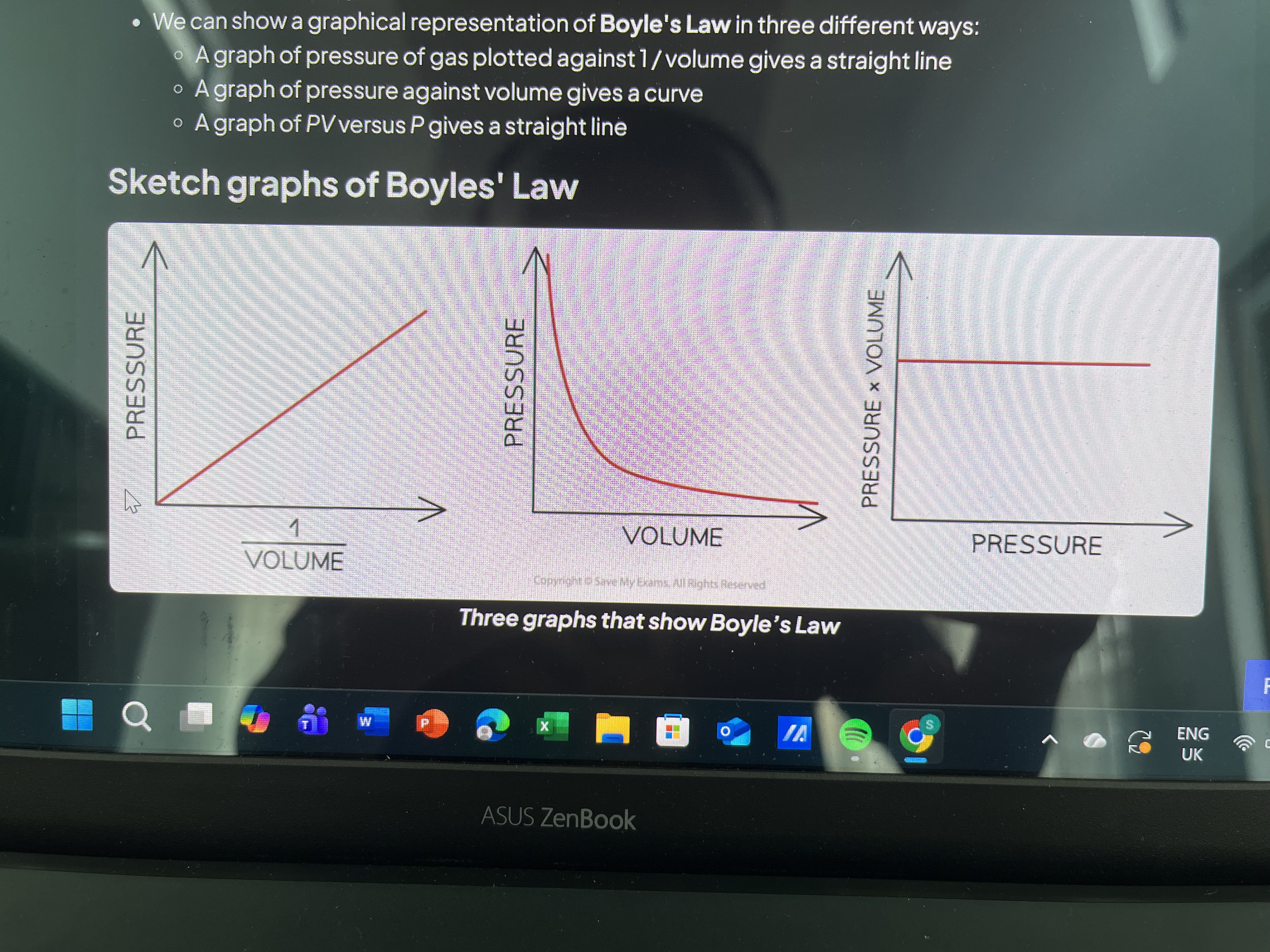
Relationship between pressure and volume of gas(Boyle’s law)
p→1/V
pV=k
p1V1=p2V2
Relationship between pressure and volume of gas(Boyle’s law)
p→1/V
pV=k
p1V1=p2V2
True or false: gases with weak intermolecular forces will show more deviation from ideal gas behaviour
False
Ideal gases have no intermolecular forces:
weak IF→less deviation
Strong IF→more deviation
What conditions allow real gases to be similar to ideal gases?
High temperatures
Low pressure
Avogadro’s law about gases volume
Gases occupying same volume under same t and p contain same amt of particles
What is the molar volume of 1 mol of an ideal gas at stp?
22.7 dm³/mol
How do u calculate the volume of a gas at stp?
V (dm³)= n x 22.7
Relationship between gas and temperature(Charles’ law)
V—>T(K)
V/T=k
More frequent collisions→gas must expand to keep p constants→V increases
Relationship between pressure and temperature
P→T(K)
P/T=k
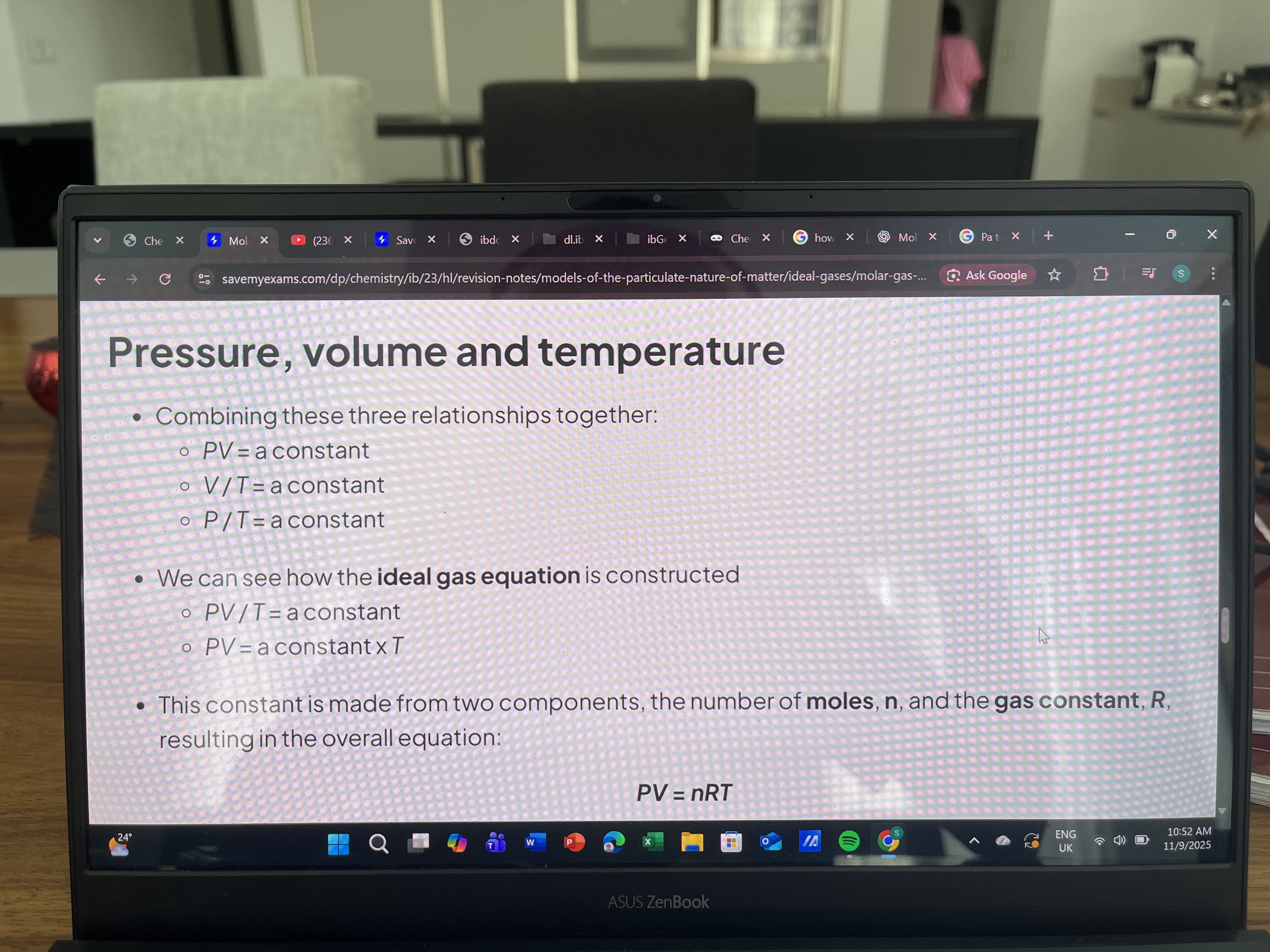
How ideal gas eqn is constructed
What is the combined gas law and units involved?
T(K)
p(Pa→0.001 kPa)
V(m³→1000dm³)
p1V1/T1=p2V2/T2
What is the ideal gas equation and the units involved
pV=nRT
T(K)
p(kPa/Pa)
R=8.31 J/K mol
n(mol)
V(dm³/m³)
Differences between ideal and real gases

Graphs of Boyle’s law
Why might the molar mass value of a real gas be different when finding it using pV=nRT?
It’s not an ideal gas so it does not perfectly follow the ideal gas law