Ch 4: Mathematical Expectation
 Call Kai
 Learn
Learn Practice Test
 Spaced Repetition
 Match
Match Flashcards
 Knowt Play
1/15

There's no tags or description
Looks like no tags are added yet.
Name | Mastery | Learn | Test | Matching | Spaced | Call with Kai |
|---|
No analytics yet
Send a link to your students to track their progress
16 Terms
What is Mathematical Expectation?
The theoretical average a random variable can take over a large number of repeated events. Synonymous with Expected Value.
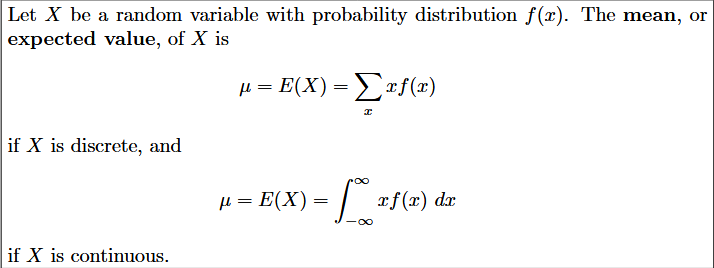
Mean of random variable E(X)
-also denoted by μx
-sum of all x * f(x)
-relate it back to finding sample mean
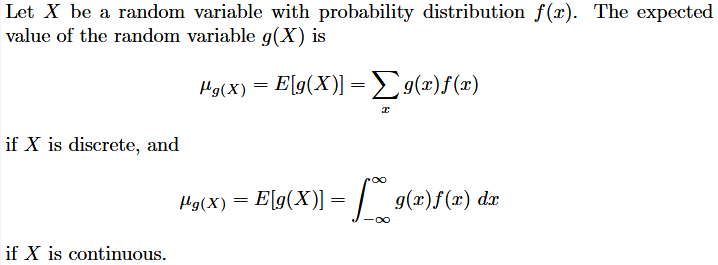
Mean of function E[g(X)]
-sum of g(x) * f(x)
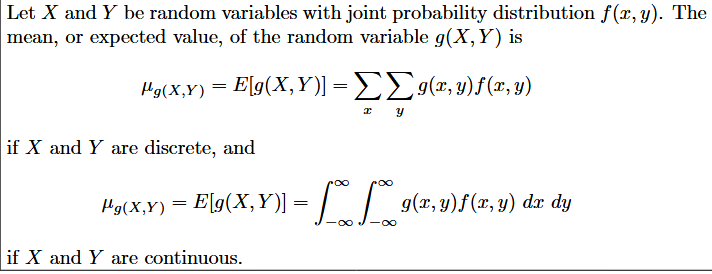
Mean of Joint Probability Distribution E[g(X, Y)]
-sum of xy * f(x, y)
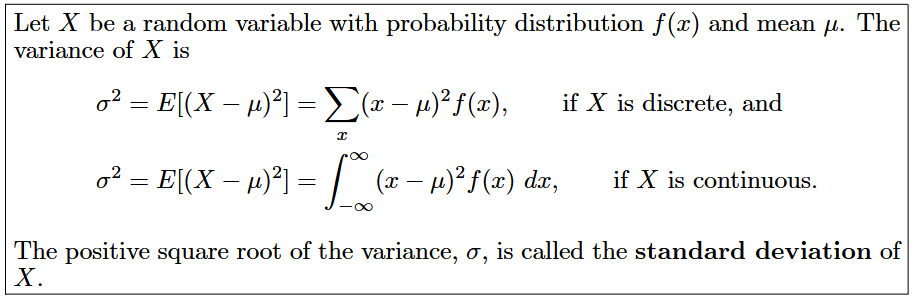
Variance of Random Variable (σ2)
V(X) = E(X2)-(μ)2
Covariance Function
-determines the linear relationship between two Random Variables (positive/negative)
-E(XY) - μxμy

Correlation Coefficient
-shows the direction AND strength of two Random Variables
-unitless version of Covariance

Theorem 4.5

Theorem 4.6

Theorem 4.7

Theorem 4.8
X and Y MUST be independent

Theorem 4.9

Corollary 4.9
If X and Y are INDEPENDENT

Corollary 4.11
Multiple independent variables

Chebyshev’s Theorem (Probability Distributions)
-recall Chebyshev’s Theorem from Ch 1

Importance of Mathematical Expectation
Knowing parameters (like mean, variance, standard deviation, covariance…) is fundamental for understanding a system’s general nature. We get an idea of central tendency, variability, and trends