34. Chromatography
 Call Kai
 Learn
Learn Practice Test
 Spaced Repetition
 Match
Match Flashcards
 Knowt Play
1/40

There's no tags or description
Looks like no tags are added yet.
Name | Mastery | Learn | Test | Matching | Spaced | Call with Kai |
|---|
No analytics yet
Send a link to your students to track their progress
41 Terms
What are the basic principles of all kinds of chromatography?
A family of separation techniques that depend on the principle that a mixture is separated if it is dissolved in a solvent and this mobile phase is passed over a solid (the stationary phase).
What is the mobile phase?
Carries the soluble components of the mixture up the plate
(the solvent)
What relationship between a sample and the mobile phase makes the sample move faster?
More soluble components / components with more affinity to the solvent move faster
Stationary phase
Whatever the moving phase moves through e.g. silica / alumina gel
What does the stationary phase do?
Holds back components of the mixture that are attracted to it.
What affects retention time?
1. Retention by the stationary phase.
2. Solubility in the moving phase.
What is the relationship between a sample and the stationary phase that make the sample move slower?
What kind of bonding does this often involve?
More affinity for the stationary phase means that a component moves slower; often attracted by hydrogen bonding
How are substances separated by chromatography?
If suitable stationary/mobile phases are chosen, the balance between affinity for the mobile phase and affinity for the stationary phase is different for each component of the mixture. Thus, they move at different rates and are separated over time.
What determines the distance a component moves?
The balance between solubility in the moving phase and retention by the stationary phase varies between the components.
1. Level of retention of the component by the stationary phase. Whether the component and the stationary phase are both polar, or could form hydrogen bonds.
2. The level of solubility of the component in the moving phase.
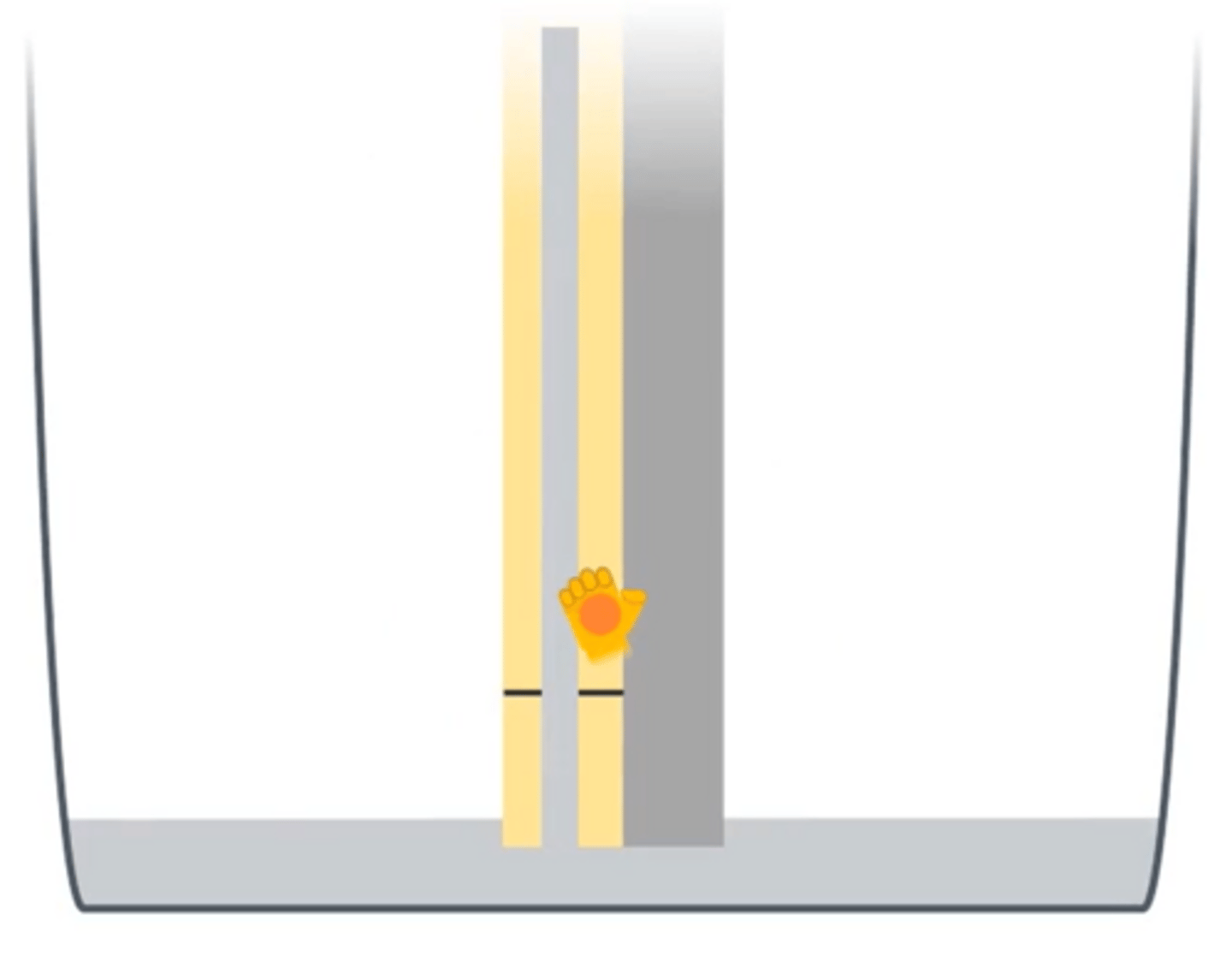
Affinity
The two components have different relative affinities (attraction) for the moving phase and stationary phase.
Here, “affinity” is just another way of referring to solubility and retention. “This component has a greater affinity for the stationary phase than this component” means more or less the same as “this component has greater retention by the stationary phase than this component”.
Thin-layer chromatography was used to analyse a mixture of propanal and dimethylpropane.The stationary phase was alumina.The moving phase was hexane.Dimethylpropane rose higher on the plate than propanal.Explain why.
Dimethylpropane is non-polar, and therefore has greater solubility in the moving phase (hexane), which is also non-polar, compared to propanal, which is polar.
Propanal is polar, and therefore has greater retention by the stationary phase (alumina), which is also polar, compared to dimethylpropane, which is non-polar. As a result, propanal is held in the stationary phase for longer.
Why will different substances show different R, values?
They are bonded differently and have different polarities - more polar bonds mean longer retention time or smaller Rf value, since hydrogen bonding/dipoles are attracted more strongly to the stationary phase
What does TLC stand for?
Thin Layer Chromatography
What is the stationary phase in TLC
Plastic/glass/metal sheet or "plate" coated in silica (SiO₂) or alumina (Al₂O₃)
What are the advantages of TLC over paper chromatography?
Runs faster
Smaller amounts of a mixture can be separated
TLC plates are more robust that paper
Describe how to set up a thin-layer chromatography experiment.
1 .Take a sheet/plate of glass, plastic or metal.
2. Coat it with a thin layer of silica gel or alumina.
3. Draw a pencil line near to the bottom.
4. Place a small drop of the sample on this line.
5. Place the plate in a beaker containing solvent, but not enough to reach the pencil line.
6. Cover the beaker.
A component which ends up near / further the solvent front will have a Rf value closer to...
Near = 1
Further = 0
Always a value between 0-1
How can you observe colourless spots?
● Shine UV light on them.
● Or spray with a developing agent (e.g. ninhydrin turns amino acid spots from colourless to purple,
so they can be seen (heating needed with ninhydrin)
How do you calculate the Rf value?
Measure the distance from the initial line (that the mixture was spotted onto) to the solvent front, and the distance from the initial line to the spot.
Rf = distance moved by spot ÷ distance moved by solvent front
What does Rf value stand for?
Retention factor; a measure of the rate of movement of a component through the chromatography apparatus; a ratio between the rate of movement of the solvent and that component
How could you confirm the identity of a substance from its Rf value?
Compare your Rf value to accepted values Rf for that substance run in the same solvent and set-up; if they match, then identity is confirmed
What is column chromatography?
● Column packed with a solid, powdered substance (silica, alumina or resin) which acts as the stationary phase
● Has solvent run through it downwards (mobile phase)
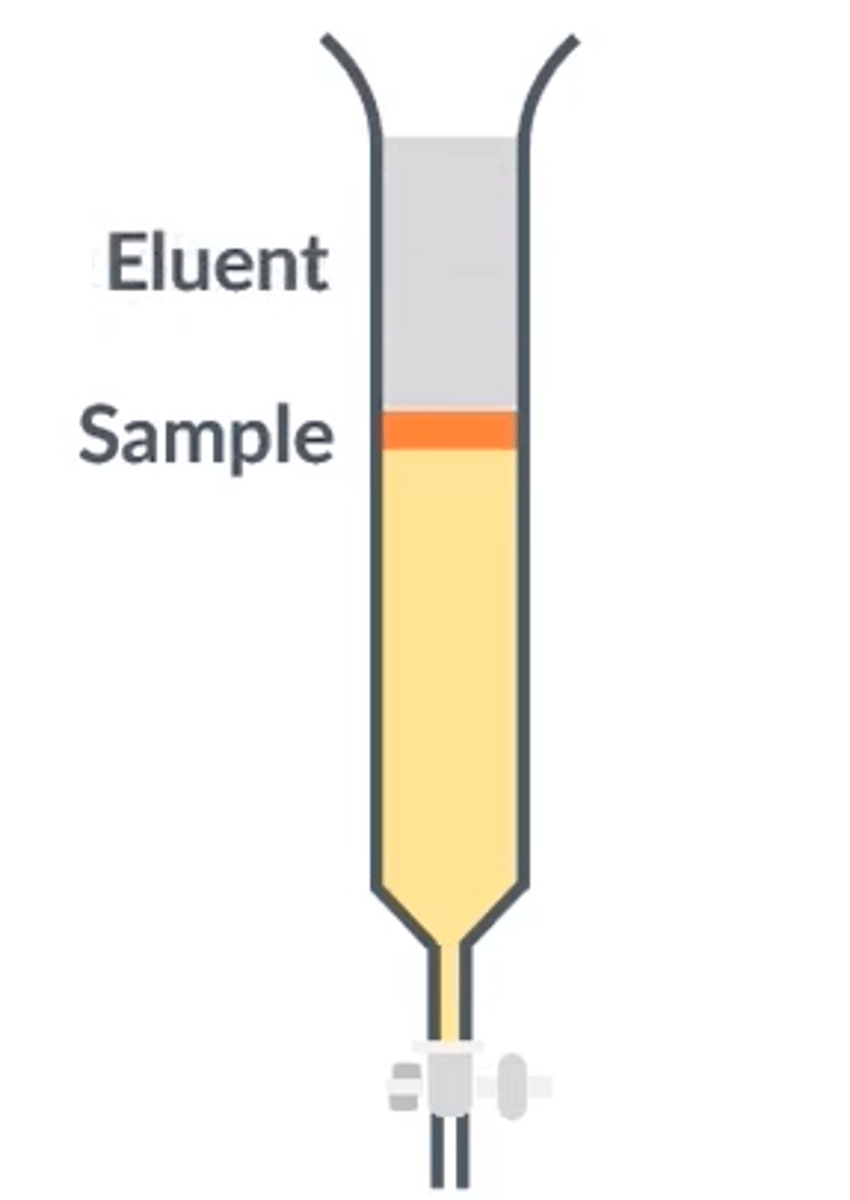
Column chromatography diagram
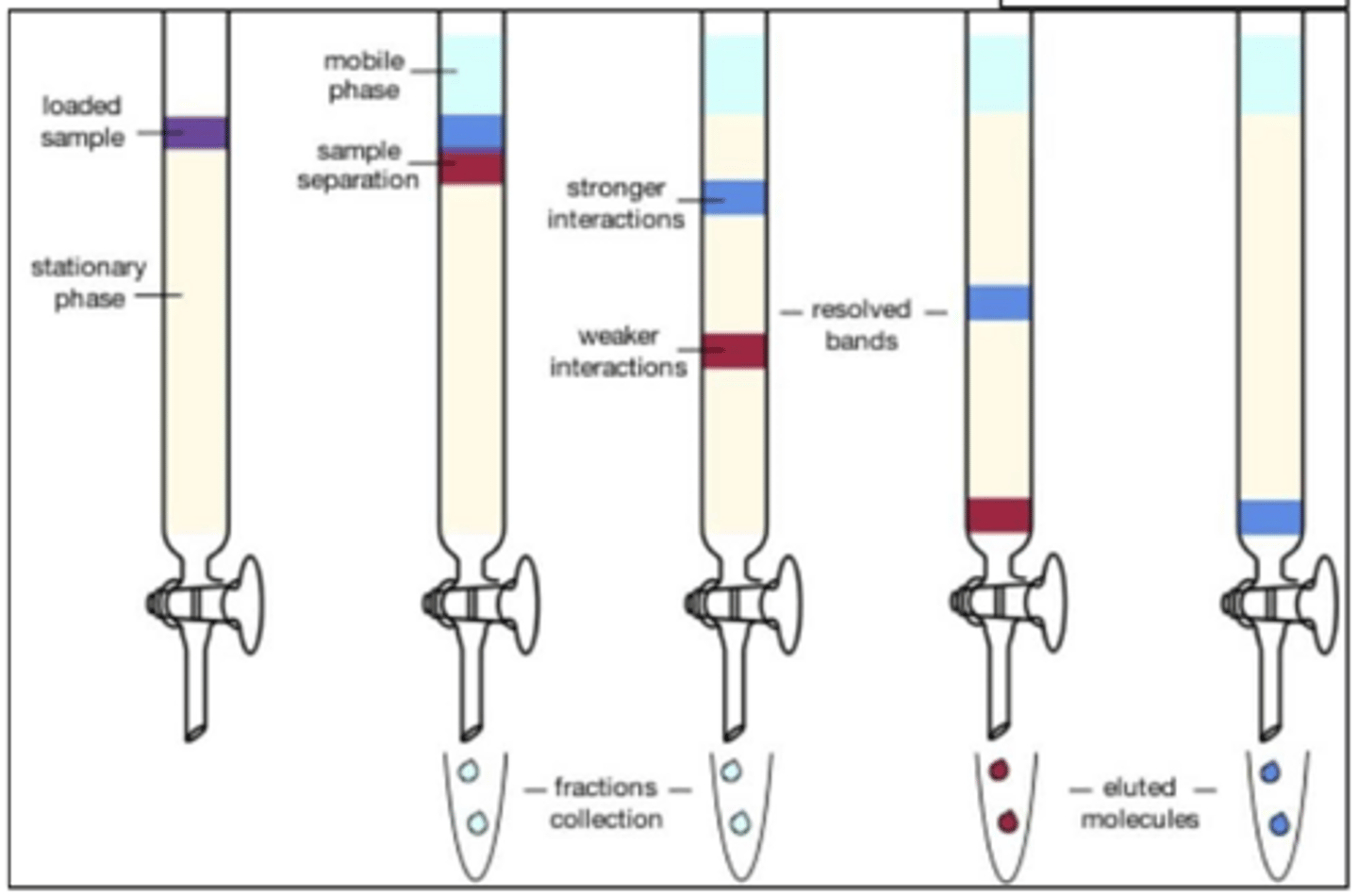
What is the stationary phase in column chromatography?
Silica, alumina or resin packed into a column
Describe how column chromatography is carried out.
1. A glass tube is packed with the stationary phase (usually silica or alumina in powder form to increase the surface area.)
2. A filter or plug is used to retain the solid in the tube.
Solvent is added to cover all the powder.
3. The mixture to be analysed is dissolved in a minimum of a solvent and added to the column.
4. A solvent or mixture of solvents is then run through the column.
5. The time for each component in the mixture to reach the end of the column is recorded (retention time)
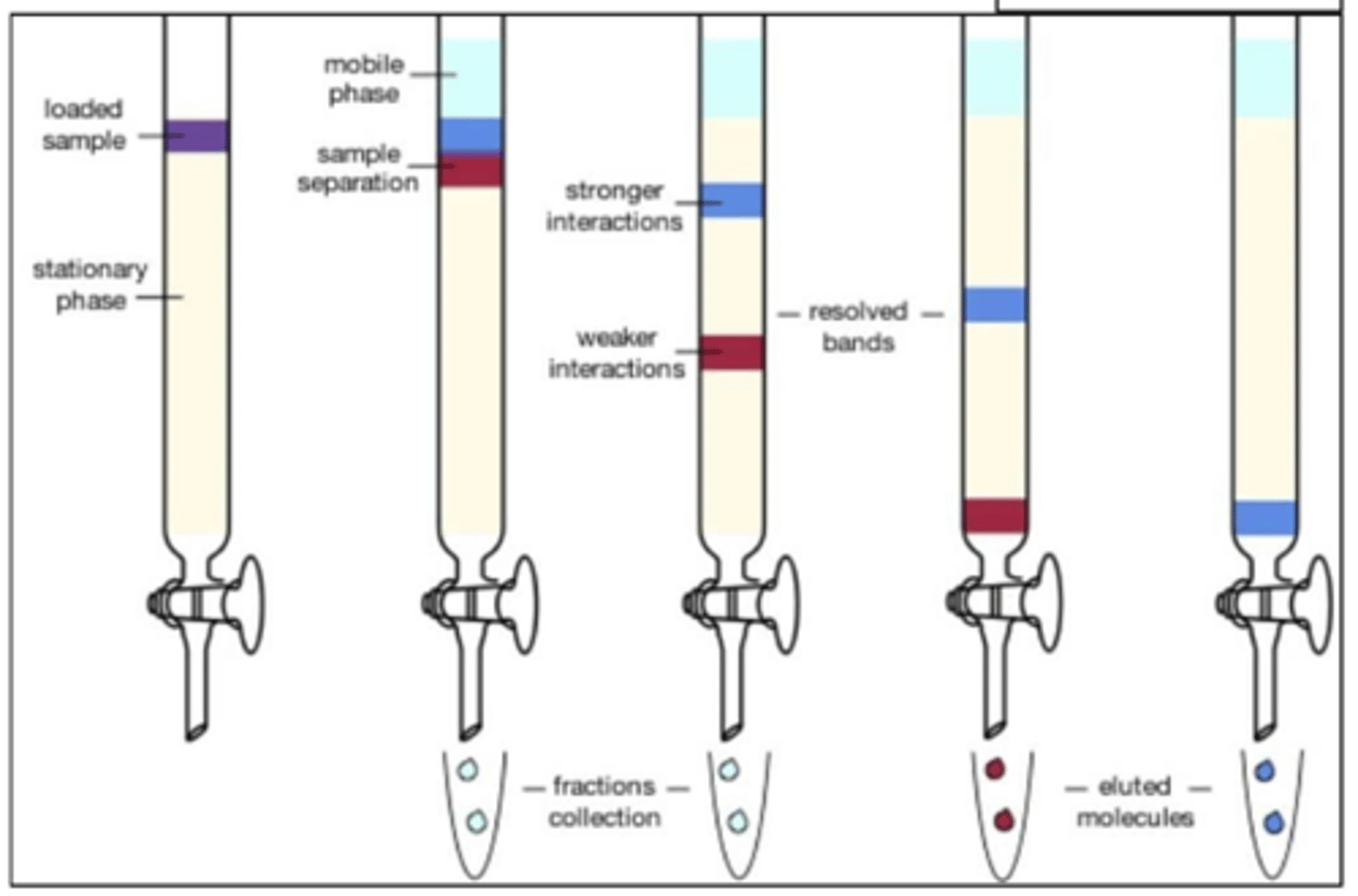
How does column chromatography work?
The varying affinities of the molecules present means they drain out of the column at different times, allowing them to be collected as separate samples.
The time taken to drain out of the column like this is measured as the retention time.
Similar to Rf values, retention times allow the individual molecules in the mixture to be identified.
What is the mobile phase in column chromatography? What is it also known as?
Solvent added at the top and runs down the column; called "eluent"
Which components travel fastest through column chromatography?
● lower retention by the stationary phase.
● higher solubility in the mobile phase (eluent)
A highly polar component will reach the bottom of the column faster if...
● The moving phase is polar.
● The stationary phase is non-polar.
Draw a diagram of column chromatography
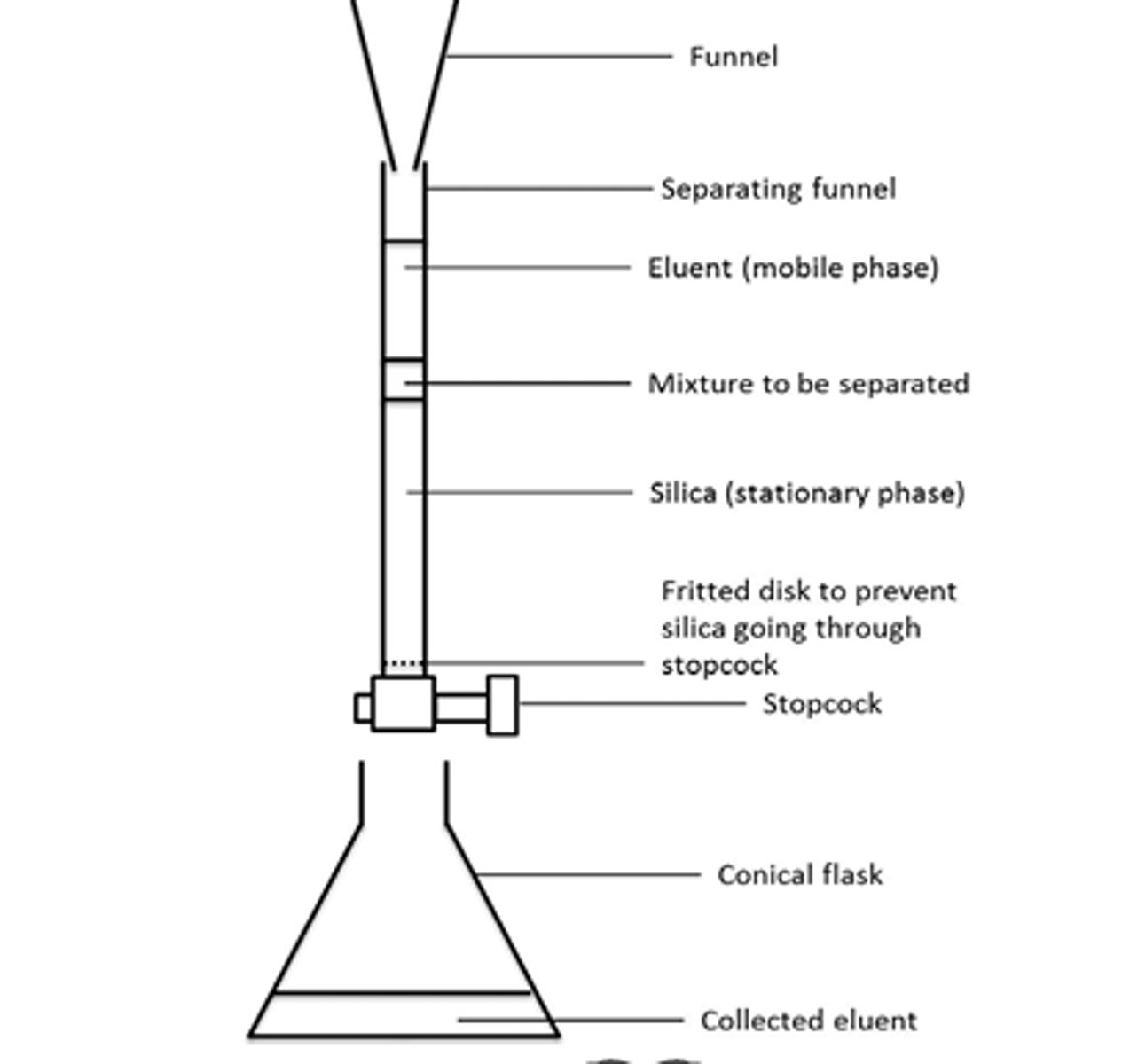
What are the advantages of column chromatography?
More than one eluent can be used, which leads to better separation
Fairly large amounts can be separated and collected after separation
Draw a diagram for gas-liquid chromatography
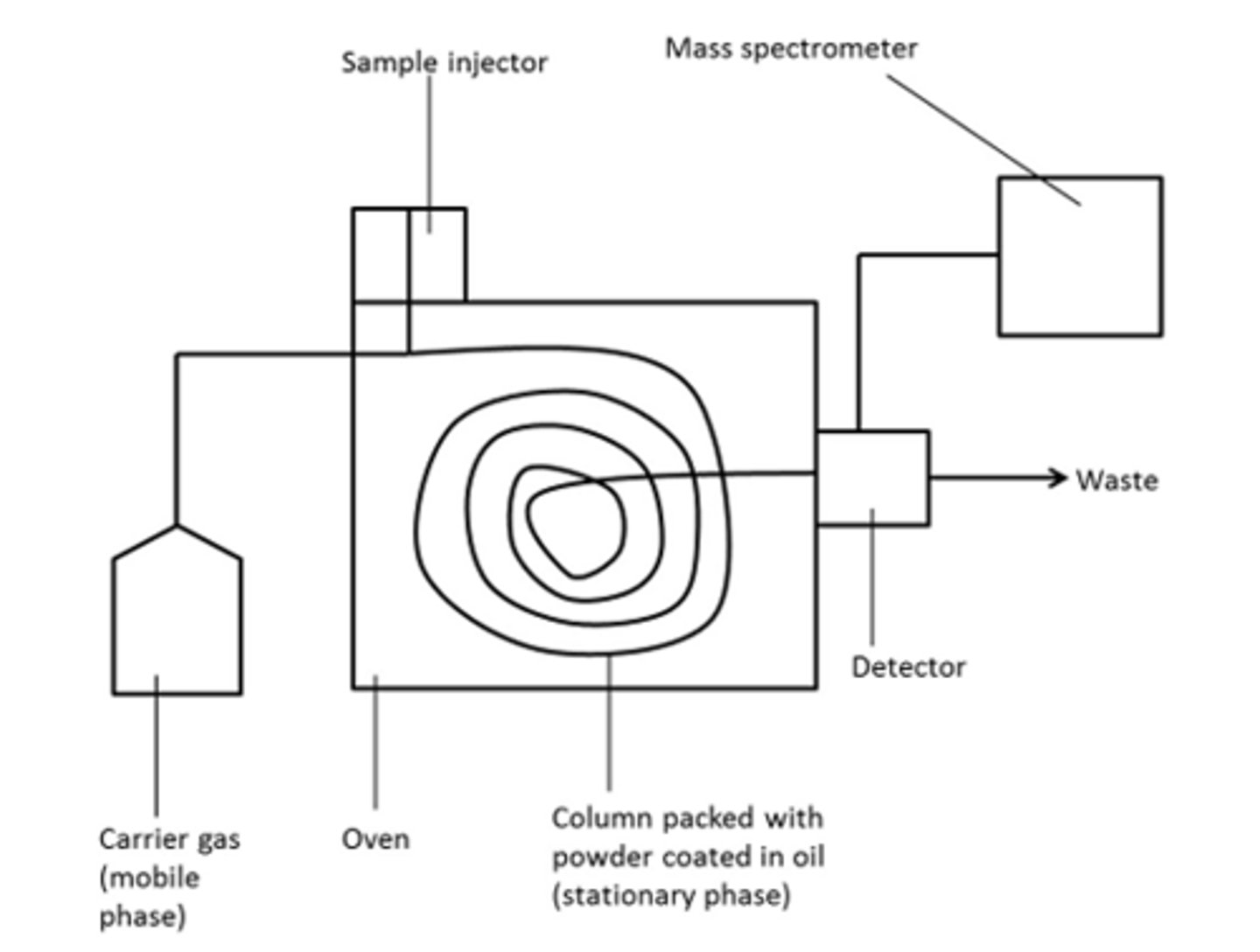
What is the stationary phase in gas-liquid chromatography?
Powder, coated with oil. Packed into a long, thin, capillary tube (100m long, 0.5mm diameter).
Coiled and placed in an oven, the temperature of which can be varied
What is the mobile phase in gas-liquid chromatography?
Carrier gas, inert e.g. N2 or He
What do you measure in gas-liquid chromatography?
Retention time; different components of the mixture take different amounts of time to move through
What are the advantages of GLC?
Very sensitive; GC can detect minute traces of substances in foodstuffs, and link oil pollution on beaches to the specific tanker the oil came from
What are GLC's uses?
Test athletes' and horses' blood and urine for drugs
How can you use GC or GCMS to identify substances?
Match Gas Chromatograph to that of a known substance under the same conditions; retention time should exactly match.
Substance's identity can be confirmed by mass spectrometry, NMR or infrared spectroscopy.
How does GCMS work?
Gas Chromatography is run, retention time is recorded, then mixture is run through a Mass Spectrometer.
Fragmentation pattern/molecular ion peak confirms identity.
How are as chromatograms read?
Height = how much the sample eluted
Width = how long it was eluting for
Area under each peak = abundance
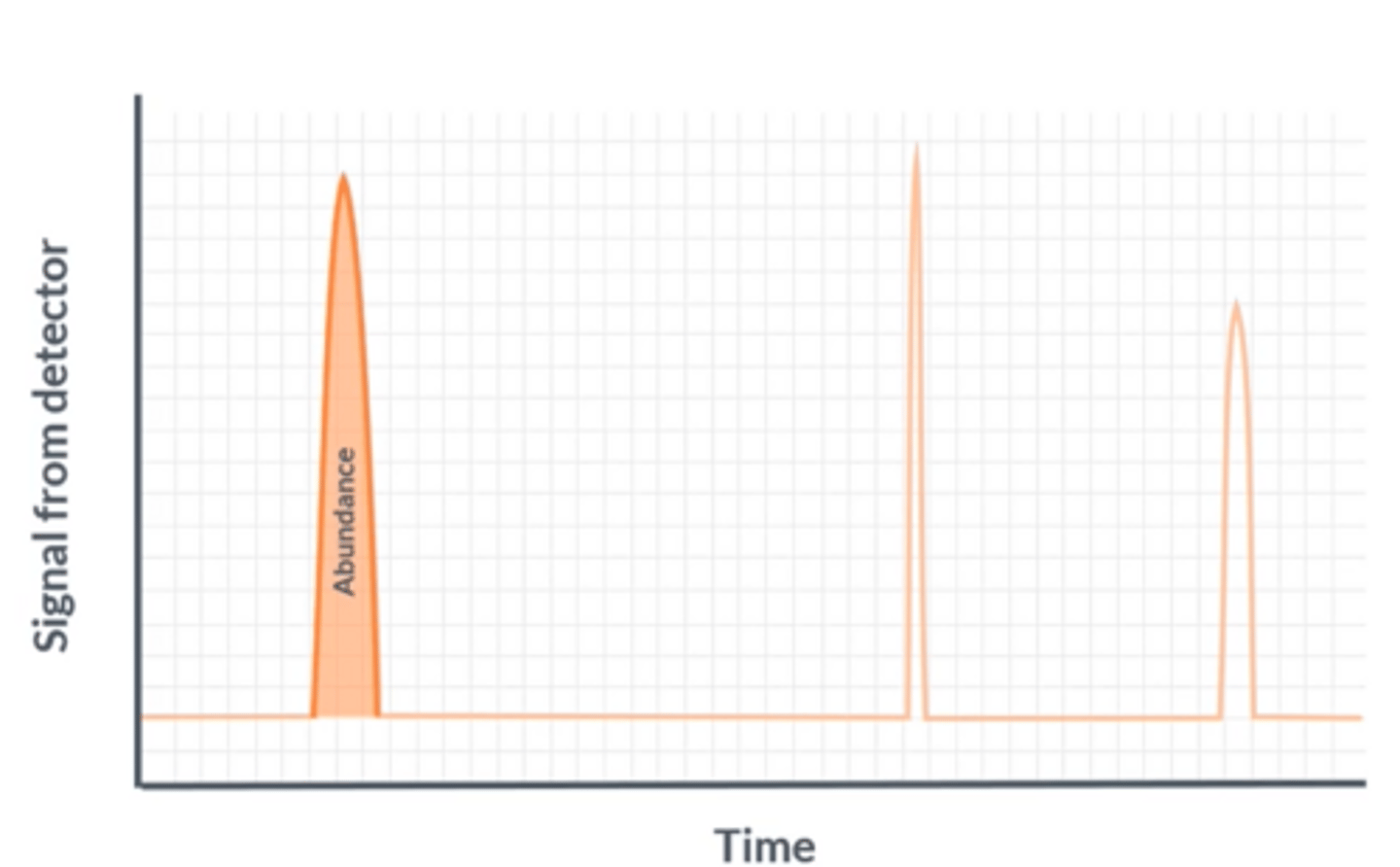
Will an alcohol or an aldehyde have a shortest retention time by column chromatography?
Aldehyde has shortest retention time, since it has a less polar bond than an alcohol. It therefore adsorbs less strongly to the stationary phase, so moves down the column at a quicker rate. Force of attraction between stationary phase and aldehyde is less