AP Chem Unit 3: Properties of Substances and Mixtures Part 2
 Call Kai
 Learn
Learn Practice Test
 Spaced Repetition
 Match
Match Flashcards
 Knowt Play
1/14

Earn XP
Description and Tags
Gas Laws, Kinetic Molecular Theory, Ideal Gas Law, Solutions
Name | Mastery | Learn | Test | Matching | Spaced | Call with Kai |
|---|
No analytics yet
Send a link to your students to track their progress
15 Terms
4 Gas Laws
Boyle’s Law: as pressure increases, volume decreases
P1V1 = P2V2
Charles’s Law: as temperature decreases, volume decreases
V1/T1 = V2/T2
Gay-Lussac’s Law: as pressure increases, temperature increases
P1/T1 = P2/T2
Avogradro’s Law: as the number of moles increase, volume increases
V1/n1 = V2/n2
The combined gas law: P1V1/n1T1 = P2V2/n2T2
Ideal Gas Law
PV = nRT
P = pressure (atm, torr, mmHg, kPa)
V = volume (L)
n = moles of gas
R = universal gas constant (differs based on units for pressure)
0.08206 L atm/mol K
62.36 L torr/mol K
8.314 J/mol K (1 J = 1 L kPa)
T = temperature (Kelvin, Celsius + 273.15)
Dalton’s Law of Partial Pressures
The sum of all partial pressures of each gas in a mixture is equal to the total pressure.
Partial pressure is the pressure each gas exerts if it were alone.
Partial pressure of a gas can be determined by multiplying the total pressure by the gas’s mole fraction.
Mole Fraction
the ratio of moles of one gas in a mixture to the total number of moles (of every gas in the mixture)
This value is usually between 0 and 1.
Kinetic Molecular Theory
A simplified model that describes the nature of gases. For ideal gases:
Volume of gas particles is negligible (size of a particle is miniscule compared to distance between particles)
Gas particles are in constant, random motion. They move in straight lines until they collide with something, which then results in gas pressure.
Elastic collisions: no kinetic energy is lost when particles collide
IMFs can be ignored. Assume that the particles have no attractive or repulsive forces between them.
Average kinetic energy is proportional to Kelvin temperature.
Maxwell-Boltzmann Distribution
shows the distribution of kinetic energies at a given temperature
The value of every point on the curve adds up to 100% of the particles in a sample.
It skews to the right (tail on the right is longer).
Hot gases move faster than cold gases.
Equation for Kinetic Energy
KE = ½ mv2
Kinetic energy is directly proportional to mass and velocity squared.
KE is calculated in joules, mass in kg, and velocity in meters/second.
Grahams’ Law
the rate of effusion (ability to diffuse through a small hole) is inversely related to particle size/molar mass
Deviation from Ideal Gas Law
All gases have attractive forces and can condense.
Molecules have volume and vary in size.
At lower temperatures, significant attraction/IMFs can decrease the number of collisions and pressure.
At high temperatures, IMFs become negligible and gases behave ideally.
Significant particle volume can increase the number of collisions and pressure.
As container volume decreases, particle volume becomes more significant, leading to greater pressure than predicted by the ideal gas law.
Gases become less ideal with lower temperature, higher pressure, significant IMFs, and significant molecular size.
Solutions (Homogeneous Mixtures)
a physical combination of any state of matter where macroscopic particles do not vary
Liquid solutions cannot be separated by filters and do not have components large enough to scatter visible light (Tyndall Effect). The components can be separated through methods that affect IMFs (eg distillation, chromatography).
Solvation
the process of mixing a solvent and solute to create a homogeneous solution
Solubility and miscibility is the ability of two substances to mix without separating. Solubility applies to solids/gases dissolving in a liquid solvent. Miscible prefers to liquids mixing with liquids.
A solution will only form if the solvent-solute interactions are equal to or greater than the solvent-solvent or solute-solute attractions. Like dissolves like.
Hydration
the process where water molecules surround ions (ion-dipole) when an ionic solid dissolves
Heterogeneous Mixtures
inconsistent mixtures that have varying properties based on the location in the mixture
Molarity
moles of solute/liters of solution
describes the ion concentrations of solutions
M1V1 = M2V2
Particulate Diagrams
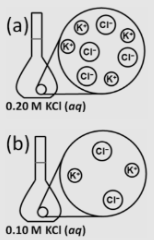
represents a solution by indicating solution concentration with number of particles, as well as particle size and ratio of particles