Week 10 - Disorders in Growth pt. 2
 Call Kai
 Learn
Learn Practice Test
 Spaced Repetition
 Match
Match Flashcards
 Knowt Play
1/9

There's no tags or description
Looks like no tags are added yet.
Name | Mastery | Learn | Test | Matching | Spaced | Call with Kai |
|---|
No analytics yet
Send a link to your students to track their progress
10 Terms
Current LE in Canada
80 M, 84 F.
LE in 2075
90.1 M 92.5 F
½ of Canadians aged 20 today will reach age 90
10% will reach 100
Top 5 leading causes of death in Canada (2020)
Cancer
Heart disease
COVID-19
Unintentional injuries (accidents)
Cerebrovascular diseases (stroke)
Exacerbated by lower income..?
Chronological v Biological Age
Chronological age is based on the passage of time and not useful for predicting someone’s level of health.
Biological age is based on changes in the body that commonly occur with age.
Psychological age is important as well.
Primary aging
Normal aka Pure aka Intrinsic Aging
Normal functioning decline that is universal part of aging in the context of overall good health.
Normal mild cognitive decline and increase in forgetfulness.
Secondary aging
Declines due to hereditary defects and negative environmental influences.
- poor diet, lack of exercise, substance abuse, environmental pollution, psychological stress.
- dementia such as Alzheimer’s disease
Frailty - poor functioning of multiple organs/systems which profoundly interfere with daily activities and make older people highly vulnerable.
Hallmarks of Aging
Genomic Instability
Telomere Attrition
Epigenetic Alterations
Loss of Proteostasis
Deregulated Nutrient Sensing
Mitochondrial Dysfunction
Cellular Senescence
Stem Cell Exhaustion
Altered Intercellular Communication
Aging at the Tissue and Organ Level (3)
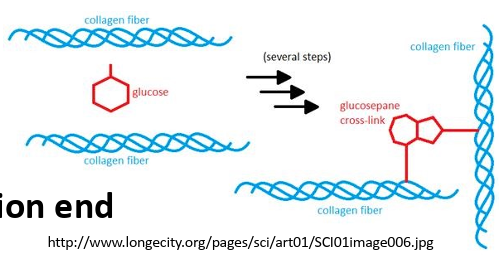
AGEs: Advanced glycation end products
- reaction btw carbohydrates and free amino groups creates cross-links in long-lived structural proteins, increases stiffness in blood vessels, joints, bladder, impairs function in kidney, heart, retina.
Stochastic epigenetic regulatory drift - turns tissues into cellular mosaics
Gradual decline of whole systems:
- Endocrine: estrogen (menopause, GH (somatopause), insulin (resistance)
- Immune system
Functional reserve
Extra capacity that keeps organs working normally despite aging. (When healthy we don’t use organs to capacity)
Integrity of cells
Organ function depends on integrity of cells.
Number of cells decreases - senescence, apoptosis, stem cell exhaustion
Function of remaining cells may be altered: build-up of damage (protein aggregates, ROS, DNA damage), epigenetic drift, problems with cell-cell communication