AP Euro Chapter 12
 Call Kai
 Learn
Learn Practice Test
 Spaced Repetition
 Match
Match Flashcards
 Knowt Play
1/67

There's no tags or description
Looks like no tags are added yet.
Name | Mastery | Learn | Test | Matching | Spaced | Call with Kai |
|---|
No analytics yet
Send a link to your students to track their progress
68 Terms
In early Renaissance Italy, art
manifested corporate power
What educational book by Baldassare Castiglione provided a treatise on training a young man in the discipline and fashion needed for the courtly ideal of being a gentleman?
The Courtier
On the Iberian Peninsula, who were the people referred to as the "New Christians"?
Jewish and Muslim converts
Who was the most prominent metalsmith who helped develop metal movable print?
Johannes Gutenberg
According to Machiavelli, government should be judged on whether it
provided order, security, and safety of the populace
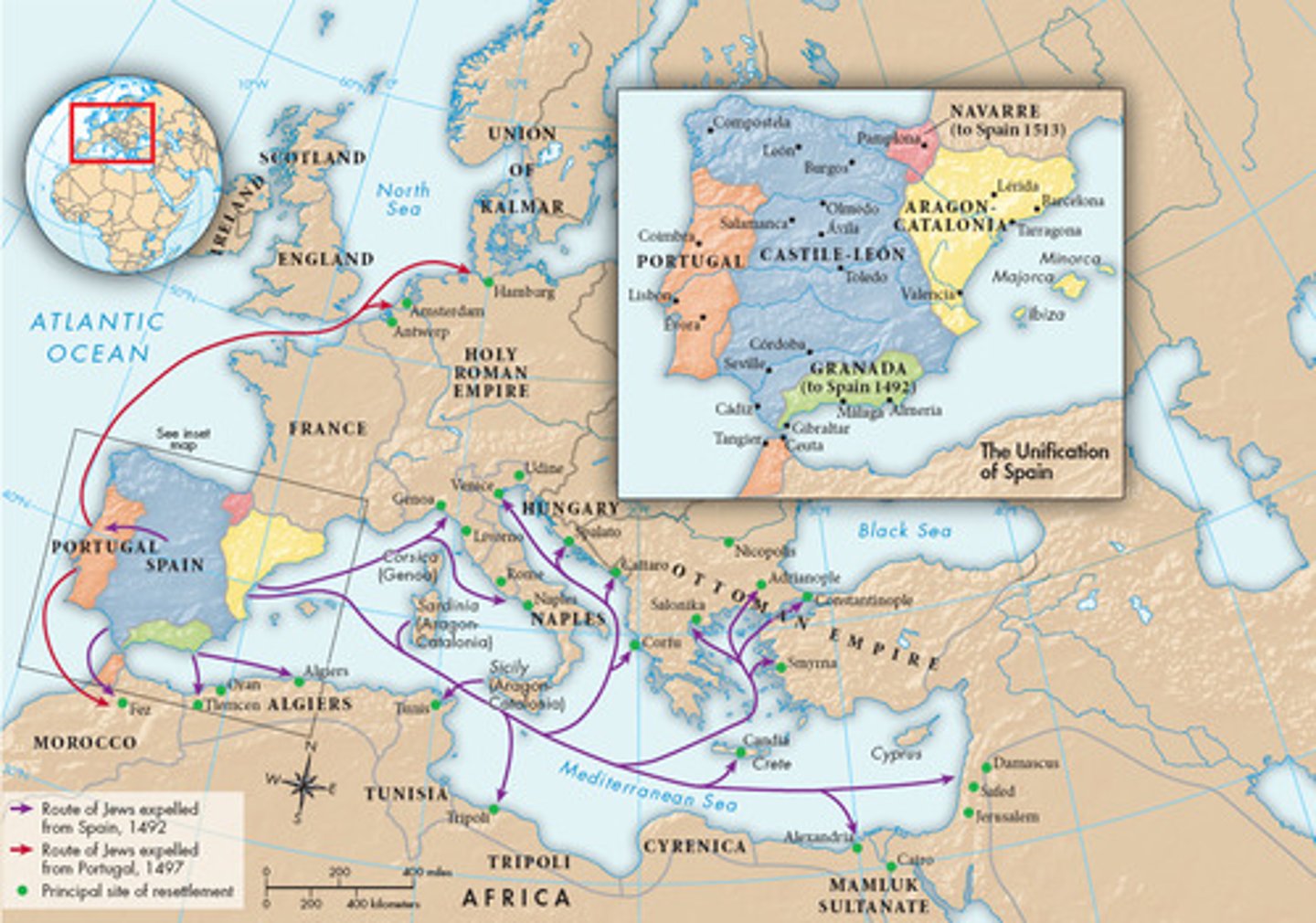
According to Map 12.3: The Unification of Spain and the Expulsion of the Jews, Fifteenth Century, where did the Jewish population of the Spanish kingdom migrate to after their ordered expulsion by Isabella and Ferdinand?
Cities in the Mediterranean and southern Europe
What individuals believed the merging of Christian and classical traditions could provide reform for the church and deepen the spiritual lives of people?
Christian humanists
Italian humanists stressed the
study of the classics for what they could reveal about human nature
According to the text, Thomas More's Utopia was remarkable for its time because it asserted that
the problems plaguing society could be solved by a beneficent government
The following is an excerpt from sixteenth-century regulations for vineyard workers:
"Men who work in the vineyards, doing work that is skilled, are to be paid 16 pence per day; in addition, they are to receive soup and wine in the morning, at midday beer, vegetables and meat, and in the evening soup, vegetables and wine. Young boys are to be paid 10 pence per day. Women who work as haymakers are to be given 6 pence a day. If the employer wants to have them doing other work, he may make an agreement with them to pay them 7 or 8 pence. He may also give them soup and vegetables to eat in the morning but no wine—milk and bread at midday, but nothing in the evening."
This passage provides evidence in support of which of the following claims?
Women were the lowest paid vineyard workers.
"Assiduous in the science and skill of dealing with arms and horses and musical instruments, as well as in the pursuit of letters and the fine arts." Who authored this quote about his own important qualities?
Leon Battista Alberti
Which of the following best characterizes the Renaissance idea of virtù?
The ability to shape the world around oneself according to one's will
How did Pico della Mirandola understand the uniqueness of humankind?
Humans, lacking a fixed place, were the one part of the created world that could freely choose to rise to the heavens or sink into the realm of animals.
Why did a woman's work receive less compensation than a man's work during the Renaissance?
It was understood that a woman was either married or to be married and, therefore, not responsible for supporting a family.
What French word was coined by historian Giorgio Vasari to describe the "rebirth" of the culture of classical antiquity?
Renaissance
The most important factor in the emergence of the Italian Renaissance was the
Great commercial revival in Italy
The following is an excerpt from the Florentine merchant and historian Benedetto Dei's description of his home city:
"Our beautiful Florence contains within the city in this present year two hundred seventy shops belonging to the wool merchants' guild. . . eighty-three rich and splendid warehouses of the silk merchants' guild. . . . The number of banks amounts to thirty-three; the shops of the cabinet-makers, whose business is carving and inlaid work, to eighty-four. . . there are forty-four goldsmiths' and jewellers' shops."
What does this passage suggest about Florence?
That there was high demand for luxury items in the city
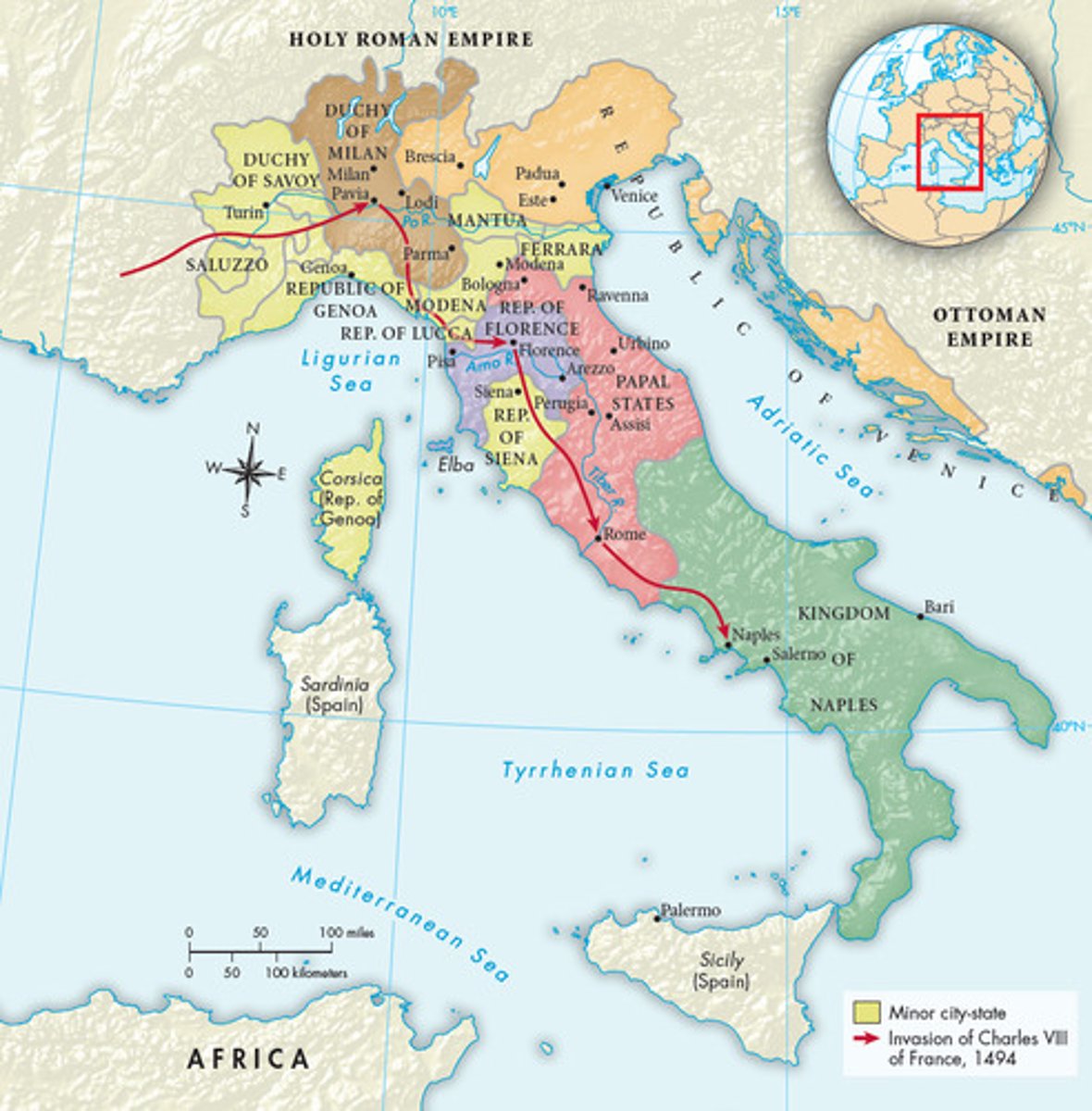
According to Map 12.1: The Italian City-States, ca. 1494, which European monarch invaded multiple Italian city-states in 1494?
Charles VIII of France
Which of the following was the most important source of patronage for Renaissance artists?
Wealthy individuals and rulers
What did Petrarch do to help bring about a new golden age in Italy?
He proposed a new kind of education.
Charles VII of France created the first __________________ anywhere in Europe.
permanent royal army
What Florentine artist was commissioned by Pope Julius II to build his tomb and paint the Sistine Chapel?
Michelangelo
Under Henry VII of England, the center of royal authority was
the royal council.
Most male Renaissance humanists argued that
women's sphere of activity was private and domestic.
Which of the following was one of the central components of the Italian Renaissance?
A glorification of individual genius
"[T]he city in this present year [contains] two hundred seventy shops belonging to the wool merchants' guild. . . eighty-three rich and splendid warehouses of the silk merchants' guild. . . . The number of banks amounts to thirty-three; the shops of the cabinet-makers, whose business is carving and inlaid work, to eighty-four. . . there are forty-four goldsmiths' and jewellers' shops." What city is Benedetto Dei describing in this quote?
Florence
The marriage of Ferdinand of Aragon and Isabella of Castile
created a dynastic union but did not unify the separate kingdoms into a single state.
Educated fifteenth-century Italians believed that
they were living in a new era of human history.
What role did the idea of "fate" play in Machiavelli's analysis in The Prince?
The most skilled and prepared ruler could not fully escape the operations of fate that might cause a prince to lose his realm.
On the Iberian Peninsula, what was the social position of African slaves?
They intermingled with the people they lived among and sometimes intermarried with them.
What purposes were served by sumptuary laws?
Sumptuary laws reinforced social hierarchies, attempted to impose moral standards, and sought to protect local industries.
Why did a unified Italian state fail to develop in the fifteenth century?
Political loyalty and feeling centered on a passionate attachment to the individual city-state.
The fall of ____________ to Christian forces in 1492 signaled the completion of the reconquista.
Granada
Which of the following gained control of papal banking toward the end of the thirteenth century?
Florentine merchants
_______________ led the way in the great commercial revival of the eleventh century.
Northern Italian cities
Which of the following inhibited women's success as painters in the Renaissance?
They could not work in public where the fresco technique was done
The Tudor Henry VII of England won broad, popular support by
promoting peace and social order at the local level
"Everyone gets a fair share, so there are never any poor men or beggars. Nobody owns anything, but everyone is rich—for what greater wealth can there be than cheerfulness, peace of mind, and freedom from anxiety? Instead of being worried about his food supply, upset by the plaintive demands of his wife, afraid of poverty for his son."
This quote (from Evaluating the Evidence 12.2) describes the ideal society depicted in what humanist's work?
Thomas More
Which of the following characterizes Girolamo Savonarola?
He came to power in Florence denouncing vice and corruption, but as people tired of his moral denunciations, he lost authority
Which of the following best defines the term race as it was used in the Renaissance?
Groupings of people based on ethnic, national, or religious factors
The Spanish conversos were which of the following?
Jewish Christians, some of whom held prominent positions in the state, church, and business
Piero della Francesca and Andrea Mantegna pioneered
perspective in painting.
Which of the following was a wealthy Florentine, the political leader of his city, and a patron of Renaissance artists?
Cosimo de Medici
Which of the following did Francesco Petrarch believe?
The recovery of classical texts would bring about a new golden age of intellectual achievement
The _____________ emerged as a distinct artistic genre during the Renaissance.
individual portrait
Which of the following characterizes the intersection of the hierarchies of wealth and orders in the Renaissance?
The nobility retained its status by taking in and integrating the new social elite of wealth.
What was the star chamber?
A court that dealt with noble threats to royal power in England
The Spanish Inquisition was an attempt to
root out insincere Jewish converts to Christianity
The Concordat of Bologna, between Francis I of France and Pope Leo X, gave the French monarch the authority to
select bishops and abbots
What new type of anti-Semitism emerged in fifteenth-century Spain?
Status as a Jew was defined as inherent in the blood, so Jews could never be true Christians.
Rich individuals sponsored artists and works of art
to glorify themselves and their families.
All of the following inhibited women's success as painters in the Renaissance except
women were not permitted to take up painting until after they were married.
How did the printing press provide a framework to challenge provincial sentiments?
individuals widely separated by geography could read the material and form a common identity that completed with local loyalties
The Renaissance courts of northern Italy particularly sought to include among their staff
black servants
Charles VII of France expanded his authority through all of the following except
eliminating nobles' militias and troops.
Castiglione's manual on gentlemanly conduct
suggested that gentlemen cultivate their abilities in a variety of fields, from athletics to music to art to mathematics
The northern Italian communes took all of the following forms except
some cities were under authority of the papacy, which ruled them as personal lands of the pope
How did the Tudor kings, with the exception of Henry VIII, weaken aristocratic influence?
They avoided major wars that would require money from Parliament
Italian balance-of-power diplomacy
was designed to prevent a single Italian state from dominating the peninsula
The subjugation of the Italian peninsula by outside invaders was
the result of the Italians' failure to coordinate a common defense
As consumer habits changed, an aristocrat's greatest expense was usually his
urban palace
Erasmus emphasized what two themes?
Education as the key to reform and Christianity as inner attitude of the heart
Why did the printing press find substantial success?
Increasing literacy and the opening of more schools and universities had created an expanding market for reading material
The term humanism, as used in the context of the Renaissance, refers to
the study of the Latin classics for moral education and insights into human nature
The Italian Renaissance began in
Florence
By 1300, most of the Italian city-states were ruled by either signori or
oligarchies
The Florentine Office of the Night was created to control
Homosexual activities (sodomy)
The leaders of the Catholic Church
readily adopted the Renaissance spirit, especially when it came to art