Cellular Reproduction: Mitosis and Meiosis (copy)
 Call Kai
 Learn
 Practice Test
 Spaced Repetition
 Match
 Flashcards
 Knowt Play
1/83

84 Terms
Mitosis - Definition and Acrostic Pneumonic
A form of cellular reproduction in which a mother cell divides to yield two genetically identical daughter cells.
2: 2 Daughter Cells
Identical Twins: Gentically Identical
Own: One
46: 46 Chromosomes each
Dogs: Diploid
Meiosis - Definition and Acrostic Pneumonic
A process of cellular reproduction occurring in SEXUALLY reproducing organisms.
One gametocyte divides to produce four non-identical haploid cells.
Four: 4 Daughter Cells
Different: Genetically Different
Hippos: Haploid
Dance Twice: 2 Divisions
with 23 Penguins: 23 Chromosomes each
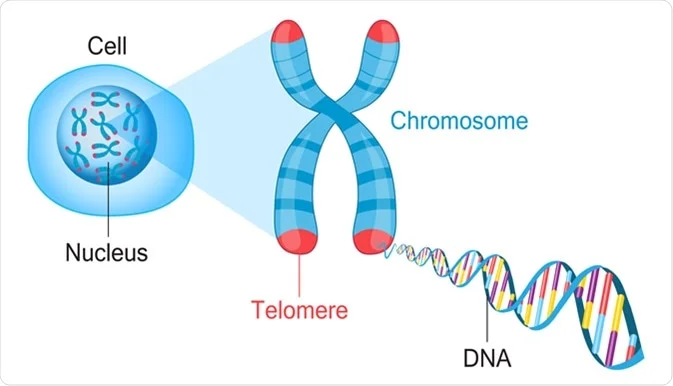
Chromosome - What is it and what does it mean.
A cellular structure carrying genetic information.
Means "colored body" because it becomes visible when stained during specific stages of mitosis.
Telomeres
Structures located at the ends of chromosomes that fray over time with repeated reading, thought to contribute to the aging process.
Interphase- What is it
The period of the cell cycle where cells spend the majority of their lives carrying out normal functions rather than actively dividing.
Active division would be like…the reproduction phase for people.

G1 Phase
The subphase of interphase.
cellular contents EXCLUDING chromosomes, are duplicated to prepare for division.
S Phase
The synthesis stage of interphase
all 46 chromosomes are duplicated.
G2 Phase
The stage of interphase where the cell does a quality check.
It goes over duplicated chromosomes to detect and resolve errors before undergoing mitosis.
3 subphases of Interphase
G1 Copy contents- copy the cellular contents
S Copy the chromosomes - duplicate to 46
G2 Check the copies - check for errors and repair in preparation
Cytokinesis
The physical process of cell division in which the cytoplasm and cellular structures are split from the parent cell into the 2 daughter cells.
Late anaphase to telophase
Prophase
Mitosis Phase 1:
Chromosomes become visible,
centrioles move to opposite poles,
spindle fibers begin forming,
and the nuclear membrane and nucleolus disappear.
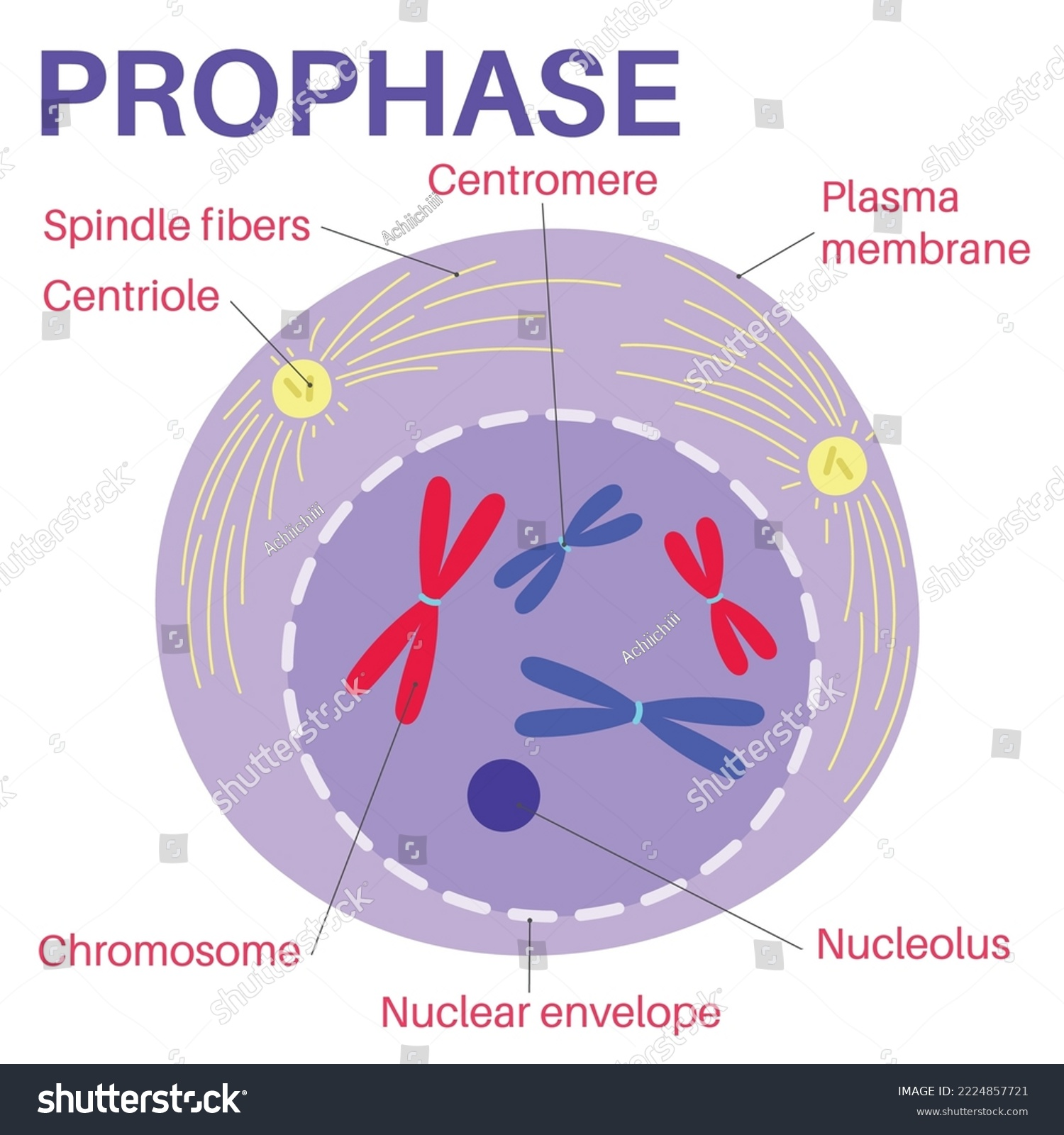
Centrioles- hint: Prophase
Cylindrical structures that migrate to opposite poles to produce spindle fibers.
Spindle Fibers
Protein structures produced that attach to chromosomes and contract to pull them apart during cell division.
Metaphase
Mitosis Stage 2:
Chromosomes align along the middle of the cell and attach to the spindle fibers.
Metaphase- Meets in the Middle

Anaphase- What happens
Mitosis Stage 3:
AWAY
Individual chromosomes are separated into two and pulled toward opposite poles by contracting spindle fibers.

Telophase
Mitosis Stage 4:
Separated chromosomes move farther apart and the mitotic spindle vanishes.
They separate into 2 individual nuclei as the nuclear envelope re-forms around each set of chromosomes.

Cleavage Furrow
The indentation that develops on the surface of a dividing animal cell during cytokinesis as it pinches in two.
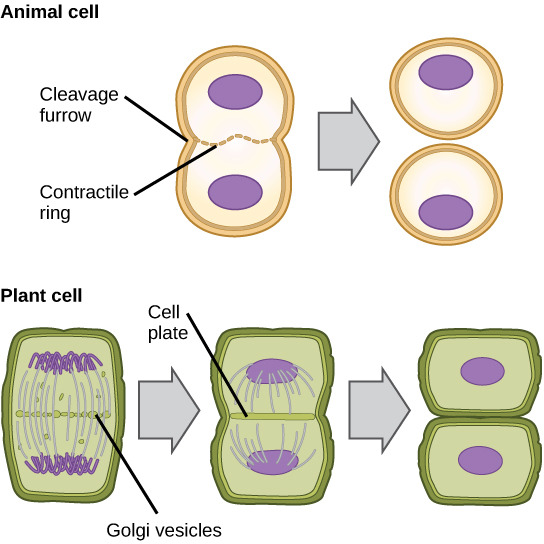
Cell Plate
A structure formed in the middle of dividing plant cells that leads to the synthesis of a new cell wall on either side.

Contact Inhibition
A cell signaling mechanism that causes normal cells to cease dividing once they come into physical contact with surrounding cells.
Essentially a “stop growing” alarm
This process prevents overgrowth by regulating cell mass - too much division can lead to tumor formation. Contact inhibition is essential for maintyaining tissue architecture and function.
Tetrad
A bundle of four chromatids (two pairs of chromosomes) that line up together during cell division (meiosis)

Crossing Over
When paired chromosomes exchange matching segments of DNA during Prophase I of meiosis, creating new gene combinations.
(Genetic variations)
Polar Body
A small, non-functional cell produced during egg formation (oogenesis) that holds extra chromosomes and eventually breaks down so one main egg can keep all the nutrients and cytoplasm.
Chromosomes
Short, condensed structures containing DNA and genetic material that is duplicated and passed down from one generation of cells to the next.
Chromatin
DNA coiled tightly around proteins, resembling beads on a string.
Typically in a loosely packed form during Interphase
Centromere
The pinched-in region of a chromosome where two identical sister chromatids are joined together and where spindle fibers attach to pull them apart during cell division.
Sister Chromatids
Two identical copies of a chromosome produced during DNA replication.
Identical halves of the X
Homologous Chromosomes
A matching pair of chromosomes (one inherited from each parent) that are the same size and carry genes for the same traits, though they may have different versions (alleles) of those genes.
Alleles
Alternative versions of a gene for the same trait located at corresponding positions
Interphase - what is happening during this stage
The non-dividing phase accounting for approximately 90% of the cell cycle, during which the cell grows, synthesizes proteins, and replicates organelles and chromosomes.
Sexually Reproducing Organisms us cells division for?
Mitosis: Used for growth and maintenance, tissue repair
Meiosis: Reproduction with germ (sex cells) or “gametes”
Somatic Cells
(Body Cells)
Diploid
Mitosis
Growth and Maintenance
Germ Cells
“Gametes” : Sperm and Egg
Sex Cells
Haploid
Meiosis
Reproduction.
G0 Phase
A state of cell cycle arrest where the cell exits the division cycle and ceases dividing. Exists outside the active cycle. “Resting’
Mitosis
The division of somatic (body) cells that produces two genetically identical diploid daughter cells (cells containing two full sets of chromosomes, one from each parent), used for growth and tissue repair
When are mutations passed down?
Only mutations in the germ cells can be passed down to the future generations.
The mutations in the somatic (body) cells are not able to be genetically passed down. e.g. Skin Cancer.
Why can some species not produce offspring with others? What happens if they can/do?
Different species have different numbers of chromosomes. This is why some cannot produce offspring together.
However, some are just close enough in chromosome count that they can produce offspring, which are often sterile.
A common example of this is mules- the cross between a donkey and a horse.
Horses have 64 Chromosomes whereas Donkeys have 62.
When they breed, the offspring inherits 32 from the horse and 31 from the donkey coming to the total of 63 chromosomes. Due to the structural difference and odd number, Mules and Hinnies are often sterile and cannot reproduce.
Cell Cycle
The cell cycle is controlled by Key Enzymes that are produces at specific points.

What are some reasons for Cancer?
A mistake in the cell cycle. these can be caused by things such as pollution, radiation, smoking, certain viruses that can damage the genes.
What are some characteristics of cancer cells?
Uncontrolled Growth (lack of contact inhibition)
Disorganized / Multilayered
Non-differentiated cells (unspecialized cells - because they’re undifferentiated, they avoid reaching maturity and continue to grow and divide)
Cancer cells often evade apoptosis and can invade surrounding tissues.
Abnormal Nuclei
Cancer
A disorder resulting from disruptions in the cell cycle leading to uncontrolled division, lack of contact inhibition, abnormal nuclei, and multilayered disorganized growth.
Metastasis
The spread of malignant cancer cells away from their primary site through blood and lymphatic vessels to distant tissues and organs.
ABCD Rule
A diagnostic criteria set for skin cancer/melanoma evaluation: Asymmetry, Border irregularity, Color variation, and Diameter exceeding 41 inch (6mm).
Radiation Therapy
A cancer treatment method that damages cellular DNA in order to disrupt and stop uncontrolled cell division.
Chemotherapy
A systemic cancer treatment that utilizes pharmacological drugs to disrupt the cell division cycle.
Cell cycle checkpoints
Is the cell the right size?
Have the correct signals been received?
Chromosome/Centrosome duplication
Enter mitosis
prophase— metaphase
Chromosomes arrived and aligned?
Anaphase
Telophase /Cytokinesis
Interphase
Human Karyotype
Organized image of human chromosomes. they are arranged into pairs based off of size, shape and patterns
22 pairs autosomes
1 pair sex chromosomes
46 total.

Autosomes
Pairs 1 through 22 are non-sex chromosomes that control general body traits and physical characteristics
Sex Chromosomes
The 23rd pair determines biological sex:
Female: Denoted as XX (two X chromosomes).
Male: Denoted as XY (one X and one Y chromosome).
Diploid (2n)
Referring to a cell containing two full sets of chromosomes
In the body cells (aside from sperm and egg) chromosomes are in pairs
(2n=46 in humans), typical of somatic body cells.
Imagine we have the cell as ABCD - it would look like AA BB CC DD which represent the homologous pairs

Haploid (n)
Referring to a cell containing a single set of chromosomes
(n=23 in humans), characteristic of mature sex cells (sperm and egg).
Haploid would look like
(Female): A B C X
(Male - Y carrying): A B C Y
(Male - X carrying): A B C X
Together for Diploid they would make either AABBCCXX OR AABBCCXY.
Sister Chromatids
2 Identical copies of a single chromosome produced during the S phase of Interphase.

Crossing Over (Genetic Recombination)
Non sister chromatids cross and exchange corresponding DNA segments.
After crossing over, the 2 chromatids will containa mixture of both the maternal and paternal DNA .
This occurs in Prophase
This allows for genetic variation

Gene Linkage
Genes situated in close physical proximity on the same chromosome, they are less likely to be split up by crossover.
Why do animals that reproduce sexually have such variation in their species?
Crossing Over, independent assortment and random fertilization create new combinations of alleles
What would happen if Crossing Over didnt occur?
Genetic variation among offspring would decrease
Why would reduced genetic variation problem if a new strain of a disease came through the population?
Fewer individuals might possess genetic traits that provide resistance to the disease
Difference in Mitosis and Meiosis regarding the homologous chromosomes
In meiosis the chromosomes make their copy, but then join to form a tetrad in Metaphase 1. 1-1 4-4 8-8 etc. and so on
In mitosis, the homologous chromosomes make a sister chromatid but then line up end to end.
Flip for visual of Meiosis vs. Mitosis - Simplified.

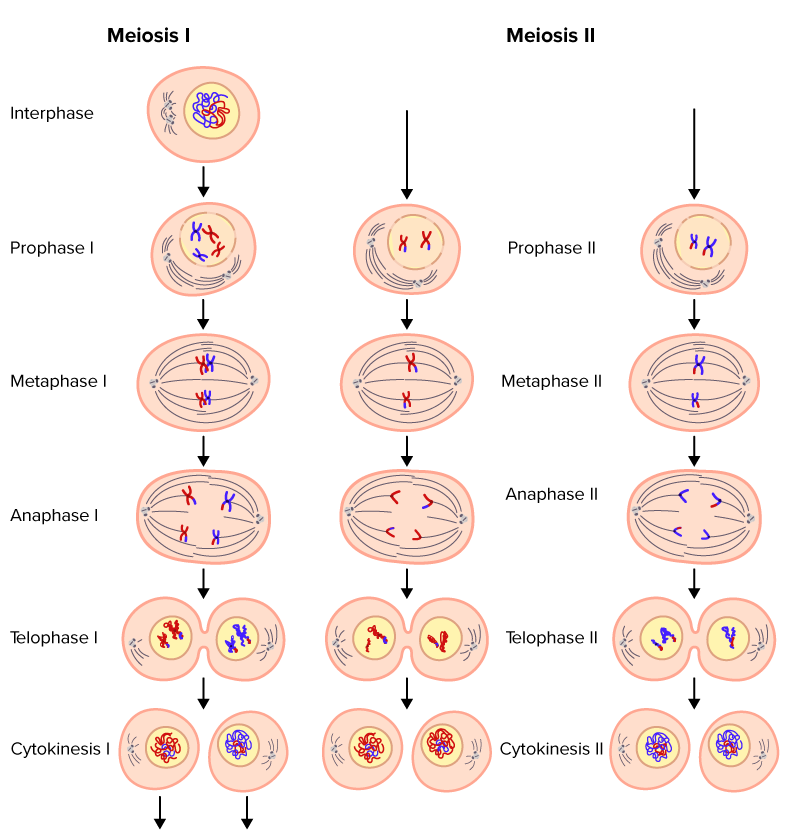
Flip for a visual of Meiosis 1 and 2
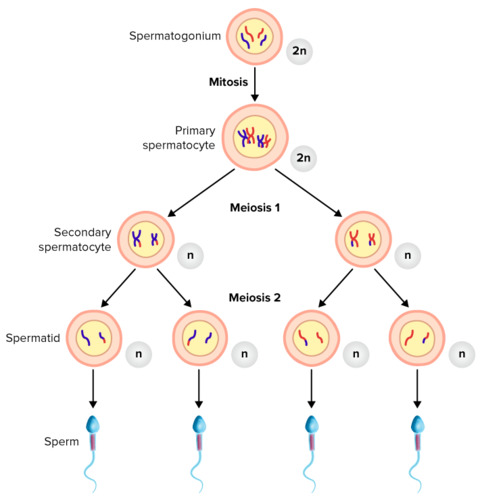
Spermatogenesis
The production of sperm cells by which diploid germ cells develop into haploid sperm cells in the testes. Here they undergo Meiosis 1 and 2 before maturing into fully fledged sperm.
Oogenesis
The process by which diploid germ cells develop into haploid egg cells (ova) in the ovaries.
During oogenesis the cytoplasm develops unequally, so 1 egg retains the most cytoplasm, nutrients and organelles needed for early development.
In short- the polar bodies are the by-product of unequal cytokinesis. Eventually, they will degenerate and be reabsorbed

Why are sperm and egg haploid?
so that during fertilization, 2 haploid sets (23+23) combine to form a diploid zygote (46)
What would happen if sperm and egg were diploid?
If both sperm and egg were diploid, the resulting zygote would have double the normal number of chromosomes, leading to an incompatible state for proper development. (96)
and then double that for future generations.
This condition could result in severe genetic imbalances, causing unviability or severe developmental defects.
Nondisjunction
When chromosomes fail to separate correctly during cell division- causing one cell to receive too many chromosomes and another to receive too few.
This can occur during meiosis 1 or 2 resulting in conditions such as Down syndrome or Turner syndrome.
XYY - Result of Nondisjunction
Biologically Male
Hyper Masculinity
Rapid Growth
Often has Mental Impairment
X0 - Nondisjunction
Biologically Female.
Underdeveloped Breasts
Shield Chest
Webbed Neck
Rudimentary Ovaries
Also known as Turner Syndrome
XXY - Result of Nondisjunction
Biologically Male
May have Developmental Delays
Also known as Klinefelter Syndrome.
breast development
fewer chest hair, baldness absent, poor beard growth - “female” pubic hair pattern
wide hips for a male
small testicular size
Trisomy 21 (Down Syndrome)
A human genetic condition typically resulting from nondisjunction that causes an extra copy of chromosome 21 affecting approximately 1 out of every 700 children.
Polyploidy
None of the homologues split during anaphase.
The gamete then has a full set of chromosomes- making it diploid.
If a haploid and diploid combine- it becomes a triploid cell
If both gametes are diploid then the result can be a tetraploid cell.
Animals would die but plants can produce larger flowers or fruit. Bananas are a common example.
Mnemonic for Stages of Cell Division
I Put My A** To It
Which stands in order for Interphase, Prophase, Metaphase, Anaphase, Telophase, and back to Interphase.
Duplicated Chromosome Structure
1 Chromosome consisting of 2 sister chromatids joined at the centromere.
The ENTIRE X shaped structure
Cell Cycle Checkpoints
Control stops in the cell cycle where the cell pauses to verify that it has grown sufficiently, received proper signals, and accurately copied its DNA before dividing.

ABCD Rule - Skini
As Borders Collapse Down
A visual guide for identifying suspicious skin moles by checking for Asymmetry, Border irregularity, Color variation, and a Diameter larger than 6mm (.25 inch ).

Metastasis
The dangerous movement of malignant cancer cells away from their primary tumor through bloodstream and lymphatic channels to colonize other organs.

Nondisjunction
A cell division mistake during meiosis where chromosome pairs fail to pull apart properly, producing gametes with an extra or missing chromosome.
Down Syndrome
A genetic condition also called Trisomy 21, caused when nondisjunction leaves a fertilized egg with three copies of chromosome 21 instead of the usual pair.

Mitosis vs. Meiosis: Comparison of Key Features
Feature | Mitosis | Meiosis |
|---|---|---|
Primary Function | Growth, tissue repair, and asexual reproduction | Gamete production for sexual reproduction |
Number of Divisions | 1 division | 2 divisions (Meiosis I and Meiosis II) |
Number of Daughter Cells | 2 daughter cells | 4 daughter cells |
Genetic Identity | Genetically identical to parent and each other | Genetically unique from parent and each other |
Ploidy of Daughter Cells | Diploid (2n; human count = 46) | Haploid (n; human count = 23) |
Synapsis of Homologues | Does not occur | Occurs during prophase I to form tetrads |
Crossing Over | Does not occur | Occurs between non-sister chromatids in prophase I |
Spermatogenesis vs. Oogenesis: Comparison
Feature | Spermatogenesis | Oogenesis |
|---|---|---|
Location | Testes | Ovaries |
Viable Gametes Formed | 4 viable mature sperm cells | 1 viable ovum (egg cell) |
Non-Functional Cells | None | 3 non-functional polar bodies |
Cytokinesis Pattern | Equal division of cytoplasm | Unequal division of cytoplasm |
Cell Morphology & Organelles | Mobile, flagellated; mitochondria located at tail base | Large, immotile cell containing all zygotic mitochondria |
Cytokinesis: Animal Cells vs. Plant Cells
Feature | Animal Cells | Plant Cells |
|---|---|---|
Dividing Structure | Cleavage furrow | Cell plate |
Cellular Mechanism | Actin contractile ring constricts the plasma membrane | Golgi-derived vesicles fuse along the midline to build a cell wall |
Direction of Division | Pinches from the exterior inward (centripetal) | Grows from the center outward to cell edges (centrifugal) |
Effect of Cell Wall | Absent; flexible plasma membrane pinches completely | Rigid cell wall prevents inward pinching |
Cell Cycle Checkpoints (G1, G2, and M)
Checkpoint | Timing | Condition Verified |
|---|---|---|
G1 Checkpoint | Late G1 phase | Evaluates cell size, nutrient stores, growth signals, and DNA integrity before duplication |
G2 Checkpoint | End of G2 phase | Confirms accurate and complete duplication of all 46 chromosomes before entering mitosis |
M (Spindle) Checkpoint | Metaphase | Verifies all chromosomes are correctly aligned along the cell equator and attached to spindle fibers |
Normal Cells vs. Cancer Cells: Growth and Characteristics
Characteristic | Normal Cells | Cancer Cells |
|---|---|---|
Division Rate | Strictly regulated by cell cycle checkpoints | Continuous, uncontrolled division |
Contact Inhibition | Present; cells stop dividing when in contact with others | Absent; cells continue dividing and pile into tumors |
Differentiation | Differentiated into specialized functional tissue cells | Non-differentiated and stem-cell-like |
Nuclear Structure | Standard size with uniform nuclear envelope | Enlarged, irregular, and abnormal nuclei |
Tissue Movement | Anchored within primary tissue | Invasive; spread to distant organs via metastasis |
Cancer Treatment: Radiation Therapy vs. Chemotherapy
Feature | Radiation Therapy | Chemotherapy |
|---|---|---|
Scope of Action | Localized target area | Systemic treatment throughout the whole body |
Mechanism | Direct high-energy beams damage DNA to stop division | Pharmacological drugs disrupt mitosis and the cell cycle |
Administration | External beams or localized radioactive implants | Intravenous infusion or oral medications |
Primary Clinical Use | Confined, localized solid tumors | Metastatic, widespread, or circulating blood cancers |
Nondisjunction: Meiosis I vs. Meiosis II
Feature | Nondisjunction in Meiosis I | Nondisjunction in Meiosis II |
|---|---|---|
Underlying Error | Homologous chromosomes fail to separate during anaphase I | Sister chromatids fail to separate during anaphase II |
Gamete Proportions | 100% abnormal (2 gametes with n+1, 2 gametes with n−1) | 50% abnormal (1 with n+1, 1 with n−1) and 50% normal (2 with n) |
Fertilization Outcome | All resulting zygotes are aneuploid (trisomy or monosomy) | Half of resulting zygotes are aneuploid; half are normal diploid (2n) |
Diploid (2n) vs. Haploid (n) Cells
Feature | Diploid (2n) | Haploid (n) |
|---|---|---|
Chromosome Sets | Contains 2 complete sets of homologous chromosomes | Contains 1 single set of chromosomes |
Human Cell Count | 46 total chromosomes (23 pairs) | 23 total chromosomes |
Typical Cell Types | Somatic body cells (e.g., skin, muscle, neurons) | Gametes (sperm and egg cells) |
Generating Process | Formed via mitosis | Formed via meiosis |