Determinants, Eigenvectors and Eigenvalues
 Call Kai
 Learn
Learn Practice Test
 Spaced Repetition
 Match
Match Flashcards
 Knowt Play
1/52

There's no tags or description
Looks like no tags are added yet.
Name | Mastery | Learn | Test | Matching | Spaced | Call with Kai |
|---|
No analytics yet
Send a link to your students to track their progress
53 Terms
What does Mij mean?
The (n-1)x(n-1) matrix obtained from M by deleting the ith row and jth column.
What’s the formula for the determinant of a matrix M?
If M is a 1×1 matrix then detM=M11. If M is an n×n matrix with n>1 then the determinant of M is:
detM=k=1∑n(−1)k+1M1kdetM1k
What is the Laplace Expansion Theorem?
For any n×n matrix M and any natural numbers 1≤i≤n and 1≤j≤n the following hold:
detM=k=1∑n(−1)i+kMikdetMik
detM=k=1∑n(−1)k+jMkjdetMkj
Remark: The value detMij is called the (i,j) minor of M, while the value (−1)i+jdetMij is the (i,j) cofactor of M.
If M is a n×n upper triangular matrix, what is detM?
detM=i=1∏nMii
Let A and B be square matrices, what is the determinant of B equal to if A is transformed into B using each of the elementary row operations?
Ari→αriB then detB=αdetA
Ari→ri+λrjB then detB=detA
Ari↔rjB then detB=−detA
Proof that a matrix A is only invertible if and only if detA=0.
Let R=RREF(A). No elementary row operations changes whether the determinant is 0.
Since R is obtained from A via a sequence of elementary row operations, detA=0⟺detR=0. However, R is n×n and is in RREF, so it follows either R=In or R contains a row of zeros. It follows that R=In iff detR=0.
Hence A is invertible ⟺R=In
⟺detR=0
⟺detA=0.
What rules are the determinants of elementary matrices given by?
detEri→αri=α
detEri→ri+λrj=1
detEri↔rj=−1
What’s the adjugate of A, where A is a square matrix, and what are its properties?
let B be the matrix given by Bij=(−1)i+jdetAji
B is the adjugated of A.
AB=detAIn=BA
in particular if detA=0 then A is invertible and A−1=detA1B
What does det(AB)=? and the proof of this
det(AB)=det(A)det(B).
Proof:
Suppose A is singular. Then AB is singular, since if AB were invertible, say C=AB, then A(BC−1)=In, so A would be invertible. Hence det(A)=0 and det(AB)=0, so det(AB)=0=det(A)det(B).
Case 2: Suppose A is invertible. Then A is a product of elementary matrices, so A=EkEk−1⋯E2E1. For any elementary matrix E, det(EB)=det(E)det(B). Therefore det(A)=det(Ek)det(Ek−1)⋯det(E1) and det(AB)=det(EkEk−1⋯E1B)=det(Ek)det(Ek−1)⋯det(E1)det(B)=det(A)det(B).
How can we work out the determinant if the matrix is in LU decomposition.
If PA=LU, where P is a permutation matrix, L has diagonal entries 1, and U is upper triangular, then det(A)=±∏i=1nUii. The sign depends on whether the number of row swaps in P is even or odd (+ if even, - if odd).
What’s the definition of an eigenvector with eigenvalue λ?
Let V be a v.s over K and T:V→V be a linear transformation.
A vector v∈V is an eigenvector of T with eigen value λ∈K if v=0 and T(v)=λv.
If A∈Mn(K), then eigenvalues and eigenvectors of A are the eigenvalues and eigenvectors of the linear map TA:V→V, Av=λv.
Remark: The zero vector is never an eigenvector.
How do we find eigenvalues and eigenvectors of a matrix?
To find eigenvalues:
evaluate det(A−λIn)=0.
To find eigenvectors:
v is a eigenvector if it is a non-trivial solution to the system (A−λIn)x=0.
What’s the characteristic polynomial?
PA(x)=det(A−xIn) is the characteristic polynomial of A.
What is an eigenspace?
The λ-eigenspace of linear map T:V→V is the subspace Eλ={v∈V∣T(v)−λv}
or with matrices
the λ-eigenspace of A is the λ-eigenspace of the linear map TA(v)=AV.
In other words the collection of all eigenvectors together with the zero vector.
What is the geometric multiplicity of an eigenvalue?
The dimension of the corresponding λ-eigenspace Eλ.
Proof that {v1,…,vk} is linearly independent where v1,…,vk are eigenvectors of T with distinct eigenvalues λ1,…,λk respectively.
Assume for contradiction that {v1,…,vk} is linearly dependent.
Then choose j such that {v1,…,vj−1} is linearly independent but vj=∑i=1j−1αivi, where the αi are not all zero.
Applying T gives λjvj=T(vj)=∑i=1j−1αiT(vi)=∑i=1j−1αiλivi.
Also, multiplying vj=∑i=1j−1αivi by λj gives λjvj=∑i=1j−1λjαivi.
Subtracting gives 0=∑i=1j−1(λi−λj)αivi.
Since {v1,…,vj−1} is linearly independent, (λi−λj)αi=0 for all i.
But the eigenvalues are distinct, so λi−λj=0. Hence αi=0 for all i, contradicting that the αi are not all zero.
Therefore {v1,…,vk} is linearly independent.
What does it mean for a field to be algebraically closed?
If every polynomial p(x)=a0+a1x+…+anxn where ai∈K and ai=0 can be factorised in the form p(x)=b(x−c1)…(x−cn) for some b,c1,…,cn∈K.
What is the algebraic multiplicity of an eigenvalue λ?
How many times the eigenvalue appears as an root of the characteristic polynomial.
What is the trace of A?
tr(a)=A11+…+Ann=i=1∑nAii
If K is an algebraically closed field and λ1,..,λn are the eigenvalues of A∈Mn(K), counted with multiplicity, what is the trace and determinant?
tr(A)=λ1+…+λn
det(A)=λ1…λn
What does it mean for a matrix A∈Mn(k) to be similar B∈Mn(K)?
There is an invertible matrix P∈Mn(K) such that B=P−1AP
Similar matrices have the same rank, trace, determinant and eigenvalues.
What does it mean for a matrix to be diagonalisable?
If A is similar to a diagonal matrix.
When is a matrix diagonalizable?
if and only if there is a basis {v1,…,vn} of Kn such that each vi is an eigenvector of A. If Avi=λivi and P=(v1 ⋯ vn), then A=PDP−1 where D=λ10⋮0amp;0amp;λ2amp;⋮amp;0amp;⋯amp;⋯amp;⋱amp;⋯amp;0amp;0amp;⋮amp;λn.
Proof:
Suppose A is diagonalizable.
Then there is an invertible matrix P and a diagonal matrix D such that D=P−1AP, so A=PDP−1.
Since P is invertible, its columns v1,…,vn form a basis of Kn.
Also AP=PD, so (Av1 ⋯ Avn)=(λ1v1 ⋯ λnvn).
Hence Avi=λivi, so each vi is an eigenvector.
Conversely, suppose {v1,…,vn} is a basis of eigenvectors with Avi=λivi. Let P=(v1 ⋯ vn) and let D be the diagonal matrix with diagonal entries λ1,…,λn. Since the columns of P form a basis, P is invertible. Then AP=(Av1 ⋯ Avn)=(λ1v1 ⋯ λnvn)=PD. Therefore A=PDP−1, so A is diagonalizable.
What can we say about if A is diagonalizable, about geometric and algebraic multiplicities?
A is diagonalisable if and only if the algebraic and geometric multiplicities of each of its eigenvalues coincide.
What is an orthogonal matrix?
A matrix P∈Mn(R) is orthogonal if and only if its columns form an orthonormal basis of Rn.
Note: columns must form an orthonormal set.
What does it mean for A and B to be orthogonally similar?
PTAP=B where P∈Mn(R) is an orthogonal matrix.
What does it mean for a matrix to be orthogonally diagonalizable.
It is orthogonally similar to a diagonal matrix.
What can we say about the structure of A∈M(R) if it is orthogonally diagonalisable and the proof?
A is symmetric.
Proof.
Assume A is orthogonally diagonalizable. Then there is an orthogonal matrix P and a diagonal matrix D such that D=PTAP. Rearranging gives A=PDPT.
Then transpose: AT=(PDPT)T=(PT)TDTPT=PDPT=A.
Therefore A is symmetric.
Note the converse is true (but not examinable).
How do you diagonalise a matrix?
To diagonalise A,
find the eigenvalues by solving det(A−λI)=0.
Then find a basis for each eigenspace by solving (A−λI)x=0.
If you get enough linearly independent eigenvectors to form a basis, put them as the columns of P.
Put the matching eigenvalues in the same order down the diagonal of D. Then A=PDP−1.
What’s the process of orthogonally diagonalising a matrix?
Find eigenvalues of A using the characteristic polynomial
For each eigenvalue, find an orthonormal basis Bλ for the eigen space Eλ.
To do this find any basis B of Eλ and
if dimEλ =1 then normalise it
if dimE_\lambda>1 apply the Gram Schmitt process to find an orthonormal basis Bλ
Let P=(v1…vn) where vi are the orthonormal basis vectors of the eigenspaces.
Then PTAP=D where D is a diagonal matrix with eigenvalues (with multiplicities) along the main diagonal?
What is a unitary matrix?
U∈Mn(C) is a unitary matrix if the columns form an orthonormal basis for Cn
A matrix if unitary if and only if U−1=?
U∗
This is the complex analogue of an orthogonal matrix.
What does it mean for
A to be unitarily similar to B?
A to be unitarily diagonalisable?
There exists a unitary matrix U∈Mn(C) such that U∗AU=B
A is unitarily similar to a diagonal matrix.
What does it mean for A∈Mn(C) to be Hermitian?
A∗=A
If A∈Mn(C) has real eigenvalues and A is unitarily diagonalisable, what else can we say about A?
A is Hermitian
Proof that is A is Hermitian then all eigenvalues of A are real?
Let λ be an eigenvalue of A
λ⟨v,v⟩=⟨λv,v⟩=⟨Av,v⟩=⟨v,A∗v⟩
=⟨v,Av⟩=⟨v,λv⟩=λ⟨v,v⟩
Proof that If A is Hermitian, then if λ1,λ2 are distinct eigenvalues with corresponding eigenvectors, then v1,v2 are orthogonal?
⟨Av1,v2⟩=⟨v1,A∗v2⟩=⟨v1,Av2⟩ since it is Hermitian
Since Av1=λ1v1 etc we have
λ1⟨v1,v2⟩=⟨λ1v1,v2⟩=⟨v1,λ2v2⟩=λ2⟨v1,v2⟩=λ2⟨v1,v2⟩
so (λ1−λ2)⟨v1,v2⟩=0 and λ1=λ2 so inner product is 0 and the vectors are orthogonal.
What does it mean for A∈Mn(C) to be normal?
AA∗=A∗A
Prove that A∈Mn(C) is unitarily diagonalisable if and only if it is normal (⟹ direction only, other direction non-examinable).
Let A∈Mn(C) be unitarily diagonalisable. That is U∗AU=D where U is unitary and D is diagonal.
Then D∗=U∗A∗U.
Since D and D∗ are diagonal, we have DD∗=D∗D. Therefore
U∗AUU∗A∗U=U∗A∗U∗AU
⟹U∗AA∗U=U∗A∗AU
⟹AA∗=A∗A by multiplying on the left by U and on the right by U∗.
What is Schur’s Theorem (no proof)?
If A∈Mn(C), then A is unitarily similar to an upper triangular matrix T. More over, the diagonal entries of T are eigenvalues of A.
The matrix decomposition A=UTU∗ with U unitary and T upper triangular is called a Schur decomposition of A.
Remark: If A is a real matrix then it is orthogonally similar to an upper triangular matrix T. Sometimes called the Triangularisation theorem.
What is the Spectral Theorem for Hermitian matrices?
If A∈Mn(K) is Hermitian (C) or symmetric (R) then there exists a unitary or orthogonal U∈Mn(K) and λ1,…,λn∈R such that
A=Uλ10⋮0amp;0amp;λ2amp;⋮amp;0amp;⋯amp;⋯amp;⋱amp;⋯amp;0amp;0amp;⋮amp;λnU∗.
The factorisation shows that a Hermitian matrix can be diagonalised using a unitary matrix U. In the real symmetric case, the equivalent factorisation uses an orthogonal matrix P.
Prove the Spectral Theorem in the complex case.
A∈Mn(C) is Hermitian. By Schur’s theorem, ∃ a unitary matrix U and an upper triangular matrix T such that U∗AU=T.
Since A∗=A, we have T∗=(U∗AU)∗=U∗A∗(U∗)∗=U∗AU=T.
Since T is upper triangular, T∗ is lower triangular. But T∗=T, so T is both upper and lower triangular, hence diagonal. Therefore A is unitarily diagonalisable. Since T=T∗, the diagonal entries of T are real.
Prove the Spectral Theorem in the R case.
Assume A∈Mn(R) is symmetric. Since A is symmetric, it is Hermitian, so it has real eigenvalues. By the triangularisation theorem, there exists an orthogonal matrix P and an upper triangular matrix T such that PTAP=T. Since AT=A, we have TT=(PTAP)T=PTAT(PT)T=PTAP=T. Since T is upper triangular, TT is lower triangular. But TT=T, so T is both upper and lower triangular, hence diagonal. Therefore Porthogonally diagonalises A.
What is the Single Value Decomposition theorem?
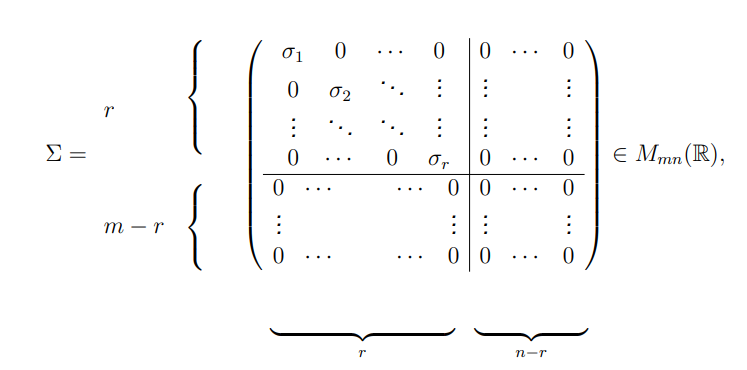
Let A∈Mmn(K). Then there exist matrices U∈Mm(K) and V∈Mn(K), which are unitary if K=C and orthogonal if K=R, such that A=UΣV∗, where Σ∈Mmn(R).
The singular values are the positive diagonal entries of Σ. They satisfy \sigma_1 \geq \sigma_2 \geq \cdots \geq \sigma_r > 0.
The number r is the dimension of the vector space spanned by the columns of A. Equivalently, r=rank(A):
NOTES:
The σi are called the nonzero singular values of A
The ui are called left singular vectors of A
The vi are called right singular vectors of A
What are u1,…,um and v1,…,vn eigenvectors of in SVD
ui are eigen vectors of AA∗ of unit norm
vi are eigenvectors of A∗A of unit norm
NOTE:
Avi=σiui for i=1,…,r, 0 for i=r+1,…,n
A∗ui=σivi for i=1,…,r, 0 for i=r+1,…,m
AA∗ui=σi2ui for i=1,…,r, 0 for i=r+1,…,m
A∗Avi=σi2vi for i=1,…,r, 0 for i=r+1,…,n
What is the Rank-Nullity Theorem?
Let T:V→W be a linear transformation from a finite-dimensional vector space V to an arbitrary space W. Then rank(T)+nullity(T)=dim(V)
Proof of the Rank-nullity theorem?
Let dim(V)=n and let B1={v1,…,vk} be a basis for ker(T), so nullity(T)=k. Since B1 is linearly independent, we can extend this to a basis of V: B={v1,…,vk,vk+1,…,vn}.
We claim that B2={T(vk+1),…,T(vn)} is a basis for Im(T).
First, it spans Im(T): if w∈Im(T), then w=T(v) for some v∈V. Write v=a1v1+⋯+anvn. Since v1,…,vk∈ker(T), T(v1)=⋯=T(vk)=0, so w=ak+1T(vk+1)+⋯+anT(vn).
Now show linear independence.
Suppose ck+1T(vk+1)+⋯+cnT(vn)=0. Then T(ck+1vk+1+⋯+cnvn)=0, so ck+1vk+1+⋯+cnvn∈ker(T).
Therefore it is a linear combination of v1,…,vk.
We can write ck+1vk+1+⋯+cnvn=c1v1+⋯+ckvk for some c1,…,ck∈K. Rearranging gives −c1v1−⋯−ckvk+ck+1vk+1+⋯+cnvn=0 so all coefficients are zero since B is linearly independent.
Hence ck+1=⋯=cn=0, so B2 is linearly independent. Therefore B2 is a basis for Im(T) and has n−k vectors. Hence rank(T)=n−k and nullity(T)=k, so rank(T)+nullity(T)=n=dim(V).
What is a Row and Column Space of a matrix?
Let A∈Mmn(K).
The Row Space of A is the subspace of Kn spanned by the rows of A, denoted by Row(A) .
The column space of A is the subspace of K^M spanned by the columns of A, denoted by Col(A)
Proof that if A,B∈Mmn(K) are row equivalent, then Row(B)=Row(A) and if they’re column equivalent, then Col(B)=Col(A).
The matrix A can be transformed into B by applying a sequence of elementary row operations. Therefore the rows of B are linear combinations of the rows of A and so Row(B)⊆Row(A). Reversing the row operations we can transform B into A so we get Row(A)⊆Row(B).
⟹Row(A)=Row(B).
Applying same argument with elementary column operations gives the second part.
Proof that for A∈Mmn(K), the dimension of Row(A) is the number of non-zero rows in RREF of A and the non-zero rows of the RREF of A for a basis for Row(A).
Let R=RREFA. Since they are row equivalent, Row(A)=Row(R) and so dim(Row(A))=dim(Row(R)) .
Suppose R has k non-zero rows. Each of these has a leading 1 with all other entries in the same column equal to 0. Therefore the non-zero rows of R are linearly independent. Hence the non-zero rows form a basis of Row(R)=Row(A) and dim(Row(A))=dim(row(R))=k as required.
What is the null space of A?
Null(A) is the subset of Kn consisting of solutions of the linear system Av=0, i.e
Null(A)={v∈Kn∣Av=0}
The dimension of Null(A) is called the nullity of A>
Remark: