Baroque Art Italy + Spain (17th Century)
 Call Kai
 Learn
Learn Practice Test
 Spaced Repetition
 Match
Match Flashcards
 Knowt Play
1/31

There's no tags or description
Looks like no tags are added yet.
Name | Mastery | Learn | Test | Matching | Spaced | Call with Kai |
|---|
No analytics yet
Send a link to your students to track their progress
32 Terms
Baroque Architecture
[ Shift from High Renaissance calm and balanced to drama, movement, & emotional impact (impress, overwhelm, inspire ]
Movement & Curves : buildings have oval shapes, curved walls, and flowing forms instead of straight lines
Dramatic use of Light : Carefully controlled - bright areas contrast w/ shadow to creat theatrical effect
Grandeur, Scale, Megalomaniacal : Massive spaces meant to feel awe-inspiring and powerful.
Megalomaniacal : Make larger to heighten importance; St. Peter’s Basilica - grand dome, sweeping spaces, dramatic interior lighting = Classic Baroque
Rich Decoration : Interiors filled w/ gold, marble, frescoes, elaborate details
Blending of Arts : Architecture, painting, sculpture are combined into one unified experience
Baroque Sculpture
Movement : Figures are in mid-action; twisting or reaching
Emotional Intensity : Facial and body expressions show strong feelings, pain, joy, ecstasy
Realism w/ Drama : Very lifelike, but more theatrical than natural
Interaction w/ Space : Sculptures often spill out into the viewers space, not just sit still
Light and Shadow : Deep carvings create strong contrast to enhance drama
Baroque Painting
Dramatic use of Light & Shadow (Chiaroscuro) : Highlights the main subject acting as a spotlight, creates theatrical & stage-like effect
Band of Light : Chiaroscuro & tenebrism, strong beam/ strip of light across the painting
Tenebrism : Extreme darkness, more intense than chiaroscuro, figures appear to emerge out of the darkness
Movement & Action : Figures are rarely still; twisting, reaching, in mid-movement;
Use diagonal lines instead of calm horizontal
Emotional Intensity : Faces and gestures show strong emotions; joy, pain, fear
Realism & Detail : Lifelike; dirt, wrinkles, textures
Use ordinary people as models to make scenes feel relatable and immediate
Focus on Viewer : Figures look at the viewer, reach into viewer space; create a sense of the viewer being part of the scene
Rich Color & Texture : Deep, bold colors: red, brown, gold
Fabric, skin, metals painted in great detail
Baroque Characteristics (for all)
Polychromatic Colors - All colors used to stimulate emotion
Multiple Points of View - Use of diagonals, twists, dramatic movement to engage the viewer and makes it more immersive.
Dramatic and immersive
Use of movement and diagonals
Unity of Form - Nothing feels random; use of light source, repeating colors and shapes support the main idea/story
A lot happening, but all points to the main emotion/action
Open Composition - Movement extends beyond the composition to make viewers feel part of the story
Abstract Theme - Fuses realistic matter (people & events) with spiritual messages/events
Focused on extraversion - focus on outside world where energy is gained from social interaction, action, and enthusiasm
Baroque Period
Catholic church reforms under Council of Trent shifts to prohibiting nude images and accessible to the general public
Church wants to expand religion; make art easier to comprehend and inspire viewers to a higher, spiritual devotion
Artist : Caravaggio created religious artwork containing real people and settings to feel real and dramatic, and show strong emotion, that clearly tells religious stories
Bernini
Mastered method of marble reduction in his early 20s
Design, playwriting, sculpture, architecture, painting
Religious works & portraits
Worked for 5 popes: very wealthy artist
Influenced by Michelangelo & Raphael
Flowing and knotting of fabric to create tension, drama, & theatrical effect
Ovid - Poet, Bernini’s sculptures were inspired by his poems
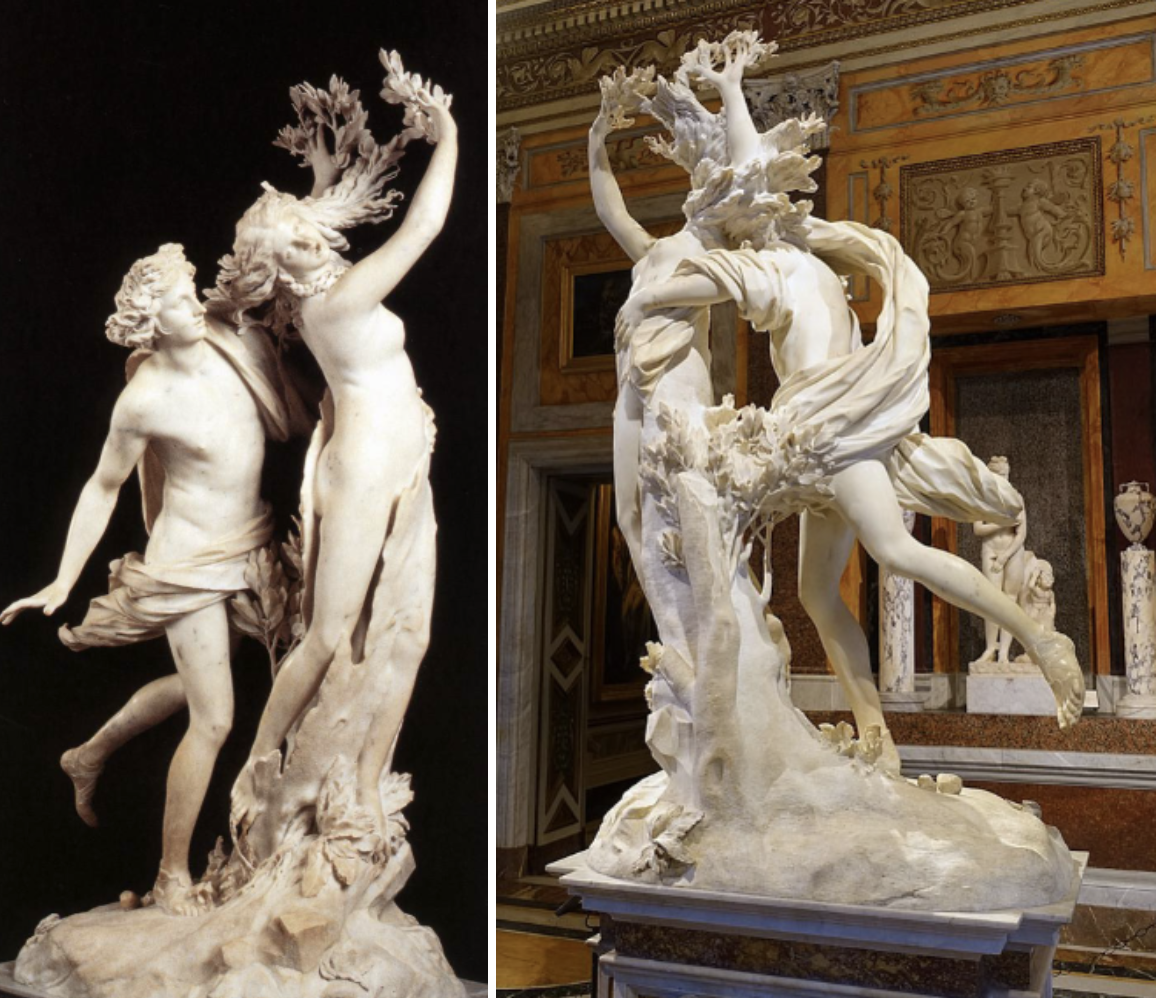
Apollo and Daphne - Bernini
Subject Matter: Depicts Ovid’s (poet) Metamorphoses
Apollo is in pursuit of Daphne, who wants to remain chaste, and her father transforms her into a tree as Apollo catches her.
Bernini captures the exact moment of transformation - Baroque art loved drama and movement
Expresses metamorphoses - change
Daphne is turning into a tree - bark feet, leaves/branches for fingers
Dynamic twisting and spiraling creates the sense of motion
Creates visual rhythm and guides the viewer upwards
Detail & Texture: Apollo’s muscular body contrasts w/ Daphne’s delicate texture of transformation in her hair and fingers
Feel tension in Apollo’s grasp
Expression: Emotional intensity in Apollo’s facial expression of longing and surprise.
Daphne: Shows fear and desperation
Intense interplay of emotion emphasizes theatricality and immediacy
Union of Space: Transformation is visible in multiple angles, viewers must walk around it to see the full narrative and makes them feel part of the moment
[ Excellent example of Baroque’s fascination with motion, drama, and psychological intensity ]
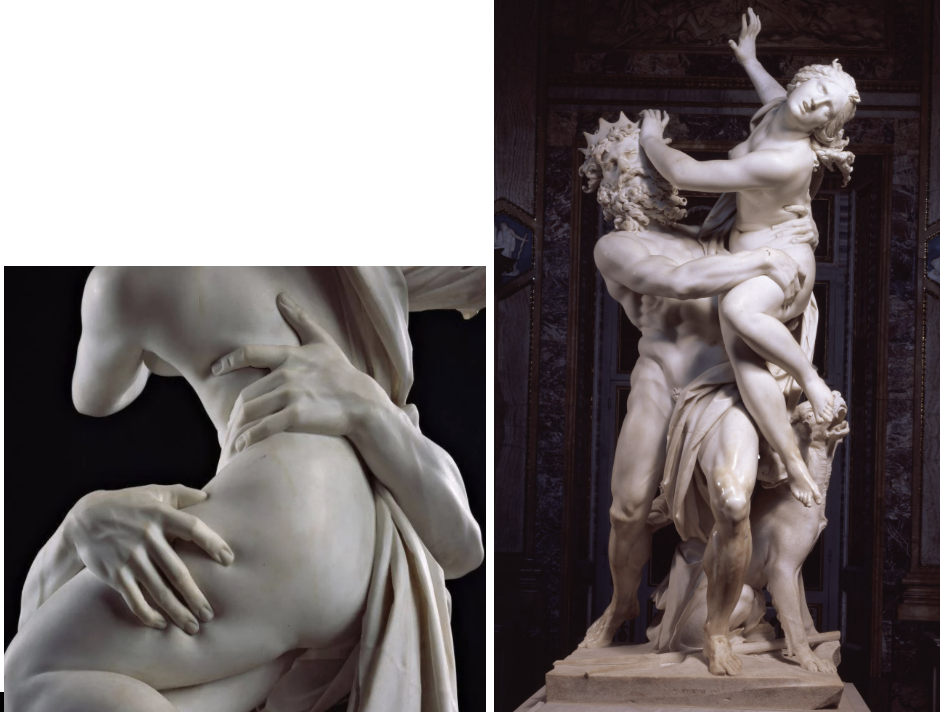
The Rape of Persephone - Bernini
Subject Matter: Persephone (goddess of seasonal change) is about to be pulled down to the underworld by Hades
Bernini captures the instant of abduction, full of struggle and emotion
Composition: Figures spiraling upward, her body twisting as she resists
Motion and tension are central
Emotional Intensity: Persephone expresses terror, while Hades is forceful and controlled
Psychological contrast shows realism and drama
Viewers see this as real human interaction instead of static stone
Persephone’s struggling body - panic tone
Hades forceful grip makes tension and weight appear realistic
Space: Sculpture is meant to be viewed from multiple angles
Technique: Bernini creates the illusion of soft flesh as Hades is pressing onto her thigh
Acute detail to depth and curvature allows him to shape each contour to mimic soft skin
Deep undercuts and delicate folds enhances - light hits different surfaces at different angles
Shadows enhance the illusion of depth and softness
[ Bernini pushes this medium beyond its limit, creating this soft illusion ]
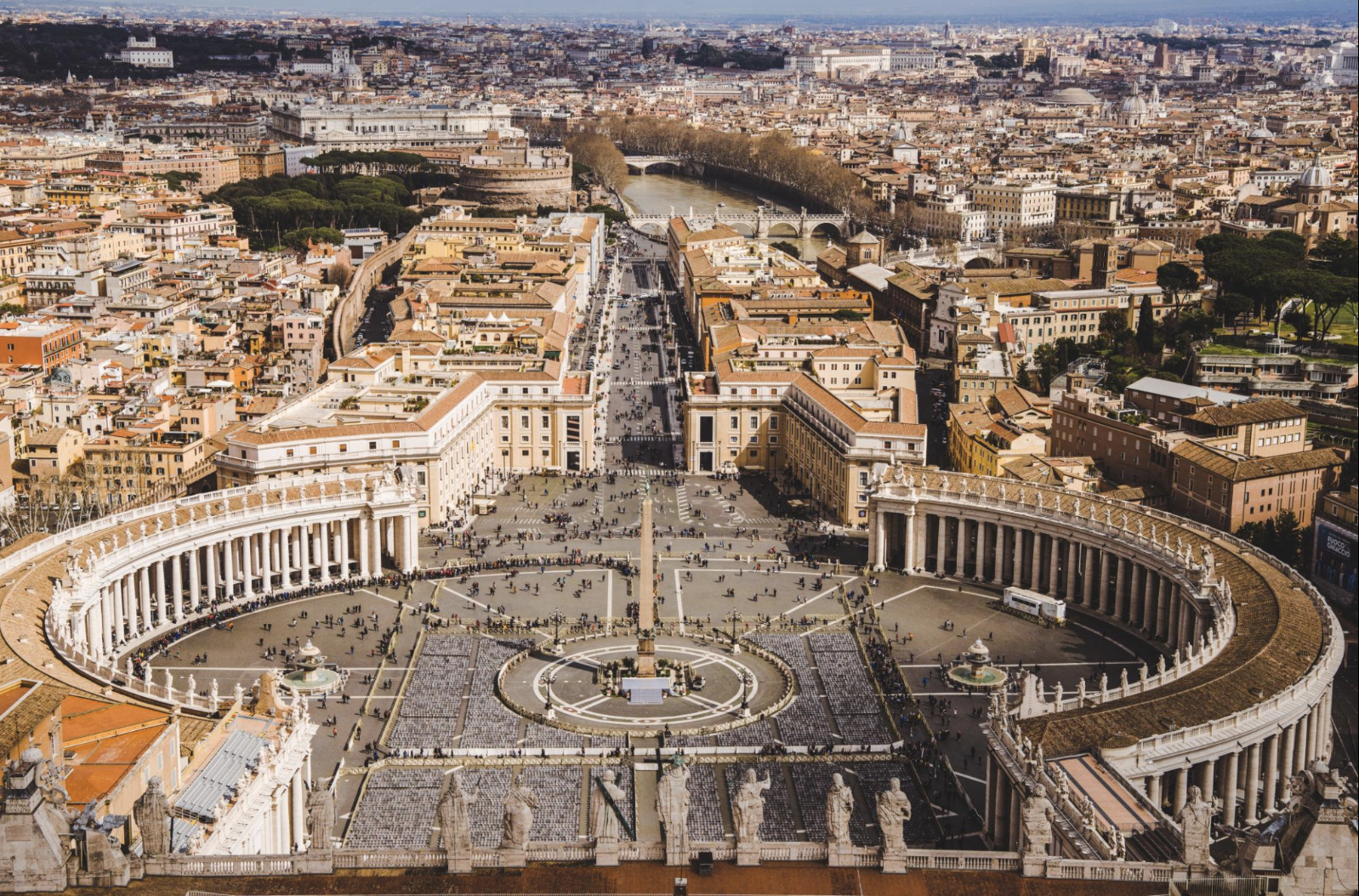
St. Peter’s Basilica, Rome
Bernini - Commissioned by Pope Alexander VI to redesign the area in front of the Basilica
The church aimed to become inclusive, welcoming, and re-engaging the public through emotional, welcoming architecture after the Counter-Reformation (be part of the Catholic Church)
Colonnade - Bernini created massive curved colonnades on both sides w/ 4 rows of Tuscan columns, topped with Saints.
Colonnades are meant to act as the “maternal arms” of the church, embracing visitors
Sweeping curvature motion of the colonnades = movement. (Baroque characteristic)
Piazza - Rectangle > redesigned into an elliptical (oval) shape, creating a sense of movement, flow, and gathering
Creates emotion and theatricality
Visual Control - Everything is perfectly aligned to pull the viewer’s eye towards the basilica facade and dome. Egyptian Obelisk is the visual anchor
[ Bernini used his control in perspective, symmetry, emotion, theatrics, and movement to engage & guide viewers]
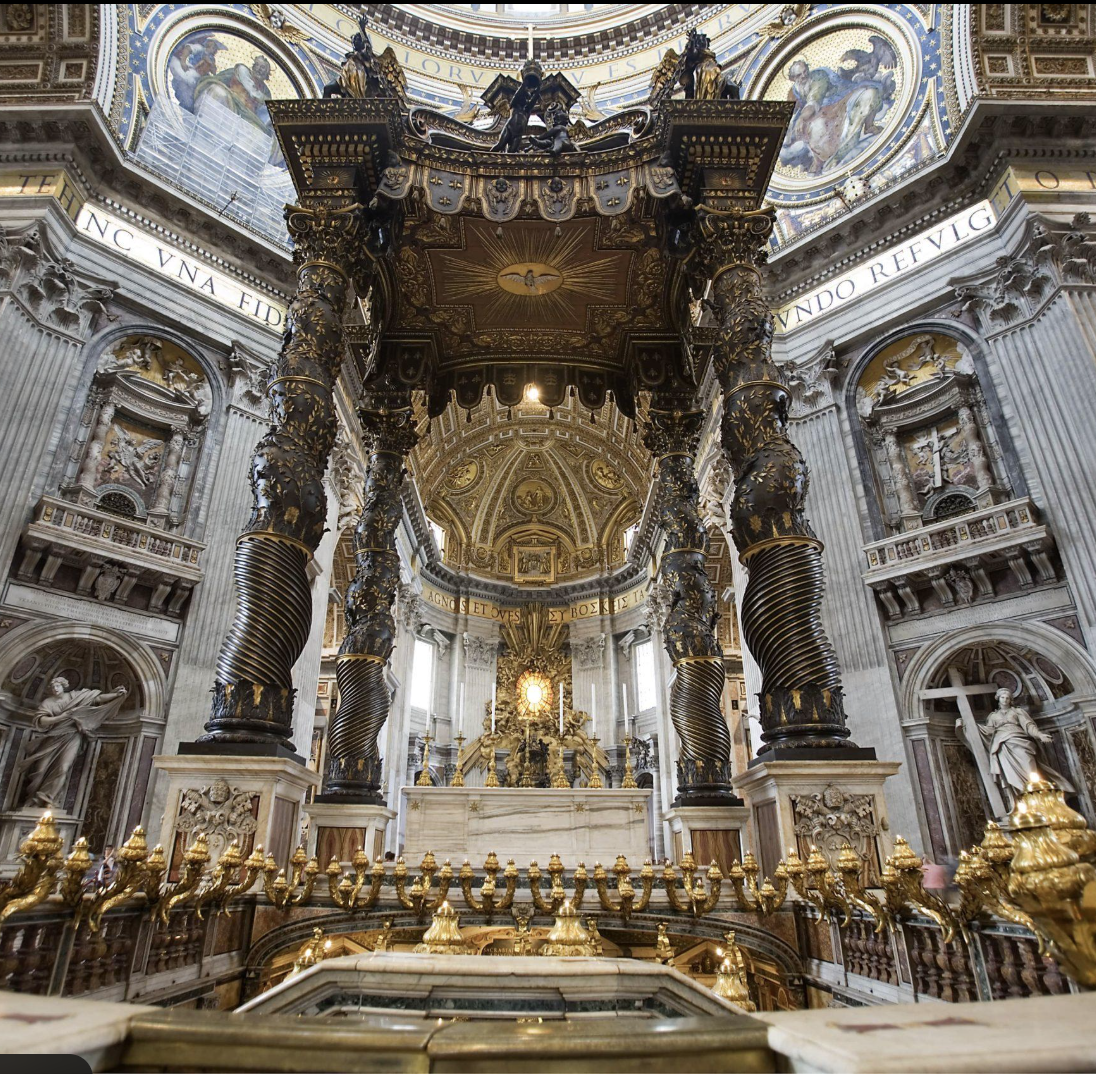
Baldacchino - Bernini
Designed for Pope Urban VIII - directly under Michelangelo’s dome & marks the site of St. Peter’s tomb below
4 Spiral Columns - Called Solomonic columns; swirling upwards to create movement
Shafts are enriched w/ laurel & olive branches
Barberini bees - coat of arms for Pope Urban’s family
Canopy - Rendered in bronze, but made to look like rich cloth hanging over
Fringed tassel edges make it feel ceremonial
Turning hard material into what seems soft, animated, and luxurious (Baroque Characteristic)
Cherubs, doves, and gold ornaments are part of Baroque characteristics
[ twisting columns move the viewer’s eye around, into the canopy,, then towards the dome. Creates dramatic vertical connection between human world of worship and divine space above ] there’s movement, drama, rich ornaments, and theatrical scale of the structure itself
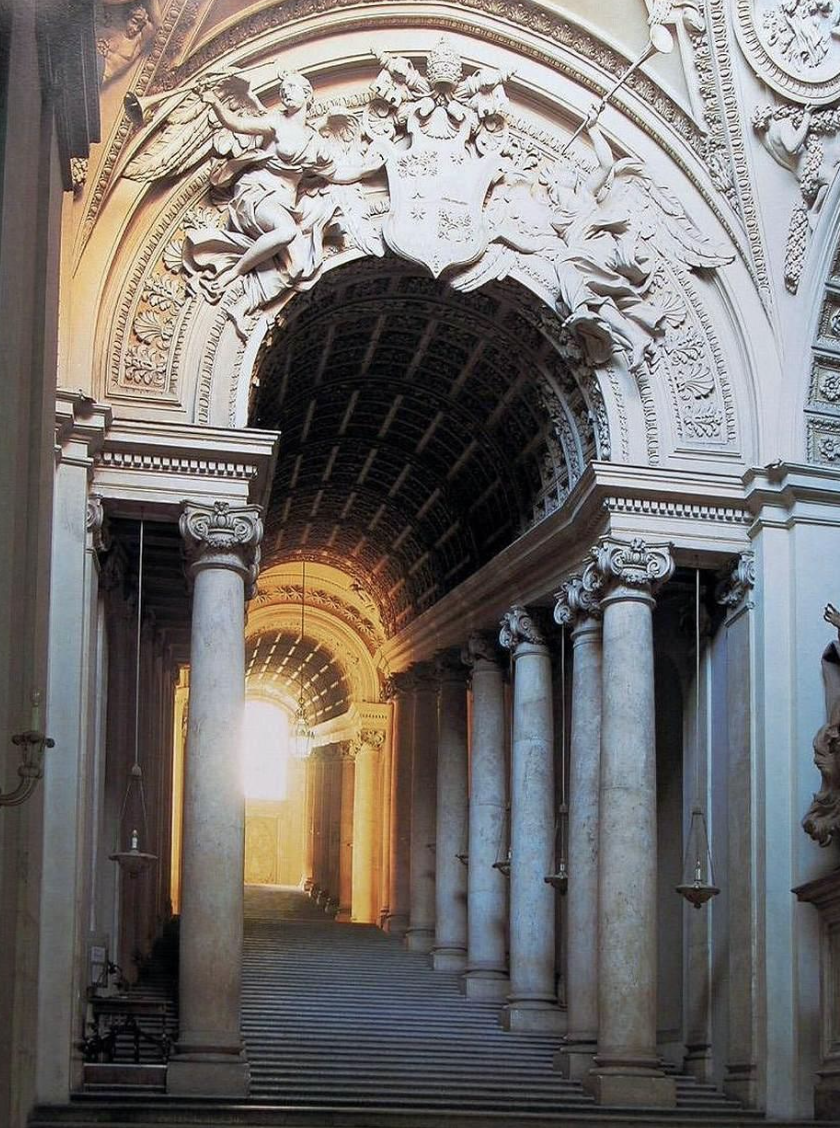
Scala Regia - Bernini
Designed by Bernini
Private staircase connected from St. Peter’s Basilica to Papal Apartments - redesigned to counter claustrophobia
Narrowing Corridor : gets narrower and shorter
Forced-perspective illusion makes it look longer and grander
Pope appears powerful and elevated walking down
All create a dramatic grand entrance
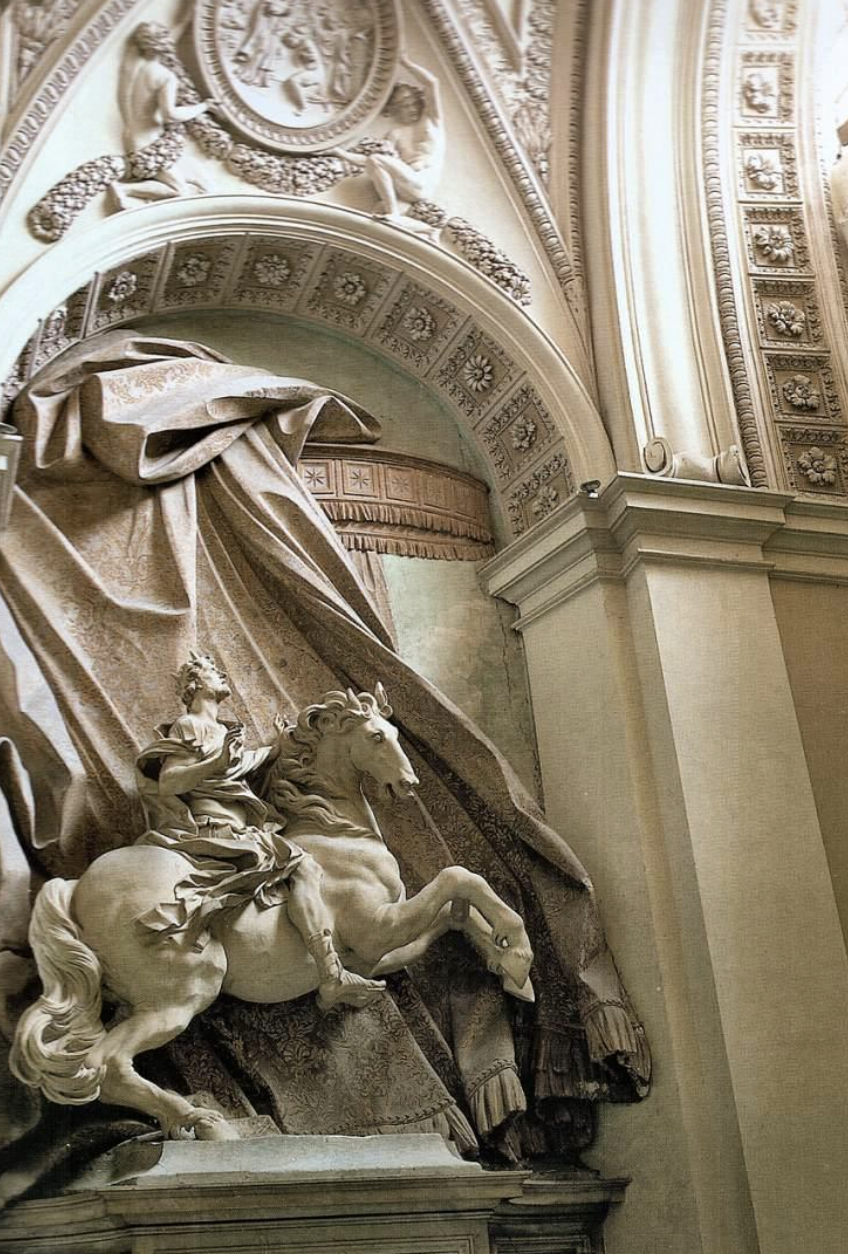
Equestrian Statue of Constantine - Bernini
Marble sculpture of Emperor Constantine on horseback, located at Scala Regia entrance
Horse: Raised & tense - creates strong movement & energy
Constantine: Looks upward in awe; spiritual and emotional moment
Light source enhances divine vision
Curtain/ fabric knots: Tension & control; theatrical backdrop
Ignorance being pulled down
Struggle/tension of conversion
[ Moment Constantine converts to Christianity ]
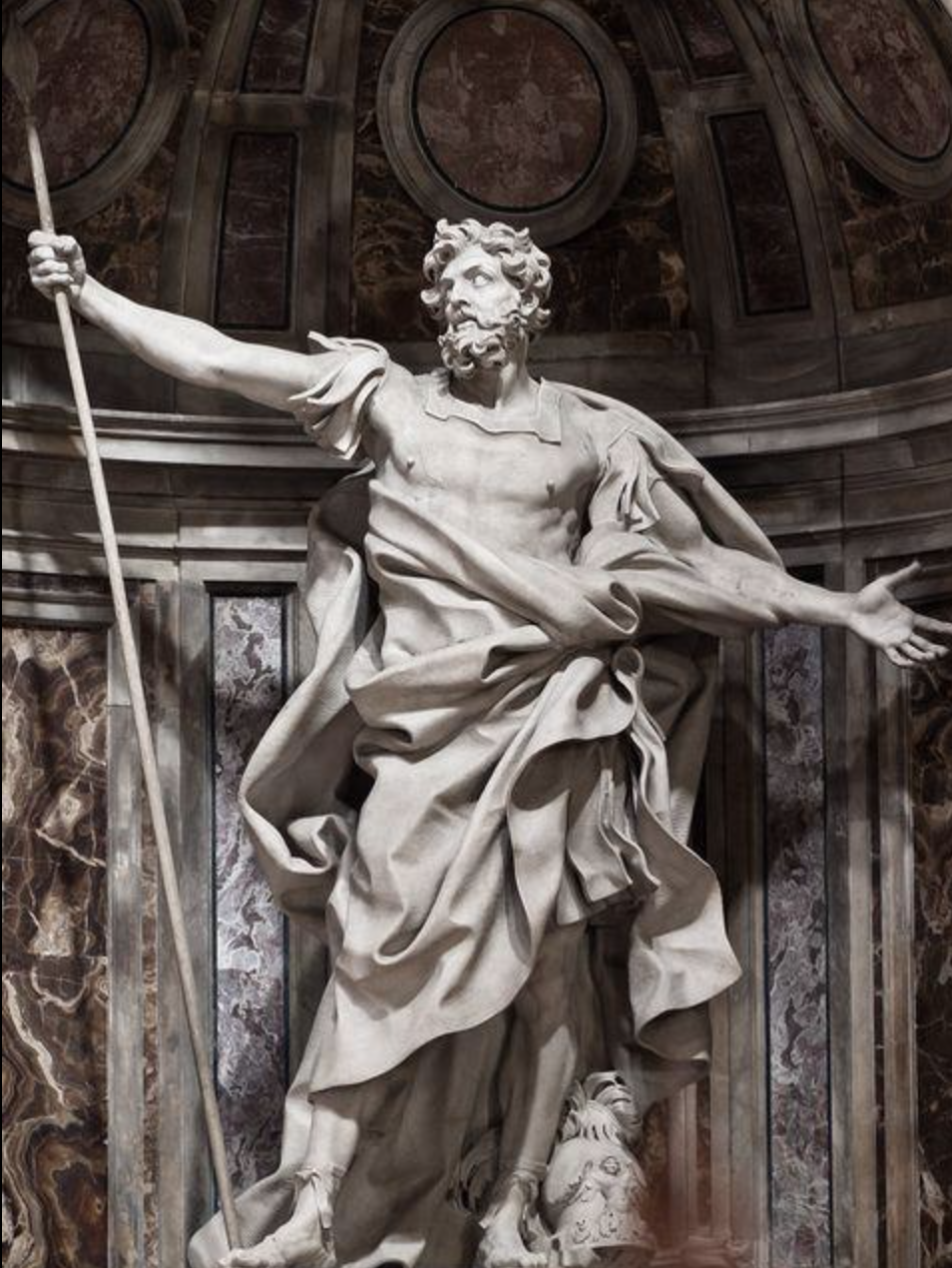
St. Longinus - Bernini
Marble, capturing St. Longinus piercing Christ
Contraposto, X- stance (Chiastic Pose) - burst of movement
Voluminous Mantle: his cloak wrapped around him creates constant motion, and folds represent inner transformation & intensity
Knotting: Spiritual angst & transformation
Open Lips: Capture high drama, captures a moment, not a pose
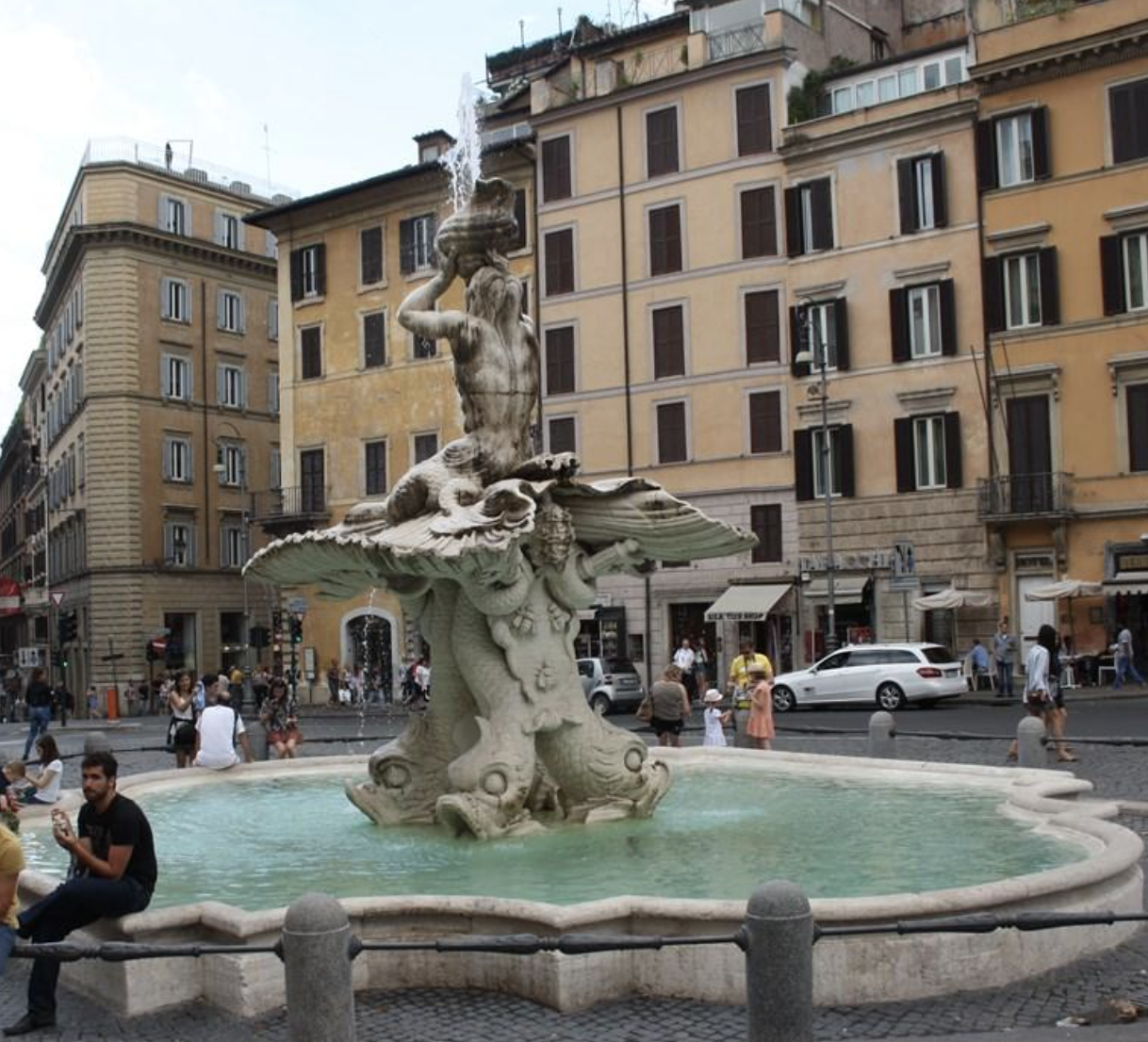
Piazza Barberini, Fontana de Tritone - Bernini
Designed by Bernini for Barberini family
Fontana de Tritone designed by Bernini
Shows Triton blowing upwards from a shell, spraying up water
Creates movement & energy
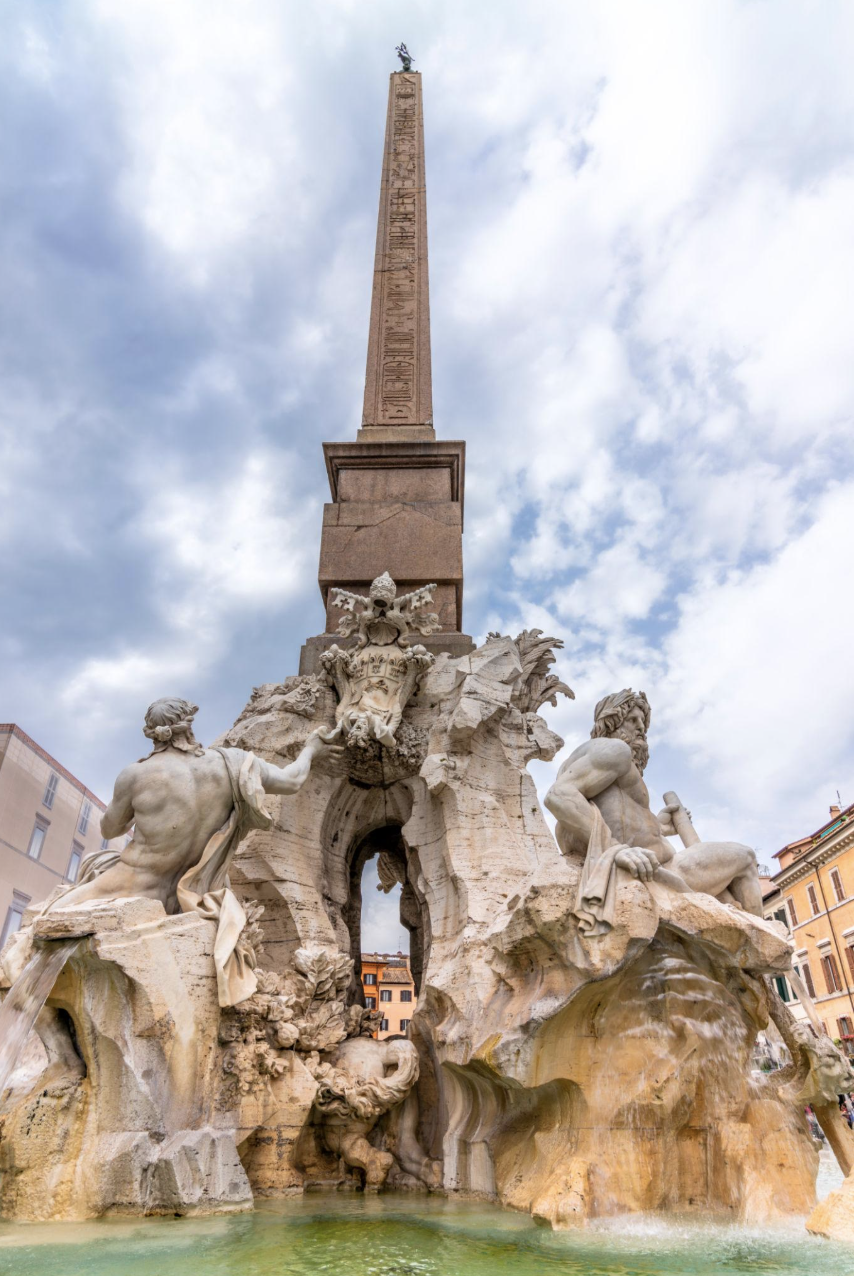
Fountain of the Four Rivers - Bernini
Depicts 4 major rivers from 4 continents using figures, an Egyptian obelisk in center
Represents global reach/ spread of the Catholic church
Combines religion, geography, and power
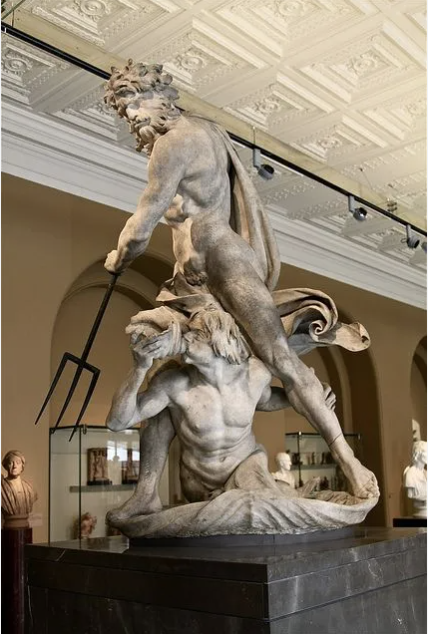
Neptune & Triton - Bernini
Neptune (god of sea): Holding trident (power)
Triton (son): Blowing on conch shell
Head of Dolphin: Cloak swirls to the shape of it
[ Bottom represents sea and chaotic nature, Neptune represents control over the sea supported by Triton ]
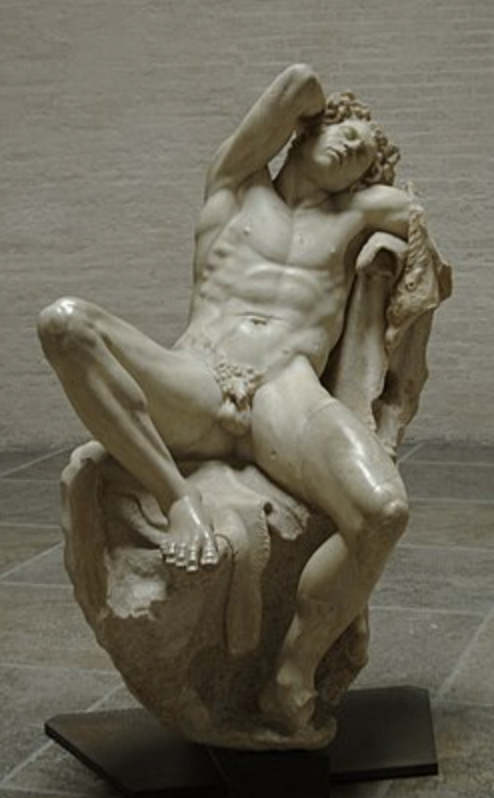
Barberini Faun - Restored by Bernini
Created during ancient Rome/ Greece period
Overtness expression (Hellenistic Period)
Post sex pose - emotional vitality
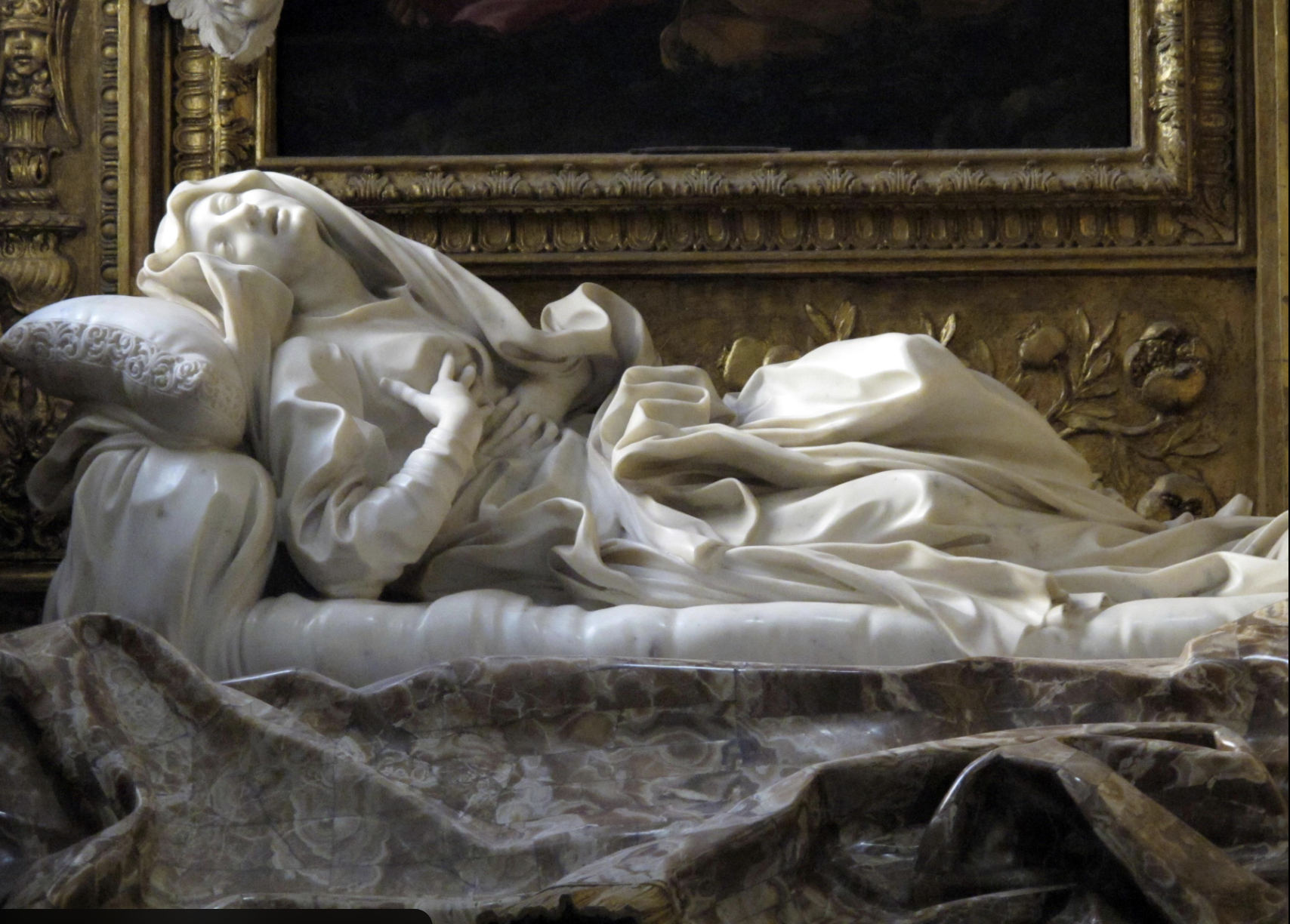
Blessed Ludovica Albertoni - Bernini
Marble, Red jasper marble (bed)
Movement: Voluminous & chaotic twisting of her death shroud & detailed hands = pain & physical intensity
Emotion: Parted lips = pain, gasp of her last breath of life
[ Expressing her final breath at the moment of death & spiritual union w/ God ]
Borromini
Focus on architecture and structure
Integrate interior & exterior sPace
Mix of concave to convex
Creates illusion via geometry & light
multiple foci
Non-geometric proportions
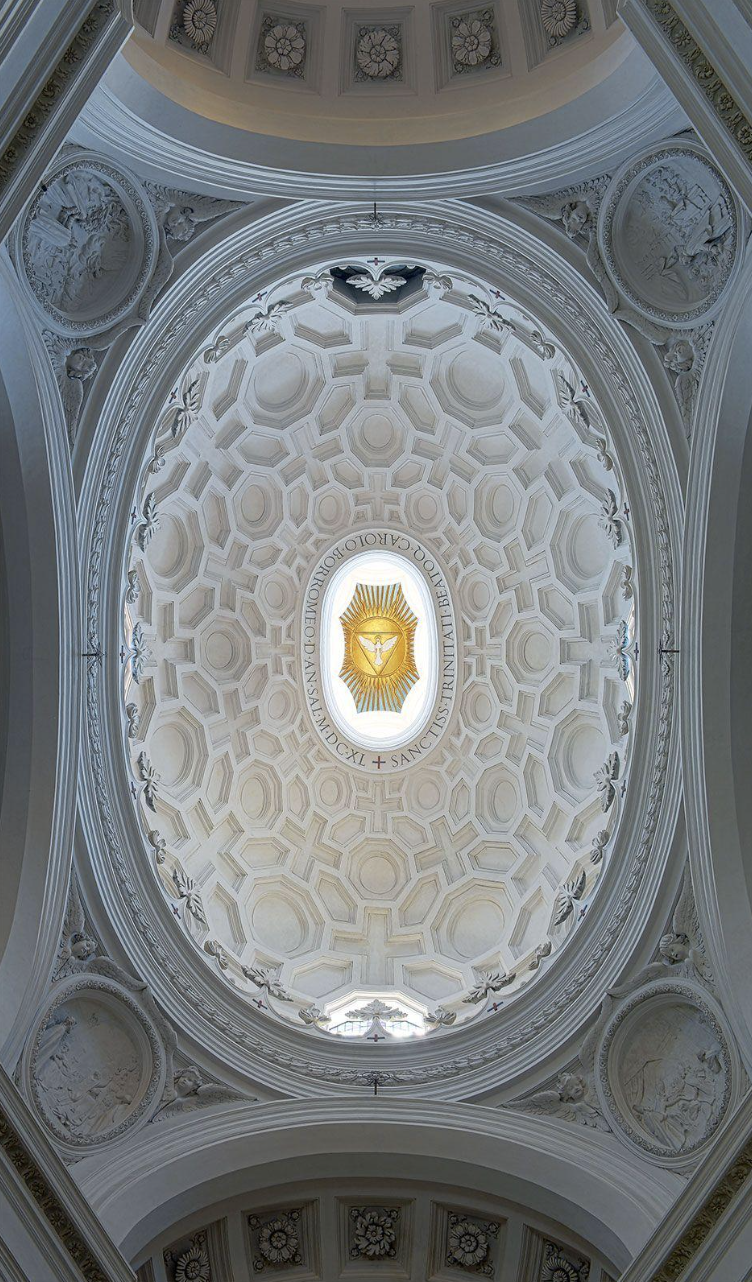
San Carlo Alle Quattro Fontane - Borromini
Outside Building : Irregularly shaped corner site, complex and flowing geometry
Moves from concave to convex waves - feels like it’s moving
Ceiling : Oval dome w/ repeating coffered pattern
Creates illusion of height & endless space
Hidden windows create soft light - feels weightless and airy
[ Break away from solid line architecture & focus on movement (dynamic & alive) ]
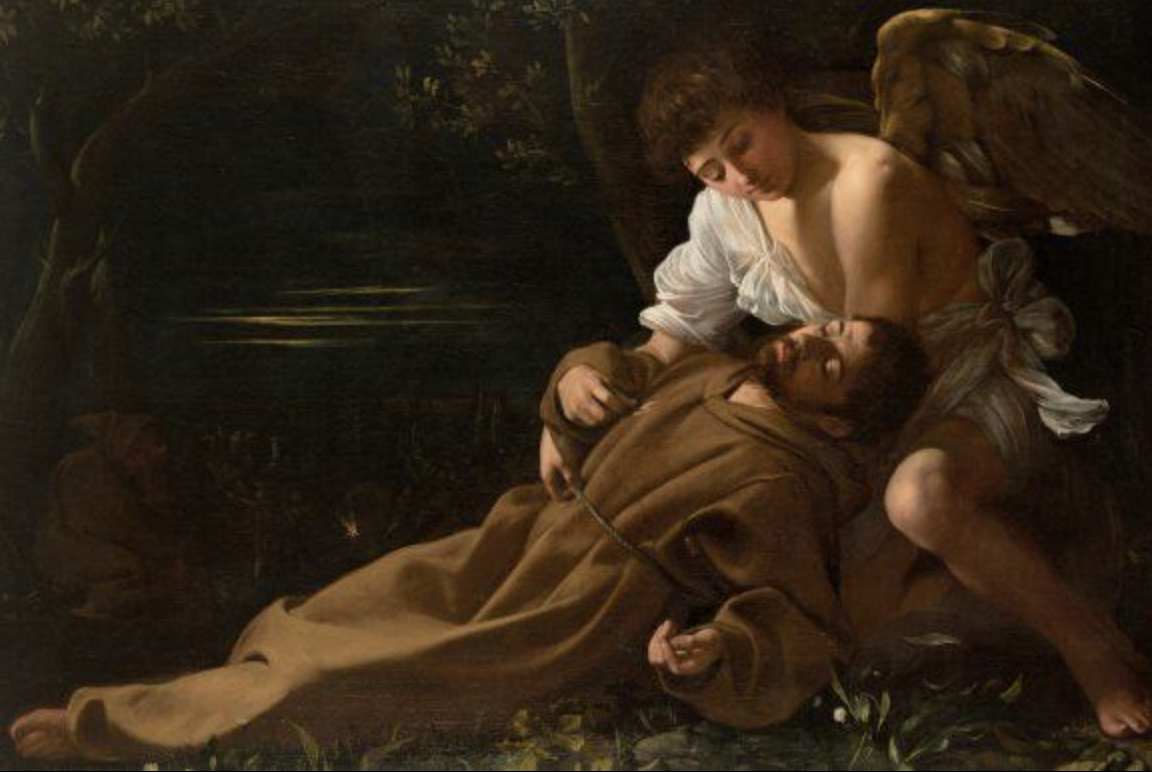
St. Francis Receiving Stigmata - Caravaggio
Caravaggio died from heat exposure
Oil Painting
Subject Matter : St. Francis receives stigmata (wounds of Christ)
Uses extreme tenebrism - extreme use of dark & light; creates drama and focus
Light directly hits St. Francis & the Angel - highlights the spiritual moment
Figures : Look like real people, not idealized
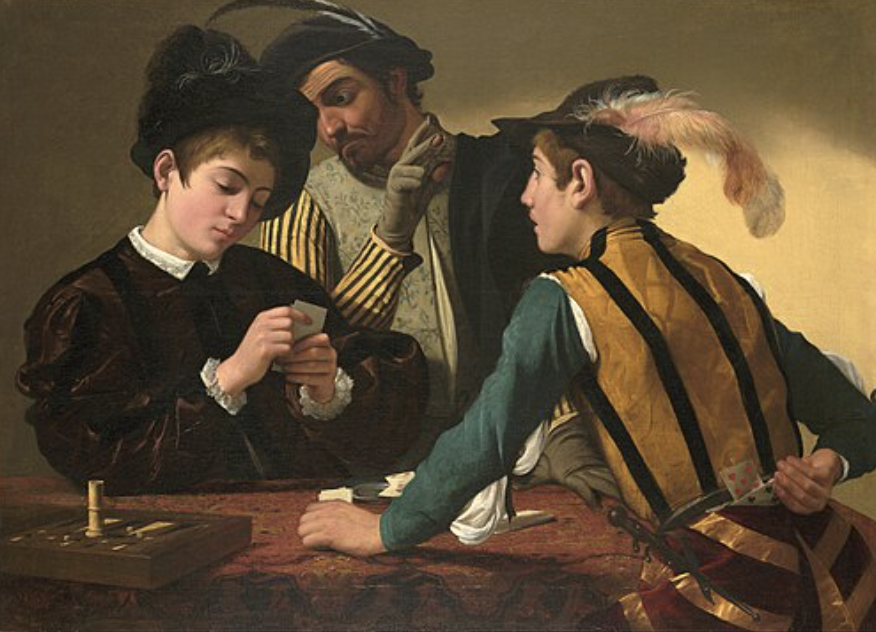
The Cardsharps - Caravaggio
Oil Painting
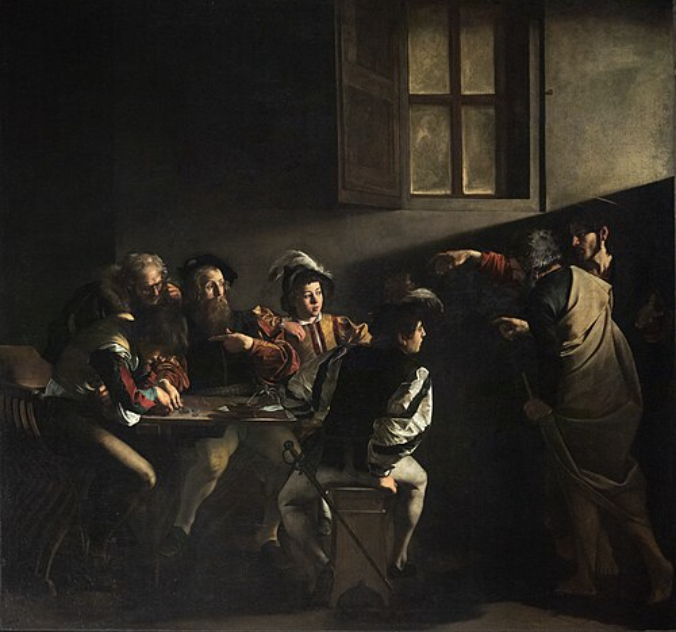
Calling of Saint Matthew - Caravaggio
Oil Painting
Subject Matter : Moment Jesus calls Matthew to follow him
Tenebrism : Very dramatic light beams from right side, cuts through darkness, & lands on Matthew - divine calling
Setting : Everyday setting (tavern) , realistic people (contemporary clothing)
Makes the story feel more real & relatable
Artist: Artemisia Gentileschi does this also
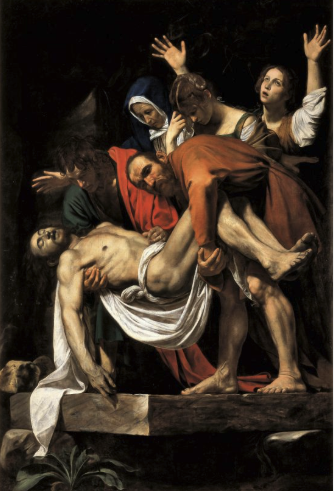
Entombment of Christ - Caravaggio
Oil on canvas, History Sacred
Subject Matter : Christ’s body being placed into the tomb
Composition : Strong diagonal line (Christ’s body) creates movement and suggests weight
Large stone slab is close to the viewer, entering our space
Realism : Christ’s body appears heavy and lifeless, strain of figures supporting him
Very human reactions - grief and sorrow (Virgin & Mary Magdalene)
Tenebrism : Contrast of light and deep shadow highlights key figures
[ Drama, movement, realism., viewer engagement = Baroque ]
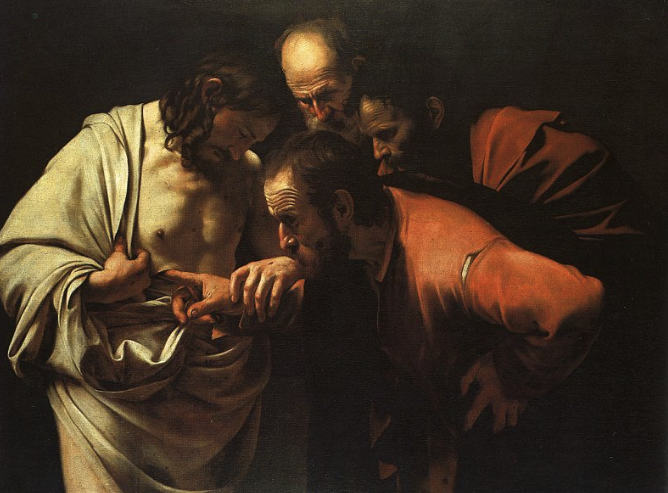
The Doubting Thomas - Caravaggio
Oil on canvas, history sacred
Subject Matter : St. Thomas touches Christ’s wounds after the Resurrection
Physical Interaction : Christ guides Thomas’s finger inserted into his wound - emphasizes touch & proof
Realism : Extreme realism w/ skin, wrinkles, & dirt - highly detailed
figures look like ordinary people
Composition : Asymmetrical, closed, figures tightly grouped, no background distractions
Forces attention on the action/ focal point (wound)
Diagonals guide the viewer
Death shroud knotting at the center works w/ tenebrism to direct attention to wound
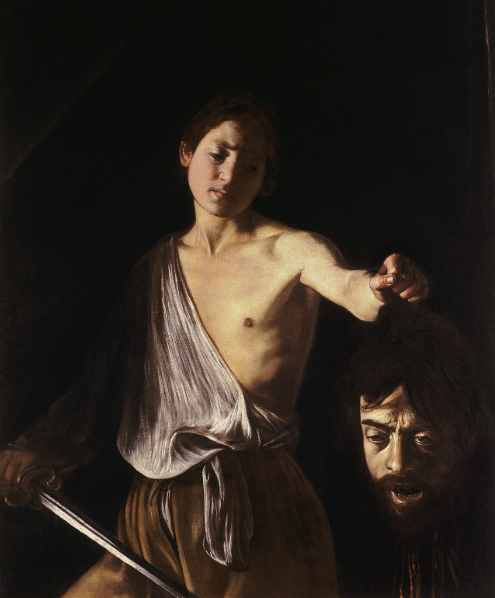
David & Goliath - Caravaggio
Oil on canvas, history sacred
Subject Matter : David holding severed head of Goliath after defeating him
Emotion : David’s expression is not triumph, but sad, thoughtful, remorseful
Psychological moment
Goliath’s Head : Highly realistic
Strong tenebrism : Strong light highlights David and the head
[ Believed to be self portrait of Caravaggio. His younger self beheading older self = self immolation or guilt and desire for forgiveness ]
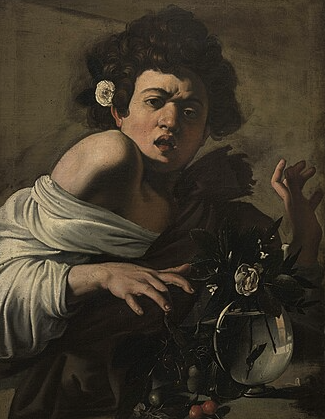
Boy Bitten By Lizard - Caravaggio
Oil on canvas, Genre
Subject Matter : Boy recoiling after being bitten by a lizard
Boy : Roman god of wine, Bacchus (Grapes = wine)
Rose : Sensory pleasure = decay & temporary life, beauty & youth fades
Glass Vase : Precious, fragile, wealth, but can still be broken = temporary
Lizard : At the bottom of painting. In darkness, echoes man’s expulsion from paradise. Deception, consequences of indulgence
Snake: Renaissance VS Lizard: Baroque
Middle Finger : Palm down = homosexuality
[Temptation & sexual pleasure = sin. Reminder of shortness of life, how quickly good fortune can fade ]
Caravaggio
Influenced by Michelangelo
Drew/painted people he saw
Commissioned by French Church - religious art that looked like someone was actually there, realistic setting, figures were people he knew
Put himself in paintings
Patron : Cardinal Del Monte
Castrado, era of opera (figures painted w/ puffy hands & face)
Committed murder, fled to Rome
Artemisia Gentileschi
Wealthy family
Expanded tenebrism to more nuance, coupled w/ dramatic staging
Autobiographical works - SA trauma w/in the church
1st female member of Florentine
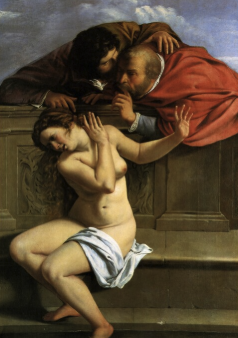
Susanna & The Elders - Gentileschi
Oil on canvas, History sacred
Subject Matter : Susanna harassed by two elders while bathing
Biblical story
Based on Gentileschi’s experience
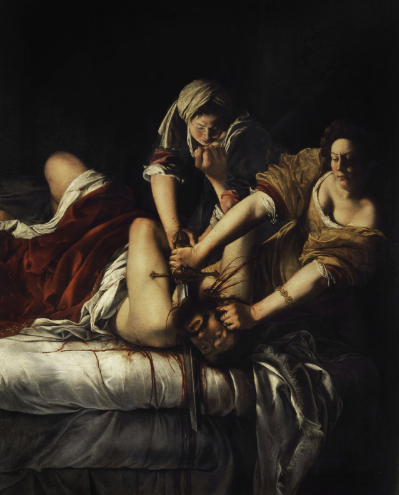
Judith & Holofernes - Gentileschi 1620
Oil on canvas, history sacred
Subject Matter : Moment Judith severs Holofernes’s head, accompanied by her maid
Foreshortening : Holofernes’s body foreshortened; head and blood splattering is close to the viewer
Composition : Diagonal lines leading to the action, Holofernes missing limbs = sense of dismemberment, larger male scale
Tenebrism : Painting in the dark, complete darkness creates very shallow background, vivid physicality
Realism : Rolled up sleeve, Judith holding his head down, dislocates it = seems no longer connected to his body
[ Violent, gory, bloody, enger, less sophisticated proportions ]
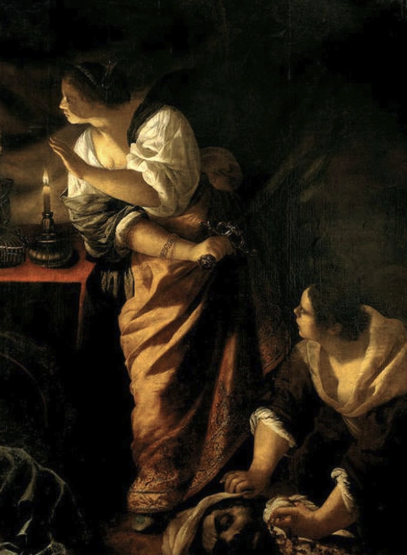
Judith & Her Maidservant with the Head of Holofernes 1960
Oil on canvas, history sacred
Subject Matter : After beheading of Holofernes. Judith holds candlelight & bloody sword while maidservant stuffs the head into a bag
Composition : Arching shapes guide viewers from top left to bottom right of the canvas
Slow diagonals accentuate the idea that the figures have stopped in movement, as they look to see if they are in danger
Technique : Tenebroso, “in the dark manner”
Rendering chiaroscuro - lights are very light, darks are very dark = theatrical spotlighting embedded in darkness
[ Lighting = candle. We can see what they’ve done, sophisticated proportions ]