Ventral and Dorsal Stream - Visual Neurophysiology and Perception Spring 2026
 Call Kai
 Learn
Learn Practice Test
 Spaced Repetition
 Match
Match Flashcards
 Knowt Play
1/117

There's no tags or description
Looks like no tags are added yet.
Name | Mastery | Learn | Test | Matching | Spaced | Call with Kai |
|---|
No analytics yet
Send a link to your students to track their progress
118 Terms
true
True or False:
The inferotemporal cortex contains specific pattern recognition areas
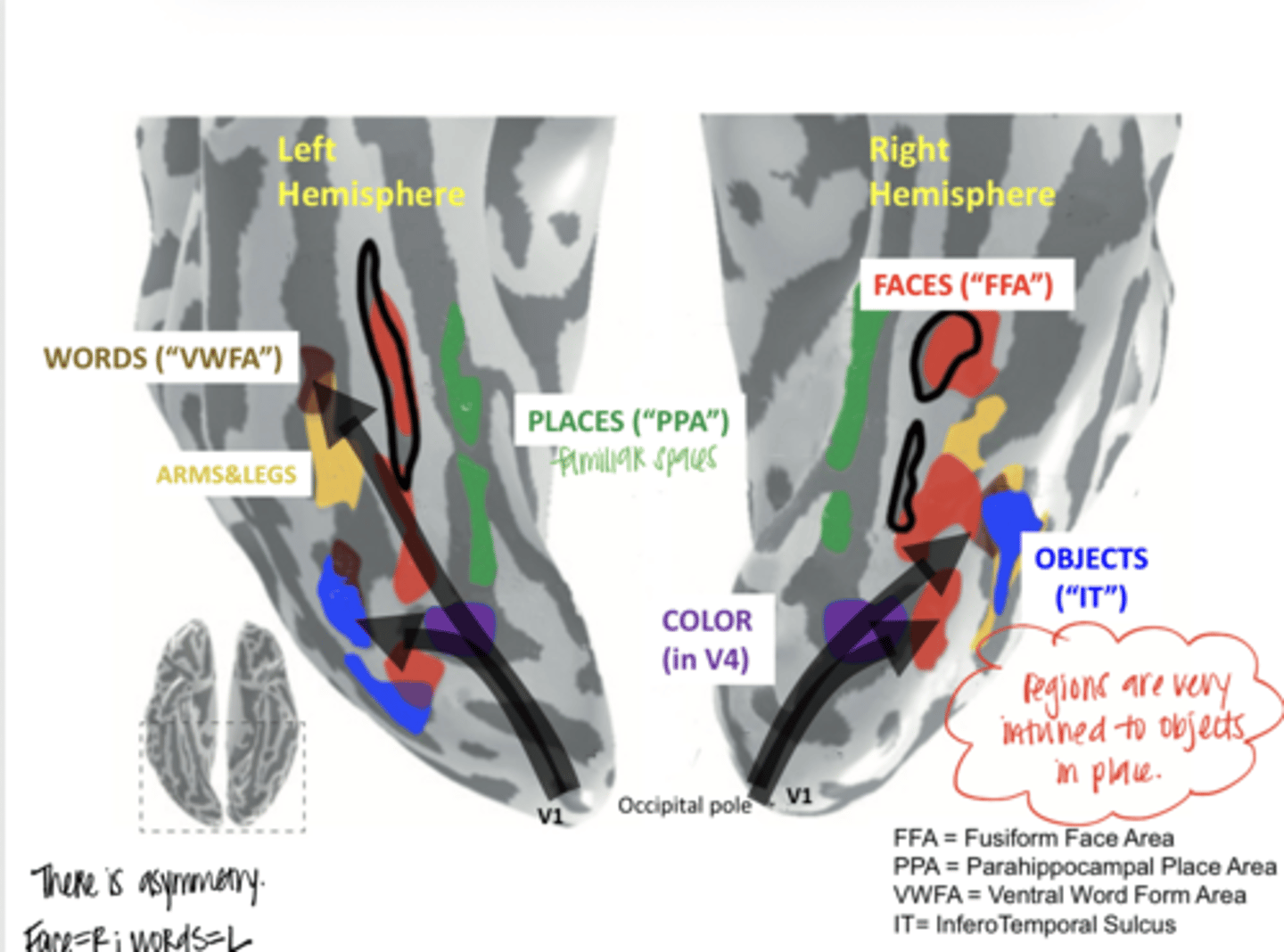
-The Fusiform Face area (FFA)
-Infertemporal sulcus (IT) -- a general object area
-The Parahippocampal place area (PPA)
-The Ventral Word Form Area
What are the specific "higher" centers of the ventral stream that are located in the inferotemporal cortex?
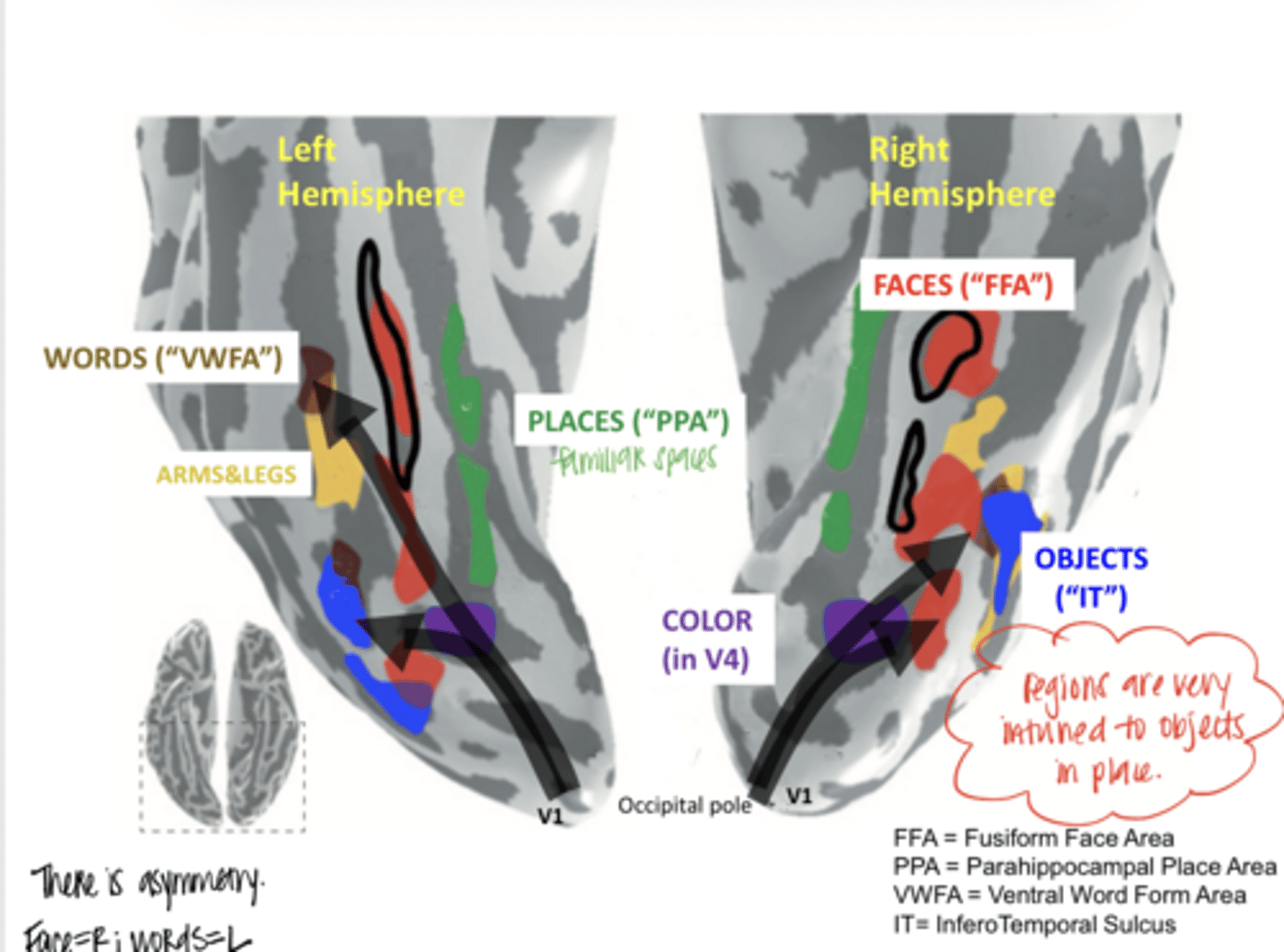
Neurological patients often exhibit very specific visual perception changes. There is often a good reason for this because specific parts of the brain are involved in specific perceptual tasks
What is the major point of having so many different "higher" centrals located along the ventral stream of the brain?
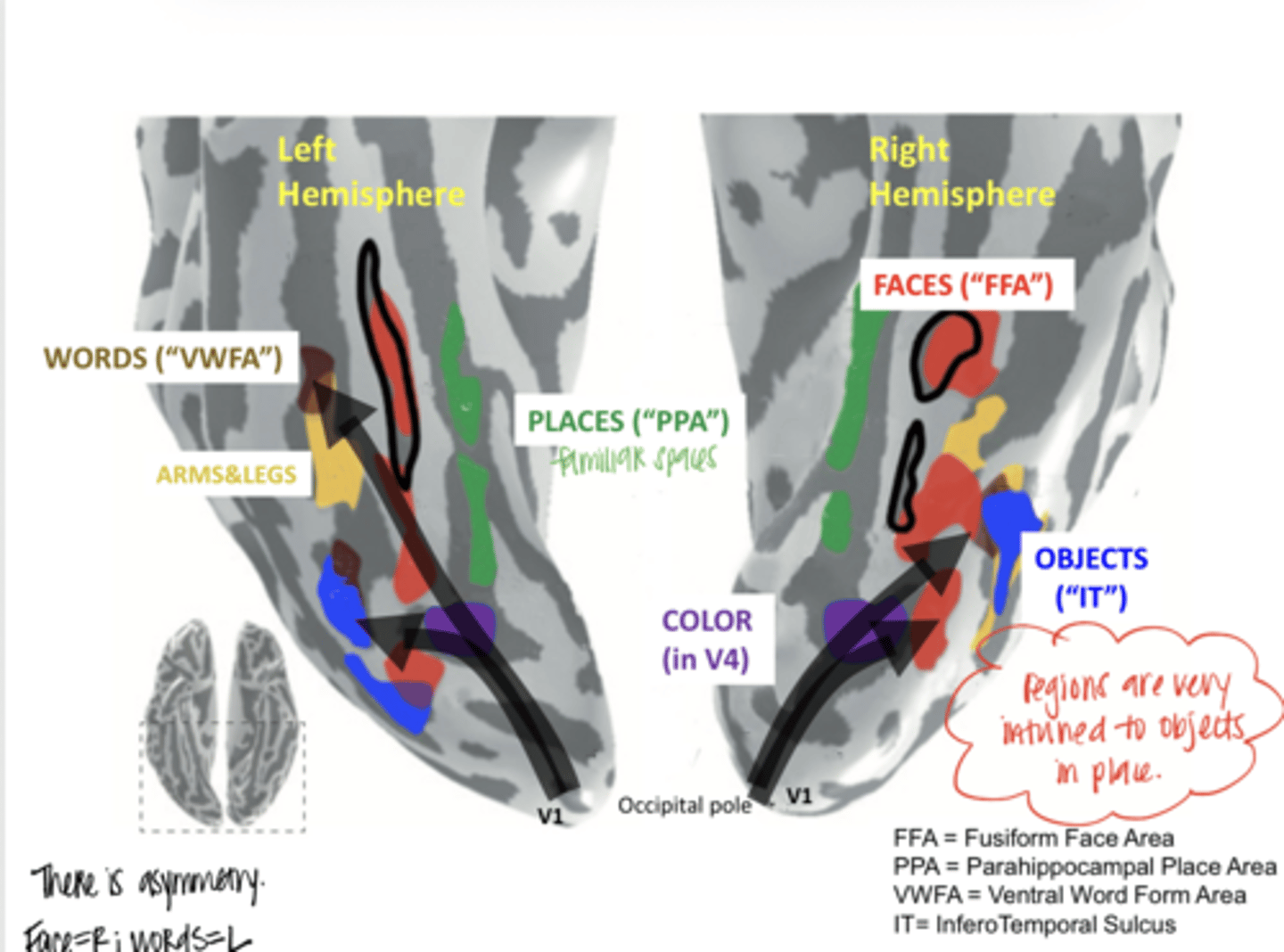
the inability to recognize input from one of your senses
What is an agnosia?
brain damage
What is an agnosia d/t?
-Prosopagnosia
-Object agnosia
-Pure alexia
What are the "Associative" agnosias discussed in this module?
prosopagnosia
selective inability to recognize faces
acquired achromatopsia (color vision deficiency)
Prosopagnosia often co-occurs with what?
inability to recognize objects, in the presence of intact ability to detect them and their features
What is object agnosia?
inability to READ words, in the presence of intact letter recognition and intact writing
What is pure alexia?
true
True or False:
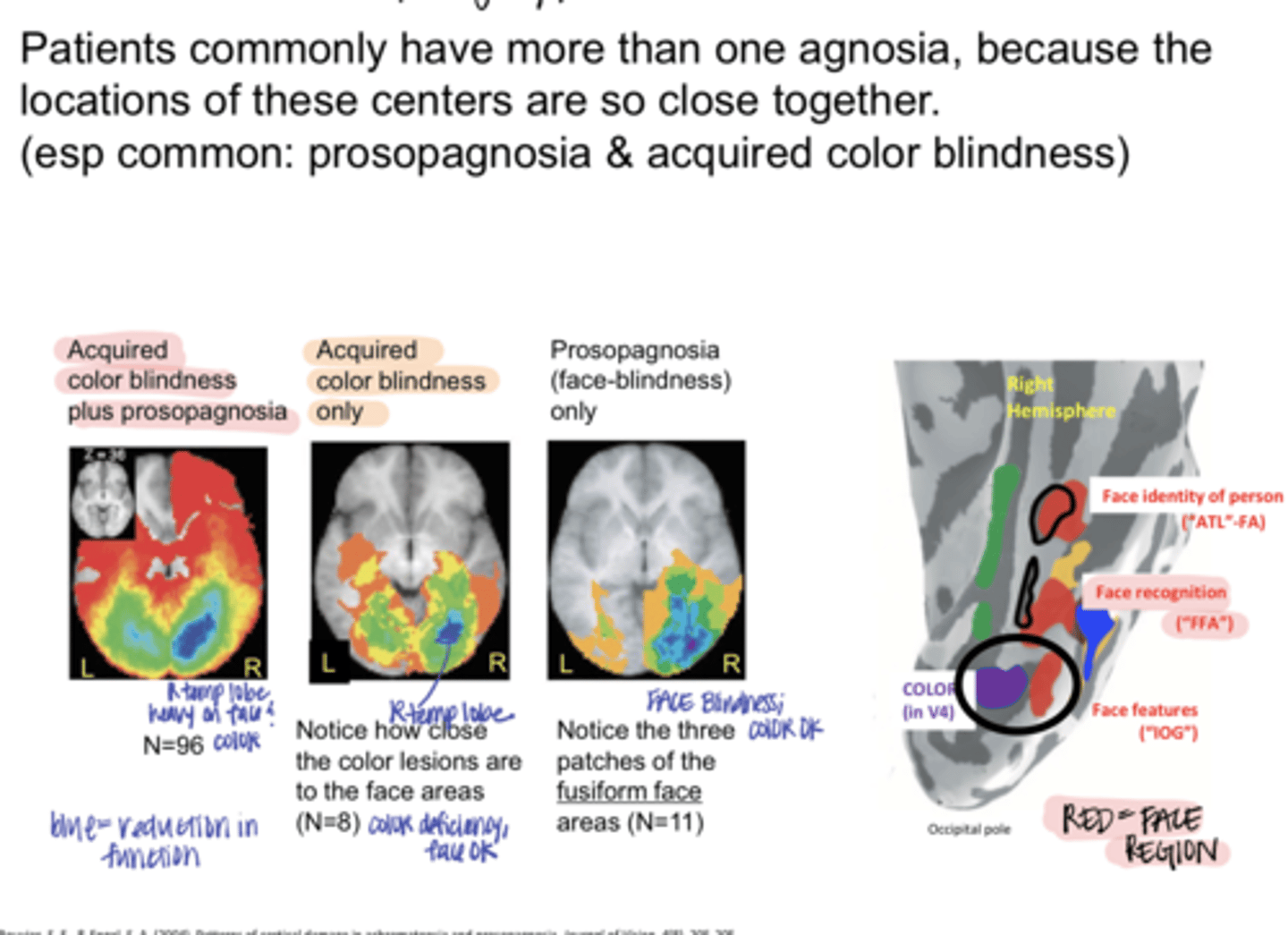
Patients commonly have more than one agnosia
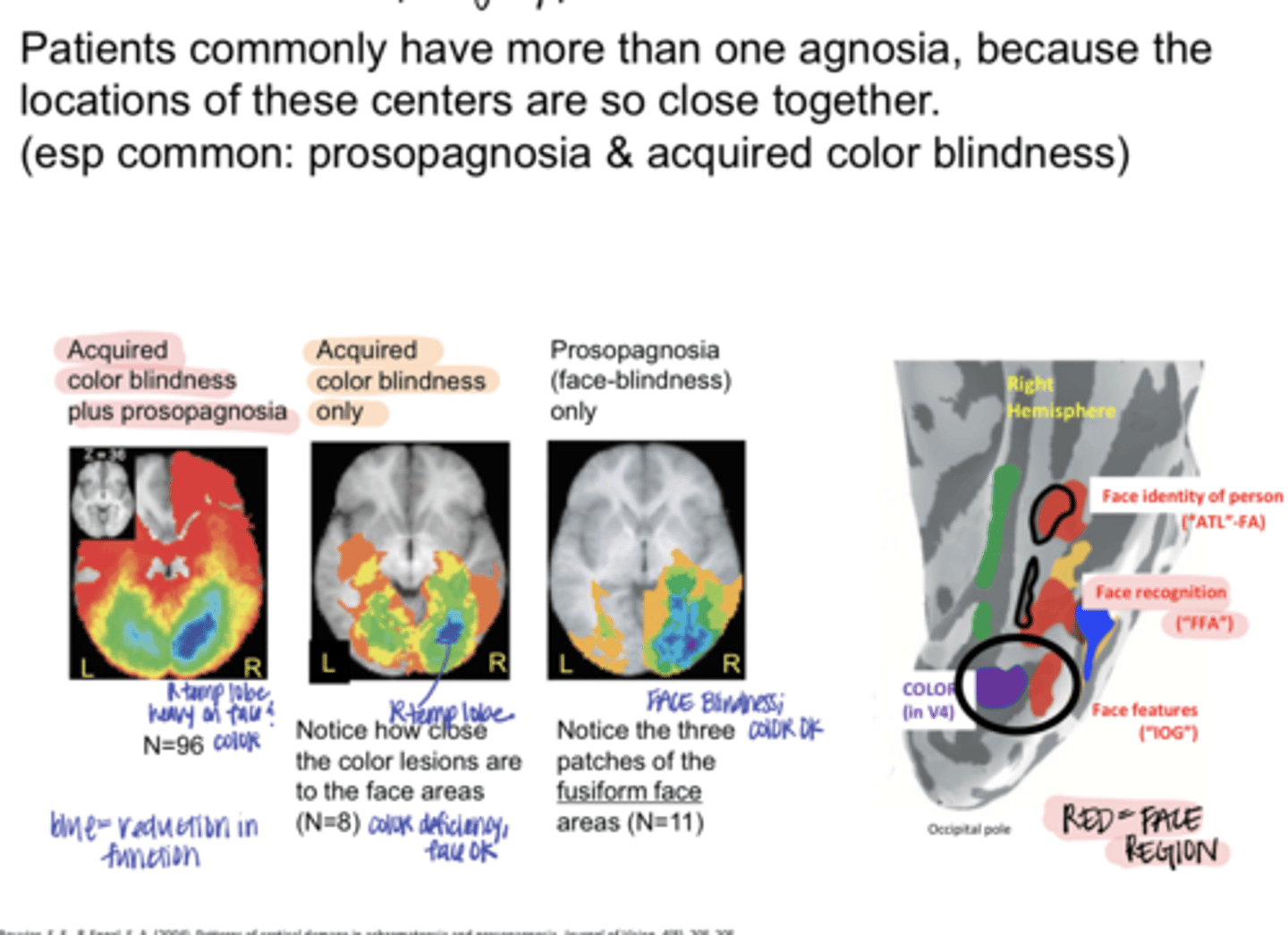
Because the locations of these centers are so close together (prosopagnosia + acquired color blindness)
Why do patients commonly have more than one agnosia?
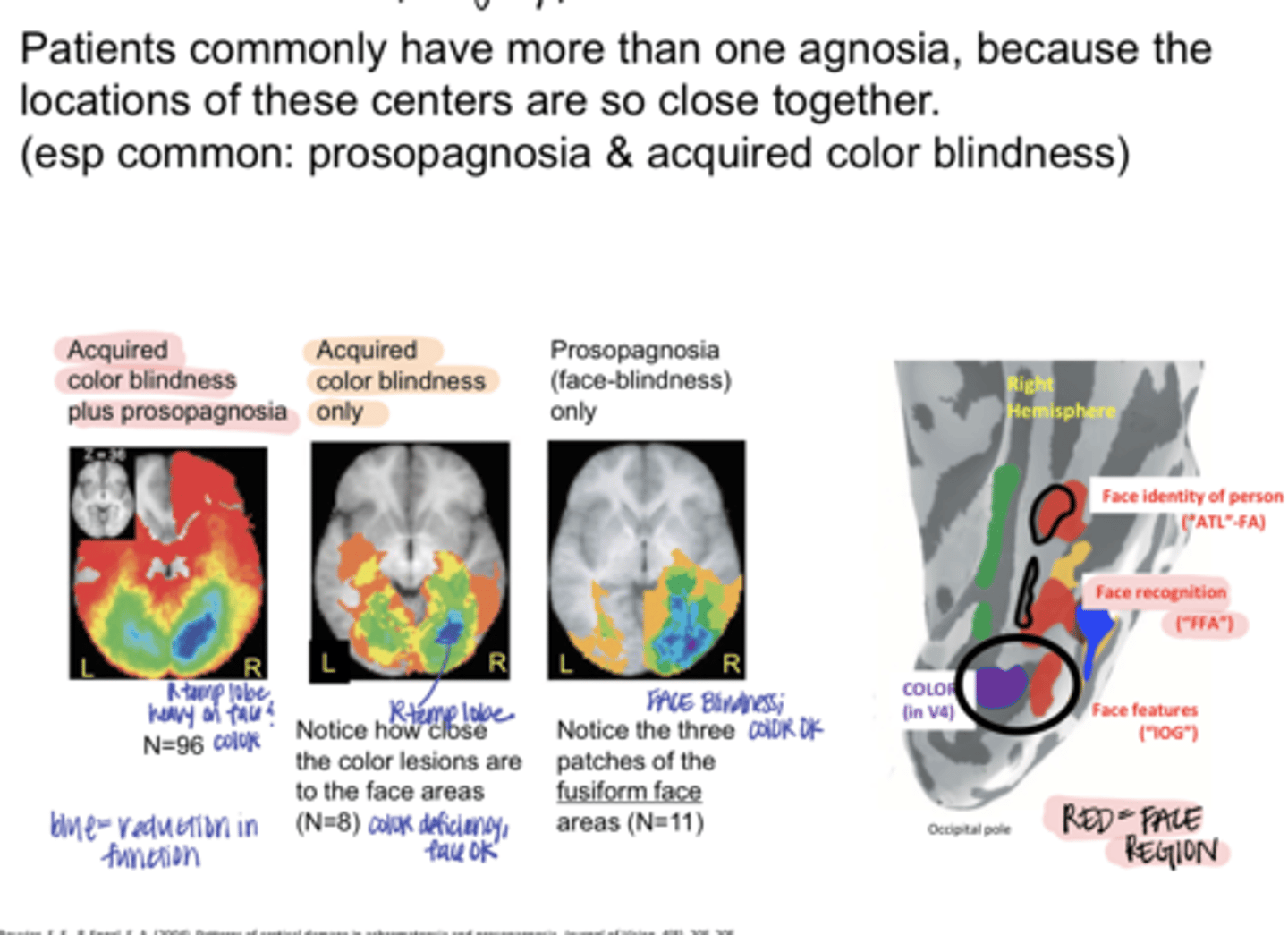
Prosopagnosia & Color Blindness Regions of the Brain -- Locations Very Close Together in the Brain (Pic)
Prosopagnosia & Color Blindness Regions of the Brain -- Locations Very Close Together in the Brain (Pic)
profound inability to recognize faces (including of family and friends)
REVIEW: What is the definition of prosopagnosia?
-individual animals or species of animals (specific cow in the herd, birds, plants)
-car types
-specific faces
An individual with prosopagnosia cannot recognize what?
Inability to recognize objects presented visually
REVIEW: What is the definition of object agnosia?
yes
Can an individual with object agnosia recognize the object in other modalities besides sight (hearing, smell, touch)?
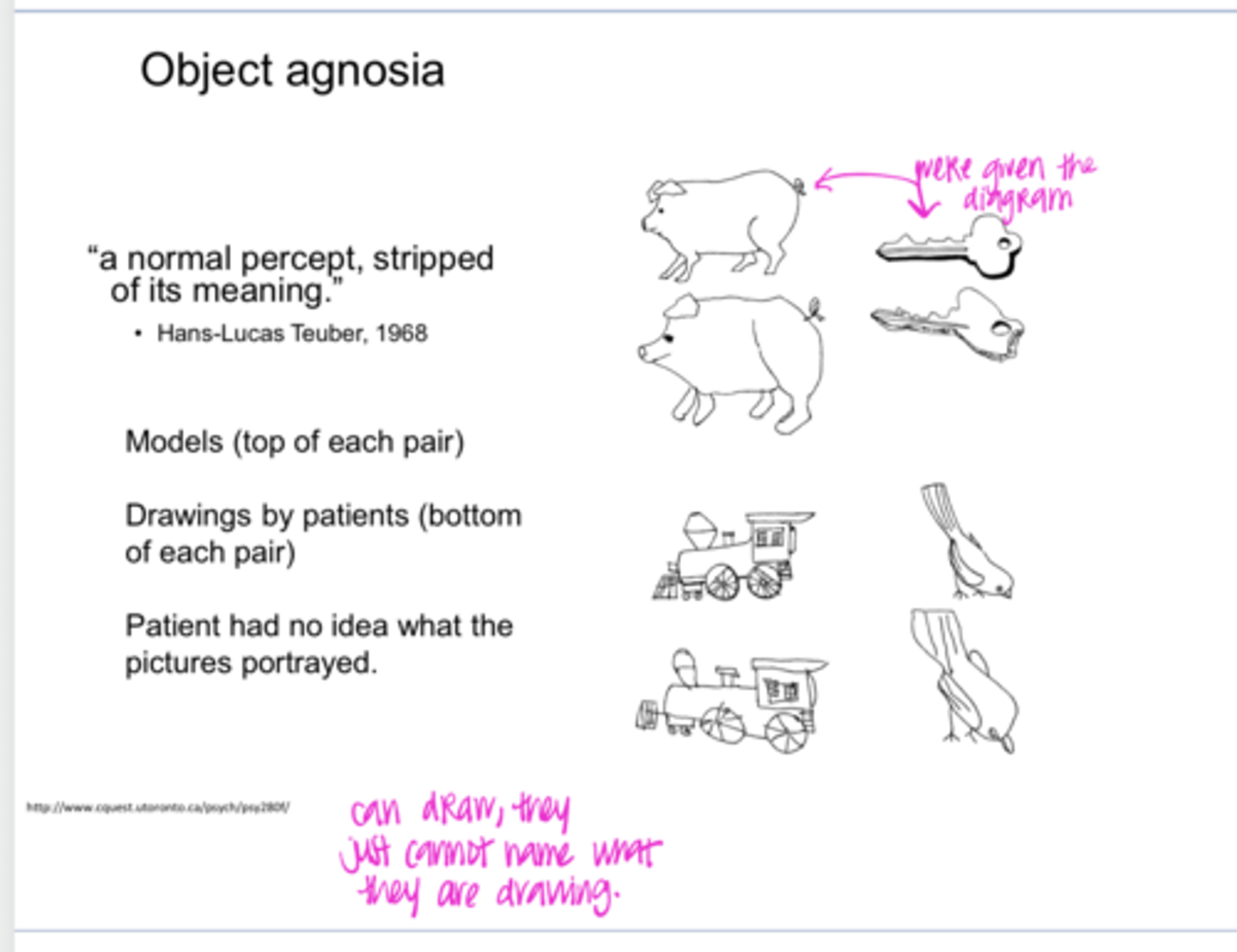
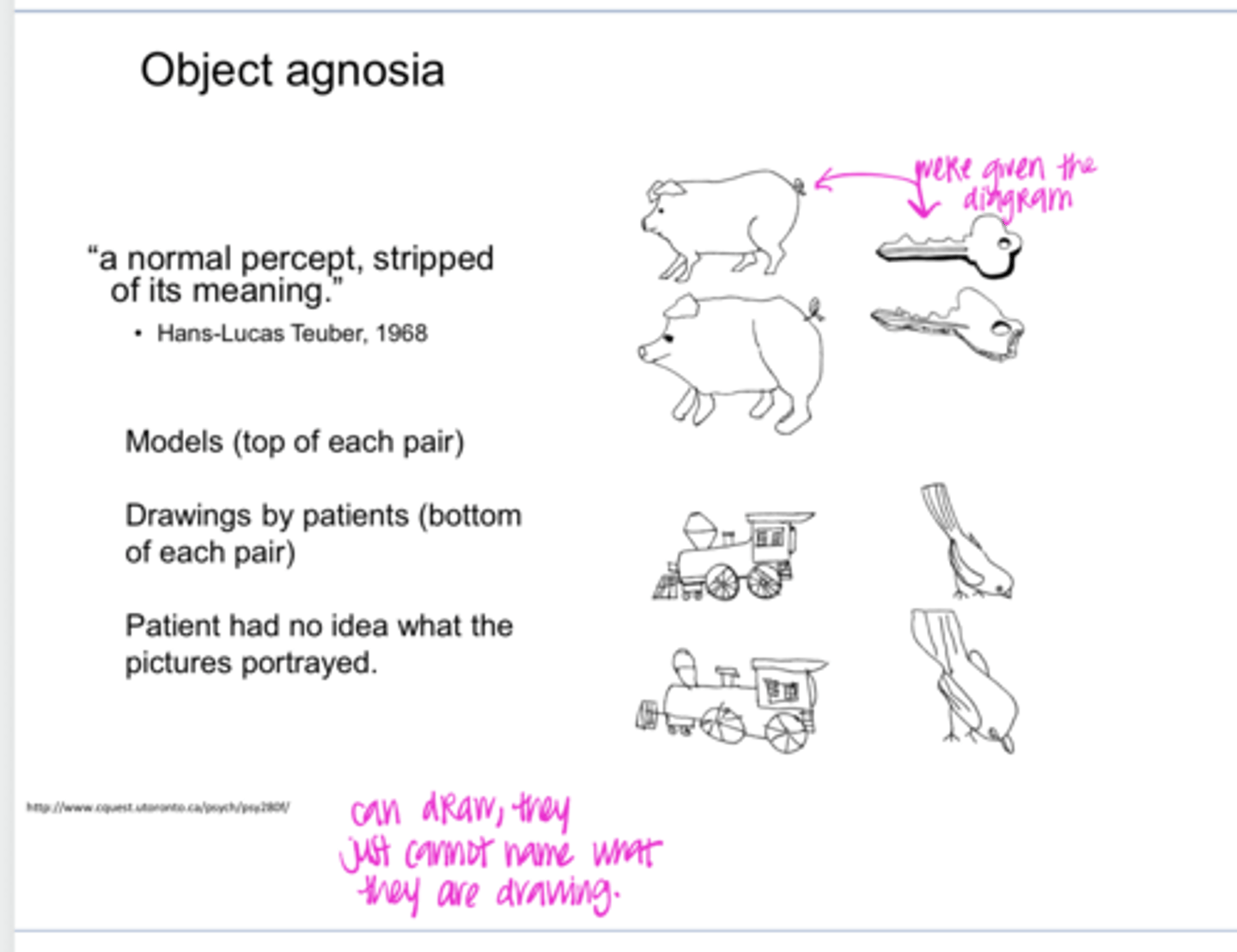
Yes -- the individual can draw objects they cannot recognize
Is sensory vision normal is an individual with object agnosia? What does this mean?
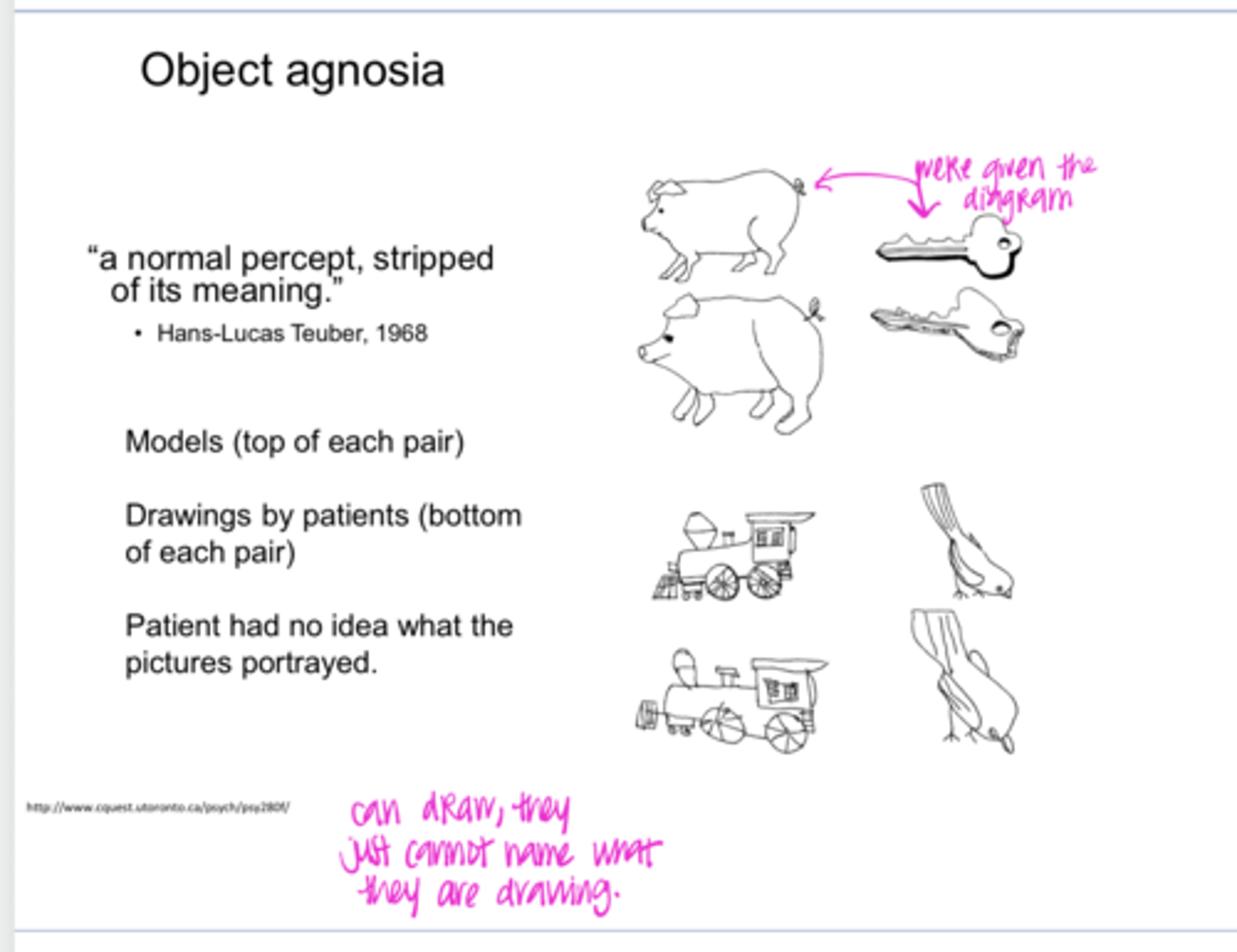
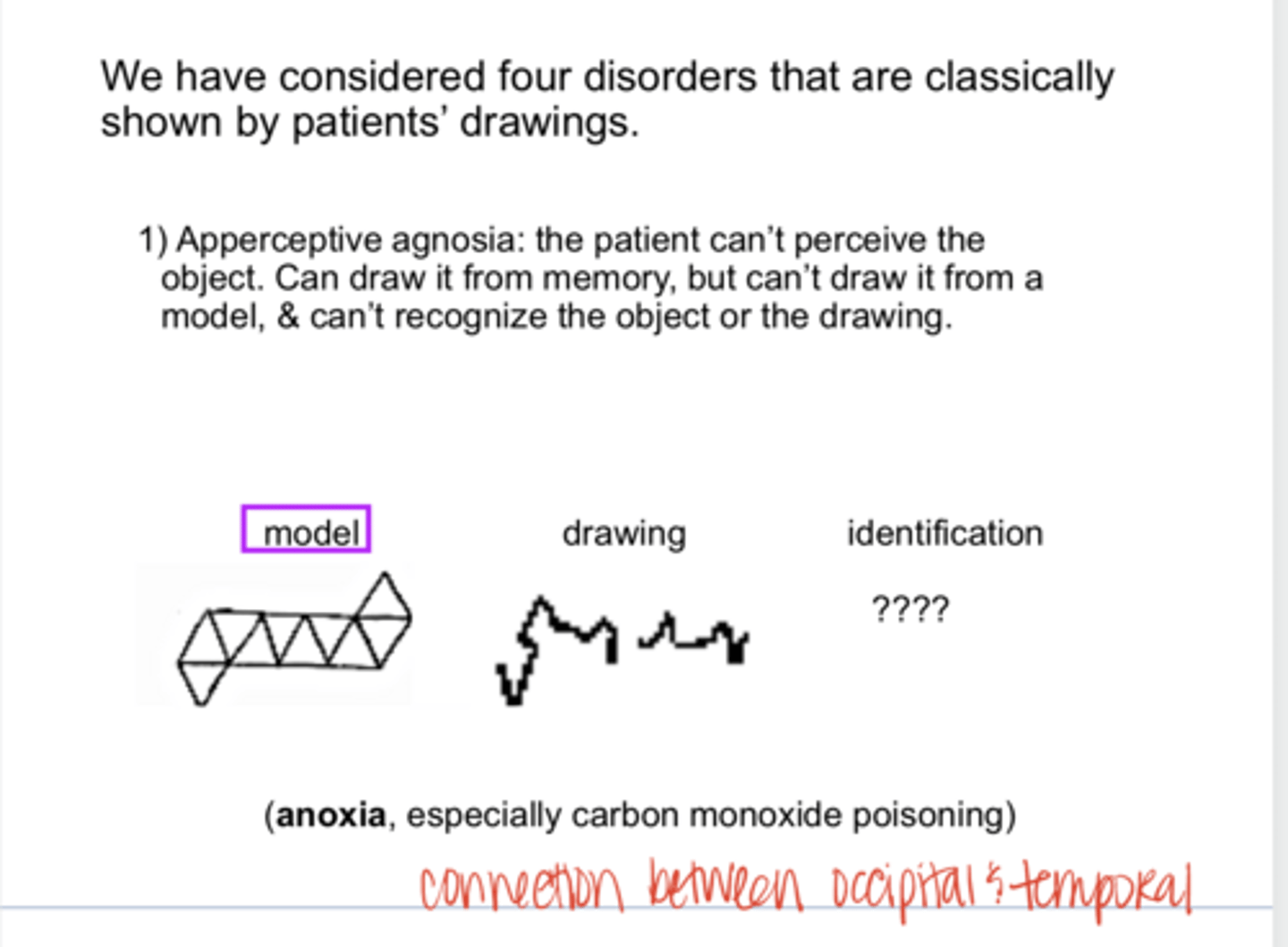
Object Agnosia -- Model & Patients Drawing (Pic)
Object Agnosia -- Model & Patients Drawing (Pic)
No
With an object agnosia, does the patient have any idea of what the pictures they are drawing portray?
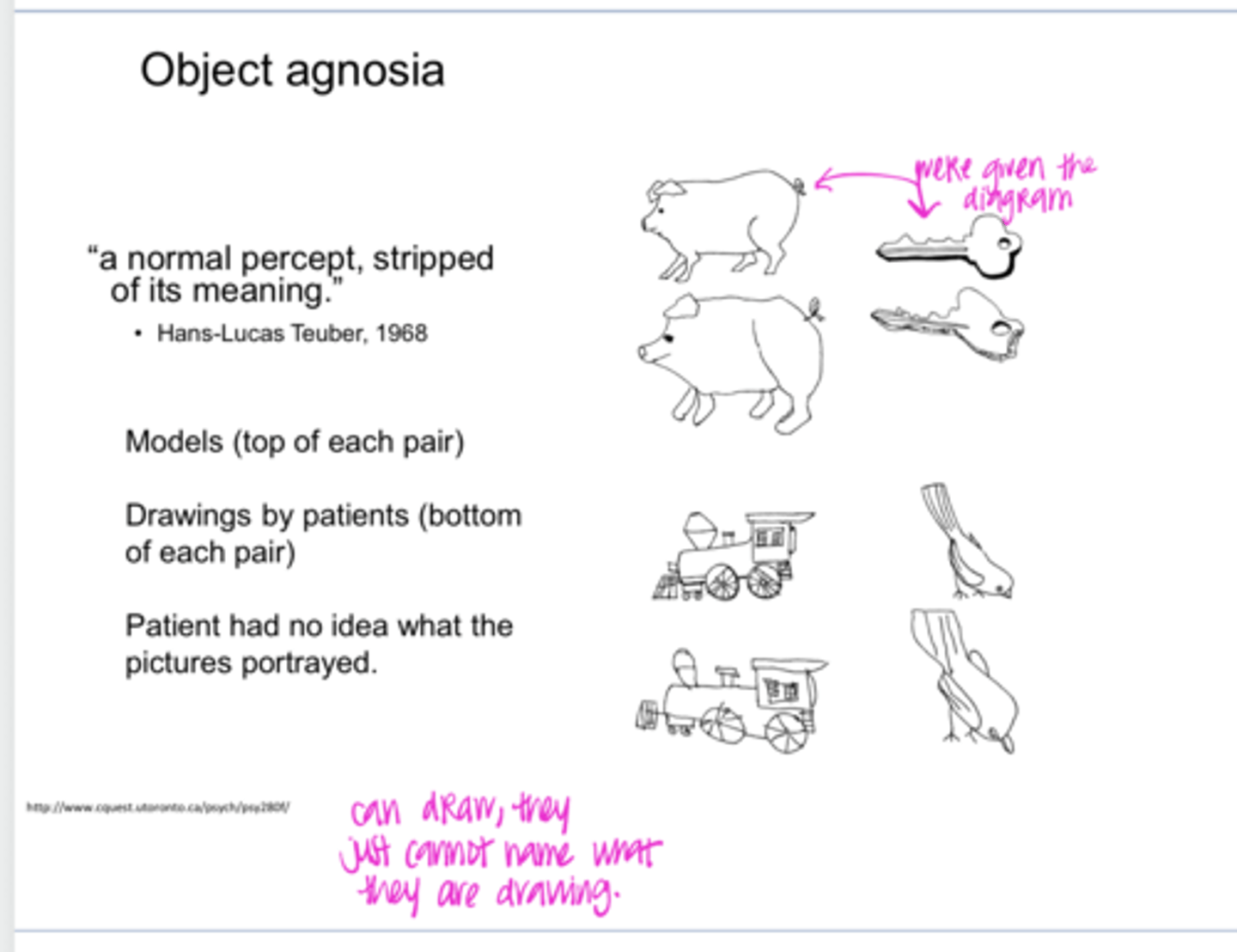
No -- they are different.
Apperceptive agnosia: patient cannot copy a model drawing
Objet agnosia: Patient can copy a model but cannot understand it
Are apperceptive agnosia and object agnosias the same?
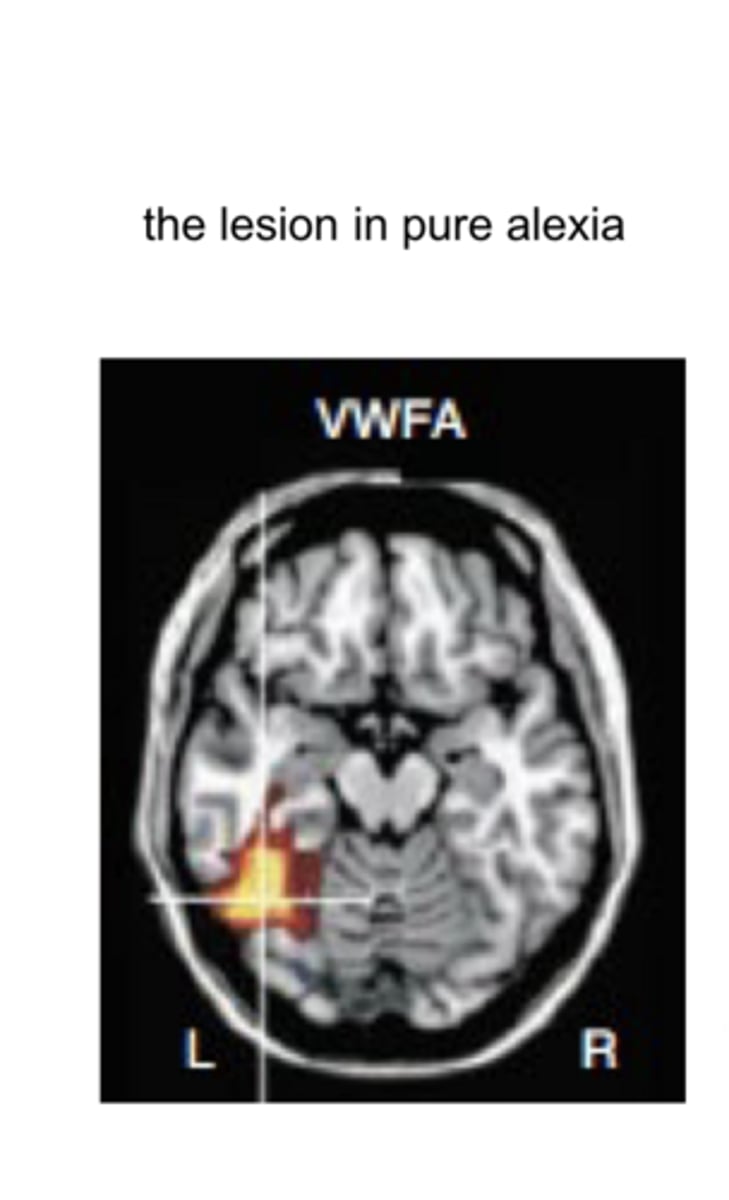
damage to the ventral word form area of the brain; left side of the brain
What is pure alexia d/t? Damage in what region of the brain?
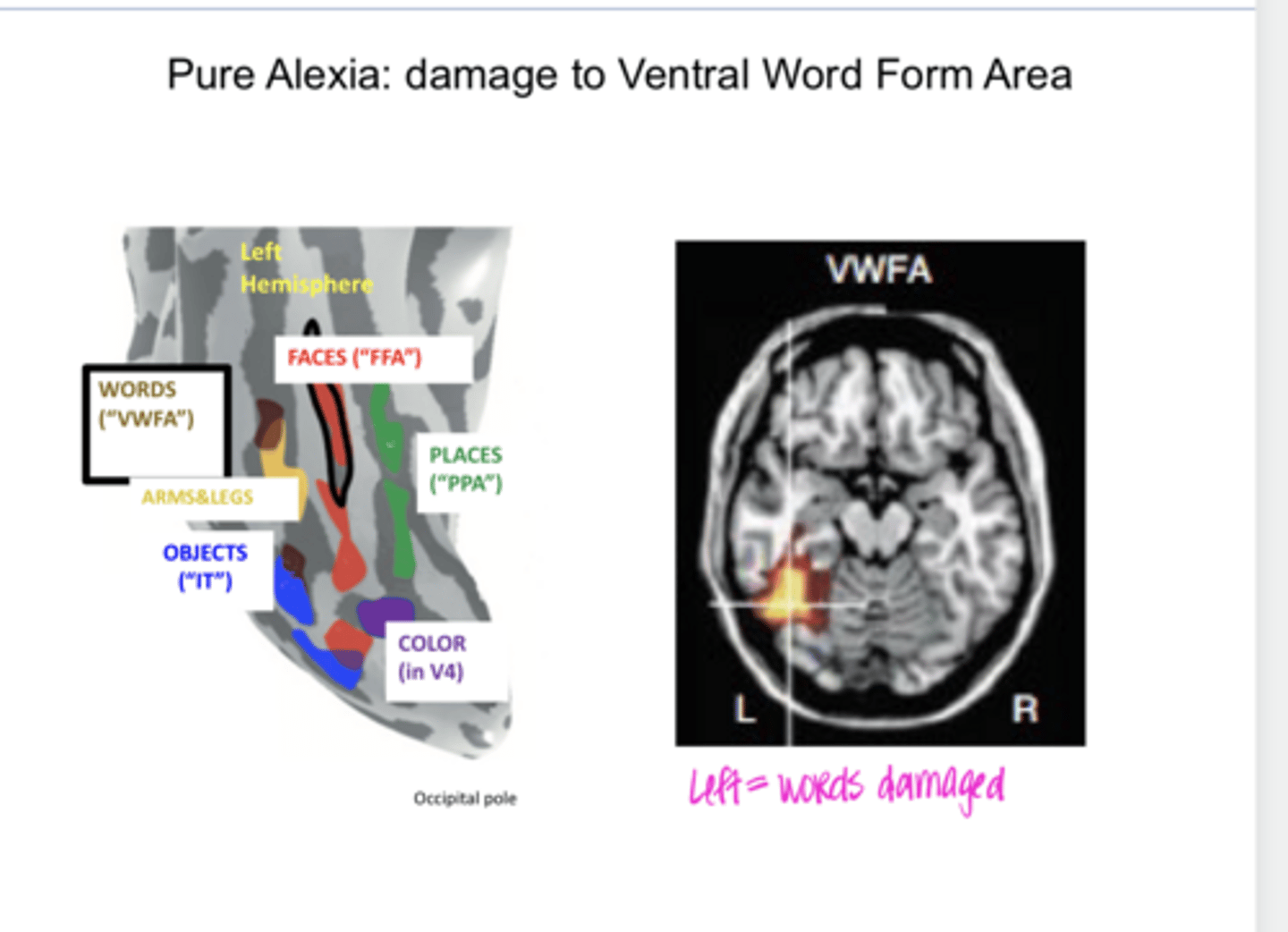
Lesion in Pure Alexia (Pic)
Lesion in Pure Alexia (Pic)
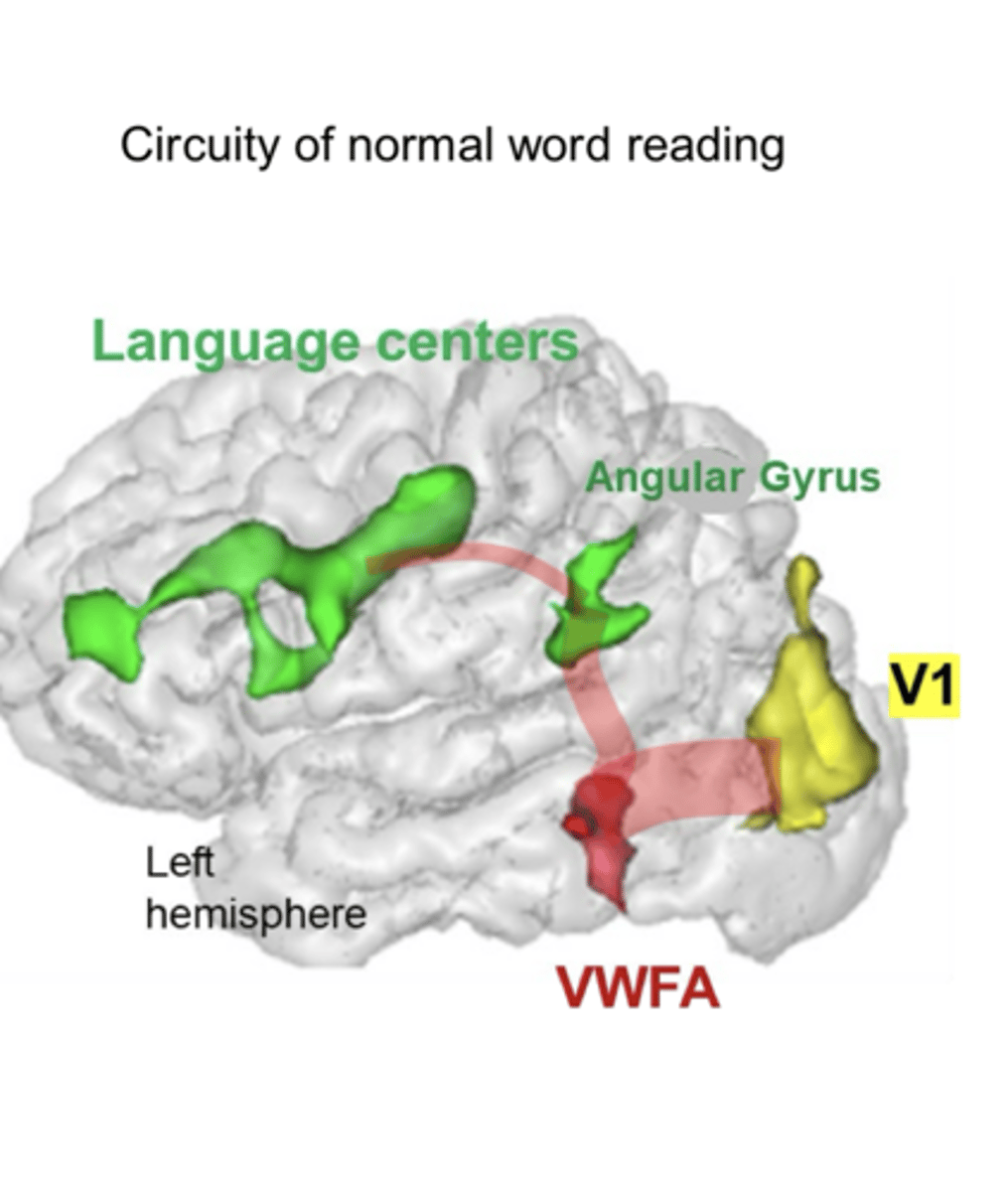
Circuitry of Normal Word Reading (Pic)
Circuitry of Normal Word Reading (Pic)
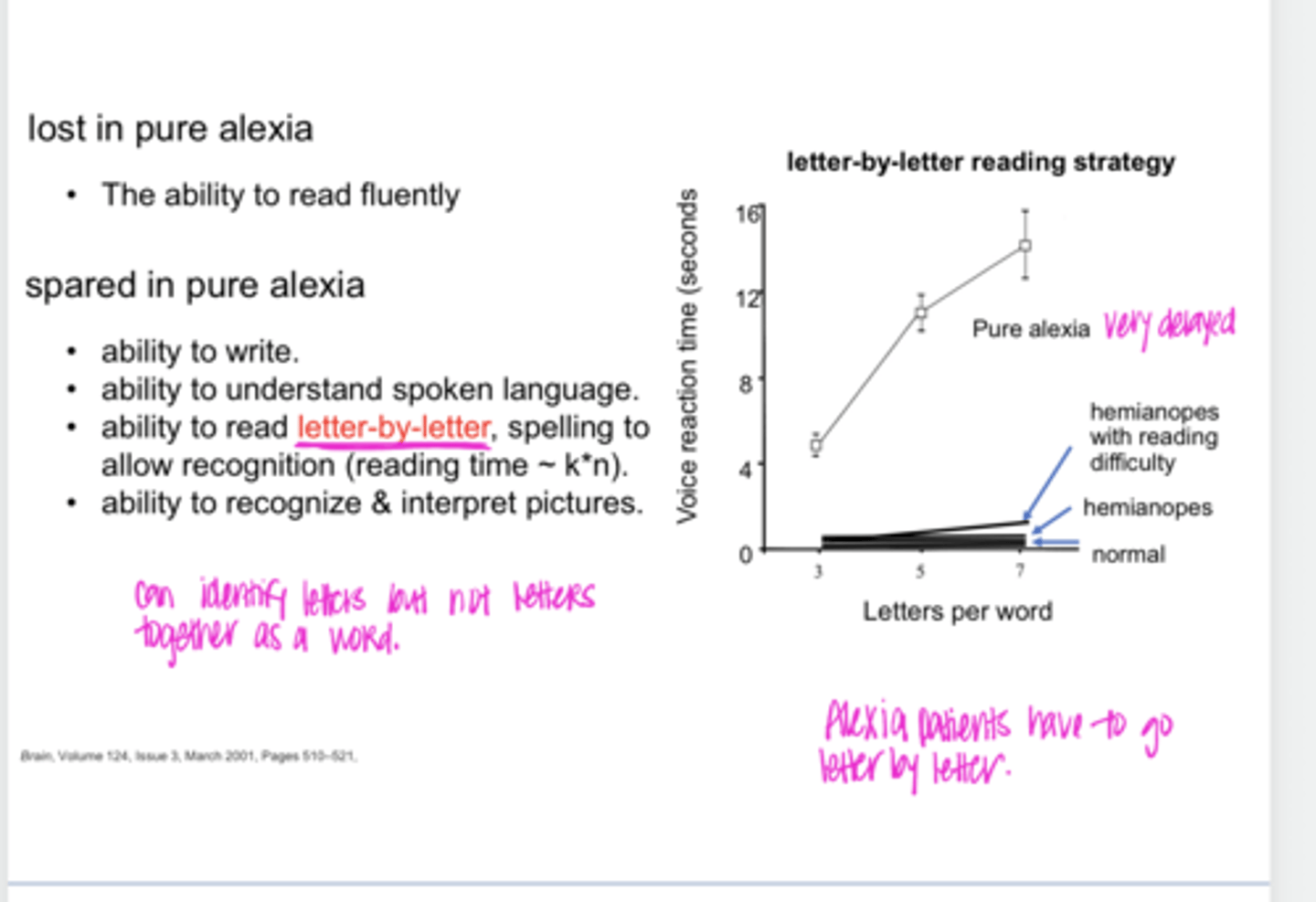
the ability to read fluently
What is lost is a pure alexia?
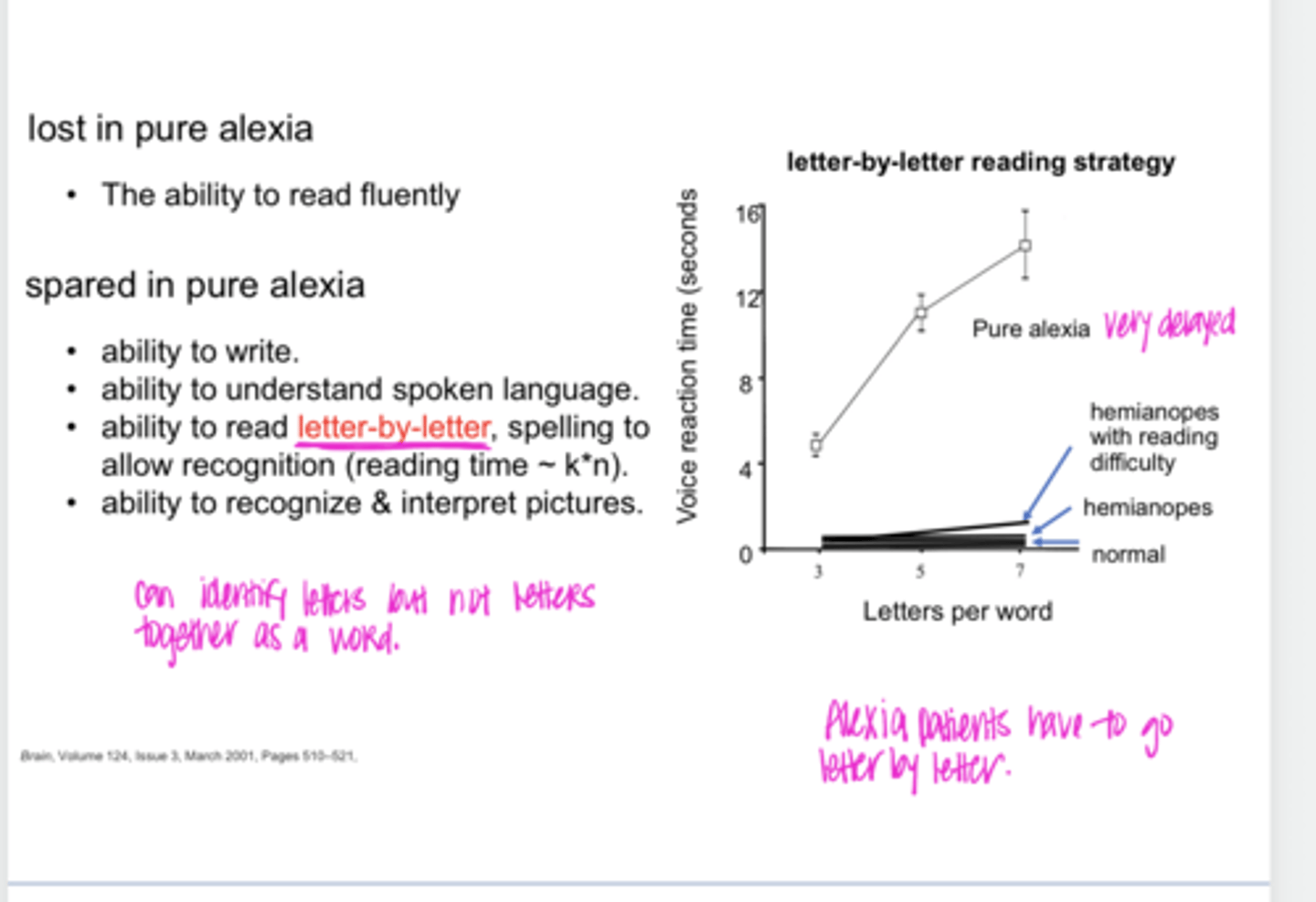
-ability to write
-ability to understand spoken language
-ability to read letter-by-letter, spelling to allow recognition
-ability to recognize and interpret pictures
What is SPARED in a pure alexia?
temporal lobe
SUMMARY: Visual info flows from the striate cortex (V1, V2) to the ________ in the ventral stream
static pattern recognition
SUMMARY: What does the ventral stream provide?
V4 -- lateral occipital complex
On its way from V1 to the temporal lobe of the brain, what does the ventral stream pass through?
apperceptive agnosia 00 profound defect in pattern recognition
What does a V4 lesion cause?
higher centers for mediating perception of distinct types of patterns
What does the temporal lobe contain that is important for vision?
perceptual defects called associative agnosias (object agnosia, prosopagnosia, pure alexia)
Lesions in the temporal lobe cause what type of defect?
motion
The dorsal stream plays a key role in our perception of _____
movement of parts of an image moving in a CERTAIN DIRECTION
REVIEW: V1 complex cells are stimulated by what?
earliest stage at which motion of entire objects (not just local parts) is extracted
Area MT in the dorsal stream is the earliest stage at which what is extracted?
No -- does not handle ventral stream info well either
Does the dorsal stream handle color?
true
True or False:
Motion is important to all parts of vision
-attracts attention for foveal viewing
-figure/ground segregation
-perception of the 3D world
Why is motion important for all parts of vision?
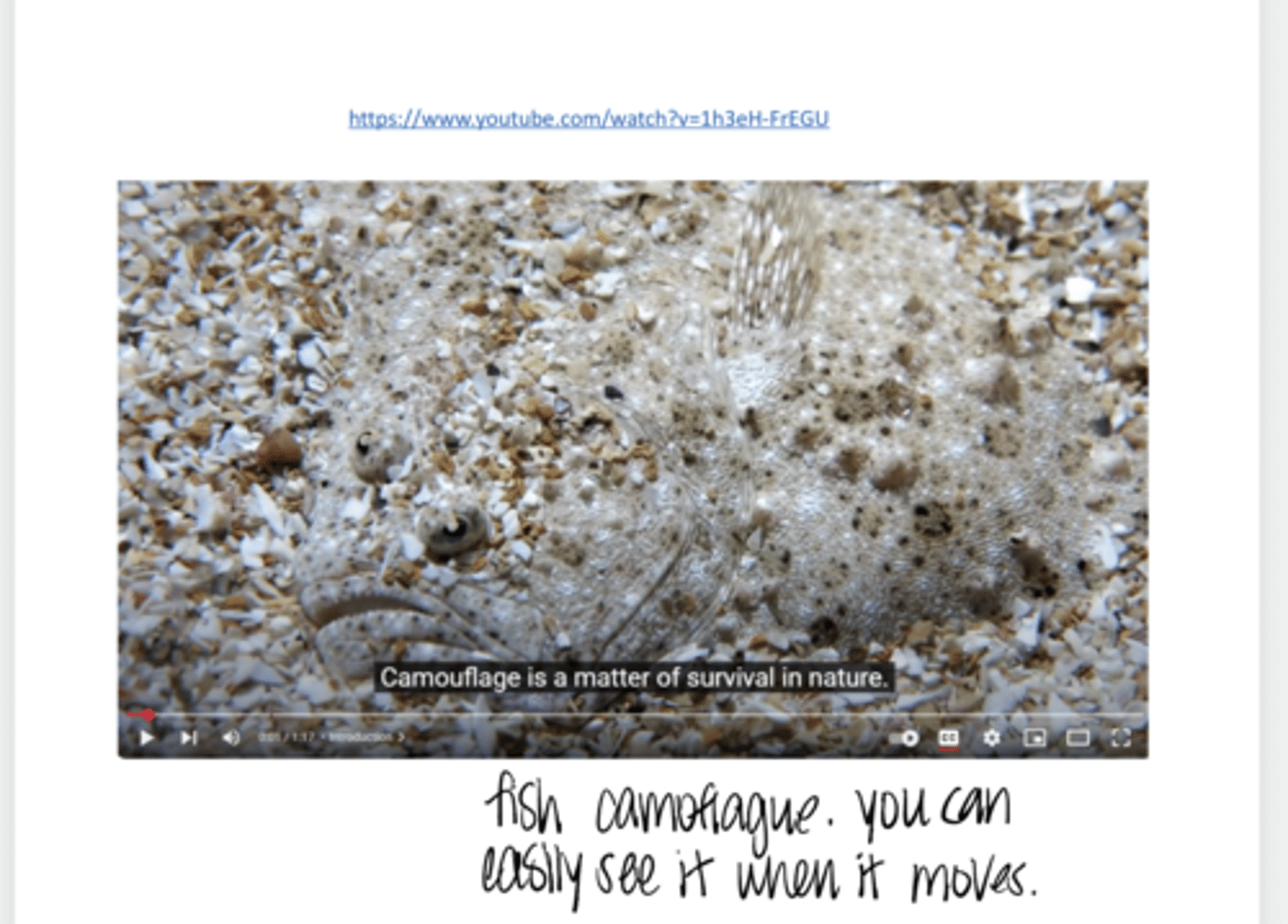
true
True or False:
Camouflage can be broken by motion
-kinetic depth effect
-motion parallax
-perception of self motion (sitting on plane and environment starts to move)
How is motion important for our perception of the 3D world?
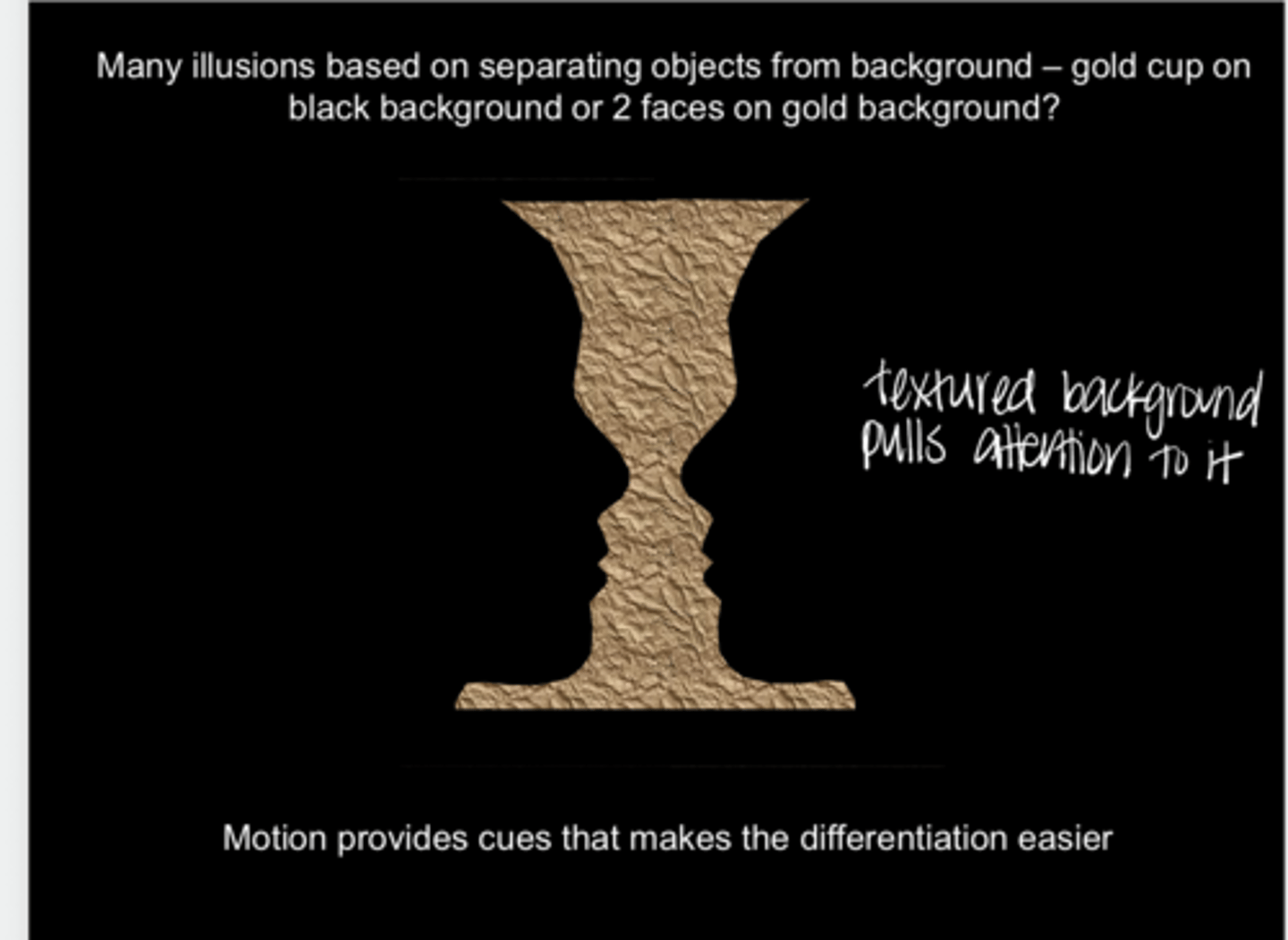
Gold Cup on Black Background or 2 Faces on Gold Background Illusion (Pic)
Gold Cup on Black Background or 2 Faces on Gold Background Illusion (Pic)
**Motion provides cues that makes the differentiation easier
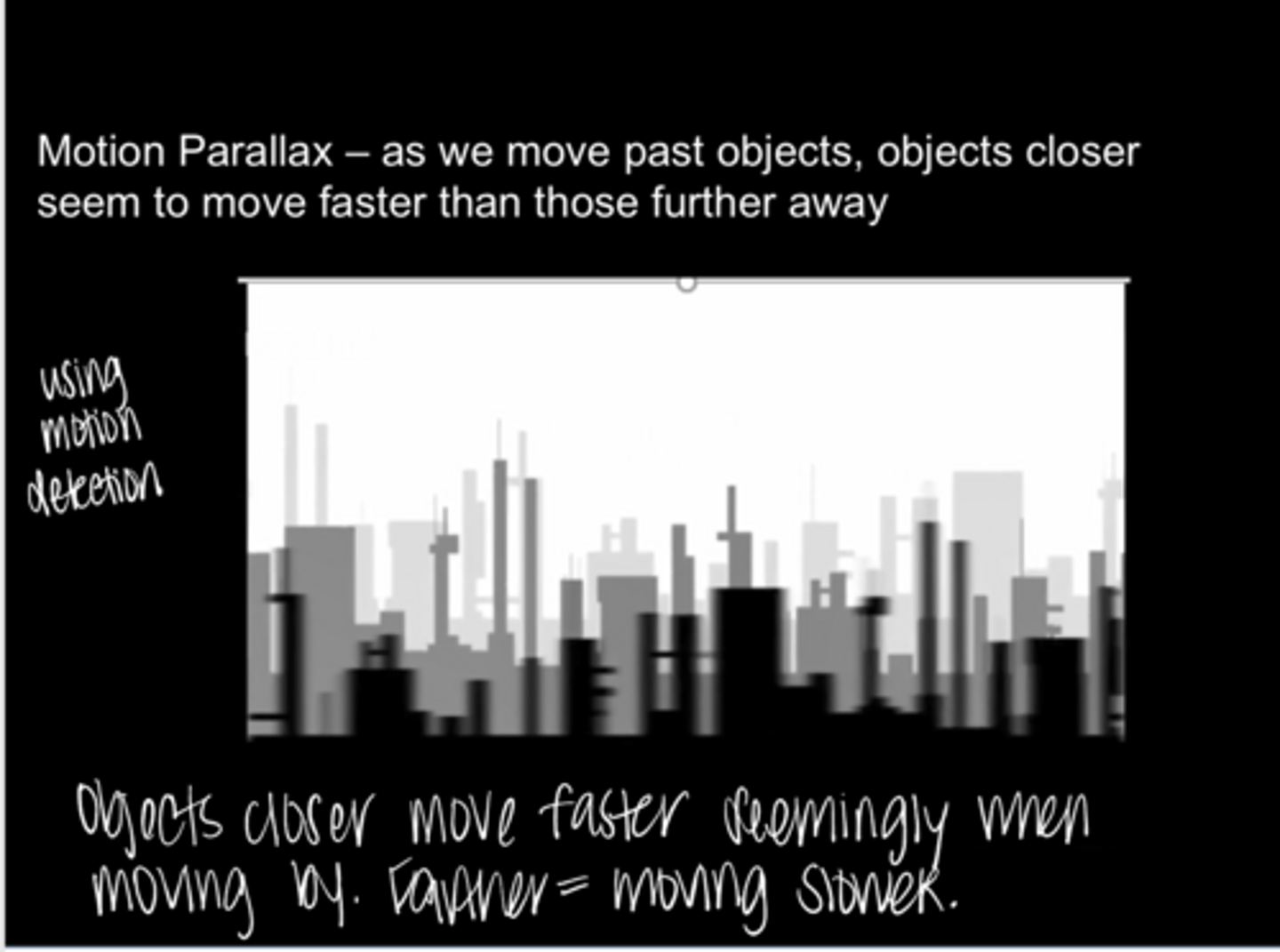
As we move past objects, objects closer seem to move faster than those that are further away
What is motion parallax?
-identifying spatial location of objects which is vital for our interactions with our environment
-crucial for motion detection
-crucial for depth perception
-needed for coordinating visual information with motor functions (mobility)
The dorsal stream plays a key role in what?
significant challenges in every day activities d/t impaired spatial awareness, movement coordination, and reaching for objects
Damage to the dorsal stream can lead to what?
Yes -- difficulty handling a smart phone, pouring a drink, crossing the street safely, & driving a car EVEN IF VA IS NORMAL
Can impairment to the dorsal stream have great consequences to a patient's life and independence?
true
True or False:
Ventral stream disorders can leave the dorsal stream function intact
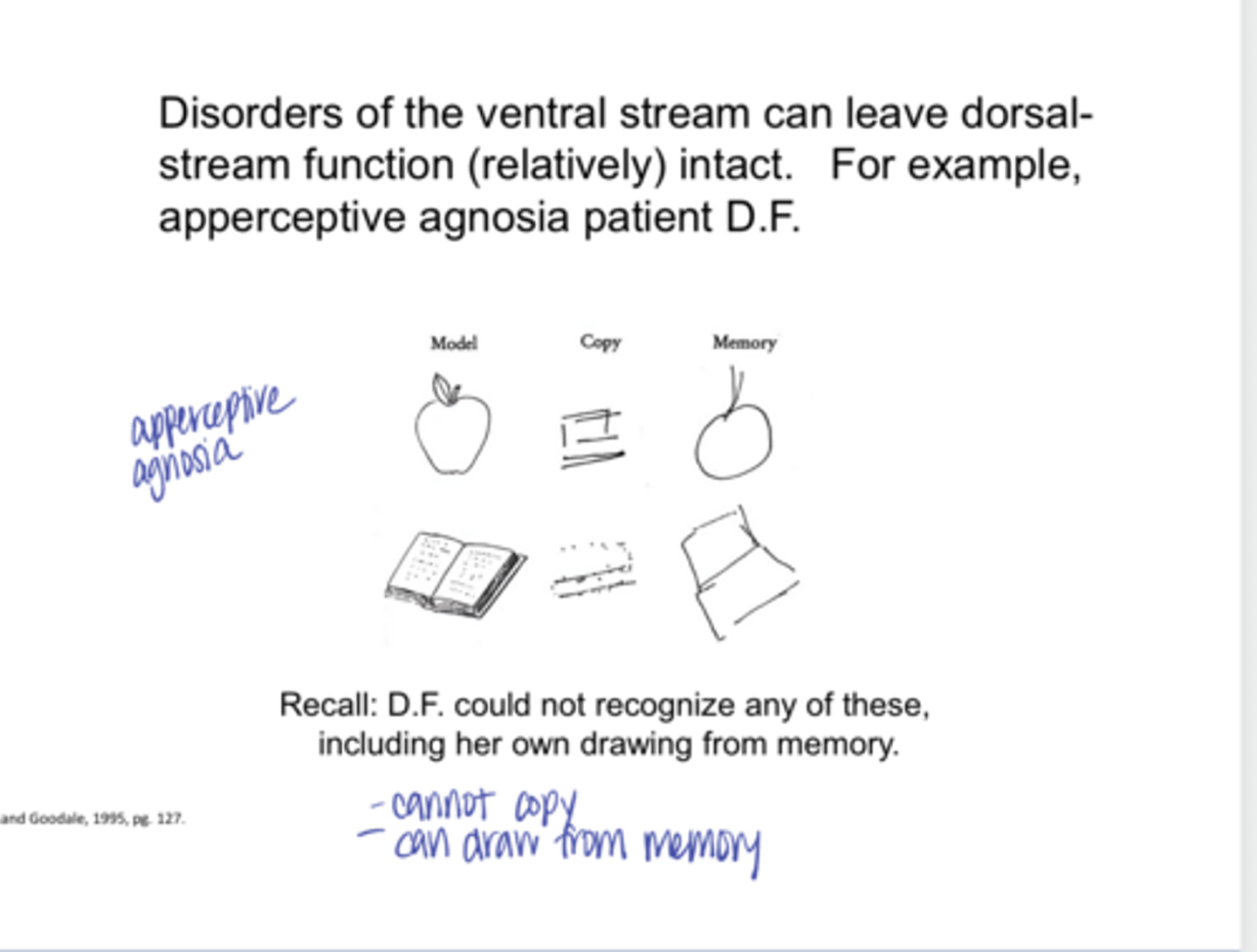
The problem is VISUAL. She HAS NOT LOST her cognitive ability to understand what objects are.
A given patient CANNOT recognize any model images, including her own drawings from memory.
This patient CAN recognize letters and numbers by touch. CAN recognize common objects by touch. CAN write letters and numbers from dictation. CAN draw common objects from memory.
What is the problem with this patient: visual or cognitive?
Yes
Can a patient with severe impairment in recognizing and drawing stimuli still have an ability to interact with the world using an intact dorsal stream?
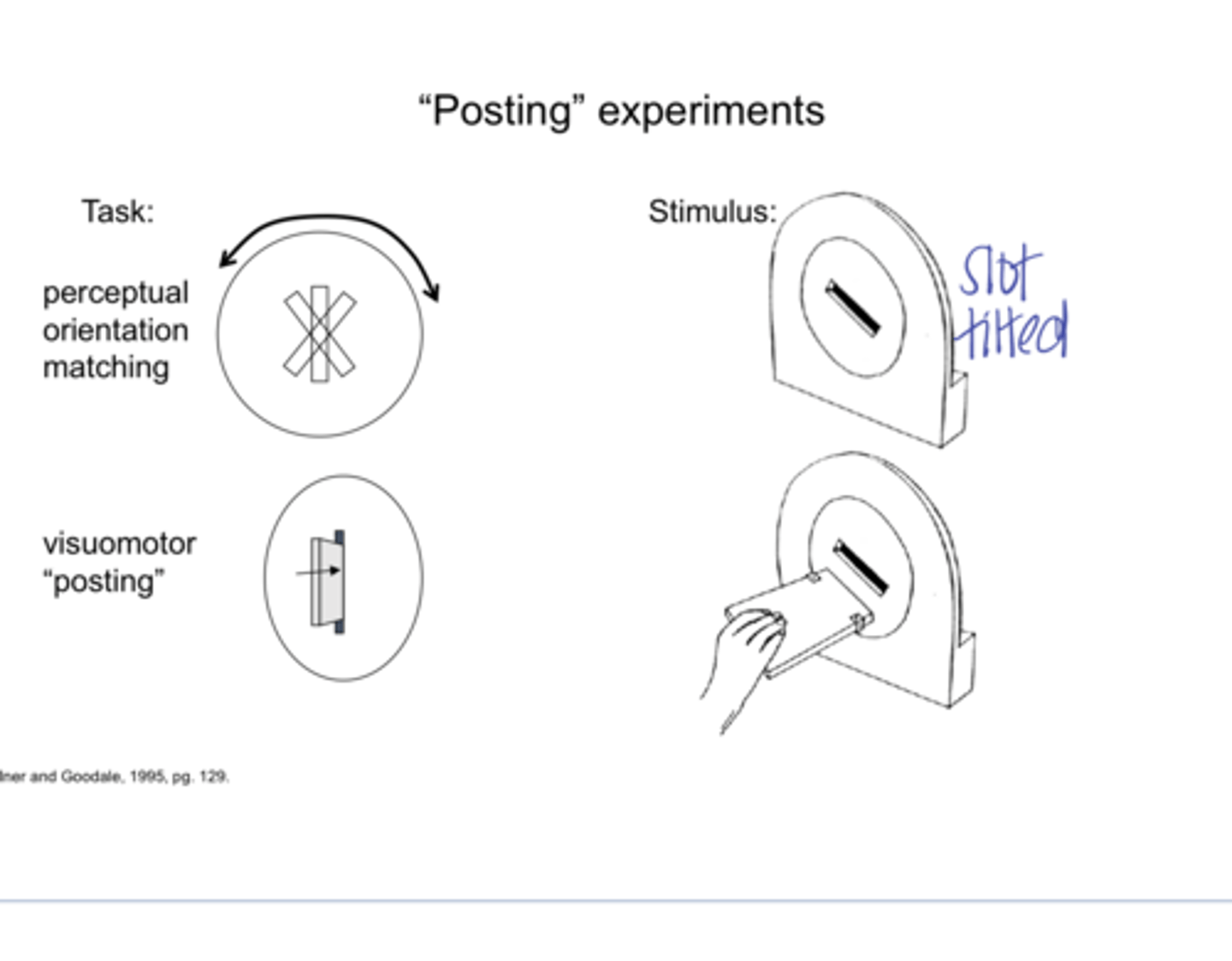
Task: Perceptual Orientation Matching using Visuomotor System
Stimulus: Tilted Slit
What is a posting experiment?
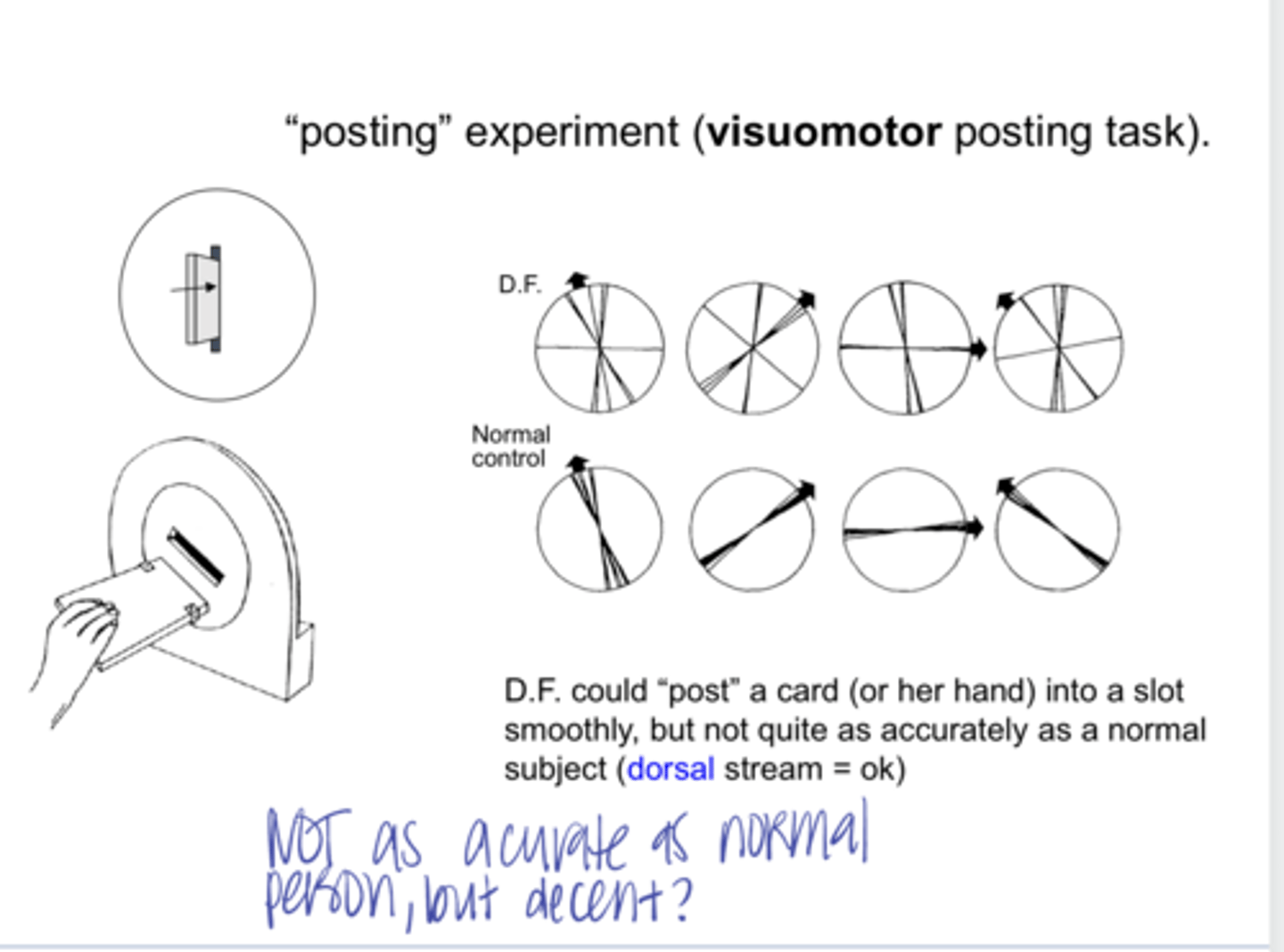
Patient should be able to "post" the card into a slit smoothly, but not quite as accurately as a normal subject (Dorsal stream is OK!)
Can a patient with a ventral stream deficit complete the posting experiment?
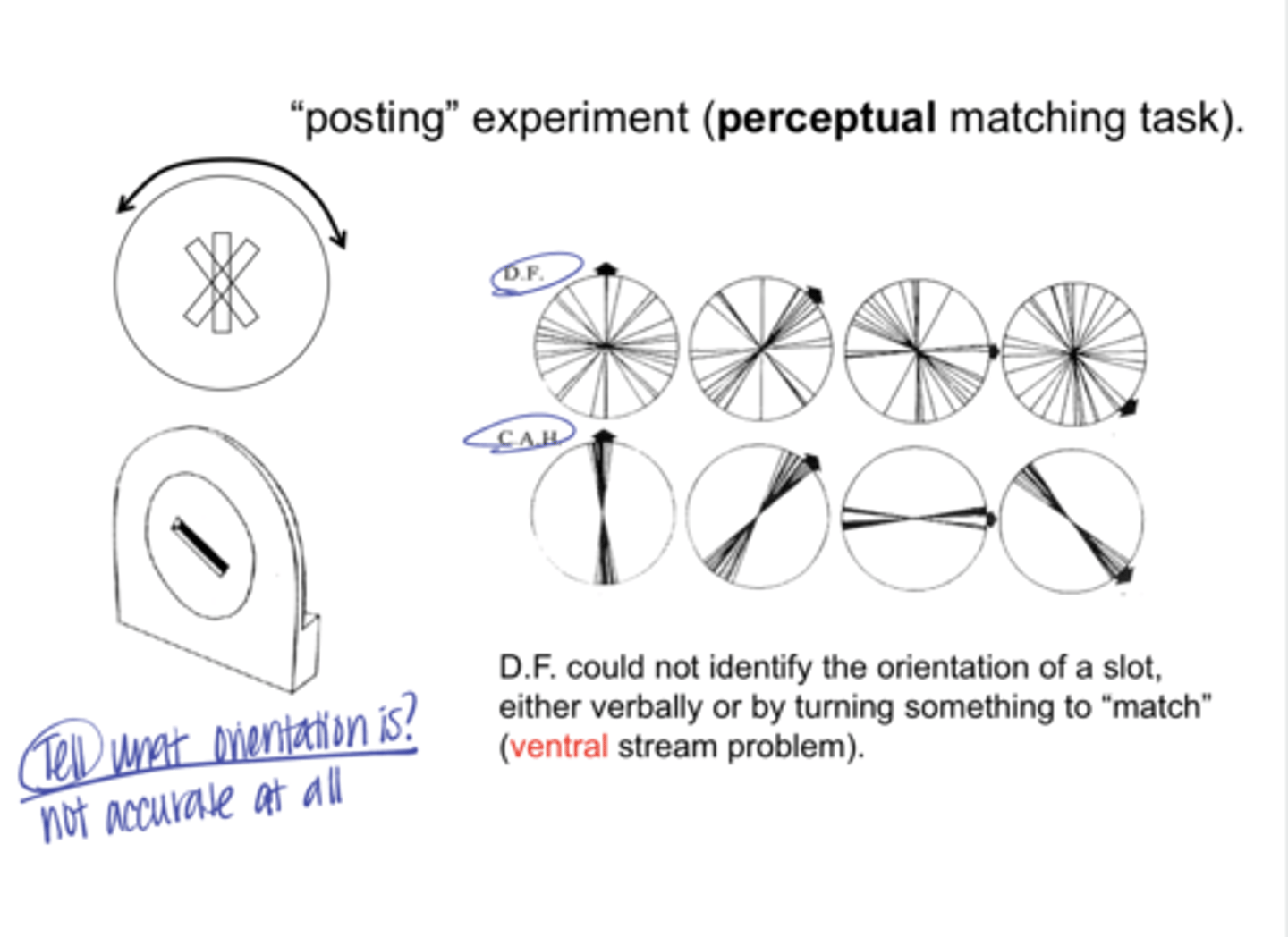
No -- this is a perceptual matching task & the patient has a ventral stream problem
Can a patient with a ventral stream deficit identify the orientation of a slit (either verbally or by turning something to match the slit) in the posting experiment?
abnormal motion perception
Damage to the dorsal stream can produce what?
perception of objects in terms of their spatial location
Damage to the dorsal stream can disturb what?
perception and recognition of objects and other VENTRAL STREAM functions
Damage to the dorsal stream can leave what intact?
Balint-Holmes Syndrome (Pic)
Balint-Holmes Syndrome (Pic)
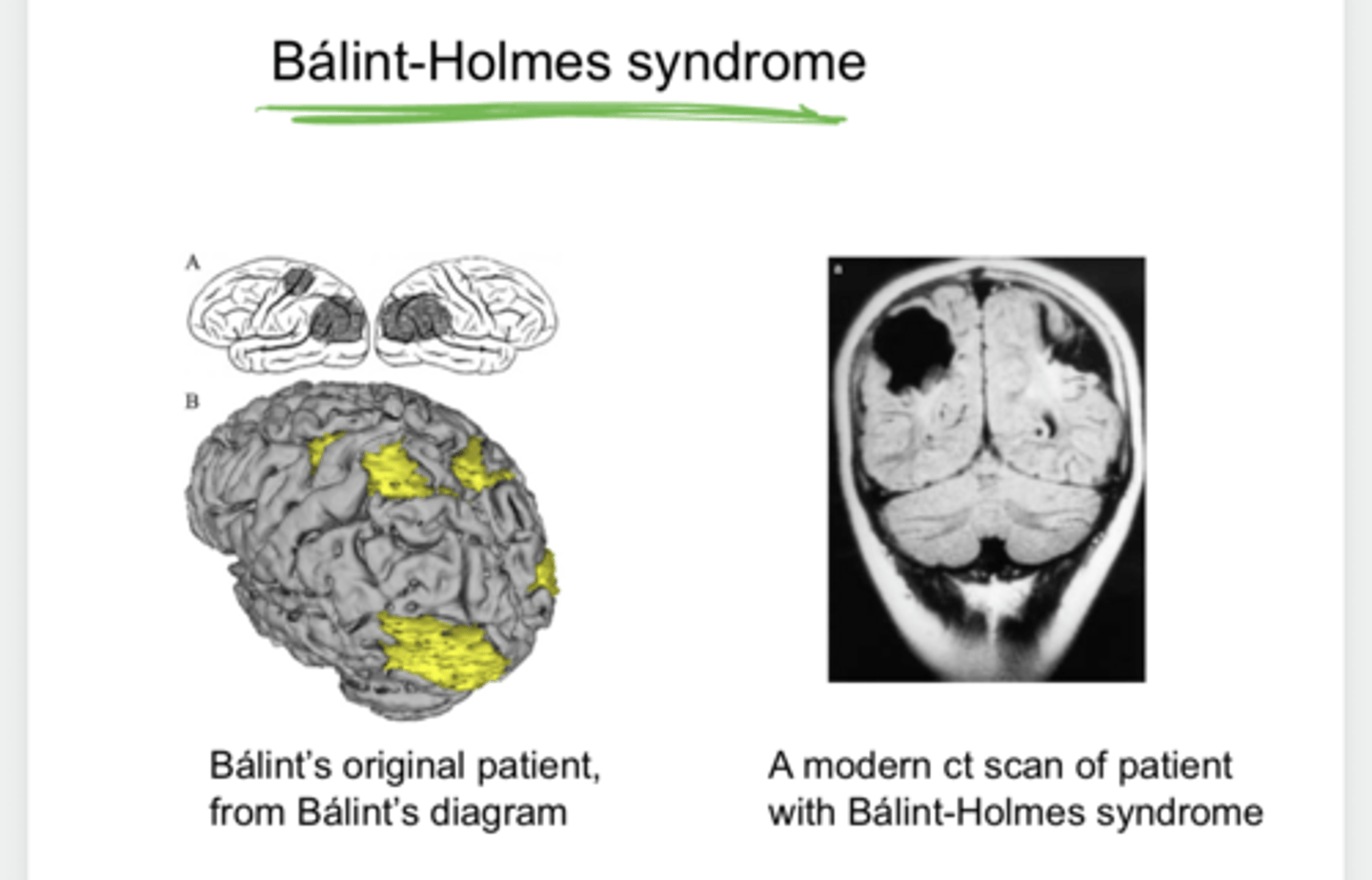
Modern CT Scan of a Patient with Balint-Holmes Syndrome (Pic)
Modern CT Scan of a Patient with Balint-Holmes Syndrome (Pic)
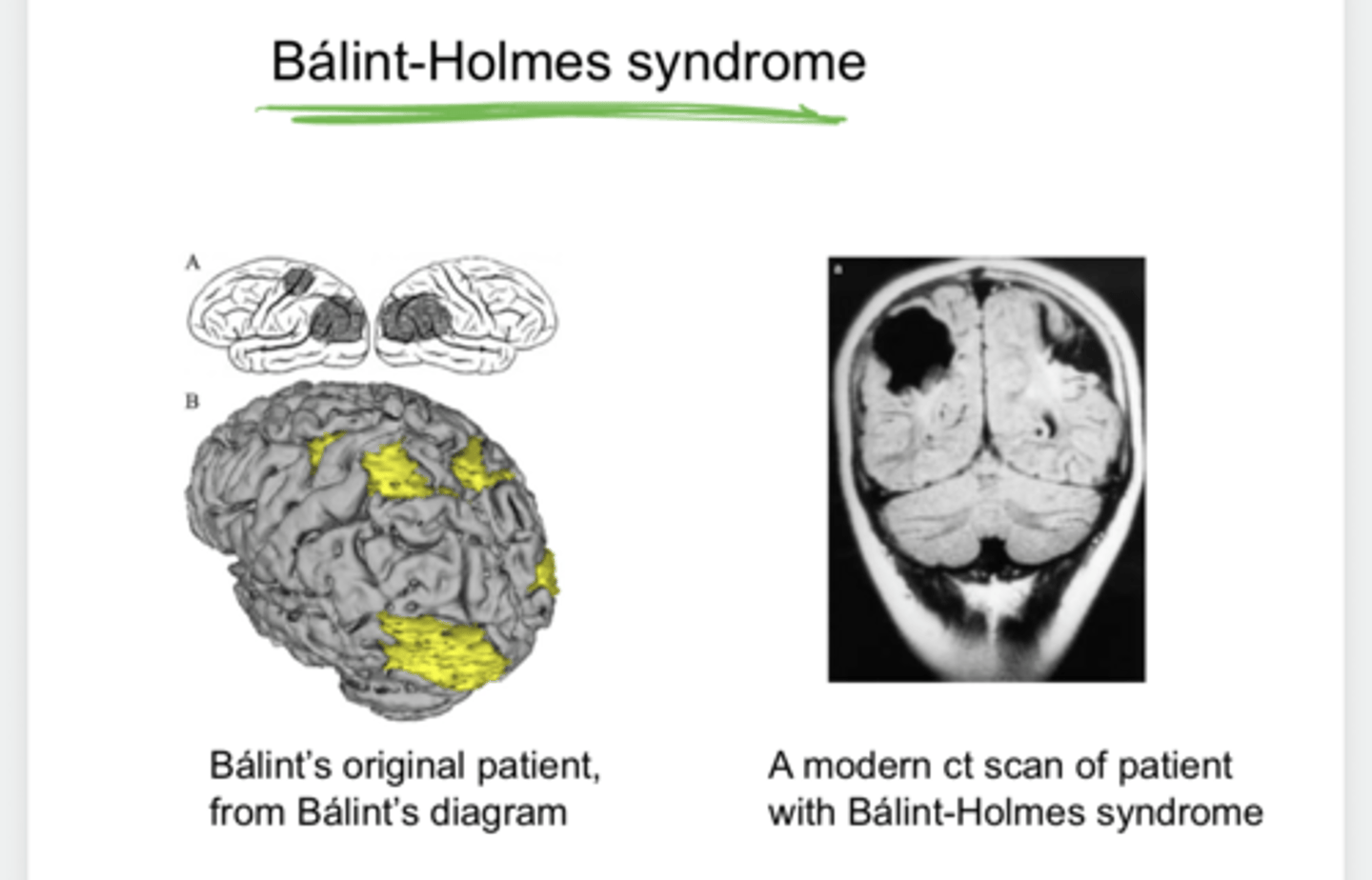
Damage to parietal lobes; part of the dorsal stram
What is Balint-Holmes Syndrome?
can be either
Is Balint-Holmes Syndrome unilateral or bilateral damage?
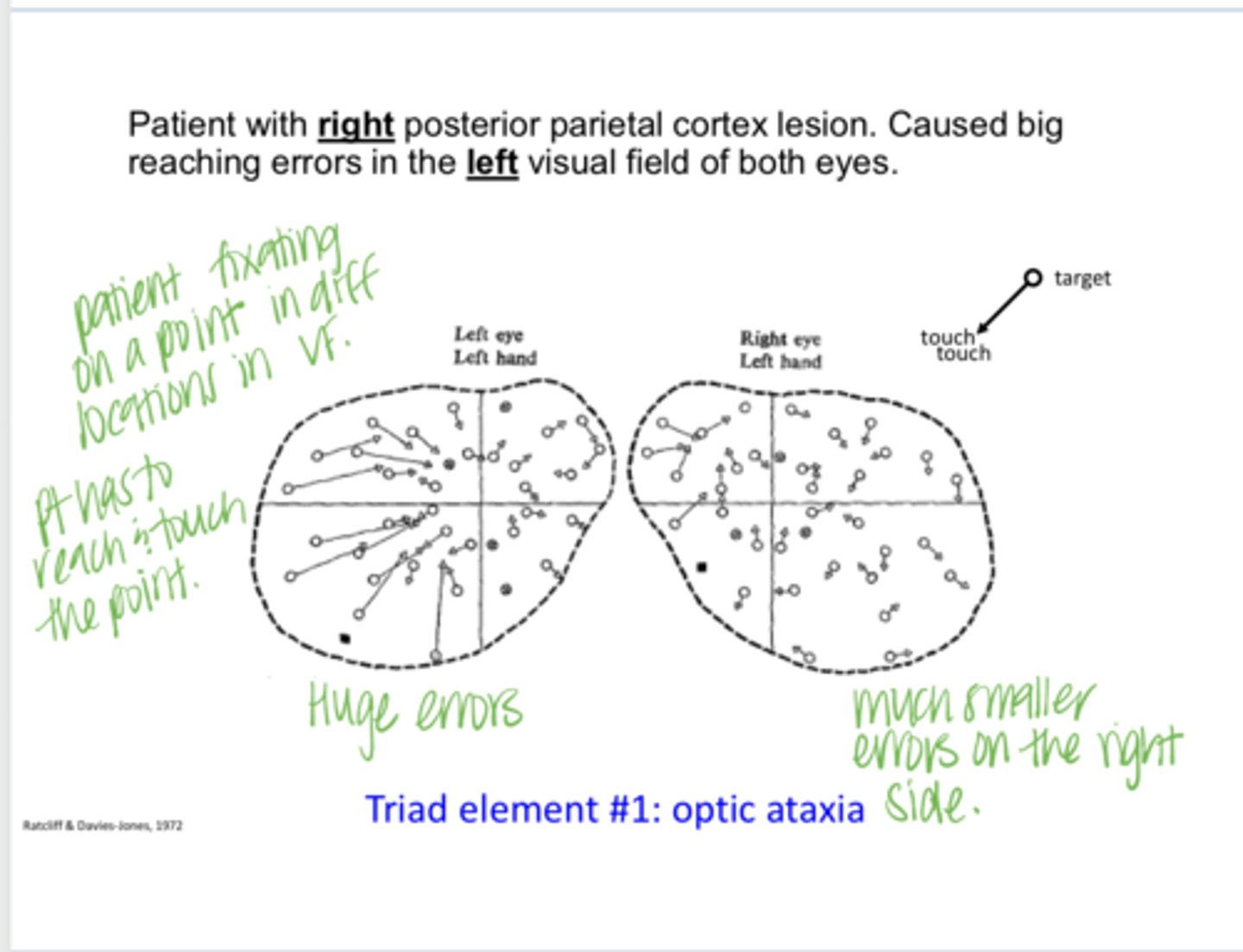
-Optic Ataxia
-Gaze Paralysis
-Simultagnosia
What is the TRIAD of clinical findings of Balint-Holmes Syndrome?
disordered reaching
What is optic ataxia as a clinical finding of Balint-Holmes Syndrome?
sticky fixation -- difficulty with eye movements
What is gaze paralysis as a clinical finding of Balint-Holmes Syndrome?
Cannot see the whole image or more than 1 thing at a time
What is simultagnosia as a clinical finding of Balint-Holmes Syndrome?
-stroke
-tumor
-Alzheimer's disease (or similar neurological conditions)
-toxins
-trauma
What is Balint-Holmes Syndrome caused by?
left
A patient with RIGHT posterior parietal cortex lesions will have reaching errors in the (right/left) VF of both eyes
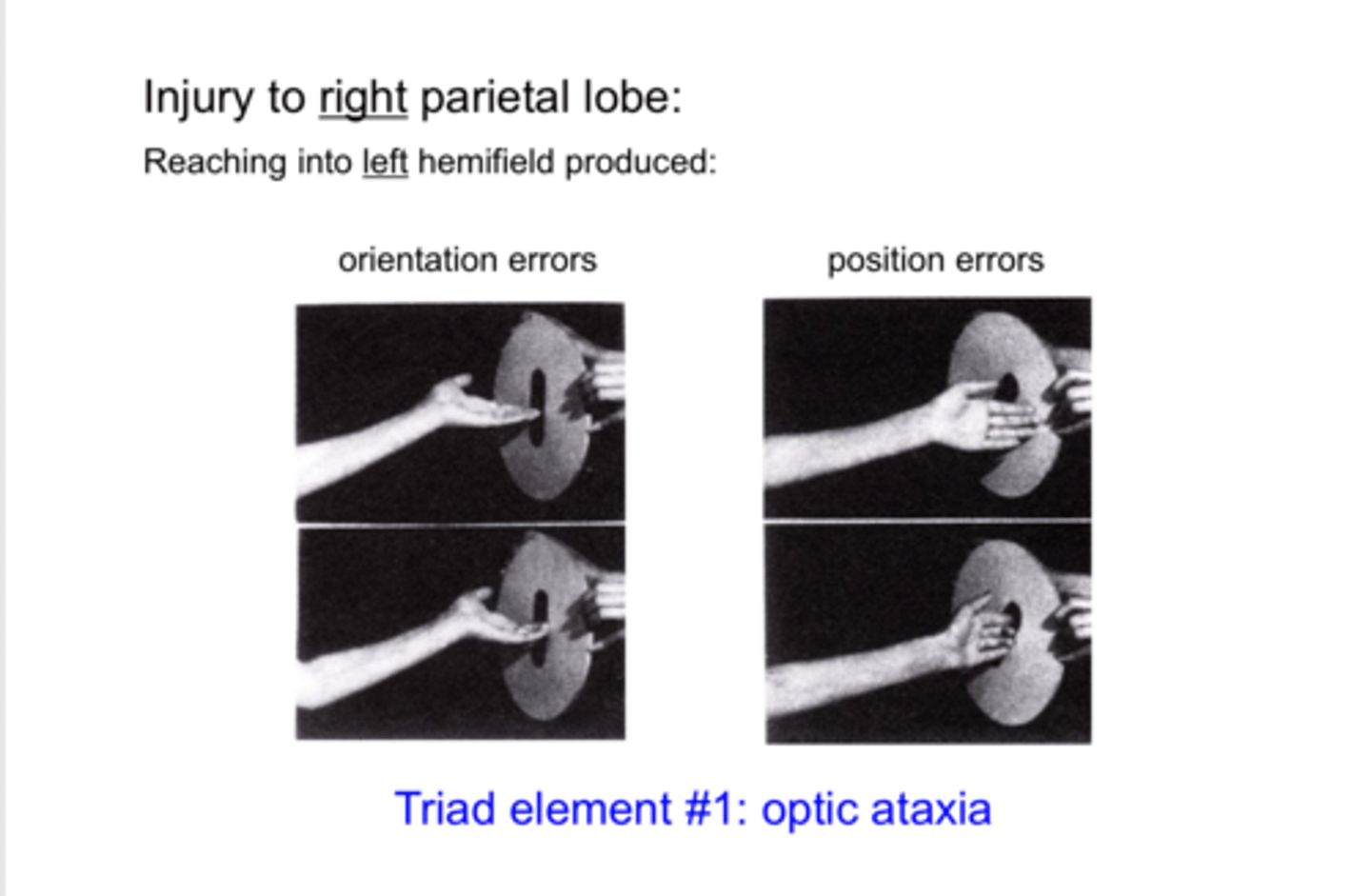
Normal location and hand orientation
When an injury to the RIGHT parietal lobe is present and the patient reaches into their RIGHT hemifield. What is the result?
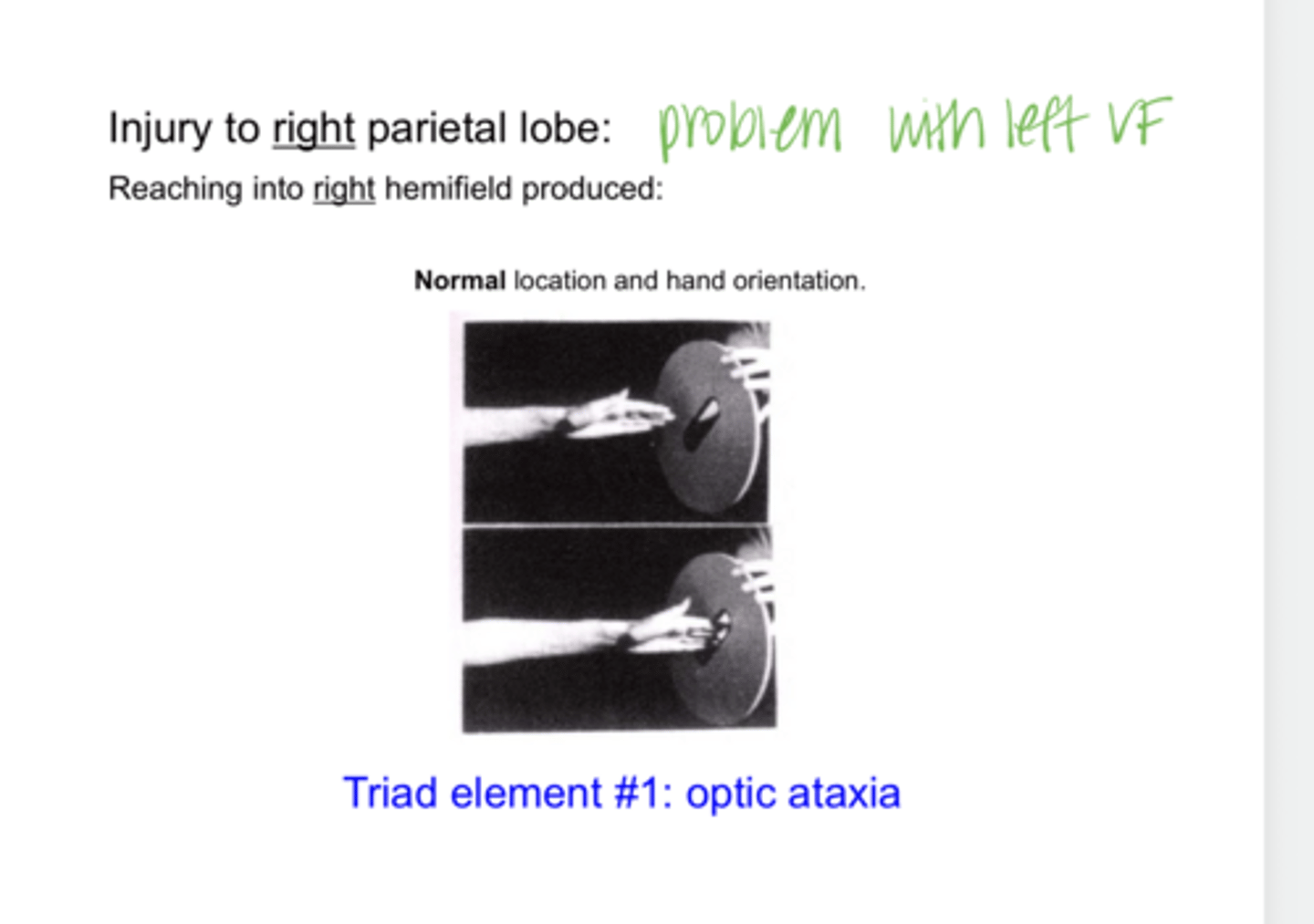
Orientation and Position errors
When an injury to the RIGHT parietal lobe is present and the patient reaches into their LEFT hemifield. What is the result?
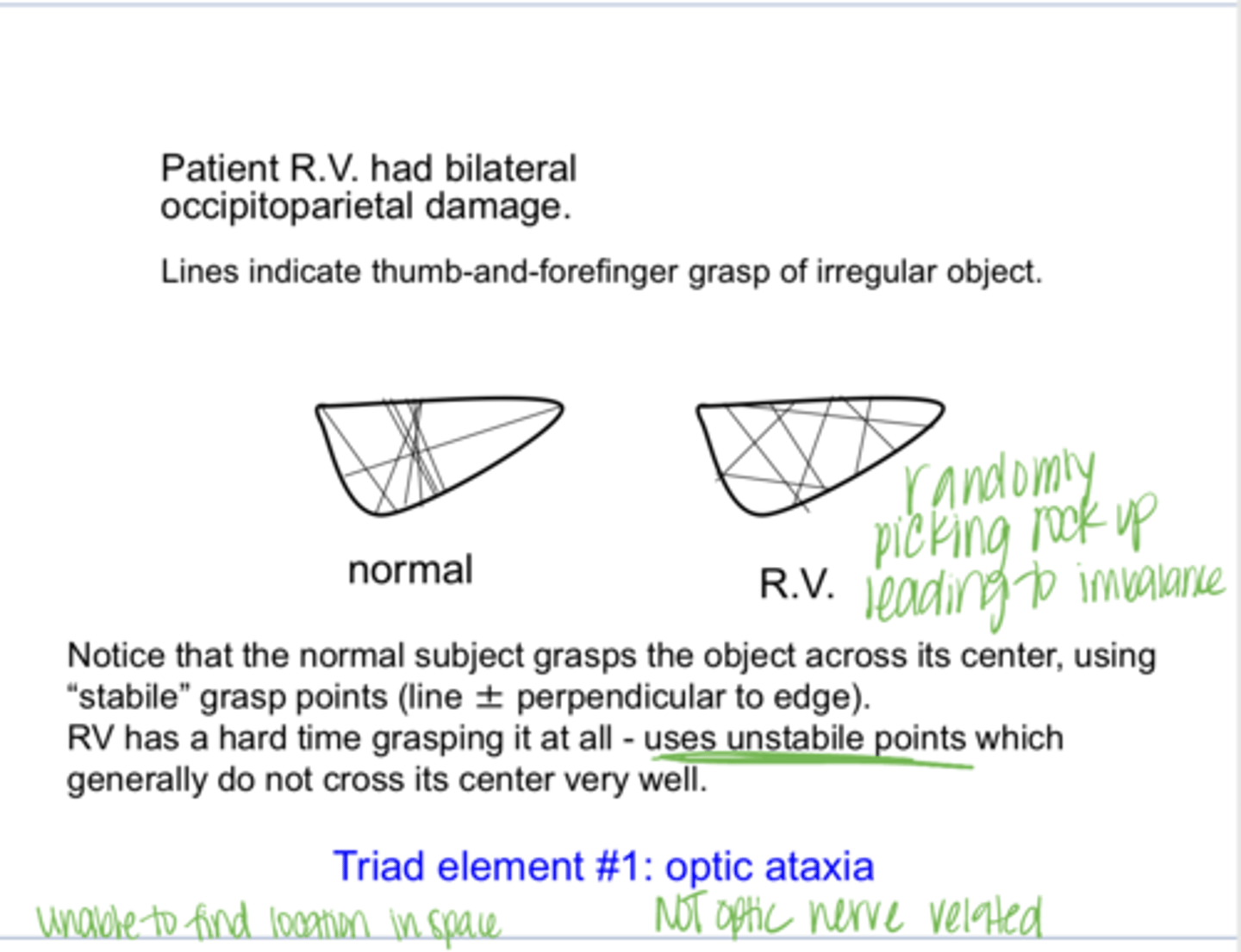
stable -- using a line perpendicular to the edge
A normal patient will grasp an object across the center, using ____ grasp points
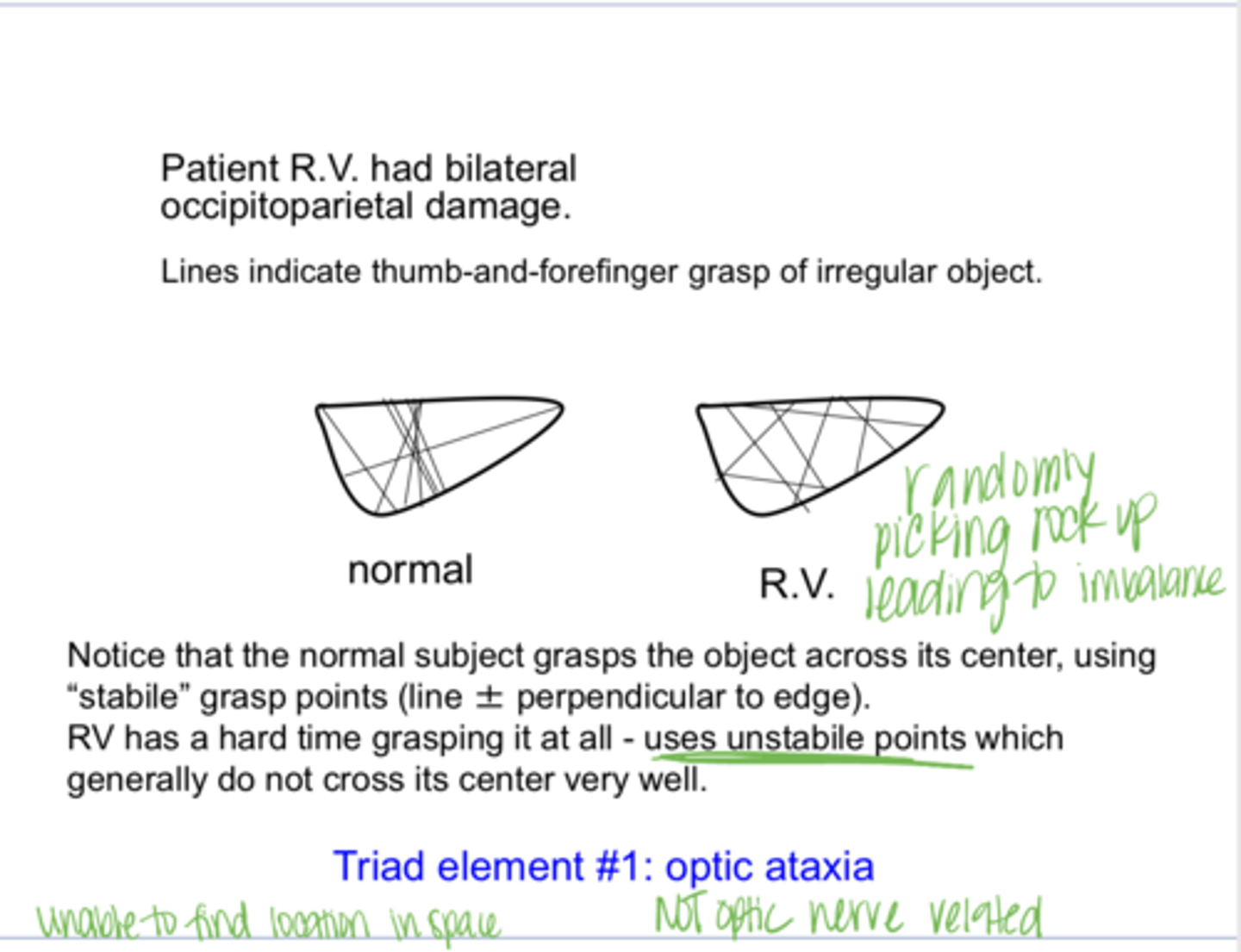
-grasping an object at all
-will use unstable points which generally DO NOT CROSS its center very well
A patient with optic ataxia will have a hard time with what?
gaze paralysis
Sticky fixation
Posterior parietal cortex
What controls the initiation of saccades under visual attention?
long
Patients with lesions in the parietal lobe tend to have (short/long) latency saccades
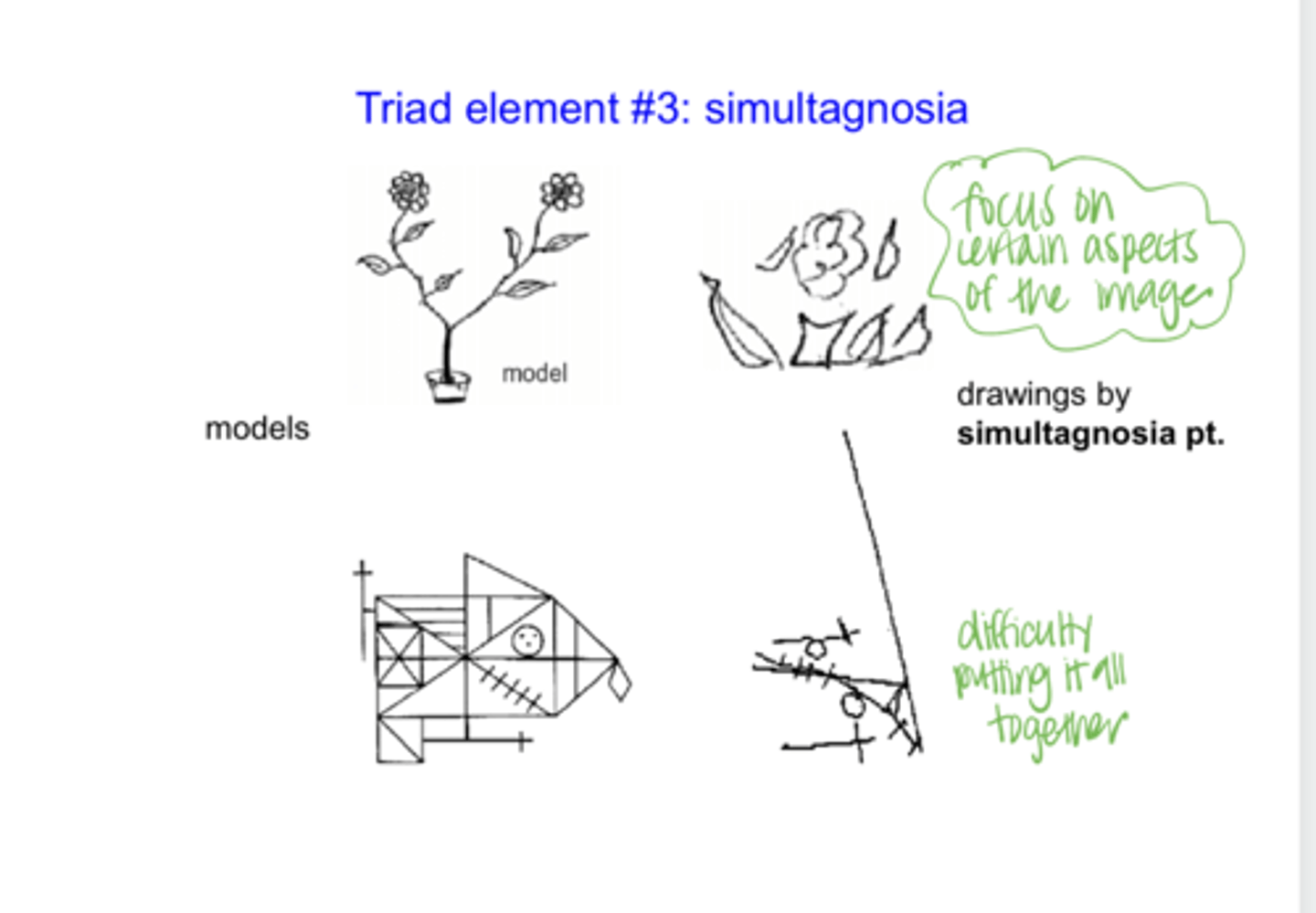
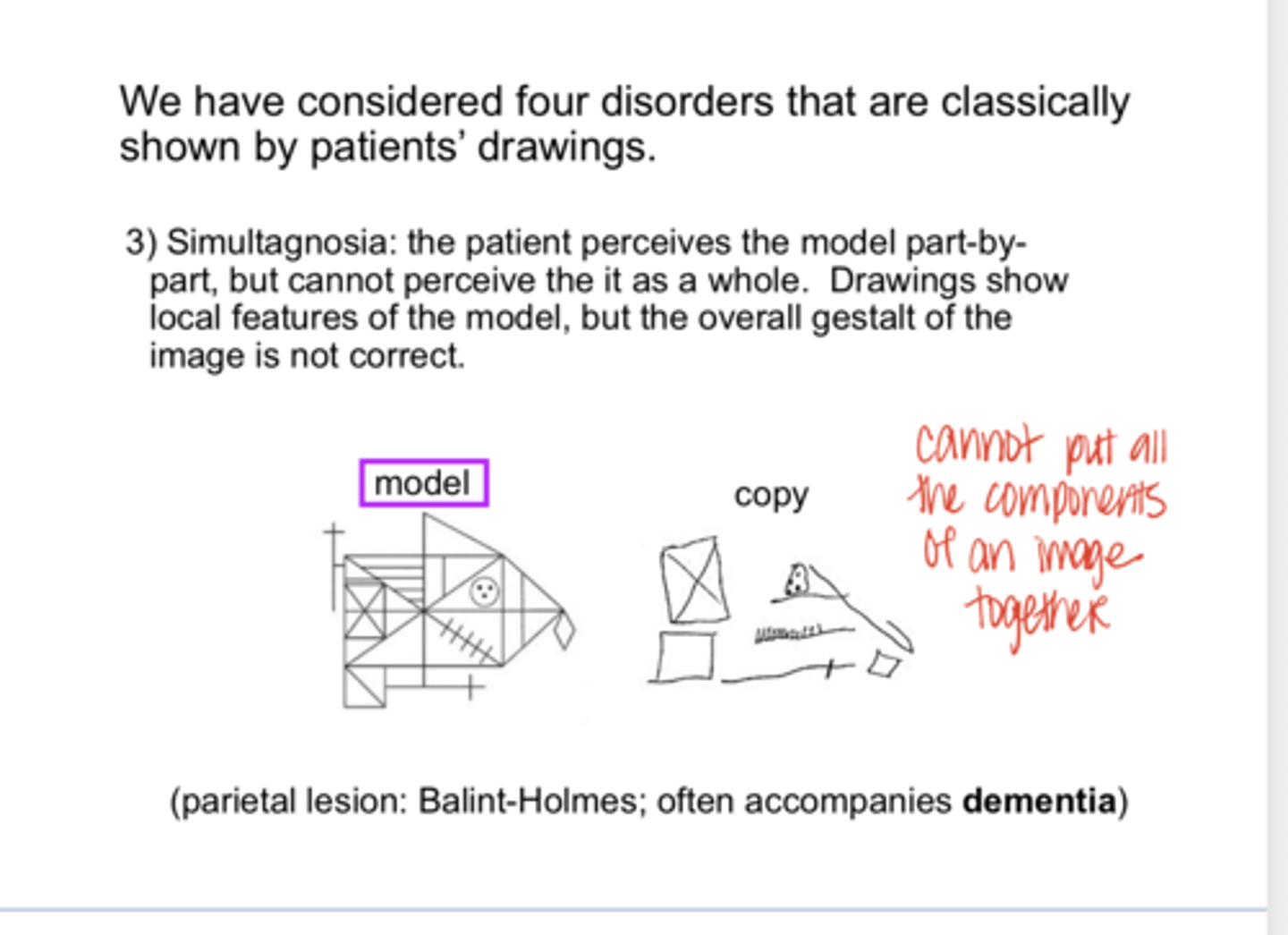
cannot understand the whole of an image; cannot see more than one component or attribute at a time
What is simultagnosia?
Alzheimers
Simultagnosia is common in ________
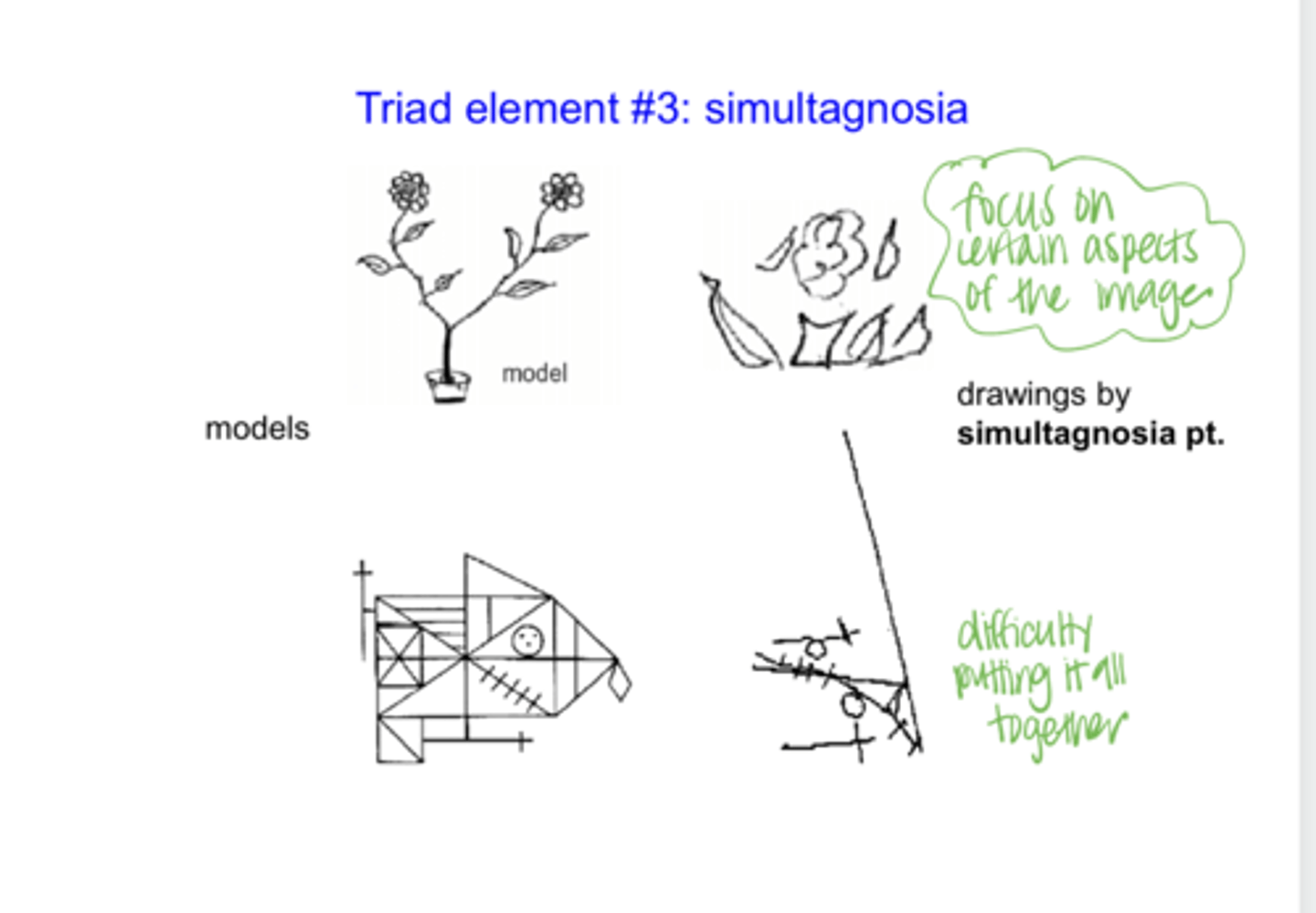
No
Is simultagnosia a ventral stream syndrome like the other agnosias?
Simultagnosia Examples (Pic)
Simultagnosia Examples (Pic)
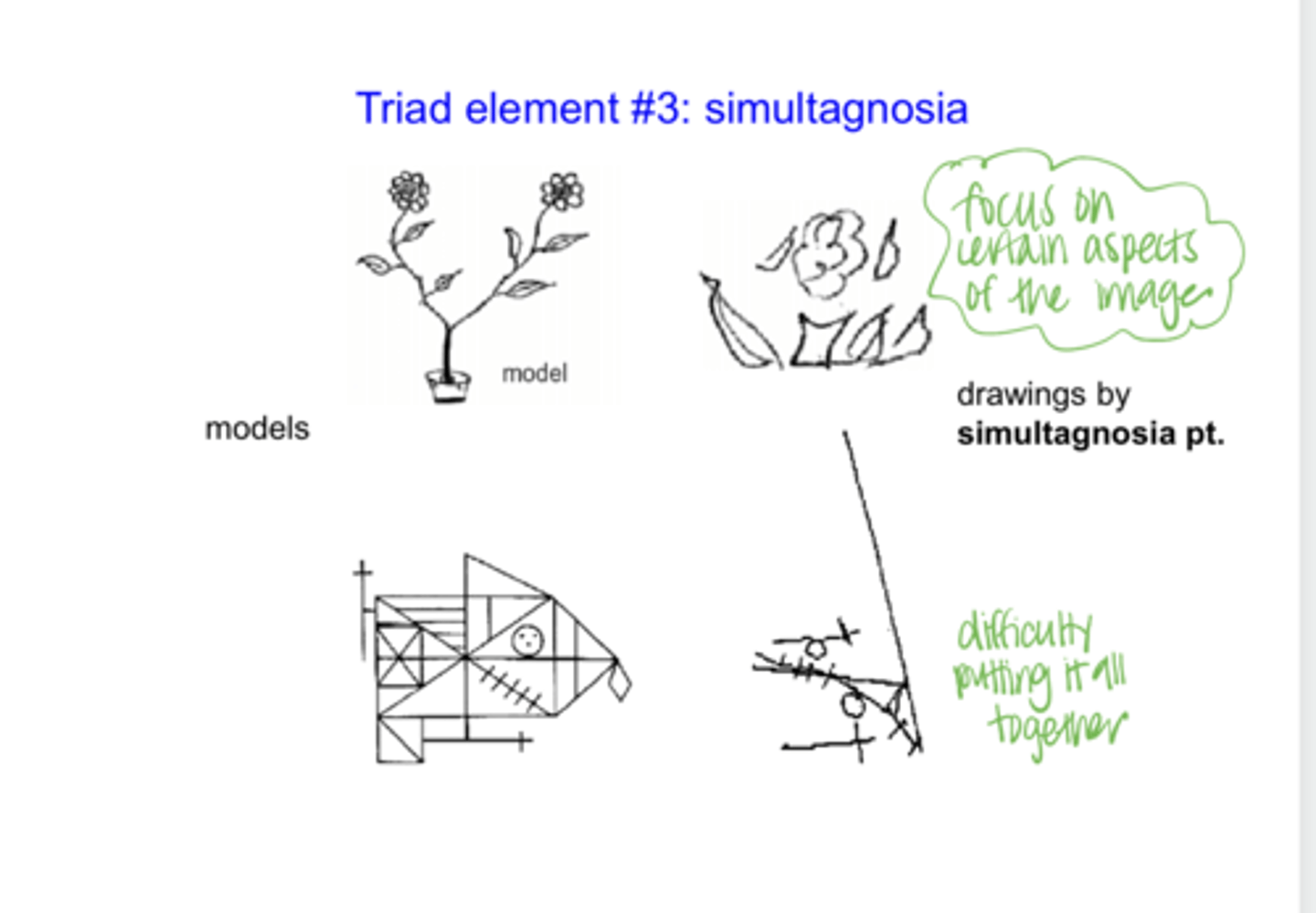
No -- they struggle with this because individual components are placed on top of each other in this test
Does an individual with Balint-Holmes Syndrome d/t damage to the parietal lobe do well with a forced-choice test for simultagnosia? Why?
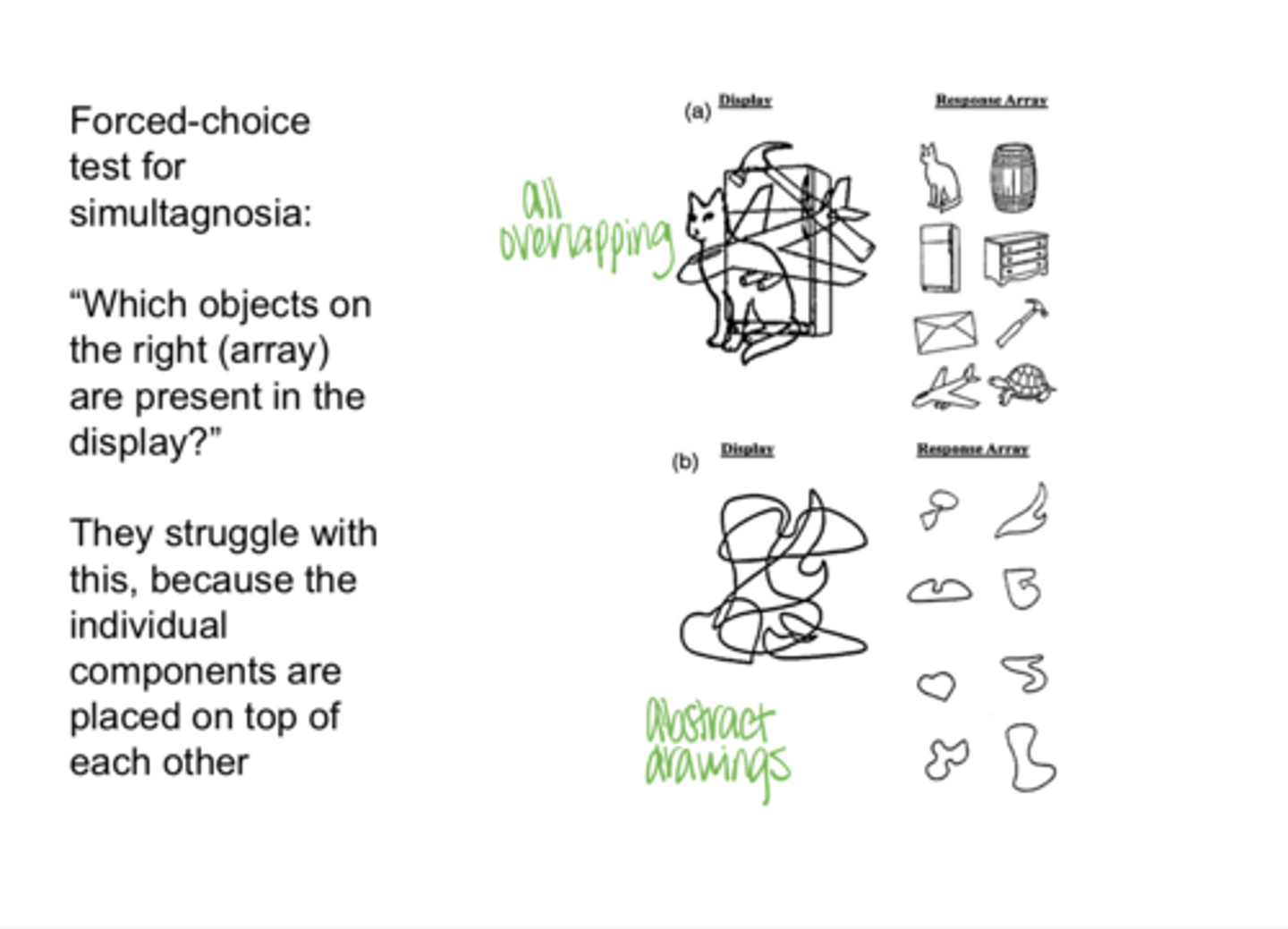
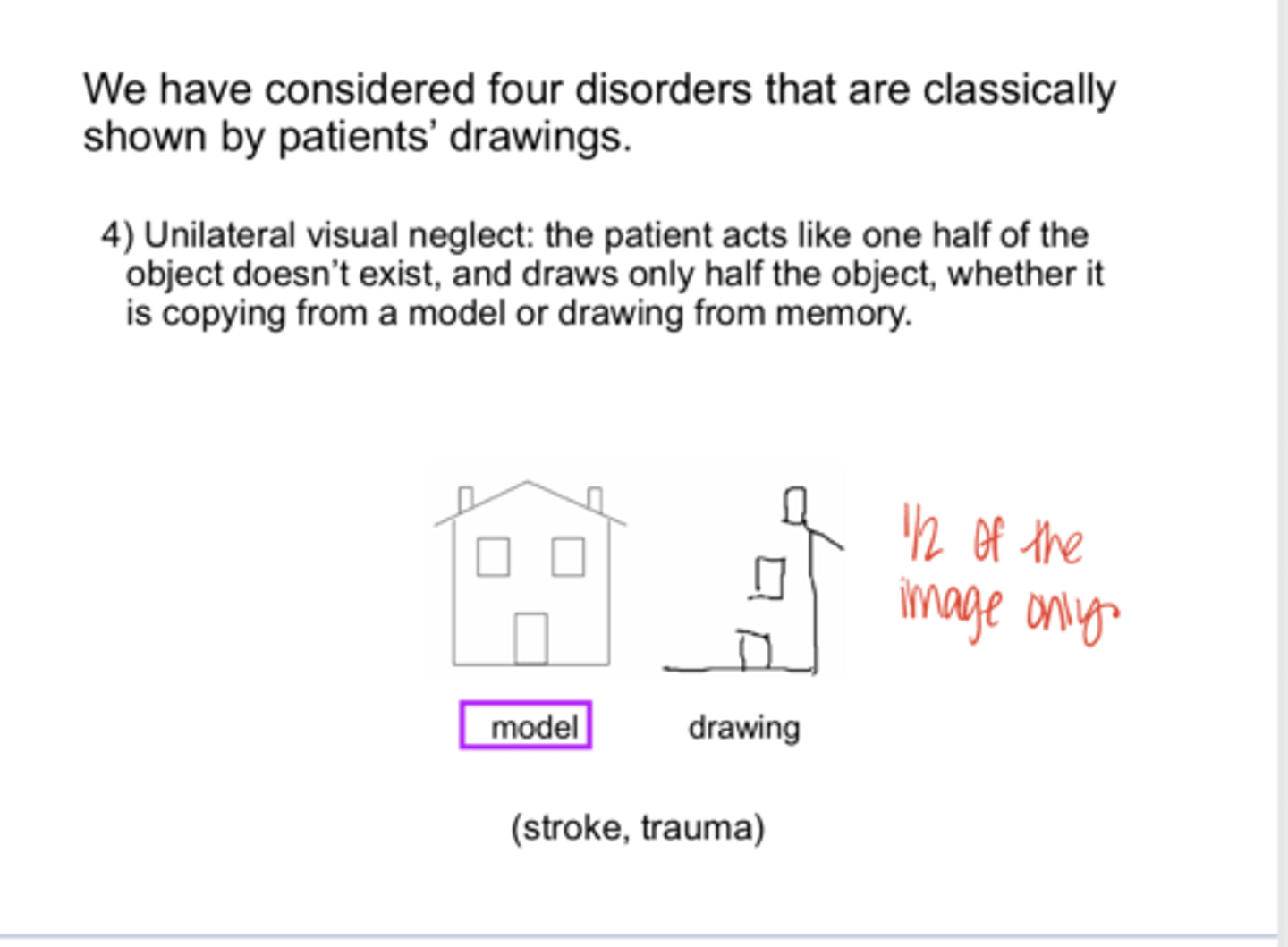
patient does NOT understand items on the neglected side, and DOES NOT interact with them. Patient may not "see" items on one side of visual space. May NOT draw them or read them (words). May not eat food on one side on a plate. May NOT realize that one side of the body exists
What is visual neglect (hemineglect syndrome)?
contralateral
Visual neglect (hemineglect syndrome) effect is (unilateral/contralateral) to the lesion
Lesion on right side of brain; Neglected Left side
What side of the brain is usually lesioned? What side is usually neglected?
Yes?
Can hemifield neglect be partly from a defect in attention?
Most common for lesions of the inferior parietal lobe, parietal/occipital area
Where is the most common lesion that affects an individual with hemifield neglect syndrome?
Yes -- seen in 50% of stroke patients
Is Hemifield neglect syndrome a common stroke, brain injury, and tumor effect?
3
Signs and symptoms of hemifield neglect often diminish after ____ months
Yes -- recovery of an independent life can be very difficult
Is hemifield neglect is chronic, is it disabling?
Neglect Affects Paired or Competing Stimuli -- Copy v Spontaneous Drawing (Pic)
Neglect Affects Paired or Competing Stimuli -- Copy v Spontaneous Drawing (Pic)
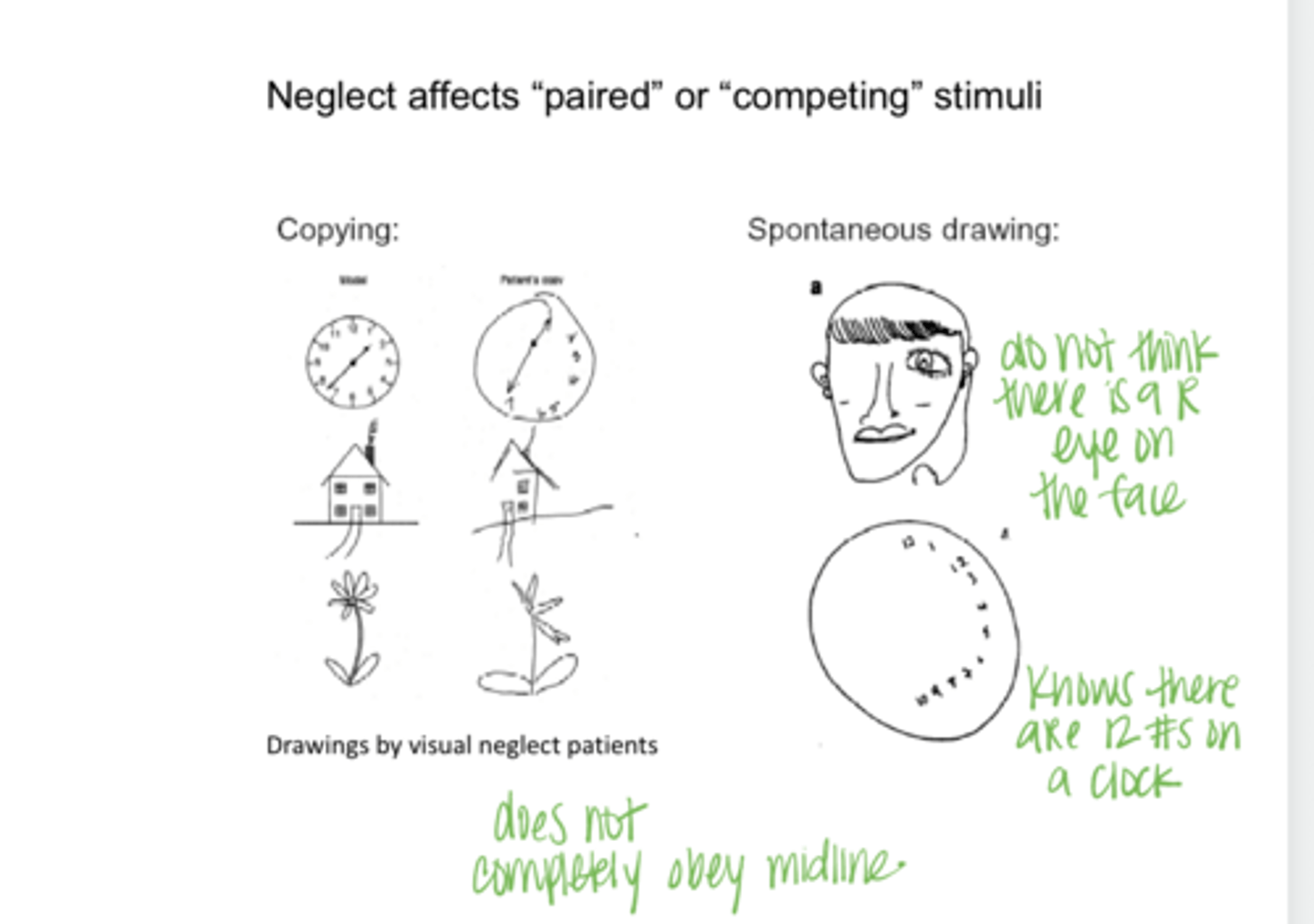
Clock Test w/ Hemifield Neglect Syndrome (Pic)
Clock Test w/ Hemifield Neglect Syndrome (Pic)
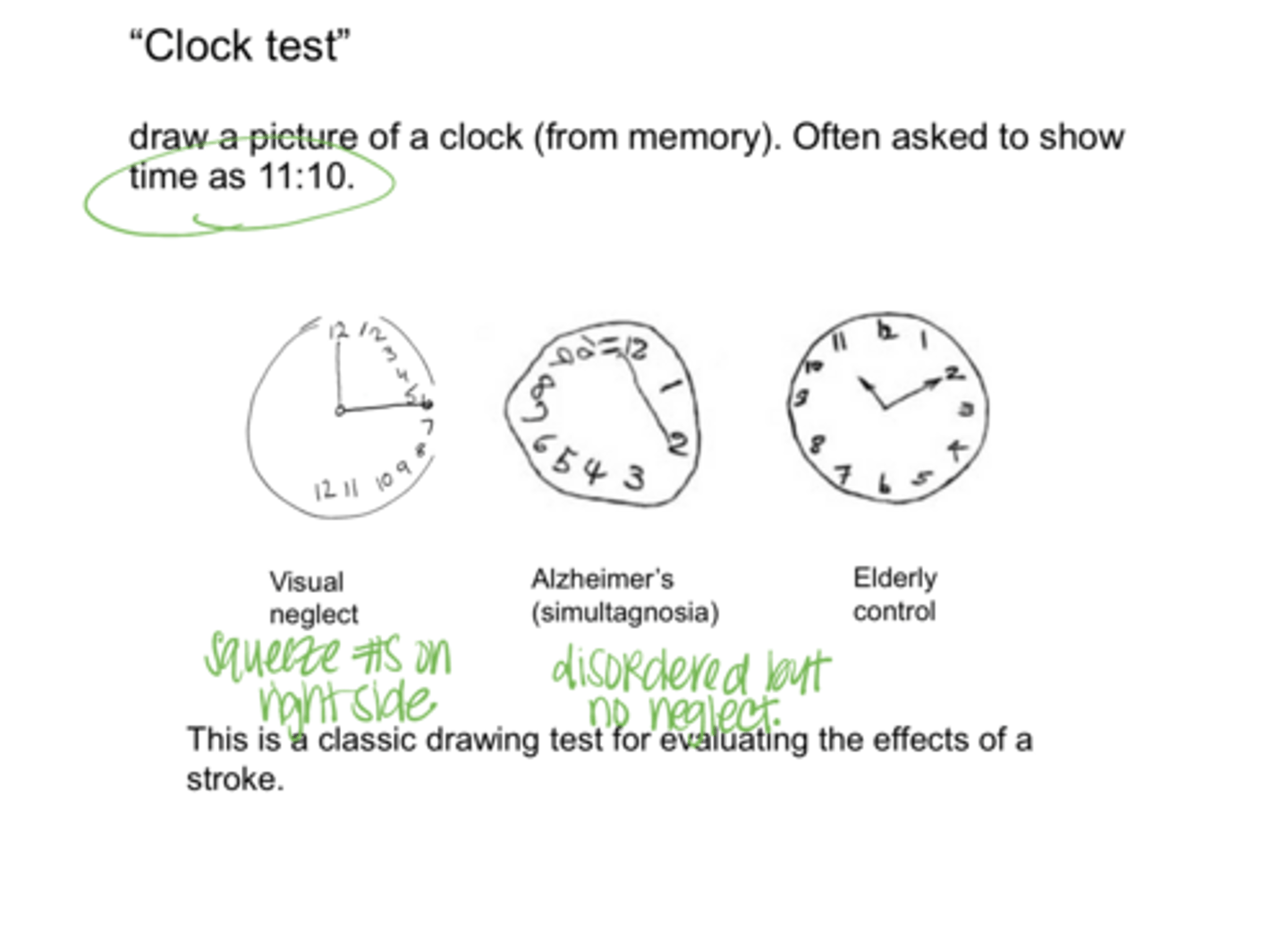
true
True or False:
Neglect affects all aspects of visual function, including eye movements
-apperceptive agnosia
-associative agnosia
-simultagnosia
-unilateral visual neglect
REVIEW: What are the 4 disorders that are classically shown by patient's drawings?
The patient cannot perceive the object. Can draw it from memory but cannot draw it from a model & cannot recognize the object or the drawing
REVIEW: What is apperceptive agnosia?
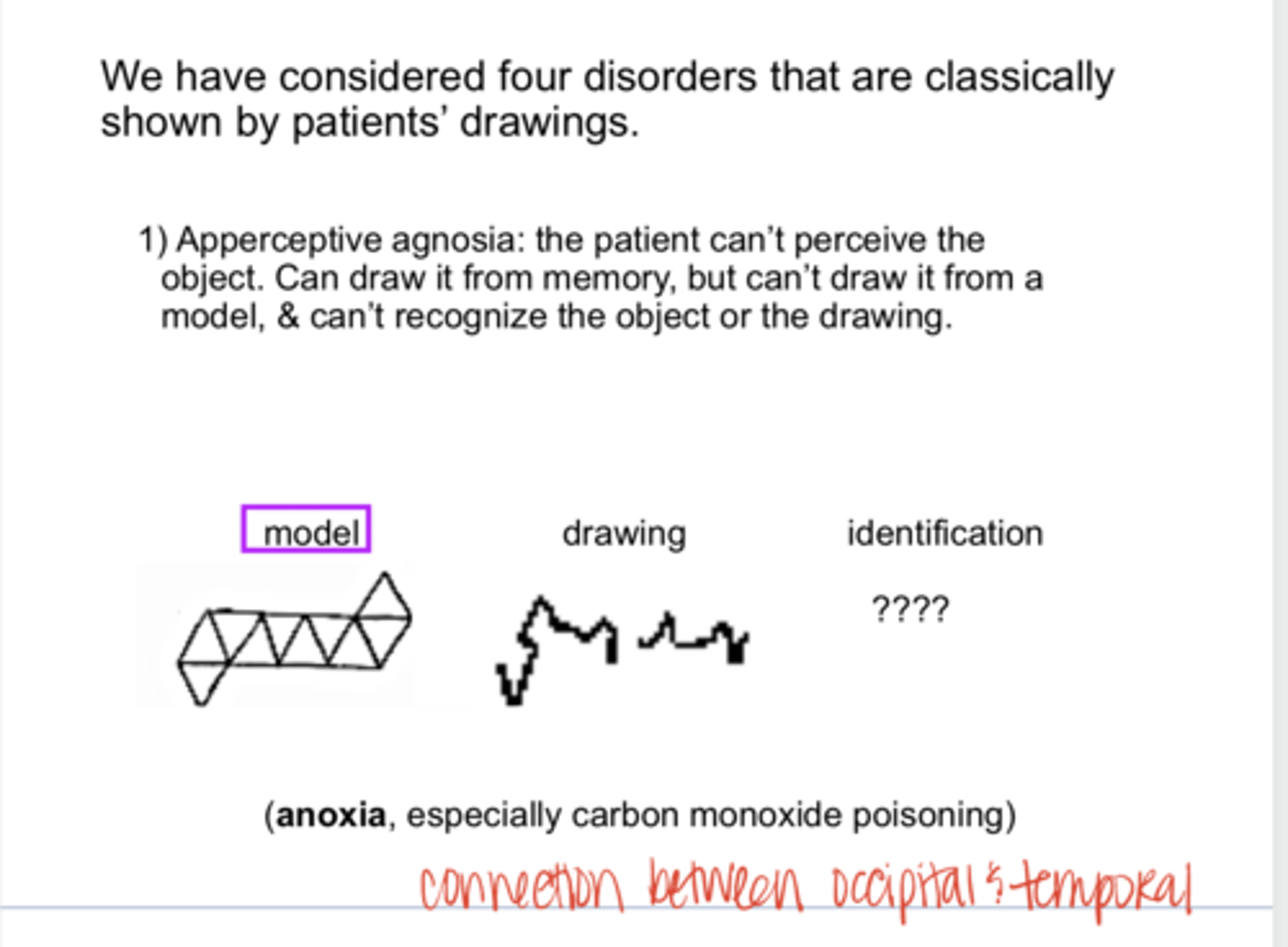
anoxia, ex: carbon monoxide poisoning
REVIEW: Apperceptive agnosia esp from what disorder?
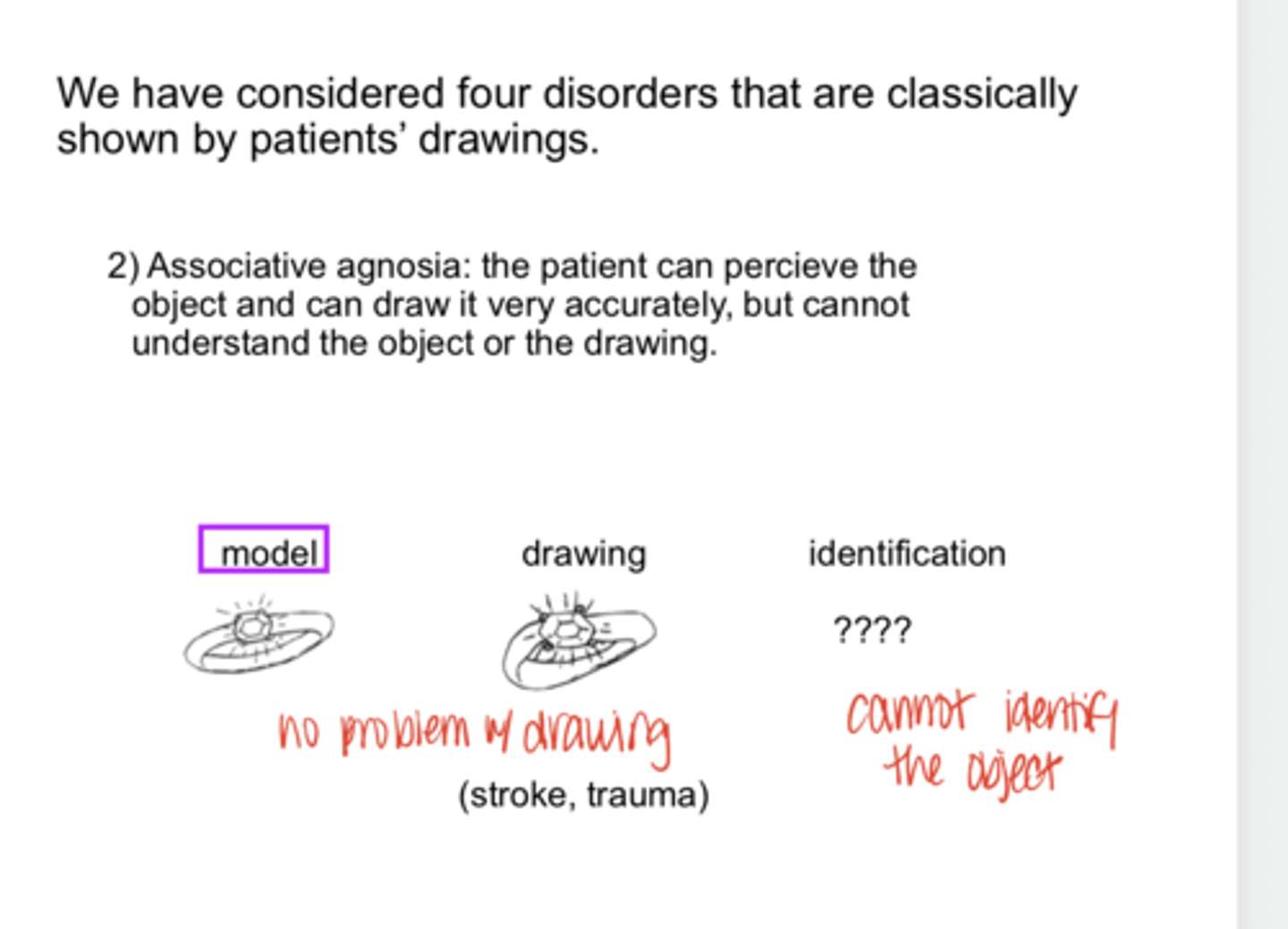
the patient can perceive the object and can draw it very accurately, but cannot understand the object or the drawing
REVIEW: What are associative agnosias?
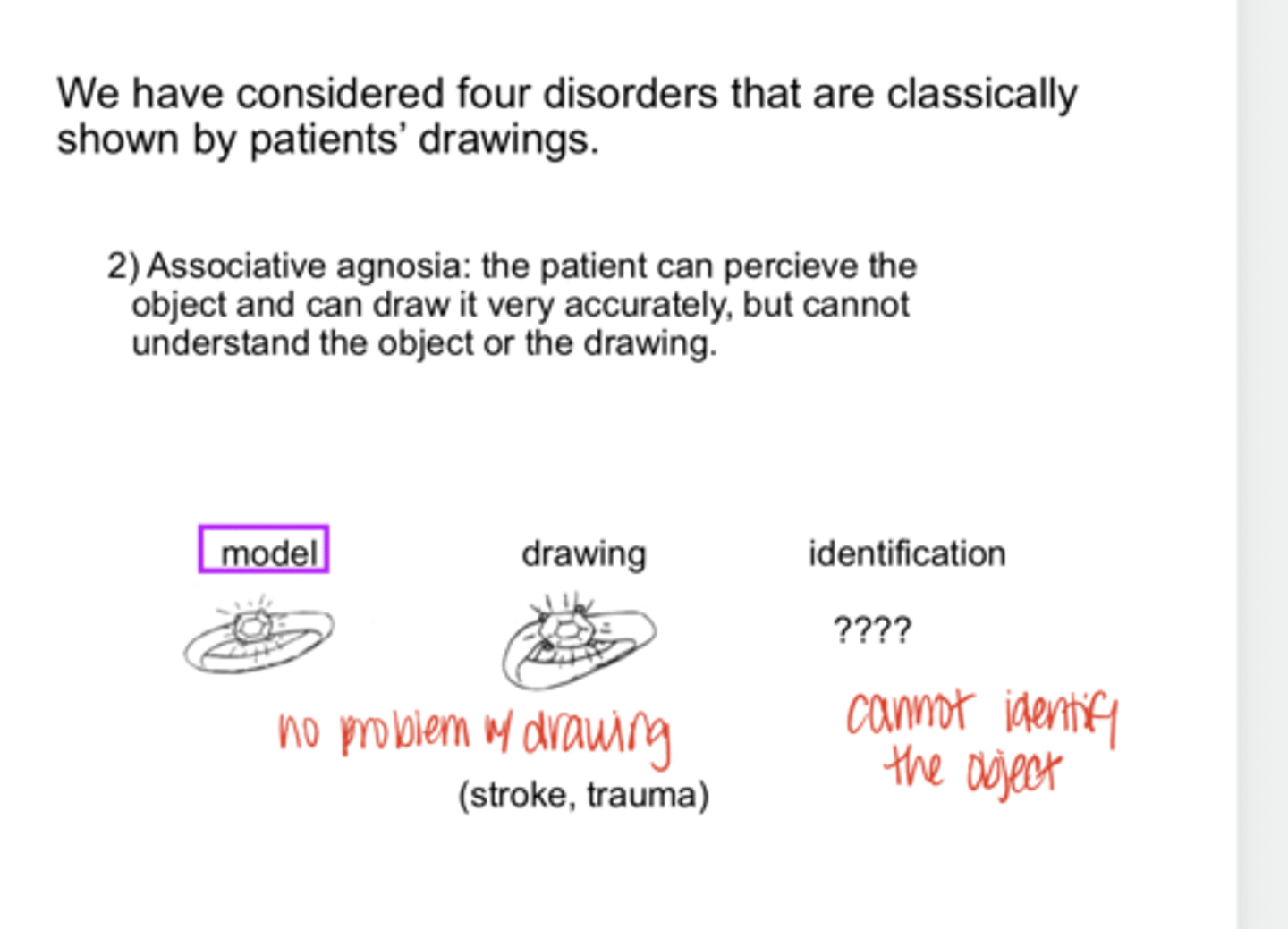
stroke, trauma
REVIEW: Associative agnosias are common with what disorders?
The patient perceives the model part by part, but cannot perceive it as a whole. Drawings show local features of the model, but the overall gestalt of the image is not correct
REVIEW: What is simultagnosia?
The patient acts like one half of the object does NOT exist, and draws only half the object, whether it is copying from a model or drawing from memory
REVIEW: What is unilateral visual neglect?
-apperceptive agnosia
-acquired cortical color vision deficiency
-associative agnosias (object, prosopagnosia, pure alexia)
REVIEW: Consequences of disorders to the ventral stream
-Balint Holmes Syndrome (optic ataxia, gaze paralysis, simultagnosia)
-visual neglect
REVIEW: Consequences of disorders to the dorsal stream
these cells convert light energy into an electrical signal
FINAL SUMMARY:
What is the function of the photoreceptors?
Receive visual information synaptically from photoreceptors and transmit this signal on to retinal ganglion cells
FINAL SUMMARY:
What is the function of bipolar cells?
-output neurons of the retina projecting to various brain centers
-the axons of the ganglion cells form the optic nerve
FINAL SUMMARY:
What is the function of retinal ganglion cells?
Retinal neurons that modulate the transmission between the photoreceptors, bipolar cells, and the ganglion cells
FINAL SUMMARY:
What is the function of the horizontal and amacrine cells of the retina?