CHEMISTRY FULL EXAM REVIEW
 Call Kai
 Learn
Learn Practice Test
 Spaced Repetition
 Match
Match Flashcards
 Knowt Play
1/23

There's no tags or description
Looks like no tags are added yet.
Name | Mastery | Learn | Test | Matching | Spaced | Call with Kai |
|---|
No analytics yet
Send a link to your students to track their progress
24 Terms
Ernest Rutherford- Gold Foil Experiment/Model
Atom is mostly empty space.
Positive charge is concentrated in a small, dense nucleus.
Strong nuclear force holds the nucleus together.
Bohr’s improved model- summary
Electrons move in fixed energy levels (orbits).
Electrons do not lose energy while in an orbit.
Electrons gain/lose energy by jumping between levels.
Quantum Mechanical Model of the Atom
The atom consists of a nucleus having a concentrated positive charge. There
is a very high probability of finding pulsating electron waves in regions of
space around the nucleus called orbitals. These regions are not sharply defined
like the orbits of Bohr's theory, but are somewhat "fuzzy"
Electron Configuration
the distribution of electrons in an atom’s atomic orbitals,arranged in shells and subshells (s,p,d,f) in order INCREASING ENERGY
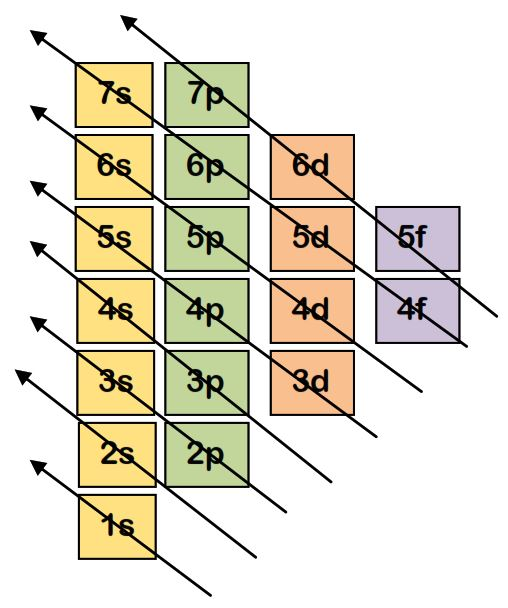
AUFBAU PRINCIPLE
imaginary process of electron addition which ensures that the electrons enter oribtals in the following order
HUND’S RULE
No electron pairing takes place in p,d, or f orbitals until each of the given set contains 1 electron
PAULI EXCLUSION PRINCIPLE
No orbital can contain more than 2 electrons, and must have opposite spin numbers