Male Reproductive System

0.0(0)
Studied by 0 people
call kaiCall Kai
learnLearn
examPractice Test
spaced repetitionSpaced Repetition
heart puzzleMatch
flashcardsFlashcards
GameKnowt Play
Card Sorting

1/40

encourage image

There's no tags or description

Looks like no tags are added yet.

Last updated 6:58 AM on 6/17/26
Name
Mastery
Learn
Test
Matching
Spaced
Call with Kai

No analytics yet

Send a link to your students to track their progress

41 Terms

1
New cards

What are the 2 main roles of the male reproductive system?

  • Produce, maintain, & transport sperm

  • Produce male s3x hormones (androgens - mostly testosterone)

2
New cards

What are the 4 components of the male reproductive system?

  • Testes (gonads)

  • Duct system

  • Accessory glands

  • External genetal!a

3
New cards
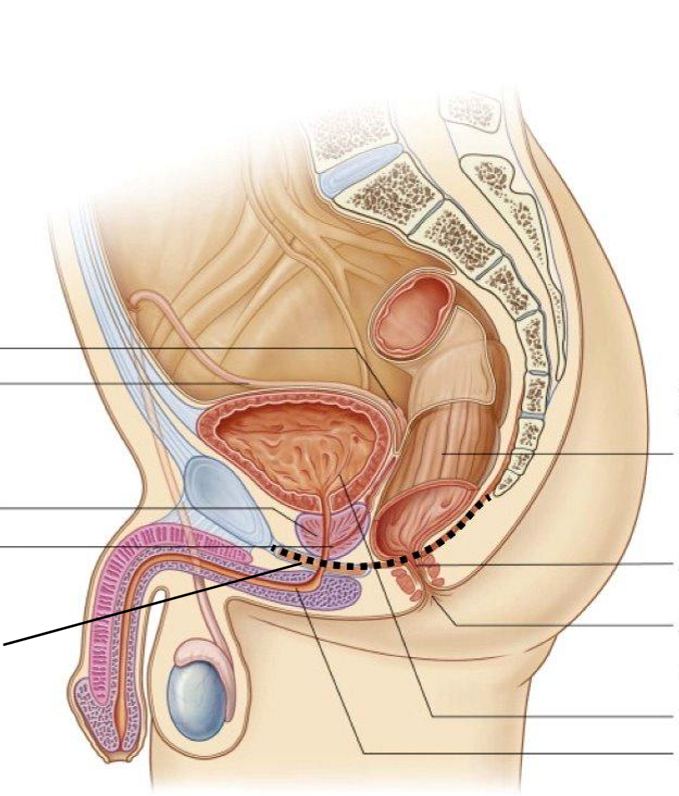
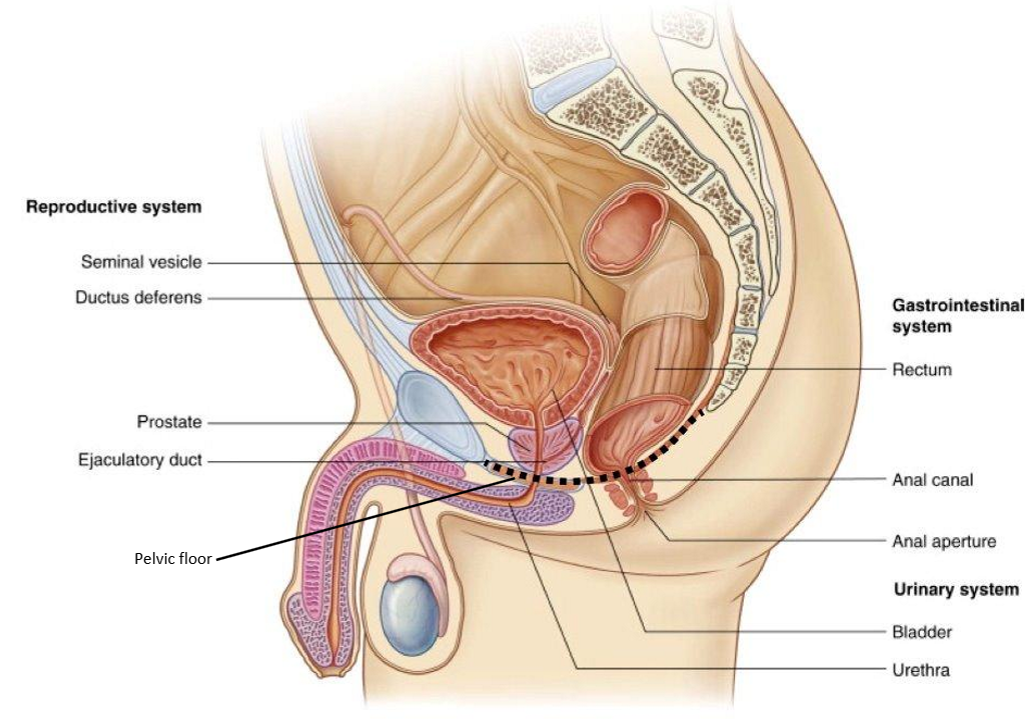
<p>Label the following diagram</p>

Label the following diagram

knowt flashcard image
4
New cards

Where are the testes located, & what is the significance of this location?

  • Testes located in scrotum (external to pelvis)

  • Essential for temperature regulation & spermatogenesis

    • Needs to be 2-4 degrees cooler than core body temp

      • Issue if testes do not descend; can lead to infertility + cancer growth
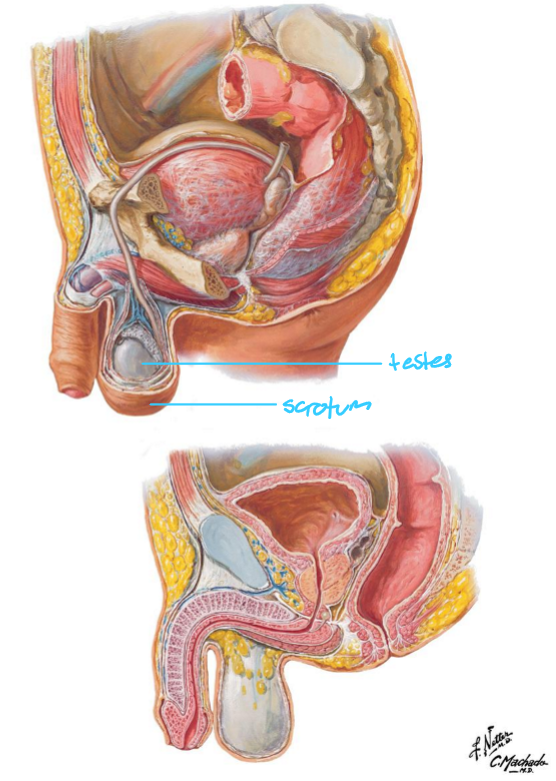
<ul><li><p>Testes located in <strong>scrotum</strong> (external to pelvis)</p></li><li><p>Essential for <strong>temperature regulation</strong> &amp; <strong>spermatogenesis</strong></p><ul><li><p>Needs to be 2-4 degrees cooler than core body temp</p><ul><li><p>Issue if testes do not descend; can lead to infertility + cancer growth</p></li></ul></li></ul></li></ul><p></p>
5
New cards

What is the male reproductive system organised around?

Continuous duct pathway w/n the pelvis & perineum

6
New cards

For the testes, state:

  • Where they are located & why this is significant

  • What they are the site of

  • What they are surrounded by

  • Paired organs located in scrotum, positioned outside essential for sperm production

  • Site of:

    • Spermatogenesis in seminiferous tubules

    • Testosterone production in Leydig cells

  • Surrounded by tunica albuginea (tough fibrous capsule)

    • Maintains testicular structure so that sperm aren’t being squashed - there is a higher risk of damage from being positioned on the outside)

7
New cards

What is the tunica vaginalis?

Peritoneum which has been dragged from the gut, which produces fluid to allow for movement & reduce friction b/w scrotum & testes
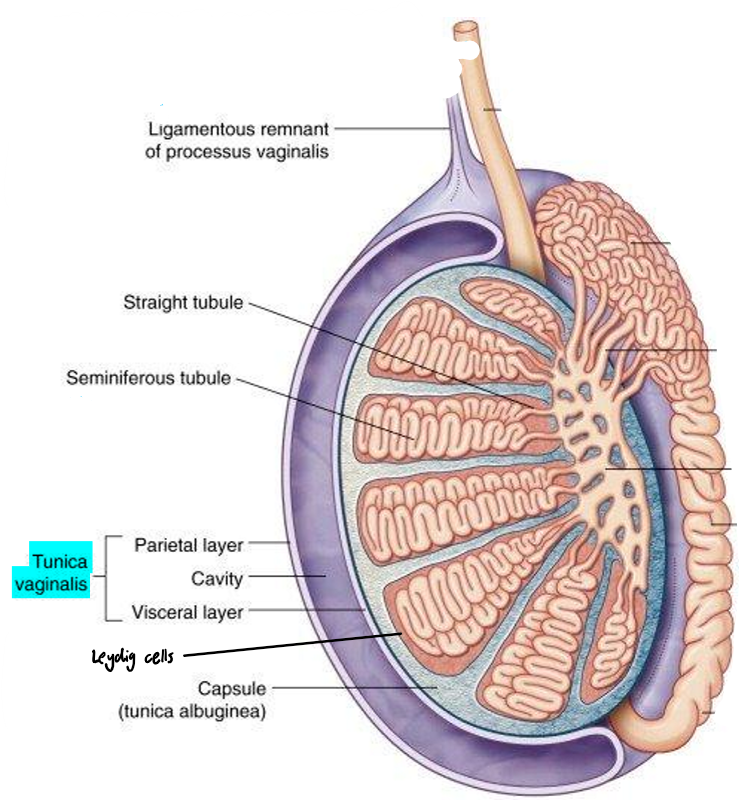
<p>Peritoneum which has been dragged from the gut, which produces fluid to allow for movement &amp; reduce friction b/w scrotum &amp; testes</p>
8
New cards

What is a hydrocele?

A fluid-filled sac around the scrotum which contributes to scrotal swelling & hernias if not completely sealed off from the abdomen

  • Forms if the ligamentous remnant of processus vaginalis is not completed sealed off once a child is born

  • Can lead to hernias or fluid from gut leaking into tunica vaginalis of testis
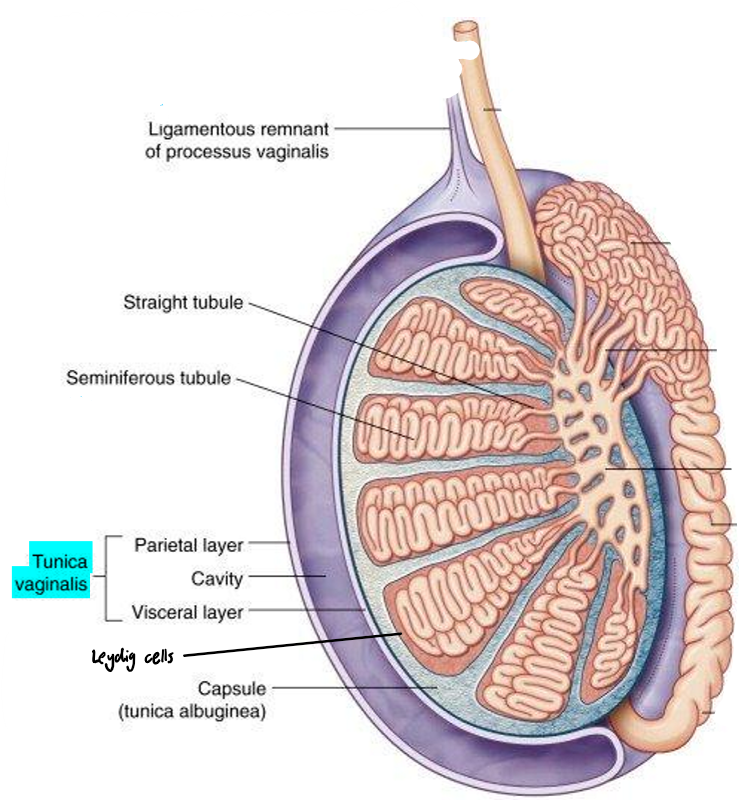
<p>A fluid-filled sac around the scrotum which contributes to scrotal swelling &amp; hernias if not completely sealed off from the abdomen</p><ul><li><p>Forms if the ligamentous remnant of processus vaginalis is not completed sealed off once a child is born</p></li><li><p>Can lead to hernias or fluid from gut leaking into tunica vaginalis of testis</p></li></ul><p></p>
9
New cards
<p>Label the following diagram of the <strong>testes</strong> (ignore the lines on the right side of the diagram)</p>

Label the following diagram of the testes (ignore the lines on the right side of the diagram)
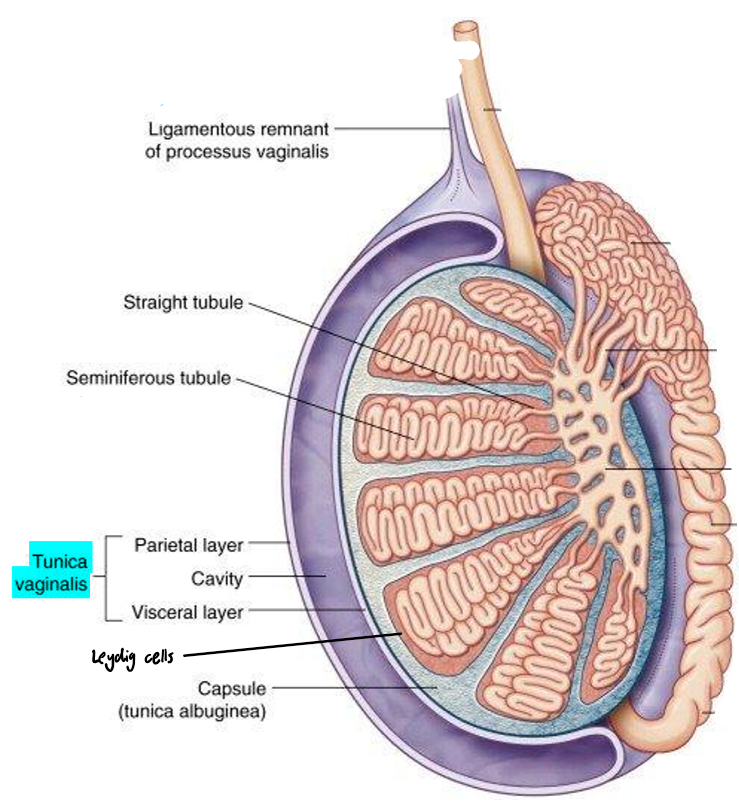
knowt flashcard image
10
New cards

Describe the process of testicular descent

  1. Testicles develop in posterior abdominal wall (posterior to the kidneys)

  2. Testicles descend into scrotum with the epididymis during foetal development

  3. Testes drag the spermatic cords & blood vessels with them as they travel through the inguinal canal & deep ring

11
New cards

What is a retractile teste?

When a teste retracts further upwards into the inguinal canal before descending again

  • Possibility of getting stuck

  • Different to if the teste just never descends

12
New cards

Are the testicles always even after birth? Describe what usually happens, & any clinical implications which may occur if something goes wrong

  • Common for one testicle to be higher than another after birth

  • Teste hasn’t descended after ~1 year → may require surgery

    • Surgery to tighten the deep ring; prevent the teste from retracting

13
New cards

Name the 2 muscles in the scrotum involved in thermoregulation

  • Dartos muscles

  • Cremaster muscles

14
New cards

Describe the dartos muscles, in terms of:

  • Composition

  • Innervation

  • Appearance & the significance of this

  • Smooth muscle

  • Autonomic innervation

    • Cannot be controlled

  • Gives scrotum wrinkled appearance

    • Can get smaller or larger depending on temperature (change surface area to alter rate of heat loss)
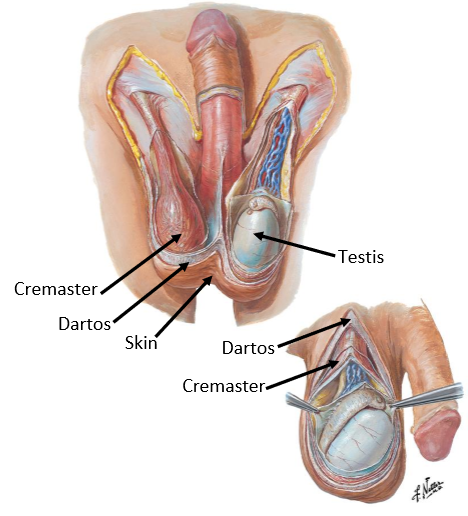
<ul><li><p><strong>Smooth</strong> muscle</p></li><li><p><strong>Autonomic </strong>innervation</p><ul><li><p>Cannot be controlled</p></li></ul></li><li><p>Gives scrotum <strong>wrinkled </strong>appearance</p><ul><li><p>Can get smaller or larger depending on temperature (change surface area to alter rate of heat loss)</p></li></ul></li></ul><p></p>
15
New cards

Describe the cremaster muscles, in terms of:

  • Composition

  • What it is a continuation of

  • What happens when it contracts

  • Skeletal muscle

  • Continuation of internal oblique muscle (abdominal muscle)

  • Contraction → pulls scrotum upwards to elevate the testes

    • Cremaster muscle wrapped all the way around the testes
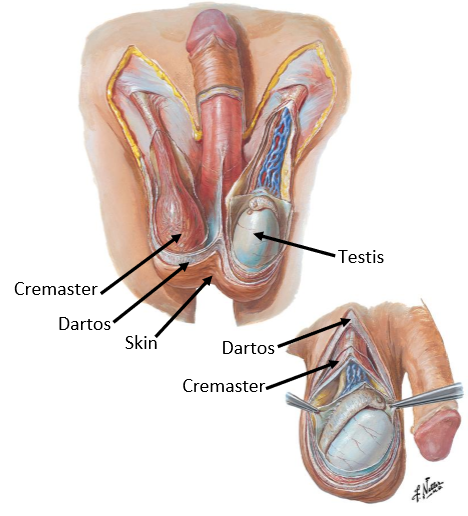
<ul><li><p><strong>Skeletal</strong> muscle</p></li><li><p>Continuation of <strong>internal oblique muscle</strong> (abdominal muscle)</p></li><li><p>Contraction → pulls scrotum upwards to elevate the testes</p><ul><li><p>Cremaster muscle wrapped <strong>all</strong> the way around the testes</p></li></ul></li></ul><p></p>
16
New cards
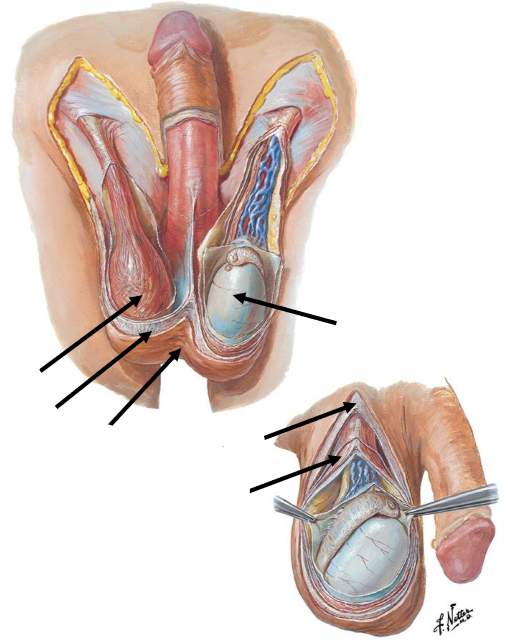
<p>Label the following diagram of the <strong>scrotum</strong></p>

Label the following diagram of the scrotum
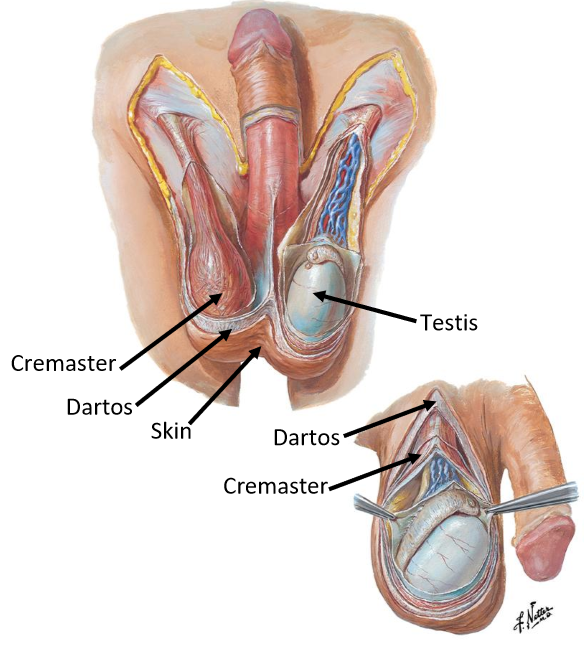
knowt flashcard image
17
New cards

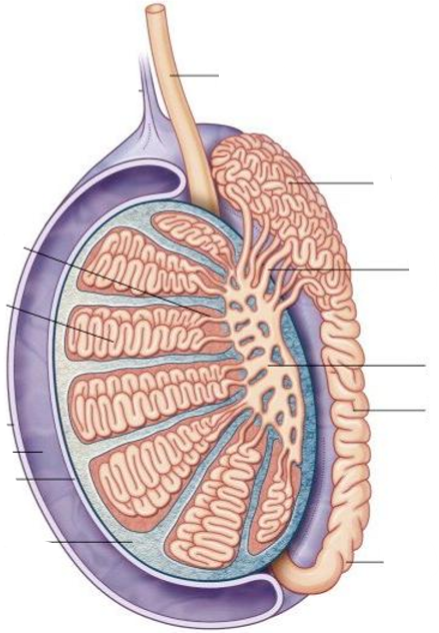
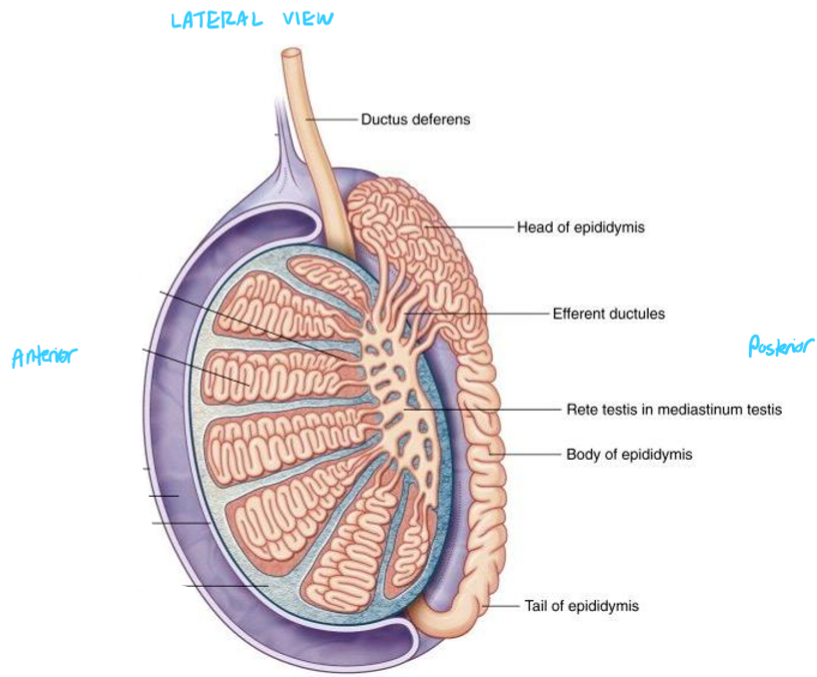
Describe the epididymis in terms of its:

  • Shape & location

  • Functions

  • Divisions

  • C-shaped structure on posterior testis

  • Functions:

    • Sperm maturation

      • Made in testes but matures in epididymis

    • Sperm storage

  • Divisions:

    • Head

    • Body

    • Tail (continuous w/ vas deferens)

    • *Sperm transferred from testes → epididymis via head → body → tail
18
New cards
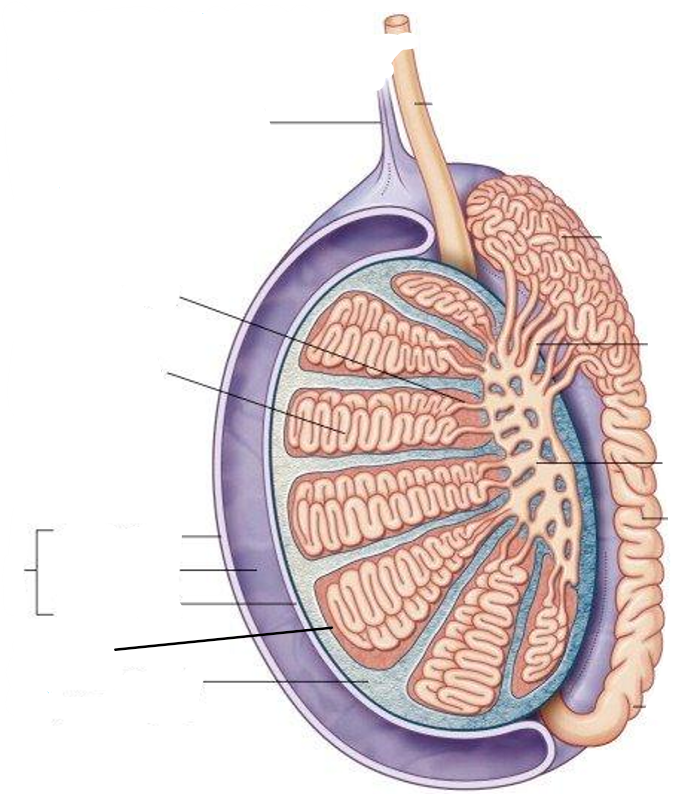
<p>Label the following diagram of the <strong>testis</strong> (ignore the left lines on the diagram)</p>

Label the following diagram of the testis (ignore the left lines on the diagram)
knowt flashcard image
19
New cards

For the vas deferens, state:

  • What it is

  • Where it runs

  • What it joins with & what it forms

  • Function

  • Thick-walled muscular tube transporting sperm

  • Runs from epididymisinguinal canalpelvis

  • Joins duct of seminal vesicleejaculatory duct

  • Function: propels sperm during ejaculation via peristaltic contractions
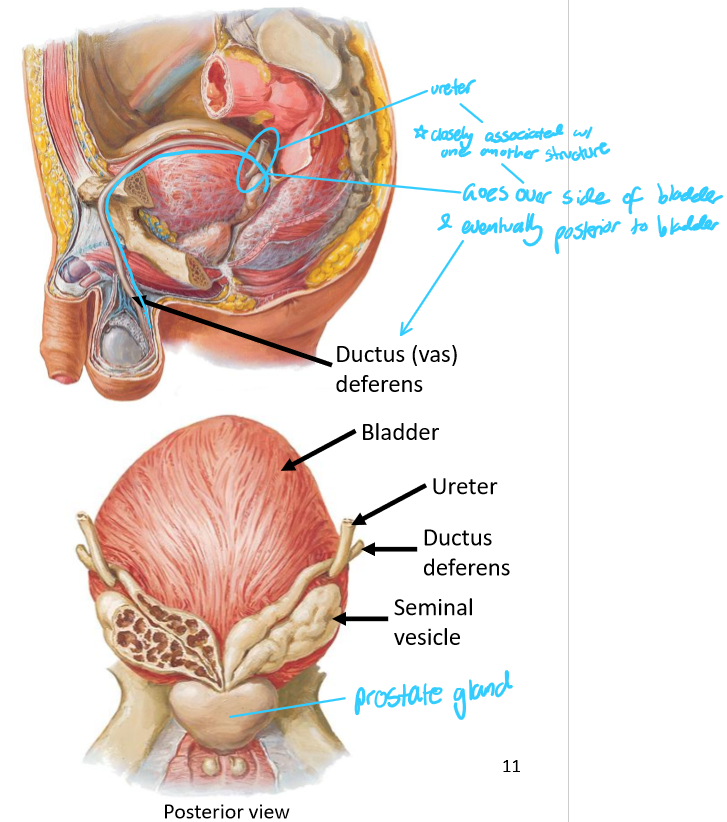
<ul><li><p>Thick-walled muscular tube transporting sperm</p></li><li><p>Runs from <strong>epididymis</strong> → <strong>inguinal canal</strong> → <strong>pelvis</strong></p></li><li><p>Joins duct of <strong>seminal vesicle</strong> → <strong>ejaculatory duct</strong></p></li><li><p><u>Function</u>: propels sperm during ejaculation via peristaltic contractions</p></li></ul><p></p>
20
New cards

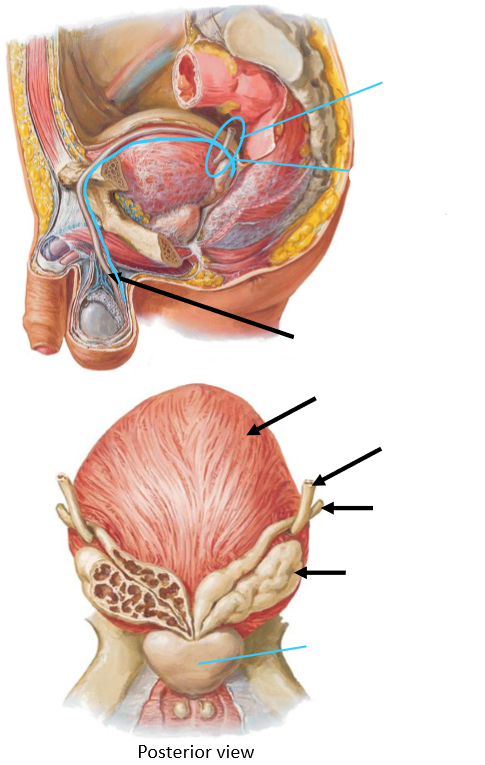
What is a vasectomy?

A contraception method when the tube carrying sperm is cut
21
New cards
<p>Label the following diagram</p>

Label the following diagram

knowt flashcard image
22
New cards

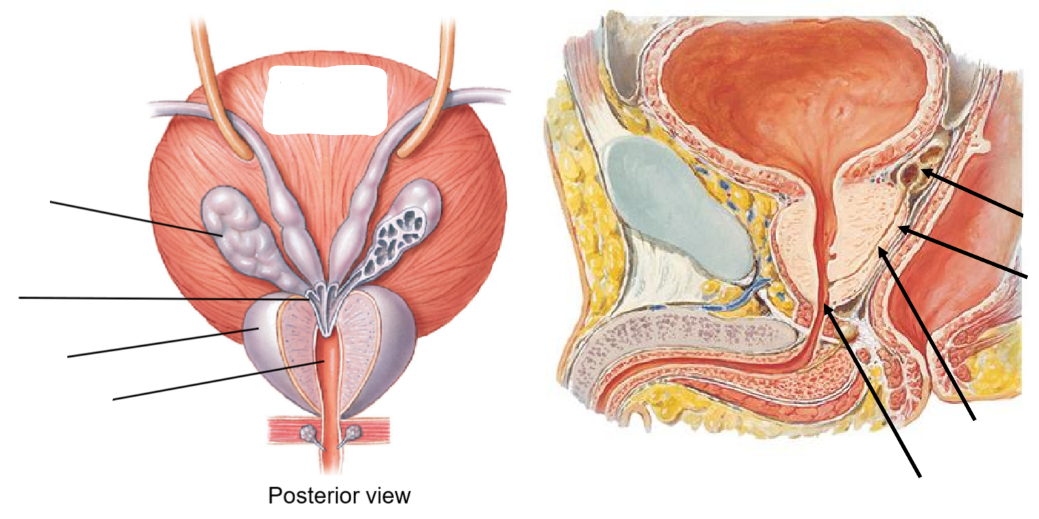
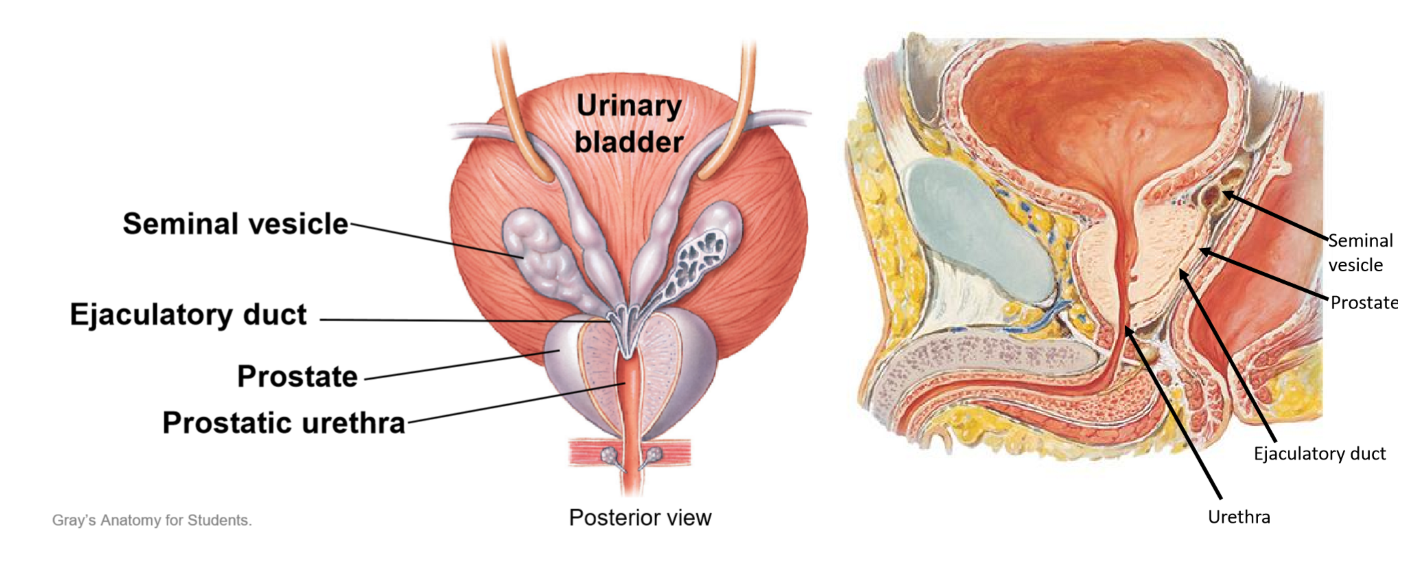
For the seminal vesicles, state:

  • What type of structure they are

  • Where they are located

  • Role

  • What they join with & what they form

  • Paired glands

  • Posterior to bladder & superior to prostate gland

  • Secrete fructose-rich, alkaline fluid → support sperm energy & survival

  • Join w/ vas deferensejaculatory ducts

<ul><li><p>Paired <strong>glands</strong></p></li><li><p><em>Posterior</em> to <strong>bladder</strong> &amp; <em>superior</em> to <strong>prostate gland</strong></p></li><li><p>Secrete fructose-rich, alkaline fluid →<strong> </strong>support sperm<strong> energy</strong> &amp; <strong>survival</strong></p></li><li><p>Join w/ <strong>vas deferens</strong> → <strong>ejaculatory ducts</strong></p></li></ul><p></p>
23
New cards

For the prostate gland, state:

  • Where it is located

  • Its role

  • The names of its 3 zones

  • Inferior to bladder, anterior to rectum, & surrounding the proximal urethra

  • Secretes alkaline fluid → support sperm function & motility + contributes to semen composition

  • Anatomical zones:

    • Peripheral zone

    • Central zone

    • Transitional zone

<ul><li><p><em>Inferior</em> to <strong>bladder</strong>, <em>anterior</em> to <strong>rectum</strong>, &amp; <em>surrounding</em> the <strong>proximal urethra</strong></p></li><li><p>Secretes alkaline fluid<strong> </strong>→ support <strong>sperm function</strong> &amp; <strong>motility</strong> + contributes to semen composition</p></li><li><p><u>Anatomical zones</u>:</p><ul><li><p><strong>Peripheral zone</strong></p></li><li><p><strong>Central zone</strong></p></li><li><p><strong>Transitional zone</strong></p></li></ul></li></ul><p></p>
24
New cards

Describe the 3 zones of the prostate gland & the clinical implications of each of these zones

  • Peripheral zone: site of where most malignant prostate cancers arise

  • Central zone: surrounds ejaculatory ducts & urethra

    • cancerous growth in this area would constrict the urethra

  • Transitional zone: site of BPH

    • Benign prostatic hyperplasia: enlarged prostate but not asymmetrical i.e. not cancerous growth
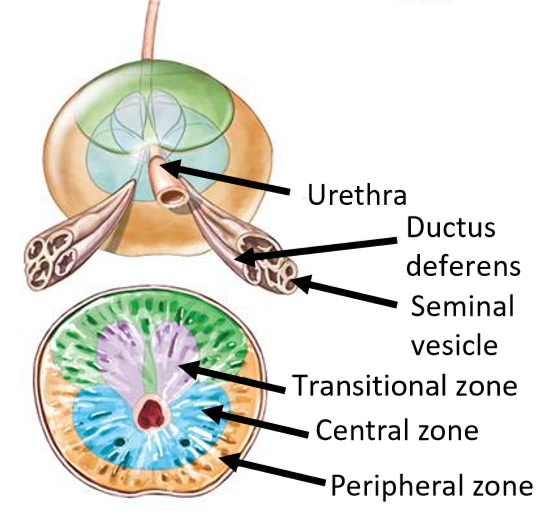
<ul><li><p><strong>Peripheral zone</strong>: site of where most malignant prostate cancers arise</p></li><li><p><strong>Central zone</strong>: surrounds ejaculatory ducts &amp; urethra</p><ul><li><p>cancerous growth in this area would constrict the urethra</p></li></ul></li><li><p><strong>Transitional zone</strong>: site of <em>BPH</em></p><ul><li><p><em>Benign prostatic hyperplasia</em>: enlarged prostate but not asymmetrical i.e. not cancerous growth</p></li></ul></li></ul><p></p>
25
New cards

What causes pain with prostate cancer?

The inability to urinate from a narrowing of the urethra, not from the growth of the cancer itself
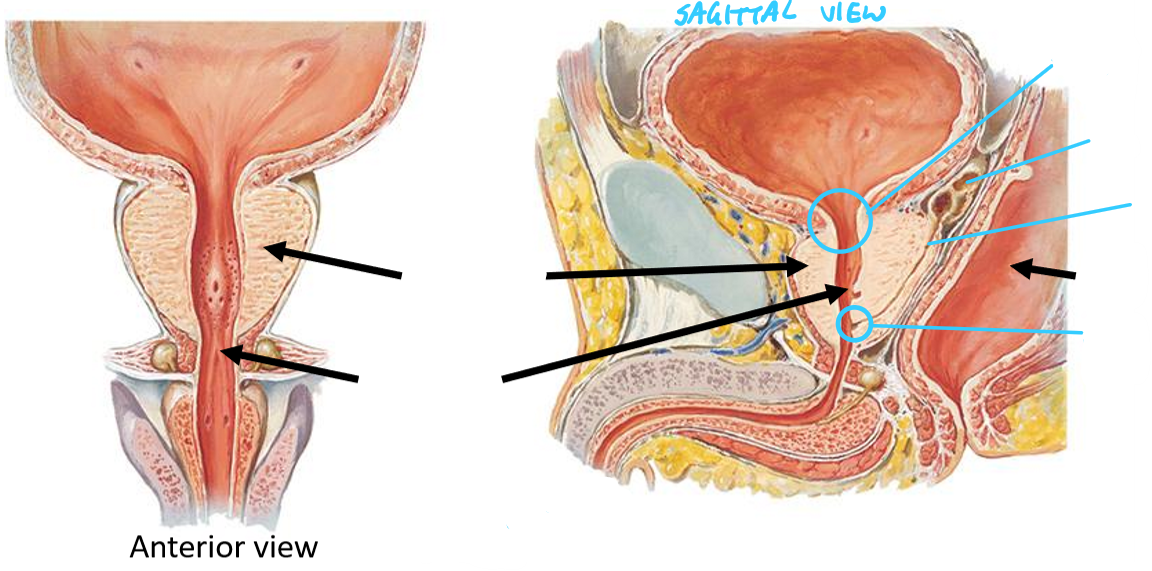
26
New cards
<p>Label the following diagram</p>

Label the following diagram

knowt flashcard image
27
New cards

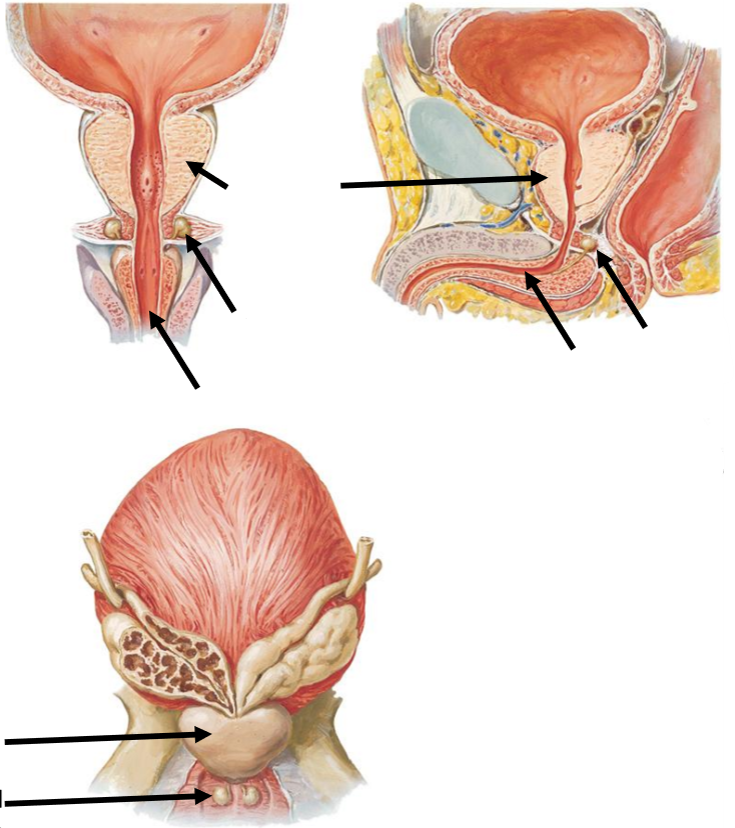
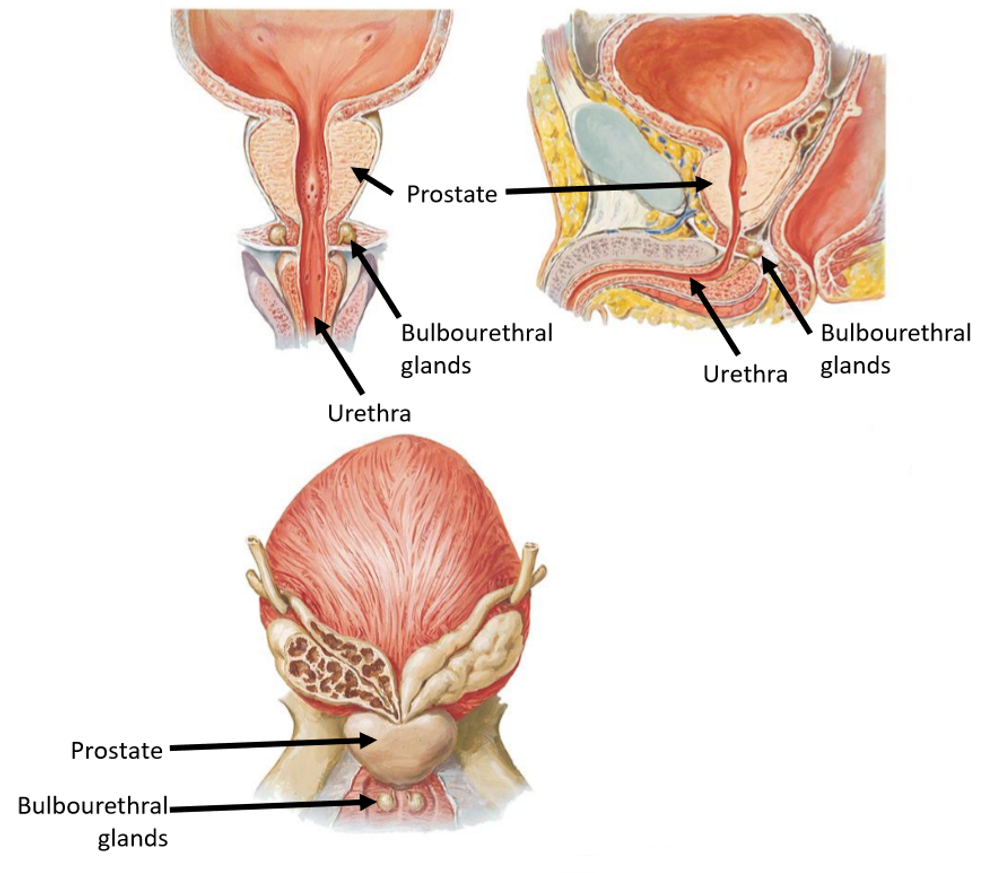
For the bulbourethral glands, state:

  • Where they are located

  • What they open into

  • What they secrete & their role

  • Small paired glands in urogenital region, inferior to the prostate

    • Underneath levator ani i.e, NOT a pelvic structure b/c they are below the pelvic floor

  • Open into proximal spongy urethra

  • Secrete pre-ejaculate mucus lubricate urethra + neutralise residual acidity (from urine)
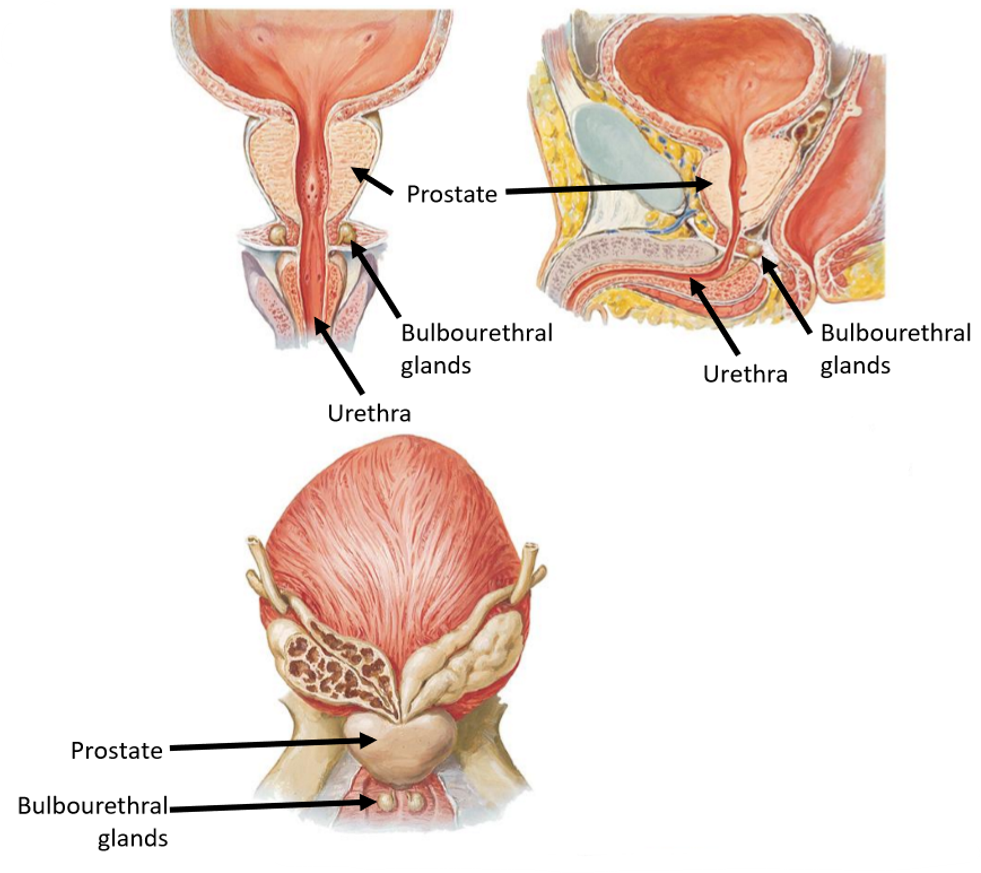
<ul><li><p>Small paired glands in <strong>urogenital region</strong>, <em>inferior</em> to the <strong>prostate</strong></p><ul><li><p><em>Underneath</em> <strong>levator ani</strong> i.e, NOT a pelvic structure b/c they are <em>below</em> the pelvic floor</p></li></ul></li><li><p>Open into <strong>proximal spongy urethra</strong></p></li><li><p>Secrete <strong>pre-ejaculate mucus </strong>→ <strong>lubricate urethra</strong> + <strong>neutralise residual acidity</strong> (from urine)</p></li></ul><p></p>
28
New cards
<p>Label the following diagram</p>

Label the following diagram

knowt flashcard image
29
New cards
<p>Label the following diagram</p>

Label the following diagram

knowt flashcard image
30
New cards

State the ejaculatory pathway

  • Testis → epididymis → vas deferens + joins w/ seminal vesicles → ejaculatory duct → prostate → prostatic urethra

    • Sperm produced in testes

    • Sperm matures in epididymis

    • Sperm transported via vas deferens

    • Sperm mixed w/ glandular secretions

    • Sperm emptied through urethra during ejaculation
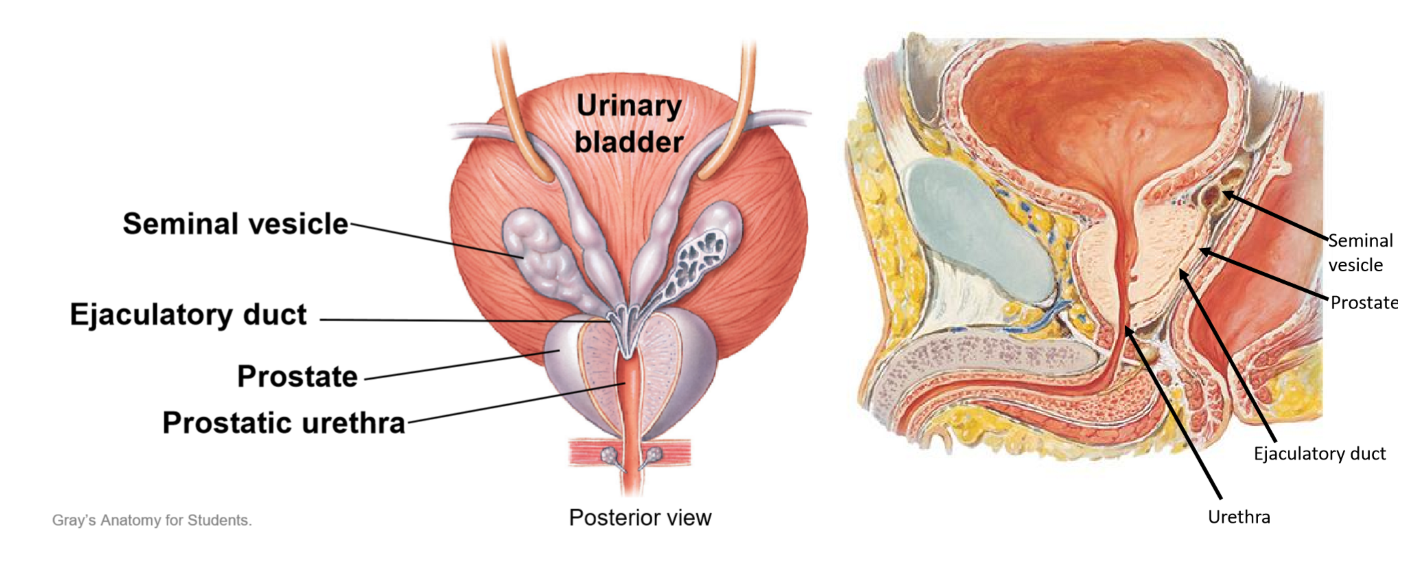
<ul><li><p>Testis → epididymis → vas deferens + joins w/ seminal vesicles → ejaculatory duct → prostate → prostatic urethra</p><ul><li><p>Sperm <em>produced</em> in <strong>testes</strong></p></li><li><p>Sperm <em>matures</em> in <strong>epididymis</strong></p></li><li><p>Sperm <em>transported</em> via <strong>vas deferens</strong></p></li><li><p>Sperm <em>mixed</em> w/ <strong>glandular secretions</strong></p></li><li><p>Sperm <em>emptied</em> through <strong>urethra</strong> during ejaculation</p></li></ul></li></ul><p></p>
31
New cards

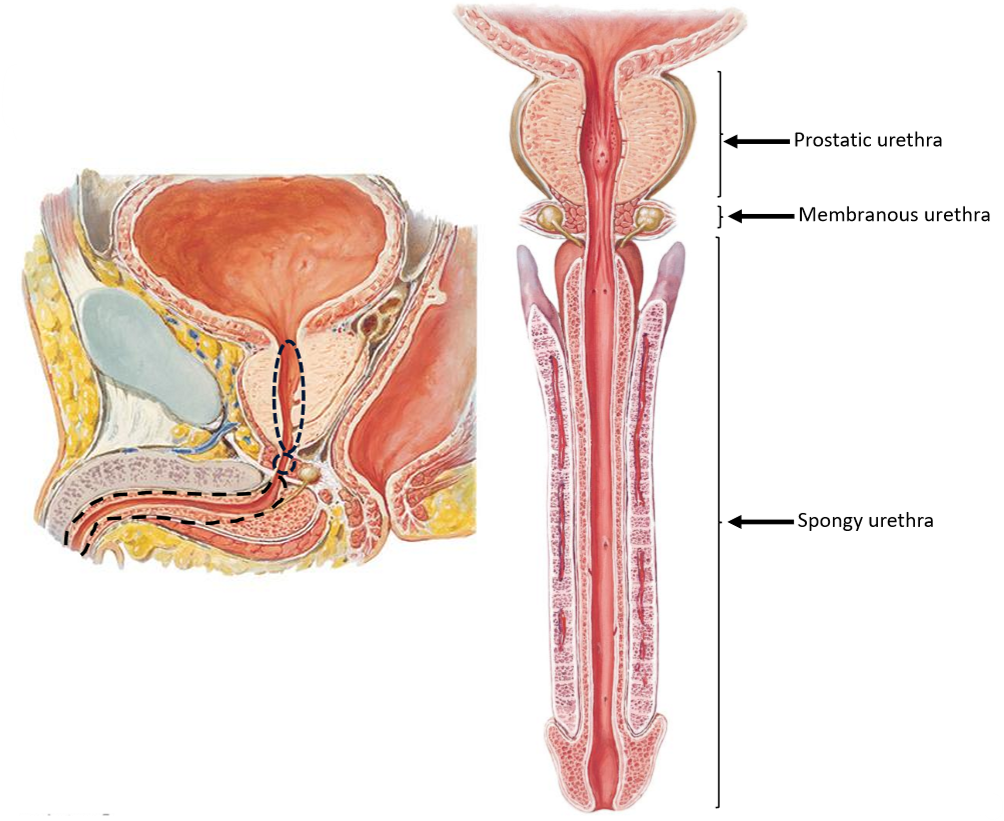
What is the urethra?

Common pathway for urine & semen
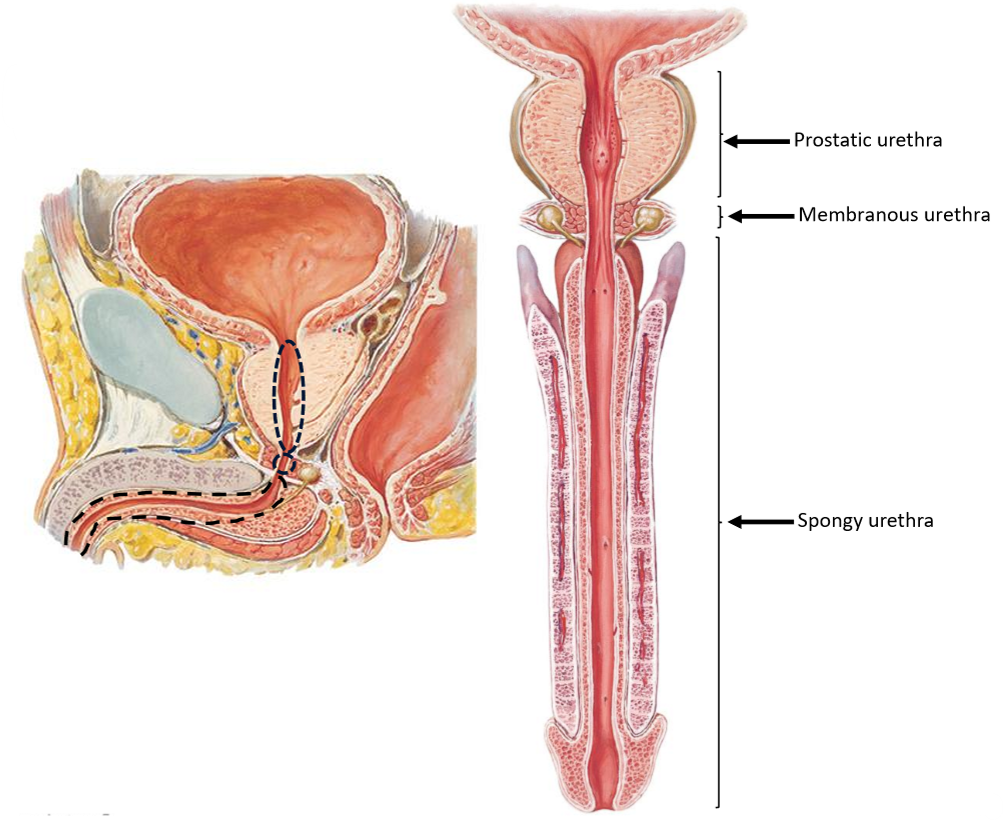
<p>Common pathway for urine &amp; semen</p>
32
New cards

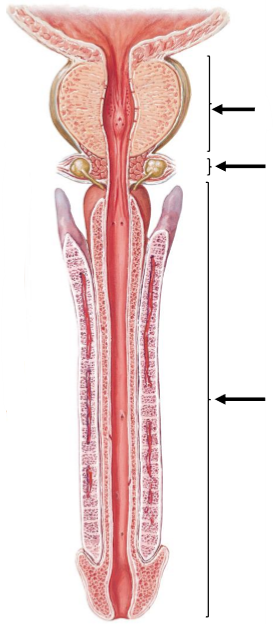
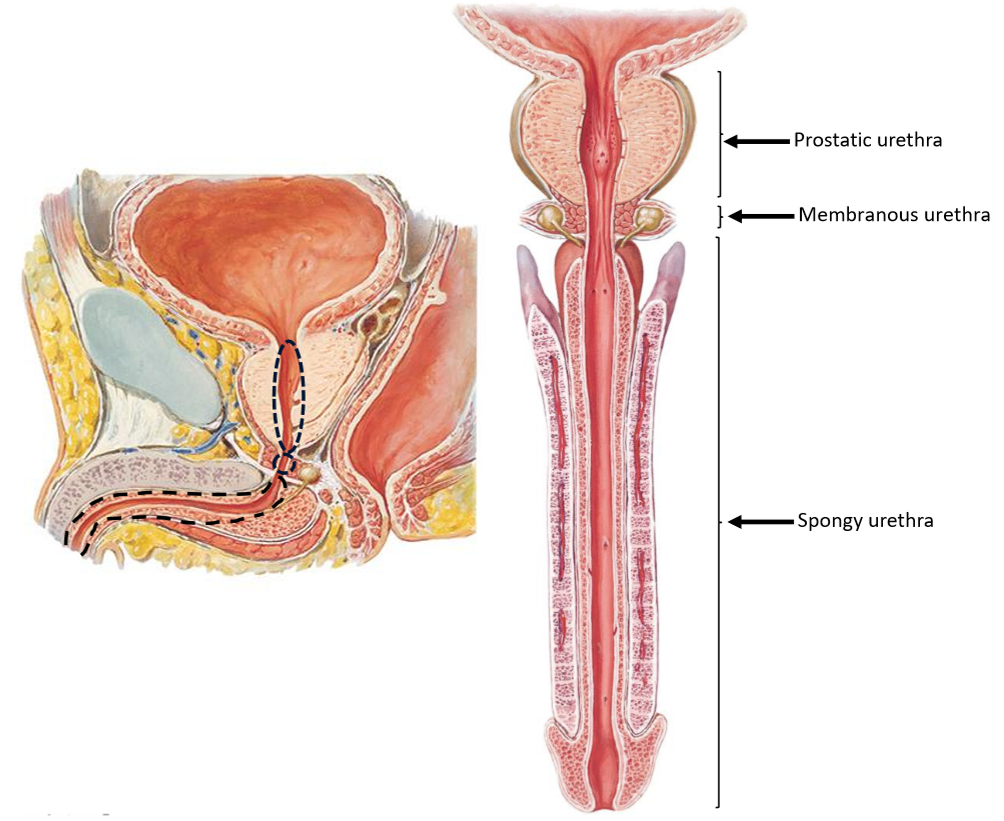
What are the 3 regions of the urethra?

  1. Prostatic urethra

  2. Membranous urethra: underneath the prostate, within perineum (where the bulbourethral glands are located), shortest portion

  3. Spongy urethra: longest portion

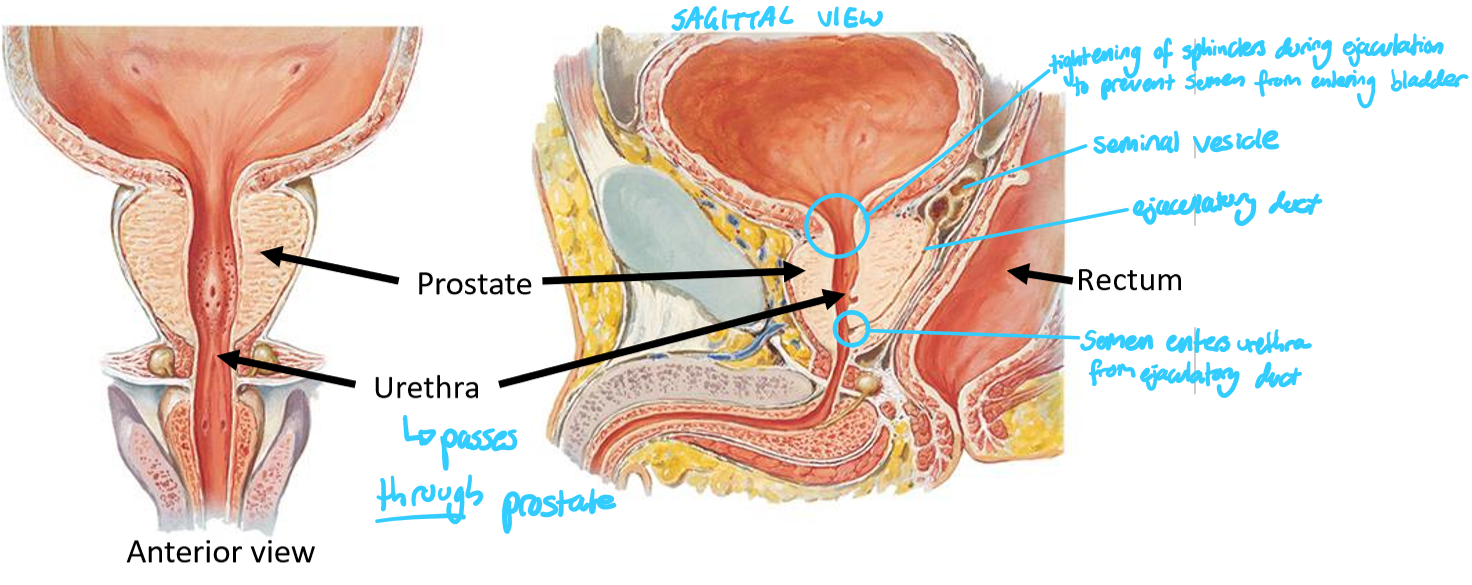
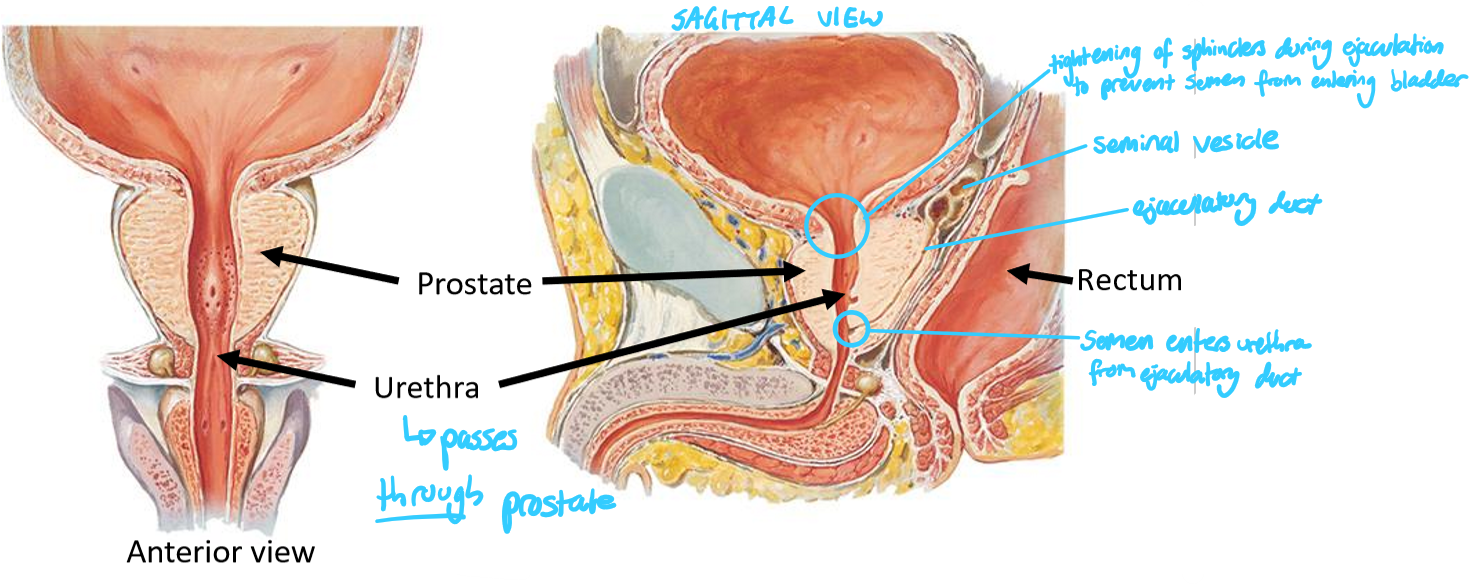
<ol><li><p><strong>Prostatic urethra</strong></p></li><li><p><strong>Membranous urethra</strong>: underneath the prostate, within perineum (where the bulbourethral glands are located), shortest portion</p></li><li><p><strong>Spongy urethra</strong>: longest portion</p></li></ol><p></p>
33
New cards
<p>Label the following diagram</p>

Label the following diagram

knowt flashcard image
34
New cards

What is the urethra supported by?

Urethra passes through perineum, & is supported by the pelvic floor structures during urination & ejaculation

35
New cards

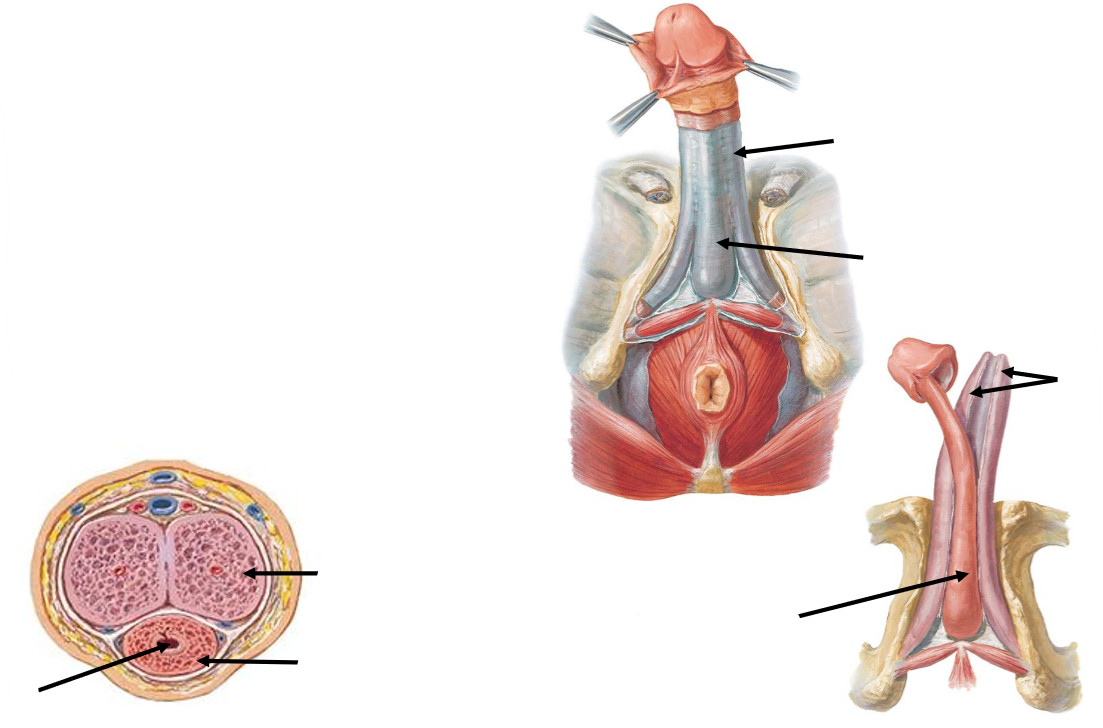
For the peni!s, state:

  • What it is

  • What it is composed of

  • Its function

  • External copulatory organ

  • Composed of erectile tissue (not muscle):

    • Corpus cavernosa: paired, fills with blood during erection

      • Would compress & seal off the urethra if the corpus spongiosum was not there

    • Corpus spongiosum: surrounds the urethra, prevents corpus cavernosa from compressing urethra during erection

      • Keeps urethra open to allow sperm to pass through

  • Functions in urination & sexu@l reproduction
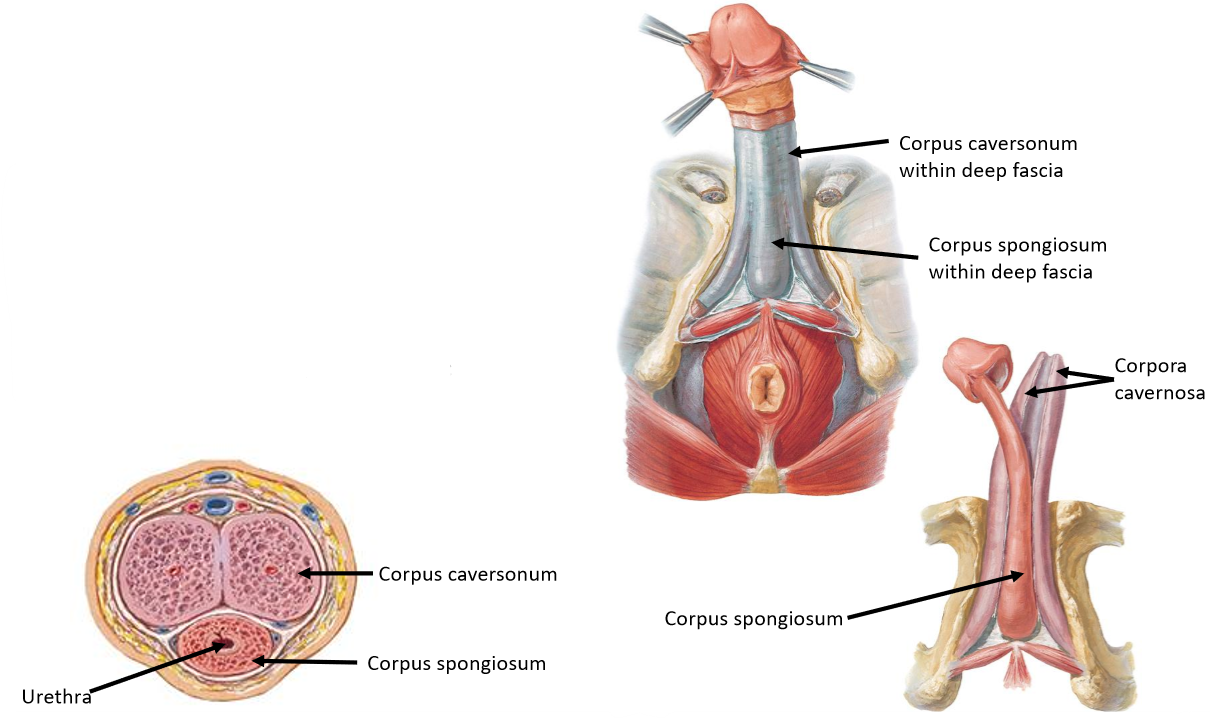
<ul><li><p>External copulatory organ</p></li><li><p>Composed of <strong>erectile<em> tissue </em></strong>(not muscle):</p><ul><li><p><strong>Corpus cavernosa</strong>: paired, fills with blood during erection</p><ul><li><p>Would compress &amp; seal off the urethra if the corpus spongiosum was not there</p></li></ul></li><li><p><strong>Corpus spongiosum</strong>: surrounds the urethra, prevents corpus cavernosa from compressing urethra during erection</p><ul><li><p>Keeps urethra open to allow sperm to pass through</p></li></ul></li></ul></li><li><p>Functions in urination &amp; sexu@l reproduction</p></li></ul><p></p>
36
New cards
<p>Label the following diagram of the <strong>pen!s</strong></p>

Label the following diagram of the pen!s
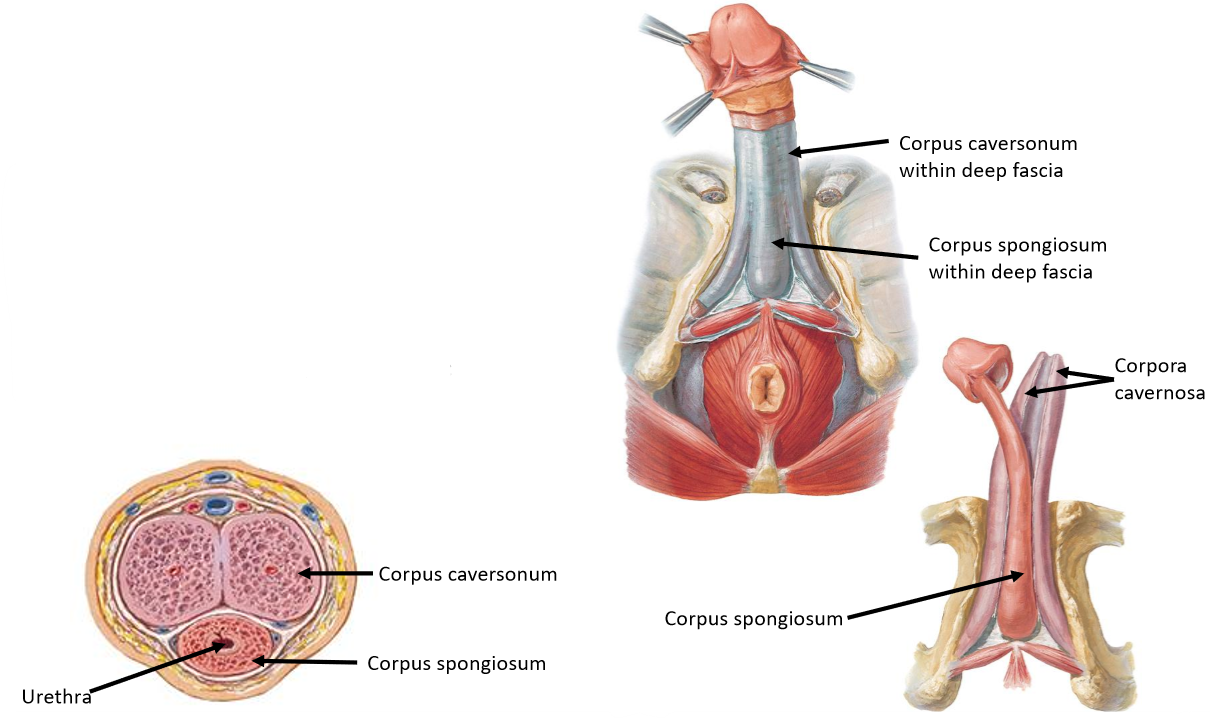
knowt flashcard image
37
New cards

Describe the spatial relationships of the following structures within the pelvis:

  • Bladder

  • Rectum

  • Prostate

  • Seminal vesicles

  • Vas deference

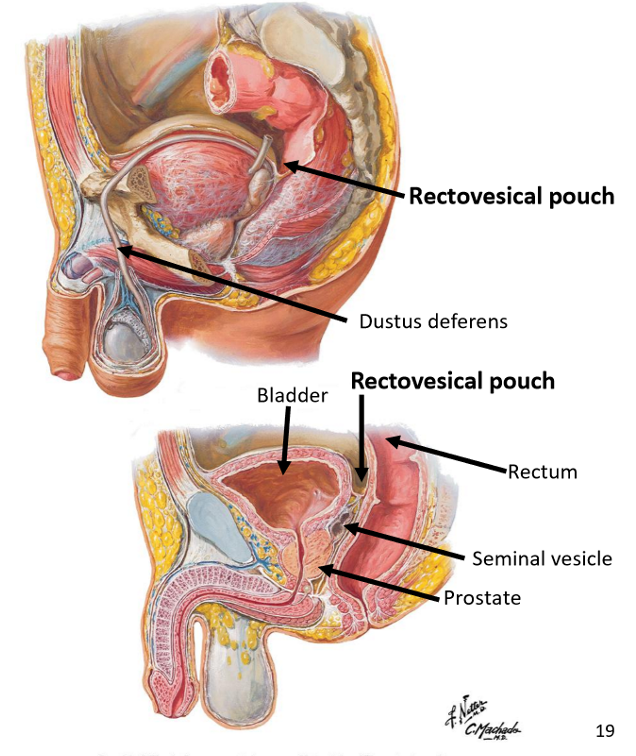
  • Peritoneum

  • Bladder: anterior to r3ctum

  • R3ctum: posterior to pelvic organs

  • Prostate: inferior to bladder + anterior to r3ctum

  • Seminal vesicles: posterior to bladder

  • Vas deferens: ascending from scrotum into pelvis via inguinal canal

  • Peritoneum: reflecting b/w bladder & rectum → rectovesical pouch (unique to males, lowest point where fluid could accumulate e.g. due to burst appendix)
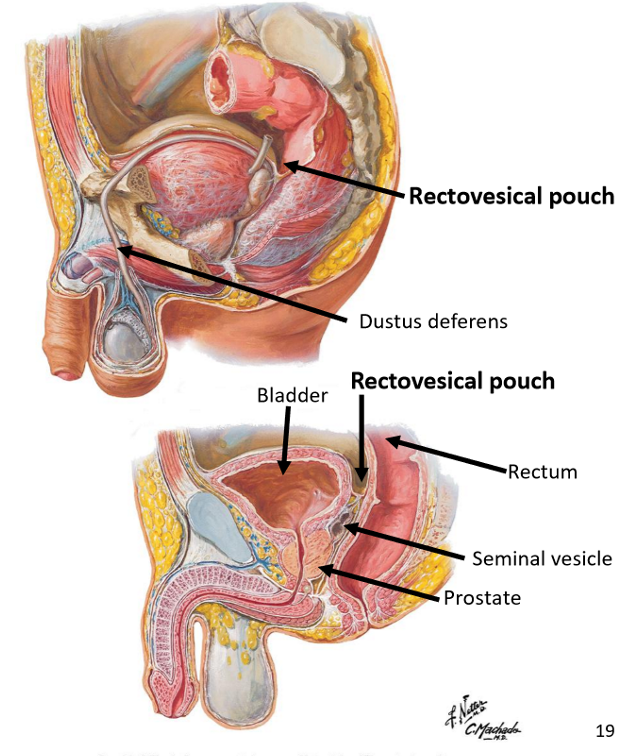
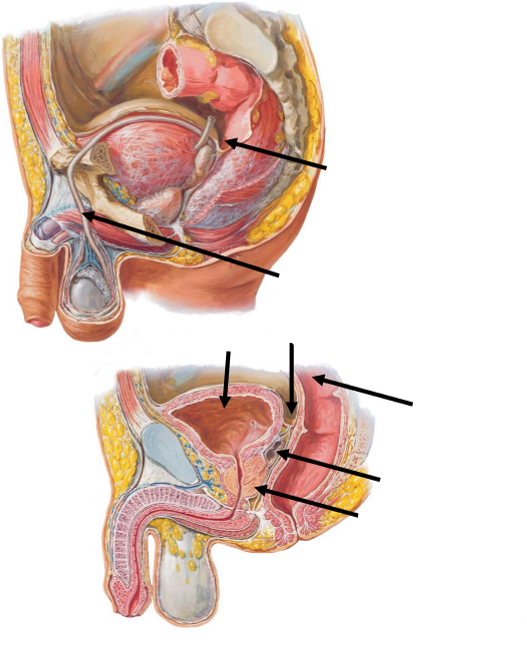
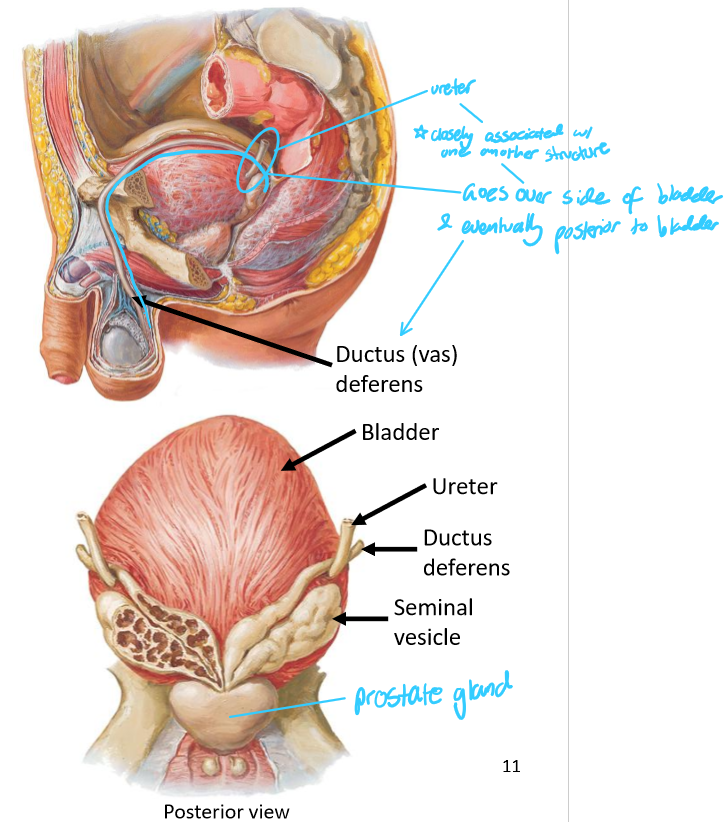
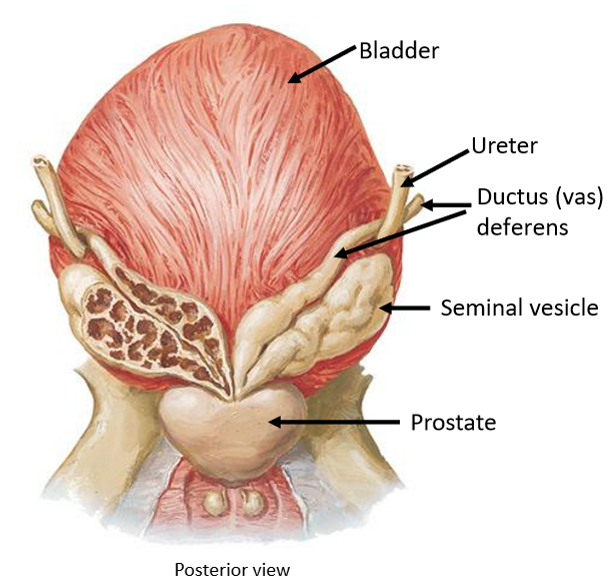
<ul><li><p><strong>Bladder</strong>: anterior to r3ctum</p></li><li><p><strong>R3ctum</strong>: posterior to pelvic organs</p></li><li><p><strong>Prostate</strong>: inferior to bladder + anterior to r3ctum</p></li><li><p><strong>Seminal vesicles</strong>: posterior to bladder</p></li><li><p><strong>Vas deferens</strong>: ascending from scrotum into pelvis via inguinal canal</p></li><li><p><strong>Peritoneum</strong>: reflecting b/w bladder &amp; rectum → <strong>rectovesical pouch </strong>(unique to males, lowest point where fluid could accumulate e.g. due to burst appendix)</p></li></ul><p></p>
38
New cards
<p>Label the following diagram</p>

Label the following diagram

knowt flashcard image
39
New cards
<p>Label the following diagram</p>

Label the following diagram

knowt flashcard image
40
New cards

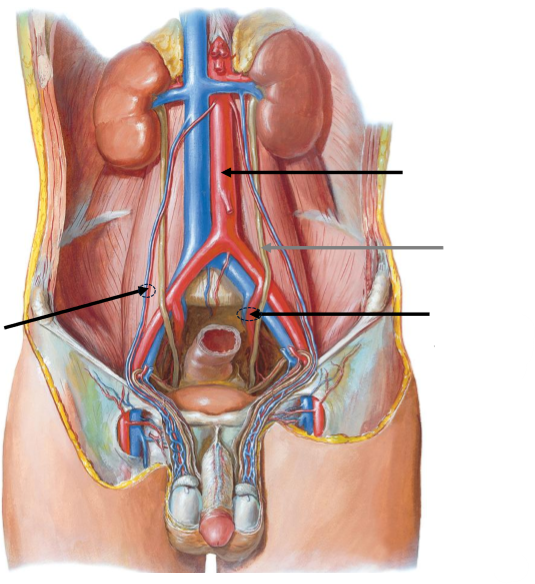
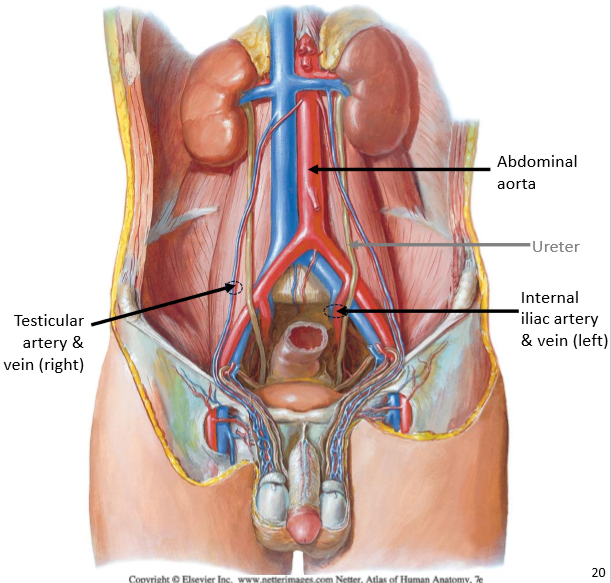
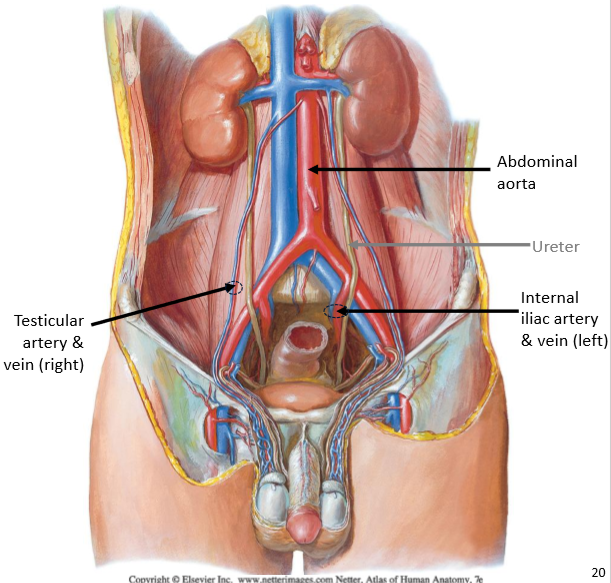
Name the vascular supply of the testes, prostate & pen!s

  • Testes: testicular arteries (branch of gonadal arteries of abdominal aorta)

    • Testicular arteries go out of the inguinal ring through the inguinal canal → testes; testicular torsion cuts off the blood supply of testicular arteries

  • Prostate: branches of internal iliac artery

  • Pen!s: branches of internal pudenal artery
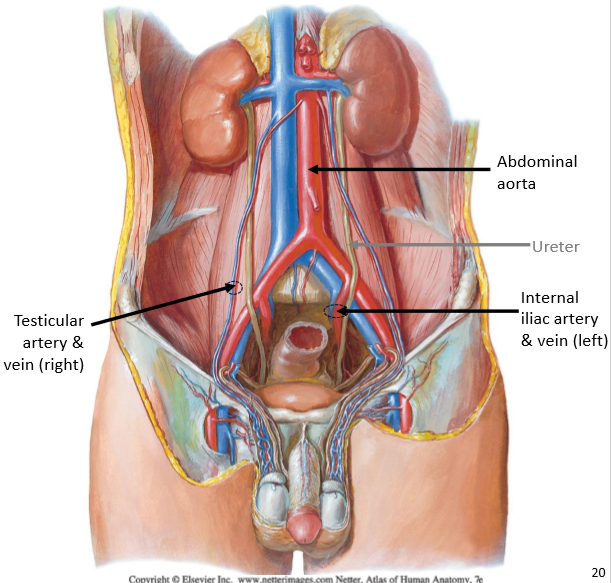
<ul><li><p><strong>Testes</strong>: <em>testicular arteries</em> (branch of <em>gonadal arteries</em> of abdominal aorta)</p><ul><li><p>Testicular arteries go out of the <strong>inguinal ring</strong> through the <strong>inguinal canal</strong> → testes; testicular torsion cuts off the blood supply of testicular arteries</p></li></ul></li><li><p><strong>Prostate</strong>: branches of <em>internal iliac artery</em></p></li><li><p><strong>Pen!s</strong>: branches of <em>internal pudenal artery</em></p></li></ul><p></p>
41
New cards

Describe the venous drainage of the male reproductive system

Generally parallel w/ arterial supply;

  • Right side → IVC

  • Left side → L renal vein

    • L renal vein crosses over abdominal aorta @ T12/L1-2IVC

<p>Generally parallel w/ arterial supply;</p><ul><li><p>Right side → <strong>IVC</strong></p></li><li><p>Left side → <strong>L renal vein</strong></p><ul><li><p>L renal vein crosses over <strong>abdominal aorta</strong> @ <strong>T12</strong>/<strong>L1-2</strong> → <strong>IVC</strong></p></li></ul></li></ul><p></p>