3. Semantic Memory and the Meaning of Words
 Call Kai
 Learn
Learn Practice Test
 Spaced Repetition
 Match
Match Flashcards
 Knowt Play
1/18

There's no tags or description
Looks like no tags are added yet.
Name | Mastery | Learn | Test | Matching | Spaced | Call with Kai |
|---|
No analytics yet
Send a link to your students to track their progress
19 Terms
What are word meanings linked to?
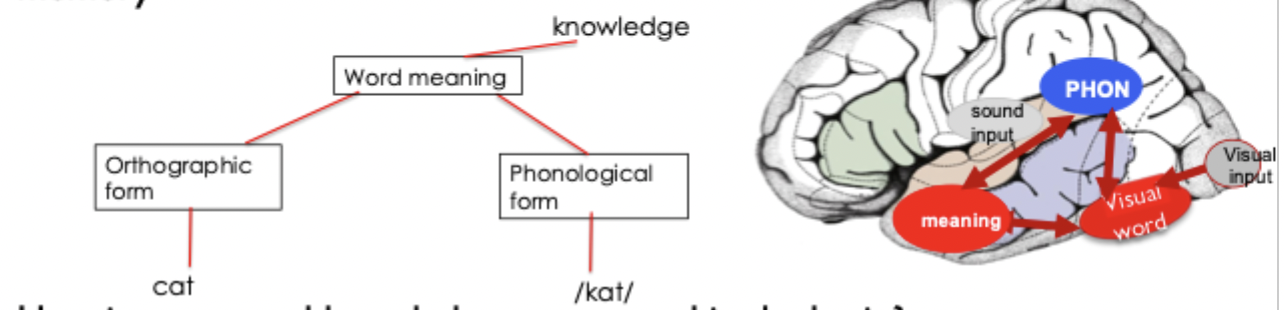
the orthographic form
the phonological form
conceptual and world knowledge
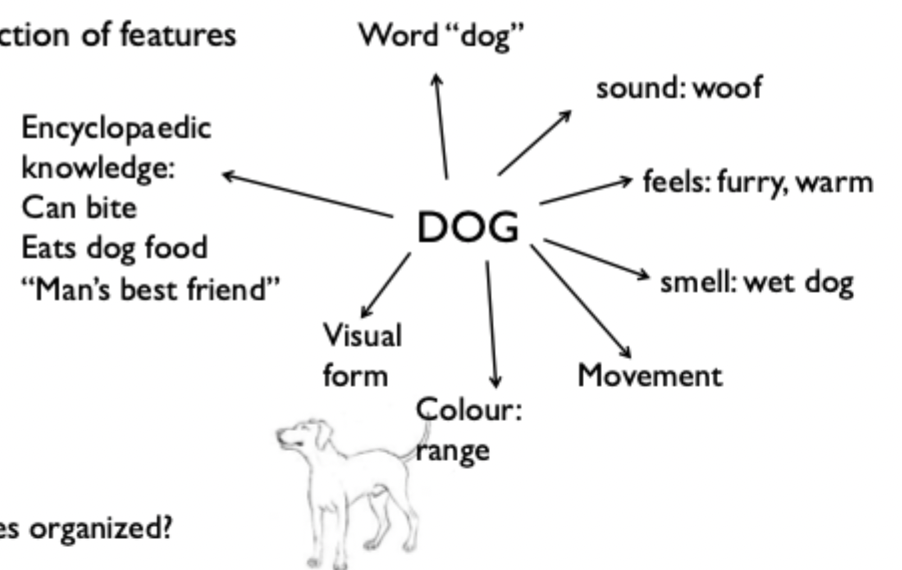
what is a concept?
concepts involve a collection of features
What is involved in hierarchically structured models of conceptual representation? (Collins & Quinlan 1969)
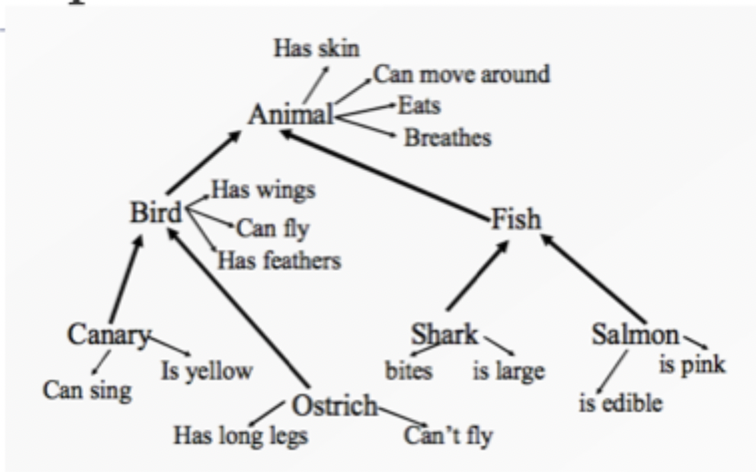
organisation based on basic level categories and superordinate categories. Evidence for this came from category verification tasks:
“A canary is an animal” Vs. “A canary is a bird” (Yes or no?) Reaction times increased as a function of nodes going up in the hierarchy
But this model did not explain why “A penguin is a bird” took longer than other cases.
What is involved in prototype models of conceptual representations?
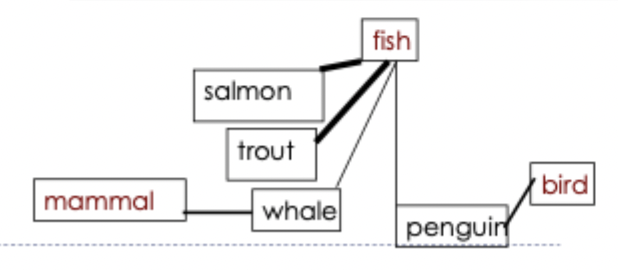
concepts made of frequent/typical features of typical category members
graded internal structure as a function of similarity to prototype
Prototype models explained that because they noted that the similarity to the prototype was an essential aspect in categorising (i.e., determining category membership).
So whales and penguins are not very similar to the prototype of mammals & birds respectively and share features with fish. This makes it more difficult to decide which category they belong to.
What is involved in embodied concepts as a cognitive theory of conceptual representations?
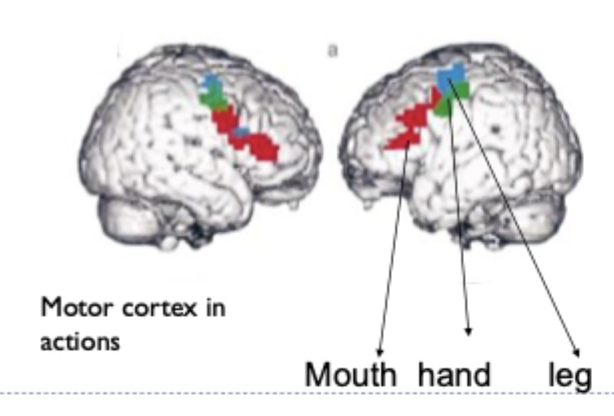
grounding concepts in body actions and perception (sensory-motor features)
JUG → perceptual simulations (shape, size) + actions it affords (drinking, grabbing, pouring); activates planning/ execution structures
Motor cortex is organised somatotopically according to the body part controlled.
Imaging studies indicate that when people observe actions or perform actions, similar brain regions are active as a function of body part involved (e.g., mouth, hand, foot). Language can elicit similar activity, suggesting that motor aspects of actions are activated when processing language and action verbs, in particular.
What was found regarding distribution of meaning?
first observed neural activity of individual moving mouth, hand and foot
then showed related action words: lick, pick, kick
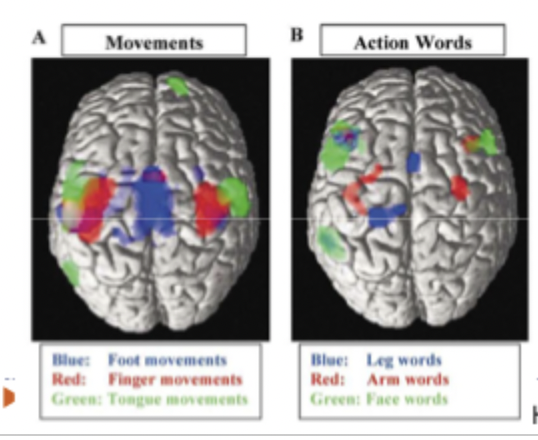
overlapping activation with the movement regions when just words shown
activating motor plans common in experience
What was found when individuals in the scanner are asked to name pictures, view pictures, match pictures and answer questions about objects/animals?
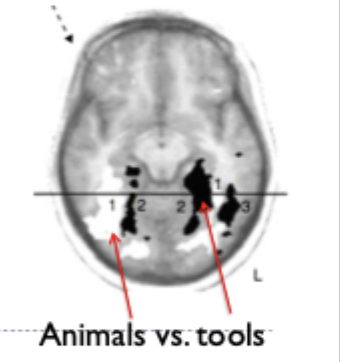
common activations across tasks with same animal and objects
What is involved in distributed models of semantic memory in the brain?
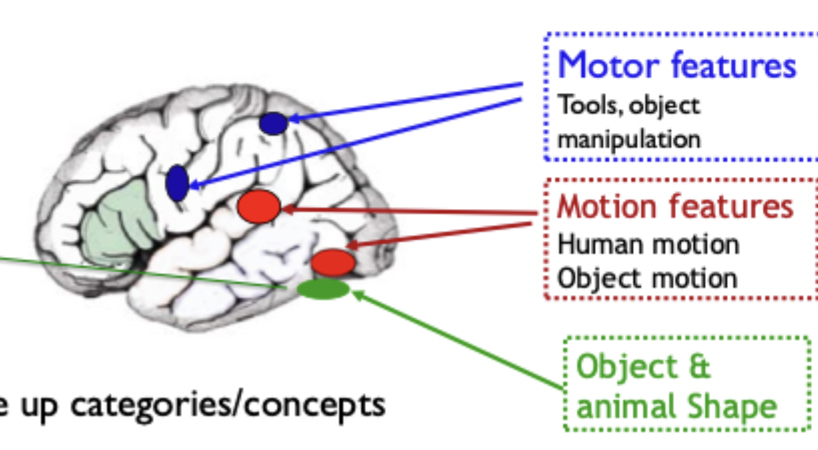
concepts: distributed networks organised around sensory-motor function
networks of features make up categories/concepts
no single meaning centre
What was the double dissociation found with patient JRB and another regarding category specific impairments?
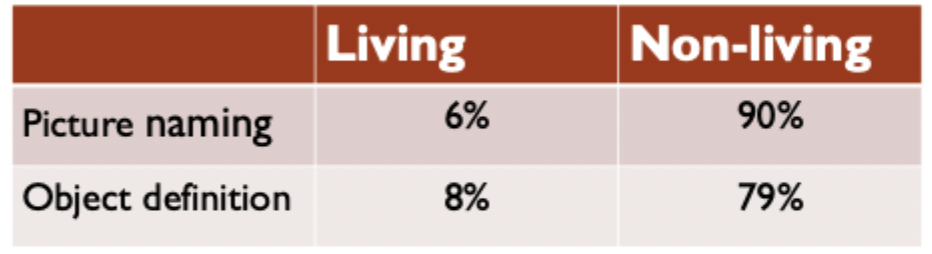
JRB: difficulty understanding and naming some categories
other patients showed the opposite pattern
struggles naming living things but not non-living things
living things tend to be known for their sensory-perceptual properties (e.g., shape)
non-living things tend to have more functional properties (actions and uses)
How can patient JRB’s type of impairment be explained?
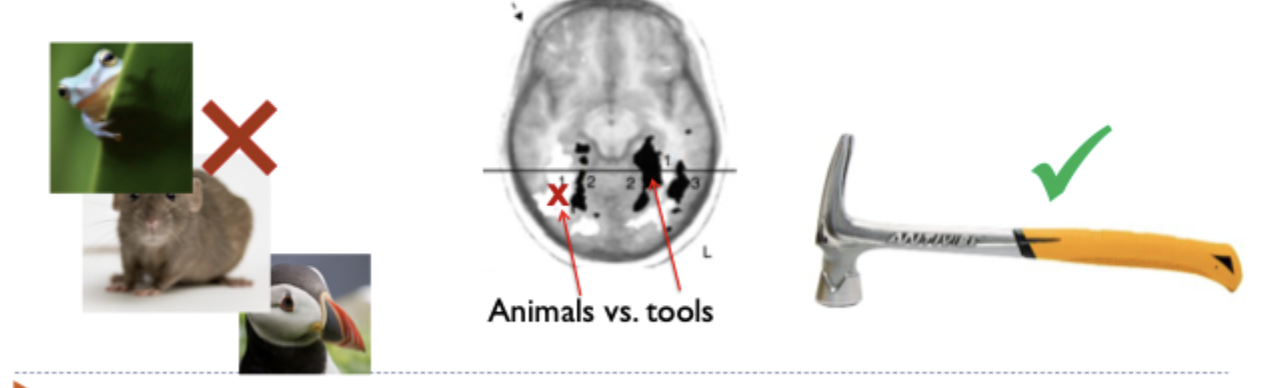
damage to category knowledge (as in hierarchical models) top node: living vs. non-living
selective damage to sensory-features → knowledge representations are clustered (as in distributed models)
What is a brief overview of Semantic Dementia?
affects the anterior temporal lobe and leads to non-category specific semantic impairments
inconsistent with distributed view of semantic features
greater damage to the ATL on the left than the right
What kinds of deficits are seen with semantic dementia?
Deficit appears multi-modal (not specific to a sensory input modality)
impairment in recognition and understanding of auditory or visual words and objects
impaired recognition when objects are cued by smell or touch
not category-specific, not restricted to a feature type
relatively preserved:
grammar (syntax)
‘episodic’ memory for events
spatial & geographical knowledge
IQ
How does Hodges study of picture naming in semantic dementia support the hierarchical model?
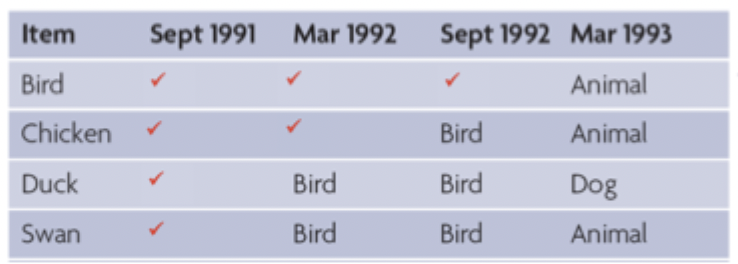
progressively lose more specific knowledge of concepts
In semantic dementia what are other factors that affect retention or loss of meaning?
familiarity/frequency: how often objects are seen and their names are heard or read in everyday life
age of acquisition: whether objects and their names are learned in early childhood or later childhood/adulthood
What did Mummery et al find about classification in semantic dementia: is this a bird?
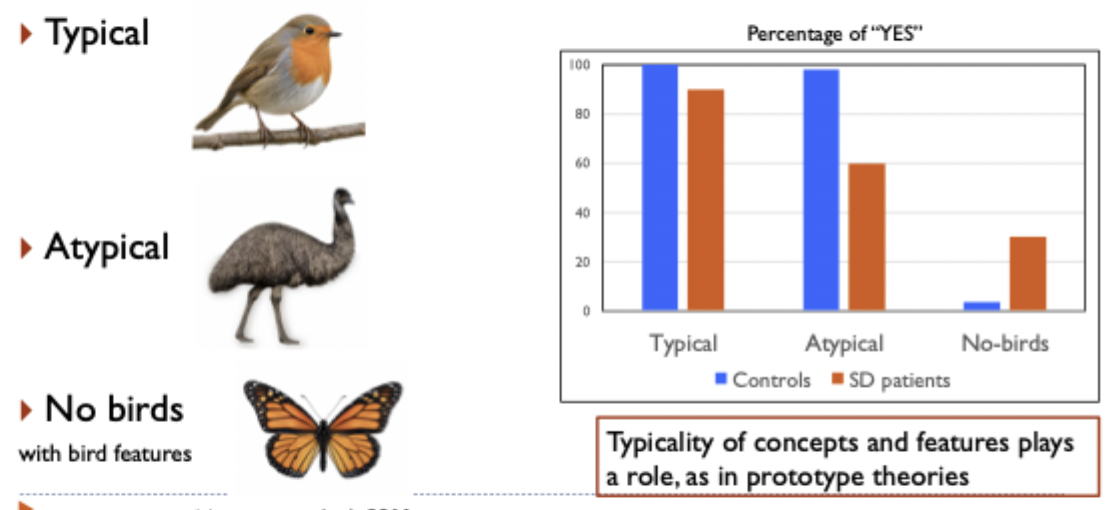
much better at typical features, and some patients will say butterflies are birds
the typicality of concepts and features plays a role, as in prototype theories
How can we explain semantic dementia? How is it consistent with the evidence showing brain activation for specific features?
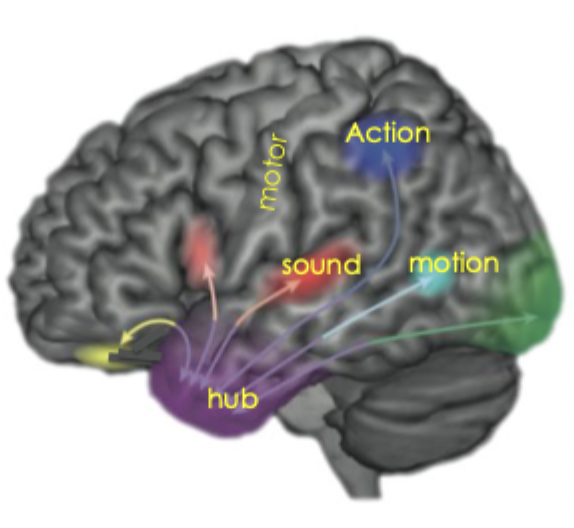
the temporal pole form a modality-independent hub where features of meaning (appearance, sound, feel, use, etc.) are brought together from different sites
What is involved in semantic selection beyond the ideas of individual concepts?
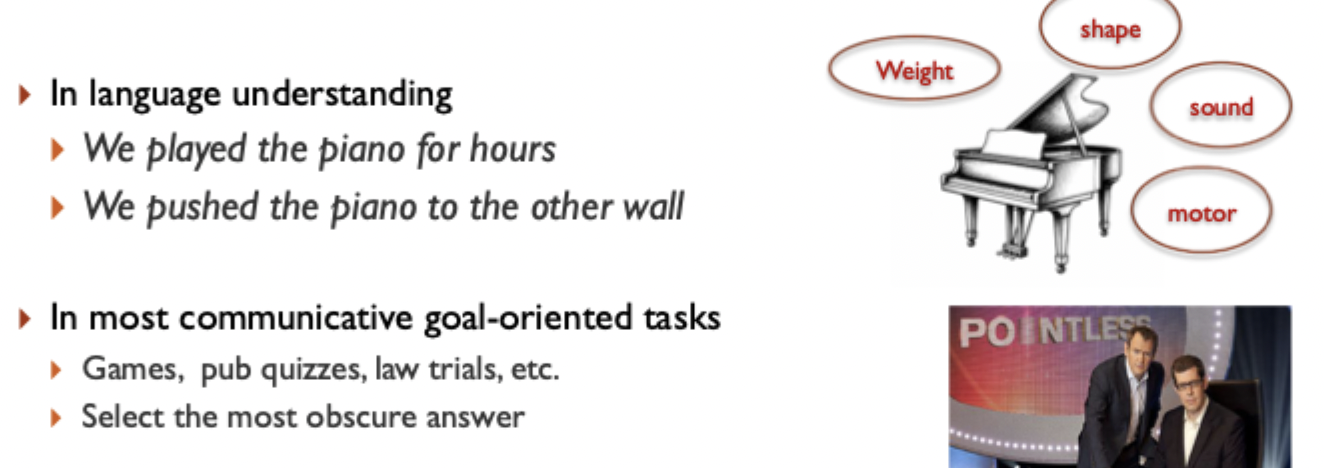
the brain not only activates multiple distributed features of concepts but also needs to select which features are relevant for the context
in language understanding and in most communicative goal-oriented tasks
What is involved in the case of ambiguity in selecting the right interpretation?
gennari et al 2007
showed ambiguous vs unambiguous words in context

in minimal phrases
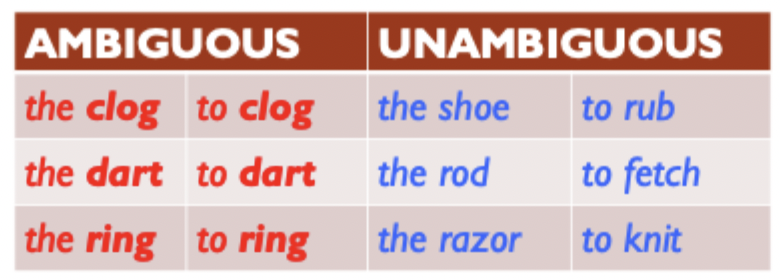
inferior frontal gyrus
posterior middle temporal gyrus
more activation in these regions for ambiguous cases
these two regions: ambiguity resolution in language
What are these regions associated with in semantic/conceptual representations and processing?:
anterior temporal lobe
inferior frontal gyrus
posterior middle temporal gyrus
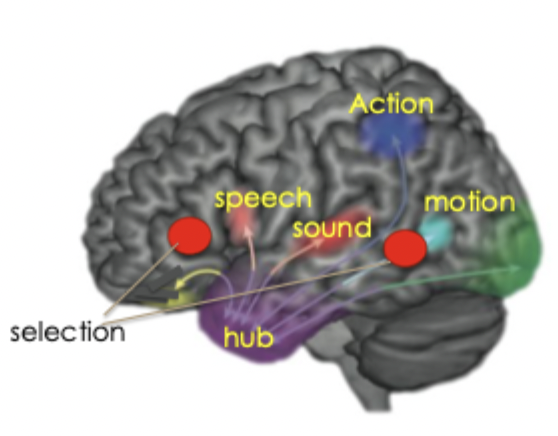
distributed meaning and regions associated with retrieval and selection of context-relevant features