Antibiotics
 Call Kai
 Learn
Learn Practice Test
 Spaced Repetition
 Match
Match Flashcards
 Knowt Play
1/29

There's no tags or description
Looks like no tags are added yet.
Name | Mastery | Learn | Test | Matching | Spaced | Call with Kai |
|---|
No analytics yet
Send a link to your students to track their progress
30 Terms
Antibiotics
-They are a class of antimicrobial drugs used to treat bacterial infections. A crucial role in the treatment and prevention of bacterial infections.
-Alexander Fleming discovered penicillin
-They are agents used to treat Bacterial Infections and are essential in curing various bacterial illnesses, help prevent post-operative infection and help in life threatening situations
How do antibiotics cause clostridioides difficile?
-Antibiotics disrupt the normal gut microbiota, which plays a crucial role in maintaining intestinal health. When a person takes antibiotics, especially broad-spectrum ones, beneficial bacteria in the gut are destroyed. This creates an imbalance, allowing C. difficile—a naturally occurring but usually suppressed bacterium—to proliferate. C. difficile produces toxins (Toxin A and Toxin B) that cause inflammation, diaorrhea, and in severe cases, pseudomembranous colitis.
Potential cdiff problems
-Normal Gut Flora Imbalance
-Diarrhoea
-Dehydration
-Medical Complications
-Vancomycin is used to treat C.diff 10mg over 5 days
-C. Diff can only be killed by hand washing not hand sanitizer
Most common antibiotics that cause c.diff
C.diff varies by antibiotic type, with the highest risk associated with broad-spectrum agents that disrupt gut flora significantly. Most common culprit are:
-Clindamycin – Strongly associated with CDI due to its extensive effect on anaerobic gut bacteria.
-Cephalosporins (especially second and third generation) – e.g., cefuroxime, ceftriaxone.
-Fluoroquinolones – e.g., ciprofloxacin, levofloxacin.
-Penicillin (especially broad-spectrum) – Co-amaxoclav
Treatment for C.diff
Management depends on the severity of the infection:
-Mild to Moderate CDI
-First-line treatment: Oral vancomycin (125 mg four times daily for 10 days)
Broad spectrum antibiotics
Medications that can treat infections caused by a wide range of bacteria, including both Gram-positive and Gram-negative bacteria e.g sepsis
Narrow- Spectrum antibiotics
Medications that target only specific bacteria, rather than a wide range, making them preferable for treating infections when the specific causative organism is known.
Bactericidal
Describes something that kills bacteria
Bacteriostatic
Refers to an agent that stops bacteria from reproducing without necessarily killing them, allowing the host's immune system to eliminate the infection. (E.g., Clindamycin)
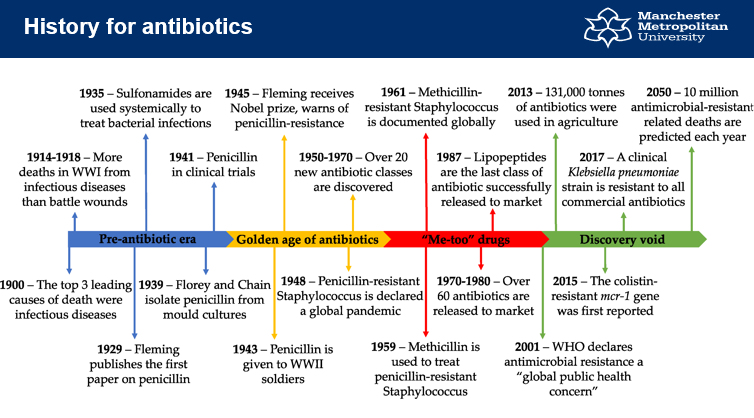
History for antibiotics
Bacteriostatic
-Bacteriostatic antibiotics inhibit bacterial growth
-Do not kill bacteria directly
-Allows the immune system time to eliminate the infection
Bactericidal
-Bactericidal antibiotics kill bacteria outright
-Leading to cell death
-Use when rapid bacteria elimination is important
ABX Mechanism of action- Cell wall synthesis
Preventing bacteria from building a protective wall.
ABX Mechanism of action- Cell membrane integrity
Disrupting the bacterial membrane, causing leakage by targeting bacterial membranes, increasing permeability and causing leakage of vital contents. This leads to bacterial death due to loss of essential ions and nutrients
E.g. Daptomycin- for MRSA
ABX Mechanism of action-Protein synthesis
Blocking the machinery that makes bacterial proteins. Bacteria uses ribosomes to make proteins, antibiotics target bacterial ribosomes (30S or 50S subunits), blocking protein production to prevent bacteria from growing and reproducing.
4 classes of antibiotics: Aminoglycosides, Tetracyclines, Macrolides, Chloramphenicol.
ABX Mechanism of action-DNA/RNA Synthesis
Preventing bacterial replication and transcription by blocking enzymes needed for DNA replication or transcription. This prevents bacterial division, stopping infection spread.
E.g. Ciprofloxacin, levofloxacin, Rifampicin
ABX Mechanism of action- Metabolic pathway
Disrupting essential bacterial metabolism. Bacteria require folic acid for DNA/RNA synthesis. Humans get folic acid from food, but bacteria must synthesize it. These antibiotics block folic acid metabolism, preventing bacterial growth.
The choice of antibiotic depends on:
-The type of bacteria
-The infection site
-Resistance mechanisms
-Patient-specific factors
What are antimicrobial peptides (AMPs)?
AMPs are small peptides (usually 10–50 amino acids long) naturally produced by human cells, plants, and bacteria as part of the innate immune system.
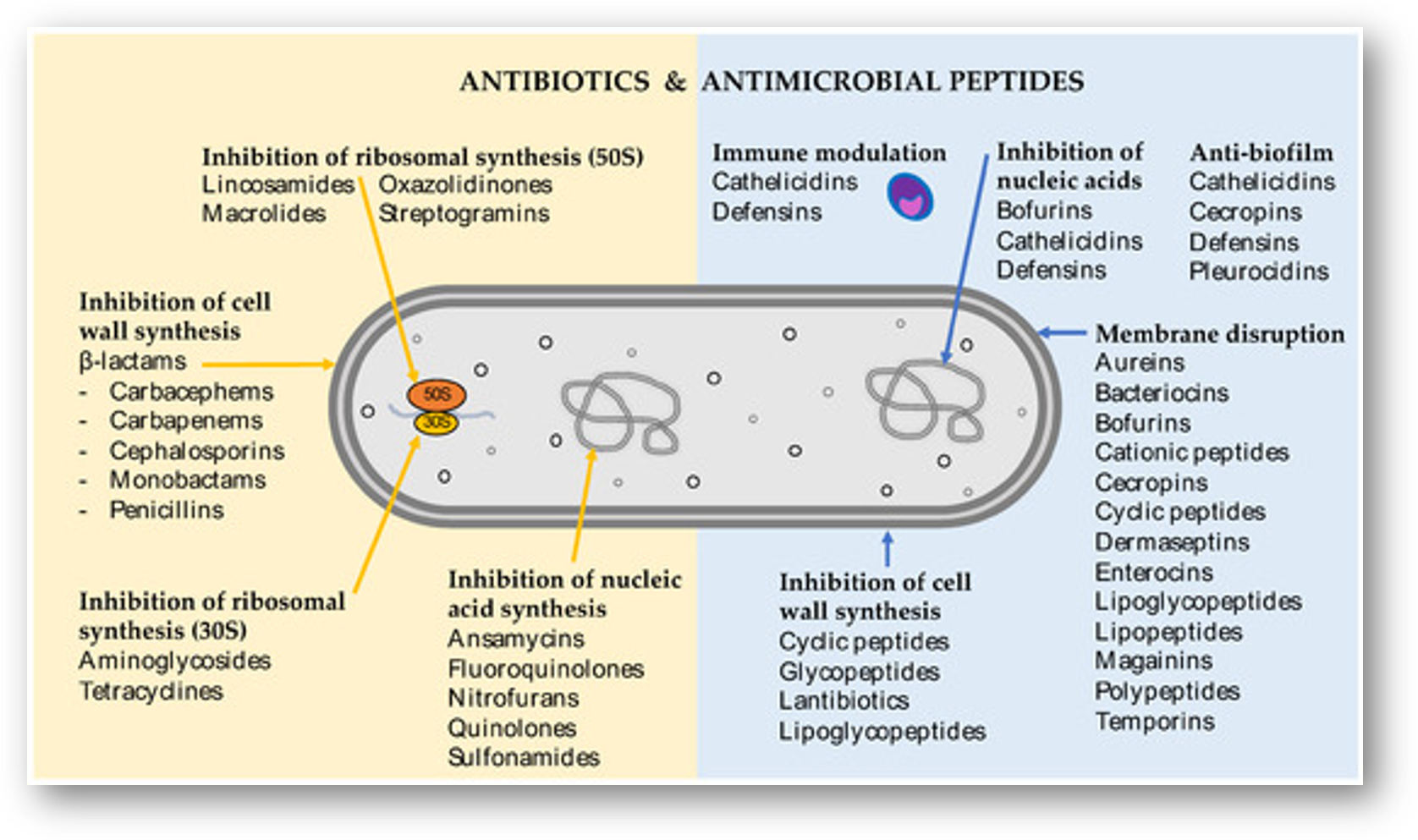
Main functions of antimicrobial peptides
Directly disrupt bacterial membranes through electrostatic interactions.
Examples of AMPs
Defensins – Found in human neutrophils, epithelial cells.
Cathelicidins (LL-37) – Found in human skin, lungs, and immune cells.
Magainins – Discovered in frogs, used in experimental medicine.
Why are AMPS important?
-Broad-spectrum activity – Can target bacteria, fungi, and viruses.
-Lower resistance potential – Bacteria struggle to modify their membranes against AMPs.
-Rapid action – Disrupts bacteria within minutes.
-Polymyxins (e.g., Colistin) are sometimes classified as both an antibiotic and an AMP, as they act like AMPs by disrupting membranes but are synthetically modified antibiotics.
Bacterial cell lysis
-Is a crucial mechanism through which bactericidal antibiotics eliminate bacterial infections.
-Antibiotics that induce cell lysis disrupt the structural integrity of bacterial cell walls or membranes, leading to bacterial death and clearance of infection.
-However, this process is challenged by antibiotic resistance mechanisms, which bacteria develop to evade lysis
Mechanisms by which antibiotics induce cell lysis
-Inhibition of peptidoglycan synthesis (Cell Wall Destruction)
-Disruption of bacterial membrane Integrity
-Activation of bacterial autolytic enzymes
Significance of bacterial cell lysis in treating infections
-Rapid Bacterial Clearance
-Prevents bacterial recovery
-Enhances immune response
-Vital for severe infections
ABX group: Penicillin’s
They treat community and hospital acquired pneumonia, cellultits, sinusitis, Group A Streptococcal infections.
Examples: amoxicillin, flucloxacillin, co-amoxiclav
Penicillin mechanism of action
Are beta-lactam antibiotics that inhibit penicillin-binding proteins which are responsible for bacterial cell wall synthesis. This results in bacterial cell death.
Oral vs IV antibiotics
Oral- you can take it at home and its cheaper
IV- Bioavailability is 100% which is important in situations where the patient has sepsis or is under emergency
Intravenous to oral switch
Timing of IV
-Review 48 hours after first IV
-Thereafter daily
Infection marker
-temp between 36 to 38 for 24 hours
-EWS decreasing
-WCC trending down
-CRP trending down
Enteral route
-Functioning GI tract
-Safe Swallow/enteral tube administration
-No vomiting last 24 hours
•Suitable switch available
ABX use in sore throat
-Sore throat are very common in the UK around 3.5 million appointments per year.
-Most infections are viral and risk of progression to serious complications is low (approximately 1% of patients)
-Despite this, antibiotics are frequently prescribed: roughly 60%-70% of consultations