EXAM 3 ORG BIO STUDY GUIDE
 Call Kai
 Learn
Learn Practice Test
 Spaced Repetition
 Match
Match Flashcards
 Knowt Play
1/32

There's no tags or description
Looks like no tags are added yet.
Name | Mastery | Learn | Test | Matching | Spaced | Call with Kai |
|---|
No analytics yet
Send a link to your students to track their progress
33 Terms
What are the unique features of angiosperms and why are they an important group of plants?
They are flowering plants characterized by their ability to produce seeds inside fruits. They have flowers for reproduction and use double fertilization to nourish the embryo. They attract pollinators and are extremely diverse. They are important because they provide most of our food, support ecosystems, and produce oxygen.
How are the major groups of plants related evolutionarily?
Plants evolved from green algae onto land in 4 broad stages. Bryophytes came first—no vascular tissue, need water to reproduce (swimming sperm). Ferns and horsetails gained vascular tissue but still reproduce by spores. Gymnosperms invented the seed, breaking dependence on standing water to reproduce. Angiosperms enclosed that seed in a fruit and added flowers, becoming the most diverse group, split into monocots & eudicots.
What are the other major groups of plants outside of angiosperms?
The major groups of plants outside of angiosperms include Bryophytes (mosses and liverworts), ferns and horsetails, and gymnosperms (conifers). Bryophytes are non-vascular and require water for reproduction (swimming sperm). Ferns and horsetails have vascular tissue but still reproduce by spores. Gymnosperms produce seeds but do not have flowers or fruits.
What is alternation of generations in the context of the plant cycle?
A reproductive cycle in plants that alternates between a haploid gametophyte generation and a diploid sporophyte generation. In this cycle, the sporophyte produces spores through meiosis, which develop into gametophytes. The gametophytes then produce gametes that fuse during fertilization to form a new sporophyte.
What are the major plant organs?
Roots, stems, and leaves
How do roots work?
They anchor the plant in the soil, absorb water and minerals, and often store carbohydrates. They also increase surface area through root hairs and may form symbiotic relationships with fungi for enhanced nutrient uptake.
How do stems work?
They provide structural support and serves as a transport system, using vascular tissue (xylem to move water and minerals upward, phloem distributes sugar throughout the plant). They also store nutrients and help position leaves for optimal light exposure.
How do leaves work?
They Are the primary site of photosynthesis, containing chloroplasts that capture light energy to produce sugars, they also regulate gas exchange through the stomata, allowing carbon dioxide in and oxygen out, while controlling water loss through transpiration.
What is the role of meristematic tissue in plant growth?
They contain actively dividing, undifferentiated cells that can develop into various specialized tissues. In plants meristems are found in the tips of roots and shoots (apical meristems) and along stems (lateral meristems), where they produce new cells through mitosis. This allows plants to grow in length (primary growth) and increase in thickness (secondary growth), as the newly formed cells differentiate into structures like vascular tissue, epidermis and ground tissue.
What are the general functions of plant hormones, pigments, and secondary metabolites?
-Plant hormones act as a chemical messenger that control growth, development and responses to stimuli (e.g. light, gravity, and stress)
-Pigments are molecules that absorb light energy for photosynthesis and contribute to coloration, which can aid in attracting pollinators and protecting against excess light.
-Secondary metabolites are organic compounds not directly involved in growth or reproduction but play important roles in defense against herbivores and pathogens, as well as ecological interactions like attracting pollinators or deterring competitors.
Where do the essential materials, elements, and energy necessary to grow a plant come from?
From a combination of the soil, air, water and sunlight. Water and dissolved mineral nutrients (nitrogen, phosphorus, and potassium) are absorbed from the soil through the roots. Carbon dioxide, which provides the carbon needed to build sugars and other organic molecules, come from the air and enters the plant through stomata in the leaves. Light energy is obtained from the sun and is captured by chlorophyll during photosynthesis to drive the production of glucose. Together, all these inputs allow plants to synthesize the organic compounds needed for growth and metabolism.
What are the major macronutrients plants need to grow?
Mineral macronutrients: Nitrogen (N), phosphorus (P), potassium (K), calcium (Ca), magnesium (Mg), and sulfur (S)
Non-mineral macronutrients: Carbon (C), Oxygen (O), Hydrogen (H)
How does water flow through plants?
Throug the xylem using a process mainly by transpiration pull. Water is absorbed by root hairs from the soil and moves into the xylem in the roots. As water evaporates from the leaves through stomata (transpiration), it creates a negative pressure that pulls water upward through the xylem in a continuous column. Cohesion between water molecules and adhesion to xylem walls help maintain this upward flow from roots to leaves. “zips”
What is ecology?
It’s the study of how organisms interact with each other and with their physical environment, including both living (biotic) and nonliving (abiotic) factors.
What is the difference between conditions and resources and what are some examples of each?
Conditions are environmental factors that affect organisms but are not consumed or used up, ex; temperature, pH, sallinity, and sunlight. Resources are things organisms use and can be depleted, ex; water, nutrients, food, space, and oxygen
Explain the snowshoe hare and Canada lynx cycles
The snowshoe hare and Canada lynx cycles are an example of predator-prey population dynamics in which the populations of both species rise and fall in a repeating pattern. When snowshoe hare populations increase, there is more food available for Canada lynx, causing the lynx population to grow. As the lynx population increases, predation on hares intensifies, leading to a decline in the hare population. With fewer hares available, the lynx population then decreases due to a lack of food. This allows the hare population to recover, and the cycle repeats.
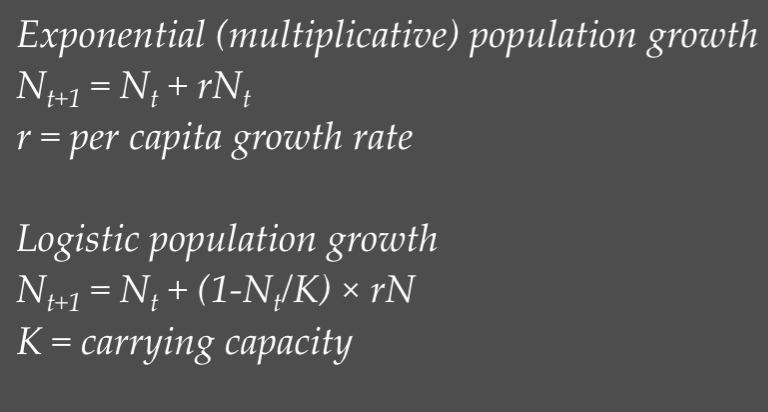
Understand the mathematics underlying exponential and logistic population models
They describe how populations grow ovetime based on resource availability.
Exponential growth: population size increases rapidly w/out limits when resources are abundant, following a constant growth rate.
Logistic growth: population growth starts exponentially but slows as resources become limited, eventually leveling off at a carrying capacity (the max population size the environment can sustain).
Why is intraspecific competition important?
it regulates population size within a species when individuals compete for limited resources like food, space, and mates. This competition reduces growth rates as population density increases, helping prevent overpopulation and resource depletion. It also promotes natural selection by favoring individuals with traits that improve survival and reproduction under crowded conditions.
What are the various types of possible interspecific interactions? Give examples
Competition (-/-): occurs when two species compete for the same limited resource
Predation (+/-): one species (predatory) kills and consumes another
Herbivory (+/-): when animals consume plants
Parasitism (+/-): one organism benefits while harming the host
Mutualism (+/+): benefits both species
Commensalism (+/0): benefits one species w/out significantly affecting the other
Amensalism (-/0): one species is harmed while the other is unaffected
What is an ecological niche?
The role and position of a species in its environment ex; how it uses resources, interacts with other organisms, and responds to environmental conditions. It includes factors like its habitat, diet, behavior, and the conditions it can tolerate, essentially describing how a species “makes a living” in an ecosystem.
What are the key features of food webs?
They’re interconnected food chains that show feeding relationships in an ecosystem. Includes multiple trophic levels (producers, consumers, decomposers) shows how energy and nutrients move between organisms. They are more realistic than food chains → species have multiple food sources and predators. Energy flows in one direction and decreases at higer trophic levels.
What are trophic cascades? Are they common in nature?
They are changes in lower trophic levels caused by effects at higher levels, often when predators influence the abundance of herbivores and indirectly affect producers ex; removing a top predator can increase herbivores, which over consume plants. Trophic cascades do occur in nature, but their strength and frequency vary depending on the ecosystem.
Explain the Yellowstone trophic cascade.
Occured after the reintroduction of wolves, who acted as a top predator. Wolves reduced the elk population and changed their behavior, causing elk to avoid overgrazing in certain areas. As a result, vegetation like willows and aspens recovered, which supported other species such as behaviors and birds. This demonstrates how changes at the top trophic can cascade down and affect multiple levels of the ecosystem.
What are ecological communities?
Groups of interacting populations of different species living in the same area. They include all the biotic interactions, such as competition, predation, and mutualism, that shape the structure and dynamics of the ecosystem
Why is the world green?
Plants are abundant because herbivores are kept in check by predators and other limiting factors. This top down control prevents herbivores from over consuming vegetation, allowing plant biomass to remain high and ecosystems to appear green.
How do ecological communities vary over time through the process of succession?
Through a process where species composition shifts following a disturbance or the creation of a new habitat. In primary succession, communities develop from bare substrate to pioneer species, while in secondary succession, communities recover more quickly after disturbances because soil is already present. Over time species interactions and environmental changes lead to more complex and stable communities.
How does disturbance affect succession.
By altering or resetting ecological communities. Small or moderate disturbances can increase diversity by creating opportunities for new species to establish. Large disturbances can reset succession to earlier stages like primary and secondary succession. Frequency and intensity of disturbance influence how quickly and in what direction a community recovers over time.
How do keystone species, ecosystem engineers, and dominant species affect ecological communities?
Keystone species-has a disproportionately large effect relative to their abundance and help maintain community structure
Ecosystem engineers- physically modify the environment, creating or altering habitats for other species
Dominant species- most abundance (have highest biomass), strongly influence community structure through their presence and resource use.
What are the components of biodiversity?
Genetic diversity- variation within a species
Species diversity- the number and abundance of different species in a community
Ecosystem diversity- the variety of habitats and ecosystems in a region
How does biodiversity vary at the global scale?
Highest diversity is found near the equator and decreasing toward the poles, (latitudinal diversity gradient). It is also higher in regions with warm, stable climates and high productivity, such as tropical rainforests and lower in extreme or variable environments like deserts and polar regions.
What role does decomposition play in soil formation?
Plays a key role in soil formation by breaking down dead organic matter into simpler nutrients. Decomposers like bacteria and fungi convert this material into humus, enriching the soil, improves texture and increase its ability to retain water and nutrients.
What are the five factors of soil formation?
CLORPT- climate, organisms, relief, parent material, time
What is a biome and what factors help to separate different biomes?
Its a large ecological region characterized by its climate, dominant vegetation, and associated animal communities. Biomes are mainly separated by temperature and precipitation, which influence the types of plants and organisms that can live there.