Unit 2
 Note
 Call Kai
 Learn
 Practice Test
 Spaced Repetition
 Match
 Flashcards
 Knowt Play
1/47

There's no tags or description
Looks like no tags are added yet.
48 Terms
What are the characteristics of living things?
Organization: Living things are made up of cells, tissues, organs, and systems.
Growth and Development: Living things grow and change throughout their lifespan.
Reproduction: Living things can produce offspring through sexual or asexual reproduction.
Response to Stimuli: Living things can respond to their environment and adjust their behavior accordingly.
Homeostasis: Living things can maintain a stable internal environment despite external changes.
Metabolism: Living things obtain and use energy to carry out life processes.
Adaptation: Living things can adapt to their surroundings through evolution.
Life Span: Living things have a limited lifespan and eventually die.
cell theory
The scientific principle stating that all living organisms are composed of cells, cells are the basic units of structure and function in living organisms, and cells arise from pre-existing cells.
prokaryote cells
Simple cells lacking a nucleus and membrane-bound organelles. Found in bacteria and archaea.
Eukaryote cells
Cells that contain a nucleus and other membrane-bound organelles. They are more complex than prokaryote cells and can be found in plants, animals, fungi, and protists. _____ cells allow for specialized functions and compartmentalization of cellular processes.
Cells of prokaryote bacteria
Cell Wall: Made of peptidoglycan: uses for support (difference between a Gram + and Gram -
Cell Membrane: Regulates what enters and leaves the cell (homeostasis)
Ribosomes: Site of protein synthesis
(no membrane), Different size than eukaryotes
Nucleoid: Region of the cell that the DNA is located
Plasmids: small circular piece of DNA that bacteria can exchange
Pili: Connect to other Bacteria to exchange plasmids
Flagella: Long tail that aids in movement.
cell wall
A rigid layer surrounding plant cells, providing support and protection. It is composed of cellulose fibers and helps maintain cell shape and prevent excessive water uptake.
cell membrane
A thin, flexible barrier that surrounds and protects the contents of a cell. It regulates the movement of substances in and out of the cell, allowing essential nutrients to enter and waste products to exit. It is composed of a phospholipid bilayer with embedded proteins.
Cytoplasm
Gel-like substance found inside cells, surrounding the organelles. It holds the cell's organelles in place and is involved in various cellular processes, such as metabolism and protein synthesis.
nucleus
Component of eukaryotic cells that contains DNA and serves as the control center for cellular activities.
nuleolus
"The _____ is a small, round structure found within the nucleus of a cell. It is involved in the production and assembly of ribosomes, which are responsible for protein synthesis. The _____ contains DNA, RNA, and proteins. It plays a crucial role in cell growth and proliferation."
ribosome
Cellular organelle responsible for protein synthesis. Found in both eukaryotic and prokaryotic cells. Consists of two subunits, large and small, that come together during protein synthesis. ______ read the genetic code from mRNA and assemble amino acids into polypeptide chains. Essential for cell function and growth.
endoplasmic reticulum
Network of membrane-bound tubes and sacs found in eukaryotic cells. Involved in protein synthesis, lipid metabolism, and calcium storage.
golgi apparatus
Stacked membrane-bound organelle involved in processing, modifying, and packaging proteins. Receives proteins from the endoplasmic reticulum and sorts them for transport to their final destinations within or outside the cell.
chloroplast
A membrane-bound organelle found in plant cells responsible for photosynthesis. Contains chlorophyll, which captures sunlight and converts it into chemical energy.
mitochondria
Double-membraned organelles found in eukaryotic cells. Responsible for producing energy through cellular respiration. Contains its own DNA and can self-replicate."
Lysosome
Membrane-bound organelle containing digestive enzymes that break down waste materials and cellular debris in a cell.
vacuole
"Organelle found in plant and animal cells responsible for storing water, nutrients, and waste products. Helps maintain cell shape and turgor pressure. Plays a role in detoxification and cellular digestion."
Centrossomes
Organelles found in animal cells that play a crucial role in cell division. They contain a pair of centrioles and help in the formation of the mitotic spindle during cell division. ______ are involved in organizing and separating chromosomes, ensuring accurate distribution of genetic material to daughter cells.
phospholipids
Main component of cell membranes
Consists of a hydrophilic head and hydrophobic tails
Forms a bilayer structure
Controls the movement of molecules in and out of the cell
Provides structural support and flexibility to the cell membrane
Bilayer
A structure composed of two layers of molecules, typically lipids, arranged in a parallel manner. It forms the basic structure of cell membranes, with hydrophilic heads facing outward and hydrophobic tails facing inward. The _____ provides a selective barrier that controls the movement of substances in and out of the cell.
cholesterol
A waxy substance found in the body and certain foods. It is essential for cell function, hormone production, and digestion.
channel proteins
Proteins embedded in cell membranes that form channels allowing specific ions or molecules to pass through, facilitating the transport of substances across the cell membrane.
carrier proteins
Proteins that transport molecules across cell membranes by binding to them and facilitating their movement. They are specific to certain molecules and play a crucial role in maintaining cellular homeostasis.
carbohydrates function in cell
Carbohydrates function in cell as a source of energy and structural support, aiding in cell recognition and communication.
What factors influence how molecules move across the cell membrane?
Concentration gradient, size of the molecule, charge of the molecule, and the presence of transport proteins.
passive transport
Type of cellular transport that does not require energy and moves molecules from an area of higher concentration to an area of lower concentration.
Diffusion
The passive movement of particles from an area of high concentration to an area of low concentration, resulting in the equal distribution of particles.
Facilitated Diffusion
Passive transport of molecules across a cell membrane with the help of transport proteins. It does not require energy and moves substances down their concentration gradient.
Osmosis
Facilitated diffusion of water only
Water moves toward solutes
Reach equilibrium
No energy
Hyperosmotic
Means more solute on the outside of the cell
Water move out of the cell
Cell shrinks
Also known as plasmolysis
hypoosmotic
Means less solute outside of the cell
More solute inside of the cell
Water moves in
Cell will expand
Also known as Turgor Pressure
Helps plants to stand tall
Turgor Pressure
Pressure exerted by the fluid inside plant cells against the cell wall, providing support and rigidity. Maintained by the influx of water through osmosis. Crucial for plant structure and function.
Isotonic
Equal amount of solute in and out of the cell
Equal movement of water in and out of the cell
No net loss or gain to cell size
Active Transport
Molecules move against the concentration gradient
Low concentration to High concentration
Never reach equilibrium-actively working AGAINST equilibrium
Requires a protein
Requires energy
sodium-potassium pump
used in nerve function and muscle cell contractions
electron transport chain
Used in photosynthesis and cell respiration
Endocytosis
Brings materials into the cell
Exocytosis
Removal of material from the cell
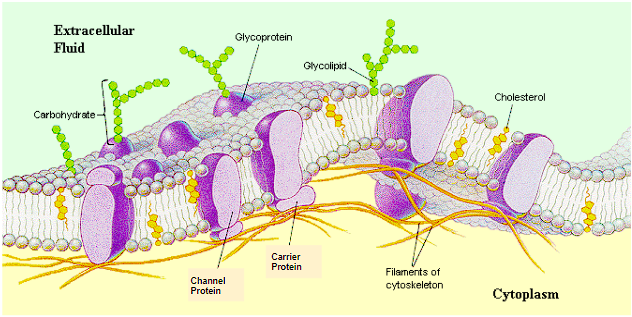
What organelle is this and where is it found?
Cell membrane, all cells
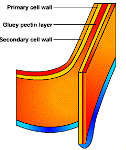
What organelle is this and where is it found?
Cell wall, all except animal cells
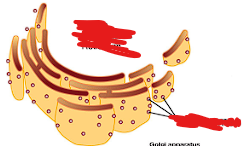
What organelle is on the outside of this and where is it found?
ribosomes, all cells
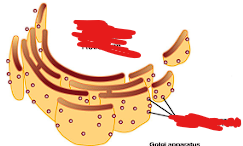
What organelle is this and where is it found?
endoplasmic reticulum, all cells except bacteria
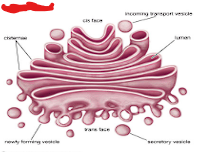
What organelle is this and where is it found?
Golgi apparatus, all cells except bacteria
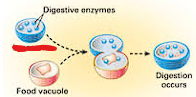
What organelle is this and where is it found?
lysosomes, all cells except bacteria

What organelle is this and where is it found?
Vacuole, all cells except bacteria
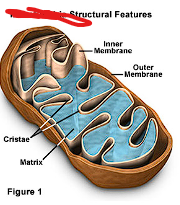
What organelle is this and where is it found?
Mitochondria, all cells except bacteria
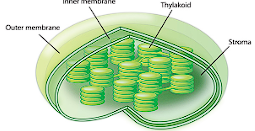
What organelle is this and where is it found?
Chloroplasts, plant cells
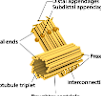
What organelle is this and where is it found?
Centrosome, animal cells