Chapter 20: Ear anatomy
 Call Kai
 Learn
Learn Practice Test
 Spaced Repetition
 Match
Match Flashcards
 Knowt Play
1/23

There's no tags or description
Looks like no tags are added yet.
Name | Mastery | Learn | Test | Matching | Spaced | Call with Kai |
|---|
No analytics yet
Send a link to your students to track their progress
24 Terms
State the structures of the outer (external) ear
Portion of the ear that is open to the air around your head:
Auricle
auditory canal
tympanic membrane (internal border of the auditory canal) —> commonly called the ear drum
State the structures of the middle ear
Hollow, air-filled chamber that houses the three smallest bones in your body:
malleus
incus
stapes
auditory (eustachian) tube
oval window
State the structures of the inner ear
Houses sensory organs of both hearing and equilibrium embedded in the temporal bone:
cochlea
vestibule
vestibular nerve
cochlea nerve
semicircular canals
Describe the outer parts of the external ear
Auricle: the outer flap of elastic cartilage, adipose tissue and skin
Auditory canal: The opening into the temporal bone is lined with skin
Tympanic membrane: Thin membrane separating the outer and middle ear
Describe the middle parts of the ear
Auditory ossicles: Three small bones that amplify
• Malleus: Hammer-shaped bone in contact with the tympanic membrane
• Incus: Anvil-shaped bone in between the other ossicles
• Stapes: Stirrup-shaped ossicle that touches the oval window
Auditory tube: Connecting tube to the upper throat
Oval window: Membrane that separates the inner and middle ear
Describe the inner parts of the ear
Cochlea: The spiral-shaped organ of hearing
Vestibule: Hollow organ that houses two organs of equilibrium, the utricle and the saccule
Vestibular nerve: Small nerve branches that innervate the organs of equilibrium
Cochlear nerve: Large nerve that innervates the cochlea and carries information about sound
Semicircular canals: Three tubular organs that sense rotational acceleration
Label the ear
For a vibration to be hear what part of the ear must the sound reach? What are the two pathways
The cochlea and there are two pathways to get it to travel to the cochlea: sound through air, sound through bone
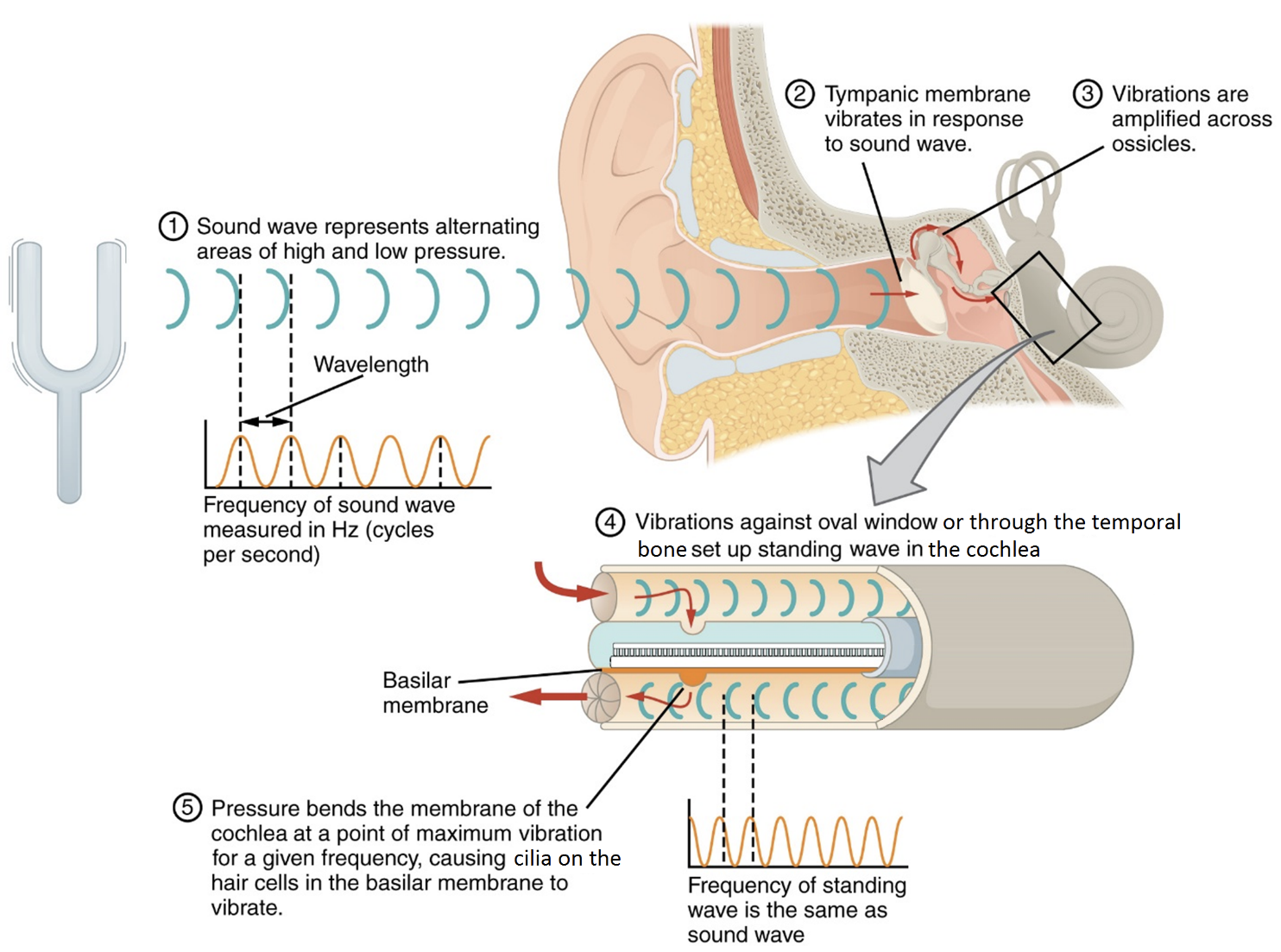
Describe how sound travels through the sound through air pathway
sound travels through the air as vibrations
vibrations hit the tympanic membrane (eardrum) —> it vibrates
vibrations are passed to the auditory ossicles
ossicles amplify force by moving vibrations from a large surface (eardrum) to a smaller one (oval window)
increased force cuases fluid in the cochlea to move
fluid movement bends the cilia on hair cells
bending causes hair cells to depolarize
hair cells release neurotransmitters
neurotransmitters trigger action potentials in the cochlear nerve
signals are sent to the brain
sound reaches the cochlea through:
air conduction
bone conduction
This is why your voice sounds different in recordings
How does sound travel through bone, and why does it affect how you hear your own voice?
Sound can travel through bone conduction (via the skeleton)
Vibrations from your voice move through your bones
These vibrations bypass:
Tympanic membrane (eardrum)
Auditory ossicles
Oval window
The cochlea is vibrated directly by the temporal bone
Bone conduction adds extra richness to your voice
This is why your voice sounds different compared to recordings (which only use air conduction)
What are the two types of hearing tests?
Weber test
Rinne test
Describe the weber test
Allows you to determine whether both ears have the same ability to hear
does not allow you to determine what sort of hearing deficit is present and it does not allow you to identify a problem if both ears are equally impaired
If sound is uneven during the weber test, what are two possibilities?
Sensorineural deafness: The cochlea, nerves, or brain do not receive or interpret sound correctly and the sound will be softer/absent in the impaired ear
Conductive deafness: the auditory canal, tympanic membrane, or ossicles are damaged/blocked. The background noise of the room, carried through the air, is absent in this ear, so the tuning fork sound, carried through the bone, seems louder in the impaired ear
Describe the rinne test
can be used to determine whether the defect in the amplifying system (conductive deafness) or in the cochlea or nervous system (sensorineural deafness)
if the amount of time the subject can hear the tuning fork through bone and air is equal for each ear, but different from ear to ear, then the individual has sensorineural deafness in the ear with the shorter times. This should be the ear that heard the sound as quieter in the weber test
If the amount of time the individual hears the sound through bone is much longer than through the air, then the individual has conductive deafness. This should be in the ear that heard the sound as louder during the Weber test.
Other combinations of results either indicate complex deficits that cannot be assessed with the Rinne and Weber tests or the limitations of doing these tests in a noisy building.
How is loudness (volume) perceived, and how can loud sounds damage hearing?
Loudness is the perception of the amplitude (height) of a sound wave
Vibrations in the cochlea bend the cilia on hair cells
Bending opens mechanically-gated ion channels
Hair cells depolarize and release neurotransmitters
Greater amplitude → more bending of cilia
More bending → more action potentials sent to the brain
Higher firing rate = perceived as louder sound
Very loud or prolonged sound can damage hair cell cilia
Damage can lead to permanent hearing loss
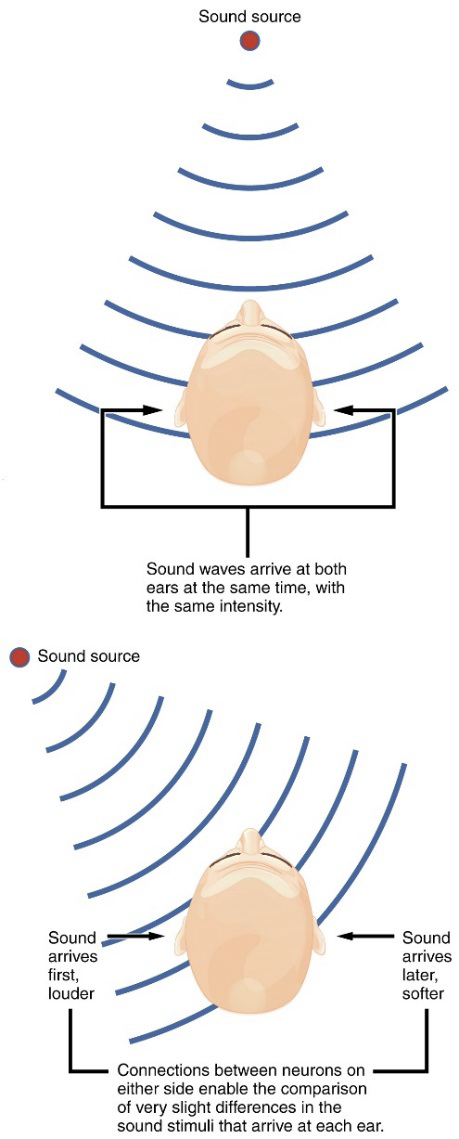
How does the brain determine the direction of a sound?
The brain uses both ears (paired ears) to detect sound direction
Compares differences in:
Volume (loudness) between ears
Time of arrival of sound at each ear
These differences help locate where the sound is coming from
This process is called sound localization
pitch